I stood in pajamas while my 47-year-old neighbor took five survey pins off my land—Until his own drone captured the truck, and his subdivision lost its surveyor approval.
Complete story · 7 parts · about 30 minutes · ending included
Part 1 · Part 2 · Part 3 · Part 4 · Part 5 · Part 6 · Part 7
Part 1 of 7
The bulldozer blade shoved into the first rail of my fence, and the old wood snapped under the steel edge. A crew followed close behind, already grading a strip of my land into somebody else’s road.
It was 5:02 a.m. on Saturday, October 3, 2026, in Silver Pine, Colorado.
I stood on my porch in pajamas and the blaze-orange parka the county issued me for plow shifts, the one I kept beside the back door. The rest of the property was black. Only the dozer’s headlights broke the dark for a quarter mile.
Juniper was shut in her stall in the barn.
The machine crawled forward. A second rail dropped. Then another.
At the far edge of the freshly graded dirt, a crew truck sat with its bed facing the work area. The foreman walked along what had been my fence line. He bent, reached into the dirt, and pulled up a steel pin with an orange plastic cap.
He tossed it into the truck bed.
Clang.
He moved several feet and did it again.
Clang.
I watched him clear the line until every pin I had passed for seventeen years was in that truck.
Five pins.
The foreman brushed dirt from his gloves and walked toward the next section of fence.
I raised my phone and started recording. The screen filled with white glare from the bulldozer lights. I adjusted the angle and tried again. Nothing but glare and the dark outline of the machine.
The foreman was still working.
I stepped down to the foot of my porch stairs. I didn’t put a boot on the graded dirt.
He noticed me and moved between me and the crew truck.
“Step on this dirt, it’s a job site — that’s trespass.”
I stopped.
The truck sat well behind him, on the far side of the scraped ground.
I took a ballpoint pen from my parka pocket and wrote 5:10 on the back of my hand. It was an old habit. Ink marked the same spot below my knuckles it always had.
The bulldozer continued along the strip.
At 5:40, a white pickup came up the entrance road. The words ELK DRAW ESTATES were lettered on its door.
Jason Dalton climbed out with a coffee cup in his hand.
He was forty-seven and owned the old forty-acre ranch next door, the land where he was building his thirty-lot subdivision. Jason walked out onto the new dirt and stopped in front of his crew.
His eyes went to the broken rails.
“Whoever built that fence was drunk, Sheila. It was never on the line.”
A couple of men laughed. One of them looked down at his boots. A third studied the bulldozer instead.
I kept my hands at my sides.
“Acknowledged.”
Jason took a slow sip, watching me over the lid.
“County wants a real road. Go plow something, plow lady.”
The foreman glanced at Jason. Nobody laughed quite as loudly that time.
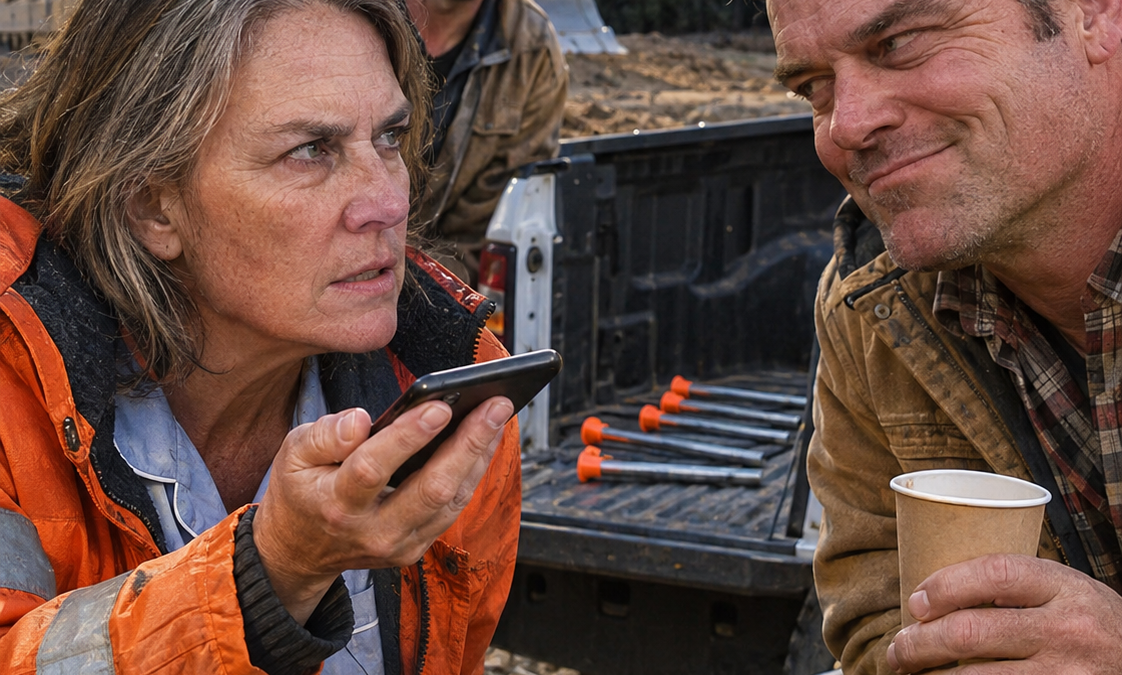
I took my phone out again and called the county sheriff’s dispatch line. I put the call on speaker so the crew could hear me.
The dispatcher answered.
“This is Sheila Engstrom,” I said. “I’m on my property in Silver Pine, on the east side of Elk Draw Estates. Five survey monuments pulled, a fence down, a dozer on my land.”
The dispatcher asked me to repeat the location.
I spelled my last name and gave the address again, slower. Then I repeated the description of what had happened.
Jason leaned on the grille of his pickup, listening.
The bulldozer engine went quiet.
The operator climbed down from the cab and stood beside the machine, watching Jason.
For several seconds, the crew froze and the work stopped.
Jason lowered the cup to his belt and stared at the dozer.
“Nothing’s moving right now,” I told the dispatcher when she asked whether the work was continuing.
She said a deputy would respond.
I gave her my number and ended the call.
The operator stayed beside the dozer. The foreman headed for the parked vehicle at the far edge of the dirt. Jason didn’t offer another comment about my fence.
I remained at the foot of the porch steps.
By 6:40, the eastern edge of the sky had turned gray. The ground was becoming visible beyond the work lights, including the long strip of fresh grading where my fence had stood.
A low hum came from above the property.
A drone moved along the graded strip.
I looked up. It passed above the parked work vehicle, then circled over the cleared stretch.
Jason raised a handheld radio.
“Get the road, not the junk!”
The drone dropped lower.
It stopped directly above the crew truck bed. In the early light I couldn’t make out a single cap, only the dark box of the bed, but I had heard all five pins land in it.
The drone stayed there. I zoomed my phone toward it and got only a blurred image.
I counted in my head.
One.
Two.
Three.
The machine remained almost perfectly still.
Four. Five. Six.
Jason lowered his radio and looked toward the sky.
Seven. Eight. Nine. Ten.
Eleven.
The drone lifted and traveled in the direction of the sales office, about three hundred yards from my house.
I never saw the person flying it.
At 6:58, the crew truck started moving. Its tires chewed across the new grade, and it turned for the entrance.
The five pins were still in its bed.
I watched until the truck disappeared down the road.
At 7:10, a county sheriff’s vehicle pulled up. Deputy Ames stepped out and walked the cleared lane.
He was forty-one, with a notebook in one hand. He examined the scattered fence timbers, then searched the stretch where the pins had been.
From beside his white pickup, Jason approached.
Ames stopped where the fence line had met the ground. He looked down, moved several steps, and checked the dirt again.
There was nothing left beneath the surface to find.
He turned toward me.
“Show me a line. Without a pin in the ground, this is a civil boundary matter. Get your surveyor out here.”
I indicated the five empty holes along my fence line.
“They were there before the machine started. Their foreman threw every one into a crew truck, and it left at 6:58.”
Ames looked at the disturbed dirt.
“Do you have a surveyor’s information?”
“I can provide it.”
“Then have your surveyor call me. I can’t chase a truck over a line nobody can show me.”
Jason stepped closer and shook Ames’s hand.
“She put that fence up drunk back in ’09. Ask anybody.”
Ames didn’t answer that.
He closed his notebook and walked back toward his vehicle. Jason stayed at the edge of the cleared lane and finished his coffee.
At 7:30, Ames drove away.
I went back to the porch.
The broken rails lay across the ground in sections. Some had split near the ends. Others were still connected to pieces of the posts. The bulldozer tracks crossed the strip where the fence had been.
At 7:52, I stood in the wreck of my fence, my phone in hand. The screen showed the subdivision’s sales page.
The latest entry sat at the top of the page.
Beside it was a small time stamp: “12m”.
Picking up where the Facebook post left off
The caption read:
“Sunrise Saturday: widening our entrance road to a full 60 feet!”
It was a video, a minute and a half long, and the thumbnail showed the graded strip from above.
Behind the fresh dirt was a row of empty holes where my fence posts had been.
I pressed screen record.
Part 2 of 7
At 0:41, the picture on my laptop turned into a dark, smeared block that filled most of the screen. Jason Dalton’s own sales page had posted the video, and I had a saved copy he could not delete.
About 8:00 a.m., I sat at my kitchen table, my phone next to the computer.
The video played on.
For eleven seconds, from 0:41 to 0:52, nothing visible held a shape. What I had recorded came off my phone screen, and reading that stretch would mean stopping on individual frames and brightening them one at a time.
I had given up that kind of work in 2014.
So I left the controls alone.
At 0:53 the picture cleared. From above, the bulldozer sat parked next to my snapped fence.
A cheerful announcer spoke over the footage.
“Elk Draw Estates is widening its entrance road to a full sixty feet.”
The camera traveled along the new dirt, crossed the turnoff, and finished its minute-and-a-half run.
I saved the recording once more to the laptop and closed the lid.
My bedroom closet stood beyond the far end of the hallway.
I opened the fireproof box on the floor and lifted out a folder with the 2009 map inside, folded in quarters. Sitting back on my heels, I rested the cover on my knee and angled the creased paper toward the light.
One printed line stopped my finger.
“set #5 rebar with orange plastic cap PLS 22418”
The “#5” was the size of the bar, five-eighths-inch rebar.
Farther down was the reception number: 2009-004417.
I closed the box and left it on the closet floor. The folder came with me into the hall.
At 11:00, I carried it outside with my 100-foot tape measure.
Nobody was on the graded strip.
The broken rails still lay where the dozer had dropped them, and loose dirt filled the track marks. Along my west line, five pin holes showed in the ground.
I crouched beside the nearest one.
The soil inside had not settled, and it crumbled when I pressed it with two fingers.
With the folder tucked under my arm, I followed the marks left by the old posts until the fresh grading began at the raw edge. I set the end of the tape at the fence holes and pulled the blade across the scraped ground.
Fourteen feet. A second pull gave me the same number.
The crew’s portable toilet still stood on the grass inside the area my rails had enclosed. It had been there since August 10, when Jason called the arrangement “borrowing.”
From the line, I looked up the rise.
The Kirbys’ mailbox showed at the top, beside the gravel drive that led toward their place. That box had been a white hump in the snow the last time it mattered.
In February 2019, a blizzard shut the valley, and at 4 a.m. I cleared a lane to their door so an ambulance could reach Ed after his stroke. A boy watched my plow lights from the kitchen window; I never stopped that night, and I never learned his name.
I turned away from the slope and walked back across my own grass toward the house.
By 3:30 p.m., I was standing at my front door with my left fingers around the folder’s corner at my hip.
Jason came alone from the sales office, crossed the yard, climbed the porch steps, and stopped at the top.
A price sheet was in his hand.
He smiled as if we had met to discuss something ordinary.
“Thought you might want this,” Jason said.
He held it toward me.
I took it from him without moving from the doorway.
The front listed Elk Draw lot reservation information. I flipped the paper around.
Across the reverse, Jason had written one line by hand:
“$2,000 — quitclaim the 14 ft east strip — sign by 10/12 — J.D.”
My thumb pressed the printout’s edge against my palm.
Jason watched my face.
I opened the folder and clipped the price sheet inside, on top.
His smile went away.
“You can settle this today, or in front of a roomful of my buyers. Your call,” Jason said.
I kept a hand flat on the map.
“The line is on the survey.”
Jason looked down at what I was holding, then back at me.
Dust marked the knees of his jeans. One boot rested at the edge of the top step, a foot from my threshold, but he came no farther.
“Community night, Tuesday at seven, at the clubhouse. Roger Oberg’s coming to show the road. Bring your little map,” Jason said.
Oberg was the county surveyor, the man whose signature every new development in the valley needed.
I closed the cover.
Jason waited for another answer.
I gave him none.
He went down the steps with one hand in his jacket pocket, while I held the folder against my side in the doorway until he reached the yard.
Without looking back, he said, “Thirty families put money down, Sheila. County wants sixty feet by the thirteenth. You’re standing on my fourteen.”
Part 3 of 7
Juniper screamed from the gap where my fence had stood.
Her front leg was trapped in the barbed wire, and the skin above her hoof was torn open.
It was 3:04 a.m. on Sunday, Oct. 4, 2026. The stall latch I had fastened in a hurry had given way, and she had shouldered the door out.
I reached her with the flashlight in my left hand. The coil came from the pile Jason’s crew had stripped off the old ranch fence and dumped on my side of the line.
Juniper tried to pull back.
The metal tightened.
I stopped moving.
Pulling at it in the dark could make the cut worse, so I called the vet; he couldn’t come before seven. I held the flashlight low beside my knee, sat in the cold dirt, and kept her head against my shoulder.
Her breath warmed the front of my coat.
The ground chilled through my jeans. Once, she shifted her weight and the loose strands clicked together, so I put one palm against her cheek until she settled.
By 5:00, my fingers had gone stiff around the light. She quit fighting and rested her jaw across my thigh.
The sky was pale by the time the vet’s truck came through the gate at 7:00.
He cut the strands free, cleaned the wound, and stitched the torn skin. I watched Juniper’s ears while he worked.
When he finished, I led her to the barn and settled her in the stall. She touched one front hoof down, lifted it again, and stood with the injured leg bent.
At noon, Jason’s crew came back.
Jason was not with them.
The workers drove 12 wooden stakes with pink plastic ribbon into my yard. A tape ran from the empty post holes left by my fence to each marker.
Fourteen feet.
Then one man nailed a sign to my corner post.
PRIVATE ROAD — ELK DRAW ESTATES
Nobody asked me anything.
I walked from one end of the row to the other with my phone and photographed each stake separately. I kept the whole marker in every picture, along with enough ground to show where it sat.
At 12:20, the screen lit with Jason’s name.
“Keep your horse off my road or I’ll bill you for the grading.”
I left the stakes where they were.
By 2:00 p.m., I was sitting at the kitchen table. The folder stayed closed beside me, with the map folded inside and the price sheet clipped on top.
I called Deputy Ames.
I gave him the dozer video, my account of the five pins going into the crew truck, and the noon markers across my yard.
Ames said, “A video of a dozer and your word about some pins doesn’t tell me where your line is. Get a surveyor to say those were your monuments.”
His voice stayed even.
I wrote down the last sentence and called Gary Brodeur at his winter place in Arizona.
He had set my boundary in 2009.
“Orange caps, PLS 22418. Those are my pins. I can’t be on your ground before the twenty-seventh.”
I asked whether anyone from his old office could come sooner.
No one could.
The next three survey firms were no better. Each one said its field crews were booked six weeks out, well past the thirteenth.
I laid my phone screen-down beside my elbow.
When I checked the barn, Juniper stood inside the stall on three legs.
At 9:00 p.m., Ames’s words about proving the line were still in my ears.
The screen recording was on my laptop. I stepped through it one frame at a time and raised the brightness on each image, something I had not done since leaving the Army in 2014.
The truck bed came into shape when the counter reached 0:41.
Five steel bars lay across it.
Orange caps showed at their ends.
From 0:41 through 0:52, the drone held over that spot for eleven seconds, steady enough for me to count the bars and trace each one against the dark metal below.
At that height, I could see the color.
I could not read any lettering on the caps.
Next I went to the frames showing the bulldozer beside the holes. A fallen rail crossed the picture at an angle, and I knew its length: 10 feet.
I used the rail as a ruler.
The edge left by the blade reached one full rail past the old fence line, then another 4 feet.
Fourteen feet.
On a sheet of paper, I wrote the list in order: the 2009 map; the frame at 0:41; the 7:52 screen recording; the “$2,000” price sheet; the 12:20 text.
Tuesday night, Jason would control the microphone and the projector. If he refused to let me plug in, the commissioners on the thirteenth would see only his map.
On Monday, Oct. 5, 2026, I spent my shift at the county yard doing maintenance on the plow trucks. I changed worn hardware, checked hydraulic lines, and put each truck back in its bay.
Near 5:30 p.m., on my way back, I passed the Kirbys’ mailbox at the top of the hill. Bev stood beside it with a stack of envelopes and waved me over, so I stopped and lowered my window.
“Jason says it all gets sorted at community night, hon. Lot seven’s for my daughter. And my grandson’s finally home. I put in a word, and Jason hired him.”
“Good for him.”
I drove on.
When I got home that evening, fresh tire tracks from two pickups ran along the graded strip. The sign was still nailed to the corner post.
Monday night, at 9:40 p.m., the county website posted the packet for the Oct. 13 hearing while I sat with the laptop at the table.
Page 37 held the county surveyor’s review memo, dated Oct. 5.
“No monuments found on east line in field check 10/5. Per developer, none existed; existing fence not on boundary. Boundary accepted as drawn. — R. Oberg”
Part 4 of 7
“In the field until Wednesday. I’ll be at the Elk Draw community night Tuesday at 7.”
The man whose memo had handed Jason fourteen feet of my land would be at Jason’s clubhouse that night, one week before the Oct. 13 hearing.
At 8:02 a.m. on Tuesday, Oct. 6, 2026, I was home, my laptop open beside a cold cup of coffee. The message I had sent gave him my survey’s reception number: 2009-004417.
I left his automatic reply on the screen and opened a blank document.
At 8:10, I started a letter of objection to the county planning office and typed it line by line. The first paragraph identified my parcel and the recorded boundary. Next I cited Roger’s Oct. 5 memo and the 14 feet his accepted line crossed into my property. I ended with the date the commissioners would vote on Elk Draw’s subdivision approval, then sent it.
A clerk answered at 9:30.
“Boundary questions on a plat go to the County Surveyor, Mr. Oberg. Your letter is in the hearing file.”
So my objection would land on the same man’s desk, and his only answer to my reception number was still that automatic reply.
Jason’s community night was the earliest place I could put the map in front of Roger.
The price sheet was clipped inside the folder. I took it out, folded it in half, and slid it into my parka pocket. Jason’s handwriting faced inward against the crease.
After that, only the 2009 map, in quarters, remained inside.
Into a canvas bag went my laptop, a spare projector cable, and the folder.
The clubhouse at the entrance to Elk Draw Estates was lit against the dark when I walked over for 7:00 p.m.
A clipboard on the table by the door held a sheet headed LETTER OF SUPPORT — ELK DRAW FINAL PLAT.
I ran my eyes down the filled lines before moving farther inside.
Fifty-two signatures were already there, including Bev Kirby’s near the middle.
“Sit with me, hon,” Bev called from her chair in front.
She wiggled her fingers in a little wave. As she turned back around, her eyes stopped at the table at the head of the room, and she gave someone there a small, private smile.
Beside the projector stood a young man with a drone case at his feet. One hand rested near Jason’s laptop. He said nothing.
Jason counted the last chairs out loud.
“Ninety! Best turnout yet.”
Applause came from several rows. Coats were draped over chair after chair.
One open place remained in the back row. I took it and set the canvas bag at my boots.
The microphone clicked once.
On Jason’s map, the entrance road filled most of the screen. A heavy line crossed its width with 60 feet marked above it.
Jason stood up front holding the microphone.
“Saturday my crew cleared some junk fence on my side. Now we build a real road.”
A man two rows ahead nodded. Someone along the wall said, “About time.”
Jason smiled at the answer and waited until the room settled on its own.
Then he turned and gestured down the table.
“Our county surveyor is here tonight,” he said. “Give everybody the official view, Roger.”
Roger Oberg sat upright at the front table with the hearing packet closed before him, his hands resting beside it. From there, Roger looked toward Jason’s map, then faced the chairs.
“I walked that east line Monday with Jason. On the ground, there was nothing to find.”
My hand went up.
Jason turned his head and found me in the last row.
“Sheila,” he said into the microphone. “She drives the county snowplow, and tonight she’s here to teach us road design.”
“That road is fourteen feet on my land. My boundary is on the public record.”
A chair leg scraped by the wall.
Jason tilted his head.
Roger turned around.
“Do you have the survey with you?”
“Yes.”
“Bring it up.”
The path from my chair to Roger’s table was clear. I stood, took out the folder, and carried it up the aisle.
Roger held out a hand.
I gave him the folder and returned to my seat in back.
Before Roger could open it, Jason reached across the table and snatched it away.
The microphone remained in Jason’s other hand.
He raised the folder over one shoulder for everyone to see and laughed.
“Whoever built that fence was drunk, Sheila. It was never on the line.”
Laughter broke across the room.
Bev’s laugh rose loudest up front. A few people turned toward her and laughed harder.
Jason kept the folder high.
“Our plow lady brought homework. There were never any pins on that line.”
Another burst followed.
I waited for the noise to thin.
“Acknowledged.”
Jason’s grin stayed put.
“May I use your projector?”
He glanced toward the young man beside the equipment, then winked at the chairs.
“Sure. Caleb, plug her in. Let’s see the art project.”
That gave me his name and nothing more.
Caleb pulled the projector cable from Jason’s laptop and held the end toward me without a word.
I rose from my back-row seat and walked up the center aisle between the ninety chairs.
At the equipment table, I plugged the cable into my own laptop.
The screen lit up with Elk Draw Estates’ own sales page.
Part 5 of 7
“Those caps are orange,” came a whisper from the chairs.
The frozen frame came from Jason’s own post; the crew truck shown there held five capped steel bars in its bed.
At 7:20 p.m., the video sat paused at 0:41, full size and uncropped, brightened until the dark picture read clearly.
A toppled fence rail lay on the grass, the row of empty post holes ran past it, the dozer’s cut crossed beyond them, and the pickup sat at the right edge.
Above the frame, the upload was stamped “Oct 3, 7:40 AM.”
Under the time was Jason’s caption: “Sunrise Saturday: widening our entrance road to a full 60 feet!”
I put the laptop’s pointer at one end of the fallen rail. The whole image stayed up, holes and cut in view, while I traced the grass from the first old post opening to the dozer’s dirt.
“One rail is ten feet. One rail and four. Fourteen.”
No one answered.
I opened the county index beside the frame and entered reception number 2009-004417. The 2009 survey came up, its monument note printed near my west line. The boundary line on the record ran straight past the same ground shown in Jason’s picture.
My pointer circled the note while the video stayed as it was.
“set #5 rebar with orange plastic cap PLS 22418”
His image showed five bars, and the filed survey named five monuments.
Facing the chairs, I told them my old job.
“I read pictures taken from above for the Army for twenty-four years. I retired a chief warrant officer.”
Nobody laughed.
Jason raised the microphone. My folder hung from his other hand, the map inside folded in quarters.
“Those are my lot stakes. Every corner out here has orange on it.”
I brought up the photo I had taken at noon Sunday beside the paused frame. It showed flat wooden markers in a line across my yard, each one whole from the dirt up to its flag.
“Your lot stakes are wood with pink ribbon. Your crew drove twelve of them into my yard Sunday. These are steel, with caps.”
Jason’s 12:20 text appeared next to the image.
I read the message’s last words aloud.
“…I’ll bill you for the grading.”
“That dirt work is in my yard.”
His thumb pressed into the microphone body.
“That date’s wrong. Caleb posts whenever he feels like it.”
I played my screen recording while the paused drone frame held beside it. The clip opened on my phone display exactly as I had captured it that morning.
At the top, the clock read 7:52 a.m., and the upload under it said “12m”. The file itself was dated Oct. 3. I let 7:52 and “12m” show together before stopping playback.
Roger opened the hearing packet in front of him and found page 37.
“Per developer, none existed.”
The Oct. 5 memo lay open under his hand.
“He told you that two days after he posted this.”
Roger’s eyes shifted to 2009-004417 on the county record.
“I searched the index under the Elk Draw parcel. Yours never came up. I’ve been in the field since six — I haven’t opened your email. I walked his line, not yours.”
Roger looked from the reception number to the orange caps, then down at his memo again. His finger stopped beside the sentence he had just read.
Jason turned to the ninety chairs.
“That strip’s always been mine. I never needed a thing from her.”
My hand went into my parka pocket.
The price sheet came out folded in half. I opened it along the crease and turned the handwritten side toward Roger. The note ran across the back in Jason’s block letters.
“$2,000 — quitclaim the 14 ft east strip — sign by 10/12 — J.D.”
His J.D. sat at the bottom of the sheet, inches from my thumb.
Roger pushed back his chair and stood.
“Jason, I’ll be withdrawing my review in the morning.”
Bev rose from the front row before Jason could lift the microphone again.
She walked to the table by the door and took the pen lying next to the support letter. The clipboard had her signature near the middle, where I had seen it when I came in.
Bev drew one line through her own name.
“I signed this an hour ago. Take my name off. She plowed our road at four in the morning the night Ed had his stroke, and I laughed at her tonight.”
A woman from the second row stepped behind Bev. Two men followed her, then another woman, each waiting for the clipboard.
More people joined the line.
Caleb lowered his eyes to the drone case at his feet.
Jason still had my folder, the 2009 map inside.
I kept the price sheet in my left hand and faced him from the equipment table.
“Whoever built that fence was drunk, Sheila. It was never on the line.”
The words crossed the same room where he had used them to get a laugh.
“I built it in 2009, Jason. On leave. Sober. On Gary’s pins.”
Behind me, his truck still sat on the screen with five steel bars in the back.
His knuckles went white on the folder.
I reached to the side of my laptop and pulled out the projector cable.
“Your own drone, Jason. Your own date.”
Part 6 of 7
“My review is withdrawn,” Roger said on the phone. “I notified the county attorney about the unresolved boundary dispute, and once I pulled my sign-off, Jason’s plat had no surveyor approval under it.”
At 9:00 a.m. Wednesday, Oct. 7, I was home, close enough to the barn to see Juniper keeping her stitched front leg under her.
By noon, the staff memo had appeared on my laptop. The document recommended that the Board continue the hearing:
“until applicant shows 60 ft legal access within applicant’s parcel”
That afternoon, Ames sat down at my kitchen table.
I opened the 7:52 screen recording on my laptop and stopped it at 0:41. At normal speed, the truck bed was only a dark smear. I brightened the paused frame until the five orange caps separated from the shadows.
Ames leaned toward the screen.
“Show me a line.”
I walked him out to my west boundary and pointed to the first empty pin hole, then the next four in the same row. The five marks showed as black circles in the pale dirt where the old fence had stood. Ames photographed each one himself. He put his boot beside the post holes, sighted down the line, and took two more pictures where the graded dirt crossed past them.
Back at his truck, he wrote the criminal mischief report with the damage estimated at $12,600. Ames handed me his card, the case number penned across the back.
Friday, Oct. 9, Bev called from her house up the slope.
“Hon, they’re asking for it back one after another.”
Bev said all thirty reservation holders had their $2,500 deposits back, $75,000 out of Jason’s account.
“Some of them are saying you sank the whole subdivision while those families had money tied up in it.”
“Not one is still waiting to be paid,” I said.
Bev let that sit.
That afternoon, an envelope from Jason’s lawyer arrived with a settlement already signed by his client.
It offered me $18,000 to rebuild 280 feet of fence and resurvey the line. The agreement also required his crew to pull the twelve pink-ribbon stakes and remove the “PRIVATE ROAD — ELK DRAW ESTATES” sign from my corner post before Monday.
I countersigned at the kitchen table and mailed it back Saturday. My signed copy went into the fireproof box in my closet.
Tuesday, Oct. 13, I sat in the audience at the final plat hearing and did not go to the microphone.
Bev did.
She carried one sheet to public comment, flattened it with her palm, and kept both hands on the lower corners while the room settled.
“I withdraw my support for Elk Draw Estates and ask that my name be removed.”
Bev did not look toward Jason. She read the rest of her withdrawal into the record, folded the page once along the center crease, and gave it to the clerk. The next person was already waiting by the aisle. By the time Bev reached her row, another letter lay on top of hers.
Behind me, metal legs scraped on the floor.
A man in a feed-store cap headed toward the microphone. A woman rose before he was back in his seat.
The line kept moving. Some sheets were folded; others were still in envelopes. The clerk took them one at a time.
Forty more letters followed Bev’s.
The clerk squared the pages and counted them against the sign-in list. Forty-one names in all.
From the board’s table, the chair read the decision.
“This hearing is continued to December eighth at nine a.m., until the applicant shows sixty feet of legal access on his own parcel.”
Jason sat alone in the back row with an empty seat on either side, his jaw tightening as the chair finished the ruling.
At 6:15 p.m. that Tuesday, Juniper was standing on all four legs in her stall.
Knuckles rapped against the wood at the front of the house.
The young man from beside the projector stood under the porch light, a small plastic case in his hand.
I opened the door.
“I’m Caleb. Jason let me go Wednesday. He made me take the video down.”
“You flew it?”
Caleb nodded.
“He told me to get the road. I got the truck. I posted it at seven-forty, before he ever looked at it.”
“Your login?”
“My login. My upload.”
I could still hear Jason shouting the order into his radio on Oct. 3: Get the road, not the junk!
“You kept the drone on the truck after that.”
“Eleven seconds.”
“On purpose?”
“Yes.”
I pointed toward the case.
“What did Jason tell you to do?”
“Erase it.”
“The original?”
He nodded once.
“You refused.”
“I kept it.”
At community night a week ago, Caleb had stood by the projector while Jason held my folded survey map in front of ninety people and made a joke out of it.
Caleb looked down at the case, then back at me.
“I came because of that.”
“What he did with my map?”
“Yes.”
Caleb’s thumb rested on the latch.
“I watched him say there were never any pins. I knew what was on my card.”
He flipped the lid open.
The memory card sat in the molded slot.
He took the original card out and put it in my palm.
Only then did Caleb point across the yard.
A light shone from the Kirby kitchen up the slope.
“Bev Kirby’s my grandma. I was sixteen, at that window, the night you plowed us out for Grandpa Ed. Grandma got me the job. Told Jason I could fly.”
Part 7 of 7
The memory card Jason had ordered erased lay on Deputy Ames’s desk between Caleb and me.
Ames had one job left before the evidence was locked away: copy the original file with its time and coordinates into his report.
On Wednesday, Oct. 14, Caleb sat at my right while Ames keyed in the incident number and made the transfer.
The deputy checked the time stamp against his notes, wrote the coordinates underneath, and closed the folder.
“Same recording you showed me from the screen capture?” Ames said.
“The original,” Caleb said. “Straight from the flight.”
Ames turned the form so Caleb could see the entry.
“You’re giving this to the sheriff’s office?”
“Yes.”
Then Ames sealed the card in an evidence envelope and took it into storage.
It stayed there.
Outside, the mountain air had turned sharp enough to sting my nose.
I called Gary from the parking lot.
He answered from Arizona.
“I’ve got a pilot for your pins. His name is Caleb. He flew the video.”
Gary said, “Put Caleb on.”
I held the phone between us.
“I can fly whatever pattern you need,” Caleb said.
“Good. I want the reset recorded for my file,” Gary said.
Caleb listened while Gary gave him the work.
“You working for him?” I said after the call ended.
“Yes.”
“I’m paying you.”
Caleb started to object.
I cut him off.
“Jason’s side already covers the resurvey. Your flying is part of that job.”
That ended it.
Before we left the lot, I wrote Caleb a check from my own account. The settlement would reimburse me when it arrived.
On Wednesday, Oct. 28, Gary was back from Arizona and standing at the west edge of my property with his own file copy of the survey folded under one arm.
He drove five new #5 rebar pins into the places his 2009 measurements called for, two corners and three between them.
Each orange cap carried PLS 22418.
Gary checked the distance from the first pin to the next mark, then planted his boot near the last cap.
“My pins. Right where I left them on paper.”
Caleb lifted the drone from the grass and flew Gary’s requested passes low over the markers, holding the camera steady at each point before landing.
The old empty holes were still visible nearby.
Now there was steel in the ground again.
During the night of Friday, Oct. 30, the first snow of the season covered Silver Pine, and at 3 a.m. Saturday, Oct. 31, I took the county plow through my route, cleared the Kirbys’ slope without being asked, and drove home.
The road behind me was clean to the Kirby mailbox.
Snow had drifted against the north wall of my barn when I pulled into the drive.
The rebuilt buck-and-rail sections ran toward the pasture gate, pale wood over white ground.
One opening remained.
Caleb was already there carrying the last rail.
Two new posts stood on the boundary, and the far one was planted beside Gary’s corner pin.
Juniper walked loose inside the pasture beyond us.
The hair around her healed front leg was shorter where the vet had clipped it, but the stitches were gone.
She put full weight on that foot and kept an even stride past the place where the barbed wire had caught her.
Then Juniper stopped near the fresh wood and stretched her nose toward Caleb’s sleeve.
“Not today,” he said. “You already ate my glove.”
A car door shut up the slope.
Bev came down from her house carrying the thermos of coffee in one hand and the tray of waffles in the other.
Snow packed under her boots as she crossed the track I had opened a few hours earlier.
“Caleb told me about the truck, hon. All of it.”
“You lost that job because you kept the proof,” Bev said to Caleb.
“Yes.”
“You should’ve told me.”
Caleb said, “I didn’t know what you’d do.”
“Neither did I.”
Bev turned back to me.
“I laughed that night at the meeting.”
“I remember,” I said.
“So do I.”
“You did our slope again.”
“Snow was there.”
“That is not an answer, hon.”
“It’s the one I’ve got.”
“My road wasn’t your problem in 2019.”
“Ed needed an ambulance.”
“You never asked me to thank you.”
“No.”
“Maybe that made it easier for me not to.”
Bev said, “I should’ve remembered that sooner.”
“I wasn’t asking for thanks,” I said. “I just didn’t want that night forgotten.”
One waffle came off the tray into my hand, and I folded it in half.
“Coffee after the rail.”
Caleb and I took our places at the opening.
We lifted the rail together and seated its ends on the waiting posts.
The final section ran to the far post beside the orange cap Gary had reset.
Juniper started down the new fence, ears forward, taking the stretch at an easy walk.
She never favored the leg, not once between the gate and the property edge.
Bev handed me the thermos.
“Ed’s gone now, but he would’ve said you built it straighter than the first one.”
“He never measured the first one.”
“Ed still would have bragged about it.”
A floodlight marked the Elk Draw entrance at the edge of Jason’s graded road, on his side of the boundary.
White letters stretched across the sign at the subdivision’s front, lit from below: “Reservations closed.”
Bev read those words and said, “Looks like they’re done over there.”
“It says enough.”
At 7:05 a.m., the snow on the upper slope had gone from gray to blue.
Caleb stood near the new rail with the drone controller in both hands.
“Low pass?” he said.
“Hold it there.”
The familiar hum rose over the barn roof.
Keeping low over the rebuilt sections, the machine traveled on, then stopped above the corner post.
Bev stood beside me, looking up.
For eleven seconds, Caleb held the aircraft steady over the orange-capped marker below.
At first light the drone hummed over my fence again, and this time I waved it down for coffee.
THE END
More stories
My Sons’ Uncle Sold Grandma’s $2 Recipe Tin, Blamed My Child Support for His Brother’s Drowning—Then Police Arrested His “Drowned” Brother in Port Arthur, Texas.I was 48 when his nephew claimed Norman died August 12 and called me “the lawn girl who thinks she’s family” — Then a September 19 postmark led to a summons for his false reportMy Sister Turned Our 70-Year-Old Mother’s Chores Into “Rent”; Her Husband Put “Sign Here, Loretta” on Mom’s Sheet, then Mom Said, “I Hold the Mortgage,” and His $65,000 Cash-Out Became $3,000.My Older Son Claimed I’d Fallen So His Younger Brother Missed A 7:00 Job—But The Doorbell Record He Didn’t Know Existed Cost Him The Team-Lead Job He’d Already Been GivenI saw the market president order two volunteers to carry my 66-year-old mother’s table to the curb—then the borough’s signed map restored Table 1 before 150 shoppers.My Mother Shamed My Daughter Over Her Last $8,000 Beside My Nephew’s Fundraiser Poster—Then the 2024 Tonsil-Surgery Photo Exposed His Made-Up Leukemia, and She Lost Her Seat as Women’s Ministry Leader








