My Father Locked Me Out With My Newborn While My Brother Filmed — Then My Grandfather Acted
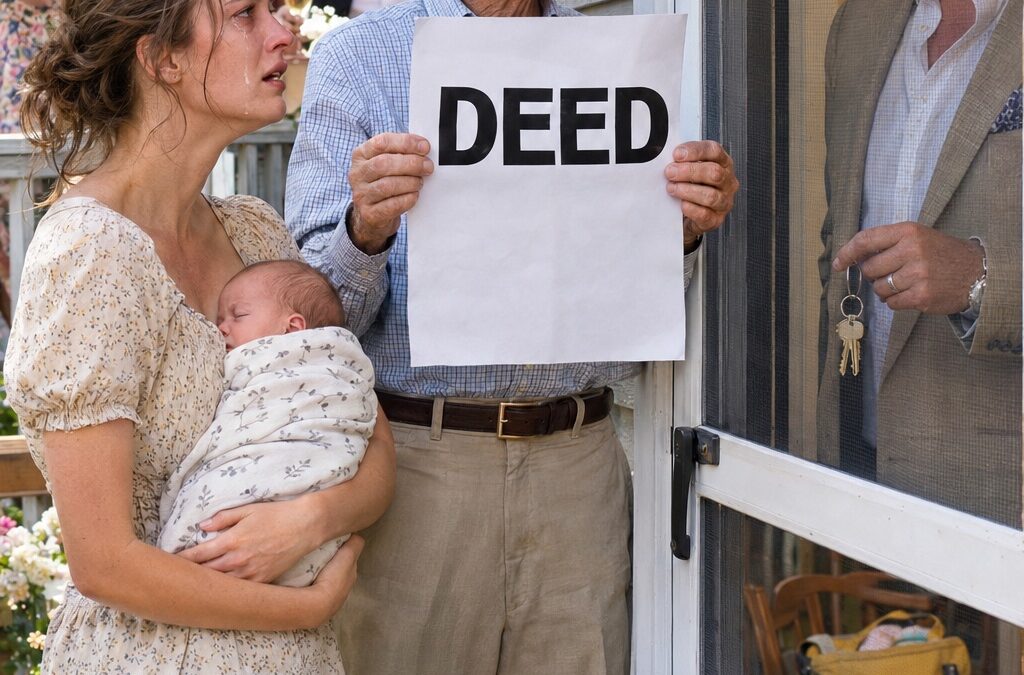
Part 3: The Name He Read
“The owner is Leah,” Grandpa said.
Dad looked at me instead of the paper.
Grandpa held the page steady against the railing.
“I gave her the cottage on December 14, 2024.”
He moved his finger down the recorded copy.
“It was recorded December 16, 2024.”
The agent stepped closer, keeping her camera against her side.
Grandpa let her examine the recording information without releasing it.
Dad still had the keys hooked around his finger.
For a moment, nobody asked me to move anywhere.
I tucked the changing pad into my yellow bag.
Mae had settled against my shoulder again.
“May I see that?” the agent asked.
Grandpa handed her the certified copy.
She read quietly, then looked toward me.
“Were you aware of this transfer?”
“Yes.”
“Have you authorized a sale?”
“No.”
She slipped her camera strap over her head.
“I won’t be taking photographs today.”
Sloane pushed the screen door open with her palm.
“Well, why didn’t anybody tell us?”
Grandpa turned toward her.
“Because I wasn’t asking permission.”
Dad stepped outside, letting the screen close behind him.
“You let me plan a family weekend around this place.”
“A welcome gathering,” Grandpa said. “That was the permission.”
Dad looked toward the relatives by the steps.
“We’ve all used this place for years.”
I adjusted Mae’s blanket beneath her cheek.
“You used it with permission,” I said.
The word DEED showed above the agent’s fingers.
Below it were the names and legal description.
Grandpa’s signature appeared with the acknowledgment from December.
The certified copy included the county’s recording information.
It wasn’t something he had typed that morning.
Dad had recognized it before Grandpa read my name.
His smile had disappeared before mine appeared anywhere aloud.
Now the borrowed keys rested against his palm.
He wasn’t turning them around his finger anymore.
The agent checked the second page carefully.
“This identifies the property near Traverse City?” she asked.
“Yes,” Grandpa said. “The cottage and its parcel.”
“And this is the recorded document?”
“A certified copy from Grand Traverse County.”
Dad leaned toward the page without asking for it.
“You signed this in December?”
“December 14.”
“Six months ago?”
“Yes.”
Dad looked at me again.
“And you knew.”
“I accepted the gift.”
He stared at the diaper bag by my feet.
It seemed to bother him that I was sitting.
I had been standing outside holding Mae long enough.
The relative who fetched my bag had brought the chair.
I wasn’t getting up to make this easier for him.
Grandpa pulled another chair nearer the doorway.
The relative offered him her arm.
He thanked her but sat without taking it.
“Why wasn’t there a family discussion?” Dad asked.
“Because it was mine to give.”
Dad rubbed the back of his neck.
“Leah brought you groceries. We’re all grateful.”
Grandpa looked up at him.
“She did more than bring groceries.”
“Dad, I’m not diminishing anything.”
“You called it soup.”
I reached into the bag for a clean cloth.
I didn’t need it yet, but unfolded it anyway.
Grandpa rested his hands on his knees.
“From March through September, she worked around my treatments.”
Dad glanced toward the seventeen relatives gathered nearby.
Several had moved away from their welcome drinks.
Grandpa kept speaking to him.
“She used vacation leave from her scheduling job.”
“I know she helped.”
“She wasn’t on vacation.”
I pressed the cloth beneath Mae’s chin.
I had been a medical scheduler long enough to recognize delays.
I knew how one late appointment rearranged a whole day.
During Grandpa’s chemotherapy, I arranged mine twice.
First around my job, then around his treatment.
Sometimes I answered work calls from outside his kitchen.
Sometimes I used leave because he couldn’t be alone.
He never paid me.
I never sent him a bill.
Grandpa touched the arm of his chair.
“She steadied the basin when I couldn’t hold it.”
“Grandpa,” I said.
“I want him to hear this.”
He looked back at Dad.
“She wiped my mouth afterward.”
I folded the clean cloth into a smaller square.
“She cooled broth on a spoon.”
I remembered that spoon against the bowl.
He kept apologizing for making me miss work.
I kept telling him the broth would spill.
That was what I could manage to say then.
“She moved the rug before helping me stand,” Grandpa continued.
I hadn’t known he noticed the rug.
His feet sometimes caught its curled edge.
“She stayed until I could keep water down.”
Dad folded his arms.
“You could have asked me for more help.”
“I did ask.”
Dad looked toward Drew.
My brother had lowered his phone against his leg.
Grandpa didn’t ask him to confirm anything.
“You told me you couldn’t get away,” he said.
“Work was complicated.”
“Yes. Leah’s work was complicated too.”
Sloane stood in the doorway, touching the screen latch.
At 29, she was younger than I was.
I was 32, holding a baby born June 2.
Dad was 56, arguing about his father’s property.
Grandpa was 79, with his document folder on his knees.
Nobody needed an explanation of those ages.
We all knew who should have brought out a diaper bag.
“Leah never asked me for the cottage,” Grandpa said.
I looked down at Mae’s closed fist.
That part mattered to me.
I had asked whether he was sure more than once.
His independent attorney had handled the deed.
He had met with her privately before signing.
There had been time for him to change his mind.
He signed it anyway and delivered it to me.
I accepted it and took over the expenses.
The insurance and property tax paperwork came to me.
The utility bills stopped going into his kitchen drawer.
Dad hadn’t seen any of that.
He had no reason to open my mail.
“You kept this from us,” he said.
“We kept a private transaction private,” Grandpa replied.
“People change their minds.”
“I haven’t.”
“But if you did?”
Grandpa smoothed the folded edge of the paper.
“That would not make Russell the owner.”
The agent returned the certified copy to him.
“I need to verify the public record independently,” she said.
“But I cannot proceed on Russell’s instructions.”
Dad shifted toward her.
“I never told you I personally owned it.”
“No. You said you were arranging the sale.”
Sloane looked quickly toward him.
He ignored her.
“You should have spoken to me before cutting me out.”
Grandpa slid the deed back over his folder.
“I didn’t take property away from you.”
Dad opened his mouth.
“I gave away my property,” Grandpa finished.
Mae moved her head against my shoulder.
I checked her cheek and tucked the cloth beneath it.
Dad looked toward the kitchen, then back at me.
“You’re going to pretend this isn’t about money?”
“You brought an agent,” I said.
The agent lowered her eyes to her camera bag.
Dad took a breath through his nose.
Then he turned toward her again.
“Tell her what a place like this could bring.”
Part 4: What The Agent Was Told
The agent kept both hands on her camera strap.
“A possible price doesn’t create authority to sell,” she said.
Dad held up his hand.
“I understand. I’m explaining the opportunity.”
“You’ve explained the price,” I told him.
The proposed amount was $384,000.
I had already heard it discussed like available cash.
Dad looked toward Mae, then toward the doorway.
“This could change things for the whole family.”
Sloane stepped onto the porch beside him.
“We weren’t going to throw the money away.”
“What were you going to do?” Grandpa asked.
Dad answered before she could.
“We’ve been looking for a place with more room.”
“A larger house,” Sloane said.
Dad glanced at her.
“For family gatherings,” he added.
“And a proper bedroom for guests,” she said.
She began describing space they didn’t currently have.
A larger kitchen was mentioned.
So was a room they could keep ready year-round.
Nobody mentioned putting the money in Grandpa’s account.
Nobody asked what he might need during retirement.
The cottage proceeds were already assigned to their house.
I shifted Mae onto my other shoulder.
Dad watched me settle her.
“You could visit there too,” he said.
“I can visit here now.”
He looked away.
The agent opened the plain folder she had brought.
“I need to clarify what I was told.”
Dad moved a step closer.
“We can discuss that separately.”
“It concerns Arthur.”
Grandpa straightened in his chair.
“Then say it here.”
She faced him instead of Dad.
“I was told you were entering permanent assisted living.”
Grandpa blinked once.
Then he looked directly at his son.
“No.”
The agent nodded.
“I was also told you wanted the cottage sold.”
“I did not.”
Sloane turned so quickly her shoulder brushed Dad’s arm.
“You said that was settled.”
“I said it made sense.”
“That is not what you told me,” she said.
Dad’s face changed when she contradicted him.
He wasn’t used to correcting two conversations at once.
“I was discussing possibilities,” he told the agent.
“You presented it as the reason for selling.”
She spoke carefully, without raising her voice.
“I understood you were helping carry out his wishes.”
Grandpa rested his water glass against his knee.
“My wishes were not discussed with me.”
Dad pointed toward the glass.
“You needed help for months.”
“With chemotherapy,” Grandpa said.
“You still get tired.”
“Yes. I’m sitting down.”
I looked at the porch boards.
I didn’t want Dad mistaking my expression for permission.
He had talked with Grandpa about fishing that morning.
He had asked whether Grandpa still had certain tackle.
There had been no discussion of permanent care.
Now he was using the treatment months as an explanation.
“I thought you were considering more support,” Dad said.
“Support is not a permanent move.”
“I didn’t say you couldn’t think.”
“You said I wanted to sell.”
Dad looked toward the agent.
She didn’t rescue him from the distinction.
“I’m not making a medical judgment,” she said.
“Good,” Grandpa answered. “Neither is my son.”
The relative beside me picked up my empty glass.
She brought it back filled with water.
I thanked her and drank before Mae stirred again.
The ordinary sound of ice made the porch feel stranger.
People were still holding half-finished welcome drinks.
Dad and Sloane’s resort ceremony was scheduled for June 15.
Their legal marriage had already taken place.
This afternoon was supposed to be a small welcome gathering.
Instead, Dad was explaining a move Grandpa hadn’t planned.
The agent closed her folder.
“My role was preliminary,” she said.
“No listing agreement has been signed.”
Dad nodded quickly.
“Exactly. Nothing was final.”
“And I had not ordered a title search.”
“Then there was no harm done.”
She looked at the door behind him.
“I’m not in a position to say that.”
I pulled Mae’s blanket away from her warm neck.
The cottage had been open until Dad latched the screen.
The solid inside door was still standing open.
He had watched me through both openings.
I didn’t need the agent to describe that part.
She turned toward me.
“I should have requested ownership information before coming.”
“I’m glad you’re checking now,” I said.
“I won’t take photographs without your authorization.”
“You don’t have it.”
“I understand.”
She put the lens cap on her camera.
Dad watched that small movement closely.
Sloane lowered herself onto a porch chair.
“We already looked at houses,” she said.
“Not now,” Dad told her.
“But we did.”
Her voice was lower than before.
She seemed to be testing which facts were still safe.
“You showed me the numbers,” she continued.
“They were estimates.”
“You said the cottage would cover most of it.”
Grandpa looked at Dad without interrupting.
Dad pulled at the cuff of his shirt.
“We haven’t bought anything,” he said.
“That’s good,” Grandpa replied.
It wasn’t said with satisfaction.
He sounded relieved they hadn’t gone further.
Drew slipped his phone into his pocket.
I wondered how much of this he had recorded.
I didn’t ask while Dad was looking around for support.
Dad stepped closer to Grandpa and bent slightly.
His voice became quieter.
“Was the transfer supposed to be temporary?”
Grandpa looked up.
“Temporary how?”
“While you recovered. While Leah handled the bills.”
I moved the yellow bag between my feet.
I could feel its canvas against my ankle.
There had never been such an arrangement.
“You put it in her name for convenience,” Dad continued.
“That isn’t what I did.”
“Maybe you understood something she didn’t.”
Grandpa stared at him for a few seconds.
“Ask me a clear question.”
“Was she supposed to give it back?”
“No.”
“If you needed money?”
“No.”
Dad glanced at the relatives.
“They should know the whole arrangement.”
“They are hearing it,” Grandpa said.
I watched Dad look toward the folder again.
He couldn’t change the owner’s name.
Now he wanted to supply conditions around it.
“Did she promise to share it?” he asked.
“No.”
“Did she promise you could keep living here?”
“I’m not living here.”
“You know what I mean.”
Grandpa leaned back carefully.
“I visit with Leah’s permission. I kept no ownership interest.”
The agent remained near the steps.
She was no longer treating this as a sale appointment.
She was waiting for a chance to leave appropriately.
Dad pointed toward the folder beneath the deed.
“If this was all planned, why bring that today?”
“Because you arranged sale photographs,” Grandpa said.
He looked toward me.
“Leah knew this morning I intended to address that.”
Dad turned.
“So you both knew.”
“I didn’t know you would lock the door,” I said.
He looked down at his shoes.
Grandpa set the certified deed across his knees.
Then he opened the attorney’s accompanying letter.
Part 5: What The Gift Allowed
Grandpa read the first paragraph before handing it over.
He gave the letter to me, not Dad.
I balanced it against the closed folder.
Mae’s cheek rested on my shoulder.
The letter referred to the deed signed December 14.
It identified the completed gift and the recording date.
There was no repayment schedule.
There was no requirement to return the cottage.
There was no direction to divide sale proceeds.
I read those portions aloud because Dad had asked.
He listened with one hand against the doorframe.
“That doesn’t cover every conversation,” he said.
“It covers what I instructed my attorney to prepare,” Grandpa answered.
I offered the letter to the agent.
She read it without taking the whole folder.
“This is beyond my role to interpret,” she said.
“But nothing here authorizes me to proceed without Leah.”
Dad reached toward the paper.
“Let me see.”
I handed him the letter after the agent returned it.
I kept the certified deed on my lap.
He read the page once, then started again.
I recognized that habit.
He was looking for a word he could question.
Sloane watched his face instead of the letter.
“Was there another agreement?” she asked.
“No,” Grandpa said.
Dad lowered the paper.
“You were sick when this happened.”
“I finished chemotherapy in September.”
“You were still recovering in December.”
“Yes.”
“You depended on her.”
“For help.”
“That can affect people.”
Grandpa held out his hand for the letter.
Dad didn’t return it immediately.
“She was there all the time,” he continued.
“I asked her to be there.”
“You might have felt obligated.”
“I felt grateful.”
Dad glanced toward me.
I looked at the empty water glass instead.
I wasn’t going to argue about his suggestion while nursing soreness pulled across my shoulders.
I wanted to feed Mae.
I wanted the door open.
I wanted my father to stop inventing conversations.
Grandpa took the letter when Dad finally released it.
“My attorney met with me privately,” he said.
“Leah was not in the room.”
“For how long?”
“Long enough for me to explain what I wanted.”
“What did you tell her?”
“That I wanted to give Leah the cottage.”
Dad made a small, impatient movement.
“I mean about why.”
“That is my conversation.”
The agent moved aside as two relatives stepped down.
People were beginning to clear space around the door.
Nobody wanted to be caught between us.
Grandpa looked toward Mae.
“She needs somewhere quieter,” he said.
“I can hear you from the kitchen,” I answered.
“Then we’ll stay close.”
I picked up the yellow bag with my free hand.
The relative who fetched it earlier carried my water.
We went through the open screened entrance together.
Dad stepped out of the way.
He did not touch the latch.
I settled in the kitchen chair beside the window.
The folder went on the table within reach.
I arranged Mae and laid out the clean cloth.
Grandpa moved his chair nearer the threshold.
Dad couldn’t draw him farther down the porch.
“Did Leah tell you what to ask for?” he asked.
“No.”
“Did she take you to the appointment?”
“She helped with transportation when I needed it.”
“So she was involved.”
“She was not in the private meeting.”
Grandpa waited until Dad stopped talking.
“I gave instructions. My attorney prepared the deed.”
He paused to take a drink.
“I signed voluntarily. I delivered it to Leah.”
Dad looked through the doorway toward me.
“And you just took it?”
“I asked whether he was sure.”
“How many times?”
“Enough that I got tired of answering,” Grandpa said.
I almost smiled, then concentrated on Mae.
His attorney had explained the expenses to me.
I had checked what I could afford.
The cottage was mortgage-free, but it wasn’t expense-free.
There were taxes, insurance, utilities, and maintenance.
I accepted those with the property.
It wasn’t a check I could spend without responsibility.
“I pay the ongoing bills,” I said.
Dad looked around the kitchen.
“That doesn’t make it less of a huge gift.”
“No,” I answered. “It doesn’t.”
He seemed annoyed I wouldn’t deny the obvious.
It was a huge gift.
It was also already given.
Grandpa offered to authorize his attorney to confirm the transaction.
Dad didn’t ask for her number.
He folded his arms instead.
I waited until Mae settled.
Then I photographed the deed and the accompanying letter.
I checked each image before moving to the next.
The recording information needed to be readable.
So did Grandpa’s signature and the property description.
Dad watched from the doorway.
“Why are you doing that?”
“So I have copies.”
“You think I’m going to take them?”
“You already reached for the folder.”
He stepped back without answering.
I saved the photographs somewhere outside my phone’s camera roll.
Then I put the certified copy inside the folder.
Grandpa told me to keep it.
I placed it away from the entrance.
I also typed a short account of the afternoon.
I included the date, the photograph request, and the lockout.
I wrote that no sale or entry permission remained.
I wasn’t sending it around the family.
I wanted the details recorded while I remembered them.
Dad waited until I put the phone down.
“Are you actually telling us to leave?”
“Yes,” I said.
“The gathering is over for me.”
Sloane appeared beside him.
“What about tonight?”
Grandpa looked toward her.
“What about it?”
“We brought our overnight bags.”
I glanced toward the hallway.
Two bags stood against the wall.
I had assumed they contained gathering supplies.
“You had permission for the welcome gathering,” Grandpa said.
“We thought staying would be simpler,” Dad answered.
“You didn’t ask.”
Dad put his hand against the doorframe again.
“I’m not having police at my wedding weekend.”
“Nobody mentioned police,” I said.
“We’re asking you to arrange another place.”
They weren’t tenants or residents.
They had permission for an afternoon, not overnight occupancy.
Still, I wanted their belongings carried out by them.
I wanted no argument about someone moving a bag.
Sloane looked at her phone.
“It’s a Saturday in June,” she said.
“The resort may have something,” Grandpa answered.
“We didn’t reserve a room there,” Dad said.
“I heard you.”
Grandpa took out his phone.
He asked Sloane for the resort’s number.
She gave it to him before Dad could object.
He dialed and waited beside the open window.
“Do you have a room available tonight?” he asked.
Part 6: The Keys On The Table
Grandpa listened, then asked for the total.
He repeated the answer so everyone could hear.
“Two hundred forty-six dollars?”
Sloane nodded as if the employee could see her.
Grandpa looked toward Dad.
“There’s a room available. I can pay directly.”
Dad shook his head.
“We don’t need charity.”
“Then you can pay them.”
Sloane touched Dad’s sleeve.
“Please let him finish.”
Grandpa gave the hotel the information it needed.
He didn’t offer money to Dad.
He paid the hotel directly for the available room.
Then he asked about check-in and repeated the instructions.
Sloane entered them into her phone.
Dad stood with his jaw set.
The hotel booking took less time than his arguments.
When Grandpa ended the call, nobody moved immediately.
Then Sloane went into the hallway for their bags.
“Do you have everything?” I asked.
She checked the kitchen counter.
“My phone charger.”
I pointed toward the outlet beside the window.
She unplugged it and wound the cord around her hand.
I stayed seated with Mae.
Nobody shoved a suitcase outside.
Nobody blocked the hallway.
There was no lease, tenancy, or residence to end.
They had come as day guests and were leaving voluntarily.
I wanted the afternoon to remain that straightforward.
A relative asked whether the gathering should move.
“You’ll need to arrange that with them,” I said.
I didn’t offer to call the resort.
I didn’t offer to pack food for the trip.
I had my own things to carry.
The agent waited near the open screen.
“I’ll verify the record when the office is open.”
“Please contact me directly,” I said.
She wrote down my contact information.
I repeated that I authorized no photographs or listing.
She repeated it back to me.
“There’s no signed listing agreement,” she added.
“My file is preliminary.”
“Please confirm when you’ve closed it.”
“I will.”
She zipped her camera into its padded case.
Dad watched from beside the kitchen table.
He had brought her professionally, not as a relative.
Now she was leaving without a usable photograph.
She thanked Grandpa for allowing her to examine the document.
Then she apologized to me again and went outside.
Sloane carried the first bag toward their car.
Dad stayed behind.
“The pictures could still be useful,” he said.
I looked at him.
“For what?”
“So you know your options.”
“I’m not having photographs taken.”
“They wouldn’t obligate you to anything.”
“No.”
He glanced toward Grandpa.
Grandpa was checking the hotel information on his phone.
He didn’t offer a different answer.
Dad lowered his voice.
“You could help us end this peacefully.”
I shifted Mae against my shoulder.
“Leaving does that.”
He stared at the table.
The certified copy was inside the folder beside me.
He couldn’t turn this into a vote.
There was no sale appointment to salvage.
Sloane came back for the second bag.
“We should go,” she told him.
Grandpa looked up.
“Russell, the cottage keys.”
Dad touched his pocket.
For a moment, he seemed not to understand.
Then he took out the ring.
I recognized the brass key with its worn edge.
It had opened the cottage for years.
It had never meant Dad owned anything here.
He separated the cottage keys from his car keys.
His fingers worked more slowly than necessary.
“What about tomorrow?” he asked.
“Ask Leah,” Grandpa said.
Dad looked toward me.
“Can we stop here before the ceremony?”
“No.”
“What if we need something?”
“Call me. Don’t come without permission.”
Sloane stood in the hall with her bag.
“The ceremony is tomorrow,” she said.
“I know.”
“You’re still coming?”
“No. Mae and I are staying here.”
Dad looked toward the porch.
Several relatives were still within hearing distance.
“Don’t make a scene out of this.”
“I’m not attending.”
I didn’t list postpartum discomfort or lack of sleep.
Both were real.
Neither needed to excuse the decision.
I was on maternity leave from my scheduling job.
I had driven from my rented apartment in Lansing.
Mae had been born only twelve days earlier.
That was enough activity without another gathering the next day.
Dad stared at me for another moment.
Then he put the borrowed keys in Grandpa’s hand.
They tapped against Grandpa’s ring.
Grandpa placed them on the kitchen table beside my folder.
Dad didn’t reach for them again.
“You don’t have future permission to use these,” I said.
He looked at the keys.
“You need to ask before entering or arranging anything here.”
“Fine.”
“I need you to mean that.”
He gave a short nod.
Sloane went outside.
Dad followed after looking once more around the kitchen.
I heard the bags go into their car.
Then the car doors closed.
I stayed seated until the engine started.
The remaining relatives collected their cups.
The one who had brought my bag asked about dishes.
“Leave them by the sink,” I said.
She did.
She didn’t ask me to reassure her about Dad.
I appreciated that.
When the last car pulled away, I laid Mae down.
Her portable sleep space was flat and clear.
I checked her breathing, then checked the time.
I had lost track of how long everything took.
Grandpa began gathering cups from the windowsill.
“You don’t have to clean,” I told him.
“I can carry cups.”
He carried two at a time to the sink.
I let him.
During chemotherapy, I had watched his every movement.
Now he could rinse a glass without my hand nearby.
He was slower than before treatment.
He was still capable of doing his own dishes.
I drank the water beside my chair.
It was warm by then.
The quiet after everyone left felt practical.
There were diapers to restock and food to put away.
I could do those things without an audience.
Drew hadn’t driven away with the others.
I saw him through the screen near the steps.
He shifted his phone between his hands.
Then he came to the entrance and stopped.
“Can I come in?”
“Yes.”
He looked toward Mae before stepping inside.
“I have the whole video,” he said.
I waited.
“From before Grandpa opened the folder.”
His phone was still in his hand.
“Do you want the unedited recording?”
Part 7: What The Camera Kept
“Yes,” I said.
Drew sat across from me and sent the file.
I waited until it finished arriving.
Then I saved another copy outside our message thread.
He watched the progress on my screen.
“I wasn’t going to post it,” he said.
“That wasn’t what I asked you outside.”
“I know.”
“I asked you to bring the diaper bag.”
He rubbed his thumb along his phone case.
“I didn’t know what to do.”
“It was on a kitchen chair.”
He nodded.
“The door was between me and her supplies.”
“I know.”
“You could have brought it out.”
“Yes.”
He stopped trying to explain for a moment.
I checked the saved file again.
The recording was longer than I expected.
He had kept filming through things he now regretted.
“I thought we might need proof,” he said.
“You could have helped and kept the recording.”
His eyes stayed on the table.
“I was afraid Dad would turn on me.”
“So you left me standing there.”
“Yes.”
He was 27.
He didn’t need instructions for carrying a canvas bag.
I didn’t say that aloud.
I wanted him to answer for the choice he made.
Not for something he might have done differently someday.
“Did you show anyone?” I asked.
“No.”
“Don’t send this around for people to watch.”
“I won’t.”
“If you tell the story, include your part.”
He put his phone face down.
“I’m sorry I left you asking.”
That was different from apologizing for a bad afternoon.
I thanked him for saying it.
I didn’t tell him everything was fine.
He asked whether I needed groceries.
“Not right now.”
He stood and pushed his chair back carefully.
Before leaving, he looked toward Mae’s sleep space.
“How is she doing?”
“She’s fed and sleeping.”
“Good.”
He waited as if there might be another task.
There wasn’t one I wanted to give him.
After he left, I played the recording without sound.
I needed to check what had been preserved.
The view included the porch steps and screened entrance.
My yellow bag was visible through the open solid door.
I saw myself point toward it.
Dad was close enough to hear every word.
Drew’s camera stayed pointed at me.
I stopped watching before the ownership announcement.
I didn’t need to see Dad’s face again that evening.
I needed to know the beginning hadn’t been cut away.
I saved the original without editing it.
Then I wrote down where the backup was stored.
Grandpa stood at the sink drying a cup.
“Would you like company tomorrow?” he asked.
“Yes.”
“I’ll stay nearby.”
That became our plan for June 15.
Not a replacement celebration.
Just breakfast, lunch, and help when I wanted it.
I slept badly because Mae slept like a newborn.
At least nobody was asking me to dress for photographs.
In the morning, Grandpa warmed food and filled my glass.
He asked before picking Mae up.
He asked before turning on the radio.
After months of arranging care around his treatments, I noticed.
I didn’t have to anticipate every need in the room.
Somebody was checking mine.
My phone collected messages about the ceremony.
One relative asked where extra gathering supplies were kept.
Another asked whether people could stop afterward.
I answered the property questions directly.
“No visits to the cottage afterward.”
I didn’t explain feeding times to everybody.
I didn’t attach the deed to prove I could refuse.
Grandpa sat outside while I settled Mae.
I could hear his chair move across the porch.
No speeches came through the screen.
No one discussed the empty place at the ceremony.
Dad and Sloane had their June 15 resort event.
I stayed at the cottage with my baby.
Later, I put my phone inside the yellow bag.
I wanted to eat without watching the screen light up.
June 16 was Monday.
I woke with a short list of business matters.
The agent contacted me first.
She had verified the recorded ownership information.
She confirmed my name and the December recording date.
She would not pursue the proposed listing.
There was no signed agreement to cancel.
She hadn’t taken preliminary photographs inside.
Her file would be closed.
“Please send that confirmation in writing,” I said.
She did.
I saved it with my property documents.
Next, I contacted the independent attorney who prepared the gift.
Grandpa authorized her to discuss the completed transaction with me.
I sent the documents and my written account.
She explained that the deed had conveyed ownership.
It wasn’t a promise to give me the cottage later.
It contained no retained interest for Grandpa.
Dad’s expected inheritance hadn’t made him an owner.
“He was never a trustee or agent either,” I said.
“Nothing you’ve provided shows that authority,” she replied.
She didn’t promise Dad could never complain or file anything.
If formal papers arrived, I should send them promptly.
That was a useful answer.
I wanted advice, not a guarantee nobody could make.
I told her about the unedited recording.
She asked me to preserve the original.
I had already done that.
She also agreed that securing access was sensible.
I arranged for a locksmith to change the locks.
I stayed at the cottage while the work was done.
The old keys went into a kitchen drawer.
The new keys stayed beside my bag.
I gave Grandpa a set because I wanted him visiting.
He asked where I preferred to keep the spare.
Dad received none.
Before the locksmith left, I tested the new lock.
I opened it from outside and locked it again.
Then I checked it from inside.
The screen latch was separate.
I touched it and left it open.
That afternoon, I fed Mae and ate something myself.
The cottage paperwork was put away.
The agent’s file was closed.
I expected the next message to concern the wedding.
Dad’s name appeared on my phone.
He asked whether I would borrow against the cottage.
Part 8: The Loan I Wouldn’t Take
Dad described the loan as a compromise.
I could keep the cottage, he wrote.
They could still move forward with their larger house.
It would avoid selling something important to the family.
I read the message twice.
The word compromise made me set the phone down.
There had been no agreement to sell.
There was nothing for me to meet him halfway on.
Mae was stirring beside me.
I changed her before answering.
Then I washed my hands and warmed my lunch.
I wanted to respond after eating, not while scrambling.
Dad sent another message before I finished.
“The cottage is mortgage-free. You have options.”
I looked around the kitchen.
The tax bill and insurance papers were put away.
The new keys sat beside the yellow bag.
I had options because the property belonged to me.
That didn’t make borrowing harmless.
His proposal put my property behind their plans.
I opened the message thread.
“I’m not borrowing against the cottage for your house.”
His reply came quickly.
“It would still stay in your name.”
“I understand. My answer is no.”
“We would make the payments.”
“I’m not pledging the cottage.”
He asked whether Grandpa had told me to refuse.
“No. This is my decision.”
I saved screenshots of the whole exchange.
Then I sent the request and refusal to the attorney.
No lender had contacted me.
I had signed no application or collateral agreement.
There was nothing to withdraw.
I wanted the new request documented beside the old one.
Dad tried calling that evening.
I was feeding Mae and let it ring.
He didn’t leave a message.
Later, I wrote one more response.
He could contact me about ordinary family matters.
He could not arrange financial appointments involving my property.
He could not authorize photographs or let anyone inside.
“I haven’t done anything since the weekend,” he wrote.
“Please keep it that way.”
“You’re making me sound dishonest.”
I looked at the agent’s written confirmation.
I considered sending it back to him.
Instead, I closed the document.
“The cottage isn’t available for your house plans.”
That ended the exchange.
No bank forms arrived.
No professional called about an appointment.
The preliminary listing stayed abandoned.
Dad stopped trying to transact with property he didn’t own.
The smaller practical changes happened through ordinary conversations.
One relative asked Grandpa about using the cottage.
He directed the request to me.
The relative called and sounded uncomfortable.
“Your dad used to handle the calendar.”
“He doesn’t now,” I said.
I checked my plans before answering.
That pause was new for me.
I usually began by working out how to accommodate someone.
Now I looked at what Mae and I needed first.
Some requests worked.
Others didn’t.
I didn’t explain every refusal beyond saying we were unavailable.
Nobody argued once the arrangements became clear.
Grandpa had my permission to visit.
That did not give him permission to invite other people.
He understood without needing it written on the refrigerator.
He had keys, but he still called.
“I’m bringing lunch. Is noon all right?”
“Could you make it one?”
“Yes.”
Then he arrived at one.
He didn’t ask what I was doing during that hour.
Sometimes I was sleeping.
Sometimes I was washing small clothes.
Sometimes I wanted the kitchen empty while I ate.
The yellow bag moved between Lansing and the cottage.
I still checked its contents before every drive.
Diapers, cloths, spare clothes, and the changing pad.
I added the new cottage keys to the same pocket.
I didn’t leave them loose where anyone might borrow them.
Drew messaged me after talking with relatives.
He told me what he had corrected.
At first, he had described a stressful wedding disagreement.
That explanation spread responsibility across everybody present.
He had now said Dad latched the door.
He said I asked for Mae’s supplies.
He said he kept filming instead of helping.
He also clarified that the deed existed long before June.
“It wasn’t something Grandpa signed because of the argument.”
“No,” I wrote. “It wasn’t.”
Drew didn’t request a thank-you.
He didn’t forward the video to prove he was cooperating.
He corrected his own words.
That was what I had asked him to do.
“I should have brought the bag,” he wrote.
“Yes.”
Our later messages were smaller.
He asked whether Mae was sleeping any longer.
I told him when I felt like answering.
He didn’t offer to pass messages between Dad and me.
I didn’t make him responsible for that either.
Sloane sent a short apology about the photographs.
She said the wedding weekend had overwhelmed her.
I read the message more than once.
It didn’t mention her words through the screen.
It didn’t mention leaving me outside with Mae.
I thanked her for writing.
I didn’t say everything was fine.
Their wedding bills remained theirs.
Grandpa’s hotel payment remained his choice.
I asked once whether he expected reimbursement.
“No,” he said.
“Not from me. From them.”
“I paid the hotel so they could go.”
He could afford the $246.
He hadn’t asked me to arrange or repay it.
I let his answer stand.
A little later, Dad asked about visiting.
This time, he asked me directly.
He didn’t announce a date.
He didn’t say he was stopping by for something.
“Would you consider a daytime visit?” he wrote.
I waited before replying.
I checked whether Grandpa would be available.
Then I checked whether I actually wanted the visit.
I didn’t want an overnight stay.
I didn’t want another financial conversation.
I wanted to know whether Dad could come as a guest.
I offered July 12, 2025.
Daytime only, at the time I specified.
Sloane would not be coming.
I told him there would be no property discussion.
He agreed.
On July 12, I put Mae’s things away slowly.
I left the deed in its drawer.
I didn’t set documents on the table for protection.
The door had a working lock.
I could decide whether to open it.
Dad’s car stopped in the drive.
I watched him step out without a bag.
Then his knuckles tapped against the newly locked door.
Part 9: The Bag On Its Peg
I looked through the window before opening it.
Dad stood outside with his hands empty.
No overnight bag waited beside his feet.
I unlocked the door and let him enter.
“Hi, Leah,” he said.
“Hi.”
He paused beside the kitchen table.
The chair where my bag had been was empty.
Mae was sleeping where I could see her.
Grandpa was outside sorting the cups he had brought.
He had agreed to stay without directing the visit.
Dad looked toward the baby.
“She’s sleeping,” I said.
“I won’t wake her.”
I pointed him toward the chair near the window.
He sat down.
For a little while, he talked about the drive.
I let him finish without asking extra questions.
Then he put both hands on the table.
“I shouldn’t have locked the door.”
I waited.
“I heard you asking for her bag.”
That was the part missing from his earlier messages.
He wasn’t calling it a misunderstanding.
He wasn’t blaming wedding arrangements.
“Yes,” I said.
He looked down at his hands.
“I was angry you wouldn’t leave.”
“I had supplies inside.”
“I know.”
“And she was twelve days old.”
“I know that too.”
He didn’t argue about the number.
Mae had been born June 2.
The gathering had happened June 14.
Those dates weren’t open to interpretation.
I looked at the old mark on the table.
A hot pan had left it years earlier.
Grandpa never thought it justified replacing the whole table.
Dad rubbed his thumb beside that mark.
“I’m sorry,” he said.
“Thank you for saying it.”
He nodded.
I didn’t say everything was forgotten.
He didn’t ask me to.
For another moment, neither of us spoke.
Then he glanced toward the window.
“I should have opened it when you asked.”
“Yes.”
“I shouldn’t have needed Dad to bring papers.”
“No.”
He swallowed and sat back.
There was nothing helpful I could add to that.
Grandpa came inside carrying the clean cups.
He greeted Dad and set them beside the sink.
Nobody put the deed on the table.
It had already been examined and verified.
Dad was here because I invited him.
There was no sale or loan conversation waiting for later.
Grandpa asked whether anyone wanted coffee.
Dad said yes.
I asked for water.
Grandpa filled my glass before making the coffee.
He didn’t treat the visit like a family hearing.
He asked Dad about the drive.
Dad gave a shorter answer the second time.
Then they talked quietly while I checked Mae.
She woke before they finished their cups.
I picked her up and felt the back of her clothes.
Dad stood as if he might help.
“Could you bring the bag?” I asked.
He looked toward the kitchen peg.
The yellow canvas strap hung in plain view.
He took it down and carried it over.
“Here.”
“Thank you.”
I pointed beside the changing pad.
He set it exactly where I asked.
There was no joke about remembering this time.
No request for credit.
He sat down while I changed her.
Drew wasn’t there with a phone.
Nobody filmed the room.
Grandpa looked out the window to give me space.
Afterward, I washed my hands and settled Mae.
Dad waited until I sat down.
“Could I hold her?”
I checked her face before answering.
“Yes. Sit here.”
He moved to the chair I indicated.
I placed her in his arms and stayed nearby.
He adjusted his elbow after I showed him how.
Then he looked down at her.
“She’s changed already.”
“She’s growing.”
He nodded.
There was no photograph request.
He didn’t ask me to send something to wedding relatives.
He just held her while I drank my water.
I let that happen without promising another visit.
When Mae began turning her head, I took her back.
Dad handed her over immediately.
He stayed a little longer, then checked the time.
“I should get going.”
“All right.”
Before leaving, he glanced at the keys near my bag.
I saw the glance.
He didn’t ask for them.
I walked him to the entrance.
“Call before coming again,” I said.
“I will.”
“And wait until I answer.”
He nodded.
Then he stepped outside.
I closed the door behind him without rushing.
The new lock turned cleanly.
Grandpa was rinsing cups when I returned.
“Was that all right?” he asked.
“It was enough for today.”
He nodded and handed me a dry cup.
We put the kitchen back the way we liked it.
I didn’t need to decide every future invitation that afternoon.
Dad had apologized for what he actually did.
He had left when the visit ended.
He had not taken a key.
Sloane stayed away from the cottage.
The agent’s file remained closed.
The proposed listing had gone no further.
Their larger-house plans were theirs to fund or postpone.
Their wedding bills remained theirs too.
There were no loan forms on my table.
I kept the deed with the other property papers.
I didn’t display it where visitors could inspect it.
It wasn’t a decoration from a family argument.
It was a document I needed to keep safe.
The old borrowed keys remained in the drawer.
The new set went back into my bag.
After lunch, Grandpa sat near the window with Mae.
I could hear him talking quietly about the trees outside.
He didn’t ask whether she understood.
He was simply enjoying talking to her.
I washed the changing pad and left it to dry.
Then I repacked the spare clothes.
I checked the diaper supply before closing the zipper.
There would be another trip between Lansing and the cottage.
There would be spilled milk and forgotten cloths.
There would be visits I welcomed and visits I declined.
None of that required another announcement on the porch.
Grandpa asked whether I wanted him to warm my lunch.
“Yes, please.”
I handed him the plate and cleared space at the table.
Mae stirred, then settled against his shirt.
He looked down and adjusted the cloth beneath her cheek.
I reached for the yellow canvas diaper bag.
Its strap was twisted from Dad carrying it over.
I straightened it with my fingers.
Then I hung it on its kitchen peg.








