My Son Shoved Me Into My Walker And Said I Had No Say — Until An Officer Arrived
Chapter 1: Thanksgiving Dressing
My son shoved me against my walker during Thanksgiving dinner.
The frame caught the outside of my sore hip.
I grabbed my dining chair and landed on its seat.
My fork struck the floor beneath the table.
Curtis stood close enough that I could see his collar.
“You don’t decide who lives here.”
Eleven relatives were there to hear him say it.
Nobody had arrived expecting police at Thanksgiving dinner.
I hadn’t expected to need them when I started cooking.
That morning, my bread bowl waited on the kitchen table.
I parked my walker beside the chair with the cushion.
Standing at the counter made my hip ache.
Sitting let me work without stopping every few minutes.
I was 72, and I knew my kitchen.
I could reach the bread without twisting toward the counter.
The wooden spoon lay across a clean dish towel.
Dana stood near the stove with the broth.
At 44, she could lift the baking dish easily.
I needed her help getting it into the oven.
“Pour slowly,” I told her. “Let me turn it.”
She tipped the broth while I loosened the bread.
I pressed a dry piece beneath the damp ones.
“Wait until that soaks before adding more.”
Dana lowered the container and watched me stir.
“You could have bought dressing.”
“He asks for mine every year.”
I shifted my leg beneath the table.
The cushion had slipped, and the chair edge pressed hard.
Dana watched me tug it back into place.
“Do you want me to finish?”
“Just give me a moment.”
I straightened my leg until the ache eased.
Then I pulled the bowl closer and kept working.
I had spent years cooking in a school cafeteria.
Being retired hadn’t stopped me from checking every serving dish.
I still wanted the hot food ready together.
I still hated discovering something forgotten after everyone sat down.
My husband died in 2020. I kept preparing the family holidays because Curtis wanted familiar meals. Making them gave me something practical to do. I could set places even when his chair stayed empty.
In 2021, I used my $38,400 savings for Curtis’s overdue debts. After that, my retirement income covered my current expenses. There wasn’t another savings account waiting behind it. I had the house and what came in each month.
Dana held the baking dish while I scraped the bowl.
“Get that corner, please,” I said.
She turned it, and I spread the dressing evenly.
When she carried it away, I kept my spoon.
I rested it across the bowl instead of standing.
The house smelled like the dinner Curtis had requested.
He had requested something else the previous week.
On November 20, 2025, he stood in this kitchen.
He said the house was worth $286,000.
He thought it was time to arrange a sale.
He had also found a rented room for me.
“You wouldn’t have all this upkeep,” he said.
“Would my dining table fit?”
“You don’t need this much furniture anymore.”
I looked toward the doorway where my walker stood.
“Who decides what I keep?”
“Don’t make everything difficult, Mom.”
He described the room without asking whether I wanted it.
I asked about cooking, and he mentioned meals elsewhere.
I asked about my sewing machine and got no answer.
His fingers tapped the counter while I sat listening.
“I haven’t agreed to leave,” I told him.
He said we could discuss it with the family.
After that visit, I contacted the attorney’s office.
I asked for my recorded deed and an explanation.
I retrieved the packet before Thanksgiving and brought it home.
It went into the drawer beside my kitchen towels.
I didn’t lay it out with the serving spoons.
I wanted dinner, not a meeting about my address.
By the time Jean arrived, the dining table was ready.
My sister was 69 and carrying rolls against her coat.
She kissed my cheek before taking them into the kitchen.
“Where do you want these?”
“Where I can reach them without getting up.”
She set them near my place and checked my chair.
Curtis came in and looked toward the oven.
“Smells right,” he said.
“Put the folding chairs out, please.”
Dana counted plates while the others removed their coats.
Eight other relatives joined Curtis, Dana, and Jean.
Their voices filled the rooms where I usually ate alone.
I checked the dressing when Dana brought it through.
It looked the way Curtis liked it.
I watched him put some beside his turkey.
For a while, people asked for butter and passed bowls.
Then Curtis placed his fork beside his plate.
“We should settle Mom’s move while everybody’s here.”
My knife stopped against the turkey.
“We aren’t settling that over dinner.”
“It’s easier when the family understands the plan.”
Jean lowered her roll.
“What plan?”
Curtis described the sale as something already being arranged.
He said someone else could handle my meals.
He mentioned not having stairs to worry about.
“My bedroom is already on the main floor.”
He kept explaining the room instead of answering me.
“Tell them what I said,” I told him.
He reached toward the gravy.
“You said you needed time.”
“I said I wasn’t agreeing to leave.”
Dana asked who wanted more dressing.
Curtis talked over her, still explaining what suited me.
I looked through the doorway toward my bedroom.
My husband’s things were still hanging in our closet.
My sewing machine sat under the spare-room window.
I knew which doorway my walker cleared without turning.
I knew what furniture I could hold when my hip caught.
“Please stop discussing me like I’m not here.”
Curtis pushed his chair back and came around the table.
I stood when he approached, reaching toward my walker.
He put his hands against my upper arms.
That was when he shoved me backward.
The walker struck my hip, and I caught the chair.
Now Jean was standing, her chair against the wall.
“Curtis, get away from her.”
He lowered his arms and looked toward the serving table.
“You’re making a scene, Mom.”
Dana stepped toward my walker.
I thought she was moving it closer to my hand.
Instead, she rolled it toward the dining-room doorway.
“People still need to get through,” she said.
Then she picked up the serving spoon.
Chapter 2: Beside My Plate
My walker stopped where I couldn’t reach its handles.
Dana stood beside the serving dish with her spoon.
For a moment, I watched her instead of speaking.
Then my hip throbbed against the chair cushion.
“Bring that back.”
“Let’s just get everybody fed.”
She looked toward the relatives waiting near the food.
I kept my palm flat against the chair seat.
“Jean, please bring it back to my chair.”
Jean moved it without asking Dana anything.
She checked that the handles were beside my hand.
Then she stayed close enough to reach my shoulder.
Curtis rubbed his mouth and glanced around the room.
“Mom got off balance.”
“You pushed me.”
“Don’t start making this into something.”
I looked beneath the table at my fallen fork.
Nobody had picked it up.
My phone was beside my water glass.
I brought it onto my lap and called police.
I gave the dispatcher my address in Fort Wayne, Indiana.
“418 Bellflower Lane. My son shoved me.”
Curtis moved toward the kitchen while I spoke.
I told the dispatcher I used a walker.
I said I was seated and had hurt my hip.
Jean kept her hand against the back of my chair.
Curtis stopped in the kitchen doorway.
“You’re calling police on Thanksgiving?”
“I need someone here.”
Dana set down the spoon.
“You’re going to upset everybody.”
Jean looked at my hip, then at Dana.
“She’s the one who got shoved.”
The dispatcher asked questions, and I answered what I could.
I hadn’t fallen onto the floor.
I was awake, breathing, and able to speak.
Curtis wasn’t touching me now.
I stayed seated when the call ended.
A relative began gathering plates near the serving table.
Another asked whether we could finish eating first.
I watched gravy settle along the edge of my plate.
The dinner I had wanted was still sitting there.
“Jean, get the packet in the kitchen drawer.”
“Which drawer?”
“The one beside the kitchen towels.”
She went into the kitchen past Curtis.
He moved aside without asking what she wanted.
Jean returned with the letter-size packet held flat.
She hadn’t opened it or disturbed the attached pages.
I laid it beside my plate.
A smear of gravy touched the placemat’s edge.
I slid the papers away from it.
Curtis watched from the doorway.
“Why have you got that out?”
“Because you keep talking about this house.”
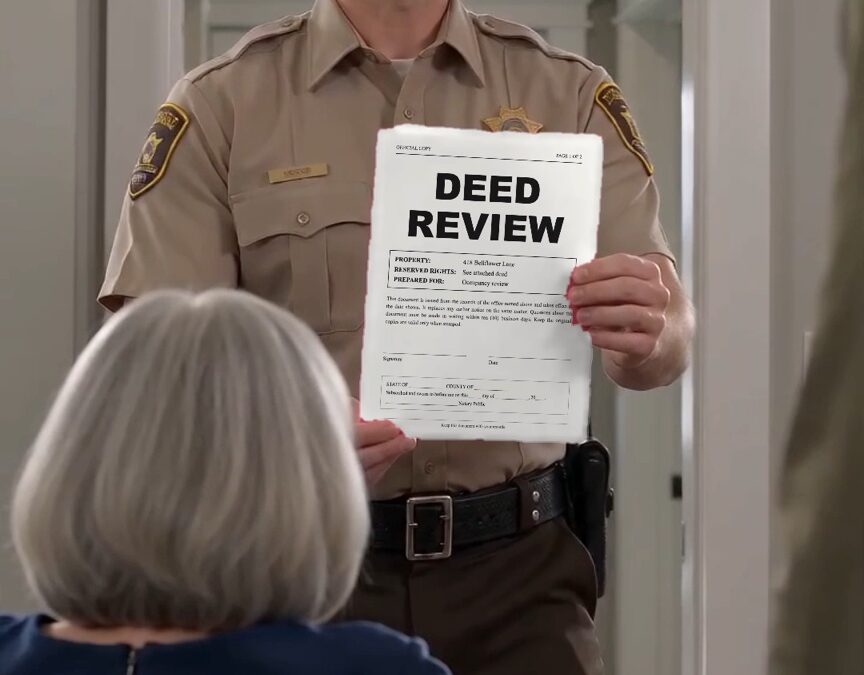
The cover read “DEED REVIEW.”
Below that were the lines the office had prepared:
“Property: 418 Bellflower Lane”
“Reserved rights: See attached deed”
“Prepared for: Occupancy review”
There was nothing about Thanksgiving on that cover.
There was nothing about a shove or a bruise.
It was the packet I had requested before dinner.
A relative suggested Curtis could apologize instead.
I kept my phone beside my glass.
“I’ve already asked someone to come.”
Curtis pulled at the cuff of his shirt.
“You’re turning a family disagreement into a police matter.”
“My hip hit the walker.”
Jean brought me a clean napkin for my lap.
I folded it rather than trying to keep eating.
The others spoke quietly near the serving table.
Dana moved dishes, but nobody asked for more dressing.
When the knock came, Jean opened the front door.
Lewis entered in uniform and looked around the dining room.
He was 39, though I learned that afterward.
He asked who had called.
“I did,” I said.
He saw my walker and came toward my chair.
Curtis started explaining from the kitchen doorway.
Lewis held a hand toward him.
“Stay over there while I speak with her.”
He asked my name and whether I needed immediate help.
I told him where Curtis had put his hands.
Then I showed him where the frame had hit me.
“Did you fall?”
“No. I caught the chair.”
“Did anyone see the contact?”
Jean stepped forward.
“I did. I was sitting right there.”
Lewis looked toward the other relatives.
He asked them to remain available while he took accounts.
Dana lowered her eyes toward the serving table.
Curtis said we had argued about a family arrangement.
“I’m trying to make things easier for her.”
“I haven’t agreed to move,” I told Lewis.
“This is where I live.”
Curtis began listing what he had done for me.
I stopped him before he finished.
“My savings paid your debts.”
His mouth closed, then opened again.
“And I made your dinner sitting in that kitchen.”
Jean rested her hand on my chair.
Lewis waited until I had finished speaking.
Then he looked at the packet beside my plate.
“Is that related to the house discussion?”
“It’s my deed paperwork.”
“May I look at it?”
I moved my glass away and passed it over.
Lewis read the cover before turning to the attachment.
He examined the recorded pages instead of stopping at the front.
Curtis straightened away from the kitchen doorway.
“I have an interest in this property,” he said.
Lewis stepped beside my seated chair.
He held the packet upright with both hands.
“We need to discuss this deed.”
He pointed to a paragraph on the recorded attachment.
“Read that paragraph before you say anything else.”
Curtis leaned forward from where he stood.
His eyes moved across the recorded page.
The small smile he had been wearing disappeared.
“Well, that doesn’t—”
He recoiled and lowered himself into a chair.
Lewis turned the page slightly so I could see it.
The deed expressly reserved exclusive possession of the entire property to me for life.
It wasn’t permission to stay in a bedroom.
It covered the house Curtis wanted emptied for sale.
Curtis stared at the attachment in Lewis’s hands.
“I thought that meant her bedroom.”
Lewis kept his finger beside the paragraph.
“Let’s read what it actually says.”
Chapter 3: The Attached Pages
Lewis read the reservation aloud from the recorded deed.
I listened to the words I had asked about.
Exclusive possession of the entire property for my life.
Curtis stayed seated while Lewis finished the paragraph.
Jean stood beside me, looking over his forearm.
The serving dishes were still uncovered behind her.
Lewis lowered the packet enough to examine the surrounding text.
He checked that the reservation belonged to the recorded instrument.
Then he looked back toward Curtis.
“This describes a remainder interest for you.”
Curtis pressed his palms against his knees.
“That’s my name on the deed.”
“Yes. That doesn’t erase the reserved possession described here.”
I moved my foot beneath the chair.
My hip hurt when I tried to straighten too far.
Lewis noticed and asked whether the pain was changing.
“It hurts where the frame caught me.”
“We’ll address that. Stay seated.”
Curtis looked from the page to my face.
“You never explained it like this.”
“You never asked to read the whole deed.”
“I understood you were keeping your room.”
“That isn’t what I kept.”
My words came out shorter than I expected.
I had spent the meal being described by somebody else.
Now the packet was open where everyone could see it.
Curtis leaned back and looked toward Dana.
She stayed beside the serving table.
He hadn’t read the complete recorded deed before that evening.
He hadn’t received a written explanation of my exclusive possession.
The packet had stayed in my drawer until Jean fetched it.
This was the first time he saw its full scope.
He had known he held an interest after my death.
He had assumed that interest gave him more control now.
Lewis placed the packet flat on a clear table edge.
He didn’t hand it to Curtis.
He kept the recorded pages together and looked at me.
“Is this the residence where you live?”
“Yes. I live here alone.”
“Does your son live here?”
“No. Curtis and Dana have their own residence.”
Curtis shifted forward.
“We’re here all the time for family things.”
“You came for Thanksgiving,” I said.
Lewis asked whether they kept a room as tenants.
“No,” I told him. “They’re visitors.”
Dana nodded when he looked in her direction.
“We came for dinner.”
Curtis lifted his hand, then lowered it again.
“I’m trying to deal with a valuable property.”
Lewis didn’t discuss what price it might bring.
He returned to the immediate question of who was present.
“Your mother says you put your hands on her.”
“We were disagreeing about moving.”
“That doesn’t answer what happened physically.”
Curtis rubbed the side of his thumb.
“I didn’t mean for her to hit anything.”
Jean drew a breath, but Lewis stopped her gently.
“I’ll take your account separately.”
I watched him close the cover without folding the pages.
The words “DEED REVIEW” faced upward again.
Curtis stared at those words instead of the serving table.
“So you’re deciding ownership in my mother’s dining room?”
Lewis shook his head.
“I’m not a judge deciding a title dispute.”
He rested his hand on the packet’s edge.
“I can read the document you’re discussing.”
Then he pointed toward the space between us.
“And I need to investigate the reported physical contact.”
The distinction mattered even before anybody explained it further.
He hadn’t arrived because Curtis wanted a house sold.
I had called because Curtis shoved me into my walker.
The deed answered what Curtis had claimed at dinner.
It didn’t tell Lewis whether a crime had occurred.
He needed our accounts and what people had seen.
Curtis looked around the room for someone to interrupt.
Nobody offered another explanation of the paragraph.
A relative began lifting an empty dish.
Lewis asked that the witnesses remain until he spoke with them.
The dish went back onto the serving table.
Jean pulled her chair nearer without sitting.
“Should I put the food away?”
“Not yet,” I said.
I didn’t want anybody reaching past my hip.
Lewis asked me whether I wanted Jean beside me.
“Yes.”
He checked that my walker was within reach.
Then he asked Curtis to remain where he was.
Curtis’s face changed when Lewis turned back toward me.
“Mom, we could have handled this without strangers.”
I looked at the place his hands had gripped.
“We were handling it. You shoved me.”
He shook his head and looked away.
Lewis asked him not to direct comments at me.
Dana picked up a folded napkin and put it down.
I could hear someone scraping a plate in the kitchen.
The sound made the room seem ordinary for a moment.
I had scraped plates after family meals for years.
I had never done it while an officer questioned my son.
Lewis asked whether the packet could stay beside me.
I told him it could.
He returned it to the clear place near my plate.
The recorded attachment remained visible beneath the cover.
I put my fingers on the paper’s lower edge.
It had been prepared in 2022 by my attorney.
It wasn’t something I had created after an argument.
My son had just learned what he should have read.
Curtis stood when Lewis asked him to.
He glanced at my plate, then toward the front door.
“Am I supposed to leave my own family dinner?”
Lewis kept his voice level.
“I’m separating people so I can take their accounts.”
Jean stepped aside to make room.
I stayed seated with the walker beside my knee.
Lewis motioned Curtis away from the dining table.
“Come with me. I need your account without interruptions.”
Chapter 4: What Everyone Saw
Curtis followed Lewis away from my chair.
I could see them without hearing every word.
Jean finally sat, but she kept facing me.
“Do you need to change position?”
“Not until somebody helps me stand.”
She moved my water closer.
I took a drink and set it down carefully.
My mouth tasted like turkey that had gone cold.
Dana began covering food near the kitchen doorway.
Her movements were quick and neat.
I watched her reach around the walker she had moved.
She didn’t touch it again.
When Lewis returned, he asked Jean to describe what she saw.
He wanted where she sat and where Curtis stood.
Jean showed him her place at the table.
“He came around toward her chair.”
“Was she standing then?”
“Yes. Her walker was beside her.”
Jean held her hands in front of her own arms.
“He put his hands here and pushed backward.”
Lewis asked what happened immediately afterward.
“She struck the frame and caught her chair.”
“Did you see her fall to the floor?”
“No.”
“Did she move toward him first?”
“No. She was trying to get to her walker.”
I kept looking at Jean’s untouched roll.
It had flattened where she set it down.
Lewis asked her not to guess what Curtis intended.
Jean nodded and described only what she had seen.
The other witnesses gave their accounts separately.
I wasn’t asked to repeat what they told him.
Some had been looking at the table when Curtis stood.
Some had turned when Jean’s chair struck the wall.
Lewis wrote down where each person had been.
He didn’t treat every face in the room as identical proof.
Dana stood with her fingers wrapped around a dish towel.
When Lewis called her over, she came without the towel.
“Did you move the walker afterward?”
“Yes.”
“Where had it been?”
“Beside her chair.”
“Why did you move it?”
“People needed to get through to the food.”
He looked toward the serving table and then at me.
“Did she ask you to move it away?”
Dana shook her head.
“No.”
I kept my hand around the walker’s grip.
Lewis asked whether I had requested its return.
“Yes,” Dana said. “Then Jean brought it back.”
She didn’t look at Jean when she said it.
There wasn’t anything else to explain about that choice.
The food had been reachable before she moved my walker.
I had not been able to reach it afterward.
Lewis asked about my pain again.
I pointed to the outside of my hip.
He explained that the injury needed documenting.
He also wanted a medical assessment arranged.
“I’ve had hip pain for a long time.”
“I understand. What changed after the shove?”
“This spot. It wasn’t sore like this before dinner.”
Jean helped me shift without pulling on my arm.
With privacy from the guests, the new bruise was documented.
I looked away while the injury was photographed.
The fabric of my clothing brushed the tender area.
I asked Jean to stay close while I adjusted it.
The medical assessment addressed that new pain separately from my usual trouble.
I explained that I had struck the walker frame.
I hadn’t hit my head or fallen onto the floor.
There was no fracture.
The injury was a bruise, but sitting still hurt.
I was given instructions about worsening pain and getting help.
Jean listened because I wanted someone else remembering them.
When I was settled again, Lewis spoke with me.
He had the witness accounts and the documented injury.
He also had what Curtis told him about the contact.
“The arrest decision is about suspected domestic battery.”
I looked toward Curtis, who was standing apart from us.
“It isn’t because of the deed?”
“No. The property paperwork doesn’t make that decision.”
Lewis explained that prosecutors and courts handled what followed.
He wasn’t announcing a conviction at my dining table.
He wasn’t granting me a house that wasn’t already mine to possess.
He was acting on the reported shove and the evidence.
Curtis watched Lewis approach him.
He straightened his shirt and began speaking immediately.
“I have a legitimate financial interest here.”
Lewis answered without opening the packet.
“That doesn’t authorize physical contact against your mother.”
Curtis looked toward me.
“Tell him I was trying to help.”
I kept both feet planted beneath my chair.
“You pushed me into my walker.”
Lewis arrested Curtis on suspicion of domestic battery.
The relatives nearest the doorway moved back.
Dana pressed her lips together and watched.
I held the folded napkin until its edges curled.
Curtis didn’t get another chance to explain my bedroom.
He didn’t carry the deed out of the room.
It stayed on the table beside my cold plate.
After Curtis was taken away, the guests gathered their things.
Nobody asked whether the dressing could go home with them.
Dana put on her coat beside the doorway.
Jean remained next to me while the others left.
Dana looked toward the table before following them.
“I’ll go with everybody.”
I nodded without trying to stand.
She left with the departing guests.
The front door closed on a room full of dishes.
Lewis supplied information about victim services and protective-order filing.
He put it where I could reach it easily.
“This explains who can help with the next steps.”
Jean read the top page over my shoulder.
“I’m staying here,” she said.
I didn’t argue or tell her she needn’t bother.
I moved my water glass to make room.
Then I looked at the filing information.
“What do I need to bring them?”
Chapter 5: The Drawer I Had Opened
Jean cleared the place beside my plate before answering.
She stacked the police information above a clean napkin.
“We can start with what’s already here.”
The deed packet had a faint bend in its cover.
I smoothed it against the dining table.
It was the same packet I had put away before dinner.
Only the room around it had changed.
Jean brought the kitchen towels from the drawer.
She checked whether any papers had slipped underneath them.
Nothing had.
I remembered placing the packet there after collecting it.
I had wanted it handy without leaving it exposed.
On November 20, 2025, Curtis hadn’t asked for documents.
He had arrived with a proposed destination for me.
He stood near the counter and described that rented room.
The house, he said, had an estimated value of $286,000.
A sale would be easier with nobody living here.
He wanted the rooms cleared and available.
I asked where my dining table would go.
He looked at it as though it were a nuisance.
“You don’t need this much furniture anymore.”
I had held the edge of the kitchen chair.
The rented room sounded smaller with every answer.
I asked whether he expected me to leave my sewing machine.
He said the practical things could be worked out.
“By whom?”
“Mom, don’t start.”
He hadn’t asked me to sign a surrender.
He hadn’t shown me a document requiring my departure.
He had spoken as though the right to decide belonged to him.
When he left, I checked that the front door caught.
Then I sat at the kitchen table without clearing his cup.
The next morning was November 21, 2025.
I contacted the attorney who had prepared my deed.
I asked for a certified recorded copy.
I also asked for an explanation of what I had kept.
The office wanted to know what had prompted the request.
“My son is talking about selling.”
I described the rented room and his demand that I relocate.
I didn’t say he had threatened physical harm.
At that point, he hadn’t shoved me.
I wanted the document understood before something was arranged.
The attorney’s office assembled the letter-size packet.
The neutral cover said “DEED REVIEW.”
It identified my property and directed readers to the attachment.
It wasn’t an accusation addressed to Curtis.
It wasn’t a letter telling him he had been warned.
I retrieved it before Thanksgiving and checked the pages.
The attorney explained the recorded reservation I had retained.
I could remain in possession of the entire property for life.
That was what the 2022 deed had been prepared to accomplish.
I had not given Curtis present possession of my house.
He held the remainder after my reserved lifetime interest.
I read the attached pages at my kitchen table.
Then I slid the packet into the towel drawer.
Curtis didn’t see it there.
I didn’t send him a written explanation before dinner.
I expected we might need to discuss it.
I didn’t expect the discussion to involve my hip.
Now Jean sat where I had opened those pages.
She placed the towels back into the drawer.
“You knew you could stay.”
“I knew what the attorney told me.”
“Why didn’t you put it out when he arrived?”
I picked a crumb from the packet’s edge.
“I was getting dinner served.”
She nodded and didn’t make me defend that answer.
We moved the records into a clean stack.
The certified deed copy stayed attached to its cover.
The police information went beside the medical instructions.
Jean found a folder among my household papers.
I put the documents inside without mixing their pages.
My pension and other retirement income still covered my living costs.
I didn’t need Curtis to take over paying my bills.
I needed to keep living where I could manage them.
The savings I had spent in 2021 were gone.
I could not purchase another house because he preferred selling this one.
Jean watched me arrange the papers.
“Do you want those debt records in here?”
“Not for proving he pushed me.”
I kept the folder focused on what had happened.
The old sacrifice explained why his words hurt.
It didn’t replace the injury evidence or Jean’s account.
The information Lewis supplied included help with protective orders.
I called victim services with the pages in front of me.
Jean sat nearby so I could ask her what I missed.
I explained that my adult son had shoved me.
I said he lived elsewhere and had been visiting.
I gave the address where I lived alone.
The person assisting me asked about the incident and my safety.
I described the walker and the new bruise.
I explained that police had responded and made an arrest.
I didn’t claim an order already existed.
I wanted to know how to request protection.
Jean wrote reminders while I listened.
We discussed the documents I should keep together.
I would need a clear account, not a family argument.
I would need to distinguish what I saw from assumptions.
I looked toward the dining doorway while answering.
Curtis had stood there complaining that I called police.
My walker was now parked beside the kitchen chair.
I could see it without turning my head.
When the call ended, Jean moved the folder closer.
“What about the sale?”
I looked down at the deed cover.
The dinner had settled what Curtis thought he controlled.
It hadn’t answered every way he might try selling.
I reached for the attorney’s contact information.
“I need to ask about his interest separately.”
Chapter 6: A Sale Without My Agreement
I called the attorney with the deed open before me.
Jean sat across the kitchen table with her reading glasses.
I told the attorney what had happened on Thanksgiving.
I described the shove before mentioning the property argument.
I said police had arrested Curtis on suspicion of domestic battery.
The attorney asked whether I was safe at home.
“Jean is staying with me.”
Then I explained what Lewis had read from the deed.
Curtis had believed my occupancy meant only my bedroom.
He had learned otherwise in front of the dinner guests.
I could still see his unfinished sentence when I spoke.
The attorney brought us back to the recorded instrument.
My right covered exclusive possession of the entire property for life.
That had not changed because Curtis wanted a sale.
“But he still owns something,” I said.
“Yes. His remainder interest.”
“Can he sell that?”
“He can transfer his own remainder interest.”
I looked at Jean across the table.
She took her glasses off and waited.
That answer sounded, at first, like another route to losing my home.
I pressed the phone closer and asked directly.
“Would that make me leave?”
“No. A transfer of his remainder doesn’t terminate your life estate.”
I wrote the answer on paper without abbreviating it.
The attorney explained that a buyer could acquire what Curtis held.
That buyer would take subject to my reserved lifetime possession.
Curtis couldn’t sell my life estate along with his interest.
He couldn’t promise immediate vacant possession on my behalf.
A buyer wanting unencumbered present possession would need my voluntary agreement.
I put my pen down to listen again.
“Not just his signature?”
“Not just his signature.”
“And not because he thinks the house should be empty?”
“No.”
Jean leaned forward when she heard my answer.
The attorney asked whether I had agreed to relinquish my rights.
“I have not.”
Had I signed anything toward that kind of transaction?
“No.”
Had Curtis requested a surrender signature on his earlier visit?
“No. He told me about the room.”
I wanted those facts kept separate.
He had proposed selling, but there was no surrender document.
There was no saved message admitting he understood my rights.
The decisive page was the recorded deed itself.
He had first read its scope beside my Thanksgiving table.
Now I understood a separate point about his future interest.
Even transferring it would not remove my possession.
The attorney explained that the deed didn’t control a criminal case.
It also didn’t automatically produce a protective order.
Those matters concerned the shove, the evidence, and court decisions.
I kept separate notes rather than putting everything under “house.”
Jean slid a fresh sheet toward me.
“Write this part where you can find it.”
I wrote that a remainder sale would not end my life estate.
Then I underlined my name in the deed’s reservation.
Not hard enough to mark the recorded copy itself.
I used the clean sheet lying beside it.
The attorney asked what outcome I wanted concerning the house.
“I want to keep living here.”
“Are you considering a voluntary surrender?”
“No.”
I looked toward the spare-room doorway.
My sewing machine was visible beneath the window.
I hadn’t moved it for photographs or possible buyers.
I hadn’t opened the closet to begin sorting my husband’s things.
There were no boxes waiting by the door.
“I’m not signing anything that gives up my possession.”
The attorney acknowledged my decision without asking me to justify it.
Any future property communication could be reviewed through counsel.
I didn’t need to negotiate at my dinner table.
I didn’t need Curtis’s permission to decline.
After the call, Jean repeated the distinction aloud.
“He can transfer what comes later.”
“Yes.”
“But not your right to be here now.”
“That’s what the attorney said.”
She reached for the kettle, then stopped.
“Do you want tea?”
I checked the position of my hip before moving.
“I’d rather have it right here.”
She made it while I put the pages away.
I kept the attorney’s explanation with the deed.
The protective-order information stayed in a separate section.
The injury instructions remained where Jean could read them.
Every page had a reason to be there.
I didn’t add the old holiday menus or debt payments.
They weren’t what a judge needed to establish the shove.
Jean brought the tea and sat without taking my folder.
I turned the cup until its handle faced my hand.
The house remained quiet while the water cooled.
Curtis had wanted a sale with the house empty.
He had been making arrangements around that assumption.
I now knew I didn’t have to help make it true.
That knowledge didn’t make the bruise stop hurting.
When I stood, I still needed the walker close.
Jean kept the chair steady without pulling me upward.
I took time before turning toward the sink.
The dish I carried was light, but I set it down early.
“I can get that,” she said.
“I know. I’m just putting it here.”
I wanted to do ordinary things without being hurried.
I also needed help with the court paperwork.
We brought the victim-services information back to the table.
The petition required an account I could verify.
I read the address slowly before writing it.
418 Bellflower Lane was my residence, not a disputed visiting place.
Curtis and Dana maintained their own separate home.
I made sure that fact was clear.
Jean checked that her eyewitness information was available.
She wasn’t going to speak for every relative.
She could describe what she had personally seen.
I opened the folder to the blank petition materials.
Then I moved my tea away from the paper.
“Let’s start with where he put his hands.”
Chapter 7: My Petition
On December 1, 2025, I filed the verified protective-order petition.
Victim services helped me with the filing process.
Jean accompanied me with the folder on her lap.
I kept my walker close through the doorway.
The bruise made the trip slower than I wanted.
Nobody helping me treated the deed as a substitute for my account.
I had to describe what Curtis had done.
I had to explain our relationship and where I lived.
I gave my age as 72 and his as 46.
He was my son, not a tenant seeking housing rights.
He and Dana maintained a separate residence.
They had come to my house for Thanksgiving dinner.
I read those details before verifying the petition.
The form made the incident look smaller on paper.
There were lines and spaces where the dining room had been.
I wrote that he placed his hands against my upper arms.
I wrote that he shoved me backward into my walker.
I caught the chair and did not fall.
The impact caused a new bruise to my hip.
I used the ordinary words I had told Lewis.
I didn’t make the injury worse to sound more convincing.
I also didn’t describe it as merely an argument.
A disagreement had happened before the physical contact.
The shove was why I had called police.
The person helping me asked about requested protection.
I wanted no contact and exclusion from my residence.
I didn’t want Curtis arriving to continue the sale discussion.
I didn’t want to move my walker away from my own door.
Jean sat beside the paperwork while I checked my answers.
“Did I leave out where you were?”
“You wrote that I witnessed it.”
I made sure her name was spelled correctly.
Then I read the account again before signing.
Verifying it meant the words were mine.
The petition went to a judge for consideration.
I wasn’t promised any particular decision by victim services.
I was told what the process required next.
The interim order came from the judge, not Lewis.
It granted no-contact and residence-exclusion relief.
The basis was the domestic-violence allegations described in my petition.
It wasn’t a ruling awarding me ownership because of the deed.
I asked the helper to explain the residence language.
I wanted to know exactly what it prohibited.
Curtis was excluded from my residence under that interim protection.
There would be service and an opportunity for a hearing.
The order wasn’t the same thing as a criminal conviction.
His criminal case remained a separate matter.
I put the order in the folder without covering the petition.
Jean asked whether I needed a copy kept at home.
We followed the filing guidance and kept the paperwork accessible.
I didn’t call Curtis to announce what the judge had done.
Service would be handled through the proper process.
I wasn’t going to turn delivery into another family argument.
At home, Jean carried the folder while I used my walker.
She waited until I was seated before setting it down.
The dining table had no holiday cloth on it now.
I had washed it because gravy marked the edge.
The bare tabletop showed the place where my packet had lain.
Jean put the new papers on that same clear space.
“Do you want the deed with these?”
“Keep it in its own section.”
I wanted the records together but not confused.
The deed explained my possession.
The police report and injury materials concerned the shove.
The order stated what protection the judge had granted.
I could find each without emptying the whole folder.
Jean stayed while service was completed.
She didn’t take over every room or move my belongings.
Her overnight things stayed out of my walking route.
At bedtime, she checked the path between my chair and bedroom.
“Is this where the walker usually goes?”
“Yes. Leave it beside the chair.”
She did, without asking me to make room for visitors.
I watched the handles settle within reach.
The difference was small enough to see immediately.
We ate at the kitchen table during those days.
I didn’t prepare the kind of meal Curtis expected for holidays.
Jean warmed what we wanted and put the rest away.
I helped where I could sit.
When my hip caught, I stopped instead of apologizing.
She didn’t hurry me to finish before food cooled.
As service moved through the process, I checked the information supplied.
I wanted to know it was completed, not guess.
When completion was confirmed, I put that information with the order.
The hearing date stayed at the front of the folder.
December 15, 2025, would require me to speak again.
I read the petition so I wouldn’t confuse later knowledge with dinner.
Curtis had not known the full reservation before Lewis showed him.
I wouldn’t claim that he had.
He had shoved me before learning it.
Jean could testify about the contact she witnessed.
I could explain the deed and my continued residence.
We would bring the documents requested for the hearing.
The house stayed quiet while I made those preparations.
I didn’t hear Curtis opening the door for a family meal.
I didn’t hear instructions about clearing a room.
But his claimed interest in the house hadn’t disappeared.
I asked my attorney how that might be raised.
The answer came without treating the protective order as a property sale.
“His position is that his deed interest should still permit family access.”
I laid my hand on the order.
“Then we need the whole deed there.”
Chapter 8: His Remainder Interest
Curtis’s next argument came through the legal process.
He did not come to my door to deliver it.
He had an interest in the deed, his position said.
He believed family access should remain available because of that interest.
It was narrower than his Thanksgiving claim.
He wasn’t still saying my rights covered only a bedroom.
He had seen the recorded paragraph disprove that.
Now he wanted his future interest treated as a reason for entry.
My attorney explained the distinction again at my kitchen table.
We had the order and deed open in separate places.
“His remainder does not give him present possession.”
I checked the paragraph Lewis had pointed out.
“And the protective order?”
“That is a separate restriction based on the court’s findings.”
The deed didn’t authorize Curtis to disregard a protective order.
The protective order didn’t take his remainder away.
Both things could be true without giving him access now.
I needed to understand that before the hearing.
I didn’t want to claim the judge could cancel his inheritance interest.
I wasn’t asking for that relief.
I was asking to remain safe in the house I possessed.
Jean brought my glasses from the counter.
I used them to read the reservation again.
The page still looked ordinary.
The recording information was attached to words I had signed in 2022.
There was no mortgage hidden in the file.
There was no trust or power of attorney changing who decided.
I hadn’t made Curtis a joint owner with current possession.
I had conveyed a remainder and reserved my lifetime possession.
My attorney explained what was relevant to the hearing.
The court would consider the domestic-violence evidence.
The deed could clarify the residence and Curtis’s claimed access.
It wasn’t the reason the shove counted.
That depended on what happened between us at dinner.
I asked whether refusing a sale could be used against me.
“You are not required to surrender your life estate.”
“What if he says I’m preventing his sale?”
“He can transfer only what he owns without your agreement.”
I looked at the signature pages without lifting my pen.
“I’m not agreeing.”
There wasn’t a new document waiting for me to sign.
I wasn’t tearing up a surrender form or returning an offer.
I was making my position clear before further property discussions.
I would not voluntarily relinquish my possession.
I would not agree to empty the house for his convenience.
The attorney noted that position and returned to the hearing materials.
We laid the police report beside the injury documentation.
Jean checked her recollection against where people had sat.
She didn’t rehearse a speech with dramatic words.
She described Curtis coming around the table.
She described my hands moving toward the walker.
She described the shove and the frame striking my hip.
“That’s what I saw,” she said.
“Keep it to that,” I told her.
The other relatives had supplied accounts to Lewis.
I didn’t call them to demand they choose me publicly.
I didn’t need them to repeat what they hadn’t seen.
Jean was available and had watched the contact directly.
The police report recorded the investigation beyond my own account.
Dana’s admission about moving the walker was in that history.
I remembered her saying people still needed to get through.
I could repeat what I had heard myself.
I couldn’t tell the judge what she privately intended.
My attorney asked me to describe the injury without exaggeration.
“It bruised my hip.”
“Did you fall?”
“No.”
“Did you have hip trouble before Thanksgiving?”
“Yes. That’s why I use the walker.”
“What was new?”
“The bruise and pain where the frame hit.”
I pointed to the spot through my clothing.
The answers were simple when I kept them separate.
Old pain hadn’t caused Curtis to put his hands on me.
It explained why the walker stood beside my chair.
The new injury followed the shove against that frame.
Jean pulled out the medical instructions we had kept.
I put them back with the injury documentation.
We checked the certified deed copy for missing pages.
Nothing had been removed since Thanksgiving.
Curtis could examine it through the proper process now.
I wasn’t concealing it from him before the hearing.
The first public confrontation had already exposed his mistaken assumption.
This time, the court would have the full attachment.
I also checked my own petition for careless language.
I had written that Curtis wanted me gone for a sale.
That was based on what he had told me.
I hadn’t written that he had completed a transaction.
He could not deliver the empty house he had described.
No buyer appeared in my driveway.
No sale sign went into my lawn.
I wasn’t going to invent either to make his plan sound further along.
Jean closed the folder when we finished.
“Do you want supper before we go over it again?”
“No more going over it tonight.”
She looked relieved and took the papers off the table.
I put the plates out while seated.
It took longer than standing at the cabinet.
Jean handed them over without correcting my pace.
The hearing was close enough that I checked the date again.
December 15, 2025, was written where I could see it.
I put the folder beside the chair I would use.
Then I checked that my walker’s path was clear.
Jean set my coat where I could reach it.
“Tomorrow, you tell them what happened.”
I touched the folder’s closed cover.
“And he gets to tell them what he claims.”
Chapter 9: The Hearing
On December 15, 2025, Jean came with me to the hearing.
She carried the folder while I managed my walker.
We followed the court’s directions about where to wait.
I didn’t approach Curtis or try to speak with him.
He was there for his opportunity to be heard.
The interim order had not decided everything permanently without him.
I kept my eyes on the doorway until we were called.
Inside, I sat where I was directed.
My hip was still something I thought about before moving.
I positioned the walker so I could reach it afterward.
Jean sat separately when her testimony required it.
The folder was opened, and the records were made available.
I answered questions about my name and residence.
Then I described Thanksgiving dinner in order.
Curtis had proposed moving me before the holiday.
At dinner, he renewed that plan in front of the relatives.
I said I hadn’t agreed to leave.
I stood as he came around toward my chair.
My walker was beside me.
“He put his hands against my upper arms.”
I paused because I could feel where they had been.
“Then he shoved me backward.”
I explained the impact against the walker frame.
I caught the chair and sat rather than falling.
The bruise was new, separate from my chronic hip pain.
The injury documentation supported that account.
The police report recorded what Lewis had investigated.
I didn’t tell the judge Lewis had awarded me the house.
He had reviewed a packet and investigated suspected domestic battery.
He had arrested Curtis based on probable cause.
The criminal case remained separate from this hearing.
The judge asked about Curtis’s residence.
“He and Dana live elsewhere.”
“Was he a tenant in your home?”
“No. He was visiting for Thanksgiving.”
I explained that I lived alone at 418 Bellflower Lane.
Jean had stayed with me after the incident.
That hadn’t made Curtis an occupant before it.
When the deed was discussed, the complete recorded copy was available.
I identified the packet I had requested before Thanksgiving.
The deed had been executed and recorded in 2022.
It conveyed Curtis a remainder interest.
It reserved exclusive possession of the entire property for my life.
I kept the explanation factual and let the document supply its words.
Curtis had an opportunity to state his position.
He said he had a legitimate interest in the house.
He argued that family access should not be treated like trespassing by strangers.
He also said he had been trying to arrange practical housing.
He didn’t repeat that I held only bedroom rights.
The recorded deed had already answered that claim.
The judge examined the reservation and the evidence about our residences.
My attorney distinguished future ownership from present possession.
The remainder did not give Curtis a current right to occupy my home.
It also didn’t excuse unwanted physical contact.
Curtis looked toward the papers rather than toward me.
The judge returned to the domestic-violence allegations.
Jean testified about where she sat at dinner.
She described Curtis coming around behind my place.
She saw his hands against my arms and the backward push.
She saw me strike the walker and catch my chair.
She did not claim I fell or suffered a fracture.
She described returning the walker after I requested it.
Her account matched what she had told Lewis.
Questions followed about her relationship with me.
“She’s my sister,” Jean said.
She didn’t pretend she had no reason to care.
She still answered only what she knew.
When asked about what Curtis intended, she didn’t invent an answer.
“I can tell you what I saw.”
I folded my hands while she spoke.
The room required waiting while other people handled the papers.
I wanted to interrupt when Curtis described the disagreement as family planning.
My attorney touched the edge of the folder.
I stayed seated and waited for the next question.
The judge reviewed the police report and injury documentation.
The shove, witnesses, and injury were considered together.
The deed clarified my right to possess the residence.
It wasn’t used as punishment for wanting a sale.
The judge continued the protective order after the hearing.
The no-contact protection remained, along with exclusion from my residence.
Curtis could not use family access as a reason to return.
He still retained his remainder interest.
The court did not erase it or award it to me.
That future interest did not give him permission to enter.
It did not authorize him to force my signature.
Any unencumbered present possession would still require my voluntary agreement.
I had given none.
I listened to the instructions about the continued order.
I wanted the terms clear before leaving the courtroom.
The criminal proceeding would follow its own process.
There was no instant sentence added to this hearing.
I didn’t leave claiming Curtis had been convicted.
I left with protection that continued after he had been heard.
Outside, Jean handed me my coat without asking how I felt.
I slid an arm into it and stopped when my hip caught.
She waited until I was ready for the other sleeve.
The attorney made sure I understood the paperwork.
I put the order in the front section of the folder.
The certified deed stayed intact behind it.
Curtis left through the proper court arrangements.
I didn’t follow him with a final speech.
Jean and I moved slowly toward the exit.
“Do you want to eat somewhere?” she asked.
I adjusted my grip on the walker.
“No. I want supper at my table.”
Chapter 10: Supper at My Table
Jean brought the folder inside before taking off her coat.
She set it on the kitchen table where we could reach it.
I parked my walker beside the chair and sat.
The trip home had made my hip ache.
For a while, I only loosened my coat.
Jean waited instead of asking me to start supper.
Then she took the paperwork out carefully.
We checked where the continued order belonged.
I wanted it available without spreading court papers over every meal.
The deed packet went back into its separate section.
Its cover still read “DEED REVIEW.”
I smoothed the bent edge before closing the folder.
I didn’t need it beside my plate that evening.
It could be put away and still do its work.
Jean carried it to the drawer I had chosen.
Not under the kitchen towels this time.
We kept the records together where I could find them.
The towels stayed in their ordinary place.
I watched her close both drawers.
“Do you want to start supper?”
“Yes. Nothing that needs the oven.”
She took out what we had planned for a small meal.
I stayed at the table and helped with the bread.
There was no bowl of dressing waiting for Curtis.
There were no extra chairs to unfold.
Jean didn’t ask which food he would have preferred.
She asked what I wanted on my plate.
I told her, and she listened.
The house hadn’t been prepared for sale while I was gone.
The dining table remained where my husband and I put it.
My sewing machine was still beneath the spare-room window.
My bedroom closet hadn’t been emptied into bags.
I had no rented-room address waiting on the counter.
There were no packing boxes beside the kitchen door.
I hadn’t been asked to choose what furniture could follow me.
That evening, I didn’t start making those choices myself.
Curtis retained the remainder interest created by the deed.
He could not turn it into my surrendered possession.
He could transfer his future interest subject to my life estate.
He could not deliver my empty home to someone wanting it now.
My attorney had made the distinction clear.
The hearing had left the protective order in place.
He could not come back claiming a family dinner as permission.
He could not bring another relocation discussion into my kitchen.
I did not have to open the door to hear it.
Any necessary property communication would go through counsel.
I would not sign away my life estate.
I had already given that answer without a speech.
Jean put a pan on the stove and checked its handle.
“Can you reach that bowl?”
“Yes. Bring it a little closer.”
She moved it rather than telling me to stand.
I tore the bread while she worked nearby.
The motion reminded me of Thanksgiving morning.
This time, I didn’t need to finish a large dish.
I stopped when my hip needed a different position.
Jean turned from the stove.
“Ready to move?”
“Not yet.”
She went back to supper and let me sit.
I straightened my leg beneath the table.
When I was comfortable, I folded the bread bag closed.
It didn’t matter that we had started later than expected.
Nobody was checking the oven or asking whether things smelled right.
There was no announcement waiting until everyone had begun eating.
I listened to the pan and Jean moving between the cabinets.
The kitchen had its usual small sounds again.
I could hear the drawer catch when she closed it.
I could hear her set down the serving spoon.
When she brought the plates, I pointed toward the dining room.
“I said I wanted my table.”
She smiled and carried them through.
I took my time standing with the walker.
Jean stayed nearby without taking my arms.
I moved through the doorway I knew I could clear.
The dining chair was where it had always been.
My fork was already laid beside the plate.
I had picked up the fallen Thanksgiving fork after everyone left.
It had gone through the wash with the rest.
I didn’t need to save it or throw it away.
Tonight, I reached for the clean one in front of me.
Jean set water beside my hand.
She sat where she could see whether I needed anything.
But she started eating rather than watching every movement.
I took a bite before the food cooled.
We talked about what needed washing and what could wait.
We checked whether there would be enough left for another meal.
I didn’t plan a larger dinner to make up for Thanksgiving.
I didn’t begin a list of Curtis’s holiday requests.
For years, I had continued those meals after my husband died.
That evening, I served what fit the help I had.
Jean passed the bread without mentioning the dressing.
I asked whether she wanted more.
She said she did, and I handed it over.
After supper, she cleared the plates while I stayed seated.
I folded my napkin and put it beside the glass.
The bruise would take its own time to stop hurting.
I still needed my usual care for my hip.
Keeping my house hadn’t changed what my body could do.
It had changed who could hurry me through it.
Jean returned from the kitchen with a damp cloth.
She wiped the table around my glass.
Then she checked the space beside my chair.
My walker had shifted slightly when I sat down.
“Here?”
“Closer, please.”
She moved it until the handles were beside my hand.
Then she let go.
We sat while the washed dishes dried in the kitchen.
The folder stayed put away.
My supper plate was cleared, and nobody needed serving.
Jean reached for her water, and I rested my palm on the walker beside my dining chair.
You Might Also Enjoy




