My Father Pushed My Wheelchair From Christmas Dinner After My Stroke — Then My Son Stepped In
Part 3: The Paragraph He Covered
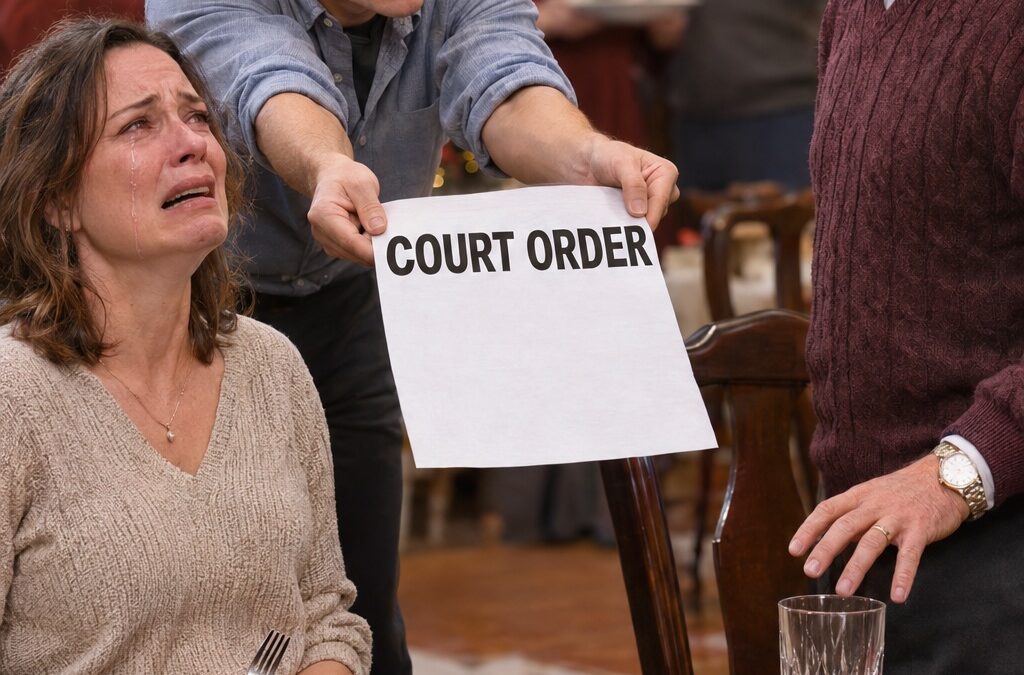
“It orders you to repay the trust,” Caleb said.
Dad bent closer to the page.
“The earlier distributions,” Caleb continued. “All $18,400.”
Beverly put the spoon down against the serving dish.
“That can’t be what it says.”
“It is,” I told her.
The order removed Dad as trustee and appointed Elaine. It required an accounting of his administration. It also ordered repayment of the unauthorized distributions already established at the hearing.
Those were separate instructions in the same signed order.
Dad had known I requested all of them. He had heard the evidence and argued against it.
He had not known what the judge finally decided.
His hand moved toward the bottom of the page.
“Let me read it myself.”
Caleb took his finger away and stepped back.
I waited while Dad read.
The only sound near me was my wheelchair’s footrest. My shoe had caught against its edge when he pushed me.
I leaned forward to straighten my foot.
Caleb crouched beside me without touching it.
“Do you want help?”
“Just move the edge of my skirt.”
He did, then stood again.
Dad finished reading and looked toward the kitchen.
“Beverly, get my hearing papers.”
“They’re not going to change this,” she said.
It was the first time she sounded uncertain.
Dad tried a different argument.
“Reimbursement still has to be considered. I’m not working for free.”
“The judge considered it,” I said.
“You can’t expect family to provide everything.”
“I didn’t ask you to.”
My lawyer had made that distinction at the hearing. The trust could pay legitimate support expenses for me. It did not give Dad permission to pay his household expenses and call them my care.
The evidence wasn’t something Caleb had found that morning.
I had started collecting it from my apartment.
After my stroke, I kept losing my place in long documents. I used a blank sheet to cover everything below the line I was reading.
Caleb sat beside me and moved it down.
We requested statements through the lawyer when Dad refused explanations. We matched disputed distributions against the records he eventually produced.
I saved the messages where he described the payments.
Then I found the invoices for my actual outside help.
They named the provider, the services, and my apartment.
My lawyer submitted those records before the noticed hearing. Dad had the opportunity to answer them.
The judge did not decide the case over Christmas dinner.
Christmas was simply when Dad finally saw the decision.
He turned toward Wayne.
“You know how much pressure we’ve been under.”
Wayne rubbed the back of his neck.
“I didn’t know she was paying for outside help.”
“The trust paid,” I said. “That was its purpose.”
Beverly folded her arms across her chest.
“So now we’re being punished for being available.”
“No,” I said. “You’re being required to return unauthorized money.”
Dad looked at me for a long moment.
Then he lowered his voice.
“You’ve been confused since the hospital.”
Caleb stepped forward, but I raised my hand.
“I had a stroke,” I said. “I didn’t give you my decisions.”
Dad glanced at the relatives nearest the doorway.
He had talked about my recovery as if I weren’t there. He had answered questions directed at me. Sometimes I had let him because speaking took effort.
This time, I waited until he looked back.
“My lawyer represented me. I attended the hearing.”
“Nobody’s saying you weren’t there.”
“You just called me confused.”
He picked up the order again.
“Who is this Elaine person?”
“An independent professional trustee.”
“Someone who charges you to spend your own money.”
“The trust pays reasonable administration costs,” I said. “She has to follow its terms.”
He turned the page back.
“I still have access to the account.”
“Elaine accepted the appointment,” I said. “The custodian received the order yesterday.”
That was the part I had checked before leaving home.
My lawyer had confirmed both things on December 24, 2025. I asked Caleb to save that message with the order.
We were not depending on Dad’s cooperation at dinner.
We were not asking him to hand over a checkbook.
The additional $27,000 could not go through him now.
Dad set the paper down very carefully.
“You should have told me before coming.”
“You knew there was a pending decision.”
“I hadn’t received anything.”
“I know,” I said. “Your copy was mailed.”
He had represented himself and received paper notices. My lawyer received the entered order electronically.
Caleb’s printout wasn’t formal service.
It didn’t need to be for the order to exist.
Dad stared at the glass he had nearly knocked over.
Beverly slid my plate back toward my place.
“Can we at least finish Christmas?”
My wheelchair was still away from the table.
I looked at the empty space where I had been sitting.
“Not here,” I said.
Caleb reached for the handles, then stopped.
“Ready?”
“Let me get my fork.”
Beverly looked down at it.
“That’s yours?”
“Yes.”
She picked it up by its blue handle.
For a moment, I thought she might put it into her kitchen drawer. Instead, she laid it on my napkin.
Caleb brought both to me.
Wayne stood and moved his chair out of our path.
“I should’ve asked what happened,” he said.
I folded the napkin around the fork.
“Yes,” I answered.
Dad wasn’t finished.
“Wait. Nobody needs to leave like this.”
He went to the sideboard and opened a drawer.
For a moment, I thought he wanted the hearing notices.
Instead, he took out a paper with a blank signature line.
“I had this ready so we could settle things.”
He laid it over the court order.
“Sign the release, Audrey, and we can stop paying lawyers.”
Part 4: The Blank Signature Line
I didn’t reach for the pen.
“What does it release?”
“All these claims between us,” Dad said.
“Then my lawyer needs to read it.”
He pushed the paper closer.
“It says we’ve resolved the family disagreement.”
The document called the disputed payments agreed compensation. It also said I would withdraw my objections.
I read that section while everyone waited.
Dad had expected Christmas to end with my signature.
The invitation, the announced withdrawal, and my uncle’s speech made more sense with that paper on the table.
I couldn’t say what Wayne had known beforehand.
I could see what Dad wanted from me now.
“I’m not signing this.”
“After everything we’ve done?”
“The court order stays with my lawyer.”
He looked at Caleb.
“You think you’re helping her?”
Caleb picked up the order without touching the release.
“I’m taking her home.”
Beverly stepped away from the table.
“Don’t tell everyone we threw you out.”
I looked down at my wheelchair brakes.
“Dad pushed my chair away during dinner.”
Nobody contradicted that.
Wayne held the doorway open while Caleb helped me through.
Outside, Caleb settled me into the car.
He folded the wheelchair and put it away. Then he handed me the napkin-wrapped fork.
“Do you want something to eat?”
I had barely touched dinner.
“Yes,” I said. “Something at home.”
He drove me to my apartment.
My aide had left a covered meal in the refrigerator. Caleb warmed it and put it on my kitchen table.
He moved the regular chair aside.
This time, nobody touched my wheelchair without asking.
I ate slowly because my jaw tired with everything else.
Caleb sat across from me with his coat still on.
“You can take that off,” I said.
He looked down, surprised, and unzipped it.
I wanted to apologize for bringing him into the argument.
Instead, I asked whether he had eaten.
“Some potatoes,” he said.
“Get a plate.”
He did.
We didn’t call anyone from the table.
After we ate, I sent my lawyer a message. I described the proposed release and asked that all money discussions go through her.
I also wrote down what Dad had done with my wheelchair.
Not because a note would settle the trust case. Because I didn’t want to minimize it when he called.
The next stage took longer than Christmas dinner.
In January 2026, Elaine began gathering the full records.
She spoke directly with the custodian and the providers. Dad had to produce the accounting required by the order.
I didn’t sit beside him sorting his papers.
I sent Elaine the records my lawyer already held.
The accounting made the earlier spending clearer.
The $18,400 had gone toward Dennis and Beverly’s household expenses. Those expenses were not for my apartment, treatment, or support.
Their reimbursement explanation had another problem.
The trust had already paid outside providers for the assistance they claimed to have supplied.
That didn’t mean family could never be paid for care.
My lawyer explained that actual services and proper authorization mattered. Dad’s label on a transfer wasn’t enough.
The court had already found these distributions unauthorized.
The accounting gave Elaine the complete administrative record. It also prevented the disputed spending from disappearing inside a vague claim about family effort.
Dad called me after receiving requests for more documentation.
“Do you know what she’s charging to go through this?”
“She has to finish the accounting.”
“You could tell her we’ve settled it.”
“We haven’t.”
He paused.
“Your mother wouldn’t have wanted this.”
I looked at the therapy putty on my kitchen table.
My mother had wanted my medical and living expenses covered. Her will said that plainly enough for professionals to administer it.
I didn’t argue with Dad about what she might say.
“Talk to my lawyer,” I told him.
Then I ended the call.
I put the phone in the kitchen drawer during therapy.
That helped more than leaving it facedown beside me.
The repayment did not arrive because Caleb confronted him.
It came through the trust proceeding and follow-up enforcement work. My lawyer and Elaine kept the repayment requirement in place.
Dad had an opportunity to comply without further collection measures.
He paid the $18,400 from personal funds in February 2026.
Elaine confirmed receipt in writing.
The money went back into the trust, not my checking account. It would be administered under the same terms as the rest.
I read that confirmation beside Caleb.
He waited while I moved my blank sheet down the page.
“Did it all come back?” he asked.
“Yes.”
He leaned back and rubbed his eyes.
I put the confirmation with the other trust papers.
Dennis remained removed as trustee.
Beverly never received the additional $27,000.
There was no arrest, and nobody lost their home. The actual consequences were the lost authority, the accounting, and the money returned.
For me, the difference showed up in ordinary requests.
Elaine asked for my therapy information and current expenses. She explained what documentation she needed and why.
When something qualified, the trust paid it.
When she needed clarification, she asked me directly.
I didn’t have to eat dinner at her house first.
I kept my accessible apartment.
My home assistance continued without Beverly describing it as her favor. My transportation stayed arranged through the providers supporting my recovery.
I still had difficult mornings.
Some days, Caleb opened containers before leaving.
Other days, I managed and sent him a message afterward.
He stopped asking whether my father had approved things.
Wayne called after the repayment.
“I was wrong at dinner,” he said.
I waited.
“I told you Dennis deserved money without asking what he’d done.”
“That hurt,” I said.
“I know. I helped him pressure you.”
That was the apology I needed to hear.
I didn’t invite him over immediately.
But I answered when he called again.
Dad sent a message asking when things would be normal.
I typed a reply, deleted most of it, and started again.
“You can ask how I am. Money goes through Elaine.”
He didn’t answer that day.
Beverly stopped sending me requests disguised as family updates.
I kept their numbers, but silenced the notifications.
Caleb came over for dinner without any court papers.
I had managed the vegetables myself and needed help draining them.
“Hold the pot steady,” I told him.
He stood beside me until I finished.
Then he set our plates on the kitchen table.
My wheelchair fit without anyone moving it backward.
I unfolded my napkin and picked up my blue-handled fork.








