My Husband Yanked Me From My Wheelchair In Front Of Our Daughter — Then My Attorney Arrived
Chapter 1: The Hospital Doorway
My husband yanked me out of my wheelchair.
His hands closed around my upper arms and pulled.
“Cancel the debt.”
My hips lifted from the seat before I could brace. My good foot scraped the hospital floor. The ankle I was forbidden to use slid forward.
Anita caught my elbow before I tipped farther.
“Let her go.”
I grabbed the black padded armrest and pushed backward. Tears ran down my face while she steadied me.
“I fixed that place myself.”
Dean stayed in front of the wheelchair, blocking my view. Behind him, Tessa stood in her graduation gown.
Our daughter was 18, and this was her graduation visit.
Vanessa stood inside the open doorway behind my chair. She moved when Anita needed room, but not before.
I pulled my repaired ankle away from the footrest’s edge.
“Don’t touch me again.”
Anita kept her hand under my elbow until I settled. Then she looked directly at Dean.
“She is not allowed to stand.”
He spread his hands toward the hallway.
“She was getting up. I was helping.”
“No, I wasn’t.”
I was 43 and a registered nurse. I knew exactly what those postoperative instructions meant. Knowing didn’t make me less dependent on somebody protecting my foot.
I had slipped on wet steps on May 28, 2025. The fracture had required surgery, and I remained hospitalized. On May 30, 2025, getting into that wheelchair had taken instructions, patience, and Anita’s help.
I had repeated the restriction back to her.
“No weight on that ankle.”
She had checked the footrest before moving me toward the threshold.
The brakes were locked when my family arrived. We hadn’t parked there to leave the floor. I wanted room for Tessa to stand beside me.
I had expected a brief visit and a photograph.
Before their arrival, I had opened my bedside drawer. My brother’s funeral program lay beside my folded clothing. He had died on May 12, 2025, and we buried him on May 18, 2025.
He was 45.
I touched the program, then closed the drawer.
I didn’t want Tessa’s gown catching on an open handle. That was what I told myself while putting it away.
When she appeared, I reached toward her.
“Come here, honey. Let me see you.”
She bent carefully around my raised leg and hugged me. The smooth fabric brushed the blanket across my lap.
For that moment, I looked only at her.
Then Dean came into view with Vanessa behind him.
Dean was 46. Vanessa was 35, and she was his girlfriend. I knew about her, but I hadn’t invited her.
Dean said she was driving them afterward.
I looked past him toward Anita at the bedside counter.
I wanted the visit to stay about Tessa.
Her gown was zipped, and she kept smoothing its front. I asked her to stand where I could see her.
Dean reached for the cancellation paperwork he had brought.
“Let’s get this handled while everybody’s here.”
“What are you talking about?”
“The money. You need to cancel the debt.”
I put my hand back on the armrest.
“I’m not signing anything today.”
Tessa pulled at her cuff.
“Dad, can we just take the pictures?”
He acted as though she hadn’t spoken.
He wanted the $48,000 loan gone. It was money I had lent him from my inheritance, money I needed available while I couldn’t work.
I couldn’t lift patients with that ankle. I couldn’t safely use the shower at home. My regular paycheck wasn’t something I could simply replace.
Dean knew all of that.
Vanessa moved farther into the doorway behind my wheelchair.
“Please move so Anita can reach me,” I said.
“We’re trying to finish a conversation.”
I turned as much as I could without shifting my leg.
“Would you help me back into the room?”
Anita left the counter.
Dean reached me before she did.
That was when his hands closed around my arms.
Now Anita was beside me, checking where my ankle rested. Tessa’s mouth stayed open, but she wasn’t speaking.
Dean looked down at my hands.
“You’re making this into something it isn’t.”
I pressed my palms flat against the padding.
“Move away from me.”
He stepped back enough for Anita to examine my position. She asked whether I felt new pain or had struck anything.
I answered her instead of him.
There had been no fall. My foot hadn’t taken my weight. But I could still feel the pressure of his fingers.
Anita checked the support beneath my leg.
She didn’t ask me to demonstrate standing. She didn’t accept his explanation that I had tried.
“I saw him pull you,” she said.
I looked toward Tessa.
She was against the wall now, gripping her gown’s cuff. I wanted her beside me and couldn’t ask.
Someone at the nurses’ station had called hospital police.
Scott arrived while Dean was still explaining himself.
He was 39, a sworn hospital police officer. He stopped where he could see me and the open doorway.
“Step away from her.”
“This is a family disagreement about money.”
Scott didn’t move aside for him.
“I need you to give her room.”
Dean shifted back again.
Scott looked at Anita, then at my extended ankle.
“Do you need to be checked?”
“Yes,” Anita said. “I need to assess her.”
He asked whether she had seen what happened.
“I saw him pull her up by her arms.”
Vanessa folded her hands together and watched the floor.
The hallway camera was outside my room. Through the open doorway, it could see the wheelchair and where Dean had stood. It wasn’t pointed at private treatment inside the room.
I hadn’t thought about that camera before.
Now I looked toward it, then back at Scott.
“I want you to write down what happened.”
Dean turned toward me.
“Rachel, tell him we don’t need trouble.”
I kept my hand on the armrest.
“I want him to write it down.”
Scott asked Anita to stay while he took statements.
Tessa stepped away from the wall before he continued.
Her graduation sleeve brushed the wheelchair handle.
“Can you wait until after graduation photographs?”
Chapter 2: The Paper Beside Me
I looked at the seam running down Tessa’s gown.
We had chosen that gown together. I remembered holding its sleeve away from the zipper.
Now she was asking Scott to wait.
“Tessa.”
“It’ll just take a little while, Mom.”
She kept looking at him instead of me.
Scott stayed beside the doorway.
“We’re not putting this off for pictures.”
She stepped back against the wall.
He asked Anita to continue, and she described the pulling. She showed him where her hand had caught my elbow.
Dean tried to speak over her.
Scott held up his hand.
“You’ll have an opportunity to give your account.”
Then he asked me where Dean had stood.
I indicated the space directly in front of the chair. I described my hips leaving the seat and my foot slipping.
I didn’t say he had dropped me.
I didn’t say I had suffered another fracture.
I told Scott what had happened, not something larger.
He looked toward the hallway camera and explained the preservation procedure. The recording would be retained through the hospital’s process.
“Please preserve it,” I said.
He confirmed that he would request it.
Anita checked my brakes again when I asked. She checked my ankle support and asked about changes in pain.
I answered while Dean stood beyond her reach.
Vanessa said she hadn’t seen the whole thing.
Scott wrote that down too.
He didn’t ask Tessa whether graduation photographs mattered. He asked what she had observed.
She rubbed her thumb against the cuff of her gown.
I could hear her breathing from my chair.
Dean waited until Scott turned toward Anita.
“That money was for us.”
“It was a loan.”
“You helped your husband. Call it a gift.”
“I didn’t call it that when you signed.”
He gave me a tight smile.
“Those papers got ruined.”
“The copies at home got damaged.”
He stepped closer, though he stayed beyond Anita.
“Then call it a gift.”
I looked past him and saw Elaine approaching.
She was 58, my Ohio attorney. We had arranged this hospital appointment before the graduation visit.
She wasn’t responding to an emergency call from me. She had come with the court’s newly issued document.
I swept my arm toward the doorway.
“Look who’s here.”
Then I moved my hand away from my raised leg.
“Please come in.”
Elaine stopped when she saw Anita beside my wheelchair. Scott told her he was documenting an incident.
She looked at me before addressing Dean.
“Rachel supplied the repair money.”
She reminded him that I had done repair work too.
Dean’s smile returned briefly.
“We don’t need another person making accusations.”
Elaine moved beside my chair.
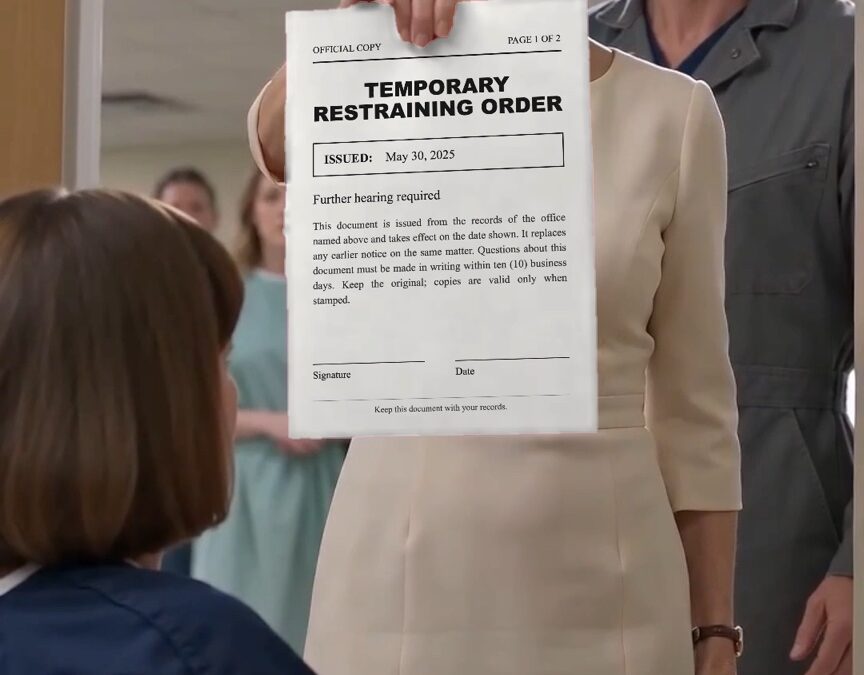
She held the letter-size document upright with both hands. Her fingers rested along its side edges at chest height.
The whole page faced outward.
“Dean, you can’t force this now.”
He leaned forward enough to see the court seal.
His eyes moved to the case caption.
The smile disappeared, and he backed away from me.
“Wait. What’s that?”
Across the document were the words “TEMPORARY RESTRAINING ORDER.”
Below them, the issued date was May 30, 2025.
The page also stated, “Further hearing required.”
Elaine answered without lowering it.
“The court has temporarily prohibited transfer of the rental.”
Dean looked from the page to her face.
“Pending a prompt hearing,” she added.
I let my hand settle against the armrest.
He had arrived trying to get my signature before moving forward. Now the rental could not be transferred while that order remained in effect.
He hadn’t seen the issued order before this moment.
He hadn’t signed it either.
His signature wasn’t required to make it a court order. Lawful notice and service still mattered, and Elaine wasn’t pretending otherwise.
“You knew I was applying for temporary relief,” she said.
“You didn’t tell me a judge had done anything.”
“It was issued before I came here.”
Dean looked toward Tessa, then back at the page.
Elaine turned it slightly so he could read without approaching me.
I had supplied a sworn affidavit before the visit. Elaine had also submitted the saved message supporting the application.
The request had been narrow.
She wasn’t asking the court to award me his property. She was asking it to preserve the rental against the threatened transfer while the dispute received a hearing.
“This doesn’t decide who owns anything,” Elaine said.
Dean caught that immediately.
“Then it doesn’t prove she owes me nothing.”
“It does not establish the debt,” Elaine replied.
She didn’t argue beyond what the document actually did.
The divorce complaint and a separate collection action had been filed that day. The temporary order came from the domestic-relations proceeding.
The money claim would require its own proof.
Dean pressed his lips together.
“You got this without hearing my side.”
“You had advance notice of the application.”
“I haven’t had a hearing.”
“A prompt hearing is required. You can oppose continued relief.”
Elaine explained that applicable security requirements had been addressed. Service requirements would be followed as well.
She didn’t tell him hospital display replaced formal service.
She didn’t tell me the case was over.
Scott remained nearby while she spoke. Anita stood within reach of my chair, and Tessa hadn’t left the wall.
Nobody had to take my description of the order.
The document was right there.
Dean looked at the cancellation paper in his hand.
He folded it against itself without offering it again.
Vanessa asked whether this meant everything had to stop.
“The order’s terms govern what may happen,” Elaine said.
She wouldn’t give Vanessa advice about getting around them.
I asked Anita to move my chair farther inside.
She checked that my foot was clear before releasing the brakes. Dean moved out of the way without touching me.
When the chair was secure again, Elaine lowered the document.
I had been holding the blanket between my fingers. I smoothed it over my knee instead.
Dean stayed near the threshold.
“You’re making a debt case out of ruined papers.”
Elaine opened the folder she had brought.
“The originals weren’t in your house.”
Chapter 3: What Stayed In Her File
Dean stared at the open folder.
Elaine didn’t hand him loose originals in a hospital doorway. She held them where the signatures and attached terms could be identified.
“These remained in my file,” she said.
Anita stood beside the chair. Scott was still taking accounts, and Tessa could hear every word.
Dean had never asked Elaine what she retained.
He had asked me about the ruined household copies.
Those weren’t the same question.
I looked at the edge of the attachment and remembered signing.
On April 8, 2021, I had lent Dean $48,000.
The funds came from an inheritance I had received earlier. I had kept that money in my individual account.
It hadn’t passed through our shared household spending.
Dean needed repairs done at his rental. He asked for a loan instead of arranging other financing.
I agreed after putting the terms in writing.
Elaine kept the signed original promissory note and attached terms. We took household copies home.
Dean had read the pages before signing.
He could have declined the loan.
Instead, he accepted the money.
The repairs weren’t something I only watched him arrange.
For six weekends during 2021, I worked there between nursing shifts. I carried my work shoes separately so construction dust wouldn’t cover them.
I remembered kneeling beside the bathroom cabinet.
Its door sagged whenever somebody let it swing open. I had a screwdriver in my hand and dust along my forearm.
“Hold the door level,” I told Dean.
He braced it while I tightened the hinge.
“Is that high enough?”
“A little higher. There.”
I tested the hinge before letting go.
The cabinet closed without scraping.
Dean stood back, pleased with how it looked.
I checked the time because I still had a nursing shift. My work clothes were folded away from the dust.
I washed my forearms and changed.
He asked whether I could finish something else before leaving.
“I have to get to work.”
I put on my nursing shoes and left him there.
That was how those weekends went. Repair clothes, work clothes, then a shift caring for patients.
The labor was real, but it wasn’t an added charge.
I wasn’t billing him afterward for tightening hinges.
The debt remained the money he had borrowed.
In the hospital, Dean looked at Elaine’s folder.
“You’re including all that work now?”
“No,” I said. “I’m asking for the loan.”
Elaine pointed to the written principal amount.
The loan was interest-free before judgment. The full $48,000 had been due April 8, 2025.
That date had already passed.
Elaine had requested payment after maturity.
There had been no payment.
Dean shifted his attention from the amount to the attachment.
“You can’t take something we discussed and ignore everything afterward.”
Elaine kept her answer limited.
“Forgiveness requires Rachel’s signed written release.”
I looked straight at him.
“I never signed one.”
There wasn’t a release hidden in another drawer. There wasn’t a payment Elaine had overlooked.
Dean had wanted a new signature because he didn’t have one.
That was why the cancellation paper had come to the hospital.
He didn’t admit it.
Instead, he asked whether I intended to claim his entire rental.
“No,” I said.
The rental had been his before we married. It remained titled solely to him.
It was also mortgage-free.
I wasn’t claiming an ownership interest because I had helped repair it. I was claiming repayment from the person who had borrowed my money.
Elaine made that distinction in front of everyone.
“The temporary order does not award Rachel this property.”
Dean looked toward Scott as though expecting an objection.
Scott was there for the hospital incident, not to decide a promissory note. He continued keeping those matters separate.
Anita asked whether I needed to reposition my leg.
I said yes.
Elaine closed the folder while Anita adjusted the support. Nobody needed the originals laid beside hospital supplies.
I watched the folder stay in Elaine’s hands.
A plumbing leak had damaged the copies at home.
I remembered lifting the damp papers from where they had been stored. The pages clung together, and the edges tore when separated.
I had told Dean the household copies were damaged.
He asked whether the writing was still readable.
“Not all of it.”
He hadn’t asked where the originals were.
I hadn’t told him Elaine’s office had flooded, because it hadn’t. I hadn’t told him she had destroyed anything, because she hadn’t.
He supplied those assumptions himself.
Now he was seeing the mistake in front of witnesses.
His eyes moved back to the cancellation paper he carried.
It would have provided what the signed attachment required: my written agreement to forgive the loan.
Without it, calling the money a gift didn’t change the pages.
He stopped mentioning the leak.
“You’ve got lawyers turning a marriage into paperwork.”
I pulled the blanket clear of my ankle.
“You brought paperwork to my hospital room.”
Elaine asked him to direct legal communications through her.
She wasn’t going to debate every memory beside my wheelchair. The originals would be available through the proper proceedings.
Dean could examine them through lawful disclosure. He could raise whatever supported defenses he had.
He couldn’t make me sign something there.
Tessa looked at the folder, then at the paper in his hand.
“Dad, can you put that away?”
He tucked it against his side.
For the first time since arriving, he wasn’t offering it.
Anita said I needed the visit brought under control. Elaine agreed that my medical care came before further discussion.
I asked Tessa to step closer.
She came only as far as my footrest.
I wanted to touch her gown again, but my fingers stayed curled around the blanket.
Elaine gathered the issued order and her file.
Before she closed everything, I asked for my phone.
Dean turned toward me when I unlocked it.
Elaine looked at the saved conversation on the screen.
“Keep that message exactly as it is.”
Chapter 4: Before Anything Could Move
The message was dated May 27, 2025.
I didn’t crop it to show only a sentence.
I opened the full conversation for Elaine.
Dean had asked me to clear the loan because he wanted to transfer the rental to Vanessa.
He had identified her himself.
I didn’t need to guess who he meant.
Elaine checked the sender information and surrounding messages. She wanted the dates and context preserved with the words.
“Leave the conversation on the phone,” she said.
“I have.”
“We’ll preserve the underlying information too.”
She explained how to retain the message with its metadata. A picture of a screen could help, but it wasn’t the whole record.
I followed her instructions without changing the conversation.
Dean had written about a proposed transfer.
It had not closed.
No deed had been delivered or recorded.
That mattered because the property was still available to preserve. Elaine hadn’t asked the court to undo a completed conveyance.
She had asked it to prevent the threatened transfer.
After the visit was brought to an end, she stayed for our appointment. Anita checked on me before giving us room to speak.
I placed my phone on the bedside table.
The cancellation paper wasn’t there.
Dean had taken it with him.
Elaine asked whether I wanted to continue that day.
“Yes.”
“You can take a break whenever you need.”
“I need this handled before anything changes.”
She pulled the chair closer without moving my wheelchair.
The filings had already begun before Dean ever touched me.
That was important to me.
I hadn’t invented a debt dispute because I was angry about the hospital. The loan had matured before my accident.
The saved transfer message had arrived before my surgery.
I remembered reading it while still able to move around normally.
My brother’s funeral program was nearby then too.
I had placed it carefully instead of letting it crease.
Dean’s message asked me to surrender money while I was still sorting through funeral things.
I read it, put the phone down, then picked it up.
Instead of answering in anger, I contacted Elaine.
“Don’t erase any of it,” she told me.
I hadn’t.
Then I slipped on the wet steps on May 28, 2025.
The fracture changed where we could meet, not whether the debt existed. From the hospital, I authorized Elaine to proceed with enforcement and divorce.
She explained that they required separate filings.
I agreed.
Before the graduation visit, I supplied the sworn affidavit she needed. We reviewed it for what I actually knew.
The money had come from my separate funds.
Dean had signed the loan papers.
Payment hadn’t been made.
His message described the transfer he wanted.
I didn’t claim he had already delivered a deed.
Elaine corrected anything that might suggest certainty beyond my knowledge.
She gave him advance notice of the temporary-relief application.
He therefore knew she was asking a court for help. He didn’t know the resulting order had issued when he came to my room.
Our scheduled appointment gave her a reason to arrive afterward.
Nothing about the hospital confrontation had been arranged.
Now she set her notes beside the phone.
“We also need to preserve the hospital evidence properly.”
“Scott said he requested the hallway recording.”
“That preservation request matters. Obtaining it has its own process.”
I authorized her to pursue lawful discovery.
I wasn’t asking anybody to send private hospital recordings informally. I wanted the footage retained and obtained through the proper channels.
She wrote down Scott’s name and Anita’s role.
I described the open doorway and where the wheelchair had been. The hallway camera could show the pulling motion and Anita’s intervention.
It did not need to show treatment behind a curtain.
Elaine separated those subjects in her notes.
Then we discussed access to my money.
Dean had authorized access to my individual banking. The account remained mine, but permission to act on it needed to end.
I contacted the bank through its established process.
I verified my identity and requested removal of his authorization.
I didn’t move money that belonged to him.
I didn’t empty a joint account.
I removed permission he no longer needed over mine.
The confirmation stayed with my records.
Elaine waited while I checked that the change was complete.
I felt foolish needing to ask whether he could still see things. She didn’t treat the question as foolish.
“Confirm the access, not just the password,” she said.
I did.
Then Anita came back to check my ankle.
I asked her about visitor restrictions.
“I don’t want Dean or Vanessa admitted to see me.”
She explained the hospital’s process and documented my request. I asked for privacy rather than a hallway argument.
Tessa wasn’t included in that restriction.
I wanted that made clear.
Anita repeated the distinction before leaving.
My daughter could visit if I agreed. My husband and his girlfriend could not assume access.
I opened the bedside drawer after Anita stepped away.
The funeral program was still flat beneath my clothing.
I took it out and set it beside my phone.
Elaine waited until I was ready to speak.
“I need somewhere I can recover safely,” I said.
“We’ll plan around what you actually have.”
She didn’t promise me immediate collection.
She didn’t suggest the temporary order was cash.
The rental remained Dean’s property, and the debt remained contested. We would have to prove the claim.
I put the phone on charge where I could reach it.
Elaine checked the saved-message information again.
Then she outlined the next step.
“On June 3, 2025, he’ll receive lawful service.”
Chapter 5: Each Case Had Its Place
On June 3, 2025, Dean received lawful service.
Elaine confirmed service of the complaints and temporary order. Seeing the page in my hospital room hadn’t replaced that requirement.
She laid the confirmations where I could read them.
“He can respond,” she said.
“I know.”
“He can also oppose continuing the temporary relief.”
I nodded and asked her to explain the hearing again.
I understood nursing instructions more easily than court procedure.
She didn’t rush through it.
The domestic-relations court would consider whether preservation relief should continue. It wouldn’t decide the entire collection case at that hearing.
The civil action would determine whether Dean owed the loan.
Scott’s investigation concerned the physical incident.
Those tracks could involve overlapping evidence without becoming the same proceeding.
I needed that repeated because Dean kept linking everything together.
His position was that I was using the hospital incident to seize his rental. That wasn’t the relief we had requested.
Elaine prepared me to answer facts, not accusations.
At the prompt hearing, Dean could challenge the restraint.
He did.
He argued that the rental was separately owned. He said preventing transfer interfered with his control of his property.
Elaine didn’t dispute the separate title.
She directed attention to the threatened transfer and unresolved financial claim. The saved message supported why temporary preservation had been requested.
I kept my hands in my lap while the court considered it.
There was no reason to pretend I owned the building.
“I’m seeking repayment,” I said when asked.
The court gave Dean an opportunity to be heard.
He wasn’t removed because I disliked his answers. He wasn’t denied the chance to oppose the order.
The court considered the arguments and available evidence.
Appropriate preservation relief continued pending further proceedings.
It still didn’t establish the debt.
Elaine explained that afterward before I could misunderstand.
“We preserved the property. We still prove the loan.”
I put the hearing papers in their designated folder.
The order had a purpose, and so did its limits.
Meanwhile, Scott completed the account of the hospital incident.
I reviewed my statement for accuracy.
Dean’s hands had lifted me partly upright.
Anita had caught my elbow and steadied me.
I had not fallen.
I had not sustained a new fracture.
I would not let fear of exaggeration make me erase what happened. I also wouldn’t add injuries I didn’t have.
Scott asked about the sequence again.
I told him when Vanessa had moved from Anita’s way. I described Dean’s claim that I had been getting up.
“Were you trying to stand?”
“No.”
“Had you asked him to assist you?”
“No.”
The answer didn’t require a speech about our marriage.
Anita’s account matched the essential movement.
She had seen his hands on my upper arms. She had reached me because he was pulling me upward.
She knew I wasn’t cleared to bear weight.
Her statement described what she saw and what she did.
It wasn’t a statement about the loan.
Elaine later obtained the preserved footage through lawful procedure.
We reviewed the portion showing the open threshold.
I didn’t watch casually.
I positioned my ankle first, then kept my eyes on the screen.
The wheelchair was visible.
Its position didn’t change before Dean reached for me.
His pulling motion was visible through the doorway.
Anita’s intervention followed.
I stopped looking when I saw my body lift.
“Can we pause?”
Elaine paused it.
I rubbed the seam of the blanket between my fingers.
It was different seeing the motion from outside my own body.
I remembered trying to keep my foot clear.
The recording showed why Anita had moved so quickly.
It didn’t show private treatment farther inside the room. It showed what the hallway camera could actually see.
Dean’s explanation was that I had simply started standing.
The recording did not support that account.
Neither did Anita’s statement.
Elaine identified those points without claiming a criminal outcome.
Scott’s investigation remained separate.
I didn’t receive a conviction to hold over Dean. No court result in the debt case automatically decided a criminal charge.
When I asked what happened next with Scott, Elaine kept her answer within her role.
“We cooperate and preserve what we have.”
I didn’t call Dean to demand an admission.
I didn’t ask Tessa to rehearse an account.
I wanted her truthful recollection, even where it embarrassed either parent.
During a conversation with Elaine, I asked about Tessa’s request.
Would that be in Scott’s report?
“If he documented it, yes.”
I looked down at my hands.
I hadn’t imagined how much that sentence would hurt afterward. Graduation photographs had sounded more urgent than finishing my statement.
But Tessa’s request wasn’t proof of the loan.
It wasn’t the reason the temporary relief continued.
Elaine kept me from mixing those hurts into the wrong papers.
For the collection case, we needed the signed terms, the funds, and nonpayment.
For the divorce, we needed accurate financial disclosures.
For the investigation, Scott needed accounts of what occurred.
I labeled the folders so I could find them.
I also kept my rehabilitation instructions separate.
My ankle didn’t improve because a hearing went well. Exercises still had to be done correctly, and weight restrictions still applied.
I adjusted the foot support before another call with Elaine.
Dean had stopped calling the damaged copies decisive.
Now he was concentrating on what he said the money meant.
Elaine opened the collection response in front of me.
“He has formally raised the gift argument.”
Chapter 6: The Documents On The Table
Elaine arranged the collection documents across the table.
I could reach them without leaning over my ankle.
The original note stayed protected in its file. Copies were available for review and disclosure.
She placed the attachment beside the account records.
Dean’s formal position was that the money had been a gift.
He could make that claim.
He would also have to confront what he signed.
I read the attachment again instead of relying on memory.
The principal came due April 8, 2025.
Forgiveness required my signed written release.
There was no condition saying marriage erased repayment.
There was no clause converting the loan into a gift because I helped with repairs.
Elaine asked me to identify the signature process.
“Were these attached terms present when he signed?”
“Yes.”
“Did he receive the money?”
“Yes.”
“Have you signed a release?”
“No.”
She let me finish before moving to another document.
I didn’t need to answer every question with a story.
The bank records traced the inherited funds into my individual account. They also showed the advance to Dean.
The source wasn’t our ordinary household paycheck deposits.
I had maintained the inheritance separately before making the loan.
Elaine followed the entries with her finger.
“This shows the path of the funds.”
I remembered how carefully I had checked the amount before advancing it.
I had wanted the repairs finished.
I had also wanted the money back when due.
Those wishes had existed together.
Next came the payment records.
There weren’t repayments hidden under another description.
I checked deposits and account activity carefully because an unsupported absolute would have hurt my own case.
“I haven’t received principal payments,” I said.
Elaine asked whether Dean had ever given me cash toward the loan.
“No.”
Had he delivered property accepted in satisfaction?
“No.”
Had we signed anything replacing the obligation?
“No.”
She recorded those answers and checked them against the documents.
Discovery gave Dean an opportunity to identify contrary evidence.
He could produce a release if he claimed one existed. He could identify payments and explain how they applied.
He could inspect the signed originals through proper arrangements.
He wasn’t being asked to accept a blurry damaged copy.
Elaine had retained the originals from the beginning.
The plumbing leak at our house had never reached her file.
I watched her compare the attachment to the disclosed copy.
Nothing was added to the principal for my labor.
That point mattered because the repair weekends could otherwise muddy the claim.
She asked whether I was seeking payment for the cabinet work.
“No.”
“For the other repairs you performed?”
“No.”
“What are you seeking?”
“The $48,000 he borrowed.”
She kept the lived history where it belonged.
It explained why I had been there and what I contributed. It didn’t increase the contractual principal.
Dean’s responses focused on the marriage.
He said spouses helped each other.
He said the repairs had been discussed as a family undertaking.
He didn’t produce my signed release.
Elaine read the response without mocking it.
“We answer the legal claim with the documents.”
I wanted to point out that Vanessa wasn’t part of our family undertaking.
That belonged elsewhere.
I closed my mouth and returned to the account record.
At another preparation session, we reviewed how I would testify.
Elaine asked short questions, then harder ones.
“Did you benefit from being married to a rental owner?”
“We were married. I’m not claiming an ownership share.”
“Did you volunteer repair labor?”
“Yes.”
“Why wasn’t the money also a gift?”
“Because we agreed to a loan and signed it.”
She nodded, then asked the next question.
She didn’t tell me to sound angrier.
She told me not to guess when I couldn’t remember.
The cabinet hinge was clear in my memory. The exact order of every repair weekend wasn’t.
I said that.
The account records supplied the money dates.
The signed documents supplied the repayment terms.
My memory didn’t have to replace either.
Dean had a fair opportunity to contest enforcement.
The case wasn’t resolved by Elaine flashing a page at the hospital. That display stopped an immediate demand from being carried out.
The court process required disclosure and an opportunity to respond.
I grew impatient with how slowly paper moved.
Then I looked at the folder marked with the hospital material.
A rushed claim could fail for reasons unrelated to truth.
I followed Elaine’s instructions and kept the originals secure.
At home in my records, I saved the banking confirmation too.
Dean’s authorized access had been removed.
I checked my account without wondering whether he was making decisions there.
That small task became part of my morning routine.
Rehabilitation was another routine.
I followed the instructions and stopped when my ankle needed rest. I didn’t promise Elaine I could sit indefinitely just because I wanted the case finished.
She arranged our preparation around what I could safely manage.
The upcoming collection hearing would address the loan.
Not whether Vanessa had been rude.
Not whether Tessa should have spoken differently.
Not whether I was a better spouse.
I underlined the principal amount on my working copy.
I left the original untouched.
Elaine collected the pages when we finished.
“Bring the facts back to the agreement,” she said.
“I can do that.”
She checked the court notice before placing it in my folder.
“The collection hearing is set.”
Chapter 7: The Amount The Court Entered
On October 17, 2025, the collection court entered judgment.
The principal was $48,000.
Assessed costs and statutory postjudgment interest were additional lawful amounts.
There was no added bill for my repair weekends.
There was no second principal amount for being humiliated.
The judgment addressed the loan we had proved.
Before that result, Dean had discovery and an opportunity to be heard. His gift claim had been presented rather than ignored.
The signed documents remained the problem for that claim.
I had watched Elaine place the agreement before the court.
The attachment established when the money became due. It also established how forgiveness had to occur.
No signed written release had been produced.
No payment had been established.
Dean’s description of family generosity didn’t replace those missing things.
I sat with my foot supported and answered what was asked.
When a question suggested I was seeking his property, I corrected it.
“I’m seeking repayment of the loan.”
When the repair work came up, I kept the distinction.
“I’m not adding that labor to the debt.”
I didn’t have to deny helping my husband.
I only had to tell the truth about the money.
After the judgment entered, Elaine reviewed it with me.
We sat with the paper between us.
I read the principal amount more slowly than necessary.
“That doesn’t mean the money is deposited yet,” she said.
“I understand.”
It was tempting to treat judgment as collection.
But Dean still held the rental.
Elaine explained the next lawful step.
She would record a certificate of judgment in the county containing the property. The resulting lien would attach to available nonexempt equity under the applicable rules.
She had checked the title and equity issues.
The rental was mortgage-free.
Required debtor exemptions were addressed.
Adequate nonexempt equity remained to support enforcement.
She wasn’t promising that every piece of property could be taken. She wasn’t ignoring protections because I was upset.
I asked her to explain how the lien differed from the order.
“The temporary restraint preserved the property,” she said.
“The lien secures the judgment?”
“Yes.”
I repeated it until I could keep them separate.
The earlier domestic-relations order had prohibited a threatened transfer. It had not established that Dean owed the loan.
The collection judgment now established the obligation.
Recording the certificate created a judgment lien against available property interests. That affected clear title in a way the earlier order had not.
Dean could not simply deliver clear title without dealing with it.
Elaine completed the recording and retained the confirmation.
I put my copy behind the judgment.
The folder had become thick enough to require rearranging.
I removed duplicate working pages rather than misplacing the important ones.
Dean’s next position wasn’t that a leak destroyed everything.
He had seen the originals and litigated the claim.
He now focused on how to resolve the property restrictions without losing control of the process entirely.
That was more practical.
He wanted an authorized sale instead of an indefinite standstill.
Elaine brought that possibility to me through the proper communications.
I didn’t insist that he keep the rental forever.
I wanted the judgment paid.
“Would a sale let him avoid paying?” I asked.
“Not under the terms we’ll require.”
She explained the connection between closing and satisfaction.
The temporary restraint would need modification by the domestic-relations court. A private understanding between Dean and me wouldn’t override it.
The judgment lien would also have to be addressed.
Payment could be made through closing from his proceeds.
I wouldn’t release the lien merely because he promised later payment.
Elaine said that before I had to ask.
I looked at the proposed steps and checked the sequence.
Sale authorization.
Closing arrangements.
Judgment payment.
Proper satisfaction afterward.
Not a release first and hope afterward.
Dean still had a valuable property to sell.
He wasn’t being awarded a punishment chosen by me. He was facing a debt judgment against available equity in something he owned.
I didn’t receive an ownership share.
Vanessa didn’t receive the rental.
The property remained in Dean’s name while the lawful sale process was considered.
At another meeting, Elaine reviewed possible payoff language.
I asked why the principal wasn’t the only amount listed.
“The judgment includes assessed costs and statutory interest.”
“The loan was interest-free.”
“Before judgment. This is postjudgment interest.”
She showed me the distinction instead of leaving me to repeat it incorrectly.
I checked that nothing duplicated the principal.
The money I had advanced was still $48,000.
The additional sums came from the court’s lawful assessment and statute.
I had spent months checking every paper because I couldn’t afford a mistake.
Now I checked the proposed payment route the same way.
My ankle needed a change of position before we finished.
I shifted carefully and rested my palms on the chair.
Elaine waited while I got comfortable.
Dean had elected to pursue an arm’s-length sale.
Any buyer would be unrelated, not Vanessa.
That mattered to the proposed court modification and to the closing safeguards.
Elaine placed the proposal beside the recorded certificate.
“The next question is whether the court will authorize this closing.”
Chapter 8: What Came Through Closing
Dean chose to sell to an unrelated buyer.
He couldn’t treat the temporary restraint as though it had expired from inconvenience. He needed the domestic-relations court to modify it.
Elaine reviewed the proposed sale arrangement with me.
The transaction had to be arm’s-length.
The judgment had to be paid through closing.
I wasn’t being asked to accept Dean’s assurance afterward.
“Does the order let him transfer it freely now?”
“No. It permits the supervised sale on the required terms.”
I read the proposed language again.
The difference mattered.
A restriction meant to preserve property could be modified to permit a transaction that actually paid the established claim.
That didn’t mean the earlier request had been unnecessary.
Without preservation, the rental might have moved before judgment. Without the judgment lien, my claim would not have had the same recorded effect on title.
Now the pieces could be resolved together.
The domestic-relations court modified its temporary restraint to permit the sale.
Elaine kept the modification with the other operative papers.
She checked that the closing arrangements matched it.
I watched her compare the property information and judgment details.
I wasn’t transferring property of my own.
I was being paid from Dean’s closing proceeds.
The rental remained his until the authorized conveyance.
There was no deed to Vanessa waiting to be accepted.
Her proposed transfer had never closed.
Dean had wanted me to remove the debt before giving her the property. Instead, the property was being sold to satisfy an enforceable obligation.
I didn’t call her to discuss the difference.
Elaine handled the communications required for payment and release.
I checked the instructions for my individual account.
Dean no longer had authorized access.
The account information went through the verified closing process, not a casual text exchange.
Elaine told me to confirm any change directly through established channels.
There was no reason to introduce a new risk after all that litigation.
Before closing, we reviewed the payoff.
The $48,000 principal appeared clearly.
Assessed costs and accrued statutory interest were identified separately.
I asked Elaine to confirm that those additional sums were authorized.
She did.
We checked that the figures would not produce a second principal recovery. The goal was satisfaction of the judgment, not money under competing descriptions.
I put my reading glasses down and rubbed my eyes.
“I want this paid correctly.”
“That is what we’re arranging.”
I had imagined repayment feeling like a conversation.
An apology, perhaps, or an admission that the money had mattered.
Instead, it looked like documents, confirmations, and careful sequencing.
I could live with that.
Dean didn’t have to agree with my feelings to satisfy a judgment.
He had to meet the legal obligation.
On December 12, 2025, the authorized sale closed.
The buyer was unrelated to him.
Closing paid me the $48,000 principal from the proceeds. Dean also paid the assessed costs and accrued statutory interest.
Elaine confirmed the transaction through the closing records.
I opened my account and looked at the received funds.
Then I closed it and opened it again.
The principal was there.
I didn’t spend it that afternoon.
I saved the confirmation and checked it against the closing documentation.
My inheritance had become a loan, then a case, then a judgment. Now the principal was money available to me again.
I called Elaine before moving anything.
“Has everything required actually been paid?”
“Yes. We’re confirming and completing the satisfaction filings.”
I waited for those steps instead of treating my screen as the whole process.
A paid judgment needed proper satisfaction.
The recorded lien needed the appropriate filing so it no longer clouded the property after payment.
The court records needed to reflect what had happened.
Elaine handled those filings and gave me copies.
I placed them behind the judgment and certificate.
The sequence was complete.
Dean had sold his separately owned rental.
He had paid the loan principal from closing proceeds.
He had also paid the authorized additional sums.
He no longer held that rental, and Vanessa hadn’t received it.
Those were concrete consequences.
I hadn’t acquired the building or charged for my repair labor.
I had recovered the money I lent.
I sat for a while with the closing confirmation beside me.
My ankle was uncomfortable, and I adjusted its support.
That ordinary irritation brought me back to what the money was for.
Recovery still required somewhere usable.
A place I could enter safely.
A bathroom I could reach without improvising.
An account I could manage without permission or interference.
I asked Elaine what remained open.
“The divorce,” she said.
“The debt won’t be collected again there?”
“No. The decree will recognize satisfaction.”
I wanted that written clearly.
I didn’t want a future argument that I had tried to recover twice. I also didn’t want a future claim that payment meant the loan had never existed.
The judgment had been satisfied.
That was the accurate description.
Elaine noted it for the decree.
I moved the paid-debt papers into a closed file.
Then I brought forward the information I had gathered about an accessible apartment.
The lease application had a place for the tenant’s name.
I pointed to it before asking Elaine my question.
“Can this be only mine?”
Chapter 9: The Name On My Lease
The accessible apartment was leased only to me.
My name appeared where the tenant signed.
Dean wasn’t listed beside it.
I checked that before signing and checked it afterward.
The entrance worked for my wheelchair.
I could move through the apartment without turning sideways against furniture. The bathroom layout didn’t require me to risk my ankle just to wash.
I tested the route instead of accepting a description.
From the doorway to the bathroom.
From the bathroom to where I would sleep.
From the chair to the place I could reach my phone.
I wanted ordinary tasks to stay ordinary.
The recovered principal made choices possible that had felt uncertain in the hospital.
I still budgeted.
Being paid didn’t mean nursing income had magically returned during recovery. Rehabilitation continued, and my ankle still required care.
I kept the banking arrangements separate and current.
Statements came where I could access them.
I checked authorized users and account permissions.
Dean’s access had not been restored.
I didn’t need a new disagreement before reviewing that information. It was simply part of managing my own account.
At the apartment, I arranged my documents where I could reach them seated.
The closed collection file stayed together.
Rehabilitation instructions went somewhere easier to grab.
I didn’t want court papers under my footrest or exercise instructions buried behind closing records.
The funeral program went in a drawer that didn’t stick.
I smoothed it before closing the drawer.
I still wished my brother could have seen Tessa graduate.
That wish hadn’t become smaller because the money was recovered.
There were days I could finish exercises without crying. There were days I needed to stop and wash my face.
I followed the rehabilitation plan either way.
Elaine contacted me about the final divorce papers.
We reviewed the language about the loan carefully.
The decree would acknowledge satisfaction of the debt.
It would not award the same $48,000 again.
There would be no second recovery disguised as an unresolved loan balance.
I asked her to show me the relevant wording.
She did.
The collection judgment and satisfaction records supported the entry.
I read the paragraph with my finger under the line.
“That’s what happened,” I said.
On February 6, 2026, the divorce became final.
I was no longer Dean’s wife.
The decree recognized the satisfied debt and prevented double recovery.
Elaine gave me the final papers and explained what needed retaining.
I asked whether anything remained for me to sign about the principal.
“No additional collection is due.”
I put the decree behind the satisfaction documents long enough to compare them.
Then I filed each where it belonged.
The collection matter was closed.
The divorce was final.
Scott’s investigation had always been separate from both.
I didn’t describe the financial result as a criminal conviction. I didn’t turn the divorce decree into something it wasn’t.
Dean had lost the rental through the sale he chose to satisfy the judgment.
He hadn’t obtained my forgiveness of the debt.
He hadn’t transferred the property to Vanessa.
I didn’t need to contact him about any of that.
Later, Tessa came to the apartment.
She paused at the doorway before asking where to stand.
I told her she could come in.
She looked around, then asked whether I needed anything moved closer.
“The water, please.”
She put it within reach rather than handing it across my ankle.
For a while, she talked about ordinary things.
I let her.
Then she stopped smoothing her sleeve and looked at me.
“I need to apologize for the hospital.”
I kept my hands in my lap.
“What part?”
“Asking Scott to wait for photographs.”
She swallowed before continuing.
“You were hurt, and he was trying to help. I acted like finishing pictures mattered more.”
I looked toward the water she had set beside me.
She didn’t ask me to withdraw a statement.
She didn’t ask me to forgive the debt.
She didn’t say an apology depended on protecting Dean.
“I shouldn’t have asked you to wait,” she said.
“No. You shouldn’t have.”
Her eyes filled, but she stayed where she was.
“I’m sorry, Mom.”
“I heard you.”
I wasn’t ready to tell her that nothing about it hurt anymore.
It still did.
But she had named what happened without asking me to erase it.
That made it possible to keep talking.
She asked whether I would consider photographs later.
“Not a replacement for what happened,” she added.
I watched her face.
“Who would be there?”
“Just us for these. Not Dad. Not Vanessa.”
I nodded, but didn’t immediately agree.
She glanced toward my wheelchair.
“We can do them however you’re comfortable.”
“I’ll be seated.”
“Okay.”
“I’m not standing because somebody wants a different picture.”
“Okay, Mom.”
She said it without sounding disappointed.
I asked her to move the water a little closer.
She did.
Then she sat beside me, and we talked about where the wheelchair could go without steps.
She was arranging the photographs around access, not asking me to manage around a picture.
Before leaving, she checked the route from my chair to the doorway.
She didn’t push anything without asking.
At the door, she turned back.
“Will you come if we keep the chair exactly where you need it?”
Chapter 10: Where I Put My Hands
I agreed to the later family photographs.
Dean would not be there.
Neither would Vanessa.
Tessa confirmed that before making the arrangements.
I didn’t ask her to carry messages between us.
There was no collection demand left for her to explain. There was no unsigned divorce paper requiring a family discussion.
Those matters were finished.
The principal had been paid through the authorized sale.
The costs and statutory interest had been paid as well.
Proper satisfaction filings reflected that payment.
The final divorce decree recognized the satisfied debt.
I kept those records because they mattered, not because I planned another argument.
On the day of the photographs, I dressed at the apartment.
I chose clothing that wouldn’t catch near my ankle.
I put my phone where I could reach it seated.
Then I checked what I needed for the outing.
Rehabilitation was continuing.
Using the wheelchair made the outing manageable without asking more of my ankle than it could safely do.
I didn’t apologize for bringing it.
Tessa arrived and waited while I finished.
“Do you want help?”
“With the bag, please.”
She picked up the bag.
She didn’t move my chair.
I checked the route before leaving the apartment.
There was no step I had to pretend I could manage. No bathroom I had to hope would work.
I knew where I was returning afterward.
The lease was mine.
The account paying for it was under my control.
If I needed rest, I could come home and rest.
Tessa asked whether I wanted the photograph arrangements explained again.
“Yes.”
She told me where we would be seated and how we could avoid steps. She had checked rather than assuming the wheelchair would fit.
I listened for the part where I would need to get up.
It never came.
When we arrived, she asked where I wanted the chair.
I chose a place with room beside me.
She checked that nothing pressed against the extended leg support.
Then she waited while I positioned myself.
I reached down and locked the brakes.
I checked them again.
Tessa watched without telling me we were in a hurry.
The chair stayed where I put it.
I adjusted my clothing across my lap.
Then I rested for a moment before anything else happened.
The first hospital photograph I had wanted was supposed to be simple. My daughter in her gown, me seated safely beside her.
Instead, I had spent that visit explaining why I hadn’t been standing.
I didn’t want to reenact the room.
I wanted this outing to be what we had agreed.
“Stand on this side,” I told Tessa.
She moved where I indicated.
“Is this okay?”
“A little closer.”
She came closer without leaning against my ankle support.
I could reach her hand.
For a moment, I held it.
Neither of us started talking about Dean.
There was nothing he needed from this photograph.
He no longer had access to my hospital room, my banking permissions, or decisions about my recovery.
He had sold his rental and paid the judgment.
Our marriage was legally over.
I didn’t need him present to confirm any of it.
Tessa smoothed her clothing, then stopped.
“I’m not going to ask you to stand.”
“I know what we agreed.”
“I just wanted you to know.”
I looked at her and nodded.
She had learned to ask before moving things.
At the apartment, she waited for me to identify what I needed. During this outing, she left the chair where I placed it.
Those were things I could see.
I didn’t have to decide whether an apology sounded perfect.
I could watch what she did afterward.
She asked whether I needed a break before photographs.
“Not yet.”
“When you do, we’ll stop.”
I believed that enough to settle back.
My ankle still ached sometimes.
My nursing work still wasn’t something I could return to by wishing. Rehabilitation had its own pace, and I followed the instructions given to me.
I wasn’t pretending the legal ending had repaired bone.
What it had done was remove uncertainty about my money.
I could pay for the apartment.
I could plan recovery without seeking Dean’s permission.
I could decide when a visit ended.
Back at home, the drawer with my brother’s program would open easily. My water would be where I could reach it.
The phone would charge beside my chair.
Those arrangements stayed the same whether anybody visited or not.
Tessa leaned slightly toward me.
“Are you ready?”
I looked down to check my foot position.
Then I checked that her clothing wasn’t caught near the wheel.
“Yes.”
She stood beside me instead of behind the handles.
I didn’t have to watch for somebody deciding to push.
My shoulders lowered against the back of the chair.
I could feel the padding beneath my palms.
In the hospital, I had grabbed those armrests to keep myself seated. Anita’s hand had been under my elbow, and Dean’s fingers had still marked where he held me.
Here, nobody was pulling.
Nobody was asking for a signature.
Nobody was postponing help until photographs were finished.
Tessa kept her place beside me while I got comfortable.
I turned my face toward her.
She smiled only after I did.
When we paused, she asked whether the chair needed adjusting.
“No. Leave it here.”
She left it there.
I kept the brakes locked for the photographs.
My daughter stood close enough that our sleeves touched.
I stayed safely seated, with my hands resting on the wheelchair’s black padded armrests.
You Might Also Enjoy




