My Father Shoved Me While My Mother Held My Wrists — Then My Grandfather Stepped In
Part 3: The Required Reviewer
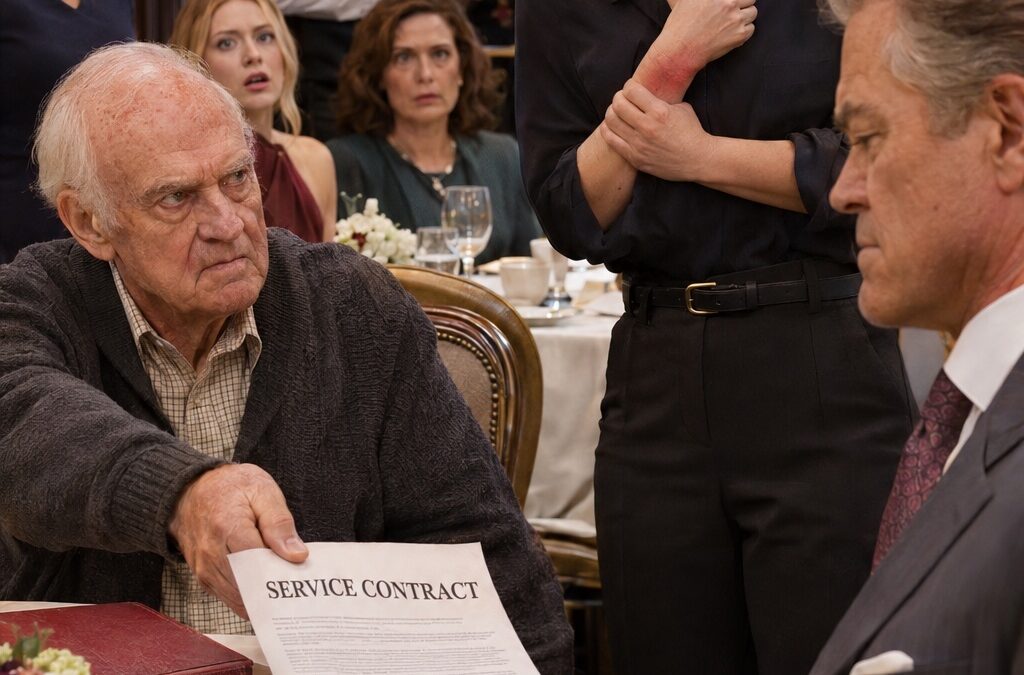
Grandpa read with his finger beneath the printed sentence.
“Audrey is the required payroll reviewer under this agreement.”
He moved his finger down and continued reading.
Replacing me required his written consent as the client.
An unauthorized substitution permitted immediate termination by written notice.
The clause did not provide a period to cure it.
My mother pulled out the chair beside my father.
“You never explained that arrangement to us, Walter.”
Grandpa turned to Janice rather than answering her.
“Did you have authority to make this agreement?”
“Yes,” she said, looking at the signature page.
“Martin and Elaine expressly authorized me to negotiate service agreements.”
“And you negotiated this one?”
“Yes. I signed it for the firm and filed it.”
My father leaned forward without touching the paper.
“We relied on your summaries. You knew that.”
“I did,” Janice said. “The agreement was available in our files.”
Grandpa kept the signature page facing my parents.
“I signed for my business. Your authorized representative signed for yours.”
Neither parent had read it before that evening.
That did not undo the authority they had given Janice.
My father smoothed his suit jacket against his lap.
“Then we need to establish whether any replacement actually occurred.”
He looked toward me, not Brooke.
“Audrey hasn’t stopped having access. An account coordinator can check work.”
Grandpa reached beside his red ledger for another page.
“This came to me through my regular client records.”
He laid the approval record beside the contract.
It carried the date October 16, 2025.
Brooke’s approval appeared where the payroll reviewer’s approval belonged.
Brooke bent toward it, keeping her hands under her napkin.
“That was the system’s approval screen,” she said.
“I wasn’t trying to change the contract.”
“Did you approve that review?” Grandpa asked.
“Yes. But the payroll went through correctly.”
I pulled my phone from my purse.
I had saved the correction history through my authorized account access.
The entries showed what existed when Brooke submitted her approval.
They also showed my correction before payroll was processed.
I opened the saved history and enlarged the relevant entry.
“There was a duplicated deduction,” I said.
“I corrected it before the worker’s pay was processed.”
Brooke looked from my screen to Grandpa’s printed record.
“I didn’t see that deduction.”
“No,” I said. “You approved the version containing it.”
Janice stood and came around far enough to read.
She checked the approval record against my screen.
Then she placed her folded napkin beside her plate.
“The correction followed Brooke’s approval,” she said.
My father reached for his water glass and stopped.
“Then Audrey was still reviewing. That’s evidence the process worked.”
Grandpa tapped the approval record, not my phone.
“You submitted Brooke as the reviewer without my written consent.”
He looked at Janice.
“Did my business provide that consent?”
“No,” she said.
My mother lowered her voice.
“Walter, nobody intended to put your workers at risk.”
Grandpa drew the ledger closer to his chair.
“I know who has been checking their pay.”
He addressed the table instead of only my parents.
“Audrey comes after her hospital shift. She checks the timecards.”
He opened the ledger at a marked page.
“She compares the corrections with what was entered.”
My dark blouse had caught beneath my watchband.
I worked the fabric loose without looking up.
Grandpa pointed to a notation in the margin.
“She found this deduction already taken from a maintenance worker.”
I remembered the handwritten correction beside that worker’s timecard.
I had checked it against the entry at his kitchen table.
Grandpa had reached for the telephone while I kept working.
“She stayed until his pay was correct,” he told them.
“That work belongs to Audrey. It isn’t Brooke’s achievement.”
Brooke folded her napkin into a smaller square.
Janice looked toward the guests who had heard her congratulations.
Nobody reached for the serving dishes anymore.
My father waited until Grandpa closed the ledger.
Then he turned his chair toward me.
“We can resolve the compensation question separately from the service issue.”
He spoke as though we were at his office.
“Finish the account quietly. We’ll discuss what happens afterward.”
“During paid work,” I said.
My mother pressed her fingertips against the tablecloth.
“You cannot leave your grandfather with unfinished payroll.”
“I’m not agreeing to unpaid work.”
“This would only be transition help,” my father said.
“Then put the paid scope in writing.”
He looked toward the guests before answering.
“There are client obligations here, Audrey. You know that.”
“I know. I’ve been doing the work.”
My phone screen went dark beside Grandpa’s contract.
I put it away instead of filling the pause.
Janice returned to her chair but did not sit.
“We’ll need the outstanding-items list,” she said.
“I can identify client records during an authorized handoff.”
My mother looked at the space beside her chair.
“We should sit down and work this out as family.”
I stayed beside Grandpa.
My wrists hurt when I lifted my purse strap.
The waiter moved away from the doorway to let me pass.
Grandpa gathered the approval record without folding it.
“I won’t decide payroll arrangements over dinner,” he said.
My father nodded, apparently hearing room for another discussion.
Grandpa placed the record inside the service contract.
“Any termination will be delivered in writing as required.”
My father’s chair scraped against the carpet.
“Then who exactly is going to handle the transfer?”
Grandpa looked up at me.
“Will you help me arrange a lawful handoff instead?”
Part 4: The Written Notice
“I’ll help define it,” I told him.
“Not another unpaid assignment.”
Grandpa put the contract beside the closed red ledger.
“That is what I’m asking.”
I left the dining room without returning to my place.
In the restroom, I set my purse beside the sink.
Red marks circled the places my mother had held.
I pulled back my sleeves and photographed my wrists.
Then I checked the pictures before saving them.
My blouse was still damp where the water had splashed.
I blotted it with a paper towel and stopped.
At the doorway, I found the waiter again.
“Please keep the written account you offered,” I said.
“I would like a copy.”
He nodded and asked where it could be sent.
I gave him my contact information, not my parents’.
He had seen the shove and caught my elbow.
I wanted his account kept apart from family explanations.
When it arrived, I saved it with the photographs.
His description named the movements he had witnessed.
It did not call the incident a misunderstanding.
I read it sitting at my own kitchen table.
Then I put my phone facedown and opened my laptop.
I still had authorized access to my work history.
I saved the correction history relevant to my own work.
I kept the approval record Grandpa had received separately.
I did not download the firm’s unrelated client files.
For the inventory, I listed records without copying their contents.
Payroll entries, timecards, corrections, and pending questions each had a place.
Beside each item, I noted where it was maintained.
I marked what belonged to Grandpa’s business.
The rest stayed where it was.
My mother called while I was checking the list.
I let it finish ringing before reading her message.
She wanted me to come by and explain everything.
I answered in writing.
“Send any work request with its scope and pay.”
My father replied with a more careful message.
He said a difficult transition could affect workers’ wages.
I opened the pending-items list before answering him.
“I have identified the payroll items requiring attention.”
“Arrange paid handling through the firm during the transfer.”
I did not argue about whether I loved Grandpa.
The next time we discussed the account, Grandpa had his contract open.
We sat at his kitchen table with the inventory between us.
He checked the notice instructions against the firm’s contact details.
He signed a written termination citing the unauthorized substitution.
The notice used the delivery method the agreement required.
He kept the delivery confirmation with his signed copy.
“This is the notice,” he said, setting down his pen.
“The restaurant conversation wasn’t.”
The termination did not erase charges already earned.
Grandpa requested the final accounting and checked the covered work.
He paid the accrued charges owed under the agreement.
I watched him mark the payment in his records.
There was no demand that my parents return past fees.
There was no claim that speaking at dinner canceled invoices.
What ended was the firm’s right to continue the account.
The records still needed to move without exposing employee information.
Janice handled the firm’s side of that transfer.
The inventory gave her a list she could verify.
Grandpa approved secure delivery into storage controlled by his business.
Passwords were not sent in the same message as records.
Access stayed available only as needed for the controlled transfer.
Grandpa checked the delivered material before approving the next step.
Pending payroll was handled through the paid transition arrangements.
The workers received their wages without an interruption.
Only after the records were verified did access change.
The firm’s permissions were removed from Grandpa’s payroll account.
Janice confirmed the handoff items against the inventory.
I kept the confirmation with my authorized work records.
My father then sent a request for transition assistance.
It did not include pay or an end to the duties.
The wording was polite and addressed an actual problem.
Brooke needed explanations of the correction notes and review steps.
I could have answered from memory at my kitchen table.
Instead, I placed the message beside the written inventory.
“I can consider a written, paid scope,” I replied.
“Please identify the records and questions you need covered.”
My mother answered before he did.
“We already paid you to learn this account.”
“You paid me for completed work,” I wrote.
She did not send a proposed scope.
Janice sent something different.
Her written correction identified me as the evening payroll reviewer.
It described Brooke’s role as account coordination, not my correction work.
She sent it to the people who had heard the dinner claim.
I read the recipients before reading the message again.
The work credited to Brooke had been performed by Audrey.
There it was, without a request that I soften it.
I printed the correction and placed it behind the incident account.
Later, at Grandpa’s table, I showed him the inventory confirmation.
He checked it against the records his business now controlled.
My parents could no longer open those records through the firm.
He slid a separate document toward me.
It was not an amendment to their old agreement.
“Would you review a narrower contract with me?” he asked.
“This would be between your business and me?”
“Yes,” he said. “But take it for advice before answering.”
Part 5: My Own Agreement
I took the proposed agreement home without signing it.
At my kitchen table, I separated the pages by subject.
Scope, scheduling, confidentiality, fees, and access all needed checking.
I wrote questions in the margins rather than calling Grandpa.
The proposed fee was $36,000 annually.
The start date was November 1, 2025.
The work would take twelve scheduled evening hours weekly.
I still had my hospital job and intended to keep it.
I could not promise open-ended availability after every shift.
The new scope excluded the firm’s former administrative services and costs.
It did not make me a replacement for their whole office.
That difference mattered when I looked at the fee.
Grandpa’s old account had cost $72,000 annually.
My agreement covered a narrower set of bookkeeping duties.
I took the draft for independent professional advice before signing.
I asked about the work I could accept personally.
I also asked what happened when requests exceeded the scope.
The advice came back with practical points to clarify.
We specified scheduled review work and handling of additional requests.
Confidential records would remain in storage controlled by Grandpa’s business.
I would receive only the access needed for my assignment.
My parents would receive no access through me.
I carried the marked draft back to Grandpa’s kitchen.
He put on his glasses and read my notes.
“If something needs more time, you want it approved first?”
“Yes. I can’t promise every evening.”
He nodded and moved to the scheduling page.
“And the hospital job stays.”
“Yes.”
We checked the revisions against the advice I had received.
Then we signed the agreement beginning November 1, 2025.
I put my copy in a folder before opening the ledger.
There was no payroll review scheduled for that visit.
I left it closed.
My father’s next message concerned the lost account.
He described the annual revenue and the administrative work it supported.
I understood what losing $72,000 annually meant to the firm.
He and my mother had jointly owned that account relationship.
Now they had received final earned fees, not continued service.
He asked whether Grandpa might reconsider after everyone settled down.
I forwarded the business question to Grandpa without adding an argument.
Grandpa answered directly.
“The termination stands. The records transfer is complete.”
My father then asked whether my new work could pass through them.
He offered to handle billing and client communication.
That would restore their involvement in the account.
“My agreement is direct,” I answered.
“I’m not authorizing access or subcontracting.”
I checked my account permissions after sending the message.
The firm was not listed.
My mother wanted a family meeting to discuss the dinner.
She suggested that we stop writing things down.
I read that message while hanging my hospital badge by the door.
Then I replied before changing out of my work clothes.
“I’m not attending further family meetings.”
She asked whether that included a meeting with Brooke.
“Yes,” I wrote.
I did not offer another place or another evening.
Brooke sent a separate message after Janice’s correction.
She said she had understood approval as part of coordinating.
She no longer claimed she had made my payroll corrections.
I kept her message with the written attribution.
I did not answer with instructions for doing the work.
Janice’s next note addressed something her correction had left out.
She named the shove she had watched at dinner.
“I saw Martin push you after Elaine held your wrists.”
I sat down before reading the rest.
“I should not have praised Brooke’s patience with you.”
She also named her request that the waiter leave.
“I treated an assault as a family inconvenience. I was wrong.”
There was no suggestion that I apologize in return.
I answered that I had received her correction and apology.
Then I put the phone away and ate supper.
My workdays at the hospital continued as before.
I checked billing entries and came home with my badge.
The evening work now had scheduled hours on my calendar.
Grandpa used those hours when sending questions and records.
Requests outside the scope stayed pending until we discussed them.
I did not open payroll files at the dinner table.
At his kitchen table, Grandpa kept my agreement with his business records.
The red ledger stayed within reach of his chair.
He had also sent his own acknowledgment to the dinner guests.
It named me as the person who had maintained his payroll.
He did not call Brooke’s coordination work mine, either.
I read it before beginning a scheduled review.
Then I put the message away and opened the records.
A maintenance worker’s timecard had a handwritten correction beside it.
I checked that correction against the entered hours.
The deductions matched the supporting records this time.
I followed the entries through to the expected pay.
Grandpa waited until I finished before asking about supper.
“Will you stay?”
“Not tonight. I’m leaving when this review is finished.”
He moved my coat from the neighboring chair.
I recorded the completed review in the agreed place.
Then I signed out of the payroll account.
Nothing remained for my parents to approve or reopen.
I put my pen away and picked up my coat.
Before leaving on time, I closed Grandpa’s red ledger.
You Might Also Enjoy




