My Mother-In-Law Told My Classmates She Was Taking My House While I Was Pregnant — Until Someone Intervened
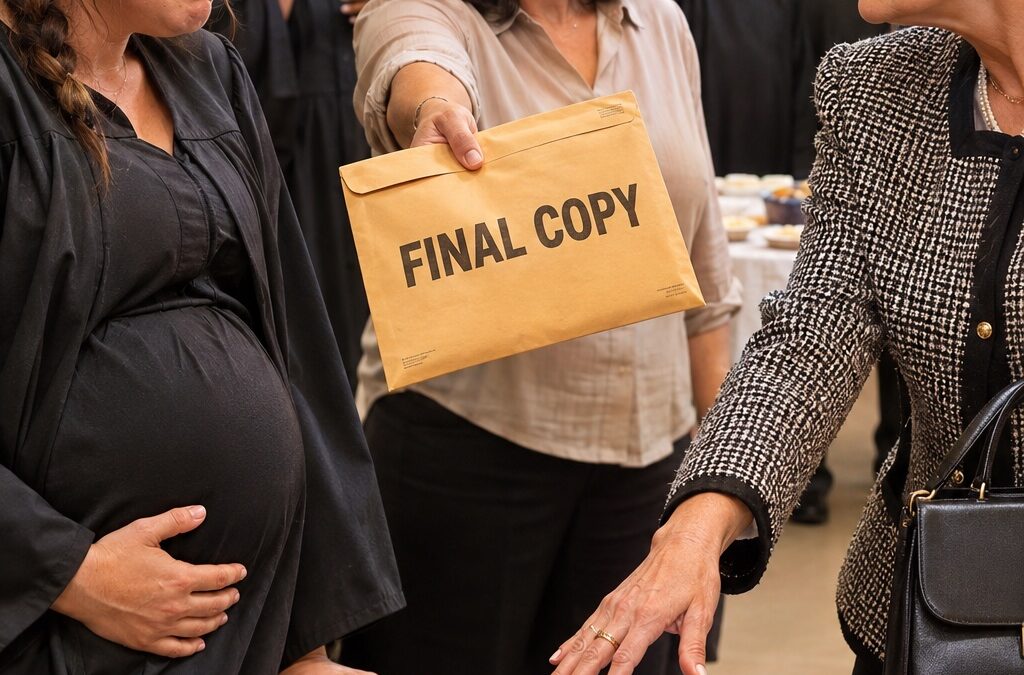
Part 3: The Paper Inside
Carla slid her finger beneath the flap and opened it.
She separated the papers without setting them on my diploma.
“This came from the county,” she said.
She turned the top sheet so I could read.
The recording confirmation was dated August 22, 2025.
The deed naming me alone had already been recorded.
I read my name, then followed Carla’s finger downward.
“Yesterday?” I asked.
“Yes. The deed is recorded in the county land records.”
Seth bent closer without reaching across my lap.
Marlene stayed beside the table, holding her purse strap.
“That isn’t something I signed,” she said.
“No,” Carla answered. “This is the new recording confirmation.”
It was a document Marlene had never seen or signed.
Carla placed the recorded deed copy beside the confirmation.
I looked between them, checking the name against my name.
Not Seth’s name. Not a list of family members.
Mine.
The envelope slipped against my gown, and I caught it.
“So she can’t call this rent now?”
“The purchase accounting is complete,” Carla said. “The deed is recorded.”
Marlene reached toward the papers, then stopped short.
“I want to know what you submitted.”
Carla kept the documents facing me.
“These are Nina’s closing copies. You can request yours.”
Owen moved my water cup closer without interrupting.
I drank, then put it beyond the papers.
The room had started making ordinary reception sounds again.
Chairs scraped somewhere behind us. A wrapper crinkled nearby.
But the classmates beside our table were still listening.
Marlene looked at them before turning back to Carla.
“You’re making this sound settled because you brought paperwork.”
“Recording happened before graduation,” Carla said.
“My being here today didn’t complete the transfer.”
I flattened the envelope’s open flap with my palm.
For the first time, I understood what I held.
These weren’t papers asking me to finish buying anything.
They documented something that had already been finished.
I asked Carla to show me the accounting next.
She placed it over the deed copy, leaving the confirmation visible.
The first entry was the $9,000 down payment.
The contract date beside it was February 1, 2018.
I remembered sitting with the prepared agreement before signing.
I had checked whether taxes were included in installments.
They weren’t. Neither were insurance or repairs.
I wanted every obligation written where I could find it.
Now Carla traced the payment entries with her finger.
“March 1, 2018, through August 1, 2025,” she said.
“Those are the scheduled monthly payments.”
There were 90 payments of $900, totaling $81,000.
With the down payment, I had paid $90,000.
The balance showed that nothing remained due.
I kept looking for another column or unfinished line.
There wasn’t a balloon payment waiting below the total.
There wasn’t interest added after the final scheduled installment.
“It was zero interest,” I said.
“That’s what the contract provides,” Carla answered.
Marlene shifted her purse onto her other shoulder.
“Nina lived there the whole time,” she said.
“That was possession under the purchase contract,” Carla answered.
“It doesn’t turn the purchase payments into rent.”
Seth looked down at my diploma beneath the envelope.
He eased its corner away from the chair arm.
I let him hold it while I handled the copies.
The paper underneath had started bending against my belly.
Carla asked whether I wanted to stand at the table.
I did, slowly, with a hand against the chair.
Owen moved it back so I had room.
Seth put my diploma on the cleared table space.
This time, he placed it directly in front of me.
Marlene watched without touching it.
I set the accounting beside it and checked the total again.
There was the full purchase price, paid through escrow.
The furnace parts weren’t folded into that number.
Neither was the replacement glass I had fitted myself.
Those expenses had come separately, from my pay.
“I also paid for the repairs,” I said.
Carla nodded but kept her finger beside the purchase balance.
“Those expenses are separate. This accounts for the contract.”
That mattered more than having somebody praise my work.
The house purchase didn’t depend on proving I deserved it.
It depended on the agreement and the payments listed there.
Marlene moved closer, lowering her voice.
“I never authorized a new transfer.”
Carla drew another sheet from the packet.
“This is the escrow-release certification,” she said.
Then she explained the papers behind the recording.
When we executed the land contract, Marlene deposited a deed.
It had been properly signed and notarized then.
That deed named me as the person receiving title.
The professionally prepared escrow instructions covered what happened next.
Once the final scheduled payment cleared, escrow released and recorded it.
No further authorization from the seller was required.
Marlene pressed her lips together and studied the sheet.
“You should have called me before doing that.”
“The standing instructions governed the release,” Carla said.
“They did not require another call for permission.”
I placed my finger beside the recording date again.
“This wasn’t signed behind her back yesterday?”
“The deed was already deposited,” Carla told me.
“The county confirmation is new. The instructions weren’t.”
I heard Seth let out a breath beside me.
He had been looking between Carla and his mother.
Now he looked only at the papers.
Marlene turned toward him.
“You understand why I expected a discussion.”
He opened his mouth, then glanced at me.
I pulled my diploma a little closer.
“The discussion couldn’t change what I already paid,” I said.
Carla stayed with the documents, not with Marlene’s expression.
She showed me which copy belonged with the recorded deed.
She pointed out the certification connecting the completed accounting to release.
Then she put the new county confirmation on top again.
“The original documents follow the escrow procedures,” she said.
“This packet gives you your final copies.”
I asked whether I needed to sign anything there.
“Not to complete this purchase,” she answered.
I folded my hands against the table edge.
For years, there had always been something else to arrange.
An installment, an insurance renewal, a property-tax payment.
A shift I could pick up around class assignments.
I had expected the completion packet to feel like another task.
Instead, I needed a moment before touching it again.
Marlene looked toward the room’s open doorway.
“People are going to misunderstand this.”
Owen stood beside the chair he had brought me.
“I heard the demand,” he said. “I heard her answer.”
Carla didn’t ask him to say anything more.
Neither did I.
I moved back into the chair and settled my gown.
Seth offered the diploma, but I asked him to wait.
I wanted the papers returned in their proper order.
Carla stacked them carefully while I watched each sheet.
The accounting. The release certification. The recorded deed copy.
Then the confirmation dated August 22, 2025.
I asked her to leave that sheet outside the envelope.
She laid it over the packet on my lap.
Marlene was no longer asking whether I owned anything.
She was watching Seth, waiting for him to speak.
He rubbed a thumb along the diploma’s lower edge.
I recognized that motion from evenings at our kitchen table.
He did it when he wanted a conversation over.
I didn’t want this conversation over with another loose promise.
I wanted to know what his mother already knew.
Carla had administered every payment, including the last one.
She had told me my completion packet would follow recording.
That meant there had been an accounting before this afternoon.
I looked up from the county confirmation.
“Was Marlene told the balance had already been paid?”
Part 4: The Notice She Had
“Yes,” Carla said. “The payoff notices went out August 6, 2025.”
She reached into her tote for the escrow file.
“The final payment had cleared. Notice went to both parties.”
I remembered my own notice arriving while I was home.
I had read it standing beside the kitchen counter.
It said the payment obligation was complete.
The final copies would follow after the deed was recorded.
I had saved it without knowing the completed recording details.
Carla placed a copy beside the county confirmation.
Then she showed me the delivery record from the file.
It documented delivery of Marlene’s payoff notice.
Marlene looked at the page without asking to hold it.
“You received this?” I asked her.
“I received something from the escrow office.”
“It said the balance was paid,” Carla said.
“The notice stated there were no remaining purchase installments.”
Marlene adjusted the cuff of her tailored jacket.
Seth stared at the notice.
“You knew before coming here?” he asked.
“I knew the scheduled arrangement was ending.”
Nobody at the table moved for a moment.
I pushed my water cup farther from the papers.
She had known when she called my payments rent.
She had known when she looked at my belly.
The demand hadn’t come from an unfinished installment.
It needed me to agree to something new.
I touched the accounting, where the balance ended.
“Then why did you tell me to leave?”
“Because we still need to discuss the family situation.”
“That isn’t an unpaid house balance,” I said.
“I didn’t say you hadn’t worked hard.”
“You said those payments were rent.”
Marlene glanced at the classmates still within hearing distance.
Then she turned her body toward Seth and me.
“All right. Call the purchase finished,” she said.
“But I still need help.”
Carla closed the escrow file but left the notice out.
She wasn’t answering a family request for me.
That was mine to answer.
Marlene rested her fingertips on her purse.
“Keep the $900 arrangement for 40 more months.”
She spoke quietly now, as if offering reasonable terms.
“That gives me something dependable. You’re already used to it.”
I looked at Seth before he could fill the pause.
“No,” I said.
Marlene raised her chin.
“You don’t even want to discuss what I need?”
“I’m not agreeing to another $36,000.”
“It would be a family arrangement.”
“It would be a new payment promise.”
Carla slid the payoff notice into my packet.
Marlene watched the paper disappear beneath the open flap.
“You can’t expect Seth to ignore his mother.”
I held out my hand toward my husband.
“My diploma, please.”
He gave it to me without adding another proposal.
I checked the corners before placing it against my chest.
Then I asked Carla to put everything back together.
She kept the new confirmation on top inside the envelope.
“Keep these with your original contract,” she told me.
“I will.”
Owen brought my chair clear while I stood.
I thanked him for helping me sit comfortably.
He nodded toward the envelope, then stepped aside.
Carla asked whether I needed anything else before leaving.
“Copies of anything showing the payoff notice,” I said.
“You have the relevant copies,” she answered.
Marlene moved toward the doorway with us.
“This could have been handled without involving everybody.”
I stopped beside the table, holding my diploma flat.
“I didn’t make the demand here.”
Seth picked up my water cup and carried it.
He stayed beside me as we left the multipurpose room.
I could still feel the gown pulling across my belly.
Outside the room, he asked whether I wanted a picture.
I looked down at the diploma against the envelope.
“Not while I’m trying to keep these straight.”
He took the cup in his other hand.
I kept both papers and diploma with me.
At home, I put the packet on our kitchen table.
I changed out of the gown before opening it again.
My braid had loosened, and pins caught against my scalp.
I laid them beside the sink and washed my face.
Seth waited in the kitchen instead of following me.
When I came back, he had cleared the table.
“I thought paying less would calm her down,” he said.
“I heard you.”
“I wasn’t trying to give away the house.”
“You offered my money after she threatened my home.”
He pulled out a chair, then sat without arguing.
I fetched the folder holding my original contract.
The recorded land contract was with the purchase records.
My down-payment record was clipped behind the signed agreement.
I spread the saved installment records beside Carla’s accounting.
The dates and amounts matched.
Seth asked whether he could help sort anything.
“Keep the repair receipts separate,” I told him.
He gathered those without putting them into the purchase stack.
The furnace parts and replacement windows totaled $4,800.
I had paid those expenses separately, just as required.
I found the receipt from the winter window work.
January 14, 2023, was written on the saved paperwork.
I remembered scraping the damaged frame while Seth held the light.
He had crouched down when I asked about cold air.
We weren’t expecting a baby then.
We had simply been making that room ready for someday.
I set the receipt back in the maintenance folder.
“I’m keeping copies of everything,” I told him.
“That makes sense.”
I saved the messages arranging Carla’s graduation handoff, too.
They showed why she had brought the sealed packet.
She had been attending for Owen, not staging an ambush.
Then I contacted classmates who had heard Marlene’s demand.
I asked them to write what they personally remembered.
Not what they thought about her or our marriage.
Just where they stood, what they heard, and what happened.
Owen sent his account of the demand and the chair.
The other accounts stayed with the reception documents.
I didn’t post them or send them around the family.
On August 25, 2025, I contacted a local real-estate attorney.
I brought the folders and retained counsel for the dispute.
Seth offered to come, but I went through the records myself.
I wanted to hear the questions without him answering first.
The attorney cleared space for the envelope on the desk.
I explained the purchase before explaining the graduation argument.
“I’m the purchaser named in the contract,” I said.
“I married Seth on June 13, 2020.”
The attorney noted that the purchase began before our marriage.
Seth was not a purchaser or grantee under those documents.
Any marital-property questions were separate from Marlene’s seller claim.
I wasn’t asking the attorney to settle my marriage.
I wanted the recorded title confirmed and her demand answered.
The attorney reviewed the packet, then kept copies.
“Don’t sign a replacement agreement,” the attorney told me.
“I haven’t.”
“And don’t send a payment while we review this.”
“I’m not authorizing one.”
Before leaving, I asked where any further demand should go.
The attorney gave me instructions for forwarding correspondence.
I saved those with the contract folder at home.
Seth watched me put the envelope away.
“Did they say it’s over?”
“They’re checking the records and answering her in writing.”
I wasn’t treating a reception conversation like a court order.
Marlene could still write another demand.
When it arrived, she called the money continuing family support.
She asked me to confirm the $900 arrangement.
I didn’t write a reply beneath her message.
I forwarded her written demand to my attorney.
Part 5: No New Payment Agreement
The attorney laid Marlene’s demand beside the purchase agreement.
I sat across the desk with my folder open.
The wording had changed from what she said at graduation.
She wasn’t calling the old installments rent anymore.
She wanted confirmation that payments would continue as family support.
“She’s asking for a new obligation,” the attorney said.
“I haven’t agreed to one.”
“Has anyone claimed authority to agree for you?”
I explained Seth’s suggestion at the reception.
Then I explained that I had refused it immediately.
The attorney made a note and checked the written demand again.
I kept my hands around the folder’s worn edges.
At work, I could carry trays through a crowded dining room.
Here, I was afraid of overlooking an ordinary sentence.
Something written politely could still ask for money I didn’t owe.
The attorney brought out the independently checked county record.
It matched the confirmation Carla had shown at graduation.
The deed naming me was recorded August 22, 2025.
The property description matched the land-contract paperwork.
The attorney had also reviewed the original agreement and escrow instructions.
They directed recording after the final scheduled payment cleared.
No fresh seller signature was required for that release.
The down payment and installments satisfied the stated purchase price.
There was no remaining interest or balloon amount.
“What about her saying she didn’t authorize it?” I asked.
“The deposited deed and escrow instructions answer that claim.”
“And her saying I rented?”
“The written contract and completed accounting answer that.”
The attorney didn’t promise that nobody would ever contact me.
Instead, we went through what the response would say.
It would identify the completed purchase and the recorded deed.
It would reject any supposed continuing payment obligation.
It would state that I accepted no new agreement.
It would ask for written acknowledgment of her remaining claim.
Or, if she had none, acknowledgment of that fact.
I asked to read the response before it went out.
The attorney turned the draft toward me.
I checked the dates, the amounts, and my name.
Nothing described the school reception as a legal proceeding.
The witnesses mattered because they could describe what was demanded.
The contract and county records established the property transaction.
I asked for that distinction to stay clear.
“I don’t want a letter saying everybody heard her lose.”
“It won’t,” the attorney said.
“It will address what she is claiming.”
At home, Seth had left dinner covered on the stove.
I put the attorney’s copy on the kitchen table.
He read it without picking up his phone.
When he finished, he asked what he should tell Marlene.
“Tell her you can’t make agreements for me.”
“I know that now.”
“I need you to say it to her.”
He sat back and looked toward the kitchen window.
I waited, holding a dish towel I hadn’t used.
“I was embarrassed at the reception,” he said.
“I wanted her to stop talking.”
“So was I.”
“I’m sorry, Nina.”
I folded the towel and laid it beside the sink.
He didn’t add that he was caught between us.
He didn’t tell me she had meant something else.
“I heard her threaten the house,” he said.
“I should have answered that instead of offering money.”
“Yes.”
He asked whether I wanted to hear the call.
“I want you to make your own answer clear.”
He called while I stood at the counter.
He told her that no further house payments were coming.
Then he said he had no permission to promise my money.
When she answered, he listened without putting me on.
I could hear her voice, but not her words.
Seth kept his eyes on the letter.
“The purchase is paid,” he said. “Nina isn’t agreeing to more.”
He did not suggest a smaller amount.
He did not offer to visit and work something out.
When the call ended, he placed the phone face down.
“I told her to send property questions to your attorney.”
I nodded and uncovered dinner.
We ate with the letter still on the table.
Afterward, he washed the dishes while I checked my work schedule.
That was the help I could use that evening.
The document exchange took place through counsel, not our kitchen.
My attorney sent the contract, accounting, and recording information.
The escrow instructions supported the release and recording.
The payoff notice and delivery record showed prior notice.
I answered questions when the attorney needed something clarified.
I didn’t send Marlene speeches about everything she had done.
Once, I started typing about the repairs.
I looked at the separate maintenance folder and stopped.
Those expenses mattered to my household and my savings.
They weren’t needed to invent another theory of ownership.
The purchase documents already supplied the answer.
Marlene’s response focused on her expectation of continued family help.
My attorney distinguished an expectation from an agreement I accepted.
I had not accepted one at graduation or afterward.
There was no rental agreement replacing the purchase.
There was no unpaid contract balance to collect.
I read each exchange after coming home from work.
Sometimes I put it down before finishing.
My feet hurt, and the baby pressed against my ribs.
I would sit, drink water, and return to the page.
Seth stopped asking whether a little payment might end it.
Instead, he asked whether anything needed copying or filing.
I gave him the envelopes to keep with the correspondence.
He filed them where I asked.
On September 12, 2025, my attorney contacted me.
Marlene had provided the written acknowledgment through counsel.
I opened the copy at our kitchen table.
It acknowledged no remaining ownership or payment claim.
I read that portion, then read the whole document.
The attorney confirmed that it answered the demand.
There wasn’t a family-support promise attached for me to accept.
There wasn’t another installment schedule slipped into the exchange.
I paid Marlene nothing further.
When Seth came home, I handed him the acknowledgment.
He stood beside the counter to read it.
“Keep this with the deed?” he asked.
“With the attorney’s letters and the rest.”
He slid it into the folder without rearranging anything.
I put the folder back where I could reach it.
The large envelope was still marked “FINAL COPY.”
Its flap no longer closed neatly after all the handling.
I tucked it inside the folder instead of replacing it.
Then I turned toward the calendar beside the refrigerator.
A payment reminder was still written on a pending note.
I had left it there while counsel answered Marlene.
It referred to the proposed continuing payment, not an installment owed.
Seth looked from the calendar to the hallway.
“The nursery window latch still catches,” he said.
I touched the edge of the reminder.
I had been waiting for another message before making ordinary plans.
The attorney’s acknowledgment was filed. The money was staying put.
I peeled the pending payment reminder from my kitchen calendar.
Part 6: The Diploma Comes Home
The empty space on the calendar stayed empty.
I didn’t replace the payment reminder with another one.
When the next household expenses came due, I paid them.
The money I wasn’t sending Marlene stayed for our needs.
I bought what we still needed for the nursery.
I kept enough available for repairs and ordinary bills.
Nothing about owning the house made those obligations disappear.
Property taxes still needed saving for. Insurance still needed paying.
But I didn’t owe another purchase installment over those expenses.
I checked the account at the kitchen table without hiding it.
Seth sat across from me with the household papers.
He asked what needed attention before the baby came.
I pointed toward the room we had been preparing.
“The window latch. It catches when I close it.”
“I’ll look at it.”
I waited for him to mention calling his mother.
He picked up the household folder instead.
“Do we still have the repair information?”
“In the maintenance section.”
He found it and put everything back in order.
The diploma was lying nearby in its protective cover.
I had kept moving it away from cups and mail.
Every time I needed the table, it needed another safe spot.
Seth lifted a grocery bag before it could cover it.
“Where do you want this to go?”
“In the nursery eventually,” I said.
He set it on the clean shelf until we were ready.
He didn’t ask why it belonged there.
That afternoon, Marlene asked whether she could come over.
I answered the message at the kitchen counter.
“Not today. We’ll let you know when a visit works.”
I didn’t mention the attorney or explain our schedule.
She replied that she wanted to see the nursery.
I left my answer where it stood.
When Seth came in, I showed him the exchange.
“Are you okay with that?” he asked.
“I’m not available for a visit today.”
“All right.”
He didn’t call her to negotiate a shorter visit.
He put his work things away and washed his hands.
I stayed at the counter until the phone screen went dark.
Then I set it down and finished putting groceries away.
The nursery window still needed attention.
Seth carried the tools in while I moved folded clothes.
The room smelled faintly of washed bedding.
I sat in the chair near the dresser.
He opened the window and checked the latch.
“Show me where it catches,” he said.
I stood and pressed the handle the way I usually did.
It stopped before sitting properly against the frame.
“There.”
He watched, then asked me to move back to the chair.
I remembered the work light on January 14, 2023.
Back then, I had scraped the damaged frame myself.
Seth had held the light wherever I pointed.
Now he examined the latch and checked its mounting.
“Do you want the hardware changed?” he asked.
“If that’s what it needs. It needs to close properly.”
He worked on it without reaching for his phone.
I folded the little clothes across my lap.
The phone stayed on the dresser, within his reach.
He never used it to ask Marlene what to do.
When he finished adjusting the latch, he tried it again.
Then he stepped aside.
“Would you check it?”
I closed the window and fastened it without forcing anything.
I ran my hand along the sill.
The frame was dry beneath my palm.
“It works,” I said.
He opened and closed it again before putting the tools away.
Then he cleared the bits of dust from the sill.
I handed him the cloth rather than doing it myself.
He wiped the surface and checked the floor.
It wasn’t a large repair.
I watched him finish it all the same.
Afterward, he put the maintenance papers back where they belonged.
No explanation to his mother followed.
No photograph went out asking whether she approved.
I returned the folded clothes to the dresser drawer.
The top was clear except for the things we needed nearby.
I measured the available space with my hand, not a ruler.
The diploma would fit without leaning against the window.
I left it on the shelf a little longer.
I wanted to place it when the baby came home.
Life before that day stayed ordinary and busy.
I finished shifts at the nursing home and came home tired.
Sometimes the folder from the attorney caught my eye.
I no longer opened it just to check the acknowledgment.
I knew where it was if I needed it.
Seth took over tasks without asking whether I was angry first.
He brought in groceries and put away the cold things.
He checked the nursery window when the weather changed.
When I asked him to carry something, he carried it.
He didn’t turn the request into a discussion about his mother.
We still had things to talk through between us.
I told him when I needed an answer from him.
Not the answer that might keep somebody else comfortable.
Once, he started explaining what Marlene would probably prefer.
He stopped and looked at the item in his hand.
“What do you want?” he asked instead.
I answered him, and we continued what we were doing.
Marlene’s request to visit did not become an open invitation.
Any visit still required us to agree beforehand.
There were no house-payment conversations waiting at our table.
Her written acknowledgment stayed filed with the completed purchase.
I didn’t carry it around to prove anything during dinner.
By October 18, 2025, the nursery was ready.
That was the day I brought my baby home.
Seth carried the baby inside while I followed slowly.
I stopped just past the doorway to take off my shoes.
The house sounded familiar around the unfamiliar little movements.
A bag brushed the wall. Seth lowered his voice.
“Do you want to sit here?”
“In the nursery.”
He took the bag ahead while keeping the baby settled.
I followed him down the hallway we had cleared.
The window was closed, and the latch sat properly.
The dresser drawers held the clothes I had folded.
I opened one, then closed it without taking anything out.
Everything I needed was already nearby.
Seth stood beside the chair with the baby against him.
I checked the window with my palm out of habit.
There was no cold air reaching the room.
Then I went back for the diploma.
Its cover had kept the edges flat through all the moving.
I slipped it out carefully and carried it down the hallway.
Seth watched from beside the nursery chair.
I set it upright on the dresser, away from the supplies.
Then I lifted my baby from his arms and sat.
Seth pulled the empty bag away from my feet.
I settled the baby against me and looked toward the dresser.
My diploma stood beside the folded cloths, facing our chair.
You Might Also Enjoy




