My Daughter-In-Law Announced My Retirement As I Stood Humiliated — Then My Friend Held Up The Papers
Chapter 1: Outside The Classroom Windows
My daughter-in-law dragged me by my arm past classrooms.
“You’re retired, starting tonight,” she said at career night.
I caught my balance beside a classroom window.
Inside, my son kept speaking into his microphone.
“I still train your dispatchers,” I told her.
Kendra tightened her fingers around my upper arm.
My tote struck my hip as she pulled again.
“Let go of me.”
A teacher stepped away from the classroom doorway.
“Please take your hand off her,” she said.
Kendra kept looking at me instead of the teacher.
My navy dress had twisted around my knees.
I pulled the hem down with my free hand.
Through the glass, Evan turned toward the hallway.
He saw his wife holding my arm.
“Evan.”
His microphone was close enough to catch his answer.
He didn’t give me one.
He turned back toward the children and continued explaining deliveries.
I had come because our granddaughter invited me.
Sadie was 10, and she wanted her family there.
“Grandma, you know the truck routes,” she had said.
“Dad should let you explain that part.”
I told her I would come watch her father.
I wasn’t expecting a microphone or a special introduction.
I wanted a seat beside the other families.
Before leaving home, I checked the invitation again.
There was nothing saying grandmothers needed anyone’s permission.
My brown bob still held the bend from my brush.
I had checked it in the glass outside.
Then I had spotted Sadie through the classroom windows.
She was watching Evan adjust the microphone.
I lifted my hand when he glanced toward me.
He looked away before I knew whether he saw.
Kendra came through the doorway before I reached it.
Her blonde ponytail brushed the shoulder of her red dress.
“What are you doing here?”
“Sadie invited me.”
“This is for people presenting their actual jobs.”
“I still have an actual job.”
Parents were waiting beside the windows for available seats.
A father stopped folding his program.
Kendra glanced at him, then lowered her voice.
“We already talked about you stepping back.”
“No. You talked. I didn’t agree.”
She stood across the doorway instead of moving aside.
Inside, Evan began describing the family delivery business.
He explained how customers called when a delivery changed.
He said good dispatchers kept the operation moving.
I waited for him to mention who trained them.
Kendra moved closer before he finished that part.
“You need to leave.”
“I’m waiting here until there’s a seat.”
“You’re not going in.”
The teacher looked between us while moving a chair.
“Is there a problem?”
“It’s a family matter,” Kendra told her.
“We’re just finding her somewhere else to wait.”
“I don’t need somewhere else.”
That was when her hand closed around my arm.
Now we were past the doorway, beside another window.
My shoe caught the edge of a floor mat.
I stopped trying to walk at her pace.
“Kendra, you’re hurting me.”
“Then stop making a scene.”
“You’re pulling me down a school hallway.”
She stopped walking but kept hold of me.
A mother moved her child behind her legs.
I pressed my tote against my side.
My blue dispatch-training notebook was still tucked inside.
Its hard corner pushed through the fabric against my ribs.
I had carried it straight from work.
At 58, I still reported for scheduled training sessions.
I still checked route sheets and reviewed dispatch instructions.
I still helped dispatchers decide what to ask drivers.
None of that had ended because Kendra wanted it ended.
My salary was $3,200 gross monthly.
My mortgage payment was $1,450 monthly.
I had no retirement notice folded inside my tote.
There was no farewell card waiting on my desk.
I had not agreed to stop working.
Earlier that week, she had told me to skip tonight.
On November 10, 2025, she sent another exclusion message.
Evan needed room to represent the business himself, she said.
I answered that I only wanted to attend.
She said Evan decided staffing, not his mother.
Then she told me I would enjoy free mornings.
“I haven’t offered you my mornings,” I answered.
She had already started leaving me off office messages.
When I asked, she called each omission an oversight.
Then the updated training schedule stopped reaching me.
I got my copy directly from the dispatch desk.
“You don’t need every little update,” she said.
“I need the ones involving my work.”
She told me I made everything harder.
I saved the messages instead of deleting them.
Afterward, I called Audrey from my kitchen.
We had been friends since before the business existed.
She was also the company’s business attorney.
I told her Kendra kept announcing a retirement.
Audrey listened without suggesting I agree to anything.
“Have you submitted a notice?” she asked.
“No.”
“Then don’t describe this as your decision.”
I asked whether I should stay home from school.
“Not if you want to attend.”
She said she would bring our company agreement.
I didn’t ask her to confront anyone at school.
I wanted someone who knew the records nearby.
Now I could feel Kendra’s thumb pressing my arm.
She glanced through the classroom glass toward Evan.
“He handles staffing,” she said. “You know that.”
“I know I haven’t agreed to retire.”
“You don’t have to agree with every decision.”
Her voice carried farther than it had near the door.
The teacher stayed close enough to hear everything.
I looked toward Evan again.
He was explaining how drivers checked their delivery lists.
He had watched me being pulled past the windows.
He was still holding the microphone.
I stopped trying to catch his eye.
Kendra leaned toward me with a small, impatient smile.
“My husband makes those calls.”
I moved my tote away from her hand.
“Then talk to Audrey.”
Kendra looked past my shoulder without releasing me.
I heard my name from the other end of the hallway.
Audrey was approaching in her green dress.
Her gray bob moved against her collar.
She looked at Kendra’s hand before she looked at me.
“This isn’t a good time,” Kendra told her.
Audrey stopped beside us.
“It needs to come off Denise.”
Chapter 2: The Cover She Recognized
“We’re discussing her retirement,” Kendra said.
Audrey kept her eyes on Kendra’s hand.
“Denise was training dispatchers this month.”
Kendra glanced toward the parents beside the windows.
“She trained the people Evan is talking about,” Audrey added.
The father near the doorway looked into the classroom.
The teacher remained beside me, her chair forgotten.
Kendra opened her mouth, then looked past Audrey.
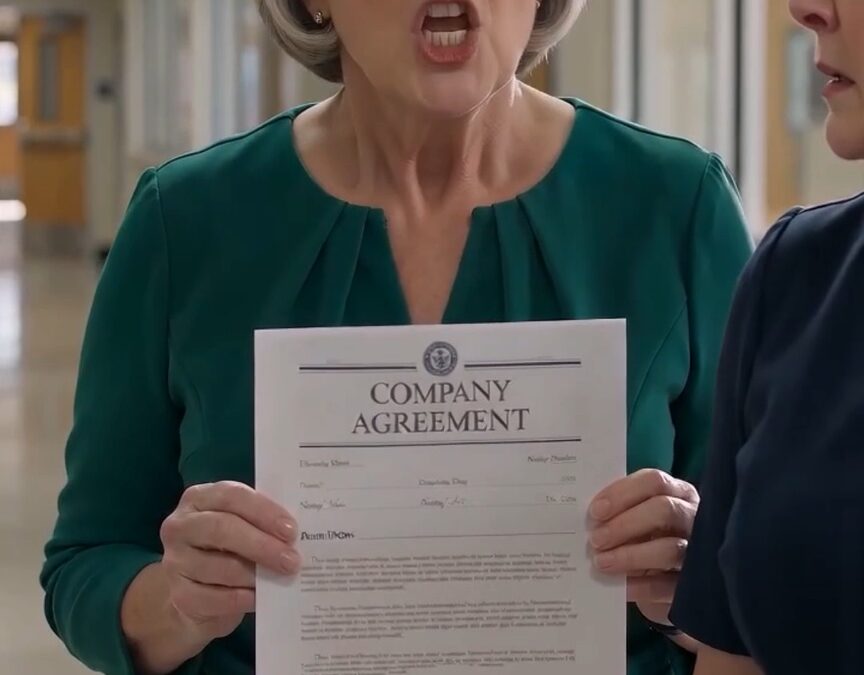
Audrey raised the document to chest height.
The cover read “COMPANY AGREEMENT.”
Kendra saw the cover and recognized who held it.
Her fingers opened, and I stepped free.
Her smile disappeared as she moved backward.
I brought my tote around in front of me.
Audrey kept the agreement upright between us.
“Kendra, she controls the company votes.”
Kendra’s mouth dropped open before she answered.
“Evan told me otherwise!”
Inside the classroom, the microphone continued carrying his voice.
The teacher moved into the space between us.
“Stay apart, please,” she told Kendra.
Then she turned toward me.
“Can you come over here?”
She indicated a chair against the opposite wall.
I walked there without looking through the windows.
My upper arm hurt where my sleeve ended.
I set my tote on my lap.
The notebook’s corner had left a crease in its fabric.
“Do you need medical help?” the teacher asked.
“I need her not to touch me again.”
“I saw what happened.”
I looked directly at her then.
“Will you write down what you saw?”
“Yes.”
Kendra drew herself up beside the window.
“We don’t need to make this official.”
The teacher didn’t step away from me.
“I’m documenting an incident at the school.”
“This is a company disagreement,” Kendra said.
The teacher glanced at my arm.
“I’m documenting what happened in this hallway.”
Audrey lowered the agreement against her green dress.
She didn’t hand it to Kendra.
I rubbed my palm against the handle of my tote.
I wanted to call Sadie out and explain.
Instead, I looked through the classroom doorway.
She was still inside with the other children.
She had come to hear about her father’s work.
I wasn’t going to bring her into the hallway argument.
“Can she stay in there?” I asked the teacher.
“Of course.”
Kendra shifted toward the doorway.
The teacher held her place without touching her.
“Please give us some space.”
I heard Evan describe loading a delivery vehicle.
His presentation sounded almost normal from that distance.
He had always been comfortable explaining the driving side.
I had practiced those explanations with him at work.
Now I listened to him finish a sentence.
Then I put my hand over my sore arm.
Audrey crouched enough to meet my eyes.
“Did you tell her she could retire you?”
“No.”
“Did you authorize any announcement?”
“No.”
“Have you stopped performing your scheduled work?”
“No.”
Kendra folded her arms against her red dress.
“She’s been talking about stepping back for ages.”
“I haven’t agreed to stop working,” I said.
“You don’t need to make every conversation a deposition.”
Audrey straightened.
“An agreement about work needs an actual agreement.”
“I’m the office manager,” Kendra replied.
“I know your position.”
“I enter payroll.”
“That does not settle what you’re claiming.”
Kendra looked toward the document again.
She seemed to be studying the cover this time.
Audrey had brought a complete company copy.
It wasn’t a letter she had written for me.
It wasn’t a demand I had prepared that afternoon.
The teacher asked whether I wanted somewhere quieter.
I shook my head.
“I want to stay where someone saw what happened.”
She nodded and pulled her chair a little closer.
I set my tote on the floor beside my shoes.
My arm felt worse without the fabric against it.
Audrey noticed me checking beneath my sleeve.
“Keep that separate from the employment issue,” she said.
“I will.”
Kendra heard her and uncrossed her arms.
“Separate? We’re all family.”
The teacher answered before I could.
“I’m here because I witnessed physical contact.”
A parent waiting nearby quietly moved farther down the hallway.
Nobody crowded us or tried to take the agreement.
Audrey kept it tucked against her chest.
I could still see the printed title above her hand.
I had signed company papers long before Kendra worked there.
For years, I had rarely needed to look at them.
My days had been filled with dispatch questions instead.
Which entrance could take a delivery vehicle?
Had the customer confirmed someone would be there?
Did the driver understand the corrected address?
I had expected those questions when I left home.
I had not expected to defend my own employment.
Kendra looked at the classroom again.
“Evan can explain what he meant.”
“Then he needs to speak for himself,” Audrey said.
“He’s doing a presentation.”
“I can hear that.”
The teacher glanced toward the children.
“We can pause without discussing this in front of them.”
I picked a loose thread from my tote handle.
Then I stopped because I was pulling it longer.
Audrey saw my hand and waited until I looked up.
“I represent the company, Denise.”
“I know.”
“I’m going to explain its agreement, not a family preference.”
“That’s what I want.”
Kendra let out a short breath.
“Fine. Explain the management structure.”
Audrey turned toward the classroom doorway.
She waited until Evan glanced in our direction.
The microphone lowered slightly, then rose again.
Audrey stepped where he could see the document.
“Evan,” she said, “please stop presenting and come outside.”
Chapter 3: The Pages Beneath The Cover
Evan finished the sentence already coming through the microphone.
Then he told the classroom he needed to pause.
He put the microphone down before coming outside.
His eyes went from me to Audrey’s document.
“What’s going on?”
I lifted my sore arm away from my dress.
“You saw part of it.”
Kendra moved toward him, but the teacher stayed between us.
“Your mother misunderstood a staffing conversation,” Kendra said.
“She’s upset about retirement.”
“I was pulled down the hallway,” I answered.
Audrey held the agreement flat against her forearm.
“We need to clarify who can authorize that staffing decision.”
Evan looked back toward the open classroom door.
“Can we do this later?”
“The children don’t need the details,” Audrey said.
“But you need to correct an unauthorized announcement now.”
The teacher stepped toward the classroom to check inside.
She remained close enough to see where we stood.
I stayed in the chair across from the windows.
Audrey asked whether I could stand comfortably.
I stood and left my tote beside my feet.
She opened the agreement where she had marked it.
Kendra watched the pages rather than my face.
“Our company was founded May 1, 2007,” Audrey said.
“Denise contributed $24,000 in startup capital.”
Evan rubbed the side of his jaw.
“I know how we started.”
“Then we should be able to agree on this.”
Audrey turned the open page toward him.
“Denise received 60% ownership and voting rights.”
Her finger moved down the page.
“You received 40%.”
Kendra looked sharply at Evan.
He didn’t dispute the ownership percentages.
I had kept that formation paperwork with our business records.
I had also kept the record of my contribution.
The money hadn’t been a birthday gift to my son.
It had gone into the company we were forming.
I stood close enough to read the familiar language.
Audrey pointed to the reserved approval provision.
“Employment termination and compensation changes require majority member approval.”
Kendra tilted her head toward Evan.
“He’s the operations manager.”
“Yes,” Audrey said.
“He runs the business every day.”
“He manages operations. This provision still applies.”
Evan looked at the page for longer this time.
Audrey didn’t hurry him or lift her finger.
“Operational management does not override the reserved member vote.”
I watched his eyes reach the relevant language.
He swallowed and stepped back from the document.
“So she has to approve it,” Kendra said.
“Denise holds the majority vote,” Audrey answered.
“Evan’s vote alone cannot authorize these decisions.”
Kendra pressed her lips together.
The title on the cover had stopped her smile.
The language inside stopped her claim about Evan’s authority.
She looked at him instead of arguing with the page.
“You said staffing was yours.”
“Routine staffing is part of operations,” he said.
“That isn’t what she just read.”
Audrey closed the agreement around her place.
“Let’s keep the questions separate.”
I bent to straighten my tote against the wall.
My notebook had shifted under the opening.
I pushed it down without taking it out.
Evan reached toward my elbow.
I moved my arm away before he touched it.
“Did she hurt you?” he asked.
“Yes.”
He looked at the place his wife had held.
Kendra turned toward Audrey again.
“Then what exactly am I permitted to do?”
“You have delegated payroll-entry permissions.”
“I handle the payroll.”
“You enter authorized information.”
Audrey waited until Kendra stopped looking toward Evan.
“You have no ownership interest in the company.”
Kendra’s face tightened.
“You cannot independently set compensation or terminate Denise.”
“I wasn’t changing ownership.”
“No,” Audrey said. “You were claiming employment authority.”
The teacher returned to the space beside the doorway.
She asked us to keep the entrance clear.
We moved farther along the same wall.
I carried my tote with the other hand.
The parents who had witnessed the dragging stayed nearby.
Nobody had to imagine how our conversation began.
Kendra lowered her voice again.
“People don’t need to hear company business.”
“I didn’t bring company business into the hallway,” I said.
“You’re retired, starting tonight” had reached everyone around us.
I didn’t repeat it back to her.
She had heard herself say it.
Audrey kept her explanation brief enough for the setting.
“The agreement gives Denise authority to approve or reject this.”
She looked at me rather than Kendra.
“It doesn’t require you to retire because someone announced it.”
“I’m not retiring,” I said.
Evan put his hands in his pockets.
“I wasn’t planning to leave her without anything.”
I looked at him.
“Without what?”
“Mom, that isn’t what I meant.”
“Then say what you mean.”
He glanced at Kendra before answering.
“I thought we could talk about a transition.”
“You watched her pull me away from the classroom.”
He looked down at the floor.
Audrey moved the agreement back under her arm.
“This does not need a decision made under pressure.”
Kendra took a breath and changed her approach.
“If Denise has approval authority, we can request approval.”
“You can submit a proposal,” Audrey said.
“That is different from announcing a termination.”
“Fine,” Kendra said. “Then treat it as a proposal.”
I looked from her to Evan.
Something about Audrey’s expression made me stay still.
She had already marked the agreement before arriving.
She had asked exact questions about my consent.
“Has someone submitted something?” I asked.
Audrey nodded.
“There is already a proposed change we need to review.”
Chapter 4: What She Had Submitted
Kendra reached toward the papers under Audrey’s arm.
Audrey held them against her side.
“I’ll show Denise the company’s copy.”
“I can explain what I sent,” Kendra said.
“You’ll have that opportunity.”
Evan looked from Audrey to his wife.
“What did you send?”
Kendra’s eyes stayed on the papers.
“The draft we discussed.”
“I didn’t see a final version.”
“It wasn’t final. That’s why I sent it for review.”
Audrey opened the material behind the agreement.
She turned the draft so I could read it.
I kept my tote in my uninjured hand.
The page described eliminating my salary through termination.
It also proposed a management raise for Kendra.
I read the amount beside each change.
Then I read them again.
“My salary is $3,200 monthly,” I said.
“Yes,” Audrey answered.
“Her proposed raise is $3,200 monthly.”
“Yes.”
Evan leaned toward the page.
Kendra watched him read instead of looking at me.
The same amount appeared beside both changes.
There was no need for anyone to calculate the difference.
My paycheck would disappear, and hers would increase.
I pressed my tote handle flat between my fingers.
At home, my mortgage statement was beside the kitchen mail.
The payment was $1,450, whether Kendra liked my work or not.
“Was any of this processed?” I asked.
“No,” Audrey said.
“Has my pay been removed?”
“No salary removal or raise has been processed.”
I let the handle settle against my palm.
“Keep it that way until the member action.”
Audrey nodded without treating that as the completed paperwork.
Kendra pointed toward a line on the draft.
“It was submitted for required review.”
“That’s correct,” Audrey said.
“Then I followed the process.”
“You submitted it. You did not receive approval.”
Audrey identified the submission date for all of us.
“November 12, 2025. I received it yesterday.”
She turned the page to her review notation.
“I flagged the missing member authorization before processing.”
Evan read that portion more slowly.
Kendra had known counsel needed to review compensation changes.
That was why Audrey had received her proposal.
But legal review was not permission to announce retirement.
It was not permission to drag me outside.
“Did you tell her I approved it?” I asked Evan.
“No.”
“Did you tell her approval was unnecessary?”
He rubbed his jaw again.
“I told her I handled staffing.”
Audrey held the agreement beside the draft.
“This is why I asked for the authorization.”
Kendra shifted her weight and looked directly at me.
“Your hours have been reduced.”
“My scheduled work continues.”
“You aren’t sitting at dispatch all day anymore.”
“I’m the dispatcher trainer.”
“Which is less work than running the office.”
Audrey lowered the pages while Kendra made her argument.
She wasn’t going to argue my schedule for me.
I had the schedule, and I knew the work.
Kendra gestured toward my tote.
“You carry that notebook around like every route needs you.”
“It contains the training notes I use.”
“Micah can answer a phone without supervision.”
“He can. That isn’t the whole job.”
Evan looked through the window toward the classroom.
I could see Sadie sitting with the other children.
The teacher had kept the interruption away from them.
I moved so my back faced the window.
I didn’t want Sadie reading my face from her chair.
Kendra followed the turn with her eyes.
“This is exactly why I wanted to handle it quietly.”
“You told me to skip career night,” I said.
“I didn’t want a disagreement at school.”
“You grabbed me.”
She looked toward the teacher and stopped speaking.
Then she returned to the compensation argument.
“The office workload has grown. Mine has grown.”
“You can propose compensation for that work,” Audrey said.
“Through authorized review and member approval.”
“That’s what I did.”
“You also announced Denise’s retirement without that approval.”
Kendra drew a breath through her nose.
“Then withdraw the announcement and consider the proposal.”
Audrey nodded once.
“Denise can consider it without accepting the announcement.”
I looked at the draft again.
The amounts hadn’t changed while we talked.
Neither had the section naming my proposed termination.
“Why does your raise match my entire salary?”
“Because the company can redirect an existing expense.”
She said it evenly, as if explaining a supply order.
There was no budget emergency written on the page.
There was no completed review of my scheduled work.
Just my compensation removed and hers increased.
“I do management work that needs proper pay,” she added.
“That request can stand on its own,” I said.
“It doesn’t need my retirement attached.”
“It needs an available budget.”
“Then submit an authorized proposal based on the budget.”
Evan looked at me when I said that.
I wasn’t saying she could never request a raise.
I was saying she couldn’t create it from my paycheck.
Audrey placed the draft behind the agreement again.
“I’ll preserve the submission and its review history.”
“I want a copy,” I said.
“You’ll receive it through the company records process.”
Kendra glanced toward my arm.
Her own hands stayed close against her dress now.
She had stopped claiming the document gave Evan authority.
She had stopped claiming the change had approval.
Instead, she looked at my tote and shook her head.
“Then explain why reduced hours should cost the same.”
I set the tote on the empty chair.
“Let’s talk about the work you left out.”
Chapter 5: The Work She Left Out
I opened my tote and took out the notebook.
The blue cover had bent slightly at the corner.
I laid it across the top of the bag.
Kendra looked at it without moving closer.
Evan stayed beside Audrey, facing away from the classroom.
“This is what I use in training,” I said.
“It isn’t a retirement scrapbook.”
I turned to the notes from October 23, 2025.
There was a route sketch beside Micah’s questions.
I recognized the place where my pen had paused.
That evening, the dispatch office had smelled of warm paper.
Micah was 24 and still learning when to stop guessing.
He sat beside me with a route sheet between us.
A driver called about a closed bridge.
Micah pulled the sheet closer to his face.
“I don’t know where to send him.”
“Don’t guess,” I said. “Start with the address.”
He read it quickly and reached toward the radio.
I put my palm flat on the route sheet.
“Again. Slowly. Make sure he confirms it.”
Micah looked at me, then back at the address.
He repeated it at a pace the driver could follow.
Then he waited for the driver to confirm.
I pointed at the delivery entrance on the sheet.
“Ask which side of the closure he’s on.”
Micah asked and listened without interrupting the answer.
He wrote the driver’s location beside the planned route.
“Now look at where he needs to enter,” I said.
Micah traced the road with his finger.
“That road gets him around the bridge.”
“Does it get him to the right entrance?”
He stopped tracing and checked the delivery instructions.
“No. He needs to come around the other side.”
“Tell him the turn. Then have him repeat it.”
He gave the instruction and waited again.
I stayed beside him while the driver traveled around.
Micah kept his hand near the radio without rushing.
When the driver called back, he had found the entrance.
I drew the turn beside Micah’s notes.
“Now tell me why that road works.”
He explained it back without looking at my drawing.
Then I asked what he would write for the next dispatcher.
“Closure, approach, and which entrance the driver confirmed.”
I nodded and let him write it himself.
That was the evening work Kendra called unnecessary.
In the hallway, I turned the notebook toward Evan.
“The driver got there because Micah checked before sending him.”
Evan looked at the sketch and recognized the location.
“I remember that closure.”
“I stayed until the route was resolved.”
Kendra folded her arms again.
“Nobody said you never help.”
“I perform scheduled training.”
“That can be transferred.”
“Anything can be proposed,” Audrey said.
“It still requires the proper approval.”
I turned to the pages behind the route sketch.
They showed questions to review during scheduled sessions.
Address confirmation. Driver read-back. Delivery entrance.
Notes on where a dispatcher hesitated or skipped a step.
I didn’t read every page aloud.
Evan had seen the work over the years.
He knew why those notes existed.
“I built dispatch over 18 years,” I said.
“The first year included unpaid evening training.”
Evan looked down at the notebook.
I remembered him eating at the dispatch desk then.
I remembered moving the food before spreading out route sheets.
We had needed people who could do the work safely.
There hadn’t been money for every hour I stayed.
But the current salary was for current work.
I closed the notebook before Kendra could change that distinction.
“My early contribution isn’t my current job description.”
Audrey nodded.
“That distinction belongs in the record.”
“My current job is training. I’m still doing it.”
Evan took his hands out of his pockets.
“I should have talked to you before this.”
“Before what?”
“Before Kendra thought the change was settled.”
Kendra turned toward him.
“You said you would handle your mother.”
He looked at her, then at me.
“I said I would get her agreement later.”
I held the notebook against my tote.
“Later than the termination?”
“Later than the proposal.”
“She announced it as a decision.”
“I know.”
Audrey watched him carefully.
“Was Denise’s agreement ever obtained?”
“No.”
“Did you tell Kendra it had been obtained?”
“No. I thought Mom would agree once we talked.”
Kendra looked away from both of us.
Her assumption had come from him, but it remained an assumption.
He had let her plan around money I still earned.
He had then kept speaking while she pulled me away.
I put the notebook back inside my tote.
“I’m not ratifying the change.”
Evan started to answer, then stopped.
Audrey repeated my words as a records question.
“You reject the proposed termination and compensation changes?”
“Yes.”
“We’ll document the member action properly.”
“Yes.”
Kendra lifted her chin.
“Then you’re keeping your salary because you own more.”
“I’m continuing the work I’m employed to do.”
“Ownership determines who approves the decision,” Audrey added.
“It does not erase the job.”
The teacher came back toward us from the classroom.
She asked whether the company discussion could end there.
“We’re finished for tonight,” I told her.
My arm was beginning to ache farther toward my shoulder.
I lifted my tote with the other hand.
The teacher glanced at the exposed edge of my sleeve.
“I’ve written down what I saw,” she said.
“Would you like my contact information before you leave?”
Chapter 6: What I Took Home
I asked the teacher for her contact information.
She wrote it where I could read it clearly.
I checked it before putting it inside my tote.
“Please keep your account in your own words,” I said.
“I will.”
“I don’t need you to explain our company.”
“I only documented what I witnessed.”
That was what I wanted.
She had seen the grip, the pulling, and my stumbling.
She had heard me ask Kendra to let go.
She had also asked Kendra to remove her hand.
Those details belonged to the hallway incident.
The company agreement could not explain away any of them.
Audrey stood nearby while I put the information away.
Kendra and Evan stayed by the classroom windows.
I didn’t ask either of them to walk me out.
The teacher asked again whether I needed immediate medical help.
I checked that I could move my arm.
“I’m going home to look at it properly.”
“If you need the school’s account, contact us.”
“Thank you.”
I could hear movement inside the classroom.
Parents were helping children gather their things.
I waited until Sadie could come to the doorway.
She looked at my tote first, then my face.
“Grandma, are you leaving?”
“Yes, honey.”
“Did you hear Dad?”
“I heard some of his presentation.”
I bent enough to hug her with my uninjured arm.
I didn’t explain payroll beside her classroom door.
I didn’t tell her which parent had done what.
She had asked her grandmother to come to school.
I thanked her for inviting me.
Then I let her return to her parents.
Outside, Audrey walked with me far enough to speak privately.
“I’ll prepare the member action tomorrow,” she said.
“I want the original submission preserved.”
“It will be.”
“And the exclusion messages are on my phone.”
“Save them as they are.”
She reminded me that she represented the company.
The company records could address employment and compensation.
My arm needed its own record.
“I understand,” I said.
“I’m not asking the agreement to cover that.”
Audrey looked at my sleeve.
“Document what you can see.”
At home, I put my tote on the kitchen table.
I left the blue notebook inside.
Usually I opened it while reheating something for supper.
That night, I cleared a place for my phone instead.
The overhead light made the tender area look washed out.
I moved closer to the window and checked again.
The bruise was beginning to show beneath my sleeve.
I photographed my upper arm without covering the mark.
Then I photographed it with enough of my shoulder visible.
I wanted the location clear, not just discolored skin.
I checked the images before setting the phone down.
The date was November 13, 2025.
I wrote down the school and where we had stood.
I wrote Kendra’s words as closely as I remembered them.
I wrote that Evan had seen us through the windows.
I wrote that he had continued his presentation.
Then I put the account aside and looked at my arm.
The sleeve seam pressed exactly where it hurt.
I changed into something loose before doing anything else.
Back at the table, I opened the saved messages.
Kendra’s November 10, 2025 message was still there.
So was her statement that Evan decided staffing.
I saved the messages with their dates visible.
I kept the full exchange, including my replies.
There was no reason to make it look different.
I had said I wanted to attend career night.
I had not agreed to retire.
I had not approved taking my salary away.
My mortgage statement was underneath the school invitation.
I slid it out and checked the payment.
The $1,450 had not changed since that morning.
I put the statement back without reaching for a calculator.
Audrey had already confirmed that payroll had not changed.
I needed the proper action completed, not guesses about disaster.
I sent her a request through the company channel.
Please preserve and provide Kendra’s submitted draft and review history.
Please include the submission showing the proposed compensation changes.
I read the request before sending it.
There was no accusation I couldn’t document.
There was no demand that company counsel act as my personal lawyer.
I wanted the company’s record of a company proposal.
Audrey acknowledged the request.
She confirmed that the draft had not been processed.
She would include the relevant material with the action paperwork.
I placed the teacher’s contact information beside my written account.
Then I placed the employment messages in a separate folder.
The distinction mattered even on my kitchen table.
The majority vote could reject an unauthorized termination.
It could remove access to payroll entry.
It could not turn grabbing my arm into an office matter.
My phone stayed quiet while I washed a plate.
I had left food untouched when I began saving records.
I ate standing by the counter, using my other arm.
Then I sat down again and opened Audrey’s message.
Her next note identified what needed my review.
The written action would confirm my continuing employment.
It would reject the proposed raise.
It would address Kendra’s payroll permissions through the normal process.
I read those items without adding any punishment of my own.
Kendra could keep doing authorized administrative work.
She could not keep the access she had tried to misuse.
I answered that I would review the documents in the morning.
Before going to bed, I checked the photographs again.
Then I saw Audrey’s final line.
“Bring the agreement copy. We’ll need to make the record complete.”
Chapter 7: The Written Member Action
On November 14, 2025, I brought my company papers.
My blue notebook stayed inside the tote beside them.
Audrey had arranged the review around the company records.
The draft proposal lay beside the agreement.
Her prepared written member action was separate from both.
I sat where I could read without twisting my arm.
The bruise looked darker than it had at home.
I kept my sleeve loose and concentrated on the documents.
Audrey began with what the action was for.
“This confirms the company’s actual decision.”
“It doesn’t pretend last night was authorized.”
“No,” she said. “It expressly rejects that.”
She gave me time to read the opening language.
It identified me as the majority member.
It referred to the voting provisions in our agreement.
It identified the purported termination and proposed compensation changes.
Nothing depended on Kendra agreeing with my reasons.
Nothing depended on Evan choosing my side afterward.
The authority was already in the company agreement.
Audrey had followed its written-action procedure.
Evan and Kendra received notice and copies as required.
Their opportunity to understand it was not another vote for them.
I moved the agreement closer and checked the provision again.
“Does this preserve my existing employment terms?”
“Yes. Your employment and gross monthly salary continue.”
“Without treating last night as a gap?”
“Correct.”
I read that portion again before moving on.
My salary remained $3,200 gross monthly.
The proposed elimination had never been processed.
The action rejected any claim that Kendra had ended it.
I placed my finger beside the paragraph about her raise.
“This rejects the proposed $3,200 monthly increase?”
“Yes.”
“Not every future compensation proposal.”
“Correct. This proposal is rejected.”
I wanted that difference in writing.
If Kendra later proposed compensation for actual work, it could be reviewed.
She would still need authorized approval.
She would not get it by moving my paycheck.
Evan sat with his copy open.
He looked more tired than he had at school.
Kendra sat straighter, with her hands on the table.
“I submitted a draft,” she said.
“I understand the draft wasn’t approved.”
Audrey acknowledged that without softening the record.
“The action also rejects the unauthorized termination announcement.”
Kendra glanced at me.
“I’ve already stopped calling it retirement.”
“I’m glad that part is clear,” I said.
She turned to the payroll-access provision.
“This will slow down the office.”
It was a practical argument, not another ownership claim.
She knew the agreement had settled that question.
“We still need timesheets entered and payroll deadlines met.”
“The action appoints an outside payroll administrator,” Audrey said.
“There will be an orderly transfer.”
“Who answers when they need corrections?”
“Authorized contacts under the written arrangement.”
Kendra looked at Evan.
He kept reading rather than promising her access back.
Audrey explained how the provider handled permissions.
The signed action would support the company’s instruction.
The provider would verify the authorized request.
Then Kendra’s payroll-entry permissions would be removed.
Nobody would borrow her password or secretly alter her account.
Company records would remain available through authorized channels.
I asked Audrey to include the confirmation when it arrived.
“It will be retained with the action,” she said.
Kendra put her copy flat on the table.
“I need records to do my office work.”
“You’ll receive what your assigned duties require,” Audrey answered.
“Payroll entry will not be among those duties.”
I looked at the written duties being prepared alongside it.
There was still ordinary administrative work for Kendra to perform.
Her employment was not being ended in that room.
Her ability to enter compensation changes was.
That was the access connected to the proposal we had seen.
Evan finally looked up.
“I’ll make sure the handoff happens.”
“You’ll coordinate operations,” Audrey said.
“The administrator will control payroll processing.”
He nodded and made a note.
I kept reading until I reached the signature page.
I had signed many routine papers without thinking about school hallways.
This time, I checked every reference before taking the pen.
Audrey asked whether I had any remaining questions.
“Does my vote carry this action under the agreement?”
“Yes.”
“Does Evan need to approve it for it to take effect?”
“No. Your majority vote is sufficient under this procedure.”
Evan heard the answer without interrupting.
I signed the written member action.
Audrey completed the company record and distribution steps.
She gave the provider the authorized instruction through its normal channel.
Then she placed my copy beside my agreement.
The action canceled the purported termination.
It blocked the proposed raise.
It authorized removing Kendra’s payroll permissions.
The work was ordinary paperwork once the authority was clear.
Kendra checked the section about her remaining employment.
“So I’m expected to keep running the office.”
“You’ll continue in the non-payroll administrative role,” I said.
“Under written duties,” Audrey added.
Kendra looked at Evan for a long moment.
He didn’t contradict either of us.
I returned the pen and put my copy in my tote.
My arm brushed the table edge, and I moved it carefully.
Evan noticed but didn’t ask in front of his wife.
Audrey checked the secure message from the provider.
“They’ve received the request,” she said.
I waited while she read the rest.
“They need the authorized handoff completed before confirming removal.”
Chapter 8: The Duties She Kept
The payroll handoff followed the provider’s normal verification process.
Audrey supplied the written authority the provider requested.
Evan supplied the operational records the administrator needed.
I reviewed my own employment information for accuracy.
There was no new salary figure to negotiate.
The existing $3,200 gross monthly amount remained in place.
When the access confirmation arrived, Audrey saved it with the action.
Kendra’s payroll permissions had been removed.
The outside administrator now handled payroll processing.
I read the confirmation before putting it with my copy.
That was the part the hallway document had made possible.
The cover had stopped Kendra long enough for someone to intervene.
The provision had identified who could approve the change.
The written action had put that authority to work.
Now the access record showed the instruction had been carried out.
Kendra received written duties for her continuing administrative position.
She still handled the office tasks assigned to her.
She could organize records and coordinate ordinary administrative requests.
She could not enter compensation or restore her payroll permissions.
She read the duties with Evan beside her.
“What happens when somebody asks me about a pay correction?”
“Send it to the administrator,” he said.
“They’re used to bringing it to me.”
“Then we’ll tell them where to send it now.”
She looked toward me.
“You’re going to have questions going outside the office.”
“Payroll questions will go to the payroll administrator.”
It wasn’t a punishment I needed to describe differently each time.
It was the new arrangement in the written duties.
Kendra checked the page again.
“My title doesn’t disappear.”
“Your payroll access does,” Audrey said.
“Your remaining employment is described there.”
Kendra took her copy.
She didn’t sign anything admitting the earlier proposal was improper.
She didn’t need to make an admission for the action to operate.
The original submission, agreement, and member record already existed.
I put my own copy away and checked my phone.
The photographs of my arm were still there.
That matter had not gone away with payroll access.
I made a police report about the physical incident.
I gave the location as the elementary school in Akron, Ohio.
I gave the date, November 13, 2025.
I described Kendra grabbing my upper arm and pulling me.
I included that I asked her to let go.
I described the teacher’s intervention and the people nearby.
I explained that my son could see us through the windows.
I did not describe the company agreement as a protection order.
I did not ask anyone to treat the payroll proposal as assault.
I provided photographs and the teacher’s contact information.
The person taking the report asked about the bruise.
I explained when I first photographed it.
I answered the questions without adding what I couldn’t know.
I didn’t know what action would follow.
Nobody promised an arrest, a charge, or a court result.
I left with a record that I had reported it.
At home, I placed that information with the hallway account.
The employment papers remained in their separate folder.
I washed the cup I had left beside the sink.
Then I took my loose sleeve away from the bruise.
The mark was still visible.
The company’s payroll correction had not changed that.
Evan had another correction to make at work.
The office had heard enough retirement talk to be confused.
Some people had been left expecting a staffing change.
He could not fix that by speaking privately to me.
He arranged to explain the actual status to employees.
I stood near the dispatch desk while he spoke.
Kendra was present for the work discussion.
She stayed near the administrative records.
“Denise has not retired,” Evan said.
“She remains our dispatcher trainer on her existing schedule.”
He looked at the staff rather than at me.
“Any statement suggesting otherwise was not an authorized company decision.”
I watched Micah put his pen down.
Evan continued without discussing anyone’s compensation.
“Payroll questions go to the outside administrator now.”
“Office paperwork follows the written duties we’ve distributed.”
Nobody was asked to pick a family member.
They were told whose instructions applied to their work.
Micah looked toward the schedule posted at dispatch.
“So the training session stays?”
“It stays,” Evan said.
I stepped closer to the desk.
“Bring the route notes you wanted to review.”
Micah nodded and opened his notebook.
Kendra gathered the administrative copies after the explanation.
A dispatcher asked her where to send a payroll question.
She stopped with the papers against her chest.
Then she gave the administrator’s contact process.
She did not offer to enter the correction herself.
I watched because that was the arrangement being tested.
It worked without another argument.
Evan waited until the staff returned to their tasks.
“I should have said that sooner,” he told me.
“Yes.”
“Can we talk when you come back for training?”
“About work?”
“And what happened at school.”
I adjusted the tote strap on my shoulder.
“We can talk before the session.”
I checked the schedule before leaving.
My next training date was November 17, 2025.
Micah had already laid his route notes beside it.
Chapter 9: The Session On My Schedule
On November 17, 2025, I returned for scheduled training.
I wore a sleeve that didn’t press against my bruise.
My tote went beside my usual desk.
I took out the blue notebook and opened it.
Micah had brought the route notes I requested.
He laid them down without asking whether I still worked there.
That small, ordinary action let me sit more comfortably.
We began with the delivery instructions he wanted reviewed.
He had marked a place where the customer’s wording was unclear.
“What would you ask before releasing the driver?” I said.
He read the note and considered it.
“Which entrance they mean.”
“And after they answer?”
“Have the driver confirm it.”
I nodded and moved my pen to the next line.
He was using what we had practiced.
I didn’t need to hover over every answer.
I needed to hear where his process still skipped.
Micah checked the route sheet against his own notes.
“This part says loading area, but the other says office.”
“What do you know for certain?”
“The address. Not the entrance.”
“Then that’s the gap.”
He wrote a question beside the conflicting instructions.
I let him finish before offering another correction.
The radio stayed beside him, untouched until he was ready.
It reminded me of the bridge closure without repeating it.
He had learned not to grab it just to do something.
Evan waited until we reached a stopping place.
He asked whether I could speak away from the desk.
I closed the notebook with my pen inside.
Micah stayed with his notes while I stepped aside.
Evan didn’t start by asking whether my arm looked better.
He looked at me directly.
“I saw Kendra pulling you past the classroom windows.”
I kept my tote strap in my hand.
“I know.”
“You said my name.”
“Yes.”
“I kept talking into the microphone.”
He paused, then continued without making me help him.
“I wanted the presentation to keep looking normal.”
I looked toward the dispatch desk.
Micah was checking the wording of another instruction.
“What did you think I was supposed to do?”
“I didn’t think about what you had to do.”
I loosened my grip on the strap.
“That is what I needed you to say.”
“I’m sorry I kept presenting while she hurt you.”
The apology was specific enough that I didn’t have to interpret it.
I didn’t tell him it was fine.
It had not been fine.
“Don’t describe it as a misunderstanding again,” I said.
“I won’t.”
“And don’t tell Sadie this was my retirement.”
“I won’t.”
He glanced toward the office.
“Kendra wants us to sit down as a family.”
“Not to discuss compensation.”
“She thinks we could make the arrangement less awkward.”
“The arrangement is in writing.”
“I know.”
“Work proposals go through the company process.”
He nodded but remained beside me.
“And family matters?”
“We can discuss Sadie without discussing my paycheck.”
He put his hands at his sides.
There was no promise that everything would return to normal.
I did not invite him to come over that evening.
I had training scheduled, and Micah was waiting.
“I’m going back to my desk,” I said.
“Okay.”
When I returned, Micah slid the corrected route sheet toward me.
“Does this ask it clearly enough?”
I read it and pointed to a word.
“Be specific about who needs to confirm.”
He changed the wording and read it back.
I checked the revised instruction in my notebook.
Then we continued with the work.
Later, I checked the payroll record through the authorized process.
The salary was still $3,200 gross monthly.
There had been no retirement gap and no interrupted payment.
The administrator’s record matched the written member action.
I saved the confirmation with my employment documents.
At home, I checked my account when the pay arrived.
The deposit had been handled normally.
I did not compare it with Kendra’s proposal again.
The rejected draft was already preserved where it belonged.
I opened the mortgage payment screen and completed the usual task.
My $1,450 payment was not waiting on a family argument.
Afterward, I put the phone down and made supper.
My notebook lay on the chair beside the table.
I opened it to check Micah’s next training questions.
There was room beside his corrected instruction for another note.
I wrote that he had caught the conflicting entrance descriptions himself.
That was progress worth recording.
At work, Kendra followed the new administrative routing.
When a payroll question reached her, she sent it onward.
She remained employed, and the written limits remained in effect.
Evan did not restore her access or promise to find another way.
Their marriage was not something I was supervising.
Their conduct at work had a documented structure now.
I kept my conversations with Kendra about assigned tasks.
She did the same.
Sadie still asked me questions about delivery trucks.
I answered without slipping complaints about her parents into them.
She wanted to know how dispatchers remembered so many roads.
“I write things down,” I told her.
She smiled because she had seen my notebook.
Before our next school visit, Evan spoke to me again.
The school had approved a follow-up career session.
He wanted to correct what he had left out.
“It’s on December 4, 2025,” he said.
“I want to tell them who built dispatch.”
Chapter 10: The Follow-Up Visit
On December 4, 2025, I returned to the school.
The follow-up career session had the school’s approval.
It was not an excuse to discuss our company dispute.
Evan had understood that before we agreed to attend.
No compensation figures belonged in front of Sadie’s classmates.
Neither did our agreement or Kendra’s proposed draft.
Kendra did not participate.
I came with my tote over my comfortable shoulder.
My blue dispatch-training notebook was inside, as usual.
This time, nobody stood across the classroom doorway.
The teacher welcomed us and showed us where to wait.
I recognized the windows before I looked at the chairs.
I adjusted my tote and kept walking.
Sadie spotted me from her seat.
She lifted her hand, and I lifted mine back.
Evan stood where the children could see him.
He waited until the teacher finished introducing the session.
Then he began differently than he had at career night.
“I left out an important part of our business.”
He looked toward me without asking me to rescue the sentence.
“My mother, Denise, built our dispatch operation.”
Sadie turned in her chair to look at me.
I set my tote beside my feet.
“She has worked in dispatch and training for 18 years.”
Evan explained what training meant in language the children understood.
A driver needed more than an address scribbled on paper.
Someone needed to confirm where the delivery could enter.
Someone needed to notice when instructions didn’t agree.
Someone needed to teach new dispatchers how to ask.
“She trained every dispatcher in our business,” he said.
“She still trains them.”
I looked down long enough to smooth my dress.
Then I looked back at him.
He described our beginning without turning it into a speech about himself.
“When we started, she worked evenings teaching dispatch.”
“Some of that early training was unpaid.”
He did not mention ownership percentages or startup dollars.
He didn’t need those figures to correct his account.
He needed to say who had done the work.
He did that in front of the same school community.
Then he asked whether I wanted to explain a training question.
I had known he would ask before we arrived.
It was an invitation, not an attempt to put me on the spot.
I stood beside the place where he was presenting.
“What would you do if the usual road closed?”
Hands went up before I finished asking.
A child suggested taking another road.
“That might work,” I said.
“But first, we confirm where the driver is.”
I showed them how a rushed answer could miss an entrance.
There were no real customer names on the example.
No private delivery information was shared.
I described a route without making anyone memorize it.
Sadie watched with her chin lifted off her hand.
“And we have the driver repeat the instruction,” I said.
“Why?” a child asked.
“So we know we understood each other.”
Evan stayed quiet while I answered.
He didn’t interrupt to improve the explanation.
When the teacher moved the session along, I sat down.
My notebook had stayed inside the tote.
I hadn’t needed to produce proof of my work there.
Evan had stated it plainly where he had once omitted it.
Afterward, Sadie came over before gathering her things.
“You got to explain the route part.”
“I did.”
“I told Dad you knew it.”
“I remember.”
She leaned against my side for a moment.
I put my arm around her without checking for pain first.
The bruise no longer decided how I moved.
The teacher thanked us for keeping the session about work.
I thanked her for arranging the visit.
I also thanked her quietly for what she had documented.
She nodded without reopening the hallway discussion near the children.
Evan carried his presentation materials toward the door.
He stopped beside me where there was room to pass.
“Was that accurate?” he asked.
“Yes.”
“Was there anything I left wrong?”
“No.”
He looked relieved, but I didn’t turn that into forgiveness for everything.
He had corrected what he said about the company.
He had apologized for continuing the presentation.
Those were actions I could acknowledge without pretending November disappeared.
“Thank you for saying it clearly,” I told him.
“I should have said it before.”
“Yes.”
We left the classroom without arguing in the hallway.
Nobody reached for my arm.
Back at work, the office followed the arrangement already in place.
The outside administrator controlled payroll processing.
Kendra remained in her non-payroll administrative role.
Her proposed raise had been rejected.
My salary continued without interruption.
Those facts did not require another family meeting.
The police report remained a report, with no promised outcome.
I kept the photographs and the teacher’s information with it.
I did not use them to negotiate compensation.
I did not withdraw my account to make office conversations easier.
Evan handled operations and used the proper approval process.
When a question involved employment or compensation, it came through company channels.
I no longer had to find my own training schedule at dispatch.
It was sent with the other work information I needed.
That afternoon, I put my tote beside my desk.
Micah approached with a route sheet held against his notebook.
He waited while I moved my chair into place.
“Can we look at this route?” he asked.
I took the sheet and read the delivery instructions.
He had already marked the entrance that needed confirmation.
“What have you checked?” I asked.
He pulled his chair beside mine and began explaining.
I uncapped my pen.
My blue dispatch-training notebook was open on my desk.
You Might Also Enjoy




