My Daughter Told The Waiter To Remove Me, A Grieving Widow — Then I Spoke Up
Chapter 1: The Empty Place
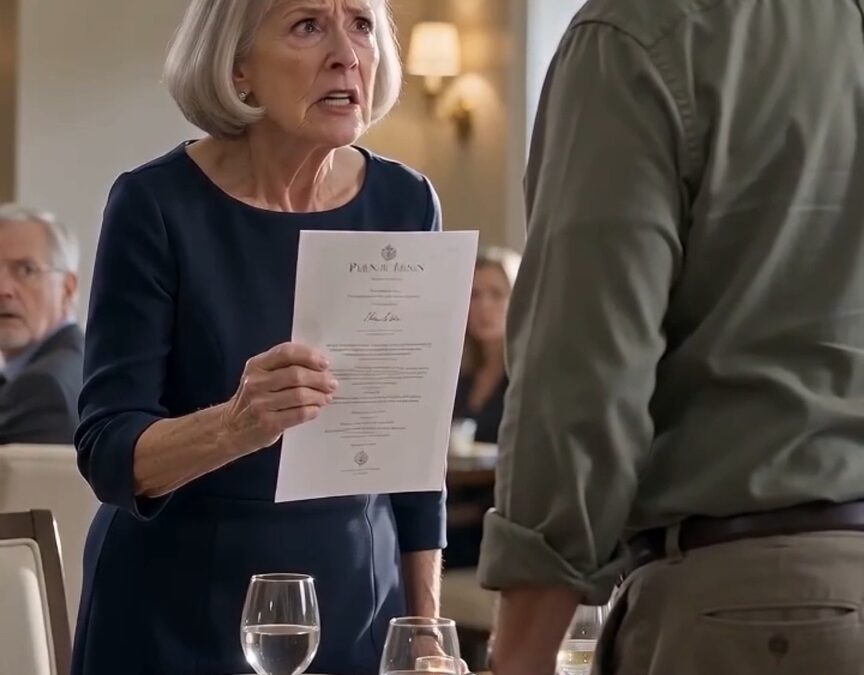
My daughter told the waiter to escort me out of my husband’s funeral luncheon.
I was 72, and Arthur’s burial flowers sat beside my chair.
The waiter had just brought the coffee around.
My chicken was still untouched beneath its pale sauce.
Natalie stood beside me in her funeral dress.
She had been watching me instead of eating.
“Could you help my mother outside?” she asked him.
He looked at me before moving toward our table.
“Does she need some air?”
“Yes,” Natalie said. “She’s getting herself worked up.”
“I haven’t asked to leave,” I told him.
He stopped near the end of the table.
Behind Natalie, relatives lowered their cups into their saucers.
Nobody reached for a coat or offered to leave.
The windows reflected the lights above our funeral lunch.
Outside, Richmond looked wet and gray through the glass.
My shoes were damp from the cemetery grass.
I pressed my heels down against the chair legs.
Natalie had asked about the workshop before the coffee arrived.
“Can we settle this before everybody leaves?”
“Not here,” I had told her.
She stayed standing when I moved the flowers closer.
“People have things to do, Mom.”
“So do I.”
“What does that mean?”
“It means I haven’t eaten.”
She looked at my plate without looking at me.
I had reserved the private room and paid for lunch. The money came from my personal checking account. Arthur liked this restaurant because nobody hurried him. I had hoped we would hear stories about him.
Instead, our daughter wanted an answer about a buyer.
“I already told the buyer we’re interested,” she said.
“You told him you were interested.”
“Don’t start splitting words.”
A relative paused with the cream pitcher above her coffee.
I put my napkin beside my untouched plate.
I could still feel the cemetery gravel through my soles.
Arthur had died on January 6, 2025.
His burial was that morning, January 11, 2025.
I had dressed without hearing him call from bed.
At home, I had left the bathroom light off.
During his illness, that light stayed on all night.
Now Natalie wanted me to consider selling the workshop.
“You don’t need that place,” she said.
“I need time to look at what you’re proposing.”
“Dad isn’t going back there.”
“I know where your father is.”
Across the table, my brother Philip folded his napkin.
He was 69, but he suddenly looked older.
I waited for him to say something to her.
He rubbed a mark on the tablecloth instead.
Natalie pulled the empty chair beside me backward.
Its legs scraped across the dining-room floor.
“You just kept the books,” she said.
“That wasn’t all I did.”
“Nobody said you didn’t help.”
“You just did.”
I picked up my fork and set it down.
“I won’t settle this over your father’s funeral lunch.”
That was when she called over the waiter.
Now he stood beside us, looking toward the hallway.
I saw him searching for the restaurant manager.
He hadn’t touched my arm or asked me to move.
Natalie leaned toward me while he waited.
“We can finish this without you making a scene.”
“I was sitting here eating lunch.”
“You weren’t eating.”
I pushed my chair back and stood to face her.
My knees hurt from the cemetery and the car.
The waiter moved aside to give me room.
I hadn’t stood because I agreed to leave.
I wanted her to stop speaking down at me.
For a moment, we stood beside the table together.
I could see the basket handle near my handbag.
The flowers still smelled faintly of the funeral home.
I turned toward my seat to sit down again.
Natalie put both arms against me and shoved.
My shoe slid before I caught my balance.
I stopped beside the doorway without falling.
The waiter moved forward, then stopped when I steadied myself.
Natalie stepped between me and my chair.
“Leave. Stop holding up my sale.”
I looked past her at my place setting.
My water glass still had a folded lemon slice.
The clean fork lay beside the plate I hadn’t finished.
“Your sale?” I asked.
“Please don’t do this today.”
“You brought it to the table.”
Philip got up before she answered.
I thought he was coming around to help me.
Instead, he reached down and lifted my plate.
“Let’s put this away,” he told the waiter.
“Philip, I wasn’t finished.”
“You can eat something at home.”
He carried it toward the serving station himself.
The waiter took it without asking me another question.
I watched the chicken disappear behind the coffee service.
Philip returned without meeting my eyes.
“A widow shouldn’t be discussing money at this lunch.”
“Then tell her to stop asking me.”
“She has arrangements to handle, Elaine.”
“So do I.”
He folded my napkin and laid it on my seat.
That small movement kept me looking at his hands.
He had seen me bring Arthur clean clothes.
He knew what the last years had required.
Yet he was clearing away my lunch for her.
Natalie kept her body between me and the table.
She glanced toward the door, expecting me to use it.
I wiped beneath my eye with the edge of my finger.
There was no place to set down my grief.
Even my napkin had been put out of reach.
“Mom, we can finish this somewhere else,” she said.
“You asked me here.”
“Everyone doesn’t need to hear the details.”
“They’ve heard what you think I did.”
A relative moved a cup away from the table’s edge.
Another looked toward the waiter by the doorway.
Nobody was eating now.
Natalie reached toward the back of my chair.
I could see my handbag beside the flower basket.
I had put something inside it before leaving home.
I knew exactly which pocket held it.
Philip started to say my name, then stopped.
I stepped away from the doorway and turned back toward the room.
Chapter 2: Hear Me First
“I kept his shop running,” I said.
Natalie looked over her shoulder at the relatives.
“You just kept the books.”
She said it as though that settled everything.
I stepped toward the table and faced her.
“Then hear me first.”
She let out a short breath through her nose.
“Mom, we can talk in the parking lot.”
“No. You asked me in front of everyone.”
Philip moved from the serving station toward my cleared place.
I bent carefully and took my handbag by its strap.
The basket stayed beside the chair where it belonged.
Inside my bag, the folded agreement rested against my wallet.
I had put it there on January 9, 2025.
That day, Natalie had come to discuss the workshop.
Arthur’s burial had not even happened yet.
She stood in my kitchen while I sorted funeral papers.
“There’s an offer for $240,000,” she told me.
“For the property?”
“Yes. It could be a clean sale.”
I put the funeral papers back into their envelope.
“We’ll discuss it after the burial.”
“The buyer won’t wait around forever.”
“I’m not discussing it today.”
She tapped the counter with her fingertips.
“I need to know whether you’ll cooperate.”
I remembered that word while I searched my bag.
She hadn’t asked what I needed from the property.
She hadn’t brought anything for me to review.
After she left, I opened our household file drawer.
I took out the agreement I had signed myself.
I checked the signature pages and folded it carefully.
Then I put it where I could reach it.
I expected another question, not a shove at lunch.
At the table, Natalie watched me open my handbag.
“Whatever that is, it can wait,” she said.
“It should have been read before this conversation.”
Philip looked from my face to the folded paper.
He knew I had kept Arthur’s accounts without wages.
He didn’t know what that paper said.
For years, people called the workshop Arthur’s place.
I answered the telephone and filed the receipts.
After retiring as a school secretary, I kept doing it.
People saw his cabinets and heard his name.
They didn’t see me matching payments to invoices.
They didn’t see what happened after he became ill.
His illness began in 2021.
There were mornings when I helped him to the sink.
He sat while I washed his back.
“Too hot?” I asked, wringing out the washcloth.
“No. Just stay there a minute.”
I worked slowly across his shoulders and beneath his neck.
A clean shirt waited on the towel rack.
When I helped him into it, his fingers struggled.
He couldn’t push the buttons through the holes anymore.
I fastened them while he watched the bathroom doorway.
“Did you finish the accounts?” he asked.
“Yes. Your customer’s measurements are entered, too.”
“Read those back to me.”
I brought his notes where he could hear me.
His shirt was still open at the collar.
He stopped me when I reached the cabinet depth.
“Check that against the drawing.”
I set down the washcloth and checked his notes.
Then I finished his shirt and straightened the collar.
That was part of caring for him for four years.
Later, after he retired, the workshop still needed accounts.
An unrelated cabinetmaker rented the property from our LLC.
Rent paid the property expenses and supported owner distributions.
That income mattered when I planned my retirement spending.
I couldn’t replace it by simply taking another job.
Standing beside my luncheon chair, I unfolded the agreement.
Natalie started reaching toward the chair again.
Philip came around and stood beside me.
He looked down at the page without taking it.
I straightened and held the agreement at chest height.
“I can explain the workshop myself,” I told the room.
The waiter remained near the doorway, watching Natalie.
I turned the signed pages so the room could see.
“I own half. You need my yes.”
Natalie stopped reaching for my chair, and her mouth fell open.
She stepped backward from the spot where she had blocked me.
For a moment, she looked at Philip instead of me.
He stayed beside me, reading the page I held.
“This is our signed LLC operating agreement,” I said.
“Arthur and I owned the property company equally.”
Natalie opened her mouth, then shut it again.
“The workshop property belongs to that company,” I continued.
“A property sale requires both owners’ written approval.”
I touched the provision without lowering the document.
“Elaine owns half. Both owners must approve any sale.”
Those were the facts she needed to understand.
The signed agreement set them out in formal language.
I wasn’t asking the room to decide whether I mattered.
I was explaining what our company documents required.
“Mom, wait. We can talk,” Natalie said.
“We are talking.”
“I didn’t know you meant ownership.”
“You never asked me.”
Her eyes moved toward the signatures.
She hadn’t read this agreement before the luncheon.
She had assumed the workshop belonged entirely to Arthur.
My bookkeeping had fit that assumption neatly enough.
Philip leaned closer without putting his hand over mine.
“Elaine, you signed this when you bought it?”
“Yes.”
Natalie glanced toward the relatives still sitting behind her.
She stopped trying to usher me toward the door.
“Dad left his estate to me,” she said.
I kept the agreement where everyone could see it.
“He could leave what was his.”
She pressed her lips together and looked at the page.
Then she asked the question she should have asked earlier.
“What exactly did he own?”
Chapter 3: Half the Workshop
“He owned his half of the company,” I said.
“Not mine.”
Natalie stood near the chair she had pulled backward.
The waiter quietly moved the coffee service farther away.
Philip stayed close enough to read over my shoulder.
I lowered the agreement slightly, but kept it open.
“We bought the property through the LLC in 2018.”
Natalie looked toward the relatives, then back at me.
“Dad handled the workshop.”
“Arthur made cabinets. We both bought the property.”
She crossed her arms, listening now.
I didn’t have to search my memory for the purchase.
I remembered the folder laid across our kitchen table.
Arthur had cleared away the crumbs before we opened it.
We had discussed whether we could afford the building.
My savings were supposed to help pay for retirement.
I had worked in a school office for years.
I knew how long it took to save money.
Arthur knew it, too.
In 2018, we each contributed $80,000.
The property cost $160,000, with no property debt.
We bought it through our property-holding LLC.
Each of us owned half of that company.
Before signing, I asked about selling the building later.
“What happens if we disagree?” I had asked.
The attorney showed us the approval provision.
Both owners had to give written approval for a sale.
I read it before putting my name underneath it.
Arthur read it, too.
We kept our signed agreement with the purchase records.
My copy went into the file drawer at home.
At the luncheon, I turned toward the relevant page.
“My contribution wasn’t a gift to your father.”
“I didn’t say it was,” Natalie replied.
“You said I just kept the books.”
She looked away from the page.
“That’s what I saw you doing.”
“That was work. This was ownership.”
Philip drew his chair slightly away from my place.
He still hadn’t offered to return my plate.
I could see him looking at the empty space.
Natalie drew closer, but left room for me now.
“Then the company owns everything in the workshop?”
“No. It owns the real estate.”
I explained that slowly because she needed the distinction.
Arthur’s tools and his personal estate were separate matters.
Her event-rental business was separate from all of it.
The property company did not own her business.
Her business did not own the workshop property.
The tenant paid rent under the existing workshop lease.
That rent covered property expenses and provided owner distributions.
None of that changed because Arthur had died.
A relative leaned forward, then settled back without speaking.
Natalie smoothed her dress along her hips.
“His will leaves his estate to me.”
“Yes.”
“He named me executor.”
“He nominated you to handle the estate.”
I wasn’t going to debate probate details over cooling food.
But I wouldn’t let her use the will against me.
“His estate holds his interest while administration is pending.”
“So I’m supposed to wait for everything?”
“You haven’t inherited his membership interest today.”
She took a breath and studied the agreement again.
She was no longer talking about my clerical help.
Now she was trying to identify what she could control.
I knew that look from our kitchen conversation.
She wanted an answer that would keep her buyer waiting.
“Couldn’t we agree now and finish the estate later?”
“I’m not agreeing to your proposed sale.”
“You haven’t even talked to the buyer.”
“I haven’t approved the price or the sale.”
“The offer is $240,000.”
“I heard you.”
“It’s a real buyer, Mom.”
“I haven’t said otherwise.”
She glanced at Philip, but he didn’t help her.
I folded the bottom page back under the agreement.
The edges had softened where I’d carried it in my bag.
Natalie reached toward it, then stopped before touching it.
“Can I have that?”
“You can have a copy through the attorney.”
“I’m your daughter.”
“Yes. You also just tried to remove me.”
Her eyes moved toward the waiter near the doorway.
He hadn’t left since she asked him to escort me.
I could see her noticing him as a witness.
She lowered her voice.
“I thought you were getting upset.”
“You shoved me when I tried to sit down.”
Philip finally looked straight at her.
Natalie didn’t argue about whether it happened.
Instead, she shifted back to the property.
“If you hold this up, the buyer could leave.”
“That doesn’t make the price acceptable.”
“You don’t know that it isn’t acceptable.”
“Then we need information before making a decision.”
I placed the agreement against my chest with both hands.
My stomach felt empty beneath my funeral clothes.
I wanted water, food, and the use of my chair.
I also wanted her to stop calling this her sale.
“We’re not selling it on your promise,” I said.
“There isn’t a contract,” she answered quickly.
“That is useful to know.”
She seemed to regret giving me that detail publicly.
Philip looked at the relatives and back at Natalie.
Nobody offered her a way around the signed agreement.
She could ask, but she couldn’t supply my approval herself.
I looked down at the basket near my feet.
A flower had bent against the handle during the commotion.
I freed it with my finger and let it rest.
When I straightened, Natalie was watching my face.
Her voice had changed from commanding to careful.
“Can we discuss the offer without everyone listening?”
“We can discuss why you need an answer so quickly.”
She glanced toward the hallway outside the private room.
Then she stepped aside and asked for a private conversation.
Chapter 4: What She Needed
I put the agreement back inside my handbag.
I didn’t give it to Natalie to carry.
We moved just outside the private dining room.
The door stayed partly open behind us.
I could still see Philip near my empty place.
The waiter spoke quietly to the restaurant manager.
Natalie waited until we were beyond the nearest relatives.
“Please don’t make this harder than it is.”
“Tell me why it has to happen quickly.”
She rubbed beneath the strap of her handbag.
For the first time that afternoon, she looked tired.
Not grieving in the way I felt it.
Tired from keeping track of something she couldn’t manage.
“My business has debts,” she said.
“How much?”
She looked back through the doorway before answering.
“$180,000.”
I kept my hand around my handbag strap.
Until then, I hadn’t known the full amount.
She owned an event-rental business, and I knew it struggled.
I hadn’t known the business owed that much.
“Have creditors sued?” I asked.
“Not yet.”
“Then what have you promised this buyer?”
“We’ve discussed $240,000 for the property.”
“Have you signed a sale contract?”
“No. It’s a nonbinding offer.”
“Is there a closing?”
“No.”
She answered faster now that the facts were coming out.
The buyer wanted a quick, uncomplicated purchase.
Natalie wanted money before her business creditors sued.
She had treated the workshop as money already available.
She had not stopped to find out who owned it.
“Once the estate gets handled, it could work,” she said.
“Not without my written approval.”
“I understand that now.”
“Then stop telling people I’m holding up your sale.”
She looked down the restaurant hallway.
I watched her press a fingernail against her purse clasp.
“I was trying to keep the business from collapsing.”
“By using property that holds my retirement savings.”
“There would still be money left.”
“You haven’t checked what the property is worth.”
“It’s an offer we have.”
“That doesn’t make it the right offer.”
She shifted closer, speaking quietly enough for privacy.
“If we lose time, the debts get worse.”
“I’m sorry your business is in trouble.”
“Then help me get this done.”
“I’m not approving a rushed sale to pay your debts.”
She looked at me as though I had changed the subject.
I hadn’t. I had finally named the reason for it.
The workshop was not security for her business debts.
My savings had not been put there for that purpose.
She couldn’t spend my interest because her business needed cash.
“I’m not asking you to hand me everything,” she said.
“You asked me to leave while you finished without me.”
“I shouldn’t have done that.”
“No.”
She waited, perhaps expecting me to soften the answer.
I adjusted the handbag strap on my shoulder instead.
“We’ll deal with the property through proper records.”
“You’re going to bring lawyers into this?”
“The company already has records with an attorney.”
She glanced again toward the dining-room door.
Through the opening, I saw the manager lift my folded napkin.
“I want a copy of the agreement,” Natalie said.
“You’ll get one.”
“And you’ll at least look at the offer?”
“I’ll have the situation reviewed.”
That was all I could honestly promise her.
We went back into the private room together.
Natalie no longer stepped ahead to block my path.
The manager came toward me before I reached my chair.
“I’m sorry your lunch was removed,” the manager said.
“Would you like your place restored?”
“Yes. I wasn’t finished.”
The manager moved the napkin from the seat.
The waiter brought a clean place setting and fresh food.
I sat without asking anyone for permission.
Philip stepped away so I could pull the chair in.
The basket handle touched my calf beneath the table.
I moved it carefully so the flowers wouldn’t be crushed.
Natalie sat down instead of standing over me.
For a while, the only sounds were cups and silverware.
I cut the chicken into small pieces.
My mouth was dry, and swallowing took some effort.
The waiter refilled my water without asking about air.
A relative spoke quietly about Arthur’s patience in the workshop.
I listened with my fork resting against the plate.
That was the kind of conversation I had wanted.
Nobody asked me to answer another property question at lunch.
Philip kept looking at the replaced plate.
I didn’t help him stop looking.
When I finished, I folded my own napkin.
I checked that the agreement remained inside my handbag.
Natalie rose when relatives began collecting their coats.
She didn’t touch my chair or offer to carry my bag.
At the doorway, she spoke near my shoulder.
“I need this handled soon.”
“I’ll call the attorney on Monday.”
“That could scare off the buyer.”
“I’m not approving the offer to keep him comfortable.”
Her face tightened, but she didn’t repeat the argument.
She knew by then that witnesses had heard my refusal.
I bent toward the flower basket, but Philip reached for it.
“I can carry that,” he said.
“You can carry it to the car.”
He lifted it carefully without disturbing the flowers.
I followed with my handbag held against my side.
At home, I set the basket near my breakfast chair.
The house smelled of the flowers before I removed my coat.
I put the agreement back on the kitchen table.
Natalie’s description of the offer was still only spoken.
On Monday, I would need every part put in writing.
Chapter 5: My Call on Monday
On January 13, 2025, I called my attorney.
The agreement lay open beside the telephone.
I had taken it from my handbag before breakfast.
Arthur’s flowers stood near my chair, still in their basket.
I moved my cup away from the signed pages.
“I need the LLC agreement checked,” I said.
“Checked against the existing records, not just my copy.”
The attorney asked what had happened.
I described the buyer discussion and the proposed price.
Then I explained what Natalie had assumed at lunch.
I didn’t begin with how she had treated me.
I began with ownership, consent, and the proposed transaction.
When those details were clear, I described the shove.
The attorney let me finish without interrupting.
“Have you signed anything concerning this proposed sale?”
“No.”
“Have you authorized Natalie to approve it for you?”
“No.”
“Do you want the proposal reviewed or rejected?”
“I refuse this proposed sale.”
Saying that at home felt different from saying it publicly.
There was no daughter blocking a chair in front of me.
There was only my copy of something I had signed.
I wanted the attorney to verify it before sending anything.
We arranged for my retained agreement to be examined.
I put it into a plain folder with my notes.
I included the purchase information I had kept at home.
I didn’t alter or write across any original pages.
At the attorney’s office, I laid the folder down.
The attorney brought out the existing LLC records.
I watched the signatures and provisions being compared.
The purchase records showed our contributions and the property purchase.
The company documents showed equal ownership.
The sale provision required both owners’ written approval.
My memory had matched the records.
The copy I had held at lunch was complete.
“Your husband’s estate holds his interest during administration,” the attorney explained.
“Your own membership interest remains yours.”
“And Natalie can’t approve a property sale for me.”
“Correct.”
The attorney also separated the property from Arthur’s other assets.
His tools were not the workshop real estate.
His will did not transfer anything I already owned.
The property company was not Natalie’s event-rental business.
Those distinctions seemed obvious when laid across a desk.
At lunch, she had tried to hurry past all of them.
“Please communicate the refusal to Natalie and the buyer.”
The attorney asked for the information Natalie had provided.
I gave what I had and requested the offer in writing.
There was no signed contract to cancel.
There was no scheduled closing to stop.
There was a proposal I had not approved.
The attorney prepared a formal communication stating my position.
It identified my ownership and the required written consent.
It made clear that I had not supplied that consent.
I read it before authorizing it to be sent.
“Please don’t describe this as a family misunderstanding,” I said.
“It’s a decision about property I partly own.”
The attorney kept the language factual.
I carried my retained agreement home in the folder.
I put it back in the drawer after checking it again.
The basket still stood beside the breakfast chair.
Some petals had begun falling onto the floor.
I picked them up before making something to eat.
Natalie called after the attorney’s communication reached her.
“You told the buyer no.”
“Yes.”
“You could have let me explain things first.”
“You explained the debts. I refused the sale.”
“The buyer doesn’t want a family dispute.”
“I don’t want an unauthorized property transaction.”
She paused long enough that I heard her breathing.
“I sent you the offer information.”
“I’ll keep it with the records.”
“You’re making this very formal.”
“It concerns most of my savings.”
She didn’t deny the agreement’s terms anymore.
Instead, she argued that the buyer might not stay.
That was a practical concern, but not a reason to agree.
“If he walks away, we start over,” she said.
“Then we start with an independent value.”
“What do you think it’s worth?”
“I don’t know yet.”
That answer seemed to frustrate her most.
She wanted my uncertainty to make me accept her certainty.
I wasn’t going to supply a made-up price.
Afterward, I wrote down what we had discussed.
I kept my notes separate from the company documents.
The attorney later confirmed that the buyer had withdrawn.
Without my approval, the proposed purchase was not proceeding.
Natalie had lost the quick transaction she had expected.
I had not sold anything or received anything.
I still owned my half and needed to evaluate it.
I returned to the attorney’s office with a clear request.
“I want an independent appraisal of the real estate.”
The existing lease needed to be available for the review.
The appraiser would need access consistent with the tenant’s work.
I didn’t want an inflated number chosen for an argument.
I wanted the property examined by someone independent.
The attorney helped arrange the proper next steps.
At home, I gathered the lease and property-expense records.
My old bookkeeping habits made that part familiar.
I labeled the folder without putting Natalie’s debts inside it.
Her business had a separate problem to resolve.
The workshop needed its own value established.
When Natalie called again, I told her about the appraisal.
“So now we wait for someone else’s number?”
“We wait for a supported value.”
She was quiet before answering.
“And what happens if it’s more than the offer?”
Chapter 6: The Price We Could Check
“Then we use that information,” I told Natalie.
I didn’t tell her what number I hoped to see.
I wanted the appraisal done without a family target.
The independent appraiser needed the property records and lease.
I gathered them at my kitchen table before the visit.
The folder held expenses, rent information, and ownership details.
It did not contain Natalie’s business debts.
Those debts did not change the workshop’s market value.
At the property, the tenant made access available.
The workshop was occupied by an unrelated cabinetmaker now.
I waited where I wouldn’t interfere with the work.
The smell of wood dust stayed on my coat.
Arthur had spent so much time in rooms like that.
I kept my attention on the folder in my hands.
The appraiser looked through the building and asked factual questions.
I answered what I knew and identified the records.
When I didn’t know something, I said so.
I didn’t point to Arthur’s workmanship as proof of value.
I didn’t describe Natalie’s lunch behavior to the appraiser.
The assignment concerned the property, not our argument.
After the inspection, I put the lease back into its sleeve.
The tenant needed to continue working without family interruptions.
I confirmed that the appraisal did not change the lease.
Nobody had asked the tenant to leave.
At home, I set the folder in the drawer.
The flowers in the basket were drying by then.
I removed the ones that had begun dropping petals.
I didn’t take the basket out with the discarded stems.
Its handle made it easy to move while cleaning.
I put it back beside the breakfast chair afterward.
The appraisal was dated February 14, 2025.
The independent value was $320,000.
I read the report before calling Natalie.
I checked that it concerned the workshop real estate.
Then I called the attorney and discussed the findings.
There was no property debt to subtract.
There were no other material LLC assets or liabilities.
The real estate supported a clear starting point for discussion.
The proposed $240,000 offer had been below the appraised value.
Natalie’s urgency would have cost me money.
I sat with the report open while the attorney explained it.
I asked about a sale and about a membership buyout.
Neither could be treated as completed while administration was pending.
Arthur’s half still belonged to his estate.
Natalie would receive it only after the estate process allowed.
I asked that she receive the report before we discussed terms.
I wanted the same pages in front of us.
When we spoke, she had already read the conclusion.
“So you won’t consider the old price now.”
“No.”
“An appraisal doesn’t guarantee a buyer.”
“I understand that.”
“We could spend time finding someone who pays less.”
“Then we evaluate an actual market sale properly.”
She had stopped claiming the workshop was entirely hers.
Now she was arguing about risk and timing.
Those were real questions, so I answered them directly.
“I’ll consider an agreed sale at a supported market price.”
“And if I want to keep it?”
“After estate administration, you can buy my half.”
“What price?”
“$160,000.”
She looked back down at the appraisal.
“That assumes half of the property value.”
“Yes. We can have the terms reviewed.”
I did not pretend a membership interest and real estate were identical.
The attorney explained the distinction in the negotiations.
With no property debt or other material company balances, we could agree.
I would not accept a minority discount to solve her cash shortage.
She would be receiving the other half through the estate.
A buyout would leave her owning the entire company.
She would also receive the benefit of the continuing lease.
“I don’t have that sitting in a bank account,” she said.
“Then don’t promise a buyout until you arrange it.”
“You know what my business owes.”
“Yes.”
“And you know why I wanted the sale.”
“Yes. That doesn’t reduce my ownership.”
She ran a finger along the edge of the report.
I kept my hands around my cup.
I had wondered whether giving her options would feel harsh.
Across the table, the numbers made it less confusing.
I wasn’t demanding her business survive or close.
I wasn’t requiring her to keep the workshop property.
I was requiring her not to use my interest without paying me.
“If we sell, I need to approve the actual terms.”
“I know.”
“If you buy me out, the purchase funds must be there.”
“I heard you.”
She sounded irritated, but she was listening.
That was different from telling a waiter to remove me.
The attorney helped put the choices into a written proposal.
It did not promise an immediate transfer from the estate.
It did not pledge my interest for Natalie’s financing.
It did not turn her business debts into company obligations.
I read every page before allowing it to go forward.
At home, I put the appraisal beside the agreement.
I no longer needed to carry either in my handbag daily.
The records had been verified and the refusal communicated.
Natalie called while I was sorting the latest rent paperwork.
“I’ve been looking at what I can sell,” she said.
“The workshop?”
“No. My inventory.”
I set the paperwork down and waited for her to continue.
Chapter 7: Her Debts, Her Inventory
Natalie’s event-rental inventory belonged to her separate business.
It had never belonged to the workshop property company.
For once, she was looking at assets she controlled.
“I can liquidate it,” she told me.
“What does that leave the business?”
“Not much of a rental business.”
I didn’t tell her that she should have done it sooner.
I knew she was describing a real loss.
But she had wanted me to absorb part of it.
I wasn’t going to apologize for refusing.
She spread her inventory information across my kitchen table.
I moved my breakfast things before she set it down.
The basket stayed on the floor beside my chair.
By then, I had removed the remaining dried flowers.
Natalie didn’t comment on the empty basket.
She was looking at what could be sold.
“I need to deal with the creditors,” she said.
“Yes.”
“If I do this, I can separate the debts from the property.”
“They were already separate from the property.”
She looked up sharply, then nodded.
“I mean in practical terms.”
“I understand.”
I let her explain without offering my savings.
She had to arrange the liquidation and payments herself.
I didn’t sign a guarantee or offer the LLC as security.
I didn’t promise to reduce the proposed buyout price.
When she gathered the papers, she looked exhausted.
“Dad would hate seeing the business sold off.”
“I can’t tell you what he would say.”
She waited, perhaps expecting me to speak for him.
I kept my cup on its saucer and said nothing more.
Later, Natalie told me the liquidation had been completed.
The inventory brought $180,000.
She used the proceeds to pay the business debts.
Those payments were separate from any purchase of my membership interest.
There was no workshop sale funding them.
There was no transfer from my personal account.
She showed me the completed debt-payment information when we discussed next steps.
I looked at it, then returned it to her.
“You should keep that with your business records.”
“You don’t want a copy?”
“Not in the workshop ownership file.”
She gathered the papers into her own folder.
Her business creditors had been paid through her inventory liquidation.
The immediate pressure behind the funeral offer was gone.
Keeping the workshop would require a different financial decision.
That was hers to make.
Philip visited while those discussions were still continuing.
I saw his car and put water on for coffee.
He stood in the doorway holding his coat awkwardly.
“Is this a bad time?”
“No. Come in.”
He looked toward the empty basket beside my chair.
Then he took the seat across from me.
For a while, he asked about the appraisal and attorney.
I answered without handing him the whole file.
He hadn’t come because he needed to review the figures.
He kept rubbing his thumb against the cup handle.
Finally, he put the cup down.
“I owe you an apology about the luncheon.”
I waited for him to finish.
“I removed your plate when you said you weren’t finished.”
“Yes.”
“I helped her make you leave.”
“You helped clear my place.”
He nodded and looked down at the table.
“I thought stopping the money talk would help.”
“You didn’t stop her. You stopped me.”
He stayed quiet.
“I told you to ask her to stop,” I said.
“You told me she had arrangements to handle.”
“I remember.”
“You knew what I had done for Arthur.”
“I did.”
“You didn’t need to know I owned the building.”
His eyes filled, but I kept my cup steady.
The apology wasn’t about whether I had won the argument.
It was about the plate he carried away.
“I’m sorry I took your lunch away,” he said.
“I’m sorry I told you to eat at home.”
I looked toward the place where Natalie had spread her papers.
“I needed my brother beside me before the agreement came out.”
“I should have been there.”
“You stood beside me afterward.”
“That doesn’t undo it.”
“No.”
He didn’t ask me to tell him he meant well.
He didn’t say everyone had been upset.
He sat while I drank the coffee that had cooled.
“I accept your apology,” I told him.
“I’m still upset about what happened.”
“I understand.”
I got up to bring something to eat.
He started to rise and reach for my cup.
“Leave that,” I said. “I’m still using it.”
He let go immediately and sat down.
We ate at the kitchen table without discussing Natalie’s offer again.
When I finished, I carried my own plate to the sink.
Philip asked before taking anything else from the table.
That mattered more than another speech would have.
At the door, he looked back at me.
“If you need me at another meeting, I’ll come.”
“I’ll tell you.”
After he left, I rinsed the cups and dried them.
Natalie called before I had put them away.
She said she had been considering the workshop buyout.
“The business debts are paid,” she said.
“I know.”
“I still want to keep the property.”
“Then you need a way to pay for my half.”
She paused, then spoke more carefully.
“I’m going to look at financing against my house.”
Chapter 8: The Other Half
Natalie owned her residence free of mortgage debt.
That gave her a possible source of financing.
It did not make a loan automatic or risk-free.
“I’ll have to see what the lender approves,” she said.
“Yes.”
“You won’t pledge your interest?”
“No.”
I had no reason to turn her buyout into my borrowing risk.
She would decide whether to borrow against her home.
I would decide whether the purchase terms protected my payment.
Until then, we remained where the documents placed us.
My half was mine.
Arthur’s estate held his half during administration.
The estate still had its own ordinary obligations to complete.
I kept that distinction in every conversation.
Natalie was nominated executor under Arthur’s will.
That did not make his membership interest personally hers at the funeral.
The attorney handled the estate process and ownership records.
I provided records when properly requested.
I did not hand over my own membership interest.
I also kept the workshop accounts current while matters were pending.
Rent still came in under the existing lease.
Property expenses still had to be paid.
Arthur’s death hadn’t stopped taxes, insurance, or maintenance obligations.
I kept the receipts arranged as I always had.
But I began setting aside what Natalie would need later.
I didn’t want a transfer followed by unanswered bookkeeping questions.
At my kitchen table, I separated company records from household records.
Arthur’s personal papers went into a different folder.
The workshop lease stayed with the property company materials.
Natalie’s business-debt information stayed out of them.
Keeping those piles separate made each conversation easier.
On June 30, 2025, estate administration completed.
The ordinary estate obligations had been paid.
Natalie received Arthur’s half of the LLC membership interest.
Under the agreement’s succession provisions, she became the other member.
Now the ownership discussion was between Natalie and me.
There was no need to pretend it had happened earlier.
The attorney confirmed the completed transfer and company records.
I read the confirmation before putting it in the file.
Natalie sat across from me during the next discussion.
“I own Dad’s half now.”
“Yes.”
“And I want to buy yours.”
“Then we can finalize terms.”
She didn’t ask again whether I would accept the old offer.
The appraisal remained the basis for our negotiated price.
The company had no property debt.
There were no other material LLC assets or liabilities.
We agreed on $160,000 for my half interest.
We agreed not to apply a minority discount.
The attorney put the agreed treatment into the purchase terms.
I read the amount without feeling any need to defend it.
It was no longer a number shouted around funeral coffee.
It was a price both sides could review.
The lease needed attention before any closing was arranged.
The existing tenant was to remain in place.
Buying my membership interest would not terminate that lease.
The property would still belong to the same LLC.
Natalie would eventually own the entire company, not a vacant promise.
We went through the lease and rent records.
The tenant confirmed the existing arrangement.
I answered questions about where payments and notices were recorded.
Natalie took notes instead of telling me I had only helped.
That didn’t erase what she had said at lunch.
It did mean she was finally looking at the work.
“Will the tenant need to sign a new lease?” she asked.
“Not because you purchase my membership interest.”
The attorney confirmed the lease would continue under its terms.
I pointed Natalie toward the company files she would receive.
She would need them when I stopped handling accounts.
“I can’t call you every time something comes in?”
“You’ll have the records.”
“I’m asking about questions.”
“Ask them before we finish the transfer.”
She tapped her pen against the page and continued reading.
I stayed until the questions on that folder were answered.
At home, I wrote down the remaining handoff items.
I made no promise to keep bookkeeping without wages afterward.
That work had occupied enough of my retirement.
Natalie submitted her financing application against her mortgage-free home.
The loan request was for $160,000.
She supplied the information the lender required.
I did not sign as a borrower or guarantee repayment.
The purchase depended on her financing, not on my patience alone.
She called as the loan review proceeded.
“They want more documents about the purchase.”
“Have the attorney provide the appropriate records.”
“They need the agreement and valuation.”
“Those are available.”
I kept my original signed agreement at home.
Copies could go where they were properly needed.
The paper that had stopped the luncheon sale now guided the transfer.
It protected a sale I chose, on terms I reviewed.
When Natalie called again, her voice sounded businesslike.
“The financing has been approved.”
I took out the attorney’s contact information.
“Then we can arrange the closing.”
She paused before adding something important.
“They’ll need everything signed before the loan funds are released.”
Chapter 9: The Closing Appointment
“The attorneys can coordinate the funding and signing,” I said.
“I won’t release my interest without verified purchase funds.”
Natalie didn’t argue.
By then, she understood I would read the instructions.
The closing was set for September 12, 2025.
Before leaving home, I checked the document list again.
I put my identification and required papers into my handbag.
The original operating agreement stayed safely in its file.
I didn’t need to hold it up to anyone again.
The closing papers had been prepared for an agreed transaction.
I ate before leaving, though I wasn’t very hungry.
I rinsed the dish and left it to dry.
Beside the breakfast chair, the empty basket stayed in place.
I brushed against its handle while pushing my chair back.
Then I went to the appointment.
Natalie was already there when I arrived.
She had a folder open in front of her.
The attorneys had the membership-interest purchase documents ready.
I took the chair offered to me and set down my bag.
Nobody told me where else I should wait.
The attorney explained the documents and the closing procedure.
I asked where the funding confirmation would appear.
The answer was provided before I touched a pen.
Natalie’s home-equity financing supplied the $160,000 purchase price.
The loan was secured against her home.
It was not a loan against my remaining savings.
It did not leave me responsible for her repayment.
I reviewed that distinction with the other closing terms.
The transaction was a purchase of my membership interest.
The LLC would continue owning the workshop real estate.
Its existing lease would continue as well.
Natalie would become the sole LLC owner after closing.
There was no separate sale of the building to her old buyer.
That proposal had ended when my refusal was communicated.
I turned the pages slowly enough to read them.
Natalie kept her hands folded near her folder.
When I reached something unfamiliar, I asked about it.
The attorney answered without moving the page out of reach.
At the payment provisions, I stopped again.
“This is the full agreed purchase amount?”
“Yes.”
“And the funds have been verified for closing?”
The attorney confirmed the funding status and explained the disbursement.
I checked the information against the closing statement.
The purchase price shown was $160,000.
I understood that personal tax obligations would be considered separately.
Nobody promised that every dollar would remain tax-free.
I had already planned to obtain tax advice afterward.
Natalie looked at the page beneath my hand.
“Is there anything else you need?”
“I’m checking the transfer and payment together.”
“All right.”
She sounded impatient, but she stayed seated.
There was no request to hurry for another buyer.
Her financing was ready, and the agreed documents were ready.
I signed only after the closing funds had been verified.
The attorney indicated the remaining signature locations.
I checked each page before signing where required.
Natalie signed her own documents.
Then the attorneys completed the membership-interest purchase.
The effective transfer left Natalie owning the entire company.
The payment instructions directed my proceeds to my account.
I kept copies of the completed closing documents.
The attorney explained what had been completed and what records would follow.
I asked when I could independently verify receipt.
Then I put my pen away.
For a moment, Natalie and I simply sat there.
We had spent months discussing a property she had assumed was hers.
Now she had paid for the portion that wasn’t.
Her business inventory had paid her business creditors.
Her home-equity loan had funded this separate purchase.
My savings had not been used to cover the business debts.
I checked that distinction once more in my closing copies.
Natalie began gathering her papers.
“I’ll need to change where the bookkeeping notices go.”
“The handoff folder identifies them.”
“And the rent records are complete?”
“They’re current through the agreed handoff.”
She opened the folder I had prepared.
The lease sat behind the property records.
The expense information followed in its labeled section.
I had included what she needed to take over.
I had not left a promise that I would keep doing it.
“You kept all of this yourself?” she asked.
“Yes.”
She looked through another section without replying.
The attorney reviewed the continuing company arrangements with her.
I listened for anything requiring my further approval.
Once my interest had transferred, future management would be Natalie’s responsibility.
She could get bookkeeping help if she needed it.
She could decide what to do with the property lawfully.
She could also keep collecting rent under the continuing lease.
Those decisions no longer involved my retirement money.
Outside the appointment, Natalie stopped beside me.
“I know this wasn’t how you wanted things to go.”
“No.”
“I thought selling would solve everything quickly.”
“It would have used money that wasn’t all yours.”
She looked down at the folder in her arms.
“I understand that now.”
I didn’t tell her the luncheon no longer mattered.
I didn’t bring it up as a new condition, either.
The purchase was finished on the terms we had agreed.
I needed time before deciding what else could change.
“Call before you come over,” I told her.
“I will.”
We went to our cars separately.
At home, I placed the closing copies on the kitchen table.
I washed my hands and filled a glass of water.
Then I sat down to check my account.
The transaction had closed, but I still wanted to see the deposit.
Chapter 10: Breakfast at Home
My account received $160,000 from the completed buyout.
I checked the deposit against the closing statement.
Then I checked the account information once more.
The money was there, under my control.
I put the statement beside the completed purchase papers.
For a while, I didn’t do anything with either.
I finished my water and looked around my kitchen.
There were no workshop receipts waiting beside the toaster.
There was no rent entry left for me to make.
I had handed those records over at closing.
The next property question would go to Natalie.
I kept the buyout papers with my own financial records.
They were not mixed into the old company bookkeeping.
My retained agreement went into the same personal file.
I had needed it to establish what belonged to me.
Now I also had documents showing my chosen sale.
The money was received before any personal tax liability.
I did not treat the whole deposit as spending money.
I arranged for tax advice and gathered the requested records.
The purchase contribution, ownership documents, and closing statement all mattered.
I brought the information instead of guessing at the tax result.
I asked what should be reserved for any resulting obligation.
Then I followed the advice for my own circumstances.
Nobody told me the proceeds were automatically tax-free.
Nobody told Natalie she could borrow from them afterward.
I kept control of where the money remained.
My retirement arrangements no longer depended on the workshop distributions.
I reviewed my regular expenses with the funds available.
I planned what could support my household and what needed holding back.
The decisions were ordinary, detailed, and mine to make.
I didn’t have to account for Natalie’s business shortfall.
Her inventory liquidation had paid those debts separately.
Her loan payments now belonged in her household planning.
I did not ask for access to her bank statements.
She did not get access to mine.
The first workshop message after closing came from Natalie.
She had found an expense notice in the company records.
“Was this normally handled with the other property bills?”
“Yes. It’s identified in the handoff folder.”
“Could you enter it for me this time?”
“No. I’m not handling the workshop accounts now.”
There was a pause on the telephone.
“All right. I’ll take care of it.”
I didn’t reach for my old ledger after we hung up.
I put the telephone down and continued making lunch.
For years, a question like that had stopped whatever I was doing.
Now the property had an owner responsible for its work.
The tenant remained under the existing lease.
Natalie managed the property and its records herself.
If she needed professional help, she could arrange it.
That was part of owning the whole company.
Our contact remained cautious.
She called before visiting, as I had asked.
Sometimes we spoke only about how we were doing.
Sometimes the conversation became awkward and ended quickly.
I didn’t fill every pause for her.
I also didn’t pretend she had become a stranger.
She was still my daughter, now 47.
I was still her mother and Arthur’s widow.
But she no longer controlled a discussion about my retirement money.
There wasn’t any of mine left inside her company.
Philip came for coffee again after the buyout.
He asked whether the payment had arrived.
“Yes,” I told him. “The full $160,000.”
“I’m glad.”
He looked toward my plate when I paused eating.
Then he waited instead of reaching across the table.
“Are you finished with that?” he asked eventually.
“Not yet.”
He left it where it was.
We talked about Arthur without discussing a sale.
Philip remembered how carefully Arthur checked cabinet doors.
I remembered the way he asked for measurements at the sink.
For once, I could mention that morning without defending my work.
I described finishing his shirt while his notes lay nearby.
Philip listened without telling me what a widow should discuss.
When he left, he asked whether I wanted help clearing up.
“I’ll do it after I finish,” I said.
“All right.”
I ate what remained while it was still warm.
Later, I took the empty basket outside to brush it clean.
Dried pieces from the burial flowers had caught beneath the rim.
I loosened them carefully over the trash.
The handle was still firm where Philip had carried it.
I wiped the bottom and let it dry.
I didn’t replace the burial flowers with artificial ones.
I didn’t put the basket away in a closet.
It had come home with me after the luncheon.
I wanted it where I could see it.
The next morning, I dressed before making breakfast.
I turned off the hallway light without checking for Arthur.
Then I filled the kettle and took down my cup.
There were days when those movements still made me stop.
That morning, I opened the cupboard and chose a plate.
I made toast and carried it to the table.
My financial folder was put away, not beside my food.
The telephone stayed on the counter while I ate.
Nobody needed an answer before I finished breakfast.
I spread jam to the edges of the toast.
I drank my coffee while it was hot.
When I moved my chair, my foot touched the handle.
I shifted it gently so it wouldn’t catch beneath a leg.
Then I settled back beside Arthur’s empty flower basket.
You Might Also Enjoy




