My fiancé demanded my $210,000 for a house I wouldn’t own—Then bank records exposed who paid for my ring, and prosecutors charged him with identity theft.
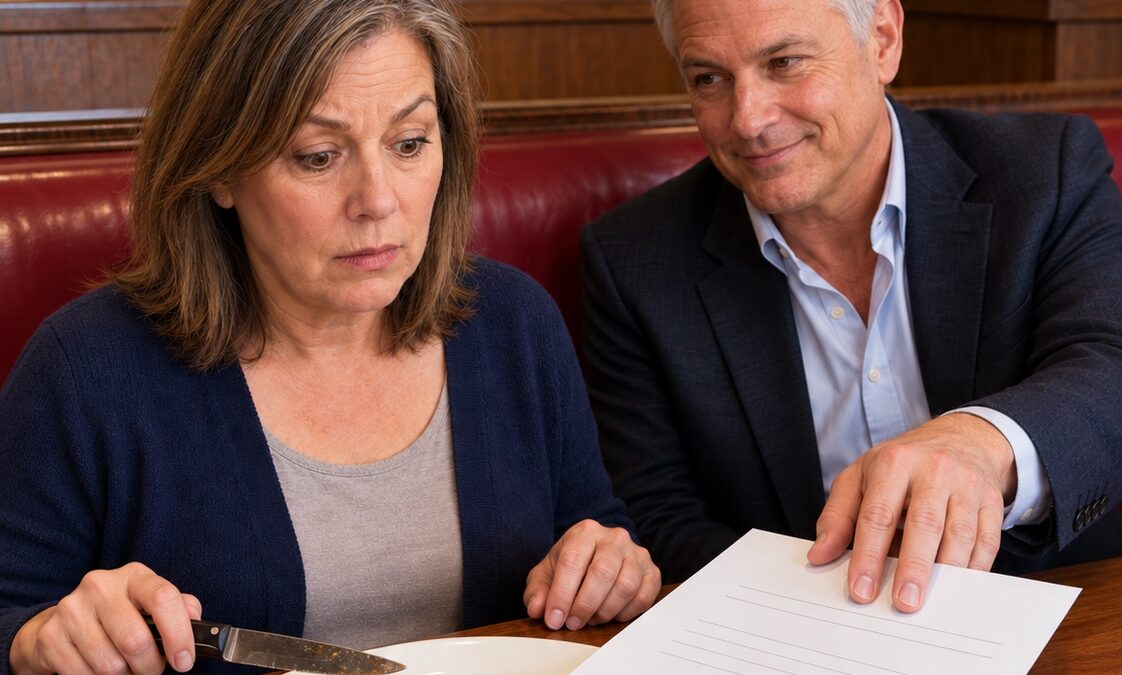
Complete story · 13 parts · about 53 minutes · ending included
Part 1 · Part 2 · Part 3 · Part 4 · Part 5 · Part 6 · Part 7 · Part 8 · Part 9 · Part 10 · Part 11 · Part 12 · Part 13
Part 1 of 13
Mitch slid a purchase agreement across my steak plate, pushing the paper through a streak of peppercorn sauce.
“Two-ten covers it, babe. Wire goes to the title company by the sixteenth.”
He tapped the buyer line with a clean fingernail.
Mitchell J. Rozeboom and Brooke A. Rozeboom.
I kept the knife in my right hand and lifted the top page with my left. At 6:30 that Sunday, August 23, the steakhouse on Eighth Street in downtown Holland smelled of charred beef. Mitch had ordered my ribeye without asking. Now it cooled beneath his paperwork.
Both signatures were dated August 3.
“Where’s my name?”
“After the wedding. Brooke’s on it so Owen’s protected if something happens to me.”
Brooke was Mitch’s daughter. Her seven-year-old son, Owen, called me Grandma Lori. In my Tuesday beginner swim class, he still watched the deep end like it could reach out and grab him. Twenty-four years at the township pool had taught me when to push and when to wait.
“Why don’t you take out a mortgage?” I asked.
Mitch laid down his fork.
“Denise torched my credit years ago. That’s why we’re paying cash.”
Brooke’s mother was his ex-wife. I’d heard that accusation before. As the finance and insurance manager at Harbor Point Motors, he explained loan terms to customers over the phone while making coffee. Nobody sounded more comfortable talking about money.
The first page listed 611 Lilac Hollow Drive, a two-bedroom fixer-upper with a crooked garage door. Purchase price: $212,000. Mitch had shown me photographs, calling it a place for family holidays.
“I haven’t agreed to buy it,” I said.
“You’re not buying anything alone, babe. We’re building something.”
“That money came from my parents.”
Mitch ran his thumb along the rim of his water glass.
“Teresa and I sold the farm last November,” I said. “My half is two hundred ten thousand dollars. It’s in a savings account under my name.”
Our parents had lived on that land for most of their marriage. After the sale, there was no reason for me to check the milking parlor for broken windows.
Mitch leaned back against the red vinyl and smiled.
“Your folks left you a farm, not a family. I’m giving you a family.”
He said it gently, as if he’d thought of a solution I ought to thank him for.
The steak knife was still in my hand. I laid it beside my plate, blade turned inward.
Across the aisle, a waitress balanced three plates on one arm. I watched her shift her weight so the gravy wouldn’t spill. At work, when a child went under and came up sputtering, I kept my voice level until the panic passed.
I looked back at Mitch.
“Let me sleep on it.”
He studied my face, then reached inside his jacket.
Mitch placed a blue velvet ring box beside my water glass. Next came a cream-colored envelope from Tjaden Jewelers, its flap already torn open.
Printed on the front were the words Insurance Appraisal — keep with your policy.
“Got the resizing done,” he said.
I had given him the ring the previous Monday because it slipped over my knuckle too easily. He lifted the lid. The gold band sat in its notch, the diamond catching a small square of light from the fixture above us.
“Why’s this open?” I asked, touching the envelope.
“Kept the sizing receipt.”
He nudged the ring box toward me.
“Put it on your renter’s policy. I saved a whole year for that ring.”
On Valentine’s Day, he had knelt by my kitchen table. I’d said yes before he finished asking.
Mitch tucked the contract into his leather folder. “Just don’t leave the wire until the last minute, okay?”
I closed the little lid and picked up the jeweler’s envelope. He paid for dinner. I took my half-eaten steak home in a white foam box.
By nine, the farmhouse was quiet except for the refrigerator motor. The rental was outside Zeeland, a mile down the road from my sister Teresa. My parents’ chipped yellow mixing bowl sat on the counter. I set my leftovers beside it.
My insurance agent wanted photographs of valuable jewelry. I pulled the appraisal from its envelope and opened my phone’s camera.
The replacement value was $6,900.
Below the description of the diamond, in print small enough that I had to hold the page beneath the stove light, was another line.
Prepared for: Lori A. Hartung, P.O. Box 418, Zeeland, MI — Original purchase 02/02/2026, Visa ••7731.
I lowered the phone.
Neither that post office box nor any Visa card belonged to me. My only card was a debit Mastercard from my credit union, the same place that held the farm money.
I opened my messages and typed to Mitch.
“Why does the appraisal say Visa 7731 and P.O. Box 418? I don’t have either.”
His reply appeared almost immediately.
“Put it in your name so the warranty’s yours. 418’s the dealership box — they let me use it. Go to sleep.”
Right above my question sat the text Mitch had sent Saturday night.
“Got your ring back. Tomorrow at dinner I need to ask you about the money. Hear me out before you say no.”
I thought of the signature date. August 3. His name had been on the purchase contract for twenty days when he asked me to pay.
The stove clock changed to 9:14.
I folded the appraisal along its creases and tucked it beneath the ring in the velvet box. The lid clicked shut under my hand, and I turned my phone face-down.
His reply accounted for my name and Box 418. It said nothing about the Visa. I left the credit union app unopened.
The money stayed put.
Part 2 of 13
“Your fiancé, line two. Third time.”
Gail Rennick tapped the glass of the lifeguard office with her knuckle. The wall clock said 9:40 Monday morning. Behind her, the indoor pool churned with the last ten minutes of senior water aerobics.
“Tell him I’m working,” I said.
“I did. Twice.”
She waited while I wiped my hands on a towel and pressed the speaker button on the desk phone.
“Mitch?”
“Hey, babe. Quick question. Have you set up the wire yet?”
“It’s Monday morning.”
“That wasn’t my question.”
“Let me sleep on it.”
A woman in the shallow lane lifted her foam dumbbells over her head. Through the office window, I could see our youngest lifeguard watching the deck instead of the clock.
Mitch spoke again, softer.
“I’d never touch your money. I just found us the house. Don’t make me look stupid in front of my kid.”
Gail stood in the doorway, one hand on the frame. She looked at the telephone, then at me. The speaker light stayed green.
“I have water to test,” I said.
“At least tell me what’s holding you up.”
“I’ll call you later.”
When I ended the call, the green light went dark. Gail’s hand stayed on the doorframe.
“He knows you’re at work,” she said.
“Yes.”
“Then he can wait until your shift ends.”
She went back to the front desk. Gail managed the office and handled complaints from parents who thought beginner lessons should produce Olympic swimmers by Thursday. She rarely raised her voice.
I carried the test kit to the shallow end, where the tile felt rough beneath my shoes. The meter showed free chlorine at 2.1 parts per million, pH at 7.4. I entered both readings in the pool’s official log, initialed the row, and checked the time.
Then I took the small notebook from my uniform pocket and copied down the chlorine number: 2.1.
I’d kept that habit since my first summer in a lifeguard chair. The official books stayed at work. My own little records came home.
A drop of pool water darkened the corner of the page. I blotted it with my sleeve.
Last November, Teresa and I had sat across from a closing agent to sign away the farm our parents had worked for decades. My sister gripped her pen too hard; the tip tore through the last copy. My share, $210,000, had reached my credit union savings account on December 10. Only my name was on it.
I had checked the balance on Friday. It was all there.
My cell buzzed against the shelf behind the chemical log. This time it was Teresa.
“Do you want potato salad or pasta salad for September twelfth?” she asked. “The caterer wants an answer.”
“Potato. There’ll be sixty people?”
“Unless your Mitch has invited the entire car dealership without telling me.”
I pushed the test kit back into its cabinet.
“Saturday evening in your old dairy barn,” I said. “Doesn’t feel like an engagement party yet.”
“Well, the folding chairs are real enough. Are you all right?”
“Just working.”
“Say it plain, Lori.”
A whistle sounded across the water. One of the aerobics ladies was waving at a misplaced kickboard.
“Potato salad,” I said. “With eggs.”
Teresa gave me a second to say something else. Then she told me she’d order it.
By Tuesday at 5:30, eight beginners were lined along the wall, blowing bubbles into the water. Owen Rozeboom had both elbows locked against the gutter and his toes pressed to the tiled side.
“Grandma Lori’s buying us a house with a yard!” he shouted.
The other children stopped blowing. One little girl asked if the house had a slide.
Owen grinned. “We could get a swing.”
His mother stood at the edge in her work scrubs, a canvas bag hanging from her elbow. Brooke usually went straight home after dropping him off, but tonight she stayed. Her eyes were red around the rims.
“Show me your kicks, Owen,” I said.
He loosened one hand. I offered mine, palm up, and he caught it.
For a few seconds his feet paddled behind him. Then he found the wall again, pleased enough to try a second time.
Brooke crouched when I brought the class to the steps.
“Dad told me you offered back in July. Thank you, Lori. Really.”
Her chin trembled on the last word. She pressed her lips together and smoothed Owen’s damp hair.
I looked at her face, then down at the small fingers wrapped around mine.
“We’ll talk later.”
Owen tugged gently.
“Would Grandma Lori get a key, too?”
“You’ll need your towel first,” I said.
He reached toward his mother. Brooke lifted him out and wrapped the striped towel around his shoulders, careful to cover his wet ears.
At 6:20, daylight was pouring across the parking lot. My hair was still damp beneath the collar of my pool polo. Mitch waited beside my car, holding a single sheet.
“There you are.” He smiled as I approached. “Saved you a trip to the computer.”
“Why are you here?”
“Riverbend Title & Escrow emailed me the wire instructions. I printed them out for you.”
He offered the page. I kept my tote on one shoulder and took it by the top corner.
The heading read “Wire Instructions — 611 Lilac Hollow Dr.”
“Everything you need’s on there. Bank opens at nine,” Mitch said.
“You could have called.”
“Already did.” His smile held. “You were busy.”
He stepped aside so I could unlock the driver’s door. I put my bag on the passenger seat and sat down with the page in my lap. Mitch tapped the roof lightly before walking to his truck.
Only after he pulled away did I look below the heading.
One line stood out in bold type.
Funds provider: Lori Hartung — Amount due: $210,000.00 — Deadline: September 16, 2026.
My name was already there.
Part 3 of 13
“What does it take to wire two hundred ten thousand dollars?” I asked.
Gail stopped peeling her orange.
It was Wednesday, August 26, and we had twenty minutes left on our lunch break at the township pool. Gail pulled a chair out from beneath the break-room table and sat beside me.
“First, you verify where it’s going,” she said. “Not by trusting the number on a handout. Then your credit union checks your identification. Why?”
I unfolded the sheet Mitch had given me in the parking lot Tuesday.
Gail set her orange on a napkin and smoothed out the fold. She found my name, the amount, and the deadline.
“Who owns the house?”
“Mitch and Brooke will, if it closes.”
“And your name?”
“Isn’t on the contract.”
She pushed the sheet back, but kept one finger resting on its edge.
Before managing the pool office, Gail had spent twenty years detecting fraud at a Grand Rapids bank.
“What else has he handled for you lately?” Gail asked.
“He had my ring resized last week.”
“Can I see what the jeweler gave you?”
I opened the photograph on my phone. The actual appraisal was at home, tucked beneath the ring in its velvet box. Gail spread two fingers across the bottom of the image and held the screen at arm’s length.
She studied the small print.
“Purchaser’s you. You don’t have a P.O. box. When did you last pull your credit?”
“Never had a reason.”
Gail handed back the phone. The vending machine rattled behind us.
She took a yellow sticky note from the supply drawer and wrote in block letters:
AnnualCreditReport.com. Freeze Equifax, Experian, TransUnion. BEFORE any wire.
I pulled my pocket notebook from my uniform, and Gail pressed the note inside its front cover.
“First, you look. Then you decide.”
“Does a ring appraisal mean somebody opened an account?”
“It means you have a question the jeweler can’t answer.”
I put the notebook away. On my way back to the deck, I passed a tangle of goggles in the lost-and-found bin. Usually, I would have sorted them. I kept walking.
At 6:15, the August sun still glared off the front windows of Mitch’s rented house in Holland.
His pickup occupied the driveway. Owen’s blue scooter leaned against a porch post.
Mitch answered in his shirtsleeves.
“Brooke took Owen to soccer,” he said. “You could’ve told me you were coming.”
“I need the red accordion folder I gave you.”
His eyebrows went up. “Tonight?”
“Yes.”
He led me past the kitchen into the small room where he kept his desk. I’d left my records with him here on Sunday, December 14, so he could prepare the tax filing.
Whenever I handed him a form, he said, “Let me handle the paperwork, babe,” and I had to ask for it back.
Mitch opened the bottom drawer and lifted out the folder.
“Here you go. See? Safe and sound.”
I set it on the desk and pulled apart the first compartment. The estate papers were there, along with the farm closing statement. A copy of my Social Security card had been stapled to that page, outside its plastic sleeve.
I touched the metal staple.
“This was separate when I gave it to you.”
“Must’ve needed to keep those two together.”
“For what?”
“I was doing the tax stuff, Lori. You asked me to.”
I checked the remaining dividers, one at a time.
No deposit receipt.
It was dated December 10, the day my $210,000 arrived. I’d placed it behind the closing statement.
“Where’s the receipt from the credit union?”
Mitch rolled the drawer shut with his knee.
“If it’s not there, maybe you took it home.”
“I didn’t.”
“Then it’ll turn up. There’s no need to make a production out of it.”
I slid each document back into its compartment, left his staple where it was, and closed the folder.
He watched me take it from the desk.
“I thought we were past all this,” he said.
“I came for my records.”
He didn’t offer to help me look for the receipt.
Outside, I put the folder on the passenger seat, sat behind the wheel, and left the driver’s door open to let the heat out. I scrolled through our messages until I reached December.
My text: “Only for the estate tax return, right?”
Mitch’s reply: “Only that. Promise.”
The gray date stamp above them read Sun, Dec 14.
The screen dimmed as Mitch stepped onto the porch.
“You’re checking up on me now?” he called, his voice even. “I paid the deposit myself. Out of my own pocket. Five grand.”
I pressed the side button and set the phone in the cup holder.
“I didn’t ask you to put down a deposit.”
Mitch came down the steps and crossed the grass.
“Brooke’s counting on this,” he said.
“So I’ve heard.”
I reached for the inside handle to shut the door. Mitch placed his palm against its outside edge and held it there. I could have pulled harder, but he was standing close enough for the corner to strike his leg.
He bent slightly, speaking just above the traffic passing at the end of the street.
“If that wire isn’t in by the 16th, I lose five grand and Brooke loses her house. That’s on you, Lori.”
Part 4 of 13
“First, nothing leaves your account unless you send it. Then we find out what they already have.”
Gail Rennick hooked the visitor’s chair out from her desk with one foot. That Thursday, August 27, my eight-thirty swimmers had just climbed out, and the next group was due at 9:20. A line of damp footprints crossed the hall outside her office.
I set the red accordion folder on my knees. The plastic clasp had turned white where I’d bent it Wednesday night, hunting for my deposit receipt.
“Do you have the wire instructions from Tuesday?” Gail asked.
I passed the page across. She glanced at the heading and laid it facedown.
“We’re not calling any number Mitch gave you.”
She typed Riverbend Title & Escrow into her browser, skipped past the ads, and opened the company’s own site. A local number ran beneath the Holland address.
“Call here,” she said. “Ask who has your information.”
I dialed on my cell and selected speaker. Gail shut the door before anyone answered.
A receptionist transferred us to Nancy Fetters, the escrow officer.
“This is Nancy.”
“My name is Lori Hartung. I’m calling about 611 Lilac Hollow Drive.”
“Are you one of the buyers, Ms. Hartung?”
“No. That’s the problem.”
Keys clicked at the other end. Somewhere beyond Gail’s wall, an instructor counted out kicks, her voice carrying across the water.
“I have the transaction,” Nancy said. “Your name is on the file because the buyer listed you as the funds provider. When someone else funds a cash purchase, we need that person’s signed authorization before we can accept the wire.”
“The agreement I saw lists Mitch and his daughter as the buyers.”
“That matches our record.”
“Has your office received anything belonging to me?”
“Your proof of funds. A deposit receipt and a farm closing statement, submitted with the offer on August 3rd.”
For a moment I watched a thin strip of tape lift from the edge of Gail’s bulletin board. The receipt had been in the folder when I gave it to Mitch in December. Last night, the slot behind the closing statement was empty.
“Was any authorization signed by me?” I asked.
“I’m not seeing one attached to those materials.”
“Has anything come to you from my account?”
“No, ma’am. Funds arrive by wire before closing, and only your own bank can send them.”
I held the phone steady against the desk.
“I never agreed to fund anything.”
Nancy stopped typing.
“Then I have to let both agents know.”
“What happens when you tell them?”
“I’ll put your statement in the file. I can’t change the purchase agreement on this call.”
“That’s fine. I want it in writing.”
“I can email you copies of your deposit receipt and farm closing statement. I just need to verify that you’re the account holder before I send them.”
She asked for the last four digits of my savings account. I opened my credit union app and read them off the screen.
“Thank you,” Nancy said. “Give me the email where you want the copies.”
I spelled out my email address, letter by letter up to the at sign.
“Only send them to me, please,” I said.
“They’ll go to you and no one else.”
“Will you tell the agents I said no?”
“I’ll state that you dispute the designation and have not authorized payment.”
Nancy gave me her direct line and ended the call.
Gail nodded at the folder in my lap.
“First, the originals stay with you,” she said. “Then write down what Nancy just told you.”
I opened my pocket notebook past Gail’s yellow note. The day’s chlorine reading sat on the top line. I had copied it from the pool log after the eight o’clock check, when the teaching lanes were empty and the water was still.
Underneath, I wrote:
8/3.
$210,000.
611 Lilac Hollow.
9/16.
8/22 “hear me out”.
The last entry was Mitch’s Saturday text.
Gail waited while I capped my pen.
“Save the email when it arrives,” she said.
“What if he asks why I called?”
“You can tell him you asked where your information went. That’s what you did.”
Three minutes to my next class. Through the window, six children in bright swim caps were gathering, and a father crouched to tighten his daughter’s goggles.
I set the notebook beside the keyboard.
“Can I use your computer for a minute?”
Gail stood and rolled her chair toward me. “Go ahead.”
I signed into my personal inbox in her browser. Nothing new. I checked that the address in the corner matched the one I’d spelled for Nancy, then hit refresh.
A message from Nancy Fetters appeared.
I opened it and clicked the attached PDF. Gail watched over my shoulder while it loaded.
The document filled the screen.
My missing deposit receipt came up first, dated December 10, 2025, for $210,000.00, with my farm closing statement on the next page. Under the amount was every digit of my savings account number.
Mitch had sent it to the seller with his August 3 offer.
Three weeks later, he took me to dinner to ask.
Part 5 of 13
Friday evening, August 28, I did the thing I had never had a reason to do.
I peeled Gail’s yellow sticky note from inside my notebook cover and flattened its curled corner against the kitchen table. Then I typed AnnualCreditReport.com into my browser.
A moth kept striking the window screen above the sink. I had washed my supper plate, but the dish towel I always folded over the oven handle lay bunched beside the faucet.
The website asked me to verify my identity. I entered my information and selected Experian. When the report came up, I went past the addresses I recognized and stopped at a credit account I didn’t.
Cedar Plains Bank Visa. Ending 7731.
Opened January 9, 2026. Current balance: $14,800.
Up in the address list, right below my home, sat an entry I had skimmed past: P.O. Box 418, Zeeland, MI.
I scrolled back down to the account and leaned closer to be sure the balance wasn’t a credit limit. Fourteen thousand eight hundred dollars owed under my name. I had never applied for that card. No statement from that bank had ever arrived at the farmhouse.
The blue velvet box was in my bedroom dresser. I brought it to the table, lifted out the insurance appraisal, and set the jeweler’s sheet beside the laptop.
The original purchase had been charged to Visa ••7731. The purchaser’s address ended in Box 418.
Both matched.
Mitch had told me to insure the ring myself. He’d also claimed the post office box belonged to his dealership.
I found his explanation in our text thread, then set my phone aside. There was nothing I wanted to ask him that night.
Gail’s next step was the freeze, and her last line told me when.
BEFORE any wire.
I went to the separate websites for Equifax, Experian, and TransUnion, following each bureau’s security-freeze steps. All three wanted their own sign-in. I saved the confirmations and recorded where to find them in my pocket notebook, beneath the numbers from the title company.
By the time the third freeze was in place, the moth was gone from the window.
I printed the credit report, waited for the last sheet to slide into the tray, and filed it in my red accordion folder. The appraisal went back beneath the ring. I shut the box and returned it to the dresser.
Saturday, August 29, was my turn at the pool’s front desk, eight until noon.
I handed out locker keys, checked family passes, and told a man that his granddaughter needed a swim diaper, even if he planned to hold her the whole time.
My phone lit up beside the sign-in clipboard at 9:08.
The first message was from Mitch.
“My agent just called me. You called the TITLE company?”
I left the phone where it lay while I finished helping a woman renew her senior membership.
At the next break, I found four more texts, each with a new reason I should call him immediately.
One said, “You could have asked me.”
Another said, “Everybody’s counting on you to be reasonable.”
I slid the phone into the drawer beneath the register, where we kept spare pens.
It vibrated against the wood while I sold two guest passes.
At 10:03, I checked again.
Fourteen messages in fifty-five minutes.
The last one read, “I called Brooke. She deserves to know what you’re doing.”
I had not spoken to his daughter since Tuesday’s lesson, when she thanked me for an offer I had never made.
A father came to collect his son’s lost flip-flop. I found the single blue one under the counter and handed it over.
On Sunday afternoon, I took the appraisal out from under the ring and tucked it into the folder’s front pocket before driving the mile to Teresa’s place.
Her kitchen smelled of tomatoes warming on the stove. Outside, a tractor moved slowly along the fence line, raising dust behind its tires.
I laid the Experian report, the ring appraisal, and Mitch’s wire-instructions sheet across her table.
Teresa dried her hands before pulling out a chair.
She started with the bank entry, tracing the date with her nail. Then she turned to the appraisal and the bold line on Mitch’s sheet with my name beside the amount due.
“Do you have this Visa?” she asked.
“No.”
“Did you sign up for one?”
“Never.”
She arranged the sheets with their edges aligned.
My sister could mend a broken fence latch without speaking for twenty minutes. Now she looked directly at me.
“Say it plain, Lori.”
“He opened a card in my name and bought my ring with it.”
Teresa reached across the table and held my hand.
Her palm was rough where the garden gloves had worn through. Neither of us pulled away when the burner timer rang.
“Have you told anybody else?” she asked.
“Gail knows about the appraisal. She hasn’t seen the credit report.”
“Does Mitch know you’ve found it?”
“No.”
Teresa glanced at my bare ring finger.
“Are you going to wear it again?”
I looked at the papers between us.
“Not this week.”
She squeezed my hand once, then went to turn off the stove. I slid everything back into the folder.
At home Sunday night, I checked the kitchen calendar. Every Tuesday had a 5:30 lesson marked in pencil. Owen’s name was written beside each one.
At 8:47 p.m., my phone showed a message from Brooke.
“Dad says you promised us in July and now you’re backing out. I don’t know what to believe. I have to protect Owen. I moved him to the Saturday class. Please don’t call him.”
The pencil rested on top of the refrigerator.
I picked it up and held the eraser above his name on the first Tuesday of September.
It never touched the paper.
Part 6 of 13
“Did you ever get a bill for this account?”
“No.”
My statement, the FTC report and the Cedar Plains authorization were already signed.
On Monday, August 31, I’d left the pool at eleven for my 11:30 appointment at the Ottawa County Sheriff’s Office in West Olive. The non-emergency line had put me through that morning to Detective Sgt. Ray Kuiper in the financial crimes unit.
He spread out my Experian report, the jeweler’s appraisal, and a printout of the deposit receipt Riverbend Title had emailed me. I kept my hands in my lap.
“Where did they send the statements?”
I pointed to the Zeeland post office box on the credit report. The same box number sat on the appraisal’s purchaser line.
“Who has a key to Box 418?”
“Mitch says it’s the dealership’s mailbox.”
“Does he pick up the mail?”
“I don’t know. He told me to go to sleep when I asked him about the address.”
The sergeant lifted the deposit receipt. It showed the $210,000 from my parents’ farm and my savings account number.
“How did your fiancé get your Social Security number?”
“I gave him my estate papers last December. He said he’d handle the tax return.”
“Did you give him permission to apply for a card?”
“No.”
“How did the seller get your proof of funds?”
“He took it out of the folder. The title company confirmed he sent it in with the house offer on August third.”
“Before he asked you?”
“Twenty days before.”
Ray set the page down and tapped the stack of case files at his elbow.
“Most of these have no name on them. Yours has three pieces of paper and a P.O. box.”
Voices came through the closed door from reception.
“Is that enough to go on?”
“It’s a place to start. But listen carefully.”
He rested his forearms on the desk.
“Right now it’s your word against his. He’ll say you gave him that folder. Whoever holds that box can pay the card off tonight and say you knew.”
I thought of the $14,800 on a Visa I hadn’t requested. He could call it a misunderstanding as easily as he called that house ours.
“What if he pays it?”
“The application still matters. The bank has thirty days to send its records to my office.”
“Do I need to keep letting him think we’re getting married?”
“Your engagement is your business. I can’t tell you to stay or go.”
He uncapped a pen. “Just don’t call Cedar Plains yourself yet. I’m sending a signed letter asking them to keep the account open during the investigation. They may agree. If they do, a closing notice won’t go to that box.”
“And if they don’t?”
“We deal with what comes.”
He squared my papers, set the sheriff’s receipt marked 26-1187 on top and passed the stack back to me. I filed it all in the red accordion folder.
“Your freeze stops anything new. I’ll get the paper.”
Outside, sunlight had heated the driver’s seat enough that I lowered both windows. A text from my fiancé waited above the weather notification: Had I chosen a cake flavor for our September party?
I opened our thread and typed, We need to talk.
Whoever held that box could pay the card off tonight and claim I knew about it, Ray had warned. I held down the delete key until the message field was blank. Then I drove toward Zeeland.
By lunchtime Tuesday, September 1, six photographs of the ranch had appeared on Facebook under his name.
“Our forever home. Closing 9/18!”
Forty people tagged me with congratulations. A woman from church asked whether the backyard had room for a swing set. I left the notifications alone while I stacked flotation belts in the equipment room.
His mother called that afternoon.
“I wanted to thank you for giving Mitchell a fresh start,” she said. “He hasn’t stopped talking about that house.”
“Teresa’s got the party arranged. Call her if you want to bring something,” I said.
“Oh, I will. I’ll see you on the twelfth.”
At 5:30, seven beginners lined up along the shallow-end wall, and Owen’s place beside the steps was empty. I helped a little girl blow bubbles without pinching her nose. The green dinosaur kickboard lay on top of the bin, dry from snout to tail. When class ended at 6:15, I put the other boards away and left Owen’s where it was.
Friday night, a coworker asked me to cover the front desk the next morning from 9:15. It wasn’t my scheduled Saturday, but I said yes.
On September 5, I arrived to find the lobby busy with children waiting for their 9:30 lessons. The woman I was relieving pointed through the glass toward the parking lot. Brooke stood beside her car with a phone against her ear.
“She brought him at nine-ten,” my coworker said. “Saw me here, left him on the bench with the others, then went out because his grandpa was calling.”
Owen sat at the end of the wooden bench, his sneakers swinging above the carpet. He noticed me and came toward the counter.
“Grandma Lori?”
“Morning, sweetheart.”
He slid a folded piece of drawing paper in front of the sign-in clipboard.
“I made you something.”
The picture showed a brown dog on bright green grass under an orange sun. Its six legs stuck out at angles, and one ear was bigger than the other.
“He’ll run fast with those,” I said.
“He’s supposed to have four.”
“I like him the way he is.”
Owen gave me a small smile. I placed the drawing on the low shelf behind the desk.
Out in the lot, Brooke was still talking.
“Can I tell you something?”
“I’m listening.”
He leaned over the counter so the kids on the bench wouldn’t hear.
“Grandpa has a secret mailbox at the post office. Number four-one-eight. He lets me turn the little key, but I can’t tell Mom.”
Part 7 of 13
“This is Lori Hartung, case 26-1187. On Monday you asked me who has a key to Box 418.”
That Saturday afternoon, I was standing in my kitchen, talking to Sgt. Ray Kuiper’s voicemail.
“Owen, Mitch’s seven-year-old grandson, told me this morning that his grandpa lets him turn that key. His mother isn’t supposed to know.”
I gave my callback number and ended the message.
The drawing Owen had slipped me lay on the table, a crease running straight through the dog’s middle.
I set Mom’s old cookbook on top of it to press the paper flat.
Monday was Labor Day. The county offices were closed, and Teresa was spending the morning arranging borrowed chairs in the old dairy barn. I was rinsing a coffee cup when Mitch’s text arrived on my phone.
He had sent a print-shop proof. Across a photograph of the ranch on Lilac Hollow Drive, gold letters announced WELCOME HOME, ROZEBOOM–HARTUNG FAMILY.
Underneath, he wrote: “Ordered the banner. Phil’s coming.”
Phil De Jong owned Harbor Point Motors, where Mitch managed financing. For months, Mitch had wanted his boss at the engagement party. Now he had a house to show off.
I saved the message without answering.
Teresa called about tablecloths that afternoon.
“White or those blue ones we used for the church supper?”
“White,” I said.
“All right. I’ll get the stains out.”
She didn’t ask whether the party was still happening. We had agreed she would keep the plans moving while I waited for Ray. A cancellation would reach Mitch before I was ready to explain anything.
Tuesday morning, September 8, Ray returned my call. I was on break, sitting on the bench outside the pool’s employee entrance.
“I added the boy’s statement to your file,” he said. “Don’t question Owen further. He’s seven.”
“I won’t.”
“When the bank records arrive, I’ll send the Zeeland postmaster a written request on sheriff’s letterhead for the box holder’s information.”
“Did you run Mitch’s name?”
“I checked. He’s never been charged with anything.”
A delivery truck backed into the service driveway, beeping as it went.
“That means there’s nothing on his record?” I asked.
“It means he’s never been charged. Whether anybody’s caught him is a different question.”
“How long until you hear from the bank?”
“Could be days, could be the full thirty.”
I held the phone away from my ear while the truck driver shut his door.
“September sixteenth is the deadline,” I said.
“I have that date.”
“And the closing is that Friday.”
“Paper first, Lori. Keep what comes in.”
He spoke slowly, and I copied his words into my pocket notebook before he hung up.
At lunch, I laid the red accordion folder on the table and sorted its contents by date. The Experian report ran four pages, and the Cedar Plains Visa was listed on the first. The appraisal was there too, along with the sheriff’s case receipt.
I put each page back in order and left Mitch’s Monday text unanswered.
If those bank records didn’t arrive by September 16, I would have to refuse the transfer without proof of what he’d done. Mitch would have two days before closing to pay off the card and insist I’d given permission.
That evening, Teresa left a voicemail asking whether the barn’s extension cords would reach the head table. I called back and reminded her that Dad’s long orange cord was in the toolbox we’d hauled over from the farm.
We discussed the party as if the only problem was an outlet.
Wednesday, September 9, Mitch texted during my afternoon shift.
“Riverbend needs the wire by the sixteenth. Are you in or out?”
I waited until the last lane had been cleared and sent one response from my phone.
“Let me sleep on it.”
At 3:30 p.m., just as I finished work, Ray called.
“The Cedar Plains package came by certified mail this morning,” he said. “Can you come to West Olive?”
“Yes.”
“Ask for me at the desk.”
I drove there without stopping at home. In the sheriff’s office, Ray pulled a thick envelope from the case file and showed me the certified-mail label. He kept the originals and handed me copies of the records concerning the account in my name.
“Take your time,” he said.
The application bore the Cedar Plains Bank logo. I found the credit line marked 7731, then took my printed Experian report from the folder and set its first page alongside the bank’s statement.
The last four digits matched, and so did the balance: $14,800.
Ray pointed to the contact section but said nothing.
The mailing address was P.O. Box 418, Zeeland, MI.
Below it were Mitch’s cell number and the email he’d sent me the house photos from.
I turned to the transaction history. Ray waited.
The first charge appeared near the top.
TJADEN JEWELERS HOLLAND $6,240.00 — 02/02/26
I thought of Mitch lifting the blue velvet box on Valentine’s Day. He had said he’d saved a whole year for the ring.
Further down, past months of gas stations and diners, sat a date already logged in my notebook.
CASH ADVANCE $5,000.00 — 08/03/26
Mitch had claimed the earnest money came from his own pocket.
He’d charged me for both.
Part 8 of 13
“I’m sending the file to the county prosecutor now,” Ray said.
His call caught me Thursday morning, September 10, in the pool’s equipment room, wedged between a lane-line reel and a shelf of chlorine buckets.
“You said ending the engagement was my business.”
“It still is. We have the bank records we needed.”
“How soon will they decide whether to charge him?”
“I can’t give you a date.”
I heard a drawer close on his end.
“Just don’t take or destroy anything of Mitch’s. If he has belongings at your place, leave them alone.”
“The ring is still at my house.”
“Keep it safe. We have copies of the purchase records.”
The door rattled as a child knocked from the hall. I covered the microphone and told her I’d be out in a minute.
“Does he know what you found?” Ray asked.
“Not from me.”
“All right. The criminal case goes at the prosecutor’s pace.”
The party was Saturday, two days off. After we hung up, I walked back to the deck and helped a six-year-old adjust the strap of her goggles.
By four that afternoon, I was at Teresa’s old dairy barn.
The side doors were propped open with bricks. Folding chairs were stacked ten high along the center aisle, waiting to be set around the round tables. Someone had swept the concrete, leaving little heaps of chaff along the wall.
A drill whined above the head table.
Mitch was on a stepladder, fastening a printed banner between two wooden beams. The photograph of 611 Lilac Hollow Drive ran across the middle. Above it stood the gold capitals from the proof he’d texted me on Labor Day:
WELCOME HOME, ROZEBOOM–HARTUNG FAMILY
He looked down when he heard my shoes.
“Perfect timing. Tell me whether the left side’s straight.”
“It’s higher than the right.”
He shifted the corner an inch and stepped down to admire it.
“Better. The printer did a nice job, didn’t he?”
“Teresa knows you’re hanging that?”
“She said I could decorate.” Mitch brushed sawdust from his sleeve. “I invited Phil De Jong and the whole finance office. Phil’s never come to one of my parties.”
At company dinners, Mitch always found a seat near Phil, even when it meant leaving me at the far end of the table.
“Are they all coming?” I asked.
“Most of them. Phil said he’d stop in. Wait until he sees the place we’re buying.”
He gestured at the picture. A length of tape was curling near the corner. He pressed it flat with his thumb.
“The party is for our engagement,” I said.
“Exactly. Everybody gets to see what we’re starting.”
Beyond him, Teresa’s good linen napkins sat in plastic tubs. She had washed and ironed them herself. My sister was planning a meal for sixty people, and Mitch had put an address behind the head table as though it were a wedding portrait.
He lowered his voice.
“When I toast, you just say the wire’s going Monday. You walk into your credit union, sign the wire form, and Riverbend has the money that day. My mom needs to hear it. Phil needs to hear it.”
I watched him fold the stepladder.
“I haven’t authorized that.”
“Don’t make it complicated in front of people. It’s one sentence.”
“You can’t promise them my savings.”
Mitch gave the banner another glance.
“Babe, I’m trying to make us look good.”
He carried the ladder toward the storage stall. I left before he came back.
Friday evening, September 11, Teresa asked whether she should cancel the party.
We were in her kitchen. A foil pan of baked beans cooled on the stove, and three grocery bags held unopened packages of plastic cups. Her handwritten seating list hung on the refrigerator under a magnet shaped like a cow.
“I can call the caterer tonight,” she said. “Some of the food’s already paid for, but I can stop the rest.”
“Give me the table first.”
Teresa cleared away the bags. I placed the blue velvet box in front of her and unfolded the jeweler’s appraisal next to it.
Next came the Experian report.
I set Mitch’s wire-instructions sheet alongside it.
I added a printout of the PDF Nancy had emailed, showing my December savings deposit.
Ray’s copies from Cedar Plains followed, the application on top of the transaction history.
Beneath the corner of the credit report, I slid the sheriff’s case receipt, 26-1187.
My pocket notebook went near Teresa’s chair, the dates visible.
Last, I laid down my phone, open to my December 14 exchange with Mitch. I scrolled to his August 22 message while she watched.
Teresa said nothing until I finished.
“Does Ray know you’re doing this?” she asked.
“He said it’s my call. He told me not to touch Mitch’s things.”
“Then why wait until Saturday?”
Through the kitchen window, I could see the old barn across the yard, its double doors still open from the afternoon’s setup.
“Yesterday he told me what I’m supposed to say at his toast,” I said. “He wants his mother and his boss to hear that I’ll pay.”
Teresa picked up the appraisal and held it by the edges.
“And what do you want them to hear?”
She creased the sheet into quarters, tucked it beneath the ring cushion, and closed the lid. I gathered the records into a stack and set the notebook and velvet box on top. All of it went into one large brown envelope. I folded down the flap and put my phone back in my pocket.
“Don’t cancel anything. He wants sixty witnesses. He’ll get them.”
Part 9 of 13
Mitch had moved my name card beside his.
When I reached the head table, he laid a finger across the two folded cards.
“That’s better,” he said. “Now everybody knows where we belong.”
Brooke and Owen had places on his other side, beneath the banner he’d hung in Teresa’s old dairy barn.
WELCOME HOME, ROZEBOOM–HARTUNG FAMILY
The photograph showed 611 Lilac Hollow Drive, including the crooked garage door.
Saturday, September 12, was warm, and Teresa had left the barn open to the evening air. Outside, cars lined her gravel lane and the edge of the hayfield. My sister held a clipboard and was waving late arrivals toward the tables.
“The potato salad came with the eggs you wanted,” she had told me when I walked in.
“Good. Did the caterer bring enough forks?”
“More than enough. Put your things down and get something to eat.”
The brown envelope was still tucked under my arm. I rested it against the front leg of my chair, out of the servers’ path, and did not open it.
Gail had taken a seat near the entrance with two women from the pool. She saw me and raised her water glass.
I nodded and went to greet a couple from church.
Phil De Jong, the owner of Harbor Point Motors, sat at the first table with Mitch’s mother. She wore a lavender jacket despite the heat. Mitch hovered over them, telling his boss about his plans for the house.
“Hope you know what you’re doing with that garage,” Phil said.
“I’ve already got somebody in mind,” Mitch answered. “He’ll take care of it.”
He put his hand on the back of Phil’s chair. His mother smiled at the banner and told the woman at her elbow that she was looking forward to dinners in the new place.
In the aisle, one of my morning lap swimmers caught my sleeve.
“Are you taking time off to move?” she asked.
“No plans to change my schedule.”
“Good. My husband only finishes his laps when you’re watching.”
“How’s his shoulder?”
“Better. He’s coming back Wednesday, if the doctor gives him the okay.”
Mitch found me near the buffet. He had the microphone in one hand and a dinner plate in the other.
“You’ve barely said hello to anybody,” he said.
“I’ve been making the rounds.”
“Remember what we talked about. My toast, then your good news.”
He nodded toward my chair and the envelope propped against it.
“The bank stuff?”
“For tonight.”
“That’s my girl,” he said, and bumped my shoulder with his.
A server asked what he wanted, and Mitch turned away to get his supper.
I took my food to the table. Brooke was cutting Owen’s baked chicken into pieces small enough for him to manage with his fork. She had not met my eyes since I came in.
The boy had a clip-on tie that kept slipping sideways. He straightened it whenever an adult noticed, then forgot about it as soon as he started eating.
Partway through supper, his dinner roll fell to the concrete. He slid off his folding chair and reached for it beneath the table.
“Five-second rule,” Owen announced.
“Not in a barn,” Brooke said.
She took the roll from him and set it on an unused saucer. I pushed the bread basket closer so he could choose another.
Owen picked the smallest one.
“Does Grandma Lori get cake with us?”
“Everybody does,” Brooke answered.
It was the closest she’d come to speaking to me all evening.
The boy asked if his cupcake had to wait until the grown-ups finished. His mother told him it did. He tugged at the clip near his throat until it came loose.
Between courses, my sister collected empty serving dishes and directed people toward the coffee. A man near the doorway asked Teresa for a box to take his leftover chicken home. She sent him to the catering worker, then stopped at my chair.
“Need anything?” she asked.
“Some water, please.”
She filled my glass and left the pitcher where I could reach it.
The speaker stood on a wooden crate near the front, plugged in through Dad’s long orange extension cord. Mitch tested the microphone while people were still eating. A high squeal made Owen cover one ear.
“Works fine,” Phil called.
Mitch grinned and set it down.
As dishes disappeared, he moved among the guests discussing the ranch. He returned to his boss more often than anyone else, stooping over Phil’s shoulder each time. Mitch’s mother kept turning to see whether the other tables had finished.
Gail stayed near the doors. When I glanced her way, she was listening to a coworker but watching me.
At seven-thirty, late sunlight still came through the wide entrance. The sky beyond the parked cars was pale, and the barn lights had not been switched on.
Mitch took the microphone off the crate. He set his glass on the head table and rang it with a spoon.
“Can I have everybody’s attention?”
Talk faded until sixty pairs of eyes were on us. Owen stopped pulling the paper from his cupcake.
Mitch lifted the glass toward the banner.
“To our house!”
Several people raised their drinks. Then he turned to me with a cheerful smile.
“Lori’s been dragging her feet on the money. I keep telling her, your folks left you a farm, not a family. I’m giving you a family.”
Laughter came from a couple of tables. Phil chuckled along with them.
Brooke looked down at her plate.
Mitch extended his arm toward me.
“Tell them, babe. Wire goes Monday?”
I stood and picked up the brown envelope.
Mitch’s hand stayed out, the microphone waiting a few inches from my chin.
I walked past it to the center of the head table.
Part 10 of 13
I laid the brown envelope on the head table beside Mitch’s empty cake plate.
The microphone stayed between us. He smiled at the guests, waiting for me to promise the wire.
I took out the blue velvet box and set it in front of him.
“What’s this?” he asked.
I opened the lid. The diamond sat in its slot. I eased up one corner of the cushion, drew out the appraisal folded into quarters, and tucked the edge back down.
Mitch stopped smiling.
The paper crackled as I flattened it. A woman at the nearest table leaned sideways to see.
“You said you saved a whole year for this ring. Then why does it say it was bought for me, on Visa 7731?”
“Insurance paperwork,” he said. “We’ve been through that.”
I took the four-page Experian report from the envelope and laid the appraisal beside it. The Cedar Plains account was listed under Lori A. Hartung, with a balance of $14,800. P.O. Box 418, Zeeland, appeared among the addresses.
“That’s not the dealership’s box, Mitch. That’s yours.”
His mother leaned forward at the first table. Phil De Jong, next to her, lifted his water glass and held it without drinking.
Mitch lowered the microphone.
“You handed me that folder, Lori. You told me to use whatever I needed.”
I took my phone from my pocket and found our messages from Sunday, December 14.
“I asked you, ‘Only for the estate tax return, right?’”
His reply was still there, directly underneath.
“‘Only that. Promise.’”
The lap swimmer who had asked whether I was taking time off put her fork down. Near the doors, Gail sat straight, her hands folded on the tablecloth.
Mitch glanced toward his daughter. Brooke watched the place setting in front of her. Owen was turning his loose clip-on tie around in his fingers.
I kept the screen in my left hand and took my pocket notebook from the envelope with my right. The amounts I’d copied at the sheriff’s office were together on one page.
“Six thousand two hundred forty dollars on February second. That was the ring.”
I moved my finger to the next entry.
“Five thousand dollars, cash advance, August third. The deposit you paid out of your own pocket.”
Mitch rubbed a thumb along the microphone’s handle.
I set the notebook beside the credit report, then took out Ray’s copies of the Cedar Plains records. I fanned the pages out where the front tables could see the bank’s heading.
“Your phone number is on this application. Your email, too.”
“It’s one card. I was going to pay it off out of the house money. That money’s basically ours.”
No one answered. Even the people out by the barn doors had stopped talking. A catering worker stood holding a tray of empty cups, unable to get past the guests crowding the aisle.
I put my phone near the box and lifted out the printout of the PDF Nancy Fetters had emailed. It showed $210,000 going into my savings on December 10. I laid it on the cloth, followed by the wire-instructions sheet Mitch had handed me in the pool parking lot.
“You sent my deposit receipt to the seller with your offer.”
He looked past me toward Teresa.
“Can somebody please tell her this isn’t how families handle money?”
My sister stayed where she was, at the end of the buffet.
I picked up my phone and held it high enough for Mitch to see the date above his August message.
“‘Tomorrow at dinner I need to ask you about the money.’ You asked me on the 23rd. Three weeks after you signed.”
Behind us, the banner still carried both our surnames. My name had never been on the purchase agreement.
I turned back to him.
“‘Your folks left you a farm, not a family. I’m giving you a family.’ You were never giving me anything.”
From the envelope I drew the sheriff’s receipt, case 26-1187, and laid it on top of the other documents with OTTAWA COUNTY SHERIFF’S OFFICE facing him.
He read it and did not touch it.
Mitch’s mother spoke from the first table.
“Couldn’t you have done this in private, Lori?”
I didn’t answer. Mitch still had the microphone, but he no longer offered it to me.
Brooke pushed back her chair. She came around behind her father and stopped at my side.
“Let me see,” she said.
I gave her my phone, open to August 22, and slid the Cedar Plains transaction page free of the stack.
She took both. Her eyes moved across the message, then down the bank’s dated entries. She held her finger under one line.
CASH ADVANCE $5,000.00 — 08/03/26
“You told me Lori offered in July.”
Mitch looked at her. “Brooke, this was supposed to be for you and Owen.”
“That’s what you said.”
She returned my phone, laid the page carefully on the table, and went to her son. Owen held up both arms. Brooke picked him up, his tie caught between them, and carried him past her father’s chair to stand beside me.
Phil set down his glass. The small sound drew Mitch’s attention.
“You run credit apps for my customers, Mitch. My office, eight a.m. Monday. Don’t go to the floor.”
Mitch stared at his boss. Outside the barn, the last daylight was thinning around the parked cars.
I lifted the ring from the velvet box and held it for a moment. Then I returned it to its slot, shut the lid, and kept my hand on top.
“You didn’t buy me a ring, Mitch. I did.”
Part 11 of 13
Mitch drove away while the catering crew was still gathering dessert plates.
Nobody had cut the cake.
In Teresa’s old dairy barn, a woman from church set her clean saucer back on the stack. Someone asked about the folding chairs.
“Leave them,” my sister said.
She climbed a ladder behind the head table and unfastened the WELCOME HOME banner. The photograph of the house on Lilac Hollow Drive disappeared as she rolled it inward. A strip of tape came loose with it.
Brooke stayed near the entrance with Owen asleep against her shoulder, his crooked tie pressed under his cheek.
“Could we stay here tonight?” she asked.
“Spare room’s made up,” Teresa said. “Come inside when you’re ready.”
She went ahead to turn down the bed. Brooke hitched Owen higher and followed, stepping around the chairs without waking him.
I carried the brown envelope home. Before ten, Ray returned the voicemail I’d left him from Teresa’s driveway. He wanted the ring logged as evidence before Mitch tried to get it back.
I set the blue velvet box beside my car keys for Monday. Later, Teresa texted: “Both asleep. Door’s open if you need us.”
On Monday, September 14, I gave Ray the ring, tucked the appraisal back under the empty box’s cushion, and asked the three credit bureaus to block the Cedar Plains card from my report.
On the way home, I stopped for gas. The pump had clicked off, but I was still holding the nozzle when my phone began ringing. Mitch’s mother. I slid the handle back into its cradle, tightened the gas cap, and answered.
“I wanted to apologize,” she said. “For calling a couple of weeks ago to thank you for giving Mitchell a fresh start. They sent him home. Something about the customer files.”
Her voice lowered on the last two words, though I was the only one who could hear her.
“From the dealership?”
“Yes. Phil took back his key card to the records room. He won’t tell me what happens next.”
“Saturday night,” she said, “I asked why you couldn’t have done it in private.”
“I remember.”
“He came over yesterday and wanted me to phone his boss. I told him I couldn’t explain those papers you showed us.”
“Thank you for calling,” I said.
“Will you tell Brooke I called? She won’t answer me.”
“That’s for you to work out with her.”
That evening at Teresa’s, two overnight bags stood by the washing machine, next to a plastic bin of toys. A basket held pajamas and dinosaur socks.
“We went to Dad’s place while he was out,” Brooke said. “I got our things. Your sister came with me.”
In the living room, Owen sorted puzzle pieces on the rug.
“Have you called your mother?” I asked.
She reached into her pocket.
“I’ve had her number all this time. Dad made every call sound like choosing sides.”
She showed me the contact marked Mom. Behind her, the washer finished its spin.
Then she tapped the name and walked into the hallway.
“It’s Brooke. Are you somewhere you can talk?”
Teresa put another toy in the bin. Nobody interrupted.
On Wednesday, September 16, I checked my credit union savings before leaving for work. All $210,000 was there.
After the banks closed, Nancy Fetters called from Riverbend Title & Escrow.
“Nothing came into the title file,” she said. “I wanted you to hear that directly.”
“Thank you.”
I wrote the date and the balance in my pocket notebook.
Thursday evening, September 17, Brooke arrived at my farmhouse with a spelling worksheet and a boy who wanted to know whether there were any crackers. I opened a sleeve from the pantry while he took out his pencil.
His mother held out her phone.
“Dad’s real estate agent forwarded this to both of us.”
It said that if they didn’t close Friday, the seller would try to keep the $5,000 deposit, and the money would sit untouched with the seller’s agent until both sides signed off or a judge decided.
“So I can’t give it back,” she said.
“No.”
“Neither can he?”
“That’s what the email says.”
Across the table, the pencil stopped moving.
“How do you spell enough?” Owen asked.
His mother sounded it out, and he wrote slowly.
She waited until he started the next line.
“Do you still have room for Owen at swimming lessons?”
“I do.”
On Friday, September 18, the house on Lilac Hollow Drive should have changed hands. At the pool, I found a pink hair tie by the shallow lane and put it in lost-and-found.
Ray had told me Monday that Cedar Plains was closing Visa 7731. Before my shift, Experian confirmed the block on my report.
At 3:10 p.m., Gail called me to the front desk. A gray-haired woman stood there in pressed slacks, carrying a flat document envelope. She had no towel or swim bag.
“I’m Denise. Brooke’s mother. She called me Monday, said today was supposed to be closing day. I didn’t want you to spend it alone.”
She slid out a certified copy, wrote her phone number on the envelope’s flap, and handed the envelope to me. The copy stayed on the counter between us.
The heading identified the Ottawa County Circuit Court, Judgment of Divorce, June 12, 2013.
One finding was highlighted yellow: three credit accounts “opened in Plaintiff’s name by Defendant without her knowledge”; statements mailed to “P.O. Box 418, Zeeland, MI.”
Owen had turned Box 418’s little key.
Part 12 of 13
Since Monday, the blue velvet box on my kitchen windowsill had held only paper.
Friday evening, I slid the appraisal out from under the cushion and set it beside the divorce judgment. P.O. Box 418 appeared on both, thirteen years apart.
Denise had written her phone number on the flap of the document envelope she’d handed me at the pool. I called as a neighbor’s porch light came on across the road.
“It’s Lori. Am I interrupting?”
“Just putting away groceries.”
A cupboard closed on her end.
“I wanted to ask what Brooke was told about the divorce.”
“She was thirteen,” Denise said. “Mitch told her I torched Dad’s credit and left.”
I looked at the judgment. Three accounts, opened without her knowledge.
“I kept that paper in a drawer,” she said. “She was a kid. I wasn’t going to make her pick between us.”
At the steakhouse in August, he’d told me, “Denise torched my credit years ago. That’s why we’re paying cash.”
He’d said it across a contract signed by him and his daughter.
“She asked me to drive her and Owen over on Sunday,” I said.
“I’ll be home.”
After we hung up, I returned the appraisal beneath the cushion and put the empty box back on the sill.
On Sunday, September 20, Brooke came out to my car carrying a canvas bag, with Owen following in sneakers that flashed red when he walked.
“Did you bring your school book?” she asked him.
“It’s in your bag.”
He pointed at the strap on his mother’s shoulder.
Before I started the engine, I took Gail’s yellow sticky note from my pocket notebook. It had stayed tucked in the back pages since the night I found the Visa.
“This was what got me to check my credit,” I told Brooke.
She read down the block letters and stopped at BEFORE any wire.
I tore out a page that held only an old chlorine reading and wrote a short list beneath it.
Pull your credit reports.
Freeze all three.
“Will it tell me if somebody’s opened something?” she asked.
“It told me.”
She folded the page around the sticky note and put both in her wallet.
We drove east on I-196. The fields past Hudsonville were cut down to stubble, and a loose zipper on the canvas bag ticked against the seat belt buckle. From the back, the boy asked how many exits until Grand Rapids.
His mother answered from the directions on her phone.
The house had green shutters and a concrete walk with a crack near the steps. I parked along the curb.
Brooke took the bag and went up the walk, her son close behind. She stood at her mother’s door for five seconds, one hand raised but motionless.
Then she knocked.
Denise opened it and stayed on the threshold.
“Hi, Mom.”
“Hi, sweetheart.”
Neither moved inside. A screen hinge squeaked when the wind caught it.
Her mother reached out and straightened the turned-up collar of her daughter’s jacket. The fabric stayed flat.
Owen stepped out from behind Brooke.
“Are you my other grandma?”
“Yes,” Denise said. “I am.”
“Do you have snacks?”
“I’ve got apples. And crackers.”
He looked at his mother for permission. She nodded, and they went in together. I pulled away from the curb after the door swung shut.
I had handed Ray the judgment on Monday, September 21, and by Friday, October 2, I was teaching a girl in orange goggles how to kick without bending her knees.
Her legs churned as though she were pedaling uphill.
“Try moving from your hips,” I said. “Keep the toes loose.”
She gripped the kickboard for another attempt.
Gail appeared beside the lane. “Office phone. Sergeant Kuiper.”
A coworker took over my group while I crossed the deck.
Ray spoke the moment I picked up.
“The postmaster answered my written request. Box 418 has been rented in Mitch’s name since 2011.”
I looked through the office glass at the bright strip of water where my class held the gutter.
“Since before the divorce.”
“It worked once, and nobody charged him. So he used it again. A pattern, not a mistake.”
The line hissed faintly.
“There’s something else,” he said. “The Ottawa County prosecutor has charged him with identity theft. It’s a felony, up to five years.”
My wet sleeve left a dark mark on the desk blotter.
“Do you need anything else from me?”
“Not today. I’ll call when I do.”
I hung up and returned to the shallow end.
The girl with orange goggles was waiting by the wall. I held the board steady while she tried again, legs straight now, heels beating the surface in small splashes.
“That’ll do,” I told her. “Take a rest.”
That afternoon, my credit union gave me the proof-of-funds letter I had requested myself.
Saturday, October 3, I carried my parents’ chipped yellow mixing bowl from the rental to Teresa’s kitchen. She had apples peeled for a cake to mark the signing, and the bowl sat on the counter beside a sack of flour.
At the end of her road stood a small empty farmhouse I had driven past for years. Its porch step needed replacing, and the kitchen window looked onto a patch of ground big enough for tomatoes. I had walked through it and counted the repairs.
The offer papers lay on the table. Teresa sat beside me while I checked the address and price against the listing.
“One hundred eighty-five thousand,” she said. “You sure about that roof?”
“I know a roofer.”
“Say it plain, Lori.”
“I budgeted for it.”
On the financing line, I wrote cash and left the second buyer’s space blank.
I signed on the line below.
Lori A. Hartung.
Part 13 of 13
“Grandma Lori, you’ve got mail!”
On Saturday, November 21, Owen ran down my gravel drive in his red jacket, his knit hat pushed halfway off his head. He stopped at the end of it, the way I’d taught him, while a pickup rattled past on the county road.
“Go ahead,” I called.
He tugged the metal door down and pulled out a small stack of envelopes. On the way back, he slowed to examine them between his mittens.
“Can I get the mail every time I come?”
“If you close it when you’re done.”
He glanced back. It was still hanging down.
“I forgot.”
“That’s what second trips are for.”
He fastened the latch, then brought me the letters. Every envelope had one name on it: Lori A. Hartung.
I carried them inside while Owen scraped his boots on the mat.
I had closed on Friday, October 30, and moved in the next morning, Saturday, October 31. The back mudroom smelled of paint. The kitchen cabinets still needed work, and the porch rail was waiting for the carpenter. I liked having a list I could finish in my own time.
I’d traded my scheduled Saturday front-desk shift with a coworker to get ready for Friendsgiving. Brooke was at the kitchen table, using a fork to crimp the edge of a pumpkin pie. She looked up.
“Anything interesting?”
“It’s all Grandma Lori’s,” he said.
“That’s how it works,” Brooke told him.
He hung his jacket on the lowest mudroom hook. One sleeve slid onto the floor.
The empty blue velvet box rested on the windowsill over my sink. I’d brought it from the old farmhouse with my last load. The ring had gone to Ray as evidence in September, and the appraisal was filed with my records.
Owen spotted it while I put the envelopes in the drawer by the stove.
“Could we take that to Aunt Teresa’s?”
“What for?”
He looked at Brooke.
“Something.”
“All right. You’ll have to keep track of it.”
He fetched the box and tucked it into the front pocket of his backpack. Brooke turned the pie plate to check her crust.
“That’s the best I can do without a ruler,” she said.
“I’ve eaten worse-looking pies.”
“You’ve baked them, too.”
She had a point.
By afternoon, Teresa’s old dairy barn smelled of roast turkey and coffee. My sister had joined two tables under a white cloth. String lights ran between the beams where Mitch’s house banner had hung in September.
A bucket of dried hydrangeas stood near the entrance. I hung my coat across the back of my chair and helped Teresa unfold the last napkins.
Gail arrived with cranberry sauce in a glass dish.
Denise brought sweet potatoes and a clean serving spoon wrapped in a dish towel. She had driven from Grand Rapids and was still carrying her casserole when Brooke crossed the room to take it.
“Careful. The handle’s hot,” Denise said.
“I’ve got it, Mom.”
Brooke set it on a trivet. Then she stayed at her mother’s elbow, and Denise didn’t step away.
As we took our seats, Denise told me this was her first holiday meal with Brooke in thirteen years. Her daughter pulled out the chair beside her.
Owen wanted the turkey leg. Teresa gave him a slice of breast meat instead, and he spent supper trying to trade it for a bigger scoop of stuffing.
“Eat some vegetables,” Brooke said.
“Sweet potatoes count,” Denise told him.
“See?” Owen held up his fork.
His mother spooned some onto his plate before he could reach for the casserole.
After the main plates had been collected, Brooke came around to my side of the table. She took a folded yellow sticky note from her wallet and placed it near my spoon.
“I froze my credit that same week,” she said. “It took me until this morning to look. All three reports are clean.”
“Good,” I said.
“I still have the list you wrote me. I wanted to give this back.”
The note was creased from riding inside the torn notebook page, but the block letters were intact.
Gail leaned over from her seat.
“First, save a copy of each,” she told Brooke. “Then have some pie.”
“I already saved them,” Brooke said.
“Even better.”
I pressed the yellow note into the inside cover of my pocket notebook, in the spot where it had rested before I’d found the Visa.
Owen disappeared beneath the table for his backpack. He came up with the blue velvet box gripped in both hands.
He set it squarely on the dessert plate in front of me.
“That’s for you.”
I lifted the lid.
Inside lay a small square of paper folded in four. Unfolded, it showed a crayon ring, its band orange and blue, with uneven yellow lines around a round green stone.
“I made you a new one,” he said. “I paid for it with my own crayons.”
The paper had gone soft from handling, so I held it by its corners.
“That’s a fine ring, sweetheart.”
“The green part’s the diamond.”
“I can see that.”
Brooke leaned over my shoulder for a look.
“He’s been working on it all week,” she said.
Teresa brought in the pie Brooke had crimped that morning and set it in front of me with a knife. Owen’s eyes followed the blade.
Saying no to the house with a yard had never meant loving him any less. Folded along its old creases, the drawing went back inside.
I closed the velvet box and kept it, because this time I knew exactly who had paid.
I slipped it into my coat pocket. Then I cut the first slice of pumpkin pie for Owen.
THE END
More stories
My HOA president sent two men with shovels into my late husband’s memorial garden and fined me $2,400—Then her own financial records cost her the presidency.








