My Father Pressed Sale Papers Against My Pregnant Belly — Then I Handed My Friend The Proof
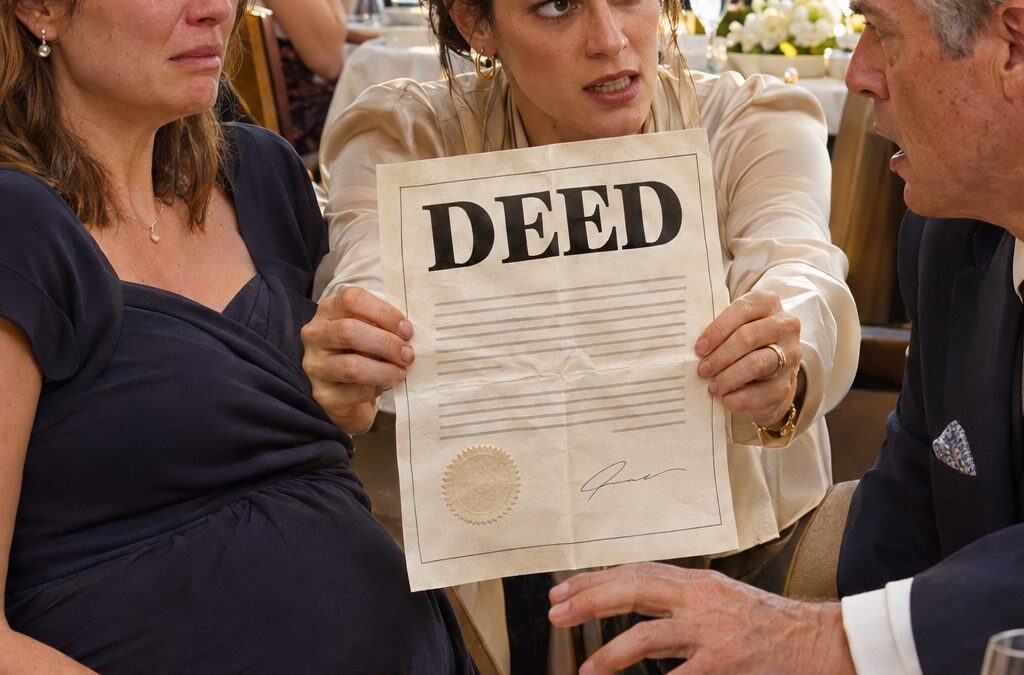
Part 3: What Audrey Had Seen
“I helped her wash him,” Audrey said.
Dad looked down at the deed.
“After his stroke, your father couldn’t bathe alone.”
She wasn’t speaking loudly.
Nobody needed her to.
“Natalie held him steady while I moved the chair. She washed his back because he couldn’t reach.”
Daniel stopped rubbing his forehead.
Audrey glanced at me before saying anything more.
I nodded, although I was looking at my plate.
“The first time I came, she called for help. He was afraid of slipping, and she couldn’t manage safely.”
That was what Dad had never asked about.
Not the visits.
Not the groceries he occasionally saw on the counter.
The part behind the bathroom door.
Grandpa had his stroke in March 2021.
After rehabilitation, he wanted to remain at his cottage.
He could make that choice with proper help.
I became most of that help.
Audrey had been there because I trusted her.
I remembered the bathroom window sticking that evening.
I had pushed it open with my elbow.
Grandpa sat forward on the bath chair, gripping my wrist.
“Don’t let me go sideways,” he told me.
“I’ve got your shoulder. Audrey’s moving the towel.”
She slid the towel where his feet would land.
I rinsed the soap from his back slowly.
Then we waited until he was ready to stand.
There was nothing pretty about the work.
Wet cuffs stuck to my arms.
Grandpa apologized while I dried the floor.
I told him to stop watching the floor and breathe.
Later, I warmed the food he had left untouched.
He couldn’t manage the bowl without knocking it sideways.
I steadied it while he worked the spoon.
“Small mouthful,” I said. “There’s no hurry.”
Audrey sat nearby, cutting food into manageable pieces.
At the restaurant, she described that evening without embellishing it.
Then she described coming back.
She had brought groceries when I couldn’t leave him.
She had stayed while I showered or collected prescriptions.
She had watched me change my work availability.
For years, my evenings belonged to that cottage.
Grandpa died in September 2024.
By then, Audrey had seen enough to recognize his routines.
She knew which chair he could rise from.
She knew why the bathroom mat couldn’t slide.
Dad knew none of those details.
“That doesn’t mean I didn’t love my father,” he said.
Audrey looked at him.
“I didn’t say that.”
“He never asked me to do those things.”
I lifted my eyes from the plate.
“He asked to stay home.”
Dad pressed his lips together.
“That’s not the same as calling me.”
“No,” I said. “It isn’t.”
Celia shifted the contract away from the water pitcher.
She was watching the guests now, not me.
One guest had both hands over her mouth.
Another had turned her chair toward Audrey.
There was no applause.
I was grateful for that.
I didn’t want Grandpa’s bathroom turned into entertainment.
Audrey’s voice softened when she spoke again.
“He told me he worried about Natalie losing work. He worried about her driving home exhausted.”
Dad rubbed the repaired button between his fingers.
“I offered to help with expenses.”
“Then discuss what you offered,” Audrey said. “Don’t erase what she did.”
Daniel looked at me.
“You never told me it was like that.”
“I asked you to come over.”
“I thought you meant visit.”
“I needed another pair of hands.”
He moved his napkin from his lap to the table.
For a moment, he seemed about to explain himself.
Then he stopped.
Dad pushed his chair back slightly.
“All right,” he said. “She helped him enormously.”
He said it toward the guests.
Then he turned back toward me.
“But Grandpa isn’t here now. We’re talking about what happens next.”
That was a different argument.
He no longer said I had received something easily.
Now he wanted my ownership treated as a temporary inconvenience.
Celia leaned forward beside him.
“We live there, Natalie.”
“I know.”
“We’ve made it our home.”
“I let you stay while you made other arrangements.”
Dad shook his head.
“You didn’t put a deadline on it.”
“I’m not claiming I did.”
I put both feet flat beneath my chair.
The baby pressed beneath my ribs.
I needed the conversation to stop circling.
“The house was transferred to me,” I said.
Audrey touched the top corner of the deed.
My grandfather’s estate had conveyed the cottage solely to me.
The executor’s deed was recorded November 18, 2024.
Dad already knew whose property it was.
The paper wasn’t a surprise about ownership.
It made his claim of settled family business harder to maintain.
There was no uncertainty I needed to sign away.
There was only a sale he wanted.
“You brought that to embarrass me,” he said.
“I brought it because you kept saying this was settled.”
“You could have trusted me to explain.”
“I read what you sent.”
Celia’s gaze moved quickly to the contract.
Dad reached for it, then stopped himself.
“This is still a fair arrangement,” he said.
“What arrangement?” Daniel asked.
Dad gave him an irritated look.
“The one we discussed.”
“I didn’t discuss it,” I said.
A server quietly asked whether we wanted dinner held.
Celia said no before anyone answered.
Then she looked at Dad.
“Give her the other page.”
He didn’t move.
“The payment page,” she said.
Audrey folded the deed along its existing crease.
She placed it beside my hand.
Celia held out her palm toward Dad.
“Let everyone see what she’s refusing.”
Part 4: The Page Underneath
Dad pulled the attachment from beneath the contract.
He slid it toward me without looking at Audrey.
I had already seen that page.
My lawyer had seen it too.
The proposed sale price was $286,000.
The attached payment directions assigned $40,000 to me.
The remaining $246,000 would go to Dad and Celia.
Those figures came before closing expenses.
My lawyer had circled that problem during our review.
There wasn’t even a sensible explanation of those expenses.
The proposal was not a closing statement.
It was an unsigned attempt to obtain my agreement.
Dad had presented it as a straightforward family solution.
At the table, he tapped beside my proposed payment.
“That’s money you can use immediately.”
“And the rest?” Audrey asked.
“That concerns our household,” Celia said.
“It comes from her house.”
“We’ve been living there.”
“Rent-free,” I said.
Celia looked at me sharply.
“We pay bills.”
“You pay the utilities you use.”
Dad lifted his chin toward the guests.
“We’re not freeloaders.”
“I didn’t call you that.”
I had deliberately avoided that word.
I had let them stay because their plans were unsettled.
I could afford the taxes and insurance then.
I wanted to help without deciding the cottage’s future.
That permission had somehow become a claim on its value.
Daniel pulled the attachment closer.
His finger moved down the page.
“I thought you were splitting it,” he said.
Dad reached for the paper.
“Don’t start doing arithmetic over dinner.”
Daniel held it in place.
“You told me Natalie was getting her share.”
“She is.”
“Of her own house?”
Celia sat back.
“Your father needs somewhere to live after the sale.”
“So do I, eventually,” I said.
I didn’t have to explain my future plans.
Still, I had thought about them for months.
The cottage needed maintenance, but it was manageable.
It could remain a place our family visited.
It could be somewhere my child knew.
I didn’t need to sell it to prove generosity.
Dad tried a different approach.
“Forget that attachment,” he said. “We can discuss the division.”
“The sale itself is the problem.”
“You haven’t even spoken to the buyers.”
“I don’t need to.”
“They’re serious people.”
“Then tell them the owner isn’t selling.”
He glanced toward the dining-room door again.
He had chosen witnesses who mattered to him.
Now those witnesses were watching him bargain with my refusal.
Celia lowered her voice.
“Think about how this looks, Natalie.”
I looked down at my belly.
The contract had left a shallow crease in my dress.
I smoothed it with my palm.
“It looked worse when he pushed that against me.”
Dad leaned forward.
“I didn’t hurt you.”
“I told you to move it.”
He opened his mouth, then looked around the table.
A guest near the window put down her fork.
“Martin, let her eat,” she said.
It was a small sentence.
It changed what he could do next.
He couldn’t keep calling the pressure a pleasant family discussion.
I reached for the contract.
Dad watched my hand with sudden attention.
I stacked it beneath the payment attachment.
Then I slid both pages back toward him.
“I am not signing.”
Celia stared at the empty space beside my plate.
“What are we supposed to tell them?”
“That you didn’t have my agreement.”
Dad tried to catch my eye.
“We could talk privately.”
“We tried that before dinner.”
“You sent me to your lawyer.”
“Because you sent me a sale contract.”
That preparation had felt excessive when I did it.
I had sat at my kitchen counter, feeling foolish.
I opened every page instead of trusting his summary.
I saved the attachment with the proposed payment directions.
I forwarded the entire packet to my lawyer.
Then I took my deed copy from its folder.
I folded it small enough to carry safely.
I hadn’t rehearsed a speech.
I had simply wanted the relevant paper nearby.
My lawyer explained what Dad could and couldn’t do.
He could bring me a proposal.
He could not convey my title without my authorization.
He wasn’t my agent.
No buyer had an owner-signed contract.
I had accepted no deposit.
His promises were not my acceptance.
Remembering that helped me stop negotiating against myself.
“I’ll have my lawyer answer in writing,” I said.
Dad pushed his chair back.
“Fine. Make everything formal.”
Audrey stood when I reached for my purse.
I needed help getting out from behind the table.
She moved my chair without making a fuss.
Daniel stood too, then hesitated.
“Nat—”
“I’m going home.”
“Can I call you?”
“Not to ask me to sign.”
He nodded.
Celia stayed seated, staring at the payment attachment.
Dad lifted his jacket from the chair.
I saw the repaired button again.
For an instant, I wanted to explain everything more gently.
Then my baby moved, and I adjusted my purse.
Audrey walked out beside me.
We passed servers holding plates near the service station.
I apologized for the interrupted dinner.
A server pointed us toward the quieter exit.
Outside, Audrey waited until I was settled.
“Did you want me to say all that?” she asked.
“Yes.”
“I should have asked before we came.”
“I didn’t know they would do that.”
She touched my shoulder, then stepped back.
I drove home without calling Dad.
At my kitchen counter, I unfolded the deed again.
I checked that I hadn’t left any pages behind.
Then I sent my lawyer a written instruction.
Reject the proposed sale.
Do not suggest different payment terms.
I was not selling.
The reply came after my lawyer reviewed my message.
There was a question beneath the confirmation.
“Do you want their permission to occupy the cottage to continue?”
Part 5: A Date In Writing
I left that question open on my screen.
The kettle clicked off behind me.
Until then, I had separated the sale from their occupancy.
They were family staying in my house.
The contract was something Dad had tried.
But he had used living there as leverage.
Celia had said it in front of everyone.
They lived there, so they should receive its value.
I picked up the phone and called my lawyer.
“I don’t want them living there indefinitely.”
“Then we need to end the arrangement properly.”
“I don’t want anyone changing locks on them.”
“That isn’t what I’m recommending.”
My lawyer reviewed how the occupancy had begun.
There was no fixed-term lease.
There had never been rent.
They paid their utilities, while I retained taxes and insurance.
I had given permission, not a deed or purchase option.
Still, it was their residence.
Owning it didn’t permit me to put their belongings outside.
I wanted a process I could follow without improvising.
My lawyer prepared a written termination.
It was delivered April 14, 2025.
The required surrender date was July 31, 2025.
There was time to find another place.
The letter also made my position clear.
No sale had been authorized.
No payment from sale proceeds had been promised.
Communication about possession would go through my lawyer.
I read the letter carefully before approving it.
Then I put a copy beside the deed.
Dad called as soon as he received it.
I let the call go to voicemail.
Afterward, I listened at my kitchen table.
He didn’t threaten to sell the cottage himself.
He knew that avenue was closed.
Instead, he talked about moving costs.
He said finding another place would be expensive.
He asked whether I could provide the proposed payment anyway.
I wrote down what he requested.
Then I sent the request to my lawyer.
The answer was no.
I wasn’t funding a move they had time to plan.
Celia sent a message about the baby.
She said I would need family help soon.
She said stress wasn’t good for any of us.
I read it while folding clean baby clothes.
Then I put the phone facedown.
I wasn’t going to exchange housing for help.
Audrey came over with food that evening.
She found me sorting a drawer more than necessary.
“Do you need to put that down?” she asked.
I had folded the same little garment repeatedly.
I set it in the drawer.
“I keep hearing Daniel say they’ll need another home.”
“They do.”
“I know.”
“That doesn’t make the contract yours to sign.”
She didn’t offer to manage my father.
She helped me put the clothes away.
That was the kind of help I could accept.
Dad next proposed remaining while they looked for buyers.
My lawyer reminded him the cottage wasn’t for sale.
Then he proposed staying until they found something suitable.
There was no definite end in that proposal.
My lawyer declined to extend the deadline.
Each answer was written and kept.
I stopped discussing the issue by phone.
When Dad called about ordinary things, I answered sometimes.
When he turned to the cottage, I ended the conversation.
It took practice.
I still found myself filling uncomfortable pauses.
I still wanted him to say he understood.
But the notice didn’t require his approval.
Daniel asked to come over.
I told him he could, without Dad or Celia.
He arrived carrying food and looked embarrassed about it.
“I didn’t know what to bring.”
“Put it in the kitchen.”
He stood by the counter while I cleared space.
Then he said he had visited the cottage.
Dad had asked him to help think through arrangements.
Instead, Daniel had noticed the bathroom.
The bath chair was gone.
The grab bars were still there.
“So that was what Audrey meant,” he said.
I kept wiping the counter.
“Yes.”
“I thought you went over because you wanted to.”
“I did want to see him.”
“That isn’t the same thing.”
“No.”
He sat down before continuing.
“I repeated what Dad told me.”
“You told me to sell my house.”
“I know.”
“So they wouldn’t need another home.”
He nodded, looking at his hands.
“I shouldn’t have put that on you.”
I rinsed the cloth and hung it to dry.
I didn’t tell him everything was fine.
It wasn’t, and I didn’t want that habit back.
But I sat across from him.
We ate the food while it was still warm.
Later, my baby arrived.
Audrey visited without bringing up the cottage immediately.
She washed her hands and asked where things belonged.
Daniel brought groceries and put them away himself.
Dad asked whether the baby changed my plans.
I said it did not change the notice.
That was the entire conversation about the house.
I was tired enough to appreciate short answers.
Some days I worried about the eventual handover.
I didn’t know whether Dad would leave willingly.
My lawyer explained what would happen if he didn’t.
There would be a court process if required.
There would not be relatives removing furniture for me.
I kept the written notices and delivery records together.
Then I went back to feeding my baby.
Near the surrender deadline, my lawyer contacted me.
Dad and Celia had arranged another residence.
They wanted to return possession voluntarily on July 30, 2025.
My lawyer would attend and document the handover.
I could bring someone with me.
I called Audrey before answering.
“Will you come back to the cottage?”
She didn’t ask which cottage.
“Yes,” she said. “Tell me where to meet you.”
Part 6: The Kitchen Drawer
Audrey met me outside on July 30, 2025.
She carried the baby while I checked my folder.
The folded deed was inside, beside the occupancy letter.
My lawyer was already speaking with Dad.
Celia stood near the doorway with a tote bag.
The porch looked different without their outdoor chairs.
A clean rectangle showed where a mat had been.
Dad handed over the house keys.
My lawyer documented the voluntary surrender of possession.
The date was before the written deadline.
There was no sheriff waiting outside.
Nobody was being forced through the doorway.
Their furniture and personal belongings were already gone.
Celia stepped back so we could enter.
“They’ve taken the last things,” Dad said.
I nodded and walked inside with my lawyer.
Audrey waited near the entrance with the baby.
I had imagined the place feeling immediately familiar.
Instead, every empty room sounded too large.
Their sofa had covered part of the worn floor.
The kitchen smelled faintly of cleaning solution.
I checked the windows and the back door.
My lawyer recorded the condition with my permission.
We checked that nothing belonging to them remained.
Then we returned to the kitchen.
Dad stood by the counter where Grandpa used to sit.
He looked at the folder under my arm.
“You brought the paperwork again.”
“For the handover.”
“I said we’d leave.”
“And you have.”
He rubbed his thumb along the counter’s edge.
Celia waited by the doorway, holding her tote.
She didn’t mention the proposed buyers.
The sale had never happened.
I had signed nothing.
There was no closing and no payout.
Dad had lost the use of the cottage.
He had not lost a house he owned.
I knew that distinction mattered legally.
Standing in front of him, it mattered personally too.
He looked toward Audrey.
“She’s always had plenty to say.”
I set my folder on the counter.
“She told the truth.”
He looked back at me.
“I wasn’t asking for a lecture.”
“Neither was I.”
My lawyer asked whether they had anything else to collect.
Celia shook her head.
Dad took longer to answer.
“No.”
They walked out together.
I didn’t follow them onto the porch.
I listened until their car pulled away.
Then I let myself sit down.
There wasn’t much furniture left to sit on.
Audrey found a chair near the kitchen wall.
She brought the baby over and waited.
“Ready?”
I put out my arms.
The baby settled against me while my lawyer finished.
The remaining steps were practical.
I would arrange maintenance and update access after surrender.
I would keep insurance appropriate to the property’s use.
I would not leave the place unchecked.
None of that required a family meeting.
My lawyer left me with the completed handover record.
Audrey walked through the cottage beside me afterward.
We stopped at the bathroom.
The grab bars were still firm.
A patch of discolored caulk needed replacing.
I made a note of it on my phone.
Audrey touched the doorway.
“I can still picture that chair.”
“So can I.”
We didn’t reenact anything.
We didn’t need to.
I looked at the space where I had stood.
I remembered Grandpa gripping my wrist.
Then the baby stirred, and I adjusted my hold.
“We should open a window,” I said.
Audrey checked the screen before raising it.
Fresh air moved through the bathroom.
I stood there until the baby settled again.
After that, the cottage became a series of ordinary jobs.
I arranged the small plumbing repairs.
I had the bathroom caulk replaced.
I checked the smoke alarms and cleaned kitchen shelves.
There were no dramatic discoveries behind the furniture.
There were worn surfaces and things needing attention.
I could decide which jobs came first.
I could decide who came through the door.
Daniel offered to help with the yard.
I told him what actually needed doing.
He arrived without bringing Dad.
He worked, put the tools away, and asked before leaving.
He no longer described the cottage as Dad’s place.
That change was small enough to notice immediately.
Our conversations didn’t return to normal all at once.
Sometimes I still remembered his voice at dinner.
Just sell it, Nat.
When that happened, I didn’t cover it with a joke.
I told him I was still upset.
He listened instead of explaining Dad to me.
Dad and I stayed in contact, but differently.
I didn’t discuss my bank balance with him.
I didn’t send him documents to interpret for me.
When he asked about visiting, we arranged a time.
There were no unannounced weekends at the cottage.
Celia remained polite and distant.
I stopped trying to make her sound warmer in my head.
Audrey came over without needing an occasion.
Sometimes she held the baby while I ate.
Sometimes we sat outside while laundry finished indoors.
She never asked me to thank her publicly.
I thanked her anyway, in my kitchen.
“You gave me permission to finish,” she said.
“I should have said something before.”
“You said no. That should have been enough.”
I put our plates in the sink.
Then I asked whether she wanted more food.
At the cottage, I kept things simple.
I brought what the baby needed.
I left room in the cupboards instead of filling them.
The kitchen table faced the window Grandpa liked.
I didn’t make it a shrine.
I ate there.
I sorted mail there.
I learned which floorboards creaked during a nap.
Sometimes I still took out the deed.
Not to prove anything to a guest.
To put it with another repair receipt or property letter.
The paper had softened along its folds.
A faint mark remained where my restaurant plate had pressed it.
I ran my thumb over that mark once.
Then I checked that the pages were all together.
The baby slept nearby while I cleared the table.
I closed the folder I had brought that morning.
The handover record went into storage at home.
The deed copy stayed where I could find it.
I folded it along the familiar crease.
Then I placed it in the kitchen drawer.








