The bank said I’d been dead 6 years when I opened an account at 52. My brother collected Mom’s $150,000 life insurance in my name.
Complete story · 10 parts · about 40 minutes · ending included
Part 1 · Part 2 · Part 3 · Part 4 · Part 5 · Part 6 · Part 7 · Part 8 · Part 9 · Part 10
Part 1 of 10
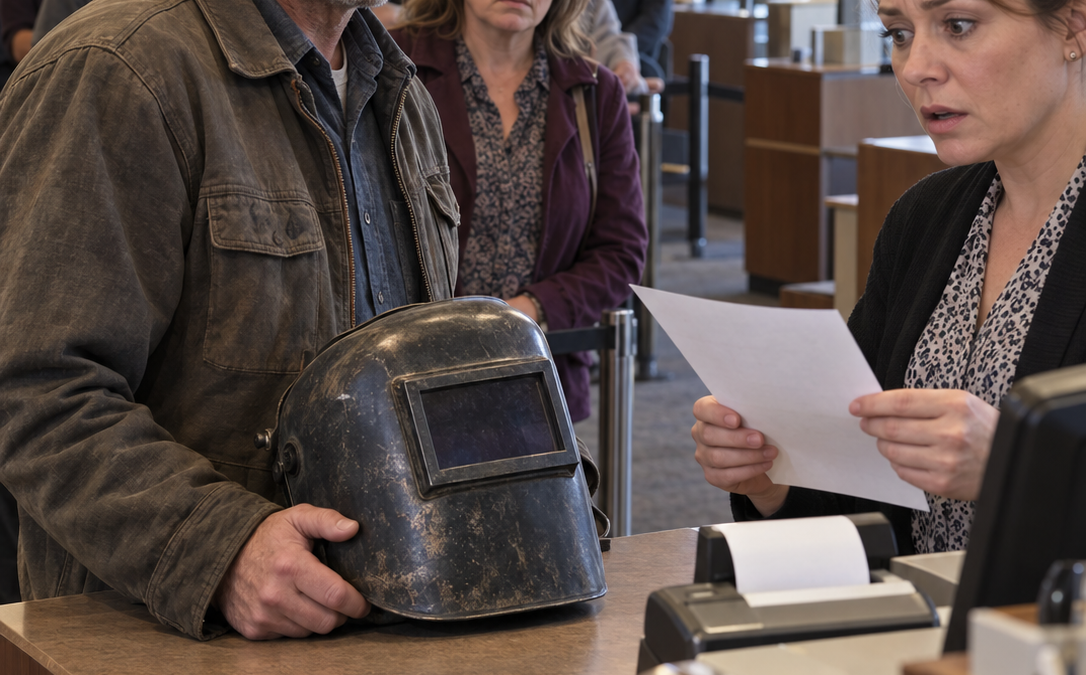
I set my welding helmet on the Gillette bank counter at 4:40 Thursday.
Nine people stood behind me when the printer pushed out a notice.
“Reported deceased. February 2020,” the teller read aloud.
“Are you here for the estate?” the teller said.
A man in line laughed.
“Looks good for a dead guy.”
“I’m standing right here,” I said.
I took the paper.
“I can’t open anything today,” the teller said.
In 1993, I’d stood in our Riverton kitchen while Dad pointed toward the door.
Mom stood beside the sink, and Grandma sat at the table.
My brother, Jeff, was fifteen.
“You’re dead to this family, Mark. Go be dead somewhere else.”
Jeff said it loudly enough for Grandma to hear without leaning forward.
I was nineteen, with my work jacket hanging from my hand.
Dad had just thrown me out over the wrecked truck.
Jeff had wrecked it.
I’d taken the blame.
That was what they knew, and I hadn’t corrected them.
Dad put my keys on the kitchen table.
“You can take what’s yours,” Dad said.
I reached for the keys, but my fingers wouldn’t close around them.
I kept looking at Jeff.
My brother stood near the refrigerator, wearing socks on the kitchen floor.
Jeff wouldn’t have looked so sure if I’d told the truth.
“You heard me,” Dad said.
“I heard you.”
Mom took a step away from the sink.
“Let him get his things,” Mom said.
Dad moved aside.
Grandma pushed her chair back, but I shook my head.
I didn’t want anybody standing between Dad and me.
I wanted Jeff to take back what he’d said.
My brother opened the refrigerator instead.
I went down the hall to my room.
The drawer stuck when I pulled it, and I jerked it hard enough to hurt my wrist.
I stuffed clothes into a bag without folding them.
I was angry, but mostly I was ashamed.
I’d said the wreck was my fault.
Now I couldn’t find a way to take that back.
From the kitchen, I heard Dad moving a chair.
Nobody came down the hall.
When I returned, Mom held out a paper sack.
“Take something to eat,” Mom said.
I accepted it without looking inside.
Grandma reached across the table and touched my sleeve.
“You have somewhere to go?” Grandma said.
“I’ll find somewhere.”
Jeff stayed beside the refrigerator.
I waited another second.
My brother looked at the bag in my hand, then toward the door.
I left with my keys digging into my palm.
At the bank counter, the teller slid my license toward me.
The photograph showed a fifty-two-year-old man with gray in his hair.
I picked it up and checked the name.
Mark Conner.
The man who had laughed shifted his feet behind me.
Nobody said anything else.
“Does that look like me?” I said.
The teller glanced at the photograph.
“Yes.”
“Then I’m here for myself.”
“I understand.”
The teller lowered her voice, which made my face burn worse.
I had come straight from welding, still wearing my work clothes.
There was a pale line of dust across my sleeve.
I’d washed my hands before leaving the shop.
I had brought my license and the papers I’d been told to bring.
I hadn’t expected to prove I was breathing.
“Can somebody else open it?” I said.
“The notice has to be resolved,” the teller said.
“With who?”
The teller pointed toward the sheet in my hand.
“There’s information on there about where to start.”
I looked down, but the print wouldn’t stay clear.
My hands were shaking.
I pressed the paper against the counter until it stopped rattling.
Behind me, somebody set a purse on the rope barrier.
I wanted to turn around and tell that man my name.
I wanted him to say his joke while looking at my face.
Instead, I put my license in my wallet.
“Your helmet,” the teller said.
I had nearly left it on the counter.
I hooked my fingers beneath the rim and carried it out.
The glass door closed before anybody called me back.
My truck sat across the parking lot.
I unlocked it, put the helmet on the passenger seat, and climbed inside.
The cab smelled like leather gloves and the coffee I’d finished before work.
My lunch container lay on the floor.
I rested the notice on the steering wheel.
There was my name again.
My address was right.
The information belonged to me, except for the part saying I was dead.
February 2020.
I had gone to work that month.
I’d bought groceries, paid rent, and driven the same roads around Gillette.
Nobody had knocked on my door to ask whether I was alive.
Nobody had called.
Who had told the world Mark was dead?
Jeff’s voice came back before I wanted it.
Go be dead somewhere else.
My brother had said that in a kitchen, in front of family.
Somebody had put it into a record that could follow me into a bank.
I didn’t know whether those things had anything to do with each other.
I wasn’t going to guess.
I flattened the page against the wheel and started with the heading.
I’d paid cash since 2019 and kept my money at a tiny credit union.
The credit union had merged that September.
That was why I’d come in to open an account.
I hadn’t borrowed a dollar since 2019.
Below my identifying information, the notice named the record carrying the flag.
My credit file listed me as deceased.
Picking up where the Facebook post left off
Part 2 of 10
I pulled the three free credit reports on my laptop that evening.
The bank’s notice lay beside my welding helmet on the table.
I searched for the word “deceased.”
The note appeared beside an old joint card from a Riverton bank.
Mom had opened that account with me in 1992.
I’d forgotten it was still attached to my name.
I leaned closer to the screen and checked the account information.
Shirley Conner.
Mark Conner.
I remembered sitting beside Mom while a bank employee pushed papers across a desk.
Mom had brought a pen from home.
“Sign where they tell you,” Mom had said.
I’d been eighteen, impatient to get out of the chair.
Now I wanted to remember what else Mom had said that day.
I couldn’t.
I downloaded the reports and put the pages beside the notice.
The card appeared in each report.
So did the deceased note.
I checked the Riverton bank’s phone number and wrote it down.
By then, the office was closed.
I slept badly and called when it opened the next morning.
“I’m listed on an account,” I said.
“I need to ask why it says I’m deceased.”
The clerk asked for my name and identifying information.
I gave the answers with the report open in front of me.
The clerk put me on hold.
I carried the phone to the kitchen window.
Outside, my truck was parked where I’d left it after the bank.
I watched a dry leaf catch beneath the front tire.
“Mr. Conner?” the clerk said.
“I’m here.”
“I found the account.”
“My mother opened it with me.”
“Yes, I see that.”
“Who told you I was dead?”
The clerk stopped speaking long enough for me to hear typing.
“I’m going to read the closure note,” the clerk said.
I picked up the pen.
“Closed December 2025 by Jeffrey Conner, executor of Shirley Conner’s estate.”
My hand stopped above the paper.
“Estate?”
“That’s what the note says.”
“What estate?”
“Your mother’s estate, sir.”
I pulled out a chair but stayed standing.
“Is my mother dead?”
The clerk’s voice became careful.
“The file shows death certificates for both account holders.”
I looked at the empty chair.
One certificate meant me.
The other meant Mom.
“Mr. Conner?”
“Nobody told me.”
The clerk didn’t try to fill the pause.
I was grateful for that.
Then I was angry that a stranger knew to wait.
My own brother hadn’t given me the chance.
“Does it say when?” I said.
“The closure note only gives me December 2025.”
“Read his name again.”
“Jeffrey Conner, executor of Shirley Conner’s estate.”
I wrote it down exactly.
Below it, I wrote what the clerk had said about the certificates.
The pen left a dark spot where I held it still.
“I need to challenge the deceased information,” I said.
The clerk explained how to send a written dispute.
I copied the instructions.
“Can you tell me who submitted the certificates?”
“The closure note names Jeffrey Conner.”
“Thank you,” I said.
After the call, I stayed at the table with the phone in my hand.
Mom was dead.
I said it aloud because I hadn’t understood it on the telephone.
“My mother’s dead.”
My voice sounded ordinary.
That upset me more than if I’d shouted.
I wanted a date, a place, somebody who had been there.
I had an account closure note.
I opened my contacts and found Jeff.
My thumb rested over the call button.
Then I opened our messages instead.
There wasn’t much to scroll through.
Jeff’s last text was from Mother’s Day, May 14, 2023.
“Mom got your card. She doesn’t know you anymore. Don’t come.”
I remembered receiving it.
I’d been standing beside the truck, holding my keys.
I’d wanted to drive to Riverton that day.
After the message, I’d put the keys away.
Mom’s dementia had already stopped the letters after 2022.
I’d believed Jeff when he said a visit wouldn’t help.
I hated admitting that now.
I had let my brother speak for Mom.
I captured Jeff’s message with its date at the top and marked the image for quick access.
In May 2023, Jeff had known I was alive.
He had answered me about a card.
By December 2025, Jeff had closed an account using a certificate saying I was dead.
I put the phone beside the report.
Why would Jeff need me dead?
The card hadn’t been used by me in years.
I’d gone into the Gillette bank to open an account.
I hadn’t asked for credit or money from anybody.
I turned back to the clerk’s instructions.
I could ask Jeff questions later.
First, I needed to put my objection in writing.
I wrote to the three credit bureaus.
I identified the account and disputed the deceased flag.
“I am alive,” I wrote.
I stopped with the pen against the page.
Yesterday, saying that at a bank counter had embarrassed me.
Now I was writing it to people who couldn’t see my face.
I included the identifying documents requested in the dispute instructions.
I kept copies of what I sent.
Before sealing the envelopes, I checked the names and account information against the reports.
I wanted somebody to handle these papers and have no excuse to misunderstand.
At the post office, I handed the envelopes across the counter.
I kept the mailing receipts.
Then I went home for a bag.
I packed clothes and put the reports in a folder.
The screenshot stayed on my phone.
I set the folder beside my helmet in the truck.
Riverton was four hours away.
I’d made that drive before with arguments prepared in my head.
This time, I wanted answers I could write down.
I pulled onto the road and followed the signs toward Riverton.
At a stop, I checked that the folder hadn’t slid off the seat.
Jeff’s name was still visible through the open flap.
I put my hand back on the wheel.
“You’re going to tell me what happened to Mom, Jeff.”
Part 3 of 10
Pastor Sandra Norman laid Mom’s obituary on the Grace Lutheran office desk.
“Jeff wrote this,” Sandra said.
Halfway down the page, I found “preceded in death by her son Mark.”
I kept my finger under that line.
Above it was Mom’s name, Shirley Conner, and her age.
Seventy-six.
She had died November 2, 2025.
I hadn’t known until a bank clerk told me.
“Who are you?” Sandra said.
“Mark Conner.”
Sandra looked at my face.
I put my license beside the obituary.
“I’m not asking you to take my word.”
Sandra picked it up, checked the photograph, then opened a cabinet.
I stayed standing while she brought a church album to the desk.
“Let me find something,” Sandra said.
The pages made a stiff scraping sound.
Sandra stopped at a confirmation photograph dated 1992.
I recognized my shirt before I recognized my face.
Mom had made me tuck it in before we left home.
Sandra held the album near my license.
“You had more hair,” Sandra said.
“Yes.”
“The eyes are the same.”
I looked down at the young man in the photograph.
I’d been eighteen.
A year later, Dad had thrown me out.
Sandra set my license beside my hand.
“I believe you, Mark.”
My jaw tightened.
I’d expected more questions before anybody said that.
“Did Mom ask for this?” I said.
I touched the obituary.
“The part about me?”
“Jeff supplied the family information,” Sandra said.
“Did you know I was alive?”
“No.”
Sandra didn’t soften the answer.
“Shirley was my friend,” Sandra said. “I wish I’d known.”
I showed Sandra the report and my notes from the bank call.
“Jeff closed our account with death certificates,” I said.
Sandra read what I’d written.
“Keep these together,” Sandra said.
“I have copies.”
“Good.”
I folded the obituary along its existing crease.
“May I take this?”
“Yes.”
“Is Jeff at Mom’s house?”
“As far as I know.”
I slid the page into my folder.
Outside, I stood beside the truck until I could make my fingers work.
Sandra had believed me.
Mom had still died without me knowing.
I was relieved and furious at the same time.
By the time I reached Mom’s street, my hands had stopped shaking.
A new boat sat in the driveway.
It rested on a trailer where I used to park.
The hull shone in the daylight.
On the side, painted letters read “SHIRLEY’S GIFT.”
I pulled to the curb and turned off the engine.
Jeff stood on the porch.
My brother watched me through the windshield without raising a hand.
I left the folder in the truck.
I wanted Jeff to look at me before he looked at paper.
Stephanie appeared behind him.
Jeff’s wife held the screen door open, then stepped onto the porch.
A neighbor paused beside the adjoining yard.
I walked to the bottom of the steps.
“Why didn’t you tell me Mom died?” I said.
Jeff glanced toward the neighbor.
Then my brother raised his voice.
“I don’t know what you’re trying to pull.”
“It’s me.”
“You’re an impostor.”
Stephanie looked from Jeff to me.
I could feel my face getting hot.
“Say my name,” I said.
Jeff gripped the porch railing.
“You need to leave.”
“Tell me why nobody called.”
“Mark,” Stephanie said, “please don’t start something here.”
“I asked about my mother.”
Stephanie pressed her lips together.
The neighbor stayed by the yard, watching openly now.
Jeff leaned forward.
“You’re dead to this family, Mark.”
My brother had used those words before.
This time, I didn’t move toward the door.
“Then why did you use my name at the bank?”
Jeff’s hand slipped off the railing.
Only for a second.
My brother straightened and looked toward the neighbor again.
“I handled what needed handling.”
“They told me you sent death certificates.”
“You don’t understand any of it.”
“Explain it.”
Jeff pointed toward the street.
“You show up here now, after I’ve done the work?”
“What work?”
“Every dollar went to the funeral and the church.”
I looked past Jeff at the front door.
Mom’s house was still there.
I had to remind myself that Mom wasn’t inside it.
“I didn’t ask you for money.”
“That’s why people come back,” Jeff said.
Stephanie lowered her eyes.
I turned toward the boat.
SHIRLEY’S GIFT.
I hadn’t come looking for anything with a price on it.
I’d wanted somebody to tell me when Mom died.
Jeff had brought money into the conversation.
“What dollars?” I said.
The screen door creaked.
A little girl stood behind it, her hand against the mesh.
“Daddy, who is that man?”
Jeff turned sharply.
Stephanie reached through the doorway and caught Chloe by the arm.
“Come inside, Chloe,” Stephanie said.
The girl leaned to see around her mother.
Stephanie pulled Chloe into the house and let the door close.
I stayed at the bottom step.
My niece hadn’t known who I was.
That hurt in a place I hadn’t prepared for.
Jeff came down a step.
“Look what you’re doing.”
“I answered your door without knocking,” I said. “That’s all.”
“You’re upsetting my family.”
“What money were you talking about?”
Jeff took a phone from his pocket.
My brother tapped the screen, then held it to his ear.
I could hear the call connecting.
“Who are you calling?” I said.
“The sheriff.”
The neighbor moved closer to the edge of the yard.
I kept my hands at my sides.
Jeff gave Mom’s address into the phone.
“There’s a man here refusing to leave,” Jeff said.
I looked at the truck.
My license was in my wallet.
The reports were on the passenger seat.
I had driven four hours to ask about Mom.
Jeff lowered the phone enough for me to hear him clearly.
“Be gone before the deputy comes.”
Part 4 of 10
I brushed loose dirt from the bottom of Mom’s family stone.
Shirley Ann Conner.
November 2, 2025.
Dad’s name was there, too.
I checked the lettering from the top down, then looked along the base.
My name was nowhere on it.
I crouched beside the grave and rested my hand on my knee.
The grass had grown over the disturbed ground.
People had stood here while Mom was lowered into it.
I’d been in Gillette, thinking she was still alive.
I tried to remember what I’d done that Sunday.
Nothing came.
That made me angry enough to press my fingers into my leg.
“Mom, I didn’t know.”
I said it toward the stone.
I wanted to say more, but that was what mattered.
I hadn’t known.
Behind me, a car door closed.
Sandra came across the grass carrying a shoebox.
I’d called from outside the cemetery and asked where to find the grave.
Sandra had given me directions and said to wait.
I stood when she reached me.
“Jeff called the sheriff,” I said.
“Did you speak to a deputy?”
“No. I left.”
Sandra looked at the stone, then held out the box.
“Shirley wanted these kept.”
The cardboard lid had softened at the corners.
I lifted it.
Birthday cards filled the box.
I recognized a blue envelope with my handwriting across the front.
Below it was a card with a crooked cake I’d thought Mom would like.
“I sent these,” I said.
“Shirley told me she’d kept every birthday card you mailed.”
I took out the blue envelope.
My return address was still legible.
Mom had slit the end neatly instead of tearing it.
Inside, I’d written that work was steady and I hoped she was doing well.
I’d signed it, “Love, Mark.”
There hadn’t been much else.
I wished there had been.
“Did Mom show you these?”
“Yes.”
“Did she ever say she didn’t want them?”
“No.”
I pressed the card flat between my palms.
I felt ashamed of how relieved I was.
Jeff had told me Mom didn’t know me anymore.
I’d still sent cards.
Now I had something Mom herself had chosen to keep.
Sandra touched a folded piece of paper near the bottom.
“There’s something else.”
I opened it against the lid.
The handwriting was Mom’s, small and crowded toward the edge.
“policy for Mark — Main Street office.”
I looked at Sandra.
“What policy?”
“Shirley told me she had a policy for you.”
“Insurance?”
“Yes.”
“Why didn’t you tell me at the church?”
“I wanted to bring you the note.”
I looked back at the grave.
“Did Jeff know?”
“I don’t know,” Sandra said.
It was an answer I could trust.
Sandra didn’t add anything she couldn’t prove.
I put the note inside its fold and replaced the cards.
“Can you help me find that office?”
“Yes.”
We went back to Grace Lutheran, where Sandra found the Main Street office’s number.
I called from a chair beside her desk.
A man answered.
I gave Mom’s name, then mine.
“I found a note about a policy for me,” I said.
“My mother died last November.”
The man asked for information to locate the policy.
I answered what I could.
Then he gave me the insurer’s claims number.
I wrote it beneath the office number.
On the next call, I explained the account closure and the deceased flag.
“My brother supplied a death certificate with my name on it.”
The claims representative asked me to spell my full name.
“Mark R. Conner.”
I could hear typing.
“Are you saying you’re the person named in the policy?”
“Yes.”
“And you’re requesting information as that person?”
“Yes. I’m asking as the named beneficiary.”
My mouth had gone dry.
I took a drink from the water Sandra set beside me.
“I need the claim file,” I said.
The representative explained what identification to send.
I wrote down the requirements and repeated them back.
A copy of my license.
A notarized letter stating that I was alive.
A written request for the file.
I asked for the address before ending the call.
Sandra watched me cap the pen.
“What did they tell you?”
“Prove I’m alive. Then ask.”
“Will you?”
“I already wrote the address.”
Back in Gillette, I typed the letter.
I put my full name at the top and stated plainly that I was living.
At the notary’s desk, I handed over my license.
The notary compared it with my face before watching me sign.
That small, ordinary check nearly undid me.
I signed without letting my hand stop.
Then I sent the letter, the license copy, and my request.
I kept copies with the credit reports.
Mom’s shoebox went on the table at home.
I opened a different card while I waited for an answer.
Some had only a short message from me.
Others mentioned work or the weather.
Mom had kept those, too.
I couldn’t ask her what the policy meant.
I couldn’t ask why Jeff had been able to tell people I was dead.
I could wait for the papers.
I went to work and checked the mail when I came home.
On Thursday, October 15, the envelope arrived.
The insurer’s return address was in the upper corner.
I carried it inside without opening anything else.
At the table, I slit the edge and pulled out the claim file.
The payment record showed $150,000.
Paid to Jeff.
I put my finger beneath the amount to keep my place.
On the claimant’s statement, I found my brother’s signature.
Jeff had signed it December 10, 2025.
I knew that handwriting.
I moved the statement aside.
Beneath it was a death certificate bearing my full name.
It gave my date of death as Saturday, February 15, 2020.
Part 5 of 10
I laid the death certificate beside my welding helmet on October 15.
The page said I had “died in Casper.”
Under informant, it named Jeffrey Conner.
I checked the date beneath my name.
Saturday, February 15, 2020.
I’d been welding near Wright that day.
I remembered the job, but a memory wasn’t enough to carry into an office.
I went to the closet where I kept old pay records.
The folders were stacked beneath a box of work gloves.
I carried the one marked 2020 to the table.
It took time to find the right pay stub.
I made myself check the dates instead of grabbing the first February page.
The stub showed the work near Wright and my hours for that Saturday.
I put it beside the certificate.
According to Jeff’s paper, I’d been dead in Casper.
According to my pay record, I’d been earning wages near Wright.
My shoulders had tightened until my neck hurt.
I stood, moved the chair back, then returned to the table.
There was more in the claim file than I’d understood that afternoon.
Mom had named me the sole primary beneficiary.
Jeff was the contingent beneficiary.
The paperwork had treated me as already dead when Mom died.
That had put Jeff in line for the $150,000.
I felt sick.
My brother hadn’t just used a cruel sentence from our childhood.
Jeff had put my death on paper and signed for money.
I printed the screenshot of his Mother’s Day 2023 message.
Then I copied the pay stub and put the records in order.
The claim file went into my helmet bag with the text and payroll page.
I kept another set at home.
The next morning, I drove to the Fremont County sheriff’s office.
At the counter, I gave my name.
“I need to report a forged death certificate,” I said.
A deputy brought me to a desk.
I set my license down before opening the bag.
The deputy looked at the photograph, then at me.
“Start with how you found out,” the deputy said.
I described the Gillette bank, the credit reports, and the closed joint account.
Then I explained how I’d learned Mom was dead.
The deputy wrote while I spoke.
I kept wanting to skip ahead to Jeff’s signature.
Instead, I followed the dates.
“This came yesterday,” I said.
I pushed the insurer’s envelope across the desk.
The deputy examined the claimant’s statement and the certificate.
“Jeffrey Conner is your brother?”
“Yes.”
“You’ve spoken to him?”
“At Mom’s house. He called me an impostor.”
The deputy looked up.
“Did he threaten you?”
“He called the sheriff and told me to leave.”
I showed the pay stub next.
“I was working that Saturday.”
The deputy checked the page against the date on the certificate.
Then I laid down the printed text.
“My brother sent that in 2023.”
The deputy read it without speaking.
I waited with my hands flat against my thighs.
“I’m taking your report,” the deputy said.
“What happens now?”
“We need the insurer’s fraud unit to verify the claim records.”
“You have his signature.”
“We still need their records and confirmation.”
“So no charges yet.”
“Not yet.”
I didn’t like the answer.
I could understand it.
The deputy kept copies and gave me the report information.
I wrote the number on the envelope before putting the original pages away.
Outside, I sat in the truck with the bag against my leg.
Jeff wouldn’t be getting a call from me.
I had put what I knew in front of someone who could investigate it.
That was as far as I could take the case that day.
I drove back to Gillette and went to work.
The papers stayed zipped inside the helmet bag when I carried it home.
I checked my phone more often than I wanted to.
When Sandra’s name appeared, I answered before taking off my jacket.
“I need to tell you something before Sunday, November first,” Sandra said.
“All Saints?”
“Yes.”
Mom used to listen carefully when the names were read.
I pictured the church office and the album on Sandra’s desk.
“Jeff gave us names for the service,” Sandra said.
“Mom’s.”
“Shirley Conner and Mark Conner.”
I gripped the phone harder.
“He gave you my name?”
“Yes.”
“For the dead?”
“Yes, Mark.”
I set my keys on the table because they were rattling in my hand.
“There’s more,” Sandra said.
“Go ahead.”
“Jeff will dedicate a bench. It cost $2,500.”
I looked toward the envelope inside my open bag.
“What did he say paid for it?”
“Jeff said it was ‘from Mom’s policy.’”
At the house, my brother had said the money went to the funeral and church.
Now Jeff planned to say something about that policy in front of people.
“Does he know you’ve talked to me?” I said.
“I haven’t told him.”
“How many people will be there?”
“We’re expecting forty.”
Forty people would hear Mom’s name.
Then mine.
My face burned as I pictured Jeff standing near the front.
“He’ll call me an impostor,” I said.
“He may.”
“The deputy took the report. The case isn’t finished.”
“I understand.”
Sandra didn’t promise that standing up would be easy.
I was grateful she didn’t try.
I took the certificate from the bag and laid it beside my license.
The photograph was the same one the bank teller had examined.
It would be the one people saw at church.
Would I let my own name be read among the dead?
I wanted to hear Mom’s name spoken by somebody who had loved her.
I also wanted Jeff to look at me when the next name came.
“Sandra?”
“I’m here.”
“Read Mom’s name. Then let me stand up.”
Part 6 of 10
I held the insurer’s envelope against my knee on Sunday, November 1.
Forty parishioners had come to Grace Lutheran for All Saints Sunday.
Jeff sat in the front pew beside Stephanie and Chloe.
From the back, I could see my brother’s arm stretched along the pew.
Jeff leaned toward somebody across the aisle and smiled.
Stephanie kept her coat folded in her lap.
Chloe’s feet didn’t reach the floor.
I had left my helmet bag in the truck.
The envelope was easier to carry without drawing attention.
My license sat in my shirt pocket.
I touched the edge through the fabric, then lowered my hand.
I didn’t want to spend the service checking whether I still had it.
A woman near the back passed me a service sheet.
“Thank you,” I said.
My voice came out rough.
I cleared my throat and looked at the printed date.
November 1, 2026.
Tomorrow would be a year since Mom died.
I hadn’t known where she was buried until September.
Sandra stood at the front with the list resting before her.
She looked toward the back once.
I gave a small nod.
Then Sandra began the service.
I stood when the people ahead of me stood.
When they sat, I sat.
The envelope slid toward the edge of my knee, and I caught it.
I was afraid of dropping the papers before I could speak.
I was afraid Jeff would turn around and start shouting before Mom’s name.
Mostly, I wanted to hear her remembered without having to argue.
Jeff adjusted his collar and glanced toward the front.
My brother looked comfortable.
That hurt, and I named it to myself.
I was angry that Jeff could sit there comfortably.
When the hymn ended, Sandra moved the list closer.
“We remember those who have died,” Sandra said.
I put the service sheet beside me.
Sandra read a name.
A bell sounded.
Someone a few pews ahead pressed a tissue beneath her eyes.
Sandra waited before reading the next name.
Another bell.
I kept my eyes on the paper in Sandra’s hands.
My name was on that list.
Jeff had supplied it while knowing I could walk into the building.
I tightened my grip on the envelope until the corner bent.
Then Sandra said, “Shirley Ann Conner.”
The bell rang for Mom.
I bowed my head.
For a few seconds, I wasn’t watching Jeff.
I pictured Mom opening the birthday cards I’d mailed.
Sandra had brought me the evidence that Mom had kept them.
Now I heard somebody say her name in a room where people remembered her.
My eyes filled.
I wiped them with the heel of my hand before looking up.
Sandra had stopped.
Her finger rested above the next line.
No name followed Mom’s.
Jeff moved first.
My brother stood and smoothed the front of his jacket.
Stephanie looked up at him.
Chloe turned toward the aisle.
“I’d like to say something about the bench,” Jeff said.
Sandra stayed beside the list.
Jeff faced the room enough for people to see him.
“Mom meant a great deal to this church.”
A man near the front nodded.
Jeff rested his hand on the pew.
“Our family wanted something here to remember her.”
I slid the certificate out of the envelope.
The page caught against the flap.
I eased it free instead of pulling hard.
Then Jeff said it.
“My brother Mark died in Casper in 2020. I buried him myself.”
I stood.
The service sheet slipped from the seat onto the floor.
I left it there.
Jeff hadn’t seen me yet.
My brother was still looking toward the middle pews, waiting.
I stepped into the aisle.
Someone turned at the sound of my shoes.
Then another person looked back.
Jeff followed their eyes.
His hand came off the pew.
I kept walking.
I wanted to hurry, but my legs felt stiff.
The certificate shook enough that I lowered it until I reached the front.
Sandra stepped aside to give me room near the microphone.
I stopped across the aisle from Jeff.
My brother stared at my face.
“Mark Conner,” I said.
I held the certificate where I could read it.
“That’s the name on this death certificate.”
Jeff opened his mouth.
I continued before he could speak.
“It says I died in Casper.”
A pew creaked behind me.
I kept my eyes on the page.
“February fifteenth, 2020. A Saturday.”
The microphone carried my voice farther than I expected.
I could hear how flat I sounded.
“Informant: Jeffrey Conner.”
I looked at my brother.
“Your name, Jeff.”
Stephanie turned toward her husband.
Jeff’s jaw tightened.
I folded the certificate down enough to reach my pocket.
Then I took out my license and held it beside my face.
“Mark R. Conner,” I said. “That’s me.”
A woman in the front pew leaned forward to see the photograph.
I turned the card so the people across the aisle could see it, too.
“My picture. My name.”
Sandra looked from the license to Jeff.
Nobody rang the bell.
Chloe leaned against Stephanie’s arm.
Stephanie kept watching my brother.
Jeff looked toward the back of the church, then toward the side door.
I stayed where I was.
How was Jeff going to explain a living brother?
“You said you buried me,” I said.
My brother tugged at his collar.
I held the license steady.
“Look at me, Jeff.”
His face had gone red.
Jeff pointed at the certificate instead of meeting my eyes.
“That’s a county mix-up. They put the wrong name on some paper.”
Part 7 of 10
I put my license away and unfolded Jeff’s claimant’s statement.
The date beside his signature was December 10, 2025.
The claim file showed a payment of $150,000.
Jeff stood beside the front pew, watching the paper in my hand.
“This came from the insurer,” I said.
My brother looked toward Sandra.
Sandra stayed near the microphone.
I lifted the statement and read the line about me.
“Primary beneficiary Mark R. Conner — deceased 02/15/2020.”
Someone behind me moved a foot against the floor.
I lowered the page enough to see Jeff.
“You signed this after Mom died.”
“I never filed anything. The insurance company mailed the check on its own.”
Jeff said it loudly.
Stephanie turned toward her husband, then looked at the statement.
I walked to the front pews and held the page by its edges.
“His signature is here,” I said.
A man leaned closer.
I moved my finger beneath Jeff’s name without covering the writing.
“December tenth, 2025.”
The woman beside him adjusted her glasses.
Nobody reached for the page.
They could see it while I held it.
I turned toward the opposite pew and showed the signature there.
Jeff watched me move across the aisle.
“You can’t bring papers in here and expect people to understand them,” Jeff said.
“I’m showing them where you signed.”
My brother stepped toward me, then stopped.
I wanted to back away.
I stayed where the people in the front pew could see my hands.
The paper was trembling.
I didn’t try to hide that.
When I returned to the microphone, I put the statement against the envelope.
My phone was in my pocket.
I took it out and opened the screenshot I’d saved.
The date was visible above Jeff’s message.
“Mother’s Day,” I said. “May fourteenth, 2023.”
Jeff stared at the screen.
“This is the last text you sent me.”
My thumb slipped against the edge of the phone.
I steadied it against the envelope and read.
“Mom got your card. She doesn’t know you anymore. Don’t come.”
I paused.
My brother had told this room he’d buried me in 2020.
People were looking from the phone to Jeff.
“You sent that to me in 2023,” I said.
Jeff rubbed a hand across his mouth.
I had waited years for an answer from him about Mom.
Now I could see my brother searching for something to say.
I didn’t fill the pause.
Then I lowered the phone.
“There’s a boat in Mom’s driveway,” I said.
Jeff’s head came up.
“SHIRLEY’S GIFT. That’s what’s painted on the side.”
Stephanie gripped the coat in her lap.
“At the house, you said the money went to the funeral and church.”
My voice had become louder.
I moved back from the microphone before continuing.
“What paid for the boat, Jeff?”
My brother looked past me toward the pews.
“He walked out on this family. Mom would’ve wanted it with me.”
Jeff pointed at me while saying it.
I felt the old shame before I could stop it.
I had left that kitchen with a bag of clothes at nineteen.
For a second, I could feel the handles in my hand.
Then Stephanie stood.
The folded coat dropped onto the seat.
“You told me that money was her savings, Jeff. You told Chloe he was in heaven.”
Jeff turned toward his wife.
“Stephanie.”
Stephanie didn’t sit.
Chloe looked up at her mother, then across the aisle at me.
“Is that Uncle Mark?”
I swallowed before I could answer.
“Yes,” I said.
Chloe studied my face.
Stephanie put a hand on Chloe’s shoulder.
Jeff reached toward his wife, but Stephanie stepped closer to the pew.
I watched my brother’s hand drop.
Nobody had laughed.
Nobody was looking at the bench dedication anymore.
The statement rested against my chest, with Jeff’s signature facing the room.
I wanted him to answer Stephanie.
I wanted him to tell Chloe why he’d said I was in heaven.
Jeff looked at the side door.
“Jeff,” Stephanie said.
My brother walked away.
His shoes struck the floor hard enough that people turned to follow him.
Jeff pushed through the side door and kept going.
The door stayed open behind him.
Cold air reached the front pew.
Sandra stepped to the microphone.
“Shirley had two sons. This is Mark Conner. He is alive.”
I looked toward the opening.
Jeff was outside now.
I could still see part of his jacket beyond the frame.
I didn’t follow him.
“You told me to go be dead. I just went to Gillette.”
My brother disappeared from view.
I lowered the papers before my arms started shaking worse.
Stephanie sat beside Chloe and picked up the coat.
Chloe kept watching me.
I wanted to go over, but I didn’t know what to say yet.
Sandra turned the list toward herself.
My name was still beneath Mom’s.
I took the forged certificate from the envelope.
The deputy had a copy.
The insurer had its records.
What would Jeff say when the next person questioning him had that report?
I carried the certificate to the altar rail and laid it flat.
Sandra picked up a pen.
I pointed to the line beneath Shirley Ann Conner.
“Take mine off.”
Sandra drew a line through my name.
I touched the certificate where Jeff was named as informant.
“The sheriff has his name now.”
Part 8 of 10
I took off my work gloves to answer the deputy’s call Tuesday.
November 3 was written on the shop calendar beside me.
“Mr. Conner, the county attorney is filing forgery charges against your brother.”
I held the phone closer.
“For the certificate?”
“For the forged document submitted with the insurance claim.”
My gloves lay across the bench.
I watched a piece of grit fall from a seam.
“The insurer’s fraud unit sent what you needed?” I said.
“We received their records.”
I had expected to feel satisfied.
Instead, my stomach tightened.
Jeff was my brother.
Jeff had also signed a statement that put me in the ground.
“Do you need anything else from me?”
“Keep your documents and your messages,” the deputy said. “We’ll contact you if we need more.”
“I kept them.”
“Good.”
The deputy gave me the information I needed about the report.
I wrote it on the back of a clean envelope.
“Thank you,” I said.
After the call, I stayed beside the bench until my hands steadied.
Then I put my gloves on.
I still had work to finish.
That evening, I took the claim file from my helmet bag.
I added the date of the deputy’s call to my notes.
November 3.
County attorney filing forgery charges.
I put the page behind the report information.
My brother’s signature was visible through the open folder.
At church, Jeff had said the company mailed money without him filing anything.
Now the insurer had supplied its own records to the deputy.
I closed the folder and put it beside Mom’s shoebox.
The next letter came from the insurer’s lawyer.
I opened it at home with my work jacket still on.
The first paragraph said the claim had been reopened.
Farther down, it named me as the beneficiary entitled to payment.
The check was enclosed.
$150,000.
I set it on the table without signing the back.
I had seen that amount in the file as money paid to Jeff.
This check had my name on it.
I looked at the payee line until I could trust that I’d understood.
Then I returned to the letter.
The insurer was demanding repayment from Jeff.
I placed my finger beneath that sentence.
My payment was here.
What Jeff owed was being demanded from him.
I called the number on the letter.
When the lawyer came on, I gave my name and the reference information.
“I received the check,” I said.
“Good.”
“And you’ve demanded repayment from my brother?”
“Yes.”
I glanced toward Mom’s box.
“He told me the money went to her funeral and the church.”
“We’ll address the payment made to him directly with him,” the lawyer said.
“Do you need my originals?”
“Keep them. We’ll let you know if anything further is needed.”
I wrote the call date beneath my other notes.
Afterward, I put the check in its envelope.
I still couldn’t open the account I’d wanted in September.
The deceased flag hadn’t been removed yet.
I wasn’t going back to that counter with a check until my records were corrected.
I put the payment somewhere safe and kept the lawyer’s letter with the file.
Sandra called later that week.
“The boat is for sale,” Sandra said.
I moved away from the kitchen faucet so I could hear.
“At the house?”
“Yes. There’s a sign on it.”
I pictured the trailer in Mom’s driveway.
SHIRLEY’S GIFT painted on the hull.
Jeff had stood above me on the porch and said the money was gone.
Now something bought with it had a sale sign.
“Has somebody bought it?” I said.
“I only saw the sign.”
Sandra never gave me more than she knew.
I dried my hands on a towel.
“The council met,” Sandra said.
I waited.
“The church returned the $2,500.”
“To Jeff?”
“Yes. And the council accepted his resignation.”
I leaned against the counter.
At the service, my brother had stood to dedicate that bench.
People had listened because Jeff had given them a story about Mom.
“How are people taking it?” I said.
“They’re asking questions.”
“About me?”
“About what Jeff told them.”
I rubbed the back of my neck.
“Thank you for calling.”
“I thought you should hear it directly.”
Sandra didn’t ask what I planned to do with the payment.
I was grateful.
I hadn’t decided.
After the call, I took my dinner from the oven.
I carried the plate to the table, then moved the folder away from my place.
For days, I’d been eating beside papers saying I was dead.
I wanted enough room to set down a fork.
I managed a few bites before looking at the phone.
Stephanie hadn’t called.
At church, she’d stood in front of Jeff and contradicted him.
I didn’t know what had happened after that.
Would Jeff’s family stand with him now that charges were being filed?
I thought about Chloe looking across the aisle.
I had answered that I was Uncle Mark.
We hadn’t had a chance to say much else.
When my phone rang, I nearly let it finish before checking the screen.
Stephanie.
I set down the fork.
“Mark?” Stephanie said.
“Yes.”
“Is this a good time?”
“It is.”
I heard a small scraping sound, as if Stephanie had moved a chair.
“Do you have the deputy’s contact information?” Stephanie said.
“I do.”
“Can you send it to me?”
“Yes.”
I reached for the folder.
Stephanie stayed on the line while I found the page.
“I can text you the name and number.”
“Thank you.”
“What do you need to tell him?”
“I saved Jeff’s January post showing the boat, and I’m giving it to the deputy.”
Part 9 of 10
“I’m at my sister’s in Lander,” Stephanie said.
“Chloe’s here with me.”
I put down the envelope holding the deputy’s contact information.
“You moved?”
“Yesterday.”
Stephanie sounded tired, but I could hear her clearly.
During our other call, she’d spoken so quietly I’d strained to listen.
“Does Chloe have what she needs?” I said.
“Yes. We brought her things.”
I looked across my kitchen toward the spare chair.
I didn’t know whether Stephanie wanted me to ask about Jeff.
I waited.
“My sister made room,” Stephanie said.
“I’m glad.”
“I printed the screenshots. I’m taking them to the sheriff’s office.”
“The boat post?”
“Yes. With the date and Jeff’s name showing.”
I pulled my notes closer.
“Keep a copy.”
“I have one.”
Stephanie paused.
“I’m sorry about what I said on the porch.”
I remembered standing below the steps while Stephanie asked me not to start something.
“I came to ask about Mom.”
“I know that now.”
I rubbed a thumb along the edge of the envelope.
“Give the deputy what you have,” I said.
“I will.”
Later, Stephanie sent a short message saying the screenshots had been delivered.
I saved it with the rest.
I didn’t call to ask what the deputy had said.
Stephanie had taken the papers there herself.
That was enough for me that evening.
I put the phone down and opened the mail.
Another bureau had answered my dispute.
The letter confirmed that the deceased flag had been removed.
When the remaining answer arrived, I spread the notices across the table.
Three bureaus.
Three corrections.
I checked my identifying information on the updated records.
The account information no longer carried the note that had stopped me at the counter.
I put the letters in a folder with the insurer’s payment.
Then I took out my license and checked that it was in my wallet.
I knew the photograph by then.
I still looked.
After work, I drove to the same Gillette bank.
My welding helmet sat on the passenger seat.
I carried it inside because I had carried it that first day.
I wanted to finish what I’d come there to do.
The same teller was working.
I waited until the counter was free, then stepped forward.
I set the helmet down.
The teller looked at it, then at my face.
“Mr. Conner?”
“Yes.”
I placed my license and the correction letters on the counter.
“The records are fixed,” I said. “I’d like to open that account.”
The teller examined the papers.
This time, I could hear the keyboard without hearing somebody laugh behind me.
I rested my hands on the counter.
They were steady until the printer started.
Then my stomach tightened.
I watched the sheet emerge.
The teller picked it up and checked the information.
Nothing was read aloud about an estate.
The teller asked me to confirm my address.
I gave it.
Then came the ordinary questions I’d expected in September.
I answered and signed where indicated.
When I took the insurer’s check from its envelope, the teller checked the payee line.
Mark R. Conner.
I endorsed it.
The teller completed the account opening and gave me the papers.
“Welcome back, Mr. Conner.”
“Thank you,” I said.
I checked the name on the receipt before putting it away.
Then I picked up my helmet.
Outside, I sat in the truck and put the account papers in the folder.
I wanted to tell somebody.
I called Sandra before starting the engine.
“They opened it,” I said.
“Your account?”
“Yes. The flag’s gone.”
“I’m glad, Mark.”
“The same teller helped me.”
Sandra waited.
“I got to finish this time.”
I drove home with the receipt in my shirt pocket.
A few days later, an envelope arrived from Lander.
My name was written in large, uneven letters.
Inside was a drawing.
A man stood beside a girl outside a building with a cross.
The man had gray marks in his hair.
The girl had made the man’s hand almost as large as his head.
Above him, Chloe had written, “Uncle Mark (not in heaven).”
I put the drawing on the table.
Then I sat beside it.
My eyes filled before I could call Stephanie.
“Did it get there?” Stephanie said.
“Yes.”
“Chloe wanted to label it herself.”
“Tell Chloe I like it.”
“You can tell her.”
A moment later, I heard my niece.
“Did you know which one was you?”
“The one with gray hair?”
“Yes.”
“I knew.”
“Mom said I could mail it.”
“I’m glad you did.”
I looked at the space Chloe had left between the figures.
“Thank you, Chloe.”
After the call, I placed the drawing beside Mom’s shoebox.
The insurance money was in my account.
I had work, a place to live, and bills I could already pay.
What was I going to do with Mom’s money?
I opened the shoebox and rested my hand on the top envelope.
Then I moved to a clean part of the table and found a pencil.
I drew the frame of a bench.
I knew how to make the joints hold.
I knew where to leave space for a backrest and how to finish the edges.
That part required work I understood.
I measured out the design and wrote a materials list.
Then I bought the steel.
When I called Sandra, the order receipt lay beside my sketch.
“Would the church have room for a bench?” I said.
“In the churchyard?”
“Yes. One I weld.”
“Have you started?”
“I bought the steel.”
“When do you think it’ll be ready?”
“It’ll be in the churchyard by Christmas Eve.”
Part 10 of 10
“Hold the bench steady,” I said.
Sandra braced the steel backrest while I tightened a bolt at its foot.
It was Christmas Eve, Thursday, December 24, and the churchyard grass was stiff with frost.
“Enough?” Sandra said.
“Nearly.”
I gave the wrench another turn, then checked the bench for movement.
It held.
Sandra straightened and rubbed her gloved hands together.
I crouched to put the tools in their box.
My knees hurt when I stood.
The bench had taken longer than I’d expected.
I’d worked on it after my shifts, then checked the edges before painting it.
I wanted somebody to sit without catching a coat or scraping a hand.
Sandra brushed dust from the seat.
“May I?”
“That’s what it’s for.”
Sandra sat and leaned against the backrest.
I watched the feet, though I’d already checked them.
“Comfortable,” Sandra said.
I looked at the plate fixed beneath the backrest.
“Shirley Ann Conner — she kept every card.”
Sandra ran a gloved finger beneath Mom’s name.
“That’s what you wanted it to say?”
“Yes.”
I had considered adding dates.
Then I’d looked at the shoebox on my table.
The words on the plate were what I wanted people to know.
I put the wrench away and closed the toolbox.
Through the church window, I could see candles waiting near the entrance.
“Stephanie said they’re coming,” Sandra said.
“With Chloe?”
“Yes.”
I nodded and carried my tools to the truck.
The shoebox was on the passenger seat.
I’d brought it inside the cab so the cardboard wouldn’t get damp.
Before going into the church, I took out a card I’d chosen at home.
It was one Mom had written to me, tucked among the birthday cards I’d sent her.
The envelope had no address.
I didn’t know why Mom had kept it there.
I knew the handwriting.
I slipped the card into my coat pocket and closed the truck door.
By the time Stephanie and Chloe arrived, the church windows glowed against the dark.
Chloe spotted me near the entrance.
“Uncle Mark.”
My niece came toward me with a mitten half off.
Stephanie followed, carrying a scarf that had come loose from Chloe’s neck.
“Did you finish it?” Chloe said.
“The bench? Yes.”
“Can I see?”
“After the service.”
Chloe looked toward Stephanie.
“We’ll have time,” Stephanie said.
I stepped aside to let them enter.
Stephanie stopped beside me.
“It’s good to see you,” Stephanie said.
“You, too.”
Chloe took a service sheet and waited until I had one.
Then my niece walked beside me down the aisle.
We sat together.
I put my coat across my knees and checked that the card was still inside.
When the candles were passed, Chloe held hers carefully.
Stephanie helped with the paper guard.
I watched the small flame near Chloe’s face.
At All Saints, I’d sat in the back with an envelope digging into my leg.
Tonight, my niece nudged my arm so I could see where we were on the service sheet.
I found the place.
When people began singing, I joined them.
My voice was low, but Chloe heard it.
My niece smiled without turning away from the page.
After the service, we carried our coats outside.
Sandra stayed near the entrance, speaking with people as they left.
Chloe found the bench before I could point it out.
“There!”
My niece hurried across the churchyard, then stopped to read the plate.
Stephanie stood beside me.
“Mom kept them?” Stephanie said.
“Yes.”
I took the card from my pocket.
“Chloe, I brought something.”
My niece came back and worked a mitten off.
I placed the card in Chloe’s bare hand.
“This one was from Grandma,” I said. “To me.”
Chloe opened it carefully.
Inside was a short birthday message, with my name at the top.
At the bottom, Mom had signed, “Love, Mom.”
“That’s her writing?” Chloe said.
“Yes.”
My niece traced the air above the letters without touching them.
“Can I hold it?”
“You can keep it.”
Chloe looked up.
I nodded before my voice failed me.
My niece closed the card and held it against her coat.
“Do you miss her?” Chloe said.
“I’m fifty-two, and I still want my mom.”
I wiped my cheek with my sleeve.
Chloe reached for my wrist and held it until I lowered my arm.
Stephanie stepped close enough to put a hand on my shoulder.
Nobody hurried me.
Then Chloe climbed onto the bench, keeping the card pressed safely against her chest.
The church bell rang.
Chloe slid over on the cold steel and patted the place beside her.
I sat down, and my niece tucked a mittened hand into mine.
THE END
More stories
My HOA president sent two men with shovels into my late husband’s memorial garden and fined me $2,400—Then her own financial records cost her the presidency.
You Might Also Enjoy




