My Husband Shamed Me After Surgery While His Girlfriend Wore My Necklace — Until The Jeweler Stepped In
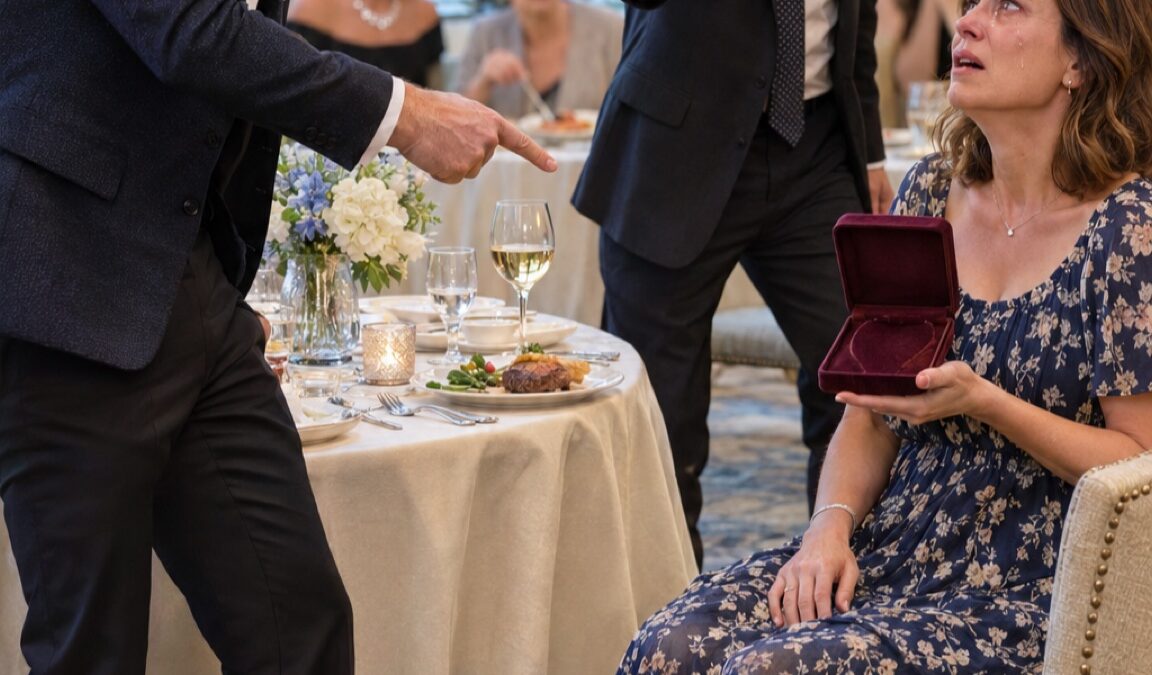
Part 3: The Request I Hadn’t Heard
“What request?” I asked.
Paul rested his empty hands against the table edge.
“He asked me to change the ownership record in my customer file. He wanted the necklace listed under him.”
Owen put his glass down.
“It was an administrative question.”
“I refused,” Paul said. “I told you Mara would have to contact me herself.”
That was what his morning message had been about.
He hadn’t left the details on voicemail. He hadn’t known whether anybody else could hear it.
I looked at Owen.
“You asked him to put my necklace under your name?”
“I asked how we could simplify things.”
Paul shook his head.
“You asked me to change the owner. I said no.”
Owen glanced around the table before answering again.
“A store record doesn’t decide what belongs to a married couple.”
“No,” Paul said. “But I won’t make a false entry.”
I had expected Owen to deny asking.
Instead, he moved immediately to what the request meant.
He wanted everyone to believe this was ordinary housekeeping. A husband managing something his recovering wife couldn’t handle.
I put the closed box beside my plate.
“I never asked you to manage my jewelry.”
“You haven’t been managing much lately.”
Vera shifted behind his chair.
“Owen, stop talking about the surgery.”
He ignored her and looked at Paul.
“You delivered it. She approved that.”
Paul reached into his delivery bag.
“I brought the delivery instructions, too.”
He laid the copy beside me, facing my place.
I recognized my signature before I read anything.
One week before dinner, I had signed that sheet in his shop. I had been tired and sore, but I had read it.
It allowed the necklace to be displayed that evening.
It specifically prohibited a gift, sale, or other transfer.
Paul tapped the return instruction without pushing the sheet toward Owen.
“This is why I stayed for collection.”
Owen hadn’t seen the instructions before that moment.
He had arranged the publicity idea with me, not the terms with Paul. My jeweler kept my customer records private.
I had thought requiring collection was being overly cautious.
Now Owen leaned forward to read the sheet.
“You made this sound like a family favor.”
“It was a favor,” I said. “It wasn’t a gift.”
Janelle took her hand off the table.
“Why did you tell me it was mine?”
Owen didn’t look at her.
“We needed some flexibility.”
“With my necklace?” I asked.
He rubbed the side of his face.
“There’s a loan payment overdue.”
Nobody moved to refill a glass or clear a plate.
“It’s a business problem,” he continued. “Selling something that sits in a box would have fixed it.”
The necklace had been appraised at $24,000.
I knew an appraisal wasn’t a promise of a sale price. So did Owen.
He had been hoping it would bring enough to help.
“You were going to sell it.”
“I was going to keep the shop operating.”
That was the same answer he used whenever he wanted my card.
A shipment was delayed.
A supplier needed paying.
Something would be paid back when the next orders cleared.
I looked at the box beside my dinner.
“You could have asked me.”
“You would have said no.”
“Yes,” I said.
He sat back.
“There. That’s exactly what I mean.”
Janelle pushed her chair away from him.
“You said you bought it for me.”
Owen turned toward her then.
“Not here.”
“You let me put it on in front of your wife.”
“You knew she was lending it tonight,” Paul said.
Janelle nodded without looking up.
“I thought she was lending it for the dinner. He said afterward it would be mine.”
Vera pulled out the empty chair beside her.
“Come sit here,” she told Janelle.
I couldn’t tell whether she was protecting Janelle or Owen.
I didn’t ask.
Paul slid the delivery instructions back into his bag.
“My file also has the estate inventory and appraisal,” he said. “I prepared the appraisal when Mara received the pieces.”
My grandmother’s estate had finished distributing the jewelry two years earlier.
Nothing about the necklace had been left undecided.
I hadn’t bought it with our earnings.
I hadn’t given it to Owen.
I hadn’t agreed to sell it.
Paul’s records supported that history. His own eyes supported what happened that afternoon.
He had watched me lend the necklace to Janelle.
He had heard the return instruction.
There wasn’t a missing conversation Owen could invent.
Owen stood again.
“This doesn’t need to become a legal argument.”
“Then stop telling people it belongs to you.”
Vera reached for the back of my chair.
“Can you stand comfortably?”
“Not quickly.”
She moved the chair without touching me.
I stood with my palm against the table.
My incision pulled when I straightened.
I was embarrassed that everyone could see how carefully I moved.
Then I looked at Owen’s untouched chair beside Janelle’s.
I didn’t want to spend another night in our room.
I picked up my purse and the box.
Paul asked whether I needed help carrying anything.
“Just stay while I make a call.”
I stepped into the adjoining lounge.
Through the doorway, I could still see the table.
I used my phone to call my card issuer.
Owen was an authorized user on my individual account. He wasn’t a joint account holder.
I asked them to remove his purchasing authority.
They explained that existing charges remained my responsibility.
I said I understood.
I wasn’t disputing purchases I had actually allowed.
I was stopping new ones.
When the call ended, I arranged a separate ride home.
I checked the pickup information, then put my phone away.
Those ordinary steps took concentration.
I kept checking that my purse was closed.
Paul waited nearby without asking me to explain my marriage.
Owen came out before my ride arrived.
“You can’t just abandon the shop.”
“I’m not buying anything else for it.”
“Those suppliers expect us to keep ordering.”
“Then you need to speak to them.”
His eyes went to my purse.
“You’re angry. Don’t make financial decisions like this.”
“I’ve already made this one.”
He lowered his voice further.
“If you make this a divorce, I’ll have somebody look at everything. Including what your grandmother left.”
I felt scared then.
I knew the jewelry was mine.
I didn’t know how expensive proving that might become.
Paul spoke from beside the doorway.
“Keep your estate records, Mara. Your attorney can review them.”
Owen looked annoyed that he had answered.
I tucked the box more securely under my arm.
My phone showed that my ride had arrived.
Owen moved between me and the dining-room entrance.
“Leave the box here. We’ll sort it out tomorrow.”
Part 4: What Came Home With Me
“No,” I said. “It’s coming with me.”
He looked toward Paul.
“You’re encouraging this.”
“I’m making sure my customer receives her property.”
Owen could have kept arguing.
There were relatives behind him and resort staff nearby.
Instead, he stepped aside and took out his phone.
I walked back into the dining room for my room bag.
I had left it beneath my chair because stairs and extra trips still tired me.
Vera picked it up before I bent down.
“I’ll carry this.”
“Thank you.”
She followed me into the hallway.
Paul walked with us as far as the lobby.
Nobody applauded.
Nobody delivered a speech about what Owen had done.
Some relatives looked away when I passed.
One reached out and touched my shoulder.
I didn’t stop walking.
Near the lobby doors, Vera handed over my bag.
“I was only trying to keep things from getting uglier.”
I adjusted the strap over my shoulder.
“You asked me to protect him.”
“I asked everybody to calm down.”
“You only asked me.”
She looked at the box under my arm.
For a moment, I thought she might defend him again.
Instead, she asked whether I had somebody to call when I got home.
“I can manage tonight.”
“If you need anything, call.”
I thanked her for carrying the bag.
I didn’t tell her everything was fine between us.
Paul waited until the driver confirmed my pickup.
He reminded me that his office could provide copies of my records.
“I’ll call you after I’ve rested,” I said.
Then I got into the car with the box.
The seat belt pressed against my sore stomach.
I folded my coat beneath it and watched the resort entrance disappear behind us.
Owen called on the way home.
I let it go to voicemail.
His message started with the business.
He wanted to know whether his card would still work.
Then he said I had misunderstood what happened with Janelle.
I saved the message without answering.
At home, I put my bag down beside the sofa.
The house was quiet.
I took my medication as prescribed and ate toast because I hadn’t finished dinner.
The velvet box stayed beside my plate.
I opened it to check the necklace before bed.
Paul had settled it neatly into its fitted lining.
The clasp was closed.
Nothing had been damaged.
I slept in the spare room because it was closer to the bathroom.
I wasn’t making a statement.
I didn’t want to climb over the laundry Owen had left beside our bed.
The next morning, I put the jewelry in my individual safe-deposit box.
I took photographs before depositing it.
Then I collected the estate inventory from my home files.
Paul sent the appraisal and display instructions after I called.
He also wrote down what he had personally witnessed.
Not what he thought about Owen.
What he had seen and heard.
The loan at the fitting.
My return instruction.
Janelle’s agreement at the table.
The necklace going back into my box.
I kept those records together.
During the week after dinner, I met with a divorce attorney.
I brought the card statements, too.
I expected her to tell me I had ruined something by paying for the shop for so long.
Instead, she asked practical questions.
Whose account was it?
Who had signed the business loan?
Which funds were inherited?
What had I actually authorized?
She explained that inherited property generally remains separate in Ohio when it can be traced and hasn’t been given away or mixed beyond recognition.
The estate inventory and appraisal mattered.
So did the fact that the necklace itself was still identifiable.
The display hadn’t changed its ownership.
A jeweler’s customer record wasn’t a deed or a court judgment.
But Owen’s attempt to change it, and Paul’s refusal, helped explain what had happened.
I filed for divorce that week.
There was no instant ruling.
There was paperwork, waiting, disclosure, and plenty of messages.
I didn’t empty our joint accounts.
I didn’t sell his equipment.
I followed my attorney’s advice about ordinary expenses and disputed money.
I paid the existing charges on my own card.
I stopped using it to subsidize his business.
Owen tried a different approach after his first angry calls.
He said the shop couldn’t afford to lose my help.
He asked whether I would finish work already promised to customers.
I asked him to send the details to my business email.
He called instead.
“We’ve never done it that way.”
“We will now.”
I would not handle his customers’ work without agreed payment.
He found someone else.
I heard about it because a customer called me directly.
She wanted an alteration done and asked my price.
I quoted it.
She said that was fine.
I wrote her appointment in my book.
For once, there wasn’t a separate conversation about helping Owen.
My recovery continued through all of it.
Some afternoons I worked briefly, then lay down.
I stopped apologizing to customers for following my doctor’s restrictions.
If I couldn’t meet a deadline, I said so.
They either booked later or went elsewhere.
The business loan did not disappear because I left.
Owen had personally guaranteed it.
I had not.
My attorney still reviewed the loan documents and our broader finances rather than assuming every business obligation was automatically his alone.
Eight months after I filed, our divorce was finalized by agreement.
The decree preserved my inherited jewelry.
It divided our marital property and assigned Owen the business and responsibility for his loan.
That agreement did not alter the lender’s rights.
It did end his claim that I should keep making voluntary purchases for him.
He kept the shop, its work, and its expenses.
He lost my card access and my unpaid labor.
I moved into a rented apartment.
Vera helped carry a sewing-machine case inside.
She apologized without mentioning whether Owen had been embarrassed.
I accepted the apology.
We didn’t talk about him while we unpacked.
Three months after the divorce, I had an ordinary evening appointment followed by dinner out.
Before leaving, I washed the loose threads from my hands.
My customer had paid before collecting her dress.
I put the receipt away and took out the velvet box.
The necklace no longer had to wait for somebody else’s event.
I lifted it from the lining and fastened it myself.
Then I set the open velvet box on my dresser, its empty necklace-shaped hollow facing the mirror.








