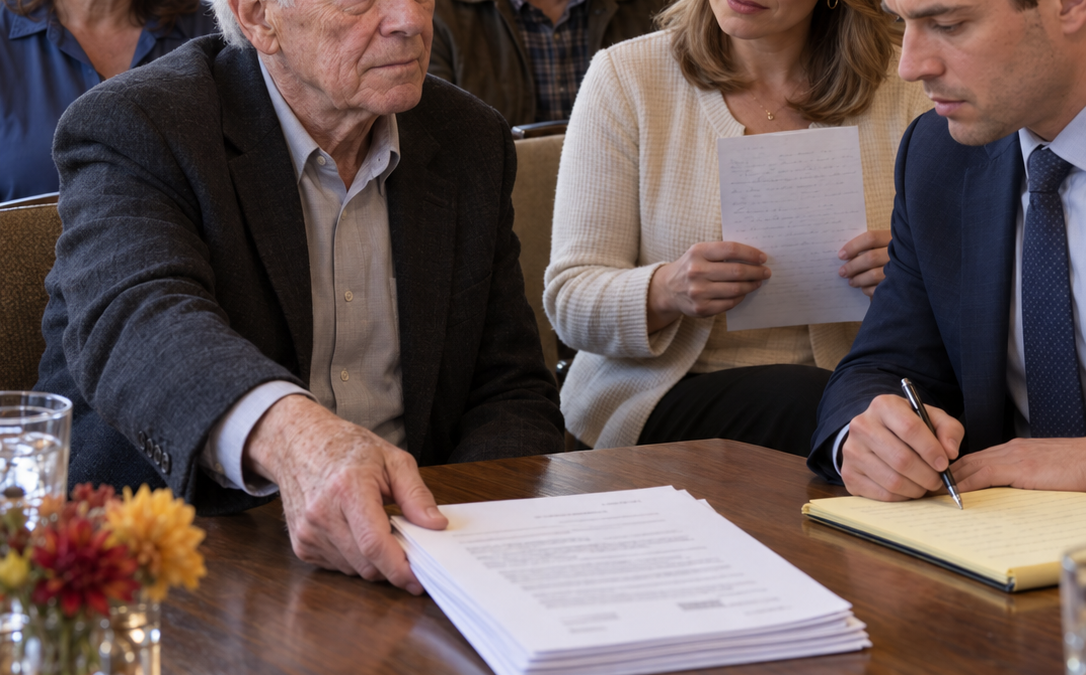
My cousin took Dad’s deed with his spare key and told a lawyer he couldn’t remember his address. Dad, 76, had his neurologist’s report ready.
Complete story · 7 parts · about 27 minutes · ending included
Part 1 · Part 2 · Part 3 · Part 4 · Part 5 · Part 6 · Part 7
Part 1 of 7
“Uncle V couldn’t even give the pharmacy his address on Friday,” Sierra said, setting her purse beside the cookies.
“I’m handling his affairs now.”
The pastor had a napkin in his hand.
The six women gathered around the table stopped choosing between the oatmeal cookies and the ones with chocolate chips.
I glanced at the clock above the fellowship hall kitchen.
It was 10:45 on Sunday, October 25, and Sierra still had her car keys looped around a finger.
“Handling what?” I said.
“Oh, Noreen.”
Sierra tipped her head toward me.
“The things that get difficult.”
My father stood beside the coffee urn in his Sunday coat.
Vern Hunt was seventy-six, and he had carried his own cup across the room without spilling anything.
“He can’t even tell you his own address. I’m saving that house from him.”
Sierra said it clearly enough for the pastor to lower his napkin.
A woman holding a paper plate turned toward Dad, and the woman beside her followed.
Their mouths softened.
One reached toward his sleeve, then stopped short of touching it.
Dad set down his cup.
“1418 Lewis Avenue. Since 1971.”
His hand went to the inside pocket of his coat.
A white clinic envelope showed above the lining before he pressed it back into place.
He said nothing more.
His fingers rested against the lapel while Sierra moved her purse to make room for someone’s plate.
“An address he’s had that long ought to come easily,” Sierra said.
“That’s why Friday concerned me.”
“Were you at the pharmacy?” I said.
“Sweetheart, I’m trying to keep this from becoming embarrassing.”
Sierra turned toward the pastor before I could answer.
“You know how private Uncle V is.”
The pastor folded his napkin into a smaller square.
“Vern, would you like to sit down?”
Dad shook his head.
There was an empty chair against the wall, but he stayed beside the urn.
“He can answer a question,” I said.
“Of course he can,” Sierra said.
“Nobody said otherwise.”
A woman at the end of the table pushed the cookie tray toward him.
“Take something home with you, Vern.”
Dad picked up an oatmeal cookie and laid it on a napkin.
The woman kept holding out the tray after he had finished.
I took it from her and set it down.
“Sierra, come over here,” I said.
“I’ve barely had a chance to say hello.”
“We can talk by the kitchen.”
Sierra smoothed the front of her blouse.
“There’s nothing to whisper about. We’re family.”
The pastor stepped aside to let someone reach the coffee.
Behind him, a chair scraped across the tile, and conversation started near the coat rack.
Sierra leaned closer to me without lowering her voice much.
“I know you work, Noreen. You can’t be over there keeping track of things.”
“I was there yesterday.”
“A visit is lovely.”
Sierra picked up a cookie, examined the bottom, and put it on her plate.
“That isn’t quite what I mean.”
At the city water-service desk, I took calls from people who wanted a different answer after I had given them the available one.
I kept my hands at my sides.
“What affairs are you handling?”
“We’ll talk when you’re ready to have a calm conversation.”
Dad lifted his cup and carried it to the tray marked USED CUPS.
He folded the napkin around his cookie and waited beside the hall door.
I went to him.
Sierra was telling the pastor how much Uncle V had done for her when she was growing up in his house.
Outside, Dad buttoned his coat before walking to his car.
I stood beside him until he had his keys out.
“I’ll come by this afternoon,” I said.
He nodded and opened the driver’s door.
The wrapped cookie went on the passenger seat.
At his house that afternoon, Dad cleared a space on the kitchen table with the flat of his hand.
He moved the grocery circular beside the salt shaker and pulled out a chair for me.
“Sit down, Noreen. I’ll show you the deed.”
“I know it’s your house.”
“I’d like you to see it.”
He went to the hall closet and shifted a pair of boots from beneath the shelf.
I followed as he lifted the fireproof box onto the narrow hall table.
The gray handle stayed upright when he released it.
He turned the lock and raised the lid.
Inside were a folded insurance policy and a manila envelope.
Dad lifted the envelope, looked beneath it, and set it on the table.
“The blue folder goes here,” he said.
He put his palm against the bottom of the box.
There was enough empty space beside his hand for a stack of papers.
“What was in it?”
“The original deed. My credit union passbook.”
Dad checked inside the manila envelope, then closed its flap.
He laid the insurance policy across it without unfolding the pages.
“Did you move the folder?” I said.
“No.”
“Could it be at your workbench?”
“I don’t take it to the workbench.”
He lowered himself onto the hall chair and drew the container closer.
I stayed standing while he examined the empty space beneath the hinge.
“The passbook was inside the deed,” he said.
“I closed the folder and put it away.”
I looked into the closet.
There was no blue edge behind the boots or under the shelf, and nothing had slipped between the wall and the table.
Dad put the remaining papers back where they belonged.
He left the lid open.
“Was the front door locked when you got home?”
“Yes.”
“And before you left?”
“I locked it before church.”
I rested my hand on the chair back.
“Who opened your box while you were in church?”
Dad set his house key on the hall table.
The brass teeth pointed toward the open lid.
The only other key to the house hung in Sierra’s kitchen.
Picking up where the Facebook post left off
Part 2 of 7
“I haven’t touched his papers since Easter.”
Sierra laughed before I could ask another question.
I stood beside Dad’s kitchen sink with my phone against my ear.
“The blue folder is missing,” I said.
“Well, where did he put it?”
“In the fireproof box.”
“Then he needs to look in the fireproof box.”
“He did.”
Dad sat at the table with the grocery circular beneath his hand.
He hadn’t turned a page since I dialed.
“Noreen, this is exactly what I was talking about this morning.”
“The deed and the passbook were in that folder.”
“I know what he keeps in it.”
Sierra stopped laughing.
A drawer opened and shut on her end of the call.
“Have you been inside his house today?” I said.
“Let’s deal with what matters. Has Uncle V eaten?”
“That wasn’t my question.”
“I heard your question.”
Dad looked up from the circular.
I kept the phone against my ear and waited.
“People misplace things,” Sierra said.
“Did you take it?”
“I already answered you.”
I turned toward the window above the sink.
Dad’s yard was empty except for leaves caught along the fence.
“If you find it, call me,” I said.
“Of course, sweetheart.”
The call ended before I lowered the phone.
Dad folded the circular along its old crease.
“What did Sierra say?” he said.
“That you misplaced it.”
He slid the paper beneath the salt shaker.
“The box was locked.”
“I know.”
He got up and put bread in the toaster.
I stayed until he had buttered it and carried the plate to the table.
His Sunday coat hung on the hook near the hall.
I left the fireproof box where he could reach it.
That evening, the family group chat lit up while I was rinsing a saucepan.
Sierra had posted an invitation headed “Family meeting.”
The message named the Rimrock Grill, next Sunday, November 1, at 12:30 p.m.
She had reserved a private room.
“We’ll be with someone from the law office,” Sierra wrote.
“Please come ready to help Uncle V. This morning was the last straw.”
I pulled a towel off the oven handle and tapped the attachment.
Sierra had forwarded an email from the firm.
The subject line included Dad’s name and the word “conservatorship.”
I sat down at my kitchen table.
The message referred to documents for the meeting and a proposed filing schedule.
One line said, “petition to be filed Nov. 2, pending daughter’s nomination.”
I put the towel beside my phone.
There was no other daughter in that sentence.
The email continued with arrangements for the restaurant meeting.
Sierra had forwarded the correspondence with the original wording still beneath her message.
I reached the signature and returned to the opening paragraph.
On that second pass, I stopped at a line above the proposed schedule.
It said, “per your engagement signed October 21.”
I lowered the phone until it rested flat against my palm.
October 21 had been Wednesday.
The missing folder had brought me to Dad’s house that afternoon.
Sierra’s announcement at church had come that morning.
I scrolled back through the family messages.
There were photographs, a birthday greeting, and a discussion about who was bringing what.
Near the beginning of Sunday’s messages, I found Sierra’s name.
The time above her text was 9:12 a.m.
“Uncle V’s already at church, swinging by his place.”
I stopped with that message centered on the screen.
The service had started at 9:30.
Dad had been in the pew while Sierra had his spare key.
My finger moved toward the reply field, then away from it.
I opened her forwarded email once more, just far enough to check the date.
The engagement line still said October 21.
Dad answered his flip phone while I was looking at the invitation.
“Did you see the family message?” I said.
“No.”
“Sierra wants us at the Rimrock Grill next Sunday.”
“What for?”
“A meeting about you. Someone from a law office is coming.”
Dad didn’t answer immediately.
I could hear a clock striking behind him.
“Did you ask for a lawyer?” I said.
“No.”
“The email mentions a petition.”
“Does it say I asked for one?”
“No.”
“Then I didn’t.”
I took a pen from the drawer and wrote the restaurant time on an envelope.
“Have you found the folder?” I said.
“It hasn’t come back.”
“I’ll call you in the morning.”
Dad said good night and ended the call.
I set the pen across the envelope.
Then I opened Natalie’s messages.
My daughter was in Bozeman, where nursing school had made her schedule difficult to catch.
I typed, “Can you pull Grandpa’s doorbell clips from Sunday morning?”
Before sending it, I added, “His blue folder is missing.”
The message showed as delivered.
I carried the saucepan to the stove and returned to my chair.
Natalie’s answer appeared while I was still holding the dish towel.
“I’m mid-shift. Tomorrow, first thing.”
I typed, “Save whatever’s there.”
“Is Grandpa okay?”
“He’s home.”
“What happened?”
“Sierra says he misplaced his papers. Finish your shift. We’ll talk tomorrow.”
Natalie sent back, “I will.”
I put the phone down beside the envelope.
What had the doorbell seen on Sunday morning?
Across the kitchen, the saucepan sat crooked on a burner.
I straightened it, then returned to Sierra’s invitation.
Her message blamed that morning.
The correspondence underneath carried Wednesday’s date.
I set the screen beside my handwritten note for next Sunday.
Sierra had hired the lawyer four days before the “last straw” Sunday.
Part 3 of 7
My phone lit up at 7:10 a.m. with a message from Natalie.
It was Monday, October 26, and my coffee was still brewing.
“Watch this,” Natalie had written.
The video beneath her message showed Dad’s front steps.
A timestamp in the corner read 9:40 a.m.
Sierra came through his front door carrying the blue folder against her blouse.
She pulled the door shut and worked her key free.
Colt’s truck waited at the curb.
Its engine rattled while Sierra walked down the steps and crossed the sidewalk.
The folder stayed tucked beneath her arm until she passed out of view.
I set my coffee mug down without filling it.
Natalie’s next message appeared beneath the clip.
“That’s from my doorbell account. I saved it.”
“Was there an alert yesterday?” I typed.
“I muted motion alerts in August. Street traffic kept setting them off.”
Natalie had been on a twelve-hour clinical shift the night before.
I looked at the time on the recording.
Sierra had sent the family her message at 9:12.
By 9:40, she was leaving with the papers she claimed Dad had misplaced.
“Keep that video,” I typed.
“I have it.”
“I’m going to Grandpa’s.”
“Tell him I’ll call after I sleep.”
I filled my travel mug and left the saucepan where it stood.
At Dad’s house, he was seated at his workbench beneath the adjustable lamp.
A clock movement rested on a square of pale cloth.
He set his tool down when I came through the doorway.
“Natalie found something,” I said.
I laid my phone beside the cloth and started the recording.
Dad leaned forward until the light caught the side of his glasses.
He watched Sierra close his door.
When the clip ended, he kept looking at the screen.
“Play it once more,” he said.
I started it from the beginning.
This time, his finger rested beside the phone as Sierra crossed the porch.
He didn’t touch the image.
“That’s my folder,” he said.
“Yes.”
Dad pushed his chair back and went to the hook in the hall.
His Sunday coat hung where I had seen it the afternoon before.
He reached into the inside pocket and took out the white clinic envelope.
I moved my phone away from the work cloth.
Dad handed me the envelope, then sat down.
The clinic’s return address was printed above his name.
Inside was an eleven-page neurology report dated September 29, 2026.
I laid the pages beneath the workbench lamp.
The examination date was September 21.
“You went to this appointment?” I said.
“Yes.”
“Who went with you?”
“Nobody.”
I turned to the summary.
It said his memory and judgment were normal.
I held that page flat while the corner of another curled against my wrist.
“Sierra kept saying I forgot things,” Dad said.
He reached for his glasses case and closed it without putting anything inside.
“So I made the appointment.”
The report covered a full neurological evaluation.
I worked through the pages, keeping them in their original order.
“When did this come?” I said.
“October first.”
“And it’s been in your coat?”
“Yes.”
His flip phone rang before I could put the report down.
Dad checked the little screen and answered.
“Morning, Pastor.”
I gathered the loose pages away from his tools.
Dad listened, then pressed the button for the speaker.
The pastor’s voice came through thin and clear.
“We’ve made a temporary adjustment to the volunteer schedule, Vern.”
Dad rested the phone on the bench.
“What adjustment?”
“After talking with Sierra yesterday, we thought we should give you some room.”
“Which jobs?”
“The usher list and the offering count.”
Dad looked at the clock movement beneath the lamp.
“For how long?”
“Until the family sorts things out.”
I put the report’s summary on top of the stack.
“My father didn’t ask to come off those lists,” I said.
“Noreen, I understand this is difficult.”
“He’s sitting here.”
“Yes, of course.”
The pastor stopped speaking for a moment.
Dad moved his elbow away from the phone.
“Is there anything else?” he said.
“No. We’ll be keeping you in our prayers.”
“Goodbye,” Dad said.
He closed the flip phone and set it beside his glasses case.
The lamp made a bright circle across the cloth.
Outside that circle, the report lay beneath my hand.
“Why didn’t you tell me about the appointment?” I said.
Dad drew the envelope closer.
“I wanted it on paper first.”
“You had it on paper yesterday.”
His thumb ran along the opened flap.
I moved my phone between us and brought up the paused recording.
Sierra stood on his steps with the folder beneath her arm.
“We can take this to the police,” I said.
“No police.”
“She took your deed.”
“I gave her that key myself.”
“That doesn’t make the folder hers.”
“I know what belongs to me, Noreen.”
He said it in the same voice he used to identify a watch part.
I turned the screen toward him.
“She told me you misplaced it.”
Dad looked at Sierra’s hand against the blue cover.
“She knew where to find it.”
I put the phone down.
The envelope was too narrow to take the pages without folding them.
Dad held it open while I matched the creases.
“Are you going to fight her before that dinner?” I said.
He stood and carried the report into the hall.
I followed him as far as the doorway.
Dad slid the papers back into his coat and pressed the pocket flat.
“We go to her dinner. I bring my own papers.”
Part 4 of 7
“I represent Mrs. Cross,” Justin Newton said.
Dad’s flip phone lay open on the kitchen table between us.
It was Tuesday, October 27, and Dad had called the number in Sierra’s forwarded email.
Justin had introduced himself as an associate at the firm.
“I can’t discuss her matter with you, Mr. Hunt.”
Dad rested his hand beside the phone.
“I’ll be there Sunday.”
He ended the call without mentioning the clinic envelope in his coat.
I looked at the restaurant invitation on my screen.
“We could send him the report,” I said.
Dad shook his head.
“Let Sierra speak Sunday.”
“In front of the family?”
“Yes.”
He closed the phone and slipped it into his pocket.
I turned the screen toward him.
The email still listed Monday, November 2, as the proposed filing date.
The words beneath it were “pending daughter’s nomination.”
“She needs my signature,” I said.
Dad adjusted his glasses.
“Has she got it?”
“No.”
“Then put that down.”
He nodded toward the phone gripped in my hand.
I loosened my fingers and propped the phone against the sugar bowl.
The email made Sunday’s meeting more than a meal with relatives.
Sierra planned to get my nomination and have the petition filed Monday.
After that came weeks of court process, a hearing, and a court-appointed lawyer for Dad.
He would have to answer questions about managing his own property.
Meanwhile, Sierra would still have his original deed and credit union passbook.
I rubbed the mark the case had left across my palm.
“What if Justin brings papers he wants signed right there?” I said.
Dad looked at the invitation.
“We’ll be there.”
He got up to rinse his cup.
I followed him as far as the sink with my phone in my hand.
“The meeting starts at twelve-thirty.”
“I can read that.”
“I know.”
He set the cup upside down on the draining board.
Back at my house, I opened the forwarded email on my computer.
I printed it with Sierra’s message and the firm’s date visible.
The printer pulled the paper through crookedly.
I straightened the sheet against the desk and checked that nothing had been cut off.
“Per your engagement signed October 21” appeared above the filing schedule.
I laid that page beside my keyboard.
Then I opened the family chat and scrolled to Sunday morning.
Sierra’s message sat beneath the 9:12 a.m. timestamp.
“Uncle V’s already at church, swinging by his place.”
I took a screenshot with her name and the time included.
The image went into a folder on my phone with a plain label: Dad.
I sent Natalie a message about Sunday’s restaurant meeting.
“Bring the video on your phone,” I wrote.
“Saved locally,” Natalie answered.
Natalie also confirmed the drive home for Saturday.
I put the printed email in a document sleeve and laid it on the kitchen counter.
The paper stayed there while I went to work, came home, and checked my messages.
Dad didn’t ask me to call the firm again.
When we spoke, he asked whether the print was large enough to read.
On Saturday, Natalie drove home from Bozeman with her overnight bag on the passenger seat.
Natalie came into my kitchen still wearing a jacket.
“Show me what you printed,” Natalie said.
I slid the sleeve across the counter.
Natalie checked the engagement date, then brought up the saved video.
Sierra’s blue folder filled a corner of the little screen.
“It plays without a connection,” Natalie said.
I watched until the truck passed out of view.
Natalie put the phone away and carried the bag down the hall.
Sierra had already caught me alone on Thursday.
I had been loading groceries outside the store when I heard my name.
Sierra stood behind my cart with her purse tucked against her side.
“Noreen, I’m glad I found you.”
I set a bag inside the trunk.
“I’m heading home.”
“This won’t take long.”
Sierra placed a hand on the cart handle.
I still had groceries in the basket.
“Have you looked at what I sent?” Sierra said.
“Yes.”
“Good. Then Sunday should be simple.”
I reached for the bread and put it beside the other bags.
“What exactly are you asking me to sign?”
“The nomination. The lawyer will explain it.”
“Then I’ll listen to him.”
Sierra smiled toward a shopper passing behind me.
When the cart wheels faded, Sierra leaned closer.
“We need to present a united family.”
“Dad didn’t ask for this.”
“Uncle V doesn’t like asking for help.”
“He called the firm Tuesday.”
Sierra’s hand tightened around the handle.
“What did he say?”
“That he’d be there Sunday.”
“And?”
“That was it.”
Sierra studied my face.
I lifted the remaining groceries out of the cart.
“So you’ll sign?” Sierra said.
“I’ll be at the meeting.”
“That isn’t what I asked.”
I closed the trunk and held out my hand for the cart.
Sierra kept hold of it.
“Nobody wants this turning into a fight over property.”
I looked at the space between Sierra and my driver’s door.
Sierra moved into it.
“What happens if I don’t sign?” I said.
The smile left Sierra’s mouth.
“Sign the nomination Sunday, or I tell everyone you want his house.”
Part 5 of 7
“Home address: could not answer.”
Sierra read from a handwritten sheet headed “Memory questionnaire.”
I checked the time on my phone.
It was 12:40 p.m. on Sunday, November 1.
The clocks had fallen back that morning.
There were eleven of us in the Rimrock Grill’s private room.
Natalie sat beside me, with Dad on her other side.
Across from us were Sierra, Colt, and Justin Newton.
Dad’s sister and her husband sat near the door.
The cousins and the church elder occupied the remaining places.
Sierra held her questionnaire above her plate.
“Last Sunday he couldn’t find his way to church. I had to go get him.”
Dad’s sister lowered her menu.
Sierra turned the page toward the family.
“He can’t even tell you his own address. I’m saving that house from him.”
Justin slid a form toward me.
The word “Nomination” appeared near the top.
He laid a pen beside it and kept his hand on the paper.
“We should discuss what this means before you sign,” Justin said.
Dad reached inside his Sunday coat.
“1418 Lewis Avenue,” he said.
He removed the clinic envelope and unfolded the pages inside.
Sierra put her questionnaire down.
“Uncle V, let’s finish what we’re doing.”
Dad pushed the eleven-page report across to Justin.
“Read the summary,” Dad said.
Justin moved the nomination aside and examined the clinic letterhead.
His eyes followed the dates before he turned to the page Dad indicated.
“Memory and judgment are normal,” Justin read aloud.
He lowered the report far enough to look at Dad.
“The examination was September twenty-first?”
“Yes.”
“And this is the report you received afterward?”
“Yes.”
Sierra reached toward the pages.
Justin kept them in front of him.
“That doctor saw him for one hour. I’ve watched him for years.”
The church elder shifted his chair closer to the table.
Justin placed the report beside his yellow pad.
“Mrs. Cross, you described an inability to manage his affairs.”
“That’s what I’ve been trying to explain.”
“He has given his address and supplied a current medical report.”
“He can have a good afternoon.”
Dad folded the empty envelope along its crease.
Sierra picked up her questionnaire again.
“Last Sunday was the last straw. That’s when I called a lawyer.”
I took the document sleeve from my bag.
Justin looked toward me as I laid the printed email on the table.
“This is the email Sierra forwarded to the family,” I said.
Sierra’s thumb stopped against the edge of her handwritten sheet.
I turned the printout so Justin could see the firm’s heading.
“Engagement signed October 21,” I read.
“That was Wednesday.”
“We’d had a conversation,” Sierra said.
“The email says signed.”
Colt moved his water glass away from his plate.
I opened the screenshot on my phone.
“This was your message last Sunday at nine-twelve.”
Sierra glanced toward the door.
I read the text without handing over the screen.
“Uncle V’s already at church, swinging by his place.”
Dad’s sister leaned forward.
“You said you had to go get him.”
“I was checking on him,” Sierra said.
“The message says he was already at church,” I said.
Justin drew the email closer and made a note on his pad.
Sierra set her questionnaire beside her fork.
“This has gotten completely away from what matters.”
Dad put the folded envelope on his knee.
“Where is my blue folder?” he said.
Sierra looked at him.
“I haven’t touched his papers since Easter.”
Natalie unlocked her phone and handed it to Dad.
He set it beside the report, with the screen facing across the table.
“Watch this,” he said.
He pressed play.
The doorbell recording showed his front steps beneath the 9:40 a.m. timestamp.
Sierra came out carrying the blue folder.
The truck engine sounded through the phone’s speaker.
Colt stared at his plate.
Nobody reached for a water glass while Sierra crossed the screen.
Dad let the recording finish before lifting his finger.
“I took them to keep them safe. Scammers go after old men.”
Sierra said it toward Justin.
He looked from the phone to the questionnaire.
“You just said you hadn’t touched them since Easter,” Justin said.
“I meant I hadn’t done anything with them.”
Dad’s sister pushed her menu aside.
Sierra turned toward the church elder.
“You know how much he trusts people.”
The elder kept looking at the phone.
Justin straightened the report and placed it on top of the printed email.
“Mr. Hunt, do you want Mrs. Cross managing your property?”
“No.”
“Did you ask her to take those documents?”
“No.”
Sierra put her hand over the questionnaire.
“Noreen, this is where you’re supposed to help.”
The nomination still lay unsigned beside my place.
I moved my drinking glass away from it.
Justin looked at the medical summary, then at the notes he had made.
He capped his pen.
“Mrs. Cross, the firm can’t file this. I’m withdrawing.”
He slid the unsigned nomination form back into his folder.
Sierra reached toward him.
“We paid for you to prepare this.”
Justin closed the cover.
“Nothing has been filed.”
Dad sat with his hands resting beside his plate.
Sierra turned toward him.
“Uncle V, we can talk about this at home.”
“I fix clocks, Sierra. I know exactly what time it is.”
He held out his hand to Natalie, who took back her phone.
“I want the blue folder returned by six,” Dad said.
“The deed and the passbook inside.”
Sierra looked at Colt.
His fork remained untouched beside his plate.
Would Sierra give the deed back?
Dad put the clinic envelope inside his coat.
“You have until six.”
His sister stood up first.
Part 6 of 7
The doorbell chimed at 5:52 p.m.
Natalie opened the camera view while Dad pushed back his chair.
Colt stood on the front steps with the blue folder beneath his arm.
Sierra stayed in the truck at the curb.
The porch light showed Colt looking toward the window beside the door.
Dad opened it before Colt could ring again.
“Sierra wanted me to bring this,” Colt said.
Dad took the folder.
“The deed and passbook?” he said.
“They’re inside.”
Colt kept his hands at his sides.
Dad opened the cover without inviting him in.
I stood behind my father while he checked beneath the folded deed.
The credit union passbook was there.
Dad lifted it enough to see the cover, then lowered it.
“That’s it,” he said.
Colt nodded and went down the steps.
The truck’s passenger door stayed closed while he climbed behind the wheel.
Dad shut the front door and turned the lock.
At the kitchen table, he spread the contents beneath the overhead light.
His name remained where it had always been on the deed.
He opened the passbook to the balance entry.
It showed $48,600.
Dad ran a finger along the crease in the document.
“Put it back the way you had it?” I said.
“In a minute.”
Natalie saved the new recording.
On the screen, Colt approached the house with the folder against his jacket.
Dad watched until his own hand appeared in the doorway.
Then he returned the papers to their blue cover.
Monday morning, a locksmith parked outside before I arrived.
Dad had cleared the hall table and moved the boots out of the way.
The fireproof box sat closed beneath the shelf.
The locksmith went from door to door, changing the locks to take new keys.
Dad stayed nearby without offering advice.
When the work was finished, the man handed him the replacements.
Dad tried a new key, then took the old one from his ring.
It slid into the lock.
It wouldn’t turn.
“And the spare?” Dad said.
“Same result,” the locksmith said.
Dad withdrew the useless key and put it in his pocket.
Sierra’s copy could hang in her kitchen.
It would no longer open his house.
That afternoon, Sierra forwarded the firm’s closing letter to the family chat.
I opened the attachment at my kitchen table.
The letter confirmed that the firm had closed her file.
No petition had been filed.
I sent the attachment to Dad’s email, then called him.
“Her file is closed,” I said.
“I heard.”
“From who?”
“My sister’s here.”
I could hear a chair moving across his kitchen floor.
“Come over if you’ve got time,” Dad said.
When I arrived, his sister was holding her phone beside an untouched cup.
Dad sat across from her with the locksmith’s receipt.
His sister looked at the screen and pressed Call.
“Sierra, it’s me.”
I hung my jacket on the back of a chair.
“No, Vern didn’t ask me to call.”
Dad folded the receipt and tucked it inside its envelope.
His sister rested her free hand on the table.
“You are not welcome at Thanksgiving.”
A voice came through the phone, too faint for me to make out.
Dad’s sister moved the cup away from her elbow.
“I was at the restaurant,” she said.
The voice continued.
“No, I’m not discussing the menu.”
His sister ended the call and set the phone facedown.
“Is that coffee still hot?” she said.
“I’ll make fresh,” Dad said.
He got up and carried the pot to the sink.
I took cups from the cupboard while his sister pulled her chair closer.
Nobody asked him to sit down.
The church elder called before we finished the coffee.
Dad opened his flip phone and listened.
His sister and I stayed at the table.
“I spoke with the pastor,” the elder said through the little speaker.
Dad lowered himself into his chair.
“I told him what I saw Sunday.”
“The papers?” Dad said.
“The report, the messages, and that recording.”
Dad put his cup down.
The elder continued speaking while I gathered the empty sugar packets.
“He’s going to call you himself.”
“Thank you,” Dad said.
The pastor called the next morning.
I was at work when Dad left me a message about it.
“The usher list is straightened out,” Dad said.
“And the offering count.”
His message ended with a click.
At lunch, I called him back.
“What did the pastor say?”
“He said he was sorry.”
“What did you say?”
“I said I’d be there Sunday.”
Through the receiver, I heard the small scrape of something against his workbench.
“Do you need anything picked up?” I said.
“No.”
“Milk?”
“I have milk, Noreen.”
I put my shopping list beneath my lunch container.
When I stopped by later that week, Dad was sorting the new keys.
The locksmith’s envelope lay open beside his glasses case.
Dad attached his house key to the ring and tested the clasp.
He put the spare on the table.
“Who gets that one?” I said.
Dad left it where it was and reached for his phone.
He called Natalie while I put the kettle on.
“Come by Saturday,” Dad said.
“I’ve got something to give you.”
Part 7 of 7
“Hold the tweezers closer to the tips,” Dad said.
Natalie moved her fingers down the steel.
“Here?”
“A little farther.”
I stood in the workroom doorway while Dad adjusted the lamp.
It was Saturday morning, and Natalie’s jacket hung over the chair behind her.
An open pocket watch rested on the pale cloth.
Dad steadied the case while Natalie worked beneath the light.
“Set the hand straight,” he said.
Natalie lowered the tweezers, then lifted them away.
“That?”
Dad leaned closer without taking the tool.
“Look from this side.”
Natalie bent until her cheek was nearly level with the bench.
“It’s crooked.”
“Yes.”
“You could have said that.”
“I did.”
Natalie looked up at him, then returned to the watch.
Dad kept his fingers beside the case while Natalie made the adjustment.
I put my purse on the hall chair.
“Coffee?” I said.
Dad pointed toward the kitchen with his chin.
“There’s some in the pot.”
“How old?”
“It was fresh when I made it.”
Natalie kept her eyes on the dial.
“Bring something we can chew, too.”
“I’ll get pie.”
Dad shifted the lamp a fraction toward Natalie.
“Don’t lean on the edge of the case,” he said.
I left them at the workbench and went out for breakfast.
When I returned, I carried the coffee tray beneath the pie box.
The front door had latched behind me when I left.
I pressed the bell with my knuckle.
The chime sounded inside, followed by footsteps.
Dad opened the door and took the box from the top of my load.
Natalie appeared behind him holding her phone.
“The camera caught your balancing act,” Natalie said.
I put the tray on the hall table.
Natalie turned the screen toward me and played the saved clip.
There was only me on the front steps, shifting the coffee beneath the box.
I had lifted my knee to keep breakfast from sliding onto the porch.
“You can delete that,” I said.
“I’m keeping it.”
Dad carried the pie into the kitchen.
“Bring the coffee before it gets old,” he said.
Natalie put the phone in a jacket pocket.
I followed with the tray while Dad took plates from the cupboard.
He opened the box and studied the apple filling showing through the crust.
“Big pieces?” I said.
“Use the plates as a guide.”
Natalie brought forks from the drawer.
Dad waited until I had cut the pie before sitting down.
He took his coffee without asking me to check the lid.
We ate at the kitchen table with the workroom door open.
From my chair, I could see the tweezers lying beside the watch.
Natalie caught Dad looking toward the bench.
“I didn’t touch it while you answered the door,” Natalie said.
“I know.”
“I thought about it.”
“I know that, too.”
Dad used his fork to collect a piece of crust.
I slid the box closer when he finished.
He cut himself another narrow slice and left it on his plate.
Then he stood and went to the back door.
A hook had been fixed beside the frame.
Beneath it, a strip of white tape carried Natalie’s name in Dad’s handwriting.
He took the new spare key from his pocket.
Natalie got up from the table.
Dad hung it on the hook.
“That’s yours,” he said.
Natalie touched the brass edge without lifting it.
“Do you want me to take it?”
“Before you leave.”
“I’ll put it on my ring.”
Dad checked that the hook held, then returned to his chair.
His pie was still where he had left it.
Natalie sat down and pulled her coffee closer.
“What time do you want me here next Saturday?”
“Call before you make the drive.”
“I could bring my books.”
“There’s room.”
Dad finished the slice and carried his plate to the sink.
I gathered the empty coffee tray and folded it flat.
In the workroom, Natalie settled into the chair beneath the lamp.
Dad stood beside her while I put his cup within reach.
“You should have been believed before we had proof,” I said, turning the handle toward him.
Dad picked it up and took a drink.
Natalie waited with her hands resting on the edge of the bench.
“May I close it?” Natalie said.
Dad checked the watch, then nodded.
Natalie fitted the cover into place while he watched.
I leaned against the doorway with my coffee.
Dad moved the tweezers back to their place on the cloth.
Natalie wound the watch and held it to his ear.
He nodded.
“Right on time.”
THE END
More stories
My HOA president sent two men with shovels into my late husband’s memorial garden and fined me $2,400—Then her own financial records cost her the presidency.
You Might Also Enjoy




