Dad told 20 relatives at Christmas that $1,200 of my paycheck now belonged to my brother. The loan note was typed three days earlier.
Complete story · 7 parts · about 29 minutes · ending included
Part 1 · Part 2 · Part 3 · Part 4 · Part 5 · Part 6 · Part 7
Part 1 of 7
A fork rang against a glass while I was reaching for a slice of ham.
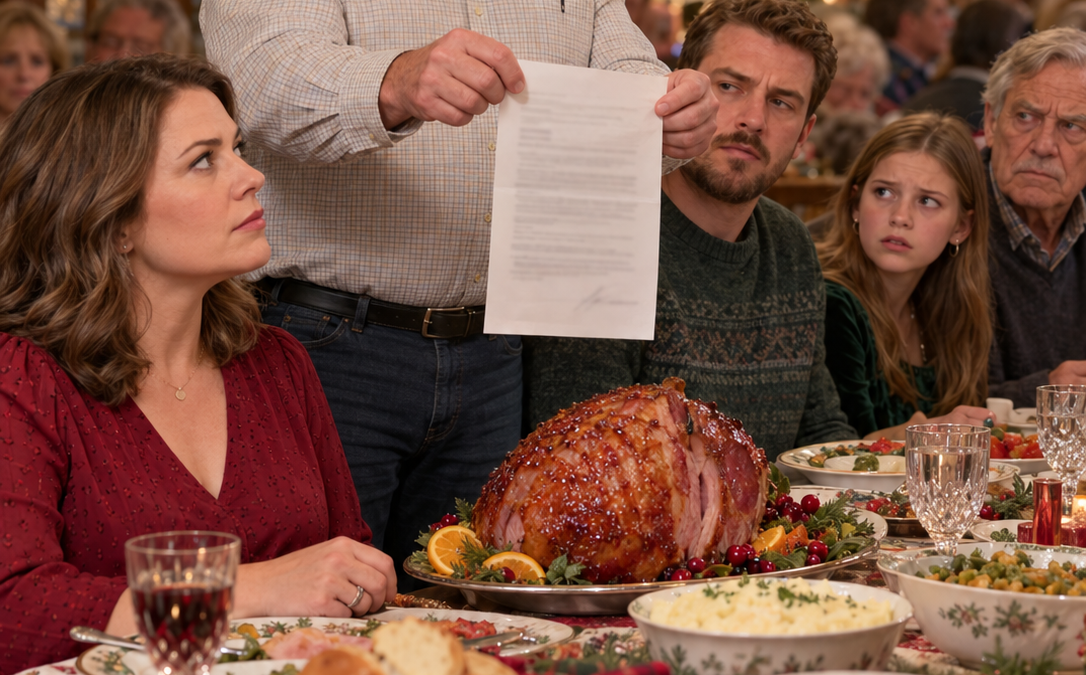
“Starting in January, Tammy, you’ll send Brody twelve hundred dollars a month,” Dad said, “because he’s got a family and you don’t.”
Twenty of us had crowded into Leroy Kucera’s farmhouse six miles north of Kearney, Nebraska, for Christmas dinner on Thursday, December 25, 2025.
Outside, snow reached the bottom rail of a fence. Inside, somebody had just asked for more potatoes.
My hand stopped above my plate.
At the head of the table, Dad remained standing, waiting for me to thank him for working out the arrangements. At sixty-six, he still used the voice that used to carry across his farm-equipment repair shop.
Brody sat near him.
My brother was thirty-three, married, with three children. Apparently that qualified him to receive a portion of my paycheck before I received it myself.
“Twelve hundred,” Brody said. “See? Dad did the math.”
Nobody asked where the figure came from.
At thirty-six, I knew exactly how many overnight shifts it took to clear that much after taxes. Holidays came with extra pay at dispatch. That was supposed to make up for missing dinners like this one.
A woman farther down the table lowered a serving spoon into a bowl without taking anything.
Setting his glass down, Dad reached into the breast pocket of his shirt.
Out came a note, typed and folded. He opened it over the ham, high enough for the people nearest him to see.
“Forty thousand dollars,” he said. “Tuition loan. August sixteenth, twenty-ten.”
My name was at the bottom, written in a hand meant to pass for mine.
“That’s not my signature.”
Across from me, Kenzie lowered her eyes to her plate.
My fourteen-year-old niece said nothing. Neither did anyone else.
The note stayed between Dad’s hands, held by its upper corners.
“You were twenty-one. Maybe you’ve forgotten what it took to get you through school.”
Brody leaned back.
“College was a while ago, Tam.”
A dish of green beans had stopped halfway around the table. The woman holding it looked toward Dad, then offered it to the next person without asking who wanted some.
There had been no private conversation before dinner. Dad hadn’t called to ask what I could afford or whether I had plans for January. He’d waited until refusing him meant doing it in front of relatives I saw twice a year.
Under the table, I pressed my heels into the floor.
Twelve years of answering 911 calls had taught me to leave room after a statement. People often kept talking if you didn’t hurry to help them.
“You’ve got no kids, Tammy. Your money’s got nowhere better to go.”
Brody laughed.
Someone at the far end made a small sound into a napkin. Nobody joined in.
My brother glanced around as though he’d offered the table something funny and the response had been disappointing.
“Come on,” he said. “She’s got a decent job. Steady hours.”
Dad nodded.
“County benefits, too.”
I worked nights when the roads iced over and callers couldn’t tell me which ditch they were in. On some mornings, I got home and sat on the edge of my bed with my boots still on because taking them off meant being alone with what I’d heard.
That wasn’t a conversation I was going to have over Christmas dinner.
Brody took a drink.
“We’re not asking you to raise the kids.”
Along its creases, Dad folded the note and returned it to the same pocket.
I hadn’t touched it. From my seat, I could still see a narrow strip of white above the fabric.
“First of the month is easiest,” my brother said.
A pat of butter had melted against a roll I hadn’t opened.
From the head of the table, Dad looked toward the far end.
“Family takes care of family. That’s how your mother and I raised you.”
Brody’s phone was beside him. Mine was in a pants pocket, where I kept it when I was waiting for a call about shift coverage.
For a moment, I wanted it to ring.
No one asked whether I had agreed. A relative offered more coffee, and Dad said yes without sitting down.
“Now, I don’t want a bunch of phone calls about this,” he said. “We’ve got it settled.”
My brother gave me a little nod, the kind people give when they’re accepting a favor.
I put my fork down.
Dad brushed a crumb off his sleeve. “At New Year’s dinner, you’ll sign an acknowledgment, in front of everybody.”
By nine-seventeen that night, I was parked in the employee lot in Kearney, with enough time before my overnight shift to get my breathing even.
The drive from the farmhouse had been slow. Snow blew across the road in thin strips, and I had kept my phone in my pocket until the car was stopped.
A family chat notification lit the screen.
Brody had posted a PDF of the note.
“So everybody’s a witness. Merry Christmas.”
He put everything in that chat. A new shop sign, a child’s report card, whatever he was grilling on a Sunday. Tonight, he’d supplied something the relatives could keep looking at after they went home.
“Nine-seventeen p.m.,” I said aloud.
At work, a time belonged beside what happened. The time had come out of my mouth before I thought about it.
On the phone screen, the document was small, but I could make out the amount and the name at the bottom. There were no file details showing. I didn’t check anything else.
Dad had said I already owed him.
Next Thursday, he expected me to put my name on another document in front of the same audience.
I typed, “I want to see the original before I sign anything.”
Through the windshield, I watched an employee cross the lot with a lunch bag tucked under one arm.
My phone vibrated.
Dad’s answer appeared beneath my message.
“Original’s in the safe deposit box. You’ll see it when you sign. Bring a pen.”
Picking up where the Facebook post left off
Part 2 of 7
I scrolled past a picture of Christmas leftovers while the call board was clear.
Brody had posted again.
“Uncle Wil’s backing the new bay, 60K! $1,200 a month starting Feb 1, check Friday Jan 2, already covered 😉”
The date above his message was Friday, December 26.
I straightened the cuff of my sleeve.
“Five-eighteen a.m.,” I said.
Beside my keyboard, the coffee had gone cold.
My headset pressed a crease into the hair above my ear.
Uncle Wil was Dad’s older brother, seventy-one, retired from the grain elevator.
He spent his winters in Arizona and used a flip phone that wouldn’t receive the family chat.
Brody had announced the arrangement to people who could congratulate him.
Wilbur wouldn’t see the replies.
Someone sent a row of clapping hands.
A cousin wrote, “Big things coming!”
I moved the screen closer.
Twelve hundred dollars a month, starting February first.
At dinner, my brother had said the first of the month was easiest.
Dad had given him the repair shop in 2023.
Now Brody had a new bay coming, an uncle putting up sixty thousand dollars, and a payment he called covered.
My next call came through before I could scroll farther.
I put the phone facedown and asked for the address.
By the time I finished entering the call information, the screen had gone dark.
I unlocked it and put “loans” into the chat’s search box.
The results took me back through messages about cars and interest rates.
Then Dad’s name appeared above a post from June 14, 2019.
“Tammy paid off her own school loans today.
Every penny. That’s my girl.”
I could still see where I’d been sitting when he posted it.
My apartment had smelled like the toast I’d forgotten while I waited for the federal loan account to update.
The balance had changed to zero.
I had called Dad before I went to bed.
Under his message, relatives had sent congratulations.
Brody had added a thumbs-up.
I took a screenshot with Dad’s name and the date showing.
Then I returned to Brody’s announcement and captured that one with its Friday heading.
In my photos, I opened the images in order.
June 14, 2019, followed by December 26, 2025.
The first had my father congratulating me for paying my own way.
The second had my brother celebrating a monthly payment someone had already covered.
A call sounded in my headset.
I set the phone beside my lunch bag and answered.
After my shift, I sat in the car until the windshield cleared.
There was a ridge of snow where the wipers had stopped.
Dad’s contact picture was an old photograph of him beside a tractor.
I pressed the call button.
“Well, there you are,” he said.
“Your brother says you haven’t answered him.”
“I want to see the original.”
“I sent you my answer last night.”
“I saw it. Before New Year’s, Dad.”
Through the speaker came the scrape of something across a counter.
His voice moved farther from the phone, then came back.
“You’ve got a copy. What else do you need?”
“The paper you say I signed.”
“You’ll see it when you sign.”
The call ended.
I stayed parked with the engine running, my hand still holding the phone beside the steering wheel.
At home, I left my boots on the mat and put bread in the toaster.
Before it popped, the family chat lit up.
Dad had written a new message.
“Tammy is refusing to honor a family debt.
I’d hoped we could handle this without making it unpleasant.”
Below that, he added, “Her brother has children to think about.”
I stood at the counter with the butter knife in my hand.
A drop of melted snow slid from my coat onto the floor.
The first private message came from a cousin who had sat near the potatoes.
“Just pay. He’s your dad.”
Another arrived while I was putting my plate in the sink.
“You make good money, Tam. Brody’s got a lot on him.”
Nobody had asked to see the original.
The chat kept moving beneath Dad’s account of what I was refusing to do.
I opened a reply and typed, “I asked to see the paper.”
Before I sent it, another cousin wrote, “Don’t make us choose sides over money.”
I deleted my sentence.
The toaster had left a dark edge on the bread, and I scraped it over the trash.
By noon, I had turned off notifications for the group.
Private messages still showed on the lock screen when I checked the time.
“Just pay,” one said.
“You’ll feel better once it’s settled.”
I put the phone on the dresser and pulled the curtains closed.
Before I lay down, I checked the alarm for my next overnight shift.
The typed note was still in the chat, dated August 16, 2010.
Dad had posted his congratulations nearly nine years after that supposed loan.
If I’d paid my own school loans, where had his forty-thousand-dollar note come from?
I reached for the phone, then left it where it was.
Kenzie’s Saturday sleepover was still on my calendar.
My niece usually brought a bag that looked packed for a week and left a hair tie beside the bathroom sink.
At Christmas dinner, Kenzie had kept looking down at her plate.
I hadn’t gotten a chance to ask about school.
Now I opened the thread with Kenzie’s mom.
The message box waited beneath the arrangements we’d already made.
I texted Kenzie’s mom: “Kenzie can still come Saturday.”
Part 3 of 7
Kenzie stopped beside my kitchen table with her overnight bag still on her shoulder. The strap slipped to her elbow, but Kenzie didn’t catch it.
“What is that doing here?”
Brody’s attachment was open on my laptop. I had enlarged the note enough to see the signature without leaning toward the screen.
“The paper from Christmas.”
Kenzie set the bag down without taking her eyes off it. The color had gone out of my niece’s face, leaving a pale line around her mouth.
I pulled out the chair beside me.
“Sit down.”
Kenzie stayed standing. Outside my apartment window, a car worked its way through the snow along the curb.
“Did my dad send you that?”
“He put it in the chat.”
Kenzie looked toward the door, where her boots had left wet marks on the mat. I moved my coffee away from the edge of the table.
“What did you see?”
“Monday night,” Kenzie said. “At our kitchen table.”
I kept my hands beside the laptop. My niece pinched the loose end of the bag’s strap between a finger and thumb.
“He was typing that exact paper. I saw your name and the forty thousand.”
“On Monday?”
Kenzie nodded.
“Then he had this yellow legal pad. He kept writing Tammy Kucera.”
My fingers curled against the underside of the table. Kenzie finally sat, keeping her coat zipped.
“Over and over,” Kenzie said. “He’d look at one, then do another underneath.”
“Did he see you watching?”
“I was getting water. He said to go upstairs.”
The refrigerator motor stopped. From the apartment next door came the muffled sound of a television.
“Please don’t say I told you.”
Kenzie pulled a sleeve over her hand and pressed the cuff against her mouth. I closed the document enough to return to the chat.
“I won’t.”
“He’ll ask. If you say somebody saw him, he’ll know.”
“I won’t say that.”
Kenzie watched while I found Brody’s Christmas message. The attachment was still beneath his words about making everybody a witness.
Until then, I’d looked at it on my phone between work and sleep. The document filled a different shape on the laptop, with menus above it.
I saved the PDF to my computer. Then I opened the copy I’d saved and clicked File.
Properties was near the bottom of the menu.
A small window appeared over the note. I moved the cursor away so it wouldn’t cover the details.
The Created field showed “12/22/2025 11:06 p.m.” The Author field said “BRODY-SHOP-PC.”
“Eleven-oh-six p.m.,” I said.
Kenzie leaned closer without touching the computer. The metal pull on her coat zipper tapped the table.
December twenty-second had been Monday. Three days before Christmas.
The note underneath that window still claimed August 16, 2010. My name remained at the bottom.
“Is that when he made it?” Kenzie said.
“That’s when this file was created.”
My niece folded her hands inside her sleeves. I left the information showing and checked that the saved copy was in my folder.
There was no need to ask Kenzie to repeat what she’d seen. I moved the mouse away from the document.
“Do you want to take your coat off?”
Kenzie unzipped it but kept the coat across her lap. I got a glass from the cupboard and filled it at the sink.
My phone vibrated against the table before I could set the water down.
Dad’s name appeared on the screen. His message began with the dinner time for New Year’s, then continued beneath it.
“If you don’t sign, you’re not welcome at Easter or anything after.”
I lowered the glass until its base touched the wood. Water had run over my thumb.
Kenzie looked at my phone.
“Is that him?”
“Yes.”
“What does he want?”
“For me to sign.”
I turned the screen toward myself. There was no question in Dad’s message, just the invitation he was taking back and the condition for getting it returned.
Before I could put the device down, a family chat notification appeared. Brody had posted a photograph.
I opened it.
The picture showed the farmhouse wall where Dad kept the family portraits. I recognized the frame around Brody’s children and the corner of the hallway beyond them.
My photograph was gone. A pale rectangle showed where it had hung, with the little hook still in the wall.
At Christmas, I’d walked past that picture on my way to wash my hands. Now the empty place was centered in Brody’s shot.
Kenzie shifted beside me, and the chair scraped the floor. I locked the phone before my niece could lean over.
“Did he say something about me?”
“No.”
“Can I see?”
“It’s about me.”
Kenzie looked down at the coat across her knees. I dried my hand on a dish towel and laid it beside the sink.
On the laptop, the properties window remained open. Behind it was the paper Dad wanted me to acknowledge in front of the family.
The file gave me a date and a computer name. Kenzie had given me the kitchen table and the yellow pad.
What would Brody ask when I showed him the date? My niece sat close enough that her sleeve brushed my arm when Kenzie reached for the water.
I opened a browser and searched for a lawyer in Kearney. One office had an appointment page with a Monday opening.
Kenzie watched me enter my name. At the box asking what the consultation concerned, I typed, “Disputed promissory note.”
“You won’t need me there?”
“No.”
“Or tell them I was there Monday?”
I took my hands off the keyboard and turned toward Kenzie.
“Your name stays out of it,” I said. “I promise.”
The appointment page showed Monday, December 29. I booked the lawyer for Monday.
Part 4 of 7
“Don’t sign an acknowledgment,” the lawyer said. He turned my laptop so the note faced him squarely.
My appointment at the Kearney office was Monday, December 29, 2025. My coat was still buttoned, with the folder of appointment paperwork across my knees.
He scrolled to the date, then down to the signature. I kept my hands away from the keyboard.
“He says this is a tuition loan?”
“Yes.”
“Did you sign it?”
“No.”
The lawyer looked at me before returning to the screen. Behind his desk, a printer pulled a sheet from its tray.
“Any real debt from 2010 is past Nebraska’s five-year limit for written contracts,” he said. “A signed written acknowledgment restarts it.”
I shifted the folder off my lap.
“He wants another signature at dinner.”
“That’s why he wants your signature.”
The lawyer took a pad from beside his keyboard and wrote down the date printed on the note. I watched the tip of his pen stop beneath the year.
“And if the note is fake?”
“A forged note for forty thousand dollars, used to demand payment, is felony forgery.”
He set the pen down.
“You can report that to the police. Keep the file he sent, along with the messages demanding money.”
“I saved it.”
I opened the properties window. The lawyer leaned toward the screen and wrote down the creation date and the computer name.
“Where did you get this?”
“My brother put it in the family chat on Christmas.”
“Keep that message, too.”
I showed him the screenshots on my phone. He read Dad’s congratulations from 2019, then Brody’s announcement about the new bay.
“The sixty thousand hasn’t changed hands?” he said.
“Friday, January second. Uncle Wil gives him the check then.”
I took the phone back and left Brody’s post open. The words “already covered” sat beside the little winking face.
“Wilbur will be at New Year’s dinner,” I said. “Before the bank appointment.”
The lawyer glanced at the calendar on his desk.
“You’re going?”
“Yes.”
“Then take copies. Keep your own pen in your bag, and sign nothing.”
Outside, I sat in my car with the laptop case on the passenger seat. I checked Brody’s post before starting the engine.
Wilbur wasn’t in that chat. By Friday, my uncle could hand over sixty thousand dollars without knowing about the paycheck Dad had assigned to Brody.
New Year’s dinner came first. I put the phone in the console and drove home.
That evening, I opened the saved PDF without going through the conversation. It loaded from the folder on my computer.
Brody could delete his attachment from the chat. I checked the screenshots next, making sure his name and the date were visible.
Then I closed the laptop and called Kenzie.
“Did I leave my hair tie?” my niece said.
“By the sink.”
“Can you keep it?”
“It’s in the drawer.”
There was a television playing behind Kenzie’s voice. I heard a door close before my niece spoke again.
“Did anybody ask you anything?”
“No.”
“Okay.”
After the call, I stood beside the refrigerator with my phone resting against my hip. On Saturday, Kenzie had watched me find the properties window.
Dad and Brody would want to know why I’d looked there. I opened a blank message, typed “The file you posted,” and stopped with my thumb above the keyboard.
I deleted it without sending.
On December 30, I took my laptop to the public library. Snow melted off my boots while I waited for the printer.
The properties page came out with the creation time and author name legible. I followed it with Dad’s June 2019 post and Brody’s announcement about Wilbur’s loan.
At a table near the windows, I laid the pages in order. I checked the dates against the images on my phone before slipping the printouts into a folder.
The corner of Brody’s announcement caught beneath the metal clasp. I freed it carefully and smoothed the edge against the table.
My phone lit up while I was putting the laptop away.
Dad had posted a photograph of a one-page document fresh from his printer. Across the top, in larger letters, it said “Acknowledgment of Debt.”
A pen lay beside it in its unopened wrapper.
“Bought a good pen for this,” Dad wrote. “Nobody can say I wasn’t ready.”
Brody replied, “Better chain it to the table so Tammy doesn’t walk off with it.”
Below that, Dad posted the arrangements.
“Dinner is 1 p.m. sharp. Wilbur will witness.”
I stood with the folder under my arm. Someone waiting for my table pulled out the opposite chair, and I moved aside.
At home, I enlarged Dad’s photograph. There was a blank line for my name near the bottom, with space beside it for a date.
He had printed a place for Wilbur’s signature, too.
I set my library pages beside the laptop. Dad’s document had a title, a signature line and an uncle appointed to watch me fill it in.
Mine had the information from a window most of the relatives might never have opened.
Twenty people would be at that table. How many would look past Dad’s place at the head of it long enough to read my printout?
I put the folder in the bag I would take to dinner. The zipper caught, and I worked it loose before closing it.
Dad called while I was hanging the bag beside my coat.
“You saw the arrangements?”
“Yes.”
“Good. I don’t want you coming late and holding supper up.”
I said nothing. Through the receiver, I heard a chair move across his kitchen floor.
“One o’clock. You sign, or you’re done in this family.”
Part 5 of 7
Dad laid the folded note beside my plate and flattened the acknowledgment over it. His thumb stayed across the line where he wanted my name.
The kitchen clock showed 1:00 p.m. Twenty people had taken their places for New Year’s dinner, with Uncle Wilbur seated across from me.
Dad held out the pen, still sealed in its wrapper.
“You signed this in August of 2010. I watched you do it.”
I set my bag on the floor and took out the folder. Beside my water glass, someone had tucked a napkin through a metal ring.
“Let’s get this done before the food gets cold,” Dad said. He pushed the acknowledgment closer.
I moved it away from the edge and laid the properties page beside his note.
“This file was created December twenty-second, twenty-twenty-five, at eleven-oh-six p.m.,” I said. “The author is BRODY-SHOP-PC.”
Brody stopped reaching for a serving spoon. Across the table, Wilbur leaned forward to see the printout.
“Anybody can mess with a date on a computer.”
My brother’s chair legs scraped as he shifted toward Dad. I kept my hand flat beside the page.
“That’s the information in the file you posted.”
“So you went digging around in it?” Brody said. “On Christmas?”
Dad lowered the wrapped pen but didn’t put it down.
“I had Brody retype the old one. The real one’s at the bank.”
“Then bring it to the police. I’m filing tomorrow.”
A relative near the kitchen doorway set a bowl down on the nearest clear place. The spoon handle knocked against a glass.
Dad looked toward the sound, then back at me.
“You’re going to call the police on your own family?”
“I’m taking them the note.”
“Over helping your brother?”
I straightened the folder beneath my hand. Dad’s elbow was close enough to catch its corner when he moved.
“Your mother and I paid every dime of that school.”
I unlocked my phone and opened the screenshot from June 14, 2019. Then I slid it to the aunt beside me.
“That’s his post.”
My aunt held the screen at reading distance. The napkin on her lap slipped to the floor, and she left it there.
“Tammy paid off her own school loans today,” my aunt said. “Every penny. That’s my girl.”
Dad reached toward the phone.
“Let me see what you’ve got there.”
My aunt turned it so he could read without taking it. His hand settled on the tablecloth beside the salt.
“That’s from years ago,” Brody said.
“Yes,” I said. “June fourteenth, twenty-nineteen.”
Wilbur looked from Dad to my brother. His fork was still in his hand, resting against the edge of his plate.
“This isn’t about the shop. It’s groceries for my kids.”
Brody said it toward the far end of the table. A cousin lowered her eyes to the food in front of her.
I took my phone back and opened the screenshot of Brody’s December 26 announcement. My thumb stopped beneath the amount before I passed it toward Wilbur.
“Read this one.”
My uncle set his glasses higher on his nose. The screen faced him, open to Brody’s promise that the payments were “already covered 😉.”
Nobody reached for a serving dish while Wilbur read.
“Uncle Wil’s backing the new bay,” he said. His voice was slow enough that Brody had time to put down his spoon.
“That’s just the announcement,” my brother said. “You knew I posted it.”
Wilbur kept looking at the phone.
“Sixty thousand,” my uncle said. “Twelve hundred a month starting February first.”
Dad moved the properties page with the back of his hand. I caught it before it slid beneath the acknowledgment.
Wilbur set down his fork.
“So my payments were coming out of her paycheck. The check’s not happening, Brody.”
My brother’s mouth stayed open. A chair creaked farther down the table.
“Stay out of it, Wil.”
Wilbur stood. He put my phone beside my plate, carefully avoiding the water glass.
“You put my name on that paper as a witness, Leroy.”
Dad looked down at the acknowledgment. The blank beside Wilbur’s printed name was still empty.
“I asked you here for dinner.”
“You asked her here to sign.”
Brody pressed his palms against the table.
“We’ve already talked about the bay. You can’t change it over something she brought in here.”
Wilbur picked up his folded napkin and laid it beside his untouched food.
“The money’s still mine.”
Dad turned toward me with the pen held between a finger and thumb. The plastic wrapper clicked against his wedding ring.
“You’ve made your point, Tammy. Now sit here and work this out.”
I was still sitting. I put the screenshots back in the folder and left the properties page beside the note.
“Turns out my money had somewhere better to go.”
Brody looked toward Dad, but Dad was watching me. The end of the pen’s package bent beneath his grip.
“I read timestamps for a living, Dad. Yours says December twenty-second.”
Dad set the pen down. It stayed in its wrapper across the unsigned acknowledgment.
Wilbur stepped away from the table and went toward the hooks by the door. My brother pushed his chair back hard enough to make the nearest water glass tremble.
“What am I supposed to tell the builder?”
My uncle took his coat down without answering. I returned the properties page to my folder and closed the clasp.
Brody followed Wilbur into the narrow space beside the table. Beyond them, I could see the farmhouse wall and the pale rectangle where my photograph had hung.
“Uncle Wil, we’re supposed to be at the bank tomorrow.”
Wilbur put on his coat and pulled the zipper to his chest.
“The bank appointment is canceled.”
Part 6 of 7
The officer slid the printed note closer and asked where I’d gotten it.
“My brother posted the file in our family chat.”
It was January 2. I sat across from him at Kearney Police with my folder open and the saved PDF on a drive beside it.
He looked at the signature, then at the name I’d entered on the report.
“You’re saying you didn’t sign this?”
“I didn’t.”
“And someone demanded payment?”
I handed him the screenshots of Dad’s messages. The officer laid them beside the note without covering the dates.
“Twelve hundred a month,” I said. “Starting this month.”
He asked about the Christmas dinner and the acknowledgment Dad had put beside my plate at New Year’s. I answered in the order the questions came.
The file properties page went on top of the stack. When he asked why I’d checked it, I pointed to the date on the note.
“I wanted to know about the file he’d sent.”
The officer copied the saved PDF and returned my drive. Nothing in the report described a kitchen table or a yellow legal pad.
Kenzie stayed out of it.
He checked Brody’s contact information, then reached for the desk phone. I sat with my hands around the handles of my bag while he dialed.
“Mr. Kucera? I’m calling from Kearney Police. I’d like you to come in and give a statement about a promissory note.”
The officer listened, wrote something down and repeated the address. He didn’t raise his voice.
Outside, I put the report information in my coat pocket before pulling on my gloves. The snow near my tires had been ground gray by other cars.
Brody’s message came while I was still parked.
“You actually went.”
I locked the screen and put the phone away. At home, I returned my drive to the desk drawer.
Later, my brother posted a photograph of a receipt in the family chat. The steel-building contractor’s name was at the top, with a $9,000 deposit listed below.
The terms said it was non-refundable.
“That’s nine thousand gone,” Brody wrote. “Uncle Wil won’t pick up.”
A cousin asked whether the contractor could hold it toward a later date. Brody answered with another picture, this one showing the same terms enlarged.
Then a private message appeared.
“You could call him, Tammy. He’ll answer you.”
I left it unanswered and plugged my phone in beside the bed. Before my next shift, I checked for messages from Kenzie.
There weren’t any.
The lawyer sent Dad a letter about the note and his demand for money. I kept my copy in the folder with the report information.
When the reply came, the office called me. Dad had signed a statement that Tammy Kucera owed the family nothing.
The lawyer emailed me the scanned page. Dad’s signature sat beneath the statement, with a date beside it.
“Keep this with your other records,” the lawyer said.
I printed it and put it behind the letter. The clasp closed over the stack without catching this time.
Dad didn’t call me about what he’d signed. His name stayed at the top of the family chat, where he’d always posted the dinner times and told people what to bring.
A departure notice appeared beneath the contractor’s receipt.
The aunt who had read Dad’s 2019 post at dinner had left the group. Later, a cousin’s name disappeared from the list.
Dad posted, “I’d appreciate people keeping family business in the family.”
More relatives left.
I scrolled up far enough to find the photograph of the farmhouse wall. My picture was still missing from the place beside Brody’s children.
The signed statement was on my desk. I moved it out of the patch of sunlight reaching through the blinds and shut the folder.
Wilbur called while I was washing a coffee mug.
“Have you got a minute?”
“Yes.”
I dried my hand before picking up the phone. My uncle waited until the water stopped running.
“Easter’s at my house this year,” he said. “I’m letting people know.”
I leaned against the counter with the dish towel over my wrist.
“What should I bring?”
“Rolls would be fine.”
“Okay.”
He cleared his throat. Somewhere near him, a drawer opened and shut.
“Leroy and Brody aren’t on the list.”
I looked toward the calendar on my refrigerator. Saturday’s square still had Kenzie’s name in it.
“Have you heard from Brody?” I said.
“The phone’s rung. I haven’t taken his calls.”
Wilbur waited a moment before asking whether I could make Easter. I said I could, and he said he’d call later about the time.
After we hung up, I put the mug in the cupboard. Then I took the spare pillow down from the closet shelf.
Kenzie’s hair tie was still in my bathroom drawer. I had put it beside an unopened toothbrush, where I wouldn’t forget to give it back.
My niece had watched her father practice my name. Now Brody had a police officer asking for a statement, and Kenzie was still sleeping under his roof.
I carried the pillow to the couch and opened our message thread. The last thing in it was my promise to keep the hair tie.
What could I ask without making Kenzie answer for what had happened at dinner? I set the phone on the cushion and went back for a clean pillowcase.
By the time I had fitted it over the corners, a notification was waiting. The message was from Kenzie’s mom.
“She told me everything. Can she still come Saturdays?”
Part 7 of 7
Kenzie pushed the frozen pizza box across my counter and pointed to the cooking instructions.
“It says directly on the rack.”
“It also says to remove the cardboard.”
“I was getting to that.”
It was Saturday, March 14, 2026. My niece’s overnight bag stood beside the couch, with a sweatshirt hanging out of the zipper.
I opened the oven while Kenzie pulled the plastic off the pizza. A loose shred of cheese fell onto the counter, and Kenzie put it back near the middle.
The apartment window had fogged above the kitchen sink. Beyond it, headlights moved along the street below.
“Six-twenty p.m.,” I said, setting the timer.
Kenzie looked at the clock on the stove.
“You know it shows the time right there.”
“I like to be thorough.”
My niece carried the empty box toward the trash, then flattened it against the counter when it wouldn’t fit. I got plates from the cupboard.
At the table, my laptop sat beside Kenzie’s school folder. My niece had been working on an assignment before deciding that food ought to come first.
“Do we have to eat at the table?” Kenzie said.
“We can eat on the couch.”
“Good. My homework’s in your spot.”
I moved the papers into a stack without turning them over. Kenzie sat down and ran a finger along the edge of the computer.
“When you looked at Dad’s paper,” my niece said, “how did you know where to look?”
I set the plates beside the stove.
“You mean the file?”
“Yeah. That little window. You just went right to it.”
“I’d used it before.”
Kenzie waited with a hand on the mouse. I pulled my chair closer.
“Open your homework.”
“The thing I was working on?”
“Yes.”
My niece brought up the file, then moved aside enough for me to reach the keyboard. A heading sat above a paragraph with a sentence crossed out.
“I’m fixing that part,” Kenzie said.
“I wasn’t grading it.”
I clicked File and moved down the menu to Properties. The window opened over the assignment.
“This is where the program keeps information about the file.”
Kenzie leaned toward the screen. I pointed to the field marked Created.
My niece started laughing.
“What?”
“Created, eleven-fifty-two p.m.”
Kenzie covered her mouth with a sleeve, then leaned back in the chair. The laughter came through the fabric anyway.
“Mom said I should start before midnight.”
I looked at the screen.
“You made it.”
“By eight whole minutes.”
“That was cutting it close.”
Kenzie wiped beneath an eye with the heel of a hand. I moved the cursor away from the date.
“Does that mean that’s when I finished?”
“No. That’s when you made this file.”
“Oh, good. Because I definitely didn’t finish at eleven-fifty-two.”
The oven timer sounded before I could close the window. Kenzie stood to get the potholders while I moved the laptop away from the plates.
“Can I shut that?”
“Sure.”
My niece closed Properties and saved the assignment. The computer made a small sound when Kenzie lowered the lid.
The crust had browned unevenly along the back. I slid the pizza onto a cutting board and waited while Kenzie tested a strand of cheese with a fork.
“That’s hot,” I said.
“I noticed.”
We carried our plates to the couch. Kenzie tucked one foot underneath the other knee and balanced dinner on the cushion until I handed over a napkin.
For a while, we watched a show neither of us had picked carefully. My niece supplied the lines a second before the characters said them.
“You’ve seen this.”
“Only parts.”
“Apparently these parts.”
Kenzie grinned and reached for another slice. A piece of pepperoni stayed behind on the plate.
After dinner, my niece carried the dishes to the sink. I wrapped what remained and put it in the refrigerator.
“Breakfast,” Kenzie said.
“If you want.”
“I want.”
The school folder stayed on the table. Kenzie took a toothbrush from the overnight bag and returned from the bathroom wearing the sweatshirt that had been caught in the zipper.
“Your hair tie’s in the drawer,” I said.
“I found it.”
My niece lifted a wrist to show me, then stopped beside the shelf near my desk. My spare dispatch headset lay there with its cord loosely coiled.
“Can I try that?”
“Go ahead.”
Kenzie settled the band over her hair and adjusted the earpiece. The microphone reached past the corner of her mouth.
“How do you keep this from poking you?”
I shortened the band and bent the microphone closer.
“Like that.”
My niece sat on the couch and spoke toward the disconnected mouthpiece.
“I’d like to report that the pizza is gone.”
“Check the refrigerator.”
Kenzie laughed and pulled the blanket over her legs. I sat in the chair beside the lamp with my feet against the edge of the coffee table.
The television kept playing. My niece’s comments grew farther apart, until I looked over and found Kenzie asleep against the cushion, still wearing the headset.
I lowered the volume and moved the empty water glass out of reach. One hand lay open beside the blanket.
I had wanted to be welcome even with my checkbook closed. I drew the covering up over Kenzie’s shoulder and left the spare pillow within reach.
The microphone rested beside my niece’s cheek. I turned off the lamp.
THE END
More stories
My HOA president sent two men with shovels into my late husband’s memorial garden and fined me $2,400—Then her own financial records cost her the presidency.
You Might Also Enjoy




