My mother promised to stay with my son while I collected his birthday cake, then left him in the party room to take my sister’s children elsewhere.
Part 3: The Extra Card
“Keep the purchases already made on my bill, including the $96,” I told her. “Remove my mother as an authorized user and cancel her extra card.”
The woman asked whether I was reporting any purchases as unauthorized.
“No. I’m responsible for what’s already there. I don’t want her making new purchases.”
I moved the phone away from my ear and looked at the screen again.
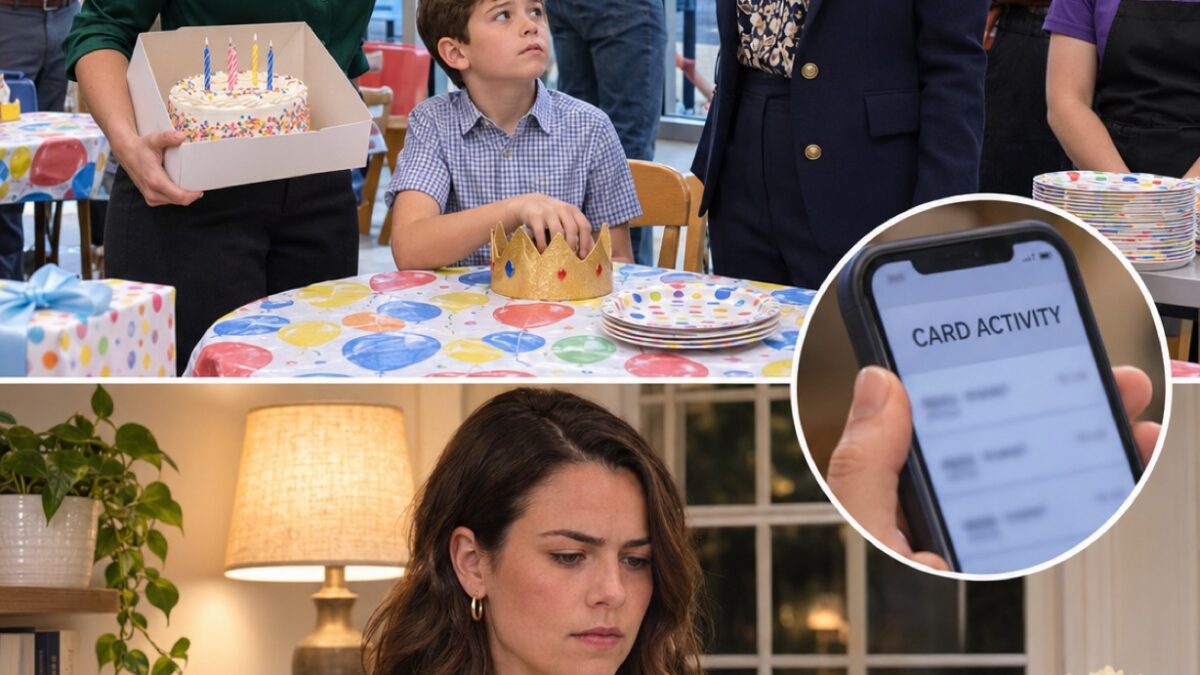
Under CARD ACTIVITY, the climbing charge sat among the things I had agreed Mom could buy. Seeing them together bothered me. It also made the distinction easy.
Those purchases were my bill.
Future purchases didn’t have to be.
The representative explained what she was doing while I sat at the kitchen table with my elbow beside Owen’s folded party napkins.
She wasn’t erasing anything. Charges that were still pending could finish posting. Removing Mom wouldn’t make money already spent disappear.
“I understand,” I said.
“And you want her removed, rather than just having a replacement card sent?”
“Yes. Removed.”
I didn’t want another piece of plastic arriving for Mom to put in the same pocket of her purse. I wanted the permission ended.
The woman confirmed that Colleen could no longer make new purchases using the extra card attached to my account.
I asked her to repeat that part.
She did.
Then I wrote it down on the back of an envelope, slowly enough that I could read my own handwriting later.
For most of that call, I had been sitting forward, braced over the table as if there were something else I needed to prove.
There wasn’t.
Mom didn’t have to agree that the climbing course was an outing. Rachel didn’t have to agree that the attendant had been put in an unfair position.
The account was mine.
The representative asked whether I needed anything else.
“No. That’s what I called to do.”
After we hung up, I stayed in the chair.
I could hear Owen moving in his room, then settling again. I waited until the house was quiet before opening the account and saving the confirmation where I had put Mom’s messages.
I checked that the confirmation showed the change.
Then I checked the name.
Colleen.
Not mine.
I hadn’t closed my own account or disputed the party spending. I had stopped another person’s access to it.
That mattered, because I knew how Mom would describe it.
She would say I had cut everybody off in a fit. She would say the children had lost something. She might even say I had refused to pay for the birthday.
I put the envelope beside my phone and opened our conversation.
My last message still asked where she was.
Above her answer was the reassurance she had sent while she was already somewhere else.
I didn’t read the whole exchange again.
I had read it aloud in a room full of parents. I didn’t need another private argument with a screen.
Instead, I started a new message.
“I removed your authorization on my credit card tonight. Your extra card can’t be used for new purchases. I’m paying the purchases already made, including the climbing charge. Please arrange your own payment for anything you plan from now on.”
I read it before sending.
There was no sentence about gratitude. No request that she understand. Nothing about whether I had been a good daughter.
Just what had changed.
I sent it.
Then I set the phone down and carried the cake box out of the kitchen.
There was frosting smeared inside the lid. Owen had insisted on bringing it home even though I had already wrapped the remaining slice.
I folded the box flat.
The cardboard resisted at the corners, and I pressed harder than I needed to. When it finally lay flat, I left it by the trash and washed my hands.
My phone lit up.
Mom wanted to know why I had done it without speaking to her.
I dried my fingers before answering.
“I told you what the card was for at the party. I’ve now ended the arrangement.”
She called.
I watched her name until the screen went dark.
I wasn’t going to whisper an argument outside Owen’s room after spending his birthday trying to keep the adults from arguing beside him.
I wrote, “I’m not discussing this by phone tonight.”
Her reply came while I was still holding it.
“You could have waited until we talked.”
I sat back down.
We had talked beside the empty cake box. She had said the employee counted. Then she had moved to the outings Rachel’s children expected.
There hadn’t been a misunderstanding left for me to explain.
“There won’t be new charges while we discuss it,” I wrote.
I put the phone on the table rather than carrying it around the house.
That was harder than I expected.
At work, as a dental assistant, I was used to finishing a task before moving to the next one. Put something away. Clean the surface. Prepare what came after.
With Mom, I had gotten used to stopping whatever I was doing whenever she needed an answer.
I rinsed the plate in the sink.
I wiped the crumbs off the counter.
Then I checked on Owen.
His blanket had slipped away from his shoulder. I pulled it up without waking him and moved a birthday gift away from the edge of his bed.
Nothing in his room needed an explanation tonight.
When I returned to the kitchen, Mom had sent another message.
She wanted to know whether the card was actually canceled or whether I had merely asked about it.
I picked up the envelope.
The words I had written were plain enough.
“It’s done,” I replied. “The issuer confirmed it.”
I attached the confirmation with the private account details out of view. She needed to know that her access had ended, not have more information about my account.
For a while, nothing came back.
I put the envelope with the records I kept for household bills. Then I moved Owen’s crown farther back on the shelf so it wouldn’t get caught under the cabinet door.
The crease across its front was still visible.
I smoothed it with my finger and stopped when I realized I was doing it again.
My phone sounded from the table.
Mom had changed the subject.
“Rachel is already counting on next weekend.”
I read that without answering.
The next weekend had not come up when I agreed to errands. It hadn’t come up while I paid the party balance, either.
Apparently, there was another plan I was supposed to fund.
I sat down again and pulled the phone toward me.
“What exactly did you tell Rachel I was paying for next weekend?”
Part 4: What She Promised
Rachel’s message opened with a picture of an earlier conversation. “This is what Mom told me,” she wrote.
It was the following afternoon.
I had my work bag beside the kitchen chair and hadn’t put it away yet. I enlarged the picture with my fingers.
Mom had told Rachel she would keep taking the children on outings.
She had also told her how those outings would be paid for.
“Leah has the family money covered on the card. We can keep doing this.”
I read the wording again.
Not “I’ll ask Leah.”
Not “If Leah agrees.”
Covered.
As if I had already handed over the money and stopped having any say in it.
Rachel followed the picture with another message.
“I didn’t make that up at the party.”
I sat down before answering.
“I believe she told you that.”
That wasn’t the same as saying Mom had permission. I wanted Rachel to see the difference without having to dig through another fight.
“She never asked me about continuing outings,” I added.
Rachel called while I was taking my lunch container out of my bag.
I put the container on the counter and answered.
“She made it sound settled,” Rachel said.
“I can see that.”
“She said the card was for family things.”
“It was for errands we agreed on.”
Rachel didn’t answer immediately.
I could hear her handling something on her end. I opened the drawer beside the table and took out the envelope from the night before.
I didn’t need the bank confirmation for this conversation.
I needed the agreement that had come before the card.
“Wait,” I told her. “I’m finding the original messages.”
“Leah, I’m not saying you didn’t help.”
“I know. I’m showing you what I agreed to.”
I scrolled back through my conversation with Mom, past pickup arrangements and shopping questions, until I reached the exchange from eight months before the birthday.
There it was.
Mom had asked whether using an extra card would make family errands easier while I was working.
I had said yes, with conditions.
Agreed errands. Ask before something different. Up to $400 in a month.
It wasn’t a payment to Mom.
It wasn’t money that became hers if she didn’t spend it on groceries or something we had discussed.
I sent Rachel the exchange.
Then I stayed quiet while she read it.
The refrigerator started humming behind me. I pressed the lunch container’s lid down because I needed something to do with my free hand.
Rachel finally said, “She told me there was room left.”
“That wasn’t hers to promise.”
“I thought you knew.”
“I didn’t.”
She sounded less certain now, but not ready to let go.
The earlier message had changed the argument. It wasn’t just about whether I had reacted too strongly at the party anymore.
Mom had promised something that belonged to me.
Rachel could see the promise and the actual agreement on the same phone.
“She does help both of us,” Rachel said.
“Yes.”
“And sometimes you’ve paid for things outside errands.”
“When she asked and I agreed.”
I didn’t deny that part. It would have been easier to insist that every charge had fit neatly into our arrangement, but that wasn’t true.
Sometimes I had said yes to something extra.
That still wasn’t permission to keep promising extras.
Rachel asked whether Mom had known I would remove the card.
“I told her it wasn’t for outings she chose herself.”
“But did you say you were canceling it?”
“I didn’t need to leave it available while we argued.”
My lunch container was still on the counter.
I opened it, decided I wasn’t hungry, and put it in the refrigerator. Rachel kept talking as I pushed it onto the shelf.
She said the children had been excited.
She said Mom had been talking about the next outing as though it was already decided.
I leaned against the counter.
“Did you know she was telling them I paid?”
“No. She just said she had it handled.”
That answer made me look back at the message.
Mom hadn’t promised Rachel a favor she would provide herself. She had promised access to my card, with herself in charge of choosing how to use it.
Rachel had accepted the benefit without asking much about it.
Neither of them had brought me into the plan.
I told Rachel I would send the original exchange without anything cropped out.
“Why?” she asked.
“So you can see what came before and after it.”
I sent it.
The messages around it were ordinary. Questions about what needed picking up, whether I would be home, whether an item was the right one.
There was no separate promise of a monthly outing fund hidden somewhere nearby.
Rachel read while we stayed on the call.
Then she said, “I wish Mom had just told me that.”
“She could have.”
I pulled my work bag off the chair and hung it where it belonged.
The movement helped. I had been sitting in the same position, defending an agreement Rachel could now read for herself.
“I’m not asking you to decide whether she meant well,” I said. “I’m telling you I didn’t agree to pay.”
Rachel said she understood what the messages said.
That was carefully phrased.
I understood that, too.
She still wanted a way for the outing to happen without having to change what the children had been told.
When we ended the call, I put the phone down and finished emptying my bag. I checked the pocket where I kept small things from work, then zipped it closed.
The phone sounded again.
Rachel had sent the promise back to me, with the part about keeping the outings going still visible.
Beneath it, she wrote that the children weren’t responsible for how Mom had worded things.
I agreed.
I typed that much.
Then I waited instead of filling the space with an offer.
The typing marks appeared, disappeared, and appeared again.
I sat at the table with my hands around an empty glass.
Finally, her message came through.
“Even if you never agreed, can’t you pay for the coming outing because the children were already promised?”
Part 5: The Children’s Disappointment
“I’m not paying for it,” I wrote. Rachel called before I could set the phone down.
“Just this once, Leah.”
I carried the phone to the counter.
“No.”
“You know what I mean.”
“I do.”
She wasn’t asking me to accept Mom’s version of the card anymore. The messages had settled that.
Now she wanted me to pay because correcting Mom’s promise would be unpleasant.
I took a dish towel off the oven handle and folded it.
Rachel told me the children had been looking forward to going. She described their excitement without saying anything I hadn’t expected.
Of course they wanted the outing.
They had been told it would happen.
“I’m not blaming them,” I said.
“Then why should they be disappointed?”
“An adult needs to pay for what an adult promised.”
She let out a breath into the phone.
I laid the towel down before I twisted it into a rope.
“I’m asking for help,” she said.
“And I’m answering.”
For a moment, neither of us spoke.
I could see Owen’s birthday crown from where I stood. It was up on the shelf, away from the dishes and the mail.
I turned toward the sink instead.
I wasn’t going to bring his birthday into every conversation with Rachel. What had happened mattered, but I didn’t need to keep describing it to justify keeping control of my own bill.
Rachel tried again.
“What if you paid this time, and then we told them after?”
“No.”
“Why does it have to be right now?”
“Because the card is already canceled.”
She knew that.
What she wanted was another route to the same money.
I pulled out the kitchen chair and sat down.
“I’m not booking it, paying you back, or giving Mom money for it.”
Rachel went quiet again.
Then she said, “They’re going to think you don’t want them to have fun.”
That hurt more than I wanted it to.
I pressed my thumbnail against a spot of dried frosting on the table edge. I had wiped the surface and missed the underneath.
I scraped it off before I answered.
“I can help explain it plainly if you want.”
“What are you going to tell them?”
“That grown-ups choose outings and grown-ups pay for them. Their grandma made a plan, and the adults have to sort it out.”
“You’d say Mom promised something she couldn’t afford?”
“I don’t know what Mom can afford.”
That stopped her.
I didn’t know.
Mom having access to my card had made it easy for all of us to avoid asking who would actually pay if I didn’t.
“I wouldn’t discuss anyone’s finances with the children,” I said. “And I wouldn’t tell them they caused a problem.”
Rachel’s voice changed a little.
She wasn’t agreeing yet. She was listening.
“I don’t want them dragged into this,” she said.
“Neither do I.”
“Mom will say you canceled their plans.”
“Then you can tell her I didn’t make their plans.”
I got up to rinse the glass I had left on the table.
The water was warm by the time Rachel spoke again.
She asked whether I was really willing to let the outing fall through.
“I’m willing not to buy it.”
That was the answer she hadn’t wanted.
I could care whether they were disappointed without accepting a new charge. Those were separate things, even if Rachel kept presenting them together.
She said she needed to talk to Mom.
“All right.”
“Don’t send her anything else yet.”
“I’ve already told her the card can’t be used.”
“I know. Let me talk to her.”
We ended the call.
I dried the glass and put it away.
Then I took the towel outside the cabinet door and folded it properly, because I had left it in a lump after insisting I was calm.
Owen came into the kitchen looking for something to drink.
I got it for him.
He didn’t ask about Rachel or Grandma. He told me about something he wanted to do at home, and I listened while he stood with his back against the cabinet.
I didn’t use the quiet moment to ask whether he had enjoyed his birthday.
I already knew he had enjoyed parts of it.
I also knew he had needed the attendant to call me.
Both things could be true without making him sort them out for the adults.
After he left the kitchen, I checked my phone.
Nothing.
I put it on the counter and started the ordinary things that still needed doing. Work clothes. Dinner dishes. The lunch container I had finally emptied.
I had been prepared for another argument from Mom.
Instead, Rachel messaged.
“I told her she has to settle how she’s paying before anybody leaves.”
I read it carefully.
She hadn’t said she agreed with me about everything. She hadn’t apologized for what she said in the party room.
But she had put the next step where it belonged.
With Mom.
I wrote, “That makes sense.”
Rachel replied that she didn’t want the children arriving somewhere and hearing an argument about payment.
“I don’t want that either,” I sent.
Then she asked whether there was any chance the old card might still work.
I picked up the envelope from the drawer.
“No. Her authorization was removed.”
I didn’t offer to test it. I didn’t say Mom could take it along just in case.
Rachel needed an answer she could plan around.
So did Mom.
I sent the relevant confirmation again, without the rest of my account information.
“This isn’t something to try at the counter.”
Rachel said she would make that clear.
I put the envelope away and shut the drawer.
For the rest of the evening, I didn’t hear from Mom.
I finished the dishes with the phone where I could see it, then moved it away before I sat down beside Owen.
He leaned against me without looking up.
I stayed there.
Later, Rachel sent another message, and this time she didn’t ask me for money.
“Mom still has that card in her purse, so is she arranging her own payment or planning to try yours?”
Part 6: Before They Go
“I’ve arranged my own payment for the weekend,” Mom wrote. “You don’t need to keep checking through Rachel.”
I was holding my phone over the kitchen counter when the message came in.
I set it down beside my work bag.
There it was.
She could make an arrangement that didn’t involve me paying for it.
I answered after reading her message again.
“Okay. I won’t be booking or paying for the outing.”
She replied that she hadn’t asked me to.
I left that alone.
There was no reason to send her the message where she had said Rachel was counting on next weekend. We had already established what the card was for and what she had promised.
Now she had another way to pay.
That was the result I had needed.
I wrote to Rachel that Mom had confirmed it.
Rachel said Mom had told her, too.
Neither of them asked me to choose an attraction, make a reservation, or send money ahead. I didn’t volunteer.
I put the phone away and took the things I needed out of my bag.
The habit of checking whether Mom needed something was still there.
For eight months, a message about an errand could turn into a question about a purchase, then a conversation about whether there was room under $400.
That amount had started taking up more space in my head than some of my own bills.
I didn’t open my account again.
I didn’t need to monitor what she planned to spend on her own outing.
Before the birthday, that would have felt like not helping.
Now I put my lunch container in the sink and went to see what Owen was doing.
He had birthday things spread around him.
I stepped around them, sat where he pointed, and let him explain what belonged where.
My phone sounded in the kitchen.
I stayed until he finished.
When I went back, Mom had sent another message.
“Since I’m taking Rachel’s children, I should collect Owen for something too. That would be fair.”
I pulled out the chair.
The request was dressed as a solution.
She had settled the money for the next outing. Now she wanted an arrangement that would make the birthday incident look finished.
I read the words “collect Owen” again.
She wasn’t asking to stop by.
She wanted to take him without me.
I didn’t answer immediately.
Instead, I asked, “Are you asking to take him out alone?”
Her reply came quickly.
“Of course. He shouldn’t be left out because you and I disagree.”
There it was again.
A child missing something because I wouldn’t accept her plan.
I laid the phone face down.
Owen hadn’t asked to join that outing. He hadn’t asked me to send him anywhere with Grandma.
Mom had made the request herself.
I went back to where he was sitting and helped move his birthday things out of the walking path. He handed me what he wanted put away, and I followed his instructions.
There was nothing urgent about answering Mom.
She wasn’t standing at the door. Owen wasn’t waiting in his coat.
I could decide before making another promise.
At the party, I had asked a simple question and received a simple answer.
Stay with him.
Yes.
I had believed that was enough.
The problem hadn’t been that I forgot to explain what “stay” meant. Mom had known he wanted to wait for the cake. She had chosen the climbing course anyway.
Then she had told me she was still in the room.
I put the last birthday item where Owen wanted it.
He asked whether I liked the spot.
“I do.”
I didn’t ask him whether he wanted to go out with Grandma.
I wasn’t going to let an excited answer settle a supervision decision he was too young to make.
Back in the kitchen, I opened Mom’s message again.
She had added that Owen liked spending time with her.
That was true.
It also wasn’t an answer to the part that mattered.
I typed, “This isn’t about making the children even.”
Then I deleted it.
It sounded like the start of another long argument about Rachel’s children, and they weren’t the issue I needed to address.
I typed something shorter.
“I’ll answer about arrangements for Owen separately.”
Mom called.
I let the call finish and wrote, “Please keep this in messages for now.”
She wanted to know whether I thought she was incapable of taking her grandson somewhere.
I looked toward the room where Owen was playing.
I hadn’t said that.
I wasn’t planning to say it.
What I needed was a plan I could rely on without wondering whether Mom would decide an employee counted as a substitute for her.
The phone felt warm in my hand.
I set it on the table and got a glass of water.
When I sat down again, I opened the saved birthday messages.
Not to reread every word.
Just enough to check that I wasn’t remembering a harsher version than what she had actually said.
“Still in the party room.”
Then the climbing course.
I closed them.
There was no confusion about the order.
I wrote a reply in the message box without sending it yet. I wanted to be clear that I wasn’t bargaining over a funded outing or making her purchase admission to see Owen.
Money and supervision needed separate answers.
Her card access was gone.
Her contact with Owen could continue with me there.
I read what I had written.
Then Mom sent another message before I pressed send.
“Tell me whether I can collect him, because I need to know if you’re really going to stop me taking him on my own.”
Part 7: A Different Arrangement
“You won’t be taking Owen out alone,” I wrote. “You can visit with him while I’m there.”
I sent it before changing the wording again.
Mom called immediately.
This time I answered, because I wanted her to hear the same answer without imagining there was another version available by phone.
“So you are keeping him away from me.”
“No. I’m offering a visit.”
“With you watching.”
“With me there.”
I stood beside the kitchen table rather than sitting down.
The chair had become the place where I read messages and tried to make everyone understand what should have been straightforward.
I didn’t want another long conversation.
Mom said I had never treated her like this before.
“That’s true.”
She waited.
I didn’t add an apology.
She said she had raised children and didn’t need instructions from me about being with a child.
“I asked you to stay with Owen. You agreed.”
“He was safe.”
“He asked an employee to call me.”
That was what the attendant had told us in the room.
It was also what Owen had done.
Mom couldn’t turn that into a private exaggeration from me. Other parents had heard the attendant explain why she stayed.
Mom changed her approach.
She said Owen would notice that I didn’t trust her.
“I won’t discuss the card with him.”
“I’m not talking about the card.”
“Neither am I.”
I moved a party napkin that had slipped behind the fruit bowl and put it away.
Mom said a visit with me there wasn’t the same thing.
“I understand.”
She wanted that sentence to mean I would change the plan.
It didn’t.
I gave her the option again, plainly.
She could spend time with Owen at home while I was there. We could keep it ordinary. No discussion of the birthday in front of him.
She said she would think about it.
“All right.”
When we hung up, I put the phone in the drawer with the envelope.
Not because I needed to hide it.
I wanted to stop looking at it while Owen was home.
He was in the next room, working with his birthday things. I stood in the doorway and asked whether he wanted help putting anything away.
He pointed without looking up.
I sat on the floor.
For a while, we sorted things according to rules he explained and then changed. I let him change them. There was no reason the toys had to be where I thought they belonged.
He handed me something to hold while he moved another thing.
I held it.
I had been careful not to turn the birthday into an interview. But I also didn’t want him thinking the adults were going to pretend that part hadn’t happened.
When there was a natural pause, I asked, “Is there anything about your party you want to talk about?”
He looked at me.
“The cake?”
“Anything.”
He thought about that while he worked something loose with his fingers.
I waited.
I didn’t mention Grandma leaving. I didn’t ask whether he had been scared. Those were answers he might give just because he could hear them in my question.
He said the attendant had stayed.
“I’m glad she did.”
“She said you were coming.”
“I was.”
He nodded and went back to what he was doing.
I let the conversation stop there.
My knee had started hurting against the floor, so I shifted and leaned against the couch. Owen moved closer because I was holding something he wanted.
He didn’t look like he was searching for a grown-up explanation.
He looked like a child who still had birthday things to examine.
I handed back what he asked for.
Then he said Grandma had gone climbing.
“Yes.”
“With the other kids.”
“Yes.”
I kept my voice ordinary.
I wasn’t going to correct his wording or use his question to deliver my side of the argument.
He needed room to say what he remembered.
Owen said he had stayed because I was bringing the cake.
“I know.”
He turned the object in his hands.
The crease in his crown came to mind, the way he had pressed it flat while waiting. I looked at what he was holding instead.
He didn’t need to see me getting upset over an object while he was trying to tell me something.
“Did you want to go play somewhere else?” I asked.
He shook his head.
“I wanted the cake to come.”
“That makes sense.”
He had made a perfectly ordinary birthday choice. Stay near the cake spot. Watch the door. Wait for Mom.
The adults had been responsible for making that work.
He put down what he was holding and asked whether Grandma had been there when I left.
“She was.”
He frowned a little.
I waited again.
From the kitchen, my phone sounded inside the drawer. I didn’t get up.
Owen glanced toward the noise and then back at me.
“You can keep talking,” I told him.
He rubbed his thumb along the edge of a birthday gift.
“I told her I was waiting.”
I nodded so he knew I heard him.
For a moment, I wanted to ask exactly what he had said and what Mom had answered.
I didn’t.
I already had enough information to make the adult decisions. I wasn’t gathering evidence from my son.
“Thank you for telling me,” I said.
He moved the gift away from his knee, then pulled it back again.
I stayed beside him.
The phone sounded again.
It could wait.
Owen looked up, and this time he held my eyes instead of watching his hands.
“Did Grandma know I was waiting for you?”
Part 8: What I Told Him
“Yes,” I told Owen. “Grandma knew you were waiting, and she was supposed to stay with you.”
He looked down at his hands.
I kept going before he had to find another question.
“You didn’t do anything wrong.”
“I wanted my cake.”
“I know, honey.”
I didn’t tell him Grandma forgot.
She hadn’t.
I didn’t tell him she left because the other children needed her more. That would have given him something ugly to compare.
I kept it to what he needed.
“She made a choice she wasn’t supposed to make. That was a grown-up mistake, not yours.”
He pressed his lips together.
“Did you know?”
“I thought she was staying with you.”
“But you came.”
“Yes. The attendant called, and I came.”
He nodded.
I wanted to promise that nothing upsetting would ever happen at another party. I could hear how easy it would be to say something enormous just to get that look off his face.
Instead, I told him what I could actually do.
“Next time, I’ll arrange the grown-ups. You won’t have to figure that out.”
He asked whether the attendant had been in trouble.
“No.”
That answer came quickly.
“She helped you. I thanked her.”
“She let me sit by her.”
“I’m glad.”
He picked up what he had been playing with and fitted it back where it belonged.
I stayed on the floor until he moved on to explaining something else.
He didn’t need me to keep checking his face.
Eventually, I got up and took our glasses to the kitchen.
My phone was still in the drawer.
Mom had sent messages asking whether I really meant that she could only see Owen with me present.
I read them while leaning against the counter.
Then I opened a reply.
“Yes. You’re welcome to visit here with me home. We can choose a time that works.”
I didn’t include what Owen had asked.
That conversation belonged to him. Mom didn’t need his exact words to understand the arrangement.
She needed an invitation she could either accept or decline.
I added that I wasn’t discussing the birthday disagreement during the visit.
Then I sent it.
The kitchen needed putting back in order, so I put the phone down and opened the cabinet.
Owen’s crown was on the shelf.
I moved it out of the way to reach something and held it for a moment.
The paper had softened where his fingers had worked the edge. I couldn’t make it look new without damaging it.
I left it alone.
From the other room, Owen asked what I was doing.
“Putting things away.”
“Not my crown.”
“I’m keeping it.”
He went back to what he was doing.
I set the crown farther from the cabinet hinge and closed the door carefully.
Mom replied while I was clearing the counter.
She said she didn’t want to be treated like a guest in her daughter’s home.
I read that standing up.
“You’re invited to spend time with Owen,” I wrote.
She said she knew how to visit.
I didn’t argue with that, either.
I gave her an ordinary option and asked her to let me know.
The message didn’t mention the card.
It didn’t offer payment for an activity or put her in charge of collecting Owen. There wasn’t a hidden favor attached that could become another reason for her to change the plan.
Come over.
I would be home.
That was all.
I set the phone aside and started getting dinner ready.
Owen came into the kitchen and asked if Grandma was coming.
“I’ve invited her.”
“Here?”
“Yes.”
He seemed satisfied with that.
I didn’t tell him she hadn’t answered. I didn’t say she was upset with me. He had already spent enough time trying to understand an adult’s decision.
He asked whether he could show her his birthday things.
“If she comes, yes.”
I caught myself before saying “when.”
Mom still had a choice to make.
After dinner, Owen helped carry things to the counter. I let him do the parts he could manage and didn’t hurry him because my phone was lighting up nearby.
The message was from Rachel.
She wanted to know whether Mom was going to see Owen.
“I’ve offered a visit here,” I wrote.
Rachel asked whether I would be there.
“Yes.”
She didn’t tell me I was punishing anyone this time.
Instead, she said Mom was upset about how formal everything sounded.
I looked at the invitation.
There was nothing formal about it. No list of demands. No speech about earning trust.
Just a plan that didn’t rely on Mom staying somewhere after she had already promised to stay.
“She can come see him,” I answered.
Rachel said she would leave it between us.
I was grateful for that, though I didn’t send a long response saying so.
I put the phone down and finished the dishes.
Later, I checked the invitation again.
It had been delivered.
Mom had answered other parts of the conversation but not the part asking whether she would come.
I didn’t send another explanation.
I didn’t offer to make the visit into an outing so it would feel better to her.
Owen had already asked whether she could see his presents. That was enough reason to keep the invitation open without changing it.
Before putting the phone away, I wrote a final, simple message.
“Please tell me whether you’re accepting the visit here with me present, so I can tell Owen what to expect.”
Part 9: She Came Without It
“I’ll come,” Mom wrote. At the visit, she stood in my doorway holding her purse against her side.
I stepped back.
“Owen’s in here.”
She came in without hugging me.
I shut the door and followed her into the living room.
Owen got up to show her what he had been waiting to show her. He talked quickly, moving between his birthday things and the place he wanted her to sit.
Mom sat down.
For a while, I stayed near the doorway with a dish towel in my hand, although I had already finished drying what needed drying.
Then I put it in the kitchen and joined them.
I wasn’t going to spend the visit standing guard.
I was also not leaving.
Mom asked Owen questions about his gifts. He answered some and ignored others because he had his own order for explaining everything.
That part was familiar.
She could be patient with him when she wanted to be.
Seeing it didn’t erase what had happened. It did make the visit feel less like the argument she had predicted.
Owen brought something to me.
“Show Grandma.”
“You show her.”
He did.
Mom glanced up at me, then back at him.
Nobody discussed the card.
Nobody asked Owen to say whether he had been frightened or whether he forgave anyone.
He was allowed to have a visit.
I went to the kitchen when he asked for a drink, staying close enough to hear the conversation.
Mom didn’t get up to follow me.
She asked Owen another question.
I filled his cup and brought it back.
There was no sudden apology waiting when I returned. Mom hadn’t transformed into a different person because she was sitting in my home under a plan I had made.
She was a little stiff.
So was I.
But Owen was talking, and she was listening.
That was enough for the moment.
My phone sounded on the kitchen counter.
I checked it while Mom and Owen were occupied with something he wanted her to see.
Rachel had written about their outing.
“Mom paid. Your card wasn’t used.”
I read it without opening my account.
There was nothing for me to reimburse or approve.
I wrote, “Thanks for confirming.”
Rachel added that the children had gone and enjoyed themselves.
“Glad they had fun,” I replied.
I meant it.
I hadn’t needed them to have a bad weekend for my decision to be valid.
Their outing could happen without my money. Mom could arrange payment. Rachel could make sure it was settled before they left.
The world had continued without me supplying an extra card.
I put the phone down.
When I came back, Mom was helping Owen put something away.
She looked at my face.
“Everything all right?”
“Yes.”
I didn’t announce Rachel’s message.
Mom already knew who had paid. I wasn’t going to turn the visit into an accounting meeting while Owen stood beside us.
He wanted to show her something else.
We moved where he wanted, and I sat down nearby.
Mom asked him about his cake.
He said it had been good.
“There’s still some,” he added.
“In the freezer,” I said.
He asked whether we could have it later.
“We’ll save it for a night at home.”
Mom looked toward the kitchen shelf, where the crown was just visible when the cabinet opened.
“You kept that?”
“He wanted it.”
She nodded.
There was a moment when I thought she might say something about him wearing it in the party room.
She didn’t.
Owen interrupted with something that needed both of us to look at it.
We looked.
The visit stayed ordinary.
Mom didn’t ask to take him outside or say he would have more fun if I let them leave. I noticed that, too.
I didn’t reward it with a new offer.
She was following the plan we had agreed on.
Later, when Owen became occupied nearby, Mom stood and picked up her purse.
I walked with her toward the kitchen.
She spoke quietly enough that he wouldn’t have to stop what he was doing to hear.
“I paid for the outing myself.”
“Rachel told me.”
“Well, I did.”
“I know.”
She adjusted the strap on her shoulder.
I could see that she wanted more from that exchange. Maybe an acknowledgment that she had managed it. Maybe an opening to say the whole problem had been unnecessary.
I didn’t know which.
I took a cup off the table and carried it to the sink.
Mom followed to the edge of the kitchen.
“I’m not going to use your card for that again.”
“The extra card is canceled.”
“I know that.”
She lowered her voice a little more.
“I’m talking about errands.”
I turned off the faucet.
She said there were still things she could pick up for us. She knew what helped while I worked. It had been convenient before the party.
That was true.
It had also stopped being convenient long before I admitted it.
Every purchase had started needing an explanation afterward, and every explanation seemed to leave me defending why I had asked.
Mom said she wasn’t asking for outing money.
I nodded.
She was making a narrower request now.
Not a return to everything.
Just errands.
Just the part of the arrangement that had sounded reasonable when I first added her.
I dried the cup and put it away.
“Anything we need, I’m arranging myself.”
“You can’t do everything yourself.”
“I’m not asking you to do it.”
She looked toward Owen, then back at me.
I waited.
There wasn’t a reason to fill the silence by offering a compromise I didn’t want.
Mom shifted her purse higher on her shoulder and made the request directly.
“Now that this is settled, will you put me back on the account for errands only?”
Part 10: The Crown Beside His Plate
“No, Mom,” I said. “I’m not opening another extra card for you.”
She pressed her lips together.
“I said errands.”
“I heard you.”
I kept my voice low because Owen was nearby, not because there was anything about the answer I needed to hide.
“The card arrangement is finished.”
Mom said it had made things easier.
“Some things,” I said.
She looked at the sink, then toward the room where Owen was still occupied.
For a moment, I thought she would ask me to list everything she had done for us.
Instead, she said I was making a permanent decision over the birthday.
“I’m making a decision about my account.”
“And you won’t reconsider.”
“No.”
That was the part I needed to say without softening it into “not right now.”
I wasn’t leaving a future date for her to ask again.
She picked up her purse.
I walked her to the door, and Owen came over to say goodbye. She hugged him and told him she liked seeing his birthday things.
He reminded her about something she hadn’t looked at long enough.
She listened while he explained it again.
Then she left.
There was no forced apology in the doorway. I didn’t ask Owen to hug her again so the visit could end looking nicer than it had felt.
I shut the door after them and went back to the kitchen.
The cup I had dried was already in the cabinet.
Nothing needed fixing.
I put the towel away.
When the remaining purchases finished appearing on my account, I checked them against what I had saved.
The agreed errands were there.
So was the $96 climbing charge.
I paid what I owed.
I didn’t report it as fraud or try to make the issuer settle an argument that belonged to my family. Mom had used a card I had allowed her to carry.
Ending that permission was the part I could change.
I saved the payment record and put the envelope away.
There was no extra card to reopen after the bill was paid.
No new allowance to start the following month.
The $400 had never been a guaranteed gift, but I had begun planning around it as if I had to leave that much available for whatever Mom called family spending.
I stopped doing that.
When I made my household budget, I included what Owen and I needed. If I wanted to help with something else, I could decide when someone actually asked.
I didn’t set aside money for outings Mom might promise.
The errands changed in smaller ways.
I kept a list in the kitchen.
Before leaving for work, I checked what we needed instead of sending Mom a message and hoping the purchase would stay within what we had discussed.
After work, I picked things up myself.
Sometimes that meant carrying my work bag and shopping bags through the door together while Owen talked beside me.
It was less convenient.
I wasn’t going to pretend otherwise.
There were evenings when I wanted to hand the list to someone and have it disappear from my day.
But when I put the receipt down, I knew what every item was.
I didn’t have to open a message asking why there was another charge.
I didn’t have to remind anyone that the limit was a household agreement, not money waiting to be used up.
Rachel stopped sending requests about the next outing.
When she mentioned plans for her children, they were plans she and Mom were arranging. I could ask whether they had enjoyed themselves without wondering whether the answer would come with a request for payment.
We still spoke.
Not every conversation was comfortable.
She never gave me a long apology for saying I would be punishing her children. I didn’t invent one for her or keep waiting for it before changing my own routine.
The payment question had been answered.
Their optional outings were theirs to fund.
Mom’s contact with Owen stayed civil and planned.
When we arranged time together, I was there. If she suggested collecting him, I gave the same answer without reopening the birthday discussion.
“We can visit together.”
Sometimes she sounded irritated.
Sometimes she simply agreed.
I didn’t ask Owen to measure whether Grandma was happier with the new arrangement. He had enough to do being a child.
He could show her something, tell her a story, or decide he was finished talking.
I handled the plans.
At home, the crown stayed on the kitchen shelf.
I moved it when I cleaned and put it back when the surface was dry. The front never flattened completely.
Owen didn’t mind.
To him, it was still his birthday crown.
One evening, he noticed me reaching into the freezer and asked about the cake.
I moved something aside and found the wrapped slice.
The frosting had kept its shape better than I expected.
“Can we have it?” he asked.
“Yes.”
I put it on the counter to thaw while we finished what we were doing. He checked it whenever he passed, asking whether it was ready yet.
I didn’t tell him to stop looking.
When it was soft enough, I unwrapped it and set it on a plate.
Owen climbed into his chair.
“Some for you,” he said.
“We can share.”
I got forks and sat beside him.
The kitchen was ordinary around us. My work bag was put away. The list for the next errands was on the counter. My phone stayed where I had left it.
Owen tasted the frosting first.
Then he looked toward the shelf.
“My crown.”
I got up and brought it over.
He tried it on, laughed when it slid, and took it off again so he could eat without holding it in place.
I had a bite of cake.
He told me which part he wanted next, and I turned the plate so he could reach it.
There were still dishes to do afterward.
I would do them.
For now, we sat together eating the last frozen slice of his birthday cake, with his paper crown beside his plate.
You Might Also Enjoy




