My mother told me at the lawyer’s office that my brother owned my vineyard estate now and had packed everything from my farmhouse bedroom.
Part 4: The Key In My Palm
“No, Mom. I won’t promise that.”
She looked at Dad, waiting for him to correct me.
He stayed seated.
I put the returned key into my purse. My mother watched me close the zipper as though I had done something to her.
“The purchase is stopped,” she said. “You have what you wanted.”
“I wanted to keep living in my house.”
Dean shifted beside her. Ruth gathered the material he had brought, keeping it separate from the notes in front of her.
My mother tried again.
“You don’t have to make this official.”
I stood up. “I’m getting advice, and I’m reporting what happened.”
That was my answer.
I wasn’t agreeing to keep quiet while she decided what to call it. She had copied my name, and Dean had used the result to ask a lawyer to help him buy my property.
Dad rose beside me.
Mom caught his sleeve before he could follow.
“Are you really leaving with her?”
“She asked me to come to the house.”
She let go.
Outside the conference room, I stopped beside the wall and took out the notes I had made about independent advice. There was a crease across the questions where I had folded the paper too tightly.
Dad waited while I called.
I explained that the proposed purchase had been stopped, but my signature had been copied and my farmhouse locks had been changed.
Then I asked the question I had been holding back.
“Can I report this without making some mistake that helps them?”
The lawyer asked me to slow down.
So I did.
I went through what I knew myself, what Dean had admitted, and what Dad had brought on his phone.
The distinction mattered.
My lawyer did not tell me what my mother intended in her own head. She asked what my mother had actually said and done.
I had plenty to describe.
She advised me to make a factual report to the county sheriff, preserve what I had, and avoid guessing about anything I could not establish.
“Can you help me get the material together?”
“Yes.”
I sat beside Dad while she explained what she needed. The proposed contract. The message conversation. My account of the meetings. Anything showing that I owned the place and had not received purchase money.
I wrote it down.
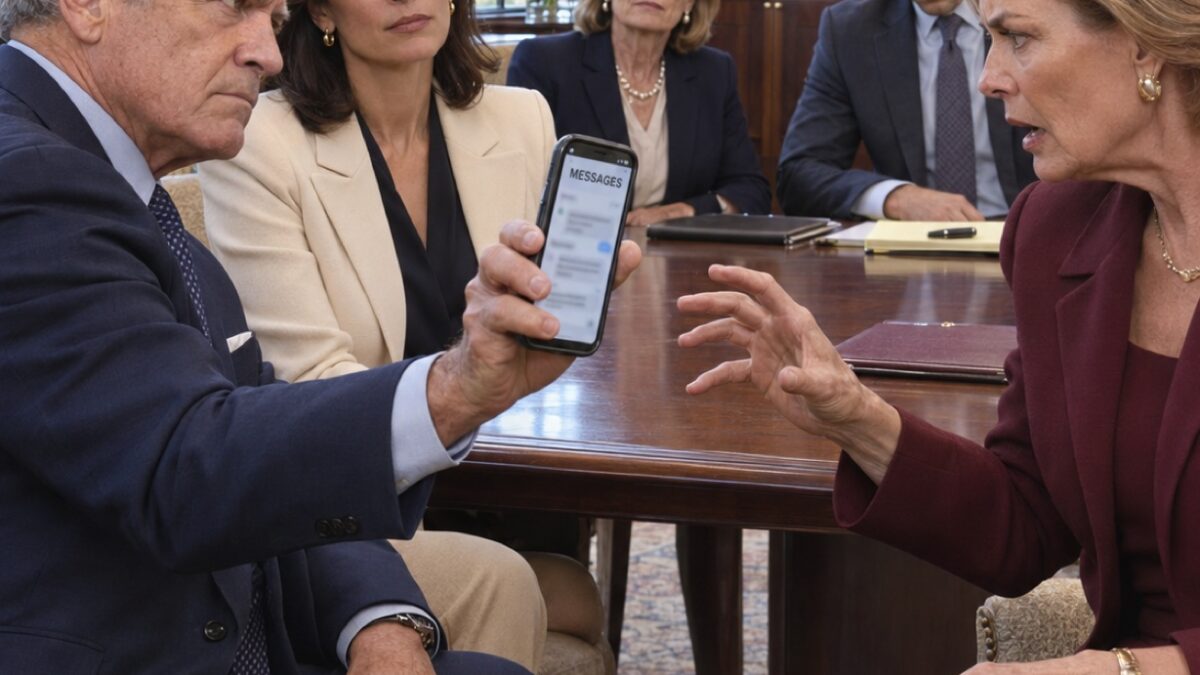
For eight years, I had kept the estate’s records because somebody had to pay the bills, check the work, and know where things were. Now I needed those same habits for something I had never imagined doing. I opened the folder on my phone where I kept property information and checked what I could send. Dad kept his own phone out, careful not to alter the conversation. We didn’t decide what should happen to Mom. We made sure my lawyer could see what had happened to me.
Before we left Charlottesville, I began the report.
Saying “my mother” to someone who didn’t know her was harder than I expected.
I kept smoothing the paper against my knee.
The person taking the information asked whether anything had actually been transferred.
“No.”
Had I signed a deed?
“No.”
Had I authorized my brother to take possession of the house?
“No.”
I explained that he had worked at the vineyard, but had never been an owner or a tenant of the farmhouse.
That needed to be clear.
His job did not give him permission to pack my bedroom.
My lawyer helped arrange delivery of the proposed contract and preserved message copies. Dad agreed to make his original phone conversation available when requested.
I did not hand over a collection of angry family texts and expect somebody to guess.
I described the copied signature, the proposed purchase, the unpaid price, and the locks.
When I finished, I asked what would happen next.
They would review the information. They might need interviews and additional records. Making a report did not mean I could choose a charge or demand an arrest.
I understood.
I wanted an accurate record, not a scene in a parking lot.
Dad walked out beside me.
“Do you want me to drive?” he asked.
“No. Just follow me.”
That afternoon, the locksmith met us at the farmhouse.
I stood on my own porch while he examined the lock my brother had installed. The returned key worked, but I still wanted it replaced.
The locksmith asked whether I had authority to order the work.
“I own the house.”
I had the information ready.
Dad waited beside the steps while I opened the door. The hallway smelled like cardboard and the laundry soap I used for my bedding.
My boxes were lined against the wall.
Not neatly enough to make it all right.
I set my purse on the hall table and walked straight to my bedroom. The bed was stripped. My dresser drawers were partly open, and the spot where I kept my slippers was empty.
Dad stopped at the doorway.
“Should I bring something in?”
“Not yet.”
I opened the closet.
Dean had left the empty hangers pushed together at the end of the rod. I slid them apart with my fingers, then let them fall back.
The locksmith called from the front door.
I went to answer him.
He needed me to check the new lock before he finished. I turned the key, pulled the door shut, and opened it again.
It worked.
Such a small thing to stand there testing.
Dad carried a bedding box into the bedroom after I pointed it out. I opened the flaps and saw my blue quilt folded beneath the sheets.
I touched the corner without lifting it out.
For now, I wanted the boxes checked and the doors secured. I didn’t want to unpack while listening for my mother’s car.
Dad helped me look through the hallway boxes. My clothing was there. So were the ordinary things I reached for without thinking: my hairbrush, the book beside my bed, the little dish where I put my earrings.
They had packed that, too.
I carried the dish back to my dresser.
Dad stayed in the hall, holding his phone.
“There’s something else in that conversation your lawyer needs,” he said.
I turned toward him.
“Something about the signature?”
“About what she wanted afterward.”
He didn’t start explaining over the open boxes. He asked whether I wanted to call my lawyer while he was still there.
I put my hairbrush down.
We sat at the kitchen table, where I had signed payroll papers and checked harvest plans while Dean was still someone I trusted with the work.
Dad laid his phone beside my notebook.
The screen went dark before he touched it awake again.
“Before you send the rest, tell me exactly what Mom asked you to help her get me to sign.”
Part 5: The Words Below The Admission
“She wanted you to acknowledge receiving the money,” Dad said.
He opened the conversation and moved below the message Ruth had read.
I leaned closer.
The copied signature had been only part of what Mom wanted him to help finish. In the same conversation, she had asked him to persuade me to acknowledge receiving the $2 million.
Money Dean had never paid.
I read the message again.
“Did she think you would ask me?”
“She wanted me to say it would settle everything.”
Dad kept the phone flat on the table. He wasn’t holding it away from me, but he wasn’t passing it around carelessly either.
I called my lawyer.
When she answered, I told her there was more in the original conversation.
Then I stopped talking and let Dad read it.
My lawyer asked whether the message was still on the same phone, in the conversation where it had arrived.
“Yes,” he said.
Had he deleted anything around it?
“No.”
Had my mother sent it after the afternoon meeting?
“Yes.”
I watched his finger rest beside the screen.
Mom had known I was denying the signature. She had known the meeting had stopped. Her response had been to ask Dad to help obtain something else from me.
Not permission.
An acknowledgment that money had already changed hands.
I moved my glass away from the phone.
“Dean said in front of everyone that he paid nothing,” I told my lawyer.
She asked me to write down his words as closely as I could remember them, without improving them or adding what I thought he meant.
I opened my notebook.
“No,” I wrote. “I haven’t paid her anything.”
Seeing that beside Mom’s request made me set the pen down.
Dad watched me.
“I didn’t ask you to do it,” he said.
“I know.”
“I want that clear.”
“It is.”
My lawyer asked for the complete thread, not just the messages that looked worst for Mom.
Dad agreed immediately.
He would provide the surrounding conversation, the order of the messages, and the information showing when they had been sent. The original would remain on his phone.
Nothing would be cropped to make it read differently.
That mattered to him.
It mattered to me, too.
I didn’t want my mother later saying we had removed the line that explained everything. If there was something helpful to her in the conversation, my lawyer could see that along with the rest.
Dad followed the instructions slowly.
I sat beside him while the preserved copy was prepared. When he wasn’t sure whether a step might change something, he asked before touching the screen.
There was no performance to it.
Just my father, wearing his reading glasses now, checking that the entire conversation had been included.
My lawyer confirmed receipt.
She would preserve it with the other material and provide the additional information through the proper channel. She explained that the request concerning the money was relevant, but it was not my job to assign a separate criminal label to every sentence.
I wrote that down, too.
“Tell them exactly what happened,” she said.
“That I can do.”
After the call, Dad pushed his chair back.
I asked him to stay a little longer.
He nodded and sat down again.
For a while, I checked my account records at the table. There was no purchase payment to find, but I wanted the records organized instead of waiting until someone asked.
Dad helped match the files to the list my lawyer had given me.
Neither of us discussed how much land Mom thought Dean deserved.
The amount in the proposed purchase was not a family suggestion. It was written as a payment, and no payment had been made.
Mom had wanted me to say otherwise.
My phone lit up while I was opening another file.
Her name filled the screen.
I let the call stop.
Then a message arrived asking whether Dad was still with me.
I showed him.
“You don’t have to answer for me,” he said.
“I wasn’t going to.”
I sent a short reply saying that anything concerning the proposed purchase should go through the lawyers.
She answered that I was making a family problem impossible to discuss.
I didn’t respond.
Instead, I sent the exchange to my lawyer and put my phone facedown.
Dad looked toward the hallway.
“Do you want help with those boxes?”
“Not the bedroom ones.”
He didn’t ask why.
We carried the boxes that belonged downstairs out of the hall. I found the kitchen towels Dean had used as padding around a lamp and put them back in their drawer.
The lamp went on the table where it belonged.
That work helped.
There was a place for each thing, and I didn’t need anybody’s agreement to put it there.
When Dad left, he checked that I had the new key.
I held it up.
He stood on the porch longer than usual.
“Your mother is going to keep asking me to fix this.”
“What are you going to tell her?”
“That I can’t change what she sent.”
I watched him walk to his car.
Inside, I closed the door and tested the lock again.
Later, my lawyer called back. The complete conversation had been preserved, and the additional material would be supplied with my report.
She asked whether Dean still had access to vineyard records through his job.
“Yes.”
That answer changed what I needed to do next.
The house was secured, but the business was not yet settled. Dean knew the harvest arrangements, had working files, and could still contact people as my manager.
I opened the employment folder.
There were the records I had kept through six seasons: his duties, his pay, the work I had assigned and the work he had completed.
Nothing promised him an ownership interest.
I had never offered land in place of wages, and he had admitted he had been paid.
Still, I sat there longer than I needed to.
Ending a proposed purchase was one thing. Ending his work meant dealing with the next harvest without the person who had managed it before.
My phone buzzed again.
This time it was Dean.
He wanted to talk about keeping his job.
I told him we could discuss work, but not at the farmhouse. My lawyer would review what I needed to do before I made any decision.
He said he understood.
Then he sent another message.
“I worked those harvests, Simone, so are you saying none of that gives me any part of the place?”
Part 6: The Folder With His Pay
“It gives you the pay you earned,” I told Dean.
I laid his employment records on the worktable.
We were at the vineyard, away from the farmhouse. I had put the papers in order before he arrived, with the current work information beside them.
Dean stayed standing.
“I’m asking to keep managing,” he said. “I’m not asking you to give me the house now.”
“Sit down.”
He pulled out a chair.
I didn’t want an argument conducted while he hovered over my paperwork. I wanted him to hear a decision about his job, not another opening to discuss ownership.
My lawyer had reviewed the employment arrangements and the notice I planned to give him. I had checked what he had earned and what needed to be paid.
Nothing was being withheld because I was angry.
Dean looked at the folder.
“You kept all that?”
“Yes.”
He opened it.
There were the terms of his work and the pay records. The work had been real. So had the wages.
I wasn’t going to pretend he had done nothing for the vineyard. He had handled harvest responsibilities that needed doing, and I had paid him to handle them.
He turned a page.
“I know the operation.”
“You do.”
“I know what needs attention.”
“Yes.”
He looked up, encouraged by the agreement.
“That’s why this doesn’t have to ruin the work.”
I moved the written notice toward him.
“I’m ending your management job.”
He didn’t touch it.
For a moment, he looked exactly as he had at Ruth’s table when he realized I could simply refuse a sale.
“You already decided?”
“Yes.”
“Before hearing me out?”
“I heard you at the lawyer’s office.”
He rubbed his forehead.
I let him read.
The notice dealt with his employment, the end of his authority to act for the vineyard, the earned pay being provided, and the work information he needed to return.
It did not accuse him of a crime.
That was not what the document was for.
Dean tapped the part about handing over the current harvest information.
“You’re going to need me to explain this.”
“I’m asking you to do that.”
“And then I leave?”
“Yes.”
He sat back.
I had spent enough time checking the pay that I could answer his questions without guessing. We reviewed the work he had completed and the amount due under our arrangement, without bringing the proposed purchase into it.
He checked his own notes.
There was nothing to dispute.
I arranged his final earned wages in the ordinary way and gave him the written record. No deduction for the locksmith. No charge for my distress. No attempt to make payroll do the job of a court.
He stared at the payment information.
“I thought you’d hold this up.”
“It’s your earned pay.”
That seemed to embarrass him more than an accusation would have.
He folded the notice, then flattened it again.
“I didn’t copy your name.”
“I haven’t said you did.”
“Mom gave me the paper.”
“And you brought it to Ruth.”
He looked down.
I kept my voice low because there were people working nearby, and they didn’t need to hear my family’s business through an open door.
“You changed my locks,” I said. “You packed my bedroom. I can’t keep you in charge here.”
He started to answer, then stopped.
There wasn’t an employment term he could point to that required me to overlook that.
After he left the table to collect his working notes, I checked access to the vineyard’s systems.
My lawyer had advised me to preserve records before changing access. I followed that order. I kept the existing work material, made sure I could reach what the business needed, and then removed the permissions tied to his management role.
I changed passwords.
I checked the shared files.
I made a list of physical keys and work materials that still needed to come back.
It was dull work, and I was grateful for that.
A box on a screen either had his access enabled or it didn’t. I didn’t have to persuade it that I was entitled to decide.
I also checked the payment arrangements.
Dean had helped manage harvest work. That did not mean he should keep the ability to speak for the vineyard after his job ended.
I made the necessary updates and kept a record of them.
No announcements about betrayal went out.
The business communication said that Dean was no longer managing the harvest and that current questions should come to me until the replacement was in place.
I read it before sending.
Then I removed a sentence that sounded like I was defending myself.
The people doing business with the vineyard needed instructions, not my account of the conference room.
Dean returned while I was closing the employment folder.
He had brought some of his current notes.
“Some of it is in the shared files,” he said.
“I’ve preserved those.”
“There are things that aren’t obvious from reading them.”
“That’s why we need a handover.”
He put the notes on the table but kept his hand on top.
I waited.
He looked toward the door, then back at me.
“Are you telling everyone I tried to steal the place?”
“I’m telling people who manages the work.”
“That’s not what I asked.”
“I’m not making a public announcement about you.”
He moved his hand.
I pulled the notes closer and saw the ordinary details I would need: work status, arrangements still open, things that required attention before the harvest could proceed.
I asked him to identify what was current and what had been replaced.
He answered one question, then another.
His tone became more familiar when he talked about the work. For a little while, I could hear the brother I had worked beside before Mom began calling it his vineyard.
Then he asked whether a good handover would change my mind.
“No.”
He closed his mouth.
I hated that he had made cooperation another negotiation, even for a moment.
“The wages are settled,” I said. “The job is ending. I still expect the vineyard’s current information back.”
He gathered the loose pages into a stack.
I told him I would send a written list of what remained missing, so neither of us had to rely on memory. He could correct anything I misunderstood.
He agreed to look at it.
That wasn’t the same as delivering it.
After he left, I marked the items already received and put the rest in a separate list. The next manager would need to start with actual information, not my brother’s suggestion that only he could understand the work.
I sent the list.
His reply arrived while I was locking the office.
“I’ll come back with the rest, but you’re going to have to let me explain what you’re taking over.”
Part 7: The Notes He Brought Back
Dean set the remaining work material on the table.
“Start with this,” he said, opening the folder toward me.
I stayed seated.
He pulled a chair alongside the table instead of across from me, then seemed to reconsider and moved it back. I didn’t comment.
We had work to finish.
I placed my list beside his notes.
He went through the current harvest information in order. What had been arranged. What still needed confirmation. Which notes were current and which had been superseded.
I marked the list as he talked.
When something didn’t match the shared files, I asked him to explain.
He did.
That helped more than another apology would have.
I needed to know whether the vineyard could keep functioning without guessing what he had left unfinished. People depended on clear instructions, and the vines did not stop needing attention because my family had made a mess.
Dean pointed to an entry.
“That one isn’t confirmed yet.”
I wrote that beside it.
“Anything else pending that isn’t marked?”
He checked the pages.
Then he named it.
I added it to the handover.
We were nearly through when he stopped explaining and looked at the employment notice beside my folder.
“Mom says you’re making sure I can’t recover from this.”
I put my pen down.
“You have your earned pay. I’m taking over the work.”
“She means everything.”
“I’m not discussing her version while we do this.”
He nodded, but didn’t return to the notes.
Instead, he stared at the table.
“I wanted it,” he said.
“The job?”
“The estate.”
I let him finish.
He rubbed the edge of a page between his fingers.
“I knew you hadn’t talked to me about selling. I knew the signature looked wrong. I kept thinking if Ruth handled it, then we could get through the rest.”
“The rest included paying me.”
“I know.”
“You hadn’t done that.”
“I know.”
He didn’t say he had seen Mom copy my name. He didn’t say she had told him what she had done before he took the proposed contract to Ruth.
What he admitted was smaller and still ugly.
He wanted the estate badly enough not to ask me the questions that might stop him getting it.
I wrote down the remaining work issue before I answered.
“You could have called me.”
“I should have.”
“Yes.”
He looked toward the farmhouse through the window.
I moved the list between us again.
“Finish this.”
He did.
By the time he left, I had the current harvest information, the work materials, and the keys associated with his role. I checked the handover against the files rather than assuming a stack of papers meant it was complete.
He stood in the doorway.
“Will you tell me if something’s missing?”
“If I need a factual answer about the handover, I’ll ask.”
He nodded.
He didn’t walk toward the house.
That mattered.
The following week, I sat down with the person I was considering as the replacement manager.
I put the same current information on the table, without the employment dispute attached.
We talked about the work.
I asked how unfinished arrangements would be checked, how changes would be documented, and what decisions needed to come back to me.
The answers were practical.
Nobody spoke as if managing the harvest meant acquiring the place.
I hadn’t realized how much I needed that until I heard it.
Before hiring, I checked the information I needed and made the role clear in writing. The manager would be paid for managing. I would remain responsible for the estate and its decisions.
It was not complicated.
It should never have become complicated.
When I offered the job, I didn’t mention replacing my brother until it was necessary to explain the transition.
Even then, I kept it brief.
“The former manager is no longer authorized to direct the work.”
The replacement manager asked where to send questions during the handover.
“To me.”
We began with Dean’s notes and checked them against what was actually happening. I walked through the work, answered what I could, and marked what needed follow-up.
For the first time since the afternoon meeting, I spent a stretch of the day concentrating on the vineyard without waiting for a message from Mom.
My phone rang while I was back at the office.
The sheriff’s office wanted interviews.
I closed the work folder.
The caller asked about arranging a time to discuss the report and the material already supplied. There would be questions for me and for Dad.
I wrote down what I needed to bring.
I didn’t ask whether someone had finally believed me.
The report was being investigated. That was what I had asked for.
After the call, I contacted my lawyer.
She helped me distinguish the business records I had gathered from the evidence directly related to the copying. I didn’t need to bury the investigator under every bill the vineyard had ever paid.
I needed the relevant material, organized accurately.
Then I called Dad.
He answered quietly.
“They want to speak with you,” I said.
“All right.”
“About the messages and what happened at Ruth’s office.”
“I expected that.”
I could hear movement near him, then a door closing.
“Is Mom there?”
“Yes.”
I looked at my own office door.
“Does she know?”
“She knows they may ask me.”
He didn’t describe an argument, and I didn’t ask him to repeat one. My mother was still his wife. He still had to go home after helping me.
That had been easy to overlook while he sat beside me at the lawyer’s table.
It wasn’t easy now.
“You don’t have to make it sound worse,” I said.
“I wasn’t planning to.”
“And you don’t have to make Dean know things he didn’t say he knew.”
“I know what I heard.”
I pressed the phone closer to my ear.
Dad had turned his screen toward Mom in a room full of witnesses. Giving a statement after living with her reaction was another decision.
He said he would confirm the arrangements.
I thanked him.
Before we ended the call, I heard Mom’s voice beyond the closed door. I couldn’t make out the words, only that she wanted him.
Dad didn’t answer her immediately.
“Simone, she wants me to tell the investigator that those messages were only a private argument between husband and wife.”
Part 8: His Phone On The Desk
“Were they?” I asked.
Dad answered without lowering his voice.
“No. She was asking me to do something.”
I stayed at my desk while he explained what he intended to say. He would describe when the messages arrived, what he had understood Mom to be requesting, and what he had done afterward.
He would not add a conversation he hadn’t heard.
He would not say Dean had watched the copying.
And he would not call an admission a joke because Mom wanted it called one now.
“I’ll bring the phone,” he said.
When he met with the investigator, the original conversation was still there.
Dad put the phone on the desk and followed the instructions he was given for making the messages available. The copies already supplied could be compared with what remained in the thread.
He didn’t arrive with only the sentence that made Mom look guilty.
He brought the surrounding conversation.
Afterward, he told me the questions had been careful.
The investigator wanted to know when Dad first learned about the copied signature. Whether he had been at the afternoon meeting. What he personally heard at the review the next morning.
Dad answered each separately.
He had not been at the afternoon meeting.
He had received the messages that evening.
He had contacted me and Ruth after reading them.
At the review, he had heard Dean say he suspected the writing and had avoided checking because it would upset Mom.
That was what he could say.
Nothing more.
I gave my own account separately.
I described being summoned to a meeting about the vineyard’s future and hearing that my brother supposedly owned my estate. I explained the locks, the boxes, and my denial that I had signed anything.
When I didn’t remember the exact wording of a question, I said so.
The investigator asked about the proposed payment.
“I received nothing.”
Had I agreed privately to give Dean the property?
“No.”
Had I allowed Patrice to sign for me?
“No.”
I kept my purse on the floor beside my chair. When I reached for my notes, the new farmhouse key caught against the zipper.
I freed it and put it back.
The investigator looked through the material about the old harvest supplier form, the source Mom had identified for the copied name.
I answered what I knew about using that form in the vineyard’s business.
I did not pretend to have witnessed her copying it.
My mother’s own message supplied that admission.
My lawyer had reminded me that facts did not become stronger because I said them angrily.
So I answered, checked what I needed to check, and corrected myself when I realized I had put something out of order.
At the end, I asked whether they needed anything else.
They would contact me if they did.
There was no promise about an outcome.
I went back to work.
The replacement manager was waiting with a question about an arrangement in Dean’s notes. We reviewed it together and made the needed call.
I was grateful to be asked something I could solve.
Later, Mom called.
I answered because I wanted to hear what she was asking, not because I had agreed to discuss the case with her.
She began with Dad.
“He’s making this sound calculated.”
“He gave his account.”
“He’s your father. Of course he’s taking your side.”
“He gave the messages you sent him.”
She paused.
Then she changed direction.
“You can still tell them you don’t want this.”
I stood beside the kitchen counter. There was a clean towel under my hand, and I folded it while she talked.
She wanted me to call and say the report had come from a family misunderstanding. She said I had my house, Dean had lost the job, and nothing had been recorded.
All of that was supposed to make the copying disappear.
“I’m not retracting truthful information,” I said.
“You’d let this happen to your own mother?”
“I reported what happened.”
“You can correct it.”
“There isn’t a false statement for me to correct.”
She stopped talking.
I set the folded towel down.
“I’m not discussing evidence with you. Have your lawyer contact mine if there’s something that needs to be addressed.”
She said my name in the voice she had used when I was younger and she expected me to come back into a room.
I stayed where I was.
Then I ended the call.
I sent a factual note about the conversation to my lawyer. I didn’t describe Mom as hysterical or cruel. I wrote what she had asked me to do and what I had answered.
My lawyer confirmed receipt.
She reminded me not to negotiate privately about my account.
I put the phone away.
Dad called later to ask whether Mom had contacted me.
“Yes.”
“She wants you to withdraw it.”
“I know.”
“I didn’t tell her you would.”
“I know that, too.”
We talked about the vineyard for a while after that. He asked how the replacement manager was settling in.
I told him about the work we had checked.
He listened without turning it into a conversation about Dean.
That was a relief.
When the matter went forward for the prosecutor’s review, my lawyer explained the difference between providing evidence and controlling the case.
I could answer questions.
I could supply records.
I could make my wishes known where appropriate.
I could not direct the prosecutor to charge somebody or promise my mother that no charge would follow.
I had never held that power.
Mom had kept asking me for promises I could not honestly make.
I asked whether the complete thread was included.
“Yes.”
The copied-name admission was there.
So was the request to get me to acknowledge receiving money that had never been paid.
I went home after work and moved another box out of the hallway. I put my clothes away, leaving the bedding box closed beside the bedroom wall.
I was living there again, but I was still doing it in pieces.
My phone rang before I could carry the empty box downstairs.
It was my lawyer.
“Patrice’s lawyer is addressing the messages now, and we should talk about what she is prepared to acknowledge.”
Part 9: The Account She Couldn’t Change
“Is she still calling it a misunderstanding?” I asked.
My lawyer asked me to sit down while she explained.
I put the empty box against the wall and sat on the edge of my bed.
Through her own counsel, Mom was accepting responsibility for copying my name. She was no longer maintaining that I had agreed to the proposed purchase or that the signature had been authorized.
I looked at the bare corner of the room where the bedding box stood.
“She’s saying she did it?”
“Yes.”
The acknowledgment was coming through the proper channel, not through a family gathering where she could revise it afterward.
My lawyer was careful about what that meant.
It did not itself decide the sentence.
It did not turn the proposed purchase into something valid.
And it did not require me to agree that the whole thing had been an understandable effort to help Dean.
I asked whether anything concerning the estate remained pending.
“No purchase is proceeding.”
That was the part I needed repeated.
The proposed sale was abandoned. Nothing had been recorded. My vineyard and farmhouse remained mine.
I had not signed them away.
After the call, I opened the property folder and placed the written confirmation with the other material.
I read it before closing the folder.
Then I checked the next work item on my desk.
The ordinary business of owning the place still required me to answer questions, approve work, and pay attention. Mom’s acceptance of responsibility did not do any of those things for me.
The replacement manager came in with updated harvest information.
We worked through it at the table.
When there was a question, I got a direct question. When a decision belonged to me, it came to me.
There was no suggestion that doing the job created a claim on my bedroom.
I signed the work approval that actually needed my signature.
Then I put the pen away.
Later, Dad asked whether my lawyer had called.
“She told me Mom is accepting responsibility for copying my name.”
He nodded.
We were at my kitchen table. He had come by after asking first, and I had said yes.
His phone was beside his cup.
“Your mother wants you to know she wasn’t trying to leave you without anything.”
I looked at him.
“Did she ask you to say that?”
“Yes.”
“I don’t want messages passed through you.”
He moved his cup a little.
“All right.”
“I can speak to her when I choose. But I’m not going to argue about whether losing my house would have counted as having nothing.”
He nodded again.
I wasn’t angry at him for telling me. I was tired of Mom trying to place a softer explanation between what she had done and what everyone now knew.
Dad asked whether he should stop discussing the case with me.
“No. Just don’t bring me requests from her.”
“That’s fair.”
We finished our coffee.
Before he left, he asked about the bedroom.
“Are you getting settled?”
“Mostly.”
He didn’t offer to unpack the bedding box.
I appreciated that.
When my lawyer called about the possibility of a plea arrangement, I took notes at the same kitchen table.
The prosecutor was considering a resolution in which Mom would plead guilty. The court would still have to accept the plea and decide the consequence within the lawful process.
My lawyer did not present it as a private bargain I could accept on everyone’s behalf.
I asked what input I could provide.
She explained.
I could describe what had happened and its effect on me. I could say what I wanted the court to understand. I could not write a punishment and expect the court simply to sign it.
I started a statement.
The first version had too much in it.
I had written about years of Mom calling the vineyard Dean’s, every correction I remembered, every time I had felt obliged to explain myself.
I set that aside.
What mattered was specific.
She had copied my name onto a proposed sale.
She had wanted Dad to help obtain a false acknowledgment of payment.
My brother had changed the locks and packed my bedroom.
I had paid for the estate, operated it, and never agreed to sell.
I wrote about standing on my porch with a locksmith.
I wrote about finding my belongings boxed in the hallway.
Then I stopped.
My lawyer read the statement and helped me keep it accurate. She did not ask me to make it more dramatic.
It didn’t need help.
Dean contacted me after learning a plea arrangement was being considered.
He wanted to know whether this meant things could start getting better.
I answered that the court matter and his employment were separate.
He called instead of texting.
“Does everything have to stay exactly like this?” he asked.
I was in the office, looking at the replacement manager’s current report.
“Your job is not being restored.”
“I mean the family.”
“I’m not deciding that in a phone call about Mom’s case.”
He went quiet.
I told him he could contact me about something specific, but I was not promising a return to how things had been.
He said he understood.
I wasn’t sure he did, but I didn’t keep explaining.
When I next spoke with my lawyer, I asked whether the proposed arrangement required me to say I forgave Mom.
“No.”
“Or that I’m satisfied?”
“No.”
That let me breathe more easily.
I could tell the truth about what had happened without supplying an emotion someone else needed for the paperwork.
I went back to my statement.
I removed a sentence that tried to explain what sort of mother I thought she had been before this. The court did not need me to settle my entire childhood.
It needed the facts of this case.
By the time the hearing was arranged, I had the statement ready and my questions written down.
I put both in a folder.
Then I called my lawyer.
“What consequence is the court being asked to impose if she pleads guilty?”
Part 10: The Sentence Read Aloud
“Probation is part of the proposed resolution,” my lawyer said.
She reminded me that the judge would make the decision.
Months later, I sat in court with that answer already in mind. I had not been promised a prison sentence, and I had not been promised that the court would dismiss everything because Mom was my mother.
Dad was there.
Dean was there, too.
I noticed him looking at me before I sat down. He gave a small nod, and I acknowledged it without moving toward him.
Mom remained with her lawyer.
There was no conference table where she could announce what the family had decided.
When the case was called, I put my hands around the folder in my lap.
The proceeding was not loud.
Questions were asked carefully. Mom had to answer them herself.
She pleaded guilty to forgery.
I heard the word from where I sat and looked down at the edge of my folder. I had spent so long describing acts separately—the copied name, the false contract, the message about money—that hearing the charge spoken plainly took a moment.
Her lawyer stood beside her.
The plea arrangement was presented.
The court addressed her understanding and the consequences of the plea. I listened instead of trying to read her face.
I had done enough of that in Ruth’s office.
The judge accepted the plea and imposed probation.
Not a family agreement.
Not a promise to behave because Dad had asked.
A court sentence.
I did not feel like standing up and saying anything clever. I adjusted the folder on my knees and waited until we were permitted to leave.
Outside the courtroom, Dad came to me.
“Are you all right?”
“I need a minute.”
He stayed beside me without filling it.
Mom was farther down the hall with her lawyer. She glanced toward us, then looked away.
I didn’t follow her.
My lawyer went over what had happened in plain language. The guilty plea was entered, the court had imposed probation, and Mom would be required to comply with the conditions explained to her.
I asked the questions I had brought.
When I understood the answers, I closed the folder.
There was no further decision about ownership hiding inside the criminal case. The estate had never been transferred. The proposed purchase remained abandoned.
I could go home.
Dean approached after my lawyer stepped aside.
He put his hands into his pockets.
“I’m glad that part’s over,” he said.
I didn’t answer immediately.
For him, there had been no charge.
That fact had been explained to me through the case: suspicion about the signature, even combined with what he wanted, did not by itself establish that he had knowingly participated in the forgery.
I had not asked Dad to exaggerate his knowledge.
I had not exaggerated it myself.
But the absence of a charge did not erase what Dean had done to me.
He had changed the locks.
He had packed the room.
He had stood beside Mom while she told me I could collect boxes but not move back.
“I’m glad the court has made its decision,” I said.
He shifted his weight.
“They didn’t charge me.”
“I know.”
“I just want you to remember that.”
“I do.”
He looked relieved too soon.
Then I added, “It doesn’t make changing my locks acceptable.”
His mouth tightened.
“I know that, Simone.”
I hoped he did.
I wasn’t going to argue about it in the courthouse hallway.
Dad looked between us, but stayed out of it.
Dean asked whether I was heading back to the vineyard.
“Yes.”
He stepped aside.
I walked out with my lawyer, asked a final practical question, and then went to my car. Before starting it, I put the court folder on the passenger seat instead of leaving it in my lap.
My phone had work messages waiting.
Nothing urgent enough to answer while parked outside the courthouse.
I drove home.
At the vineyard, the replacement manager was checking current work against the plan. I went into the office and put the folder away before joining in.
The manager asked whether I wanted to review something now or later.
“Now is fine.”
We went through it.
I could follow the details. I could make the decisions. The court hearing had not taken the whole day away from me.
That felt important in a practical way.
The vineyard needed to run, and it was running.
When I reached the farmhouse, I took off my jacket and hung it in the closet. My clothes were back where I could find them. The hallway was mostly clear.
The bedding box remained in my bedroom.
I had been using other bedding rather than open it.
I looked at it, then went downstairs to make something to eat.
Dad called that evening.
We talked about the hearing first. He did not ask me to say Mom had suffered enough.
Then he asked whether I wanted company.
“Not tonight.”
“All right.”
It was a complete answer, and he accepted it.
After we hung up, I washed my plate and put it away.
Mom sent a message later.
She said the court matter had been resolved and that the family needed a chance to get back to normal.
I read it while standing in the kitchen.
There was no mention of the acknowledgment she had wanted me to sign. No mention of my boxed room.
I didn’t need another admission from her that night. The court had already heard one.
What I needed was to decide how my home and business would work from then on.
Dean sent his own message before I had answered hers.
He suggested that they come by the farmhouse so we could talk properly, without lawyers or court papers involved.
I sat at the table and read both messages again.
The new key lay beside my hand.
I wasn’t afraid they owned the house now. That had been settled before I ever contacted the sheriff.
But I knew how quickly “come by” could become Mom standing in my hallway, explaining what she thought I should accept.
I put their messages together in my notes and called my lawyer about the business restrictions I wanted kept clear.
Afterward, I opened a reply to Dean.
“Are you asking to visit as my brother, or are you asking me to let you and Mom come back as though none of this happened?”
Part 11: The Box Beside My Bed
“As your brother,” Dean replied.
I set the phone down before deciding what to say.
His answer did not require me to open the door that evening. It did not require me to restore the job or let Mom come along because she preferred it.
I typed slowly.
“No uninvited visits. I’ll let you know when I’m willing to meet.”
Then I answered Mom separately.
The vineyard’s business was not open to her involvement. She was not to give instructions, speak on its behalf, or arrange anything concerning the estate.
The farmhouse was my home.
Any visit required my invitation.
I read the message before sending it, removing a sentence about how she ought to understand this by now.
I did not need to win another argument.
I needed to say what I would allow.
She replied that it sounded formal.
I left it there.
The next time business instructions went out, they came from me or the replacement manager acting within the job. Patrice had no role in them.
Neither did Dean.
I made sure the people who needed to know had clear information. I did not send the court result around with a warning attached.
It was enough to say who had authority.
The replacement manager settled into the work without treating every routine decision as a test of loyalty. We reviewed current conditions, checked arrangements, and kept notes where both of us could find them.
Questions came to the office.
Nobody needed to enter my house to get an answer about the vineyard.
I liked that separation.
When I left work, I could walk toward the farmhouse without someone following to finish a discussion at my kitchen table.
Some evenings, I still brought paperwork home because I chose to.
Other evenings, I left it on the desk.
The first time I did, I nearly went back for the folder out of habit. Then I remembered there was nothing in it that could not wait.
I went inside.
My blue quilt was still in its box.
I had unpacked almost everything around it. Clothes were hanging in the closet. The little dish was on my dresser, and my hairbrush was where my hand expected it to be.
The bedding box had become the last thing I stepped around.
I knew what was inside.
I also knew opening it would mean seeing how carefully Dean had folded the quilt after taking it off my bed.
Careful packing had been Mom’s defense.
I hadn’t wanted to hear her answer in my room every time I touched it.
One afternoon, Dad asked whether he could stop by after I finished work.
I said yes.
He knocked.
That ordinary knock made me pause before I opened the door. He had always been welcome, but now he waited to be invited instead of assuming.
I let him in.
We sat in the kitchen, and he asked about the replacement manager.
I showed him the current work plan.
He listened, asked a practical question, and handed it back. He didn’t suggest Dean could have done the job better.
After a while, he told me Mom was complying with probation.
I nodded.
“I’m glad she is.”
He looked down at his cup.
“She asks about you.”
“You can tell her I’m working.”
“All right.”
“And you don’t need to give her a report about my house.”
He looked up.
“I won’t.”
I believed him.
He had kept the original messages, given his account, and continued telling the truth after the confrontation was no longer new. I didn’t ask him to stop being her husband in order to be my father.
I asked him not to help her manage me.
He could do that.
When he left, he waited while I checked that his visit had not run past anything I needed to do.
There wasn’t anything.
We stood on the porch for a moment.
“Call when you want to come again,” I said.
“I will.”
I watched him drive away, then went back inside.
Dean and I had limited contact after that.
Sometimes I answered.
Sometimes I said I wasn’t available.
When we did speak, I did not discuss a return to vineyard management. If he brought it up, I said the position was filled and the decision stood.
There was no unpaid balance I held over him.
His wages were paid.
His work information had been handed over.
The business no longer depended on whether he was pleased with me.
That made speaking to him as my brother easier, though not easy.
I could end a call without wondering whether the harvest would suffer for it.
Mom received the contact I chose to have with her. I did not promise a schedule or offer access to my home as proof that I still cared.
When she tried to discuss the vineyard, I changed the subject.
If she returned to it, I ended the conversation.
She learned that I meant it.
At work, the replacement manager and I finished a review and put away the current notes. There were still things to do, as there always were, but they were listed and assigned.
I locked the office.
Walking toward the farmhouse, I noticed I was thinking about supper instead of the case.
I reached into my pocket for my key.
The lock opened smoothly.
Inside, I put my bag on the hall table and went upstairs. I took off my earrings, placed them in their dish, and changed out of my work clothes.
Then I looked at the box.
I pulled it away from the wall.
The cardboard made a dry sound against the floorboards. I sat beside it and opened the flaps all the way instead of reaching through the top.
The sheets were folded over the quilt.
I lifted them out and carried them to the linen shelf.
When I returned, there was nothing left covering the blue fabric.
I slid my hands beneath it.
It smelled faintly of the box, so I opened the bedroom window and shook it out gently. The folds loosened as I held it across my arms.
I did not call Dad to tell him.
I did not take a picture for Dean.
I carried the empty box downstairs, flattened it, and put it with the others to be taken away.
Then I went back to my bedroom.
My slippers were beside the bed. My book was on the nightstand. The closet held my clothes, and the door downstairs would stay locked until I chose to open it.
I spread my blue quilt across my own bed, pulled the corners straight, and smoothed it flat with both hands.
You Might Also Enjoy




