At my 70th birthday dinner, my daughter handed me a nursing home brochure and a pen. The $6,000 deposit receipt in my mail said whose card paid.
Complete story · 7 parts · about 28 minutes · ending included
Part 1 · Part 2 · Part 3 · Part 4 · Part 5 · Part 6 · Part 7
Part 1 of 7
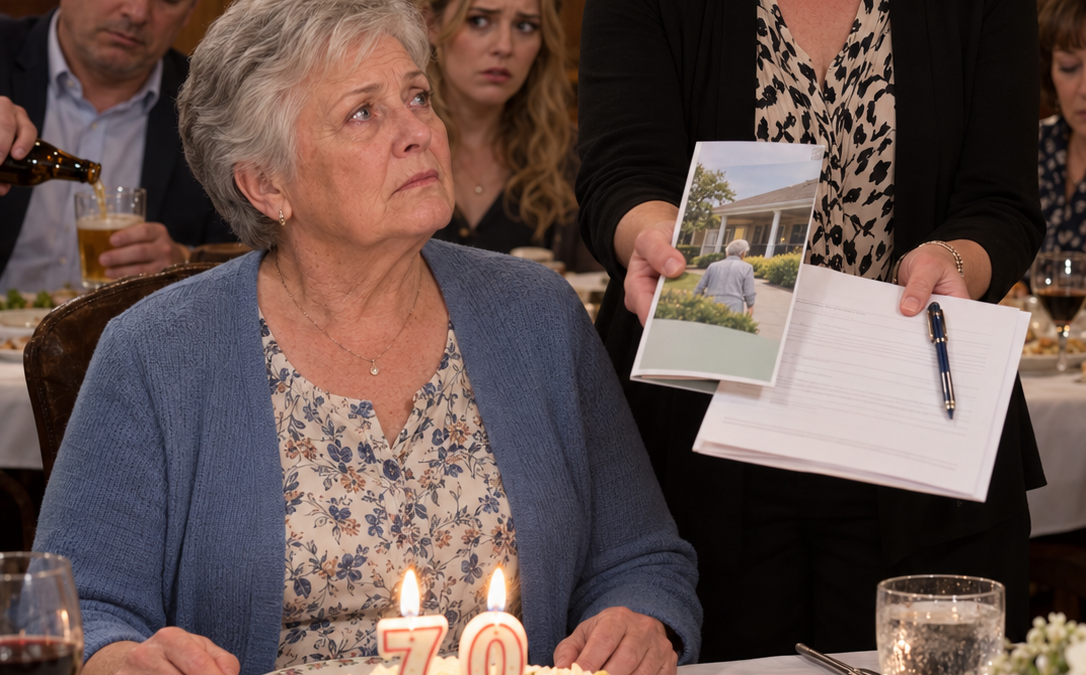
Lynette tapped her glass at 6:40 p.m. and handed me an Elm Prairie Care Center brochure.
An admission agreement and a pen followed, beside my cake’s “70” candle.
“You’re seventy, Mom. Sign tonight and stop being everybody’s problem.”
Eighteen relatives were watching in the steakhouse’s back room.
My daughter stayed standing, holding the pen out until I took it.
I had thought Lynette was getting ready to make a toast.
Two cousins stared at their plates.
Gordon reached for the pitcher and refilled his beer.
My face burned.
I looked down at the brochure, then at the cake someone had carried in for me.
The frosting had a little smear where the box had touched it.
I had been looking forward to a corner piece.
“Not with cake on the table,” I said.
I laid the pen beside my fork.
Lynette’s smile stayed in place, but my daughter’s fingers tightened around the glass.
“Mom, we’re trying to have a nice evening.”
“So am I.”
A cousin moved a bread basket toward me.
I shook my head.
My stomach had tightened so much I couldn’t have swallowed a bite.
The agreement lay across my empty dinner plate.
I lifted the pages by one corner and moved them onto the tablecloth.
Lynette watched me do it.
“It’s easier while everybody’s here,” my daughter said.
I straightened my fork beside the pen.
Across the table, Corinne had stopped unfolding her napkin.
My granddaughter looked at the papers, then at me.
I wanted to tell Corinne I was fine.
I wasn’t fine, and I didn’t want to pretend.
A server came through the door carrying water.
Lynette stepped aside, and the pitcher made its way around the table.
I took a drink before setting my glass down carefully.
My hand wasn’t steady.
Through the open door, I could hear people ordering dinner in the main room.
Out there, it was Saturday night on Norfolk Avenue.
In here, I was waiting for my daughter to let me have my birthday.
Lynette set the glass down and rested a hand on my chair.
“Before anybody gets upset, Mom and I already discussed this.”
I turned toward my daughter.
Lynette spoke past me to the relatives beside the cake.
“She agreed back in September. She asked me to find a place.”
I had never asked Lynette to find me a nursing home.
Hearing that claim in front of my family made me feel trapped.
If I objected, I would be arguing at my own birthday dinner.
If I stayed quiet, my relatives might believe it.
“Lynette,” I said.
My daughter raised a finger without looking at me.
“The move-in is November 2. That’s a Monday, so we have time to get organized.”
Someone near the cake reached for a water glass, then left it alone.
“This place is my gift to you, Mom. I paid the deposit.”
Gordon nodded at the word “gift.”
I looked at my son-in-law, but Gordon was watching Lynette.
My daughter leaned closer.
“Did you bring the house papers?”
On Thursday, Lynette had told me to bring my blue folder.
I had expected a private conversation.
“Yes,” I said.
A chair leg scraped the floor behind me.
I held still while Lynette waited.
My fingers stayed flat against the edge of the tablecloth.
The blue folder was in my tote, against my leg beneath the table.
Lynette held out a hand.
I kept mine on the table.
“Later,” I said.
My daughter lowered that waiting hand and pulled out the next chair.
The chair legs scraped the floor.
An aunt asked whether we were ready to order.
Menus opened around me.
I picked mine up, although I already knew what I wanted.
For a little while, people talked about baked potatoes and salad dressing.
I was grateful for something ordinary to answer.
When the server reached me, I ordered my dinner.
“Anything else?” the server said.
“Coffee, please.”
Lynette started to say something.
I looked directly at my daughter until the server moved on.
Corinne shifted closer to my end of the table.
“Do you want me beside you, Grandma?”
“Yes.”
My granddaughter brought a chair over without making an announcement.
Corinne worked in an ICU in Norfolk.
My granddaughter knew how to ask a plain question and wait for the answer.
I needed that.
Lynette gathered a loose menu and passed it down the table.
I picked up the brochure.
The cover showed a paved path beside a low brick building.
Inside were photographs of a dining room and an upholstered chair beside a window.
I didn’t study the rooms.
I was thinking about my kitchen on Prospect Avenue.
That morning, I had made breakfast there.
Before leaving, I had checked that the stove was off and locked my door.
I had expected to go home after cake.
My eyes stung, and I lowered the brochure before anyone could notice.
“I need a minute,” I said.
Corinne moved the chair back so I could stand.
I lifted my purse from beside my tote.
The folder stayed beneath the table.
Near the doorway stood a narrow table with spare napkins.
I went there, still holding the brochure.
From that spot, I could see my cake between the water glasses.
Nobody had lit the candle.
I turned the brochure over.
A green elm appeared above the care center’s name.
I knew that little tree.
At 5:20 that afternoon, I had taken an envelope from my mailbox.
It had arrived with the day’s mail, addressed to me.
I had carried it inside, then tucked it into my purse before dinner.
I never opened mail in a car.
After twenty-eight years delivering it, I still wanted a table beneath anything I opened.
The envelope had been waiting while my daughter offered me a pen.
A nursing home had mailed me an envelope, though I had never called it.
I opened my purse and found the sealed envelope.
Above the return address was the same green elm printed on Lynette’s brochure.
Picking up where the Facebook post left off
Part 2 of 7
Lynette passed a realtor’s printout across the table beside my “70” candle.
“Two hundred forty-eight thousand dollars,” my aunt said.
“List date, November 16. Seller, Lynette Fischer.”
I stood near the doorway with the sealed envelope against my purse.
My aunt tilted the paper toward the light.
“Is that what houses are going for now?”
“It’s an estimate,” Lynette said. “The realtor thinks it’s a reasonable starting point.”
My daughter said it as if I had already packed.
On Sunday, Lynette had been in my kitchen, cleaning out a drawer.
I lowered the brochure and walked back toward my chair.
The printout traveled past the menus.
Gordon glanced at it, then handed it along without saying anything.
A cousin leaned forward to see the amount.
I wanted someone to look at me before discussing what my house might bring.
Corinne did.
My granddaughter pushed my chair back from the table.
I stayed standing.
“Let me see that,” I said.
My aunt held the printout toward me, but Lynette reached across first.
“I’m handling the house. I’m her only daughter.”
My daughter said it clearly enough to reach the far end.
I looked at the paper in Lynette’s hand.
My name hadn’t been read as the seller.
Lynette’s had.
“Give me the printout,” I said.
“It’s just something to look at.”
“Then I’ll look at it.”
Lynette placed the sheet beside the dinner plate and covered its corner with a hand.
“We can go through it after you finish the other papers.”
The pen was still beside my fork.
I hadn’t touched it since laying it down.
My daughter glanced toward the admission agreement.
I pulled my chair out and sat.
For a moment, I needed the seat beneath me.
My knees felt weak, and I was angry about that, too.
I didn’t want anybody mistaking a shaky pair of knees for agreement.
A server arrived with my coffee.
I moved the brochure so the cup could fit.
“Cream?” the server said.
“Please.”
That small exchange gave me time to get my voice steady.
Lynette folded the edge of a napkin over the printout.
I could still see the amount.
Two hundred forty-eight thousand dollars for the house I expected to sleep in that night.
There had been no conversation about where my furniture would go.
Nobody had asked what I wanted to keep.
I looked down at the tote beneath my chair.
My toe brushed the tote’s strap, with the blue folder still tucked inside.
On Thursday, I had followed my daughter’s instructions and brought the house papers.
Now Lynette wouldn’t even let me hold a realtor’s estimate.
“Grandma,” Corinne said quietly, “your coffee’s hot.”
“Thank you.”
I hadn’t noticed my fingers against the cup.
I moved my hand away.
At the other end, someone asked Gordon about work.
My son-in-law turned toward the question.
I looked at Lynette.
My daughter was straightening the agreement with the edge of the table.
The envelope pressed against my wrist.
I wanted to know why Elm Prairie had written to me.
I lifted my purse and stood again.
“I’ll be in the hall,” I said.
Corinne started to move the chair.
“I can manage.”
My granddaughter nodded and stayed seated.
I left the brochure beside my coffee.
The folder remained in my tote.
Beyond the back-room door, a small table stood beneath a framed picture.
I set my purse on it.
I could still hear my relatives through the doorway, talking around my empty chair.
I laid the envelope flat.
The postmark was October 20.
My name and Prospect Avenue address showed through the window.
I slid a finger beneath the flap and opened it carefully.
A folded sheet came out.
I spread it on the table, smoothing the edge with my palm.
The heading said “Reservation Deposit Receipt.”
Below that was my name.
I leaned closer.
“Reservation deposit $6,000.00.”
“Room 114.”
“Resident: Loretta Kubik.”
My mouth went dry.
I hadn’t reserved a room.
I hadn’t spoken to anyone at Elm Prairie.
Until my birthday dinner, I hadn’t even held their brochure.
The next line named the payment method.
“Visa ending 0417.”
Under that, the receipt said, “authorized online by Lynette Fischer.”
I put a hand against the table.
Lynette had told my family the deposit was a gift.
The paper didn’t say my daughter had used a card belonging to Lynette.
It gave those last digits and my billing address.
My own house on Prospect Avenue.
The transaction date was October 19, 2026.
Monday.
The time beside it was 9:12 p.m.
I had been at home that evening.
I certainly hadn’t been reserving a nursing-home room online.
A server passed with a tray, and I drew the receipt closer.
I wasn’t ready for anyone else to see it.
I needed to be sure what I was looking at.
Was 0417 really my card?
The digits looked familiar.
I used a check register even though people kept telling me I didn’t need one.
I wrote down payments and kept telephone numbers inside the cover.
That was where I had written the last digits of my Visa.
I opened the smaller compartment of my purse.
My register was tucked behind a packet of tissues.
From the back room, I heard Lynette laugh at something Gordon said.
I took the register out and laid it beside the receipt.
Inside the cover, beneath the credit union’s telephone number, was my own handwriting.
Visa 0417.
The receipt matched the Visa in my kitchen drawer, the drawer Lynette had “cleaned” on Sunday.
Part 3 of 7
I dialed the credit union’s twenty-four-hour number from my check register.
The receipt lay beside my phone on the hallway table.
“I need to check a six-thousand-dollar charge,” I said.
The agent asked me to identify myself.
I gave my name and answered the security questions.
Through the doorway, I could see my coffee cup beside the brochure.
The agent asked for a moment.
I kept a finger on the receipt’s payment line.
My birthday dinner was continuing a few feet away.
Someone asked for more butter.
Then the agent came back.
“There’s a charge for six thousand dollars from Elm Prairie Care Center.”
“October nineteenth?”
“Yes.”
The receipt was right.
I had hoped there might be some mistake in the paperwork.
There wasn’t.
“Did you make that payment?” the agent said.
“No.”
“Did you give anyone permission to use your card?”
“I never gave anyone the card or permission.”
Saying it out loud hurt more than seeing the receipt.
The authorization line had my daughter’s name on it.
I looked toward the back room before continuing.
“My daughter’s name is on the receipt. Mine is the billing address.”
“Do you recognize the purchase?”
“It’s a room deposit. I didn’t ask for a room.”
The agent told me the card would be blocked.
I asked for a pen, then realized I was speaking to someone on the telephone.
My face grew hot.
“There’s one here,” I said.
A pen stood in a little holder near the spare napkins.
I took it and wrote the date inside my register.
October 24, 2026.
The agent explained that I needed to follow the phone report with a written dispute.
“I’ll send it Monday,” I said.
“Keep that receipt.”
“I will.”
The agent confirmed the block before ending the call.
I set the phone down.
The charge was still on my account, but the card couldn’t be used again.
I had done what I could that night.
My daughter appeared in the doorway before I could close the register.
Lynette looked at the phone, then at the paper beneath my hand.
I covered the receipt with the register.
“Who are you calling?”
I picked up my purse.
Lynette stepped closer, keeping the voice low enough for the hallway.
“You’re making me the bad guy on your birthday. Elm Prairie already has you down for the memory wing.”
My chest tightened.
A memory wing.
I had never been interviewed by anyone there.
Nobody had called to ask whether I wanted care.
I opened my mouth.
Lynette turned and went back into the room before I could answer.
For a few seconds, I watched the doorway.
I was frightened now.
My daughter had just described a place for me as if my being there was settled.
At the table, Lynette reached for a water glass.
I could hear my daughter asking someone to pass the cream.
Corinne came into the hallway a moment later.
My granddaughter stopped beside the table.
“Grandma?”
I moved the register and handed Corinne the receipt.
“Look at the payment.”
Corinne held the sheet beneath the light.
My granddaughter read from the heading to the authorization line.
Then Corinne went through the entries once more, ending at Lynette’s name.
I watched Corinne’s face.
My granddaughter’s jaw tightened, but the paper stayed steady.
“Your card?” Corinne said.
“The credit union confirmed it.”
“Did you report it?”
“Yes. They blocked it.”
Corinne lowered the receipt.
“I’m sorry, Grandma.”
I nodded because I couldn’t answer that yet.
From inside came the scrape of a chair.
Corinne glanced toward the sound, then looked directly at me.
“Grandma, do you have the blue folder?”
“It’s in my tote. Under my chair.”
“I’ll get it.”
My granddaughter went through the doorway.
I stayed at the hallway table with my purse open.
I could see Corinne bend beside my chair.
Lynette said something I couldn’t hear.
Corinne lifted the tote and returned without stopping.
My granddaughter set it beside my purse.
I took out the blue folder.
The clasp caught against the fabric, and I eased it free.
I had brought it because Lynette told me to.
I hadn’t expected to need it this way.
Corinne put the receipt down where I could see it.
I opened the folder.
The certification of trust was inside the front pocket.
Behind it was the recorded deed.
I drew the pages out and placed them beside each other.
The trust’s name was printed across the certification.
Loretta Kubik Revocable Trust.
I had signed it on March 6, 2019.
The deed bore the Madison County recording information.
I found the name I needed.
“Loretta Kubik, Trustee.”
Both documents were there.
My house had been in my trust since 2019.
Lynette had been asking for house papers without knowing what those papers would show.
Corinne leaned over the table.
“That’s the recorded deed,” my granddaughter said.
“Yes.”
“And the certification.”
“Yes.”
I held the deed flat while Corinne checked the heading.
Nobody needed to tell me whose house it was.
But I wanted the papers where my relatives could see them.
The thought of speaking made my stomach tighten.
Eighteen relatives had heard Lynette say I was everybody’s problem.
They had listened while my daughter put a date on my move.
I looked through the doorway at the place beside my fork.
The agreement was still there.
Would I say what these papers meant in front of all eighteen?
I slid the deed and certification back into the blue folder.
The receipt went on top.
Corinne waited beside me.
“Bring the agreement she gave me. I’m going back in.”
Part 4 of 7
When I reached my chair, Lynette clinked a spoon against her glass.
The pen still lay beside my fork.
“Everybody stays for the signing,” my daughter said.
A cousin who had started to stand settled back into the seat.
Lynette looked down the table.
“I want you here so nobody can say I pushed her.”
I set the blue folder beside my plate.
The receipt was tucked inside, above the deed and certification.
My daughter watched the clasp.
Corinne came around my chair carrying the admission agreement.
My granddaughter placed it where I could read it.
“Thank you,” I said.
Lynette held out a hand for the pages.
“I’ll show you where.”
“I’m reading it.”
“We’ve already discussed the important parts.”
I drew the agreement closer.
My daughter’s hand stayed there another second before dropping to the table.
Someone reached for the bread basket.
Nobody passed it.
I put my purse beneath my chair and moved my coffee aside.
I wanted room for the paper.
Lynette sat down, but my daughter kept the glass in hand.
The spoon rested against its rim.
I looked at the agreement’s first page.
My name was there.
Farther down, beside the move-in date, someone had written “11/2.”
I knew that handwriting.
Lynette made a narrow number one and pressed hard on the downward stroke.
I had seen it on birthday cards and grocery lists.
November 2 was written as if I had already chosen it.
I turned the page.
The resident signature line was blank.
I ran a finger beneath the empty space.
No signature.
No date from me.
Across the table, my aunt adjusted the napkin on her lap.
Lynette leaned toward the agreement.
“The pen works, Mom.”
I didn’t pick it up.
Near the printed referral information was another date.
10/19/2026.
October 19.
My daughter had told this room I agreed in September.
The referral on the paper was from Monday.
I held the page flat and checked the label beside those numbers.
Referral date.
That was what it said.
A server entered carrying dinner plates, and Lynette moved the glass aside.
I lifted the agreement so my meal could be set down.
The plate was warm against my wrist.
For a few minutes, people shifted cups and made room for food.
My brother asked for steak sauce.
Gordon moved the beer pitcher out of the server’s way.
I waited until the server had left before placing the agreement beside my dinner.
Steam rose from my baked potato.
I had been hungry when I arrived.
Now I wanted the room to stop treating my signature like part of the evening’s service.
Corinne stayed close to my chair.
My granddaughter looked past me toward Lynette’s plate.
The realtor’s printout was still there, partly beneath a folded napkin.
Corinne reached for it.
Lynette caught the napkin before it slipped onto the floor.
“Careful,” my daughter said.
Corinne lifted the sheet without answering.
My granddaughter studied the lower portion, then turned it toward me.
A fingertip stopped beneath a small line.
“Owner of record: KUBIK LORETTA, TRUSTEE.”
Corinne kept the voice low.
I leaned toward the paper.
Above that line was the estimate my aunt had read aloud.
The seller’s name was Lynette Fischer.
But the owner’s name was mine, followed by “TRUSTEE.”
The printout matched the documents in my blue folder.
I looked from that small line to my daughter.
Lynette was cutting into dinner.
My daughter hadn’t asked Corinne what the paper said.
“Leave that here,” I said.
Corinne laid the printout beside the folder.
I placed the agreement on the other side.
I needed the papers separate so I could find each one.
Lynette stopped cutting.
“You’re getting gravy on things.”
My plate hadn’t touched the documents.
I moved it farther away anyway.
My brother set down the steak sauce.
“Retta, just sign it and keep the peace.”
My hand shook on the folder clasp.
I pressed my palm against it, but the trembling continued.
That hurt.
My brother had watched Lynette hand me a nursing-home agreement beside my birthday cake.
Now my brother wanted me to finish what my daughter had started.
I looked toward the cousins who had stared at their plates earlier.
One was cutting a potato into small pieces.
The other watched my hand.
I was angry, and I was embarrassed that they could see me shaking.
Corinne pulled the chair closer.
“Do you need a minute, Grandma?”
“No.”
My voice came out clearly.
I loosened my grip on the clasp.
Lynette placed the knife across the plate.
“There’s no reason to upset everybody.”
“I’m reading what you gave me.”
“It’s a standard form.”
I turned the agreement so the blank signature line faced me.
My daughter reached for the pen.
For a second, I thought Lynette might take it away.
Instead, my daughter uncapped it and laid it across the paper.
I could hear a fork scrape a plate at the far end.
Nobody offered to leave now.
They were waiting to see what I would do.
Would my family believe a seventy-year-old woman over her daughter?
I drew the blue folder closer.
Lynette’s chair moved back.
My daughter reached across my place setting and slid the agreement directly in front of me.
“Sign, Mom, or I tell the whole church you can’t manage a checkbook.”
Part 5 of 7
I laid the receipt beside the cake and its unlit “70” candle.
“Visa ending zero four one seven,” I said.
“Six thousand dollars, billed to my house on Prospect Avenue.”
Lynette reached toward the sheet.
I held it flat.
“Authorized online by Lynette Fischer.”
My daughter stopped reaching.
I read the transaction date and time.
“October nineteenth. Nine twelve p.m.”
A cousin lowered a fork.
Gordon looked at Lynette.
“You told this room you paid the deposit,” I said. “This is my card.”
My daughter glanced toward the door.
“You’d never have done it yourself. I was going to pay it back from the house.”
My aunt pushed her plate away.
I left the receipt beside the cake where my relatives could see it.
“You didn’t have my permission.”
“It was to hold the room.”
“On my card.”
Lynette picked up the pen, then set it down without writing.
My daughter was still standing beside my chair.
I took the admission agreement and turned it toward the table.
“Here’s where the resident signs.”
I pointed to the empty line.
“I haven’t signed.”
My brother leaned forward.
I moved my finger to the handwritten date.
“Eleven two. November second. Lynette wrote that.”
Nobody needed to compare the handwriting.
My daughter had been writing dates on family calendars for years.
Lynette folded the napkin beside the dinner plate.
I showed the printed referral date next.
“October nineteenth, twenty twenty-six.”
I kept the page facing my relatives.
“You said I asked you in September.”
“September, October — what does it matter? You forget things, Mom.”
My face burned again.
This time, I didn’t lower my eyes.
“I didn’t forget asking you. I never asked.”
Corinne stood beside me.
My granddaughter didn’t touch the agreement or try to answer for me.
I was grateful for that.
I wanted my family to hear me say it.
“I didn’t choose this room. I didn’t agree to move.”
Lynette opened her mouth as a server appeared with a water pitcher.
The server stopped just inside the doorway.
I moved the papers away from the edge.
“We’re fine for water,” I said.
The door closed behind the server.
I sat down and pulled the blue folder onto my lap.
My thumb slipped against the clasp.
I steadied it with my other hand and opened it.
The certification came out first.
Then the recorded deed.
I set the documents on the table without passing them around yet.
Lynette watched the blue folder.
“These are the house papers you asked me to bring.”
“I know what they are.”
I turned the certification so the heading faced my daughter.
“The house is in the Loretta Kubik Revocable Trust.”
Lynette’s eyes moved over the page.
“It’s been there since 2019,” I said. “I’m the trustee.”
Gordon set his fork down.
I placed the deed beside the certification.
“This is recorded with Madison County. Loretta Kubik, Trustee.”
My brother looked from the deed to the agreement.
I reached for the realtor’s printout.
“Your own paper says it.”
I found the small line Corinne had shown me.
“Owner of record: KUBIK LORETTA, TRUSTEE.”
I passed the printout to Gordon.
“The trustee signs a sale,” I said. “That’s me.”
Lynette pulled the chair out and sat.
For a moment, my daughter studied the documents without speaking.
Then Lynette looked at Corinne.
“You knew about this?”
“I’m the successor trustee. Not Mom.”
My granddaughter’s voice was quiet and exact.
Lynette stared at Corinne.
I rested a hand beside the deed.
“Corinne is named to take over if I can’t serve. I’m still serving.”
Gordon looked down at the printout.
My son-in-law checked the seller’s name at the top.
Then Gordon found the owner’s name below it.
I waited.
I had been waiting for someone to look past Lynette’s announcements since the brochure reached my plate.
Gordon put down his beer.
“You told me she asked for this. She never did, did she?”
Lynette reached toward Gordon.
My son-in-law slid the realtor’s printout back to me.
“No,” I said. “I never did.”
Gordon kept his hands beside the plate.
Lynette’s hand dropped.
I gathered the deed and certification into the folder.
I left the receipt and agreement out.
“The credit union confirmed the charge,” I said. “I reported it as unauthorized.”
My daughter’s face lost color.
“They blocked the card. I’m sending the written dispute Monday.”
“You called them tonight?”
“Yes.”
Lynette looked at my purse beneath the chair.
I stood and moved the receipt closer to my daughter.
“You will call Elm Prairie Monday. The six thousand dollars goes back to the card.”
My daughter stared at the amount.
“It doesn’t go toward another room,” I said.
Gordon pulled the beer glass away from the paperwork.
Nobody was eating now.
I took the pen from beside the agreement and laid it near Lynette’s hand.
“My house, my card, my signature. None of them are yours.”
My daughter looked around the table.
My brother sat back.
The cousins watched Lynette instead of their plates.
What would Lynette do on Monday?
I had told my daughter what had to happen.
I hadn’t heard a promise.
Lynette picked up the pen and pressed the cap into place.
The click carried across the table.
My daughter took the purse from the chair and walked out.
Gordon stayed seated.
I turned toward my cake.
The candle was still planted crookedly in the frosting.
I pulled out the “70” and wrapped it in a clean napkin.
Corinne moved a dessert plate beside me.
I picked up the cake knife.
“And Monday,” I said, cutting the first slice, “I’m calling Elm Prairie myself.”
Part 6 of 7
On Monday, October 26, I mailed my written dispute at the post office.
A copy of the $6,000 receipt was inside the envelope.
I kept the original in my blue folder.
The clerk took the letter, and I went home to Prospect Avenue.
At my kitchen table, I found Elm Prairie’s number on the brochure.
I asked for the director.
“My name is Loretta Kubik. There’s a reservation for Room 114 in my name.”
The director asked me to wait while the file was brought up.
I kept the unsigned agreement beside the telephone.
“We have Lynette Fischer listed as the contact,” the director said.
“I’m the person named as the resident.”
“Yes.”
“I never agreed to move there. I never signed your admission agreement.”
I heard paper moving.
“There’s no resident signature in this file.”
“There won’t be one.”
The director said Lynette had called about the deposit refund that morning.
My daughter had made the call.
I still wanted the cancellation confirmed directly to me.
“The charge was made on my card without permission,” I said.
“The refund will go back to the original payment account.”
“And the room?”
“I’m canceling the reservation for Room 114. The resident never signed.”
I wrote that down beneath the date.
“Please mail the confirmation to me.”
The director checked my billing address.
It was the address Lynette had supplied to use my card.
This time, I had asked for the letter myself.
On Wednesday, October 28, I called the credit union from my kitchen.
The agent checked my account.
“The six-thousand-dollar credit has posted.”
I closed my eyes for a moment.
“From Elm Prairie?”
“Yes.”
I thanked the agent and wrote the amount in my register.
Six thousand dollars returned.
That afternoon, I took the realtor’s number from the printout.
The paper still had Lynette typed as the seller.
I gave the realtor my name and the property address.
“I’m the trustee,” I said. “I haven’t authorized a sale.”
The realtor checked the file.
“The planned November sixteenth listing is off,” the realtor said.
I waited with the phone against my ear.
“Only the trustee can sign. Your daughter can’t authorize this.”
“Thank you.”
I put the printout in the blue folder.
The estimate remained $248,000.
My house would not be going on the market.
On Thursday, October 29, I carried the folder into my lawyer’s office.
I set it on the desk and took out the trust papers.
My lawyer placed the amendment in front of me.
I read it before touching the pen.
“This removes Lynette as a beneficiary,” the lawyer said.
“Yes.”
“You want to proceed?”
“Yes.”
My hands were steady when I signed.
I had spent days listening to my daughter tell people what I wanted.
At that desk, I answered for myself.
The lawyer checked the signed amendment and prepared my copy.
I slid it into the folder.
I felt sad when I saw Lynette’s name on the page.
I signed anyway.
Before the locksmith arrived that afternoon, Lynette returned my house key.
I had asked for it back.
My daughter stood on the front step and held it out.
I took it without inviting Lynette inside.
“You’re really changing the locks?”
“Yes.”
“I gave you the key.”
“I know.”
Lynette looked past me into the hallway.
I kept my hand on the door.
My daughter left without asking about the refund.
Later, the locksmith rekeyed the locks and handed me the new key.
I tried it myself before the locksmith drove away.
Then I put my copy of the amendment on the kitchen table.
I had wanted to tell Lynette about it on the doorstep.
I was glad I hadn’t tried to have that conversation there.
My daughter had returned the key.
That was enough for that visit.
My phone sounded that evening while I opened the day’s mail at the table.
Gordon’s name appeared above a new post in the family group chat.
I left an envelope flat beneath my hand and picked up the phone.
“Lynette told me Loretta asked to move to Elm Prairie,” Gordon wrote.
“Loretta never asked. I heard her say that at dinner.”
I sat down.
Gordon wrote that Lynette had $31,000 in lake-cabin credit-card debt.
My son-in-law had known about the debt.
Gordon hadn’t known about my card.
“The deposit came from Loretta’s account without her permission,” the next message said.
“She reported it, and the money has been refunded.”
I looked at the amount again.
Thirty-one thousand dollars.
Nobody had mentioned that while discussing the price of my house.
My aunt responded first.
“I’m sorry, Retta. I should have asked you.”
I typed, “Thank you.”
I didn’t know what else to say yet.
Then a cousin asked about Thanksgiving.
Another cousin proposed my house.
Messages began appearing before I could answer.
“I vote for Loretta’s.”
“Me too. I’ll bring potatoes.”
Someone offered folding tables.
I looked from the phone toward my kitchen doorway.
There would be room if we moved things around.
I wanted my family there.
I typed, “Thanksgiving here is fine. Ask me before bringing furniture.”
A cousin sent back a laughing face and promised to call.
I smiled at the screen.
I had agreed to host dinner in my own house.
I hadn’t invited Lynette.
Would my daughter come to Thanksgiving anyway?
Then Corinne’s message appeared beneath the votes.
“Thanksgiving at Grandma Loretta’s. Just family who asks first.”
Part 7 of 7
“Use that platter, Gordon,” I said, pointing beside the turkey.
It was Thanksgiving, November 26, and seventeen relatives filled my kitchen.
Two card tables stood beyond my usual table.
Gordon moved the platter where I wanted it.
My son-in-law steadied the turkey with a fork and began carving.
“Thin slices?” Gordon said.
“Some. Leave me a thick one.”
My brother carried a bowl of potatoes through the doorway.
A cousin followed with the extra chairs.
I showed my relatives where to put them.
There was no chair set aside for Lynette.
I hadn’t laid a place for my daughter.
When the front door opened, I looked up.
It was my aunt, bringing the rolls from her car.
I took the basket and moved aside so my aunt could get through.
“Where do you want these, Retta?”
“Next to the butter.”
My kitchen was warm enough that I had pushed up my sleeves.
The window above the sink had fogged around the edges.
Someone was asking where I kept serving spoons.
I opened the drawer and handed one over.
At the counter, Corinne lifted the gravy boat.
My granddaughter looked beneath it, then toward the stack of papers beside the radio.
The Elm Prairie brochure was there.
Corinne picked it up, folded it flat, and laid it beneath the gravy boat.
A cousin noticed the green elm.
“That’s an expensive trivet.”
The cousins laughed.
I looked at the brochure under the gravy.
“That’s where it can stay,” I said.
Corinne smiled and turned the handle toward the table.
Gordon put another slice of turkey on the platter.
My brother asked whether anybody had seen the salt.
It was in front of him.
The laughter started again, and I joined in.
I had moved the blue folder onto the counter while wiping the shelf that morning.
Now I shifted it away from a damp serving spoon.
The clasp was closed.
I didn’t need any of its papers for dinner.
“Grandma, where does this go?”
Corinne’s little boy stood beside me holding a stack of napkins.
I pointed toward the plates.
“Put one at each place.”
He started with mine.
I watched him smooth the napkin with the side of his hand.
Then I went to the cupboard for the candle.
It was still wrapped in the napkin from my birthday dinner.
I opened the paper carefully over the counter.
A little dried frosting clung to the bottom of the “70.”
Corinne saw what I was holding.
“Do you want a cake plate?”
“The pie will do.”
My granddaughter moved the pumpkin pie toward me.
I pressed the saved candle into the filling, clear of the crust.
The boy returned with an empty hand.
“Is that yours?”
“Yes.”
“That’s a big number.”
“It fits.”
He leaned against Corinne’s leg and looked up.
“Can I light it?”
“With me,” Corinne said.
My granddaughter brought over the long lighter and guided his hand.
The wick caught.
He smiled so broadly I could see the gap between his little teeth.
I reached for a dessert plate, but Corinne touched my arm.
“Sit for a minute, Grandma.”
My granddaughter pulled out the chair at the head of my kitchen table.
I started to say there were things to carry.
Gordon lifted the turkey platter.
“I’ve got this.”
My brother took the rolls.
The boy stepped back so I could reach my chair.
I sat down.
Corinne smoothed my blouse at the shoulder, then kissed my cheek.
I turned toward the stove, blinking hard, and couldn’t get a word out.
I reached for the napkin the boy had placed beside my plate.
Corinne stayed there while I dabbed beneath my eyes.
I looked toward the doorway, then back at my granddaughter.
“I didn’t stop loving her when I told her no.”
“I know, Grandma.”
Corinne’s hand stayed on my shoulder.
Nobody reached past me for food.
My brother stood holding the bread basket until I could look up.
“Those can go down here,” I said.
He set the rolls within my reach.
The boy was watching the candle.
“Can I blow it out?”
I nodded.
He leaned toward the pumpkin pie and blew.
The flame went out, leaving a thin curl of smoke above the “70.”
Corinne moved the pie safely onto the counter.
I stood and picked up the blue folder.
I put it back on the shelf above the radio.
Gordon waited with the carving knife beside the platter.
I pulled my chair out where I wanted it.
“Come sit down,” I said. “Dinner’s ready.”
THE END
More stories
My nephew’s wife sent my 69-year-old mother to eat in the kitchen at the christening. Mom had already traced the missing $38,400.On Christmas Eve my son shut his door on me in front of 12 carolers. The SUV in his driveway is still titled in my name.My husband’s mother sold her home, then told 40 guests I’d be moving into the garage. The lender wrote to the company that owns our home.I came home from 3 weeks of chemo to 9 strangers drinking on my dock. My daughter-in-law had rented my lake house for $6,300.My wife charged my daughter, 31, $900 a month for her childhood bedroom while her son pays nothing. My daughter co-owns the house.My late wife’s niece toasted my 79-year-old father as ‘our basement tenant’ at Thanksgiving. She ran a daycare in his living room.
You Might Also Enjoy




