My son-in-law became HOA president and fined my rain barrels $4,800 in front of 90 neighbors. The clubhouse he runs meetings in sits on my land.
Complete story · 7 parts · about 29 minutes · ending included
Part 1 · Part 2 · Part 3 · Part 4 · Part 5 · Part 6 · Part 7
Part 1 of 7
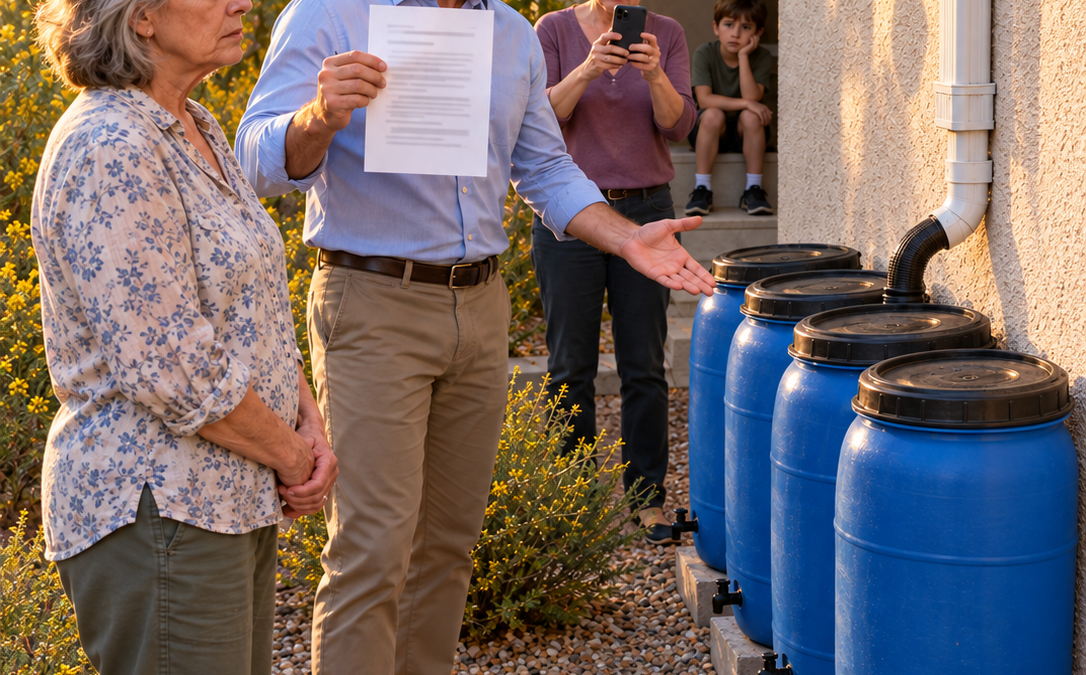
Lance held a fine notice beside my four blue rain barrels.
At 6:20 p.m. on September 11, my son-in-law pointed to the paper.
“Get the barrels in it,” Lance said to the board member with the phone.
“For the record,” the man said.
Hudson watched from my porch, his fingers curled around the railing.
Lance gave me the folded notice.
“Bring that tonight, Nadine.”
At 7:00 p.m., I sat in the clubhouse with 90 owners.
Lance stood at the microphone.
“Nadine Harlow, $4,800,” Lance said.
My grandson’s father looked straight at me.
“She got three written warnings and ignored every one.”
A chair scraped behind me.
“Rules apply to everyone, Nadine. Even widows who think they’re special.”
I stood before I could talk myself out of it.
“The barrels stay full, Lance.”
Then I sat.
My knees felt weak, and I pressed them together beneath the chair.
Nobody clapped.
A man across the aisle lowered his eyes to his budget packet.
The woman beside him stopped turning pages.
I was embarrassed, and I hated that Lance could see it.
Those barrels caught roof runoff beside my house.
I used the water on my plants.
Lance had photographed them like evidence from a crime scene.
Now my name and that dollar amount were hanging over the room.
Lance adjusted the microphone.
“We’re trying to maintain standards here.”
“Where are the three warnings?” I said.
Lance glanced past me at the room’s far end.
“We’re not going to use meeting time for individual disputes.”
“You used it for my name.”
“You have the notice, Nadine.”
Lance tapped his stack of papers.
“The response instructions are on it.”
I kept my mouth closed.
My fingers had started trembling, and I tucked them beneath the packet.
I was 66 years old.
I had worked 31 years at Tucson’s water treatment plant.
I knew what happened when somebody wrote down a number without supporting it.
But knowing that didn’t stop my cheeks from getting hot.
Lance had called me a widow in front of my neighbors.
Vernon had been gone since March 14, 2022.
I still caught myself setting aside things I wanted to tell him.
That evening, I wanted to tell him what Lance had said.
I drew my purse nearer with my foot.
The folded notice was inside, beside my house keys.
I had brought it because Lance told me to.
I had even checked that my blouse was clean before leaving home.
That part hurt more than I wanted to admit.
I had come expecting a meeting where I could explain my barrels.
Lance had come ready to read out a debt.
At the front table, Dolores Pickett kept her minutes book open.
Dolores had been secretary-treasurer for nine years.
Her pen moved while Lance turned to the next item.
I watched the page beneath her hand.
I wanted my question written there.
I wanted a record that I had stood up.
Lance lifted the budget packet.
“Let’s get back to something that benefits the whole neighborhood.”
Paper rustled around me.
I opened mine and worked the corner flat against my knee.
Page 4 had columns of small figures.
At the plant, I logged readings before anybody adjusted a valve.
A number belonged beside a date, and I kept the record.
Retirement hadn’t changed that habit.
I raised my phone and snapped a picture of the page.
The overhead lights left a white streak across the screen.
I tipped the packet and took a clearer picture.
Then I put the phone away.
Lance clicked to a drawing on the screen behind him.
The clubhouse in the drawing looked brighter than the room around us.
“This is the renovation proposal,” Lance said.
“The vote will be September thirtieth.”
Someone behind me said, “How much?”
“Four hundred twelve thousand dollars.”
I wrote $412,000 in the packet’s margin.
My pencil point broke beneath the last zero.
Lance smiled toward the rows of chairs.
“This is an investment in Desert Willow Ranch.”
A man near the aisle raised his hand.
“Does the association own the building outright?”
Lance rested his hands on the podium.
“The association owns this clubhouse and every inch of ground under it.”
The man nodded and lowered his hand.
I looked at the screen, then at the brown mark on the ceiling.
Lance spoke about improvements while I rubbed pencil dust from my thumb.
I heard the amount again.
Four hundred twelve thousand.
Then I heard my own amount in his voice.
Four thousand eight hundred.
I couldn’t make the barrels beside my house fit that bill.
Before the meeting ended, Lance reminded us about September thirtieth.
“Come prepared to vote.”
People stood and gathered their papers.
I stayed seated until the aisle cleared.
A neighbor who usually talked to me about pruning walked past with a tight smile.
I couldn’t tell whether the neighbor felt sorry for me or agreed with Lance.
I didn’t have the strength to find out.
At home, the porch light showed the blue sides of my barrels.
I stopped beside them before unlocking the door.
That afternoon, Hudson had stood just a few feet away.
I could still picture his fingers on the railing.
Inside, I set the budget packet on the kitchen table.
My purse tipped against a chair, and my keys slid to the bottom.
I found the folded notice and spread it beneath the light.
I had listened to Lance say I ignored three warnings.
I had searched my memory through his renovation speech.
Nothing had come before that evening.
No envelope tucked beneath the grocery circulars.
No letter I had set aside to answer.
I flattened the crease with my palm.
Near the top was the date: September 11, 2025.
Below it, a stamp read “FIRST NOTICE.”
I moved my finger down to the calculation.
Four barrels, 55 gallons each.
One hundred dollars a day.
Forty-eight days.
The fine began on July 25.
Lance had charged me $4,800 before delivering the paper stamped “FIRST NOTICE.”
Picking up where the Facebook post left off
Part 2 of 7
I addressed the envelope on Friday, September 12, with the $4,800 notice beside me.
The response address was Lance’s house.
I knew it without checking the street number.
I had taken Hudson there after school and carried casseroles through that door.
Now I was supposed to send my objection there.
I set my pen down before pressing hard enough to tear the envelope.
In my response, I disputed the fine.
I stated that September 11 was my first notice.
I requested copies of the warnings Lance claimed I had ignored.
Then I asked for the observation record and a chance to be heard.
I signed my name, made a copy, and drove to the post office.
“Certified mail,” I said at the counter.
The clerk attached the label while I watched.
I put the receipt in a folder with my copy.
Back in the car, I wrote the mailing date beside the tracking number.
My stomach still felt tight.
I wanted Lance to stop treating my house as something he managed.
For now, I had a receipt showing I had answered.
At home, I took my phone outside.
The four blue barrels stood where Lance had posed with his notice.
I photographed the sealed lids from above.
Then I moved closer to show the screens.
I checked each picture before taking the next.
I wanted the mesh visible.
I wanted the fitted edges clear.
The first-flush diverters were harder to photograph in the narrow space beside the wall.
I crouched until my knees complained and angled the phone upward.
Those fittings directed the first dirty runoff away from the stored water.
I had kept the setup clean.
I knew how water behaved when people neglected it.
That had been my work for 31 years.
I went inside and opened the drawer beneath the kitchen phone.
My gallon log was under a stack of appliance instructions.
Six years of dates and amounts filled its pages.
Some entries were neat.
Others leaned sideways where I had written against the porch post.
I copied the pages and added them to the folder.
The original went back in the drawer.
By then, my knees ached from crouching.
I sat at the table and looked at the certified-mail receipt.
Answering Lance had taken most of my morning.
The barrels had required less attention than that.
Mandy called that afternoon.
“Come for dinner Sunday, Mom.”
“Will Lance be there?”
“It’s his house too.”
“I know whose address I wrote.”
Mandy paused.
“Please come. Hudson wants to see you.”
I agreed because I wanted to see Hudson.
On Sunday, September 14, I arrived with a small dish of sliced peaches.
Mandy took it at the door.
“Thanks, Mom.”
Voices came from the dining room.
The board member who had photographed my barrels sat beside Lance.
Another board member occupied the chair across from him.
I stopped with my purse still over my shoulder.
Mandy touched my elbow.
“They were already coming.”
“Then you could have told me.”
“Please. Dinner’s ready.”
I followed Mandy to the table.
Hudson sat beside the empty chair meant for me.
“Grandma, I saved this.”
“Thank you.”
Hudson moved his glass closer to his plate so I had room.
That small effort nearly made me cry.
I put my napkin in my lap and kept my eyes on the serving dish.
For a while, we passed food.
Lance asked one board member about a roof repair.
Mandy asked Hudson about school.
Then Lance put down his fork.
“Did you send the response?”
“Friday.”
“You could have brought it over.”
“I mailed it to the address provided.”
The man with the phone reached for his water.
Lance smiled at the guests.
“Nadine likes paperwork.”
“I like dates.”
Mandy’s fork stopped above her plate.
“Can we eat?”
“This won’t take long,” Lance said.
I knew then that dinner had a purpose.
Lance leaned back in his chair.
“This is about the rules. It has nothing to do with family.”
“Then leave my family out of it.”
“I’m trying to help you.”
Lance glanced toward the board members before looking at me.
“You should sell and move into our casita before the fines eat the house.”
My throat tightened around the food I had just swallowed.
Hudson stared at Lance.
Mandy set her fork down.
“We haven’t decided anything like that.”
“There’s nothing to decide,” I said.
“The casita would be easier,” Lance said.
“No yard to maintain. No barrels to argue over.”
“I’m staying home.”
One board member studied the potatoes.
The other wiped his mouth and folded his napkin.
Neither told Lance that my house wasn’t dinner-table business.
Mandy turned toward me.
“Please, Mom, just pay it.”
I looked at my daughter.
Mandy’s eyes were wet, but the request stayed between us.
I had expected Mandy to ask Lance to stop.
Instead, Mandy wanted me to write a check.
“I disputed it,” I said.
Lance picked up his fork.
“Well, you know where this goes.”
I couldn’t finish the food on my plate.
After dinner, I carried my purse onto the porch.
Hudson followed and pulled the door nearly shut.
“Grandma.”
I bent closer.
Hudson whispered, “Dad said, ‘Grandma’s house is worth a lot.’”
My fingers tightened around my purse strap.
“When did Dad say that?”
“I heard it.”
Hudson watched my mouth before asking the next question.
“If you move, who reads your rain gauge?”
“I’m staying home.”
Hudson nodded, but kept looking through the door.
I rested my palm against his shoulder until Mandy came outside.
At my kitchen table that evening, I opened the budget photograph on my phone.
I wanted to look at figures nobody could interrupt.
Page 4 filled the screen.
Near the bottom, a dollar amount caught my eye.
One dollar.
I moved the phone beneath the lamp, though the light couldn’t sharpen a photograph.
“Why does the HOA pay anyone one dollar?”
I spread my fingers across the screen and enlarged the row.
“Clubhouse ground lease — V. & N. Harlow — $1.00.”
Part 3 of 7
I pulled Vernon’s “CORNER” box from the hall closet Monday, September 15.
The cardboard scraped my wrist as I carried it to the table.
It had been in that closet since 2022.
I set my phone beside it, with page 4 enlarged.
V. & N. Harlow.
I lifted the lid.
A deed lay beneath an envelope of receipts.
The property description meant little to me until I found the acreage.
1.3 acres.
Then I saw our names.
“Vernon and Nadine Harlow, as community property with right of survivorship.”
Beneath the deed was an invoice from Hector Ochoa, dated 2004.
The description read “ground lease, clubhouse parcel.”
I called the number printed at the top.
“Hector, this is Nadine Harlow.”
“Nadine. What have you found?”
“Your invoice for the corner.”
Hector stopped speaking for a few seconds.
“Do you have the deed?”
“In front of me.”
“I’ll bring my file.”
That afternoon, Hector laid a folder beside my cold coffee.
At 74, Hector moved carefully, but his hands were steady.
“I kept this in my garage cabinet,” Hector said.
“Since 2004.”
Hector slid the lease toward me.
The signatures were dated November 8, 2004.
I recognized Vernon’s handwriting before I read the names above it.
“He told me he gave the corner to the neighborhood.”
“I drafted a lease.”
“I was working nights then.”
Vernon had handled the property papers.
When he said, “I gave the corner to the neighborhood,” I believed him.
I hadn’t asked to see anything.
Hector tapped the rent clause with his pen.
“One dollar a year.”
“That line was in Lance’s packet.”
“It should be. It’s an association expense.”
Hector moved the pen down the page.
“One-year terms, renewing January first unless proper notice is delivered by October first.”
“This October?”
“Yes.”
Hector read the delivery clause aloud.
Notice could be delivered at a duly noticed board or members’ meeting.
Certified mail to the association’s address of record was another option.
“Then the lease ends December thirty-first,” Hector said.
I kept my palms flat on the table.
“What happens to the clubhouse?”
Hector pointed to another clause.
“The buildings go to the landowner at the end.”
I looked toward the window.
Beyond my yard, the clubhouse roof showed above the wall.
I had sat beneath that roof while Lance read my name.
“Who owns it now?” I said.
“The association has the buildings under this lease. You own the ground.”
Hector placed the deed beside the contract.
“The survivorship language passed Vernon’s interest to you without probate.”
Nobody had needed to list that parcel for me after Vernon died.
The association paid its tax bill directly.
No bill had arrived to make me question what Vernon had said.
I had never searched for land I thought we had donated.
Hector helped me find the parcel on the Pima County assessor’s site.
The owner field read “Harlow Nadine.”
I touched the screen.
“My name.”
“Yes.”
“Does the association have this lease?”
“The original belongs in its files.”
Hector let me sit with that.
Then Hector tapped the deadline.
“What do you want to do with a lease only you can end?”
“I need to see the violation file.”
Hector nodded and left his copy with me.
I put it back in the box, beneath the deed.
On Wednesday, September 17, I met Dolores at the clubhouse office.
“I want my violation file,” I said.
Dolores opened a drawer.
I stayed on my side of the desk while Dolores sorted the papers.
“Copies of the warnings,” I said.
Dolores set a thin stack beside the minutes book.
I waited for more.
Instead, Dolores pulled out a printed email.
“This was sent August second.”
I looked at the sender.
Lance.
The recipients listed the board.
Dolores’s name was there.
I read the message beneath the date.
“Keep the fines running. She’ll be in our casita by Christmas and the house goes on the market.”
My stomach turned.
I put the paper down before my fingers creased it.
“He wrote this about me.”
Dolores kept her eyes on the desk.
“There was never a hearing.”
“Did you receive this?”
“Yes.”
“May I keep it?”
“That’s your copy.”
I gathered the papers.
Dolores didn’t offer an excuse, and I couldn’t ask for one calmly.
I carried Dolores’s pages to the parking lot and sat behind the wheel until my fingers steadied.
Christmas.
Lance had already put a season on selling my house.
Hudson’s whisper on the porch came back to me.
My grandson had heard enough to worry about the rain gauge.
I carried the email home and put it beside the certified-mail receipt.
On Thursday, September 18, Lance’s reply arrived.
I opened it standing at the kitchen counter.
The letter listed an observation date: July 25.
The observer was identified as “L. Stroud.”
There was one observation.
No copies of three warnings.
I took the letter to the table and placed it beside the September 11 notice.
My phone rang before I sat down.
Mandy’s name filled the screen.
“Mom, I need to talk about Saturday.”
“Hudson’s birthday.”
“Yes.”
I waited.
“Lance thinks it would be better if you didn’t come.”
I gripped the edge of the chair.
“Does Hudson think that?”
“Please don’t make me put him in the middle.”
“Am I welcome or not?”
Mandy’s voice dropped.
“Not Saturday.”
I looked at the small gift bag I had set by the hall.
I had chosen it before the meeting.
“I haven’t asked Hudson to take sides.”
“I know, Mom.”
“Then tell him I love him.”
“Mom, please.”
“I’ll talk to you later.”
I ended the call before Mandy could hear me cry.
For a while, I couldn’t make my fingers open.
Then I let go of the chair and sat.
I wanted to go to that birthday.
I wanted Mandy to call back and say the invitation was hers to give.
The phone stayed dark.
I brought the “CORNER” box to the table.
The lease lay across Lance’s email.
I called Hector.
“Did something happen?” Hector said.
“Yes.”
I kept my eyes on the October deadline.
“Draft the notice of nonrenewal.”
Part 4 of 7
Hector turned his screen toward me on Friday, September 19.
The association’s state filing showed Lance’s home address.
An August change had put it there.
“That’s where I sent my response,” I said.
“Yes.”
Hector printed the filing and circled the address with his pen.
I recognized the street where Hudson rode his bicycle.
“Certified mail worked last week,” I said.
“Lance answered last week.”
Hector set the page beside the lease.
“This time, the envelope could sit unclaimed past October first.”
My stomach tightened.
The deadline was printed clearly enough.
Getting the notice into the mail wasn’t the same as getting it delivered.
“So I take it to him.”
“At a duly noticed board or members’ meeting,” Hector said.
Hector tapped the delivery clause.
“We follow what you signed.”
I looked at the meeting notice Hector had placed beside the filing.
September 30.
“The last properly noticed meeting before the deadline,” Hector said.
“One evening.”
“Yes.”
I could picture Lance at the podium, turning away from my question.
He had used the microphone to announce my fine.
Then he had said there wasn’t time to discuss it.
“Will Lance let me reach the microphone?”
“Prepare to speak during owner comments.”
“And if he cuts me off?”
“I’ll be there with the lease.”
Hector drew the papers closer.
“We’ll have the notice ready.”
I nodded, though my mouth had gone dry.
I didn’t like putting that much on one evening.
I liked leaving it in Lance’s mailbox even less.
On Tuesday, September 23, Hector laid the finished notice on his desk.
My name appeared above the signature line.
Nadine Harlow.
The parcel description followed.
I checked it against the deed while Hector waited.
Then I checked the association’s name and the December 31 termination date.
I had spent years signing plant records.
This paper made my fingers hesitate.
Once delivered properly, it would end the lease Vernon had arranged.
The clubhouse and pool stood on that corner.
People I knew used them.
I wanted those neighbors to understand what Lance had done.
I also wanted my house left out of his plans.
Hector put his pen beside my hand.
“Any questions about what this says?”
“No.”
I signed and dated the notice.
Hector made copies.
I kept the signed notice in a folder for the meeting.
Another copy went into an envelope addressed to the association at Lance’s house.
“I still want to mail it,” I said.
“A backup,” Hector said.
“Yes.”
At the post office, I watched the clerk attach the certified-mail label.
I put that receipt behind the one from September 12.
There were two now.
I wrote the new tracking number on my copy before starting the car.
When I got home, a flyer hung from my front door.
“Vote YES — $2,575.”
Lance’s renovation campaign had reached my porch.
I lifted the paper from the handle.
Below the amount was the September 30 meeting date.
I carried it inside and set it beside the $4,800 notice.
A renovation assessment for 160 homes.
A barrel fine for mine.
Through the front window, I saw Lance moving down the sidewalk.
He stopped at another door with his stack of flyers.
On the neighborhood app, Lance announced that he had hung them on 160 doors.
The post beneath that announcement showed my barrels.
It was the photograph taken while I stood nearby.
My face wasn’t visible.
The blue containers and Lance’s notice were clear.
I knew exactly where Hudson had been when that picture was taken.
The caption called the setup a violation.
Three neighbors had commented against me.
One said I should follow the rules like the rest of the neighborhood.
Another complained about how the barrels looked.
The third said exceptions only encouraged more violations.
I recognized the names.
I had waved to one of those neighbors that morning.
I put the phone down because I wanted to answer while angry.
Then I picked it up and saved the post.
I saved the comments too.
The pictures went into the folder with the letters.
I didn’t type a reply.
Mandy came alone later that week.
I opened the door and looked past my daughter toward the driveway.
“Hudson’s home,” Mandy said.
“I see.”
Mandy stepped inside with her purse still on her shoulder.
I moved the folder from the kitchen table into a drawer.
“Coffee?”
“No. Please sit down.”
I took the chair nearest the counter.
Mandy stayed standing until I pointed to the other one.
“Mom, this is getting worse.”
“The fine was already $4,800.”
“People are talking.”
“I saw the comments.”
Mandy pressed her lips together.
“Lance says you’re making this personal.”
“Lance brought up selling my house at dinner.”
“I told him that wasn’t decided.”
“It isn’t his decision.”
Mandy lowered her purse to the floor.
“Please, Mom, just pay it.”
My chest hurt hearing that request again.
Mandy leaned forward.
“I can’t keep going between you.”
“I haven’t asked you to.”
“You know what I mean.”
I did.
Mandy wanted a check written and a quieter house to go home to.
I wanted my daughter to hear what paying would cost me.
I couldn’t fit that into a sentence Mandy would accept.
So I kept my answer short.
“I’m going to the meeting Tuesday.”
Mandy rubbed her forehead.
“Lance will read your name.”
“He’s done that.”
“Please don’t let this turn into another scene.”
“Sit in the front row.”
Mandy looked up.
“What?”
“Tuesday. Sit in the front row.”
“Why?”
“I want you close enough to hear me.”
Mandy’s eyes filled.
“Mom.”
“I’m asking you to come.”
Mandy picked up her purse without promising.
I walked my daughter to the door.
After Mandy left, I took the folder from the drawer.
I lifted the cover and found my signature on the notice.
Then I placed the lease behind it, with the deed and Lance’s letters.
My phone lit up beside the renovation flyer.
Lance’s name appeared above the message.
“Pay by Tuesday or I read your name again in front of everybody.”
Part 5 of 7
At 7:00 p.m. on September 30, Lance raised his renovation packet.
The clubhouse held 112 owners.
My signed notice rested inside the folder on my lap.
“The association owns this clubhouse and every inch of ground under it.”
Lance said it with the same smile I had seen before.
Mandy sat beside me in the front row.
My daughter had arrived without Lance and taken the empty chair.
Hector sat on my other side.
I had thanked Mandy for coming.
Mandy had touched my wrist, then folded her hands around her purse.
Now Lance pointed toward the drawing behind him.
“Four hundred twelve thousand dollars,” Lance said.
“Twenty-five seventy-five per home. We’re protecting your investment.”
I looked at the walls around us.
Neighbors stood along the back because the chairs were filled.
Dolores sat at the front table with her minutes book.
The pen in my folder had left an ink mark on my thumb.
I rubbed it once, then stopped.
Hector leaned close.
“Keep the papers in order.”
“They are.”
Lance moved through the meeting business.
I watched the clock and waited for owner comments.
When Lance opened that portion, I stood.
Lance’s smile tightened.
“Nadine, if this is about your barrels, you have the response instructions.”
“It’s about page four.”
I carried the folder to the microphone.
My knees felt loose, but I reached it without stopping.
“I’m reading from the budget packet distributed September eleventh.”
I held up the page.
“Clubhouse ground lease — V. & N. Harlow — $1.00.”
Paper moved behind me.
An owner said, “A lease?”
“Yes,” I said.
Lance stepped closer to the podium.
“That’s an old accounting entry.”
“It’s an expense in your packet.”
I set the budget page beside the microphone.
Then I opened the lease.
“The agreement was signed November eighth, 2004.”
Hector came forward and stood beside me.
I read the renewal clause aloud, keeping my finger beneath the words.
The terms renewed January 1 unless notice arrived by October 1.
I continued through the permitted delivery methods.
A duly noticed board or members’ meeting was one.
Then I read the clause transferring the buildings to the landowner at termination.
Lance reached toward the paper.
I kept it on the table.
Hector placed the deed beside it and tapped our names with his pen.
“Community property with right of survivorship,” Hector said.
“Vernon’s interest passed to Nadine when he died.”
Someone in the second row leaned forward.
Lance looked at Hector, then at me.
I took the signed notice from my folder.
“This ends the lease December thirty-first.”
I handed it to Lance.
He accepted it before looking at the heading.
Dolores checked the clock.
The minute hand had reached 7:42 p.m.
Dolores wrote the time in the book, added “notice received,” and signed.
I watched the pen leave the page.
The notice had reached the association before October 1.
Lance held it away from his body.
“Vernon meant that land for this neighborhood. Everybody here knows it.”
My throat tightened at Vernon’s name.
I wanted him there to answer for himself.
Instead, Hector tapped the signature page.
“Vernon signed this agreement.”
Lance looked toward the chairs.
“You’re going to take the clubhouse over rain barrels?”
“I’m delivering notice under the lease.”
Mandy hadn’t moved.
My daughter’s purse sat on the floor between her shoes.
I could see Mandy’s fingers pressed together in her lap.
Lance laid the notice down.
“She got three written warnings and ignored every one.”
I pulled his reply from the folder.
“Your letter is dated September eighteenth.”
I held it toward the room.
“It lists July twenty-fifth as the observation date.”
My finger moved to the next line.
“The observer is ‘L. Stroud.’”
Lance’s jaw tightened.
“One date. One observer. No copies of warnings.”
I placed the September 11 fine notice beside it.
“This is stamped ‘FIRST NOTICE.’ You charged me for forty-eight days before delivering it.”
An owner near the aisle said, “Did she get a hearing?”
Lance gripped the edge of the podium.
“This is about the rules. It has nothing to do with family.”
Dolores lifted the August 2 email.
“I have something for the record.”
Lance turned.
“Dolores, that’s board correspondence.”
Dolores adjusted the paper beneath the table light.
“Sent August second to the board.”
Then Dolores read his words aloud.
“Keep the fines running.” Dolores paused. “She’ll be in our casita by Christmas and the house goes on the market.”
Mandy bent forward as if her stomach hurt.
I wanted to go back to that chair.
I stayed at the microphone.
Lance gave a short laugh.
“That email was a joke between board members. You’re taking it out of context.”
Dolores stood with the minutes book.
“I was copied on that email, Lance. There were no warnings. There was no hearing.”
Lance opened his mouth.
Dolores kept standing.
The owner who had asked about a hearing shook his head.
I gathered my copies, leaving the delivered notice on the front table.
My hands were shaking.
I put the papers inside the folder before anybody could see how much.
“Rules apply to everyone, Lance. The lease ends December thirty-first.”
I returned to the front row and sat beside Mandy.
My daughter reached across the chair arm and held my wrist.
Mandy’s palm was cold.
I turned my hand and took it.
The renovation vote came next.
Lance read the proposal with his eyes on the packet.
This time, he didn’t point to the drawing.
I listened while the ballots were counted.
Dolores checked the tally before announcing it.
“One hundred four opposed. Eight in favor.”
The $412,000 renovation had failed.
Behind me, a chair scraped.
“What’s the board going to do about its president?” an owner said.
Lance began stacking his papers.
Three board members spoke together at the end of the front table.
Then they faced the room.
One kept a hand on the minutes book while another addressed the owners.
“We’re calling an emergency board meeting for Thursday.”
Part 6 of 7
On Thursday, October 2, Dolores set my $4,800 fine notice on the board table.
I sat with Hector near the front.
Lance had taken a chair at the far end.
Nobody had put up the renovation drawing.
Dolores opened the minutes book.
“The board has reviewed the violation file.”
I kept my folder closed on my knees.
“There was no notice before the daily fines began,” Dolores said.
“And no opportunity for a hearing.”
A board member made the motion to void the fine.
Another seconded it.
The motion passed.
Dolores recorded the decision, then looked at me.
“The balance is zero, Nadine.”
I loosened my grip on the folder.
“Please send that in writing.”
“I will.”
Lance pushed his chair back a few inches.
Before the next item, he placed a sheet of paper on the table.
“I’m resigning as president, effective immediately.”
Dolores took the paper.
Lance didn’t look toward my chair.
I had expected to feel pleased seeing him leave that position.
Mostly, I felt tired.
Hector rested his pen across his notebook.
Dolores lifted another letter.
“The renovation bidder has withdrawn its proposal.”
I recognized the firm’s name on the letterhead when Dolores held it up.
It was Lance’s employer.
The roofing and remodeling company had submitted the $412,000 bid.
I looked at him.
“Your company?”
“I work there, Nadine. You know that.”
“You didn’t say whose bid it was.”
Lance gathered his papers.
“The project failed. The bid’s withdrawn. I don’t get the commission.”
Dolores placed the letter in the association file.
I watched it disappear beneath the resignation.
Lance left before I did.
In the parking lot, Hector waited while I found my keys.
“Keep the board’s letter with your records,” Hector said.
“I will.”
My shoulders hurt from holding them stiff.
I lowered them and sat behind the wheel.
There was no fine left to pay.
On Saturday, October 4, Mandy sat at my kitchen table.
I placed the August 2 email in front of my daughter.
Mandy had heard Dolores read it at the meeting.
Now Mandy held the paper.
I poured coffee and waited.
Mandy’s thumb stopped beneath the sentence about Christmas.
“The house goes on the market,” Mandy said.
“Yes.”
Mandy looked toward the window, then back at the page.
“You were sitting at our table eating dinner.”
“I remember.”
“And he’d already written this.”
I left the coffee beside Mandy’s hand.
My daughter didn’t touch it.
After a while, Mandy laid the email flat.
“Please don’t put it away yet.”
“I won’t.”
Mandy stayed bent over the page.
I could hear the refrigerator running behind us.
Then my daughter said, “He’s going to his brother’s apartment in Marana.”
“When?”
“Today.”
I sat down across from Mandy.
My daughter’s eyes were swollen.
I wanted to reach across the table, but I waited.
Mandy slid a hand toward me.
I covered it with mine.
“I should have let you come to the birthday.”
I swallowed before answering.
“Yes.”
Mandy cried then.
I held my daughter’s hand and let the coffee cool.
Later, Mandy asked me to ride home with her.
I waited on the front walk while Mandy went inside.
Lance came through the doorway carrying two suitcases.
He loaded them into his truck.
I stood beside the porch rail where Hudson had whispered to me.
Lance shut the truck door, then noticed me.
For a few seconds, neither of us spoke.
“Does this make you happy, Nadine?”
“No.”
Mandy stepped onto the porch.
Lance looked toward his wife.
Mandy stayed beside the door until Lance climbed into the truck.
I watched him pull away with the suitcases behind the seat.
Then Mandy said, “I need to get Hudson’s things.”
“I’ll wait.”
On Monday, December 15, Dolores met me at the clubhouse table.
Acting president was printed beneath her name on the new lease.
Hector had reviewed the agreement before we came.
I checked the rent clause with my finger beneath the line.
“Twenty-four hundred dollars a month,” I said.
“For ten years,” Dolores said.
I signed, then passed the papers across the table.
Dolores signed for the association.
The pen made a small scratching sound.
I thought about Vernon’s dollar-a-year arrangement.
This agreement had taken longer conversations and more paper.
I checked that my copy had the signatures before closing the folder.
Dolores opened the minutes book beside it.
“The rain-barrel rule is recorded here.”
I leaned closer.
The new board had approved a rule allowing rain barrels.
Dolores turned the book so I could see the wording.
I read it with my blue barrels in mind.
“I’d like a copy of that too.”
“You’ll have one.”
Outside, Mandy and Hudson waited on the patio.
The cistern I had arranged to add on the clubhouse roof was in place.
The downspout connection would carry runoff into it.
Hudson tilted his face upward.
“Is it ready?”
“The connections are finished,” I said.
Hudson moved until he could see the gauge clearly.
I followed him across the patio.
The tank was empty.
I wanted rain badly enough to feel foolish looking at a clear sky.
Dolores came outside carrying my copies.
“Now we need some weather,” Dolores said.
“Will it catch the first rain?” Mandy said.
“It’s ready for it.”
Hudson stood beside me without speaking.
I could see my grandson studying the gauge markings.
At my house, Hudson liked to call out the reading before I reached it.
I put the lease beneath my arm and waited.
Hudson looked up at me.
“Grandma, can I be the one who reads the gauge?”
Part 7 of 7
Rain drummed on the clubhouse roof Saturday, January 10, 2026.
I stood beneath the patio cover with Vernon’s old log against my chest.
Above me, the downspout began feeding the cistern.
At first, I heard separate drops inside the pipe.
Then the sound became a steady rush.
“It’s going in,” Hudson said.
My grandson stood near the patio edge, watching the connection.
“Yes.”
“Can you hear how much?”
“I can hear that it’s working.”
Hudson tilted his face toward the roof.
The rain darkened his hair before I called him back under cover.
Mandy shook out an umbrella beside the clubhouse door.
“Give me a second.”
The fabric opened with a snap.
Hudson ducked beneath it before Mandy had raised the handle.
I laughed, and my grandson looked back at me.
“What?”
“Nothing. Stay with your mother.”
I set the log on a dry table.
Vernon’s name was written inside the cover.
I had brought my pencil tucked between the pages.
For a while, I left it there and listened to the water.
The cistern was catching its first winter rain.
My four blue barrels were filling at home.
I hadn’t moved them.
Behind me, the clubhouse door opened.
Neighbors carried coffee onto the patio, shielding the cups with their hands.
One man caught the door with his heel for the person following him.
Someone pulled a chair away from the wet edge.
A woman set a cup beside my log.
“Cream?”
“Black is fine.”
The cup warmed my fingers.
People looked up at the roof and asked about the tank.
I pointed out the downspout connection.
Hudson came back beneath the cover to listen.
“The first runoff gets diverted,” I said.
“Then the water goes into storage.”
“That’s what Grandma has at home,” Hudson said.
I looked at him over my coffee.
My grandson stood a little straighter.
Dolores arrived with the minutes book inside a plastic bag.
“Don’t put that near the edge,” I said.
“I’ve been keeping records for nine years, Nadine.”
“I know.”
Dolores smiled and placed the book on the dry end of the table.
The pages stayed beneath the plastic.
“I brought the rain-barrel rule if anybody wanted to see it.”
A neighbor leaned closer.
Dolores opened to the recorded approval and held the bag aside.
I watched the neighbor read.
Nobody asked me to defend my barrels.
I took a sip of coffee while Dolores answered a question.
Hudson tugged gently at my sleeve.
“Can I check now?”
I glanced toward the gauge.
Rain struck the clear sides and ran down the patio post.
“Let it collect a little longer.”
“How much longer?”
“Finish warming your hands.”
Hudson wrapped his fingers around the outside of my cup.
I kept hold of the handle.
Mandy stood beside us with the open umbrella resting against her shoulder.
My daughter watched Hudson’s hands around mine.
Then Mandy reached for my log.
“I’ll carry this out.”
“The pages need to stay dry.”
“I’ll keep them dry, Mom.”
I let Mandy take it.
The rain softened enough that I could hear the neighbors talking behind us.
Hudson stepped toward the gauge.
Mandy lifted the umbrella and called me over.
I started to stand at the edge, leaving room for my grandson.
Mandy caught my sleeve.
“Closer, Mom.”
I moved beneath the fabric.
Mandy slid an arm around my shoulders and pulled me beside her.
My daughter held me there while Hudson bent to inspect the markings.
I had wanted to be loved when I said no, too.
I pressed my lips together.
Mandy’s thumb moved against my shoulder.
For a few seconds, I couldn’t look down at the log.
Then I took it from my daughter and opened to a clean line.
The umbrella covered the page.
Mandy’s outside sleeve was getting wet.
I reached toward the handle.
“You’re in the rain.”
“I’m fine here.”
Hudson crouched until his eyes were level with the reading.
“Zero point four two inches.”
“Check the marks,” I said.
My grandson leaned closer.
“Zero point four two.”
“That’s it.”
I wrote the date first.
January 10, 2026.
The pencil moved easily once I started.
Behind us, Dolores closed the minutes book and passed another neighbor a cup.
Water pattered against Mandy’s umbrella.
Hudson tapped the gauge with one fingertip.
I wrote “0.42 in.” in Vernon’s old log.
Then we stayed beneath the umbrella and watched the water rise.
THE END
More stories
On Halloween, my neighbor sent his crew to rip out my wife’s wheelchair ramp in front of 70 trick-or-treating families. I spent 28 years enforcing the law he broke.At my daughter’s baby shower, my second wife gave my late wife’s rocking chair to her daughter in front of 30 guests. My daughter’s name is carved under the seat.At Grandma’s 90th birthday, my aunt told 60 guests I’d never thanked Grandma for six years of checks I never got. Grandma’s register says 72 were cashed.At my 70th birthday dinner, my daughter handed me a nursing home brochure and a pen. The $6,000 deposit receipt in my mail said whose card paid.My mom told 16 relatives at her retirement party that my brother made the family proud. I’ve paid the $1,850 rent on her flower shop for 3 years.At our 15th anniversary party my husband gave his assistant a Cancun trip in front of 40 guests. The bank letter in my purse said who paid.
You Might Also Enjoy




