While I was at my husband’s grave on our 40th anniversary, my son-in-law sold his 1971 pickup for $900. The title was in my purse.
Complete story · 7 parts · about 28 minutes · ending included
Part 1 · Part 2 · Part 3 · Part 4 · Part 5 · Part 6 · Part 7
Part 1 of 7
At 4:30 Saturday afternoon, I pulled in beside my empty carport.
The fortieth-anniversary carnations lay on the passenger seat.
A dark oil stain marked where Bobby’s green Ford had sat for forty-seven years.
I left the flowers in the car and went inside.
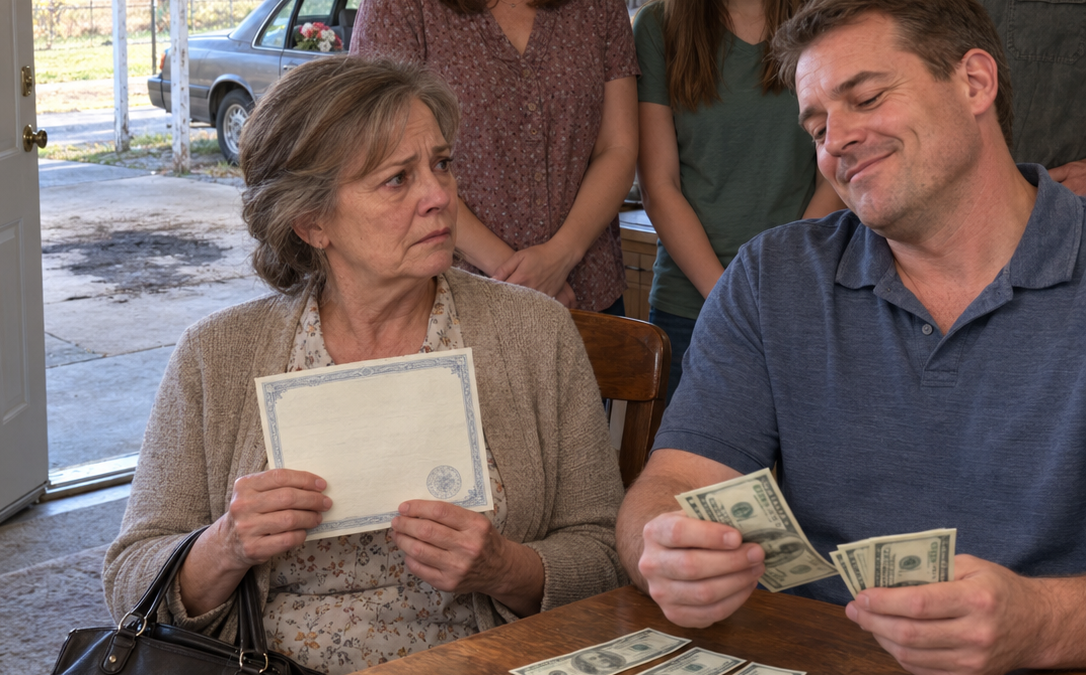
Josh sat at my kitchen table, counting hundred-dollar bills in front of Mallory, Reagan, and our neighbor.
“One hundred. Two hundred. Three hundred.”
He kept going until he reached nine hundred, then spread the bills where we could see them.
Josh looked up at me and grinned.
“That pile of rust was hogging my parking spot. Bobby’s not coming back.”
My fingers tightened around my car keys.
I had just come from my husband’s grave.
The neighbor stopped lifting his coffee cup.
Reagan stood beside the refrigerator with her arms pressed against her stomach.
Mallory had a dish towel in her hands.
Nobody said Bobby’s name after Josh did.
I put my keys in the little dish beside the door.
They missed the bottom and struck the rim.
Josh tapped the edge of the money straight against the table.
“Got somebody to haul it away,” he said.
For a few seconds, I couldn’t get my mouth to work.
That morning, I had stood beside the Ford before leaving.
The sea-foam paint had looked pale under the carport roof.
Bobby had bought that truck in 1979.
He used to come through this door with grease along his thumb and ask what was for supper.
Now there was cash beside the place where he used to eat.
“You sold Bobby’s truck,” I said.
Josh leaned back in the chair.
“Jeanette, you weren’t driving it.”
Reagan looked at me.
I could see that Reagan had been waiting for me to come home.
Her cheeks were red, and the skin beneath her nose looked sore.
I wanted to go to Reagan, but Josh was still talking.
“You ought to thank me for getting something out of it.”
Our neighbor lowered his cup onto the table.
The little click made Josh glance his way.
“Old vehicles are a headache,” Josh said.
The neighbor looked toward the back door without answering.
I walked to the kitchen window.
From there, I could see the empty space beneath the roof.
There should have been a rounded green hood beyond the glass.
Instead, I saw the concrete clear through to the yard.
My face burned.
I had spent part of that afternoon telling Bobby about our granddaughter.
Reagan would turn sixteen on November 7.
I had told him that standing beside his stone, with October wind pushing my coat open.
Josh had been here selling the truck.
Behind me, a chair leg bumped the table.
I turned.
Josh was gathering the bills into a stack again.
Mallory stood near the sink, twisting the towel.
My daughter had lived under this roof with Josh and Reagan since April of the previous year.
I had never asked them for rent.
I hadn’t expected to come home and find Josh selling what was here.
“Was it gone before I got back from the cemetery?” I said.
“Well, obviously,” Josh said.
The neighbor looked down into his cup.
I hated that I felt embarrassed in my own kitchen.
Josh had done this, yet I was the one standing there with burning cheeks.
Reagan moved away from the refrigerator.
For a second, I thought Reagan would come stand beside me.
Instead, Reagan halted at the corner of the kitchen table and stared at the money.
Josh put his palm over the stack.
“Don’t start,” he said.
I stepped closer.
“Who bought it?”
Josh gave a short laugh.
“Doesn’t matter, he’s gone, it’s done.”
Mallory stared at the sink.
Reagan ran to her room crying.
Her bedroom door shut down the hall.
I took one step after Reagan, then stopped.
I needed a name before Josh put that money away.
“Tell me where the truck went,” I said.
Josh shook his head.
“You’re making this into something.”
The neighbor pushed his chair back and stood.
“I’d better get home,” he said.
Josh lifted a hand without looking at him.
I stayed beside the table while the back door opened and closed.
Mallory laid the towel beside the faucet.
“Josh,” Mallory said.
“What?”
Mallory didn’t answer.
I slipped my hand into my brown purse.
My fingertips found the zipper of the inside pocket.
Beneath it was the folded title.
I knew that paper by touch.
I had carried it there since May.
My hand stopped shaking enough for me to feel the crease.
Josh watched my face.
He had counted out the money in front of witnesses.
He had told me the truck was gone.
Yet he hadn’t asked me for a single thing.
I looked at his hand resting on those bills.
He didn’t know where the paper was.
He hadn’t even thought to look.
“Is that so,” I said.
Josh nodded toward the carport.
“That space has been wasted long enough.”
I took my phone from the main compartment of my purse.
Josh moved his palm off the money to pick up his cup.
I pointed the camera down.
Nine hundred-dollar bills lay on my kitchen table.
I took the picture.
“What are you doing?” Josh said.
I checked that the money was clear in the photograph.
Then the phone went back in my coat pocket.
Mallory looked from Josh to me.
I could still hear Reagan crying through the bedroom door.
My chest hurt, and I was angry enough that speaking felt dangerous.
I closed my purse and held it against my side.
Josh settled back in Bobby’s chair.
“You’ll get over it, Jeanette.”
He thought the truck leaving my driveway had settled the matter.
The title to that truck was in my purse, in my name.
Josh had sold a truck he couldn’t sign for.
Picking up where the Facebook post left off
Part 2 of 7
The boat trailer rattled beneath my bedroom window that Saturday night.
I pushed the curtain aside and watched Josh guide it under the carport.
His bass boat covered the oil stain Bobby’s Ford had left behind.
“Finally got a garage.”
Josh said it loudly enough for me to hear through the glass.
I let the curtain fall.
My anniversary carnations were still on the passenger seat of my car.
I had forgotten to bring them inside.
For a while, I stood in the bedroom without turning on the light.
I was afraid that if I went outside, I would start yelling.
I didn’t want Reagan hearing me lose control.
A soft knock came at the door.
“Grandma?”
“Come in.”
Reagan stepped inside with her phone held against her chest.
Her face was washed, but her eyelids were swollen.
“I found something,” Reagan said.
I switched on the bedside lamp.
“Show me.”
Reagan sat on the edge of the bed and turned the screen toward me.
At the top was Josh’s name and a picture of Bobby’s truck.
The Ford was parked under my carport.
I recognized the little crack in the concrete beside the front tire.
Josh had stood in my driveway and taken that picture.
Under his name was the date.
Saturday, October 3, 2026.
I put on my reading glasses.
“1971 Ford, runs, $900 cash, must be gone by the 17th.”
My stomach tightened.
October 3.
Josh had put Bobby’s truck up for sale two weeks before our anniversary.
Today hadn’t been a sudden offer from somebody passing through.
There had been a picture, a price, and a deadline.
Reagan touched the bottom of the screen.
“There’s a name.”
Below the listing was a question.
“Still available? — Terry Qualls.”
I leaned closer.
The name meant nothing to me.
But it was more than Josh had given me in the kitchen.
“Can you save this?” I said.
“I already did.”
Reagan showed me the image saved on her phone.
The date was visible.
So were Josh’s name, the price, and Terry’s question.
“Send it to me.”
My phone sounded inside my purse.
I opened the picture and made sure the whole listing had come through.
Then I set my phone beside the lamp.
“Did you ask Dad about it?” I said.
“No.”
“Good.”
Reagan looked down at her hands.
“Was Pop’s truck really only worth nine hundred dollars?”
“No.”
“How much?”
“About fourteen thousand.”
Reagan looked up sharply.
I felt sick saying it.
Josh sold boat trailers for a living.
He knew how to put a price on something he wanted to sell.
I couldn’t tell Reagan why he had chosen that price.
I could only show Reagan what Bobby had chosen.
“Come here,” I said.
My cedar chest stood at the foot of the bed.
I moved the folded blanket off the lid and opened it.
Reagan slid down from the mattress to sit beside me.
The smell of cedar rose from the chest.
I lifted out the folder I had kept there since probate.
My hands were steadier now.
There was something I could do besides stand in a room and hurt.
“Your Pop left a will,” I said.
Reagan watched me open the folder.
I found the part about the truck and held it beneath the lamp.
Then I read it aloud.
Bobby had left the 1971 Ford F-100 to Reagan on her sixteenth birthday.
He had named me executor and directed me to hold it until then.
Reagan didn’t move.
I lowered the page so Reagan could see it.
“The truck comes to me?” Reagan said.
“On your birthday.”
“November seventh?”
“Yes.”
Reagan pressed her lips together.
For a few seconds, I thought Reagan would start crying again.
Instead, Reagan touched the edge of the paper.
“Then Dad sold my birthday present.”
My throat tightened.
“He sold a truck he had no right to sell.”
“Does Mom know?”
“I haven’t shown your mama this.”
Reagan pulled her hand back.
“Can we get it?”
“We’re going to try.”
I wanted to promise more.
But I didn’t know where the Ford was, or whether Terry had bought it.
I couldn’t bring it home that night by wanting it badly enough.
Reagan stayed beside me while I put the will back in its folder.
I returned it to the cedar chest and shut the lid.
Then I took my phone into the kitchen.
The table was empty now.
Josh had taken the cash.
I sat in the chair nearest the back door, and Reagan sat beside me.
Outside, Josh pulled a cover across the boat.
Through the window, I could see his arms moving beneath the carport light.
I opened the listing Reagan had shown me and found Terry Qualls’s account.
My thumb rested over the message box.
“What if he didn’t buy it?” Reagan said.
“Then he can tell me that.”
I typed slowly.
“I am the owner on the title of the green Ford. Please call me.”
I added my phone number and sent the message.
Reagan leaned toward the screen.
We waited.
The refrigerator motor started.
Josh came through the back door carrying nothing, pleased with himself.
He looked at us sitting together.
“What are you two doing?”
“Talking,” I said.
Josh went down the hall.
I turned the phone facedown until his footsteps passed my bedroom.
Then I checked the screen.
There was no answer from Terry.
Reagan looked toward the hallway.
“Should I tell Mom what Pop wrote?”
“Not tonight.”
I brought my purse onto my lap and checked the inside zipper.
The folded title was still there, where I had carried it since May.
I left it in the pocket and closed the zipper.
Then I looked at Reagan.
“Not a word to anyone yet.”
Part 3 of 7
My phone rang Monday evening, October 19, beside my untouched supper.
The screen showed a number I didn’t know.
I answered with my brown purse hooked over the back of my chair.
“Mrs. Cagle?”
“Yes.”
“Terry Qualls. You sent me a message about that green truck.”
I pushed my plate away.
“Did you buy it?”
“Paid your son-in-law nine hundred dollars Saturday afternoon.”
My fingers tightened around the phone.
“Do you still have it?”
“Yes, ma’am. But I’ve got a problem.”
I stood and carried the phone down the hall.
My bedroom door was open.
I stepped inside and shut it.
“What happened?” I said.
“I took the paper he gave me to the Putnam County Clerk this morning.”
Terry paused.
“They wouldn’t take it.”
“What paper?”
“Handwritten bill of sale. He said the title would follow.”
I lowered myself onto the quilt.
The lamp was still turned toward the spot where Reagan had read Bobby’s will.
“The clerk wanted the original title,” Terry said.
“Did you call Josh?”
“More than once.”
“What did he tell you?”
“I can send you that, too.”
Terry sounded tired.
I had spent Sunday checking my phone while he had been waiting for a paper Josh couldn’t give him.
“Please send me what you’ve got,” I said.
“I’ll send pictures. Call me back when you’ve seen them.”
The call ended.
I stayed seated with the phone in my hand.
A message arrived, followed by another.
The first photograph showed a sheet of paper on a wooden table.
I enlarged the handwriting.
“$900, title to follow — Josh Spivey, owner.”
Owner.
Josh had written that beside his own name.
He hadn’t merely opened the carport and let somebody drive away.
He had put his claim on paper and taken the man’s money.
I saved the photograph.
The next image showed Terry’s messages to Josh.
Terry had asked about the title.
Josh’s answer was short.
“Title’s in the mail. Quit calling.”
My face grew hot.
My purse, with the title inside, had been hanging on the kitchen chair all evening.
I reached for my purse before remembering I had left it there.
I went straight down the hall and lifted it from the chair.
Mallory stood at the counter, rinsing a cup.
“Everything okay?” Mallory said.
“I need to finish a call.”
Mallory looked at the plate I hadn’t touched.
I carried my purse through the back door.
The porch light was on.
Beyond it, Josh’s covered boat sat where the Ford belonged.
I pulled a chair close to the house and called Terry.
“I got the photographs,” I said.
“That’s what he gave me.”
“I believe you.”
“Then whose truck did I buy?”
I opened my purse and put my fingers against the inside pocket.
“The title is in my name as executor of my husband’s estate.”
Terry didn’t answer right away.
“My husband left the truck to our granddaughter,” I said.
“Your son-in-law didn’t mention that.”
“Under the will, I hold it until her sixteenth birthday.”
“So he couldn’t sell it.”
“No.”
Terry breathed into the phone.
“I need a legal title or my nine hundred back.”
“I understand.”
“I didn’t know about any of this.”
“I know.”
I believed him.
He had gone to the clerk with the paper Josh gave him.
Now he had sent me the proof without trying to hide his part.
“Where is the truck?” I said.
“Locked in my barn in Overton County.”
“Is it safe there?”
“Yes, ma’am. Nobody’s driving it.”
I looked toward the carport.
For the first time since Saturday, I knew where Bobby’s Ford was.
I wanted to ask Terry for directions and go right then.
Before I could, Terry spoke.
“I leave for West Texas at dawn.”
“Tomorrow?”
“Yes. Welding job. I’ll be gone until November sixth.”
My hand pressed flat against my purse.
November 6 was the day before Reagan’s birthday.
“Can somebody let us into the barn?” I said.
“I’ve got it locked up. I’d rather handle this myself when I’m back.”
I couldn’t blame him for wanting to be there.
He had paid cash and been handed a useless bill of sale.
“Will you keep the truck there until then?” I said.
“I will.”
I checked the date on my phone.
“Can you bring it here Saturday, November seventh?”
“That work for you?”
“Yes. Four o’clock.”
“And my money?”
“You’ll get your nine hundred dollars back that day.”
I said it plainly.
Josh had taken the money.
I intended to make him return it.
Terry gave me his word that the Ford would stay locked up.
I gave him my address.
Before we hung up, I asked him to keep the paper and his messages.
“Already saved them,” Terry said.
I stayed on the porch long enough to save his number.
Then I went inside.
Reagan stood in the hallway.
“Was that him?” Reagan said.
“Yes.”
“Does he have Pop’s truck?”
“It’s safe in his barn.”
Reagan gripped the doorframe.
I explained about Texas and November 6.
Reagan listened without interrupting.
“Dad can’t get the title, can he?”
I held my purse closer.
“He won’t get it from me.”
There were nearly three weeks before Terry came back.
I couldn’t leave that purse on a kitchen chair anymore.
Reagan followed me to the calendar.
Under “Reagan’s party,” I wrote “Terry, 4 p.m.”
“Your daddy doesn’t know who’s coming to your birthday.”
Part 4 of 7
Josh carried borrowed folding tables into my backyard before Reagan’s sixteenth birthday.
I stood at the kitchen window with my purse over my shoulder.
He leaned a table against the fence and waved me outside.
“Come tell me where you want these.”
I stepped onto the porch.
“Ask Reagan. It’s her party.”
Josh pulled out his phone instead.
“I’m handling the setup.”
He called somebody about chairs while I stood there.
“The boat’s going to be the centerpiece,” he said.
I looked at the covered bass boat beneath my carport.
Bobby’s truck had been gone less than two weeks.
Josh was planning where guests would stand around the thing he’d put in its place.
“Put the cake table in the backyard,” I said when he finished.
“There’s more cover up here.”
“Reagan’s cake goes in the backyard.”
Josh shoved his phone into his pocket.
“Fine, Jeanette.”
That afternoon, he started hanging string lights beneath the carport roof.
Reagan came home from school and stopped beside me on the porch.
“What does his boat have to do with my birthday?” Reagan said.
“Nothing.”
“Then why’s he decorating it?”
“Ask your daddy.”
Reagan watched Josh climb down from the stepladder.
Then Reagan went inside without asking.
I followed, carrying my purse into the bedroom.
I had stopped leaving it on chairs.
At night, I kept it beside my bed.
When I went out for groceries, it went with me.
The title stayed in the zip pocket.
I knew Terry couldn’t return until November 6.
Knowing the date didn’t make the waiting easier.
A few days later, I found Bobby’s desk drawers pulled open.
I had gone into the living room to get my reading glasses.
The bottom drawer stuck out far enough to catch my skirt.
Bobby had kept envelopes there, along with instruction books and spare pens.
Now the envelopes lay crooked across the open drawer.
I hadn’t left them that way.
I pushed it shut.
Josh stood in the doorway with a glass of water.
“Where’d Bobby keep his papers?”
He said it casually, as if he’d asked where I kept the batteries.
“Somewhere safe.”
“What kind of answer is that?”
“The answer I’ve got.”
Josh took a drink.
“I was looking for something to write on.”
I pointed at the pad beside the telephone.
He glanced toward it, then walked away.
I waited until his footsteps reached the kitchen.
My hand was cold against the drawer handle.
He hadn’t said title.
I didn’t need him to.
I checked my purse before I went to bed.
The folded paper was still inside.
The next evening, Mallory asked Josh about the money.
I was putting clean plates into the cabinet.
Josh stood at the counter, eating from a bag of chips.
“Could we use some of that truck cash for Reagan’s party?” Mallory said.
Josh folded the top of the bag.
“It went to the light bill.”
Mallory looked toward me.
I kept my hand on the cabinet door.
Josh hadn’t handed me money for that bill.
I hadn’t asked him to pay it.
“The whole amount?” Mallory said.
“Bills aren’t cheap, Mallory.”
“I know. I just thought—”
“You want me to help around here, don’t you?”
Mallory picked up a plate from the drying rack.
“I’m asking about the party.”
“And I said I paid a bill.”
Josh left the kitchen.
Mallory slid the plate into the cabinet beside my hand.
I wanted to ask why believing him came so easily.
Instead, I moved aside and let Mallory finish.
I needed the money to still exist.
That night, Reagan knocked on my bedroom door.
I was sitting on the bed with the saved listing open on my phone.
Reagan came inside and shut the door.
“Grandma, the money’s in the boat.”
I put the phone down.
“Tell me what you saw.”
“Dad had an envelope out by the carport.”
“Did you see money?”
Reagan nodded.
“He opened it. There were hundred-dollar bills inside.”
My chest tightened.
“Then what?”
“He put it in the boat’s dry box.”
Reagan pointed through the wall toward the carport.
“I watched him tuck it down inside.”
“Did he see you?”
“I was at the kitchen window.”
I reached for Reagan’s hand.
“Don’t go looking in there.”
“I wasn’t going to take it.”
“I know. Leave it where it is.”
Reagan sat beside me.
“He told Mom it was gone.”
“I heard him.”
“Are you going to tell her?”
“Not tonight.”
I wanted Mallory to hear the truth while Josh was standing there.
I wanted him to answer for it.
Reagan stayed until the hallway went quiet.
Before leaving, Reagan checked the calendar on my dresser.
“Next Friday he gets back,” Reagan said.
“Yes.”
“And Saturday he brings it?”
“That’s the plan.”
By Friday, November 6, the folding tables were standing in the backyard.
Josh had left the stepladder beneath an unfinished row of lights.
I was wiping the kitchen counter when my phone sounded.
Terry’s name appeared.
“Back in Tennessee. See you at four.”
I read the message standing beside the sink.
Then I sent a short reply.
“We’ll be here.”
My hands started shaking.
After waiting that long, I had one more night to get through.
I put the phone in my purse and went outside.
Josh stood on the ladder, hanging the last lights.
He looked down as I passed beneath the carport roof.
“If that buyer ever comes around, you let me do the talking.”
Part 5 of 7
At 4:10 Saturday afternoon, Bobby’s green Ford rolled up my driveway.
Thirty guests had gathered for Reagan’s sixteenth birthday.
Terry Qualls was behind the wheel.
I recognized the truck before I could see his face.
Reagan stopped beside the cake table with a paper plate in her hand.
Josh came out from under the carport.
“What the hell is he doing here?”
I stepped off the porch with my purse and a folder.
“He came to settle something.”
Terry parked and shut off the engine.
For a second, nobody moved toward him.
“Some fella just pulled up and offered cash. I didn’t plan a thing.”
I took the printed listing from my folder and held it up.
“October third, Josh.”
His smile went away.
I read the words beneath the picture.
“1971 Ford, runs, $900 cash, must be gone by the 17th.”
A guest near the folding chairs lowered his cup.
“You put a deadline on it,” I said.
Josh reached toward the page.
I moved it out of his reach.
“That doesn’t mean anything.”
“It means you planned it.”
Terry stepped down from the cab.
He had a folded sheet in his shirt pocket.
Josh pointed at him.
“I never told anybody that truck was mine.”
Terry unfolded the bill of sale.
“You wrote it right here.”
Terry held the paper toward Josh, then turned it so the nearest guests could see.
“Josh Spivey, owner.”
My son-in-law looked toward Mallory.
Mallory stood near the porch steps.
Reagan put the unused plate on the cake table.
“I was just helping this family clean up,” Josh said.
Terry kept the paper in his hand.
“You took nine hundred dollars from me.”
“And you got a running truck.”
“One I couldn’t register.”
Josh spread his hands.
“Nobody said a word to me about paperwork.”
Terry took out his phone.
“I asked you about the title.”
Josh glanced toward the backyard.
People had come closer without speaking.
Terry found the messages and read his question about the missing title.
Then Terry read Josh’s answer.
“Title’s in the mail. Quit calling.”
My face felt hot.
I’d seen those words on my phone.
Hearing them in my driveway, beside Bobby’s truck, hurt differently.
Josh had made this man feel like a nuisance for asking for what he’d paid for.
“That’s enough,” Josh said.
“No,” I said.
Josh turned toward me.
“Jeanette said herself that truck needed to go.”
I opened the inside pocket of my purse.
My fingers caught briefly on the zipper.
I was shaking, and I didn’t try to hide it.
The title came out folded along the same crease I’d felt that first afternoon.
I opened it.
“Jeanette Cagle,” I read.
Josh stared at the paper.
“Executor.”
I held it where Josh could see my name.
“The title wasn’t in the mail.”
He reached out.
I pulled it back against my folder.
“You didn’t have permission to sell it.”
“Mallory’s his daughter.”
“Bobby left a will.”
Mallory moved down the porch steps.
I took the will from the folder and found the truck clause.
Then I read aloud the part leaving the Ford to Reagan on her sixteenth birthday.
I read that I was to hold it as executor until then.
Reagan covered her mouth.
I lowered the page.
“Today’s her birthday.”
Josh looked at the Ford, then at the boat beneath my carport.
Terry folded his bill of sale along its worn crease.
“The clerk told me I needed the original title,” Terry said.
He pointed toward the paper in my hand.
“You couldn’t give me that.”
Mallory came to stand beside the driveway.
“You told me Mama said yes. She was at Daddy’s grave.”
Josh’s jaw tightened.
“Don’t do this out here.”
“Where’s the money?” Mallory said.
“It went toward things.”
“You said the light bill.”
I looked at Josh.
“He gets his nine hundred back today.”
Josh didn’t answer.
“If he doesn’t, I’ll make a report.”
Reagan leaned close to Mallory and whispered.
“Mom, the envelope’s in the boat’s dry box. I saw him put it there.”
Mallory walked beneath the carport.
Josh stepped after Mallory.
“Leave my boat alone.”
Mallory kept going.
Reagan came to my side and took the folder so I could hold the title flat.
We watched Mallory lean into the boat and open the dry box.
Josh stopped beside the trailer.
Mallory lifted out the envelope.
My knees felt weak.
Until that envelope appeared, I’d been afraid he’d moved it.
Mallory opened the flap and looked inside.
Then Mallory carried it down the driveway to Terry.
“Hold out your hand,” Mallory said.
Terry did.
“One hundred.”
Mallory placed the first bill in his palm.
“Two hundred. Three hundred.”
Josh stood under the lights he’d hung for Reagan’s party.
Mallory kept counting.
“Four hundred. Five hundred. Six hundred.”
Nobody spoke over my daughter.
“Seven hundred. Eight hundred. Nine hundred.”
Terry checked the stack and nodded.
“That’s my money.”
Mallory folded the empty envelope.
I looked toward Reagan.
“Bring the folder to the cake table.”
Reagan walked beside me through the guests.
Terry followed with the truck keys.
I laid the title on the table, clear of the frosting and plates.
For weeks, I’d carried that paper against my side.
Now I smoothed it flat and picked up a pen.
Reagan stood close enough that our sleeves touched.
“Pop meant this for you,” I said.
“I know.”
I signed the title over to Reagan.
Terry put the keys beside my hand.
I set them on top of the signed paper.
Josh had followed us into the backyard.
He stopped across the table.
“Bobby’s truck was never yours to sell, Josh.”
Mallory came around the cake table.
My daughter pulled off her wedding ring and set it beside the cake.
“Go to your brother’s tonight.”
Part 6 of 7
“Reagan Spivey?” the clerk said across the counter.
It was Monday, November 9, and Reagan stood beside me in Putnam County.
The signed title and Bobby’s will lay in front of us.
“That’s me,” Reagan said.
The clerk checked the papers.
Reagan held the edge of my sleeve beneath the counter.
I could feel the pull whenever the clerk moved a page.
“Everything’s here,” the clerk said.
Reagan looked at me.
I nodded, but my throat was too tight to say anything.
Mallory had driven Terry home to Overton County in her car.
The Ford had stayed in my driveway.
Now Reagan was waiting for the paper that would put her own name on it.
The clerk issued the new title and passed it across the counter.
Reagan Spivey.
My granddaughter stared at the name.
“That’s really mine.”
“Yes,” I said.
Reagan held the paper by its edges.
Outside, I opened the folder I’d brought.
Reagan carefully slid the title inside.
“Can we put it somewhere safe?” Reagan said.
“We will.”
I carried the folder to my car.
Reagan walked close beside me, smiling without seeming to notice.
By Saturday, Josh had arranged to come get his boat.
Mallory told me that morning while I was rinsing breakfast dishes.
“He’s taking it to his brother’s in Sparta.”
“What time?”
“He didn’t say.”
Mallory stood at the counter with a cup of coffee.
The wedding ring hadn’t gone back on.
I dried my hands and looked out at the carport.
The string lights were still hanging.
I had left them alone.
That afternoon, Josh backed up to the boat trailer.
Mallory went onto the porch.
I stayed in the kitchen doorway.
Josh got out and looked toward the house.
“Where’s Reagan?”
“Inside,” Mallory said.
“Tell her I’m here.”
“Reagan knows.”
Josh stood there a few seconds.
Then he went back to the trailer.
Nobody came down the steps to help.
He had to back up again to line up the hitch.
After that, he crouched between the vehicle and the trailer.
Metal scraped against concrete.
Josh stood, wiped his palms on his pants, and glanced toward us.
“Could use somebody watching the lights.”
Mallory stayed on the porch.
I kept my hands at my waist.
Josh walked from the driver’s seat to the back of the trailer himself.
He checked the connection, then went around once more.
I had watched Bobby do chores in that driveway for years.
If Bobby needed a hand, I gave him one.
This time, I stood still.
Josh climbed into the driver’s seat and lowered the window.
“I’ll be back for the rest of my things.”
“Arrange it with me first,” Mallory said.
He looked past my daughter toward the doorway.
I didn’t offer another arrangement.
Josh pulled out slowly.
The boat passed beneath the lights and cleared the carport roof.
Mallory watched until the trailer reached the street.
Then my daughter came inside.
“Coffee?” I said.
Mallory nodded.
I poured it without asking anything else.
Later that afternoon, Mallory’s phone kept sounding on the kitchen table.
My daughter turned the screen down.
“Josh?” I said.
“Yes.”
“What does he want?”
“His brother wants the real version.”
I set a dish in the drying rack.
“Of what?”
“Why he had to leave.”
Mallory rubbed the spot where the ring had been.
“What did Josh tell him?”
“That we embarrassed him over an old truck.”
My face warmed, but I kept drying.
Mallory picked up the phone when it sounded again.
“The men’s group at church has heard about it, too.”
Some of those men had stood in my backyard.
They had heard Josh claim the Ford was his.
Mallory put the phone down.
“People at work have been asking me about Saturday.”
“What do you tell them?”
“What happened.”
I looked at my daughter.
Mallory didn’t apologize for Josh.
After a while, my daughter opened another message.
“His fishing buddies have stopped calling.”
“Did he say that?”
Mallory nodded.
“He wants to know who I’ve been talking to.”
“What did you say?”
“That I didn’t need to tell people who were standing right there.”
I left the dish towel beside the sink.
“I need to clean out the truck.”
Mallory looked toward the driveway.
“Go ahead. I’ll finish these.”
The Ford was back under the carport.
I opened the driver’s door and stood with my hand on the seat.
I had brought out a rag and a small bucket.
There was dust along the dashboard and grit in the floor mat.
I wiped the steering wheel, then worked around the gauges.
Bobby had rested his hand there.
I stopped for a minute.
I missed him so badly that I had to sit down.
The seat gave beneath me with the same familiar sound.
I leaned forward and cleaned the inside of the windshield.
When I lowered the sun visor, a folded piece of paper slipped against my wrist.
I caught it before it reached the floor.
Bobby’s handwriting was on it.
I put the rag in the bucket and opened the fold.
“For Reagan — check the oil every Sunday. Love, Pop.”
My eyes filled.
He had written it for Reagan to find in the driver’s seat.
I could hear him saying it, plain and serious, as if checking the oil mattered more than getting the truck.
I held the note against my knee until I could see clearly.
Then I folded it along Bobby’s crease and left it on the dashboard for Reagan.
My granddaughter came onto the porch.
“Grandma, what did you find?”
“Your Pop left you something.”
Part 7 of 7
“Easy on the brake,” I said, holding fresh carnations against my coat.
It was Sunday, November 15.
Reagan drove Bobby’s green Ford toward Cookeville City Cemetery on her learner’s permit.
“I know, Grandma.”
“I know you know.”
Reagan glanced at me, then returned her eyes to the road.
The folded note sat between us on the seat.
I had left it for Reagan the afternoon before.
Reagan had picked it up, seen Bobby’s handwriting, and asked to take it with us.
I hadn’t asked why.
At a stop sign, Reagan brought the truck to a careful halt.
I steadied the flowers against my knees.
“Was that better?”
“That was good.”
Reagan checked the road before pulling out.
I watched my granddaughter’s hands on the wheel.
Bobby’s hands had rested there for so much of our married life.
Now Reagan’s sleeves hung over the same worn places.
My throat tightened.
I looked through the windshield until I could speak normally.
“The entrance is up ahead.”
“I see it.”
Reagan slowed before the turn.
Inside the cemetery, the tires crunched along the lane.
Bobby’s stone stood ahead, beside the place where I had stood on our anniversary.
“Here?” Reagan said.
“A little farther.”
Reagan eased forward and parked where the truck bed faced the stone.
Then Reagan shut off the engine.
We sat without getting out.
“You did fine,” I said.
“I was scared I’d hit something.”
“You took your time.”
Reagan let go of the steering wheel.
The impressions of the seams showed across her palms.
I passed the carnations over while I opened my door.
The air was cold enough to make my eyes water.
Reagan came around the front of the Ford carrying the flowers and Bobby’s note.
I took the carnations and walked beside my granddaughter to the stone.
We bent down together.
I placed the fresh stems where Bobby’s name was carved.
Reagan brushed a leaf away from the base.
“Hi, Pop.”
I pressed my lips together.
Reagan unfolded the paper with care.
The corner fluttered in the wind, and Reagan held it down with a thumb.
“For Reagan,” Reagan read.
Then my granddaughter paused.
I waited.
“Check the oil every Sunday. Love, Pop.”
Reagan gave a little laugh.
“He knew I’d forget the oil.”
The laugh broke halfway through.
Reagan covered her face with the note still held in one hand.
I put my arm around my granddaughter’s shoulders.
For a while, Reagan cried against my coat.
I kept my hand on the back of her head.
There was nothing I needed to explain.
When Reagan stepped back, I took a tissue from my pocket.
“Sorry,” Reagan said.
“Here.”
Reagan wiped her cheeks and folded the note.
“It’s Sunday.”
“Yes.”
“Where’s the rag?”
“In the cab.”
Reagan looked toward the truck.
“We ought to check it.”
I nodded.
My granddaughter walked back to the Ford and reached inside for the hood release.
I took the clean rag from behind the seat.
By the time I came around, Reagan had the hood raised.
“Make sure it’s secure,” I said.
Reagan checked before letting go.
We stood beside the engine.
Bobby used to keep a rag ready when he checked the oil.
I held this one open the same way.
Reagan found the dipstick and pulled it free.
“Wipe it first?”
“Yes.”
I held the cloth while Reagan drew the metal through it.
Then Reagan slid the dipstick back into its tube.
“Push it down the whole way,” I said.
“Like that?”
“That’s it.”
Reagan pulled it out again and leaned close to the marks.
I bent beside my granddaughter.
The oil reached the full mark.
“Looks good,” I said.
Reagan nodded, but didn’t put it away yet.
Instead, Reagan looked over the side of the truck toward Bobby’s stone.
“Can we sit a minute?”
“Sure.”
I spread the rag beneath the dipstick while Reagan carried it to the back.
We lowered the tailgate.
Reagan sat, then patted the space close beside her.
“Right here, Grandma.”
I had been about to stand and let Reagan have a moment alone.
Instead, I sat where my granddaughter had asked.
Reagan moved closer until our shoulders touched.
The sun warmed my face, though my fingers were cold.
“I missed having someone save me a place,” I said.
My voice caught on the last word.
Reagan took my hand.
I leaned against my granddaughter and cried without trying to hide my face.
Reagan stayed beside me.
After a while, I wiped my cheeks with the tissue from my pocket.
Bobby’s note rested on Reagan’s knee.
The dipstick lay across the rag between us.
Reagan picked it up and held it toward the cold sunlight.
Then my granddaughter looked straight at the headstone.
“Right at the full mark, Pop.”
THE END
More stories
I gave my mom half my liver. At her recovery party, Dad toasted my sister for saving her and handed her Mom’s car keys in front of 40 guests.On Mother’s Day, my daughter toasted her mother-in-law as ‘the mom I never had’ in front of 20 guests, then gave her my mother’s pearls.My son sold his condo and pulled a moving truck into my driveway on my 68th birthday, in front of 25 neighbors. My street doesn’t allow anyone under 55.On Memorial Day my daughter gave my lake house’s 4 bedrooms to her in-laws and left my suitcase on the porch. She forgot what I kept in 2019.On Halloween, my neighbor sent his crew to rip out my wife’s wheelchair ramp in front of 70 trick-or-treating families. I spent 28 years enforcing the law he broke.At my daughter’s baby shower, my second wife gave my late wife’s rocking chair to her daughter in front of 30 guests. My daughter’s name is carved under the seat.
You Might Also Enjoy




