The Boxes She Opened
Original fiction.
Read the story from the beginning
Chapter 1: The Boxes She Opened
Rita had one of Amy’s shirts folded over her forearm when she heard the bathroom door open.
She should have put it back in the box. The thought came cleanly and too late.
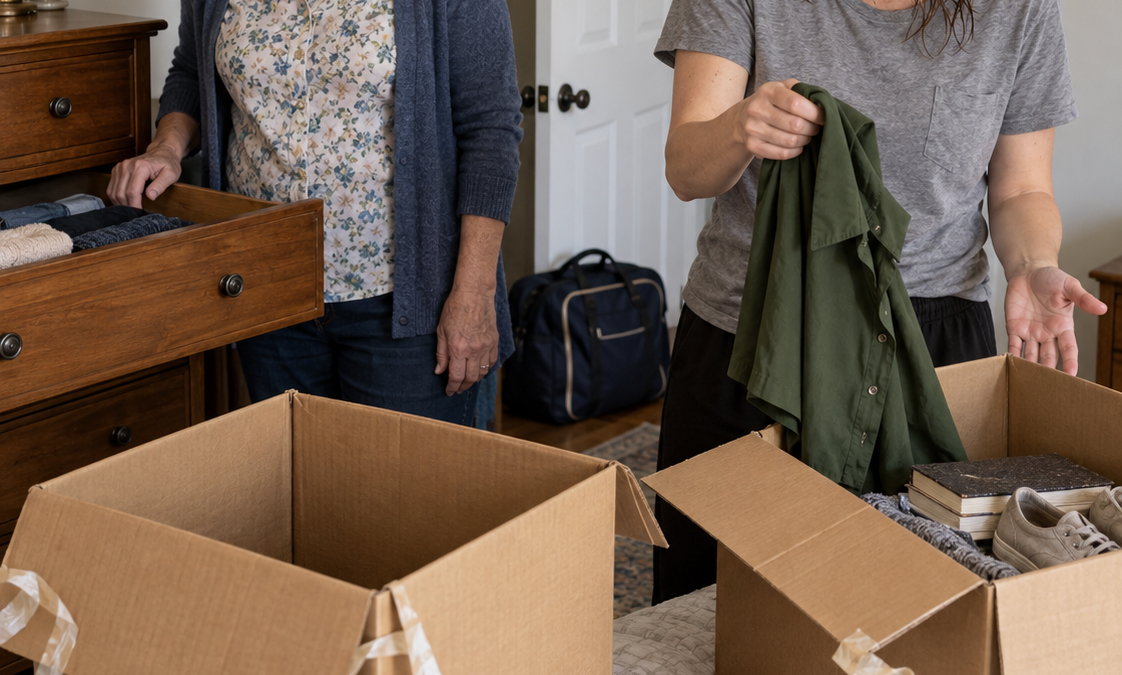
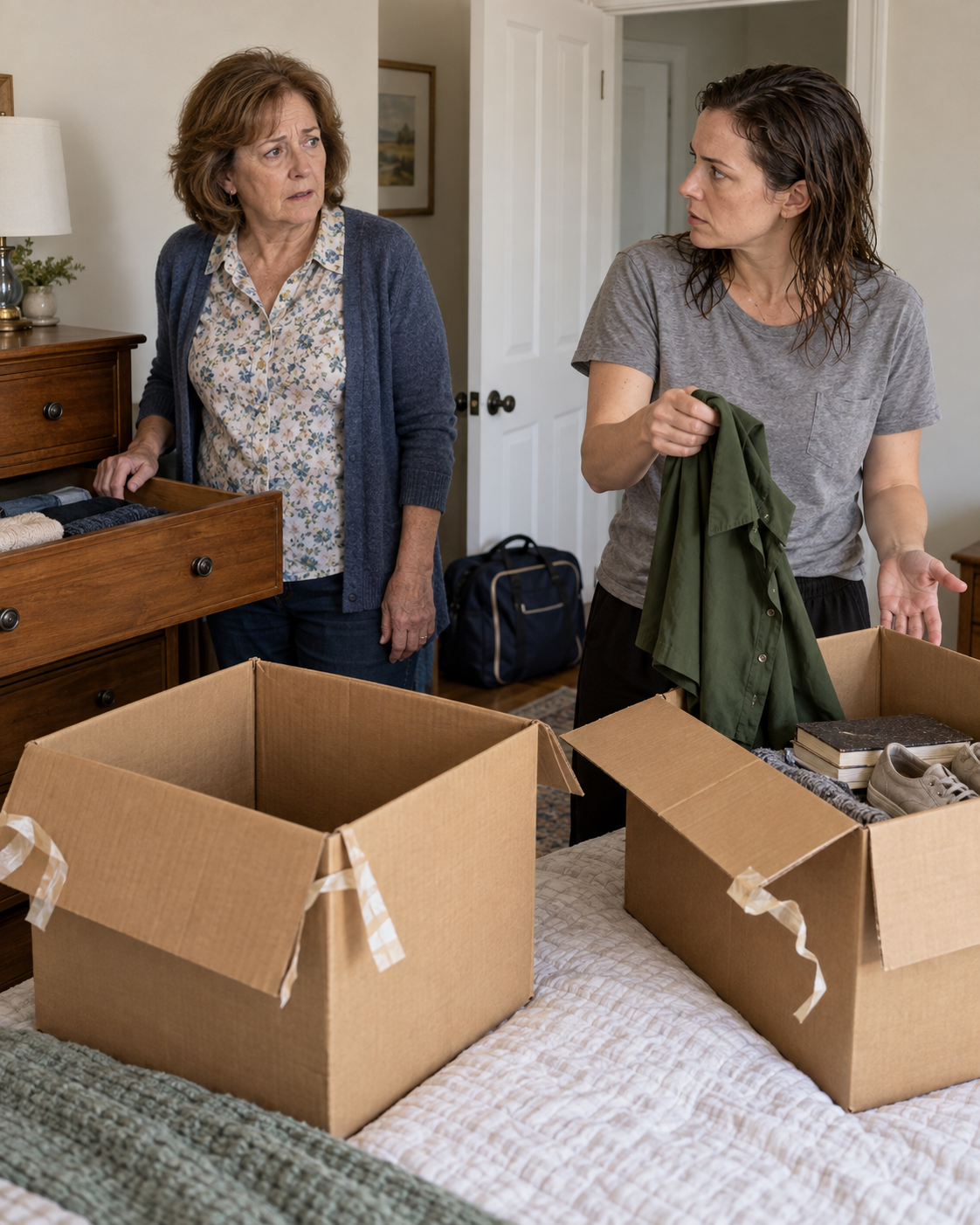
Instead, she slid open the second drawer of the guest-room dresser and laid the shirt on top of the stack she had already rebuilt there: jeans beneath, knit tops above, the green blouse Amy wore to work when she had a meeting. On the bed, two medium cardboard boxes sat open with their cut tape curled along the flaps. One was nearly empty. The other held only three books and a pair of shoes.
Amy appeared in the doorway with damp hair combed back from her face. She wore the black pants she had set aside for moving and a gray T-shirt. For a second she looked at Rita, then at the boxes.
Then she crossed the room, pulled open the dresser drawer, and lifted out the green blouse.
“What happened to the packing?”
Rita rested her hand on the drawer front. “I was straightening up.”
Amy looked at the opened box on the bed. “You were unpacking me.”
“There’s no reason to make it sound like that.”
“What should I call it?”
Rita glanced toward the hallway. The overnight bag was still by the guest-room door, zipped and ready. Amy had packed it before breakfast. Rita had watched her carry the two boxes from the room to the front hall, then watched her take a shower before the drive. She had waited until the water started running before cutting through the tape with the kitchen scissors.
There had been no confusion about what she was doing.
“I just think you’re rushing this,” Rita said.
Amy set the blouse on the bed. “The apartment is ready.”
“I know what you said.”
“I said I was moving today.”
“I know.”
The word landed harder than Rita intended. Amy’s face changed—not dramatically, not with tears or shouting. She simply stopped looking puzzled.
“So you knew,” she said.
Rita folded her arms. “Knowing the date doesn’t mean I think the date makes sense.”
Amy looked at the shelf where her books had been returned in a neat row. Rita had even arranged them by height without thinking about it. Seven weeks earlier that shelf had held two framed pictures and a ceramic bowl Rita never used. She had cleared it the afternoon Amy called and asked if the guest room was free for a while.
For seven weeks, Rita had not asked for rent. She cooked for two, listened when Amy wanted to talk, and learned not to question her the moment she came home from work.
Most weeknights Amy stood at the counter while Rita finished dinner, stealing a carrot slice from the cutting board. Later, one washed and the other dried while they talked about ordinary things—a broken copier, the neighbor’s loose dog, bad grocery-store tomatoes.
The house had sounded inhabited. Rita had stopped noticing when temporary began to feel normal.
Rita looked at the empty box instead of at her daughter.
“You’ve had a rough seven weeks,” she said. “You don’t have to prove anything by getting out fast.”
“I’m not proving anything.”
“You separated and came here because you needed somewhere to land. I’m saying you can stay until you know what you’re doing.”
Amy’s mouth tightened. “I do know what I’m doing today.”
“That place is small.”
“Yes.”
“And expensive for what it is.”
“I saw the amount before I paid it.”
“You’ll be there by yourself.”
Amy picked up one of the loose strips of tape from the bed and wound it around two fingers. “Mom, I’m not asking you to decide whether my separation is working. I’m not asking you to decide whether the apartment is a good enough answer to it.”
“I’m trying to keep you from making a second bad decision because the first one hurt.”
Amy’s eyes came up. “You don’t know that this is a bad decision.”
“I know you.”
“You know me. That’s different.”
Rita felt heat climb into her face. “I gave you a room. I’ve been here every night you wanted to talk. I’ve tried not to pry into things you clearly didn’t want to tell me. I have done everything I know how to do to make this easier.”
“I know.”
The quickness of the answer took some force out of Rita’s next sentence.
Amy put the tape on the dresser. “I know you did. I’m grateful. I’m not pretending the last seven weeks didn’t matter.”
“Then why is it such a crime for me to think you need a little more time?”
“Thinking it isn’t the problem.” Amy pointed at the boxes. “That is.”
Rita looked at them.
Four days ago, Amy had said in the kitchen, “The apartment’s ready. I’m moving Saturday. Can you help me with the boxes?”
Rita had said yes, then spent four days offering smaller delays: better weather next weekend, another week in the guest room, no need to rush while the separation was unsettled. None had changed the date.
This morning, with the taped boxes by the door, Rita had done something that could.
Amy waited.
Rita sat on the edge of the bed. The mattress dipped under her, making the nearly empty box tilt toward her knee.
“I knew you were leaving today,” she said.
Amy said nothing.
“I wanted you to stay longer.”
There it was. Smaller than all the reasons Rita had put around it, and more embarrassing because it was true.
She rubbed her palm over the cardboard flap. “I thought if you gave it another week, maybe you’d see there was no reason to hurry.”
“And if I didn’t?”
“I don’t know.”
“That’s the problem.” Amy’s voice stayed level, but it had gone tired. “You were going to make me argue my way back into a plan I already made.”
Rita almost said, I was only trying to help.
The sentence was ready. She had used versions of it all morning in her own head.
But the dresser drawer was open. Amy’s clothes were inside because Rita had put them there after Amy had packed them herself.
Amy lifted the empty clothes box from the bed and set it on the floor. Then she took the book box from the chair and placed it beside the first.
“I can put the bag in my car and go,” she said. “The boxes fit. I don’t need you to drive me or carry anything.”
Rita’s stomach tightened.
Amy continued, “But you said you’d help. If you still want to help, put my things back the way I had them.”
Rita looked toward the hall. “I can do that.”
“No debate about another week.”
“All right.”
“No asking for a key.”
Rita had, in fact, thought about asking for one. She felt caught even though she had never said it aloud.
“All right.”
“And I’m not promising Sunday dinner or Tuesday dinner or any other night right now.”
Rita pressed her lips together.
Amy waited again.
“All right,” Rita said.
“I packed the work clothes on the bottom, casual stuff on top. Shoes along the side. Books flat, not standing.”
Rita got up. “We’ll need new tape.”
“There’s a roll in the kitchen drawer.”
Rita brought it back with the dispenser and knelt by the first box.
Amy stayed in the room, but she did not supervise every movement. She picked up the overnight bag, checked the zipper, and carried it to the front hall. When she returned, Rita was taking the green blouse out of the dresser.
“Bottom?” Rita asked.
“Work clothes first.”
Rita placed it where Amy had told her.
She emptied the drawer one stack at a time. Her hands knew how to do useful things: fold sleeves inward, keep shoes from crushing fabric, fill a corner so nothing shifted. The trouble was not that Rita did not know how to help. The trouble was how easily she added instructions to the work.
“These shoes would be better in the other box,” she said automatically.
Amy leaned against the dresser. “I had them with the clothes.”
Rita held the shoes for a beat, then set them along the side of the clothes box.
“Right.”
The books were next. Rita took them off the shelf in the order she had arranged them and laid them flat as Amy requested. One paperback had a bent cover. Rita smoothed it with her thumb.
“You want this one?”
“Yes.”
Rita put it in.
By the time she pulled the tape across the second box, the room looked different. Not empty yet, but decided. The dresser drawers held only the spare blankets and an extra set of sheets Rita had kept there before Amy came. The shelf showed the lighter rectangle of dust where the books had sat.
Amy pressed down one box flap while Rita sealed it.
“Thank you,” she said.
The words did not restore anything. Rita noticed that and kept taping.
They carried the boxes to Amy’s sedan just before noon. Everything fit easily: two boxes in the back seat, overnight bag on the floor behind the passenger side. Rita could have stayed home and Amy still would have left.
Instead, Rita locked the front door and got into the passenger seat.
The drive was short. Rita knew the neighborhood from Amy’s photographs but had not been there before. She resisted commenting on the route.
The building was plain brick with a narrow parking lot. Rita noticed a railing that needed paint and a sagging gutter because noticing was effortless.
Amy parked, shut off the engine, and looked at her.
“Books first?” Rita asked.
“Clothes. The books are heavier.”
Rita nodded. “Clothes first.”
She carried the box up while Amy took the overnight bag. The apartment was on an upper floor reached by an indoor stairwell. By the time Rita stepped through the door, she was breathing harder than she wanted Amy to notice.
The place was modest, exactly as the photographs had suggested: a small living room, little kitchen counter space, a narrow window facing the parking lot, and one crooked blind.
Rita’s mind immediately began correcting it. The table would fit better against the other wall. Amy would need shelves. The blind could probably be fixed in ten minutes.
She set the box down by the wall.
“Here?”
Amy looked over. “Bedroom, please.”
Rita picked it back up.
In the bedroom, Amy pointed to a spot near the closet. Rita put the box there and left it closed.
When they returned for the books, Amy took one end and Rita took the other on the stairs. At the apartment door, Rita said, “Where do you want this?”
“Living room, under the window for now.”
Rita wanted to say the window might draft. She wanted to suggest opening the box immediately so the weight would not sit on the cardboard bottom. She wanted to ask whether Amy had eaten, whether she had enough towels, whether she had thought about what the first night alone might feel like.
She carried the box under the window.
“Want me to unpack any of it?”
“No. I’ll do it.”
“All right.”
Amy set her overnight bag near the bedroom door. For a moment neither of them moved.
Then Amy said, “I want tonight to myself.”
Rita looked toward the crooked blind. “I figured you might want help getting settled.”
“I wanted help carrying the boxes.”
Rita heard the distinction.
She picked up her purse from the floor. “I’m sorry I opened them.”
Amy looked at her.
Rita made herself stop there. No because. No I was worried. No you know I meant well.
After a moment, Amy said, “Okay.”
It was not forgiveness. It was not rejection either.
At the door, Amy thanked her for carrying the boxes. Rita said, “Call if you need something,” and hated how close the sentence came to sounding like an assignment.
Amy only nodded. “I’ll let you know.”
Rita walked down the stairs alone.
Back at home, she went into the guest room before she took off her shoes.
The second dresser drawer was empty except for the paper liner. She opened it all the way and then closed it. On the shelf, she found one paperback pushed behind the ceramic bowl she had moved out of Amy’s way seven weeks earlier. Rita recognized it as one Amy had packed in the book box before Rita unpacked it that morning. She must have missed it when she put everything back.
Her first impulse was to drive over with it. She could leave it at the door. She could bring the screwdriver for the blind too.
Rita stood with the paperback in her hand until the reasons ran out.
She put the book on the hall table instead.
Then she went to the kitchen and made dinner for one.
She took down the smaller skillet. That was the ordinary task that got her. For seven weeks she had reached automatically for the larger one. She set one plate on the table and almost set down a second before catching herself.
Her phone was beside the salt shaker.
At six twenty-three, it buzzed.
Made it through the first round of unpacking. I’m good for tonight.
Rita read the message twice.
She typed, Glad you’re settled. Then deleted settled.
Glad you made it in. Good night.
She sent that and put the phone face down.
She did not ask what Amy had unpacked or whether the building was quiet. She did not mention the book or drive back.
The house was too quiet. Rita ate at the kitchen table and let that be true without making Amy fix it.
A week passed before Amy invited her over.
“Come by Saturday around eleven if you want,” she said on the phone. “Just for a little while. I have errands after.”
Rita heard the limit in the invitation. She also heard the invitation.
At eleven the next Saturday, she climbed the same stairs with Amy’s paperback tucked under her arm.
The apartment looked more lived in but not transformed. Two mugs stood by the sink. A folded blanket rested on the arm of the chair. Some books were on the floor against the living-room wall because there was still no shelf for them. The crooked blind was still crooked.
Rita disliked that immediately.
Amy noticed where she was looking. “It works.”
“I didn’t say anything.”
“You made a face.”
Rita almost defended the face. Instead she held up the paperback.
“This was behind the bowl in the guest room.”
“Oh. I wondered where that went.”
Rita stepped farther inside. There was space on the end table beside the chair. There was also a stack of books on the floor near the wall, and Rita could already see how she would arrange them if Amy asked.
She did not walk toward either place.
“Where do you want it?” she asked.
Amy pointed. “On the floor with the others is fine.”
Rita set the paperback on top of the stack.
“You’re really going to leave them there?” she asked.
“For now.”
Rita looked at the stack, then at Amy.
“All right.”
Amy went into the kitchen and opened a cabinet. “Coffee?”
“Yes, please.”
They drank it at the small table. Amy talked about a problem with the copier at work. Rita told her the neighbor’s dog had escaped again and been found sitting three houses down like it had an appointment there. Amy laughed once, briefly, and Rita felt the old instinct to treat that sound as proof that everything was repaired.
She did not.
When the clock on the stove reached the time Amy had mentioned for her errands, Rita carried her mug to the sink.
“You can leave it,” Amy said.
Rita set the mug down where Amy had asked.
At the door, Rita could have asked about dinner, shelves, sleep, or the separation—anything that placed her in Amy’s next week.
She put on her coat instead.
“Thanks for the coffee,” she said.
“Thanks for bringing the book.”
Rita nodded and stepped into the hall.
Amy did not promise the apartment would work. Rita did not ask her to.
The door closed gently behind her, and Rita walked down the stairs with nothing arranged beyond that morning.
End of story.