At our Fourth of July cookout, my granddaughter asked why I’d stopped helping with nursing school. I’d sent $300 every month to the account her aunt set up.
Complete story · 7 parts · about 28 minutes · ending included
Part 1 · Part 2 · Part 3 · Part 4 · Part 5 · Part 6 · Part 7
Part 1 of 7
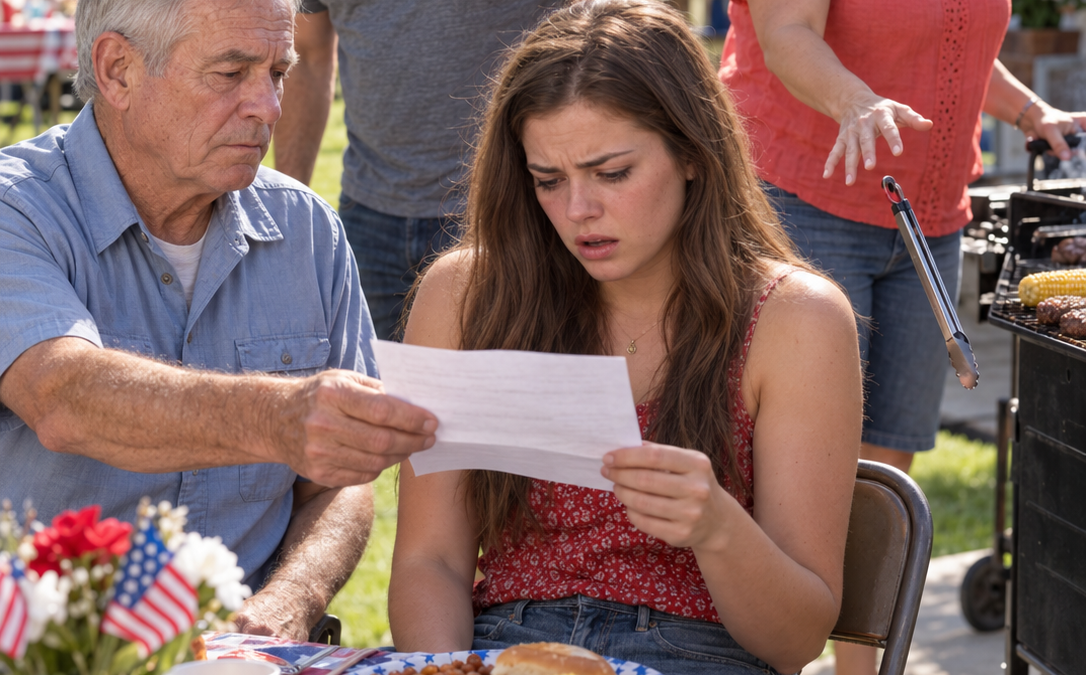
At 1:40 p.m., Macy set her plate beside mine at Clint’s folding table.
“Grandpa, why did you stop helping me with nursing school?”
My daughter Shelly turned from the grill, tongs still in her hand.
“Grandpa quit on you in January. Some men stop caring at seventy.”
Shelly made sure her words reached the far table.
There were twenty-five of us in Clint’s backyard that Saturday, July Fourth.
A fork stopped halfway to somebody’s mouth.
Macy stayed on her feet, looking at me.
My face burned.
“That’s not so,” I said.
I put my cup down before I spilled it.
“When did you hear that, Macy?”
“January. Aunt Shelly told me.”
I thought of the credit union envelope in my kitchen drawer.
It had come in June, between a utility bill and grocery coupons.
Shelly had said not to worry about it.
I had called my daughter because I didn’t understand the letter.
After Shelly’s answer, I had put it away with my statements.
Now Macy stood beside a plate she hadn’t touched.
January.
My granddaughter had believed I’d quit helping her since January.
I drew the chair next to mine back from the table.
Macy sat on the edge, keeping her knees turned toward the yard.
“Look at me,” I said.
Macy lifted her eyes.
I wanted to explain, but I needed that paper in my hand.
I could remember the envelope better than the words inside it.
That frightened me.
Shelly set a hamburger on a platter.
“Let’s get you something hot, Dad,” Shelly said.
“I have food.”
“You haven’t eaten.”
I looked down at my plate.
My hamburger was still there, the bun pressed flat beneath my thumb.
Across the table, Clint lowered his paper napkin.
My son looked from Macy to Shelly, then back to me.
“Anybody need ketchup?” Clint said.
Nobody answered.
Clint reached for the bottle anyway.
I knew that move.
My son wanted the cookout moving again, with people passing food instead of listening.
Shelly lifted the platter toward the tables.
“Come on, before these get cold,” Shelly said.
Chairs scraped against the patio.
Someone asked where the extra napkins were.
Macy picked up her fork, then laid it across her plate.
I watched my granddaughter fold the corner of a napkin.
At twenty, Macy was studying nursing in Ankeny and working weekends as a CNA.
I had wanted school to be something she could finish without debt.
Three hundred dollars a month was what I could manage.
I had arranged it while I was still working on diesel engines.
Retirement hadn’t changed what I wanted for Macy.
Shelly carried the platter past us.
“Macy, honey, there’s more food when you’re ready,” Shelly said.
Macy nodded without looking up.
Shelly’s hand settled on the back of my chair.
I felt the pressure through the plastic.
“Enjoy your lunch, Dad.”
Then Shelly went back toward the grill.
I had spent years finding problems by listening carefully.
A knock under a hood could tell me where to start.
Here, I had heard my daughter plainly, and I still couldn’t make sense of it.
I pushed my plate away.
Macy noticed.
“I wasn’t trying to ruin lunch,” Macy said.
“You didn’t.”
“I just wanted to ask you myself.”
“I’m glad you did.”
Macy’s mouth tightened.
I was hurt that my granddaughter had carried this for months.
I was angry with Shelly, too.
But I didn’t know enough yet to say what had happened.
A gust lifted the napkins near the mustard.
I pinned them beneath my cup and stood.
“I need some water,” I said.
Macy moved her chair so I could pass.
Inside Clint’s kitchen, the refrigerator hummed beside me.
The backyard voices came through the open screen door.
I stood at the sink and ran cold water over my fingers.
My hands were shaking.
I was seventy, and my daughter had used that number against me.
Shelly had made it sound like an explanation.
I dried my hands on a paper towel.
My wallet was in my back pocket.
My truck keys weren’t in the front one.
Clint had moved my pickup earlier so someone could get into the driveway.
I had told him to hang on to the keys.
Outside, Toni Brewer stood near the end of a folding table.
My niece held a cup but wasn’t drinking.
Toni looked toward the kitchen door when I stepped out.
“Uncle Arlen?”
“I’ll be back in a minute.”
Toni nodded and stayed where she was.
I wasn’t ready to ask anyone to explain anything.
First, I needed the letter.
Macy had left the table and was standing near the porch steps.
My granddaughter held the unfinished plate against her waist.
“Are you leaving?” Macy said.
“For a little while.”
“Because I asked?”
“No.”
I said it firmly enough that Macy stopped picking at the plate’s rim.
Then I lowered my voice.
“You asked me a fair question.”
Macy looked toward the grill.
Shelly was talking to a relative, smiling with the tongs raised.
“I didn’t know how else to ask,” Macy said.
“You did fine.”
Part of me wanted to stay right there with Macy.
The rest of me was already at the kitchen drawer back home.
I needed to see exactly what that June envelope said.
I could picture the folded sheet inside it.
I remembered smoothing it on the counter before I called Shelly.
I had kept the original.
I kept every paper about Macy’s school money in that drawer.
Clint came toward the porch carrying an empty serving bowl.
“Dad, you need something?”
“My keys.”
Clint stopped beside the bottom step.
“What’s wrong?”
“I have a credit union letter at home.”
Behind Clint, Shelly turned away from the grill.
My daughter’s smile faded when I said “credit union.”
I held out my hand.
“Clint, I need my truck keys for twenty minutes.”
Picking up where the Facebook post left off
Part 2 of 7
Clint dropped my truck keys into my hand beside the porch steps.
I had reached the pickup when Shelly came through the side gate.
My daughter still had the grill tongs.
“That fund ran dry paying her fall tuition. Don’t do this today.”
I stopped with the key against the door lock.
“Then what happened to the account?”
“That was my account, Dad. My name, my money.”
Shelly said it as if I had forgotten something simple.
I looked through the gate toward the folding tables.
Macy wasn’t where I could see her.
“I sent that money for school,” I said.
“And I handled it.”
Shelly lowered her voice when someone came around the garage.
“Get back inside the yard. Clint worked hard on this.”
“I’m going home.”
“Dad.”
I unlocked the pickup.
Shelly put a hand against the door before I could open it.
“You’re upsetting Macy.”
My fingers tightened around the keys.
“She asked me a question.”
“She’s tired. You know how students get.”
“Macy knew what she asked.”
Shelly took her hand away.
I opened the door and climbed in.
My daughter leaned toward the window before I started the engine.
“Leave the paperwork for another day.”
“I’ll be back.”
Shelly stepped away from the truck.
In the mirror, I saw my daughter watching as I pulled out.
I drove home through Newton with the radio off.
At a stop sign, I realized my jaw hurt from clenching it.
Shelly had given me different answers.
The fund was empty.
The account was hers.
And I was supposed to return to my hamburger.
I didn’t know what to believe yet.
But I knew what had left my own account.
At home, I went straight to the kitchen drawer.
I pulled it open so hard the contents slid forward.
My checkbook caught against a stack of envelopes.
I carried the papers to the table and brought out the rest.
The June credit union envelope was near the bottom.
My name showed through its window.
I had received it on June 3 and kept it right here.
The letter inside was dated June 2, 2026.
I flattened the fold beneath my palm.
The notice concerned my automatic transfer of $300 scheduled for June 1.
It hadn’t gone through.
The receiving share ended in 0417.
Farther down, the letter gave a reason.
The receiving share had been closed on May 28.
I put my finger beneath that date.
May.
Macy had said January.
I pulled a chair close and sat down.
My statements lay beside the envelope.
I sorted them by date, starting with September 2024.
There was the first transfer.
Three hundred dollars.
October showed the same amount.
So did November and December.
I took a pencil from the drawer and worked down the stack.
I marked the transfer lines, keeping the pages in order.
January 2025.
February.
The payments continued through the rest of that year.
Then I reached January 2026.
Three hundred dollars had left my account that month, too.
I pressed the pencil so hard the point broke.
I laid it down and kept counting with my finger.
February, March, April, May.
Twenty-one transfers.
Three hundred dollars each.
Six thousand three hundred dollars.
My bank records showed money leaving through May, months after Macy believed I’d stopped.
They didn’t show what happened after it arrived.
I couldn’t see tuition payments on these pages.
I couldn’t see a balance for Macy’s fund.
I had been checking my side and trusting Shelly with the rest.
My stomach tightened.
I looked for the paper we had signed when this started.
It was folded behind an older statement.
August 26, 2024.
Shelly had opened the account, and I had signed the monthly transfer form beside her.
My daughter’s handwriting filled the description line.
I recognized the way Shelly made a capital M.
I had seen it on birthday envelopes and grocery lists.
My signature sat below the instructions for the monthly payment.
I remembered sitting beside Shelly with a pen in my hand.
I had asked where to sign.
My daughter had turned the form toward me and pointed.
Now I set my copy beside the June notice.
I needed to know what Shelly had told me after that letter arrived.
My phone was in my shirt pocket.
I opened our messages and found June 4.
Shelly’s answer was still there.
My daughter had said the fund had moved to a better rate.
I had accepted that explanation in June.
I had planned to visit the branch after the holiday.
Today, Shelly had said the fund ran dry paying fall tuition.
I looked from the screen to my statements.
Why would an empty fund need a new account number?
I started to call my daughter.
Then I stopped with my thumb above Shelly’s name.
I had already heard what Shelly wanted me to do.
Leave the papers.
Come back to lunch.
I opened the camera instead.
The overhead light put a yellow patch across the letter.
I moved the pages nearer the window.
I photographed the notice, checking that the date and closing line were clear.
Then I photographed the statements in order.
I included each page with a transfer on it.
The 2024 form came last.
I kept its edges inside the picture so nothing would be cut off.
Then I saved a screenshot of Shelly’s June message.
My hands had steadied enough to hold the phone level.
I gathered the originals and slid them into the envelope.
The form stayed on top while I checked the photograph.
Under Shelly’s name, the description read “custodian for Macy Weber.”
On my phone, my daughter’s June 4 message said, “I moved Macy’s fund to a better rate. Send future transfers to my share ending 2290.”
Part 3 of 7
I handed Toni the June 2 letter behind Clint’s garage.
“Tell me what this account is.”
My niece held the page flat against the siding, out of the wind.
Toni worked as a paralegal at a family-law office in Des Moines.
I watched her finger follow the printed line.
“Shelly Kranz, Custodian for Macy Weber, Iowa UTMA,” Toni said.
Then Toni looked at me.
“This is a custodial account, Uncle Arlen. The money belongs to Macy.”
“Shelly said it was hers.”
“Shelly controls it as custodian. That doesn’t make it her money.”
I took out the transfer form and held it beside the notice.
Toni checked the handwriting, then returned to the letter.
“The receiving share was closed on May twenty-eighth,” Toni said.
“Could I have closed it?”
“No. You weren’t the custodian.”
“Macy?”
“Under this arrangement, Shelly controls it until Macy turns twenty-one.”
Toni tapped Shelly’s name.
“Only the custodian could close it.”
I leaned against the garage.
The siding was hot through my shirt.
I had signed that form beside my daughter.
I had thought I understood what I was signing.
“What about statements?” I said.
“They go to Shelly. Your statements show your transfers, not this account’s balance.”
That explained the stack I had brought.
I could prove what I sent.
Shelly had been the person who could see what remained.
From the yard, I heard my daughter offering someone another hamburger.
My face grew hot.
Toni lowered the page.
“Let me check something.”
My niece opened Shelly’s public page on her phone.
Toni moved through pictures while I held the papers against my chest.
Then her thumb stopped.
“What is it?” I said.
Toni turned the screen toward me.
Shelly stood beside a pontoon at a dealer.
My daughter had one hand on the railing, smiling at the camera.
Above the photograph was May 29.
Under it, Shelly had written, “Down payment DONE. Lake life!”
I looked at the closing date on the letter.
May 28.
“The next day,” I said.
“Yes.”
My mouth had gone dry.
I had spent the drive home wondering whether I’d misunderstood my daughter.
Now I was looking at a boat.
“Does that tell us where the money went?”
“It gives us something to ask about,” Toni said.
My niece saved the post with the date showing.
“We need the account records to trace the money.”
I wanted to walk straight to the grill.
My knees had already turned toward the corner of the garage.
Then I saw Macy near the cooler.
My granddaughter was trying to lift a water bottle from beneath the ice.
I gave Toni the envelope to hold and crossed the yard.
“Here,” I said.
I pulled the bottle free and handed it to Macy.
“Thanks, Grandpa.”
Macy closed the lid and stayed beside it.
There was room to sit, but neither of us did.
“How’s school?” I said.
Macy looked down at the bottle.
“I’m keeping up.”
I waited.
My granddaughter twisted the cap without opening it.
“I had to borrow for spring.”
“How much?”
“Twenty-five hundred.”
I felt sick.
“When?”
“January.”
The grill lid clanged behind us.
I kept my eyes on Macy.
“Through school?” I said.
“A private loan.”
My granddaughter said it quietly, as if borrowing had been something shameful.
“I work weekends as a CNA,” Macy said.
“I know.”
“I thought I could cover more than I did.”
Macy picked at the edge of the bottle label.
“Then there was tuition, and I still needed gas to get to work.”
I had wanted Macy studying, sleeping, and finishing school.
Instead, my granddaughter had been adding work hours and owing money.
“Why didn’t you call me?”
Macy’s eyes filled, but no tears fell.
“Aunt Shelly said bringing it up would embarrass you.”
I gripped the cooler handle.
“I thought you were done with me.”
Macy said it plainly.
That hurt worse than Shelly’s words at lunch.
My granddaughter had been wondering whether I still cared.
“You haven’t done anything wrong,” I said.
“I know you didn’t promise to pay for everything.”
“Macy.”
My granddaughter finally looked at me.
“I’m glad you asked today.”
Macy nodded, but her shoulders stayed tight.
I couldn’t repair months of hurt beside a cooler.
I could find out what had happened to the money.
Toni waited near the garage with my envelope beneath her arm.
I touched Macy’s shoulder before I went back.
My granddaughter kept the unopened water bottle against her chest.
Behind the garage, I took the papers from Toni.
“What can we do today?”
“The credit union is closed for the holiday,” Toni said.
“And the court?”
“Closed. Nothing can be filed until Monday.”
I looked at the letter again.
It was Saturday.
Shelly was still serving food, and Macy had a loan I hadn’t known existed.
Was I supposed to wait until Monday while Shelly kept telling that story?
Toni brought up a page on her phone.
“Iowa law lets the person who gave the money petition for an accounting.”
“What does that mean?”
“Asking a judge to require records showing what came in and where it went.”
“I can ask?”
“Yes. You’re the transferor.”
Toni pointed toward my statements.
“You have proof of your payments.”
My niece looked back at the screen.
“You can also ask for removal of the custodian.”
“Your office handles that?”
“An attorney there can file the petition Monday.”
I nodded.
I hadn’t wanted a court case.
I had wanted my granddaughter to finish nursing school without owing anybody.
From beyond the garage, Shelly called my name.
“Dad, are you coming back to the table?”
I folded the letter along its crease and put it in my shirt pocket.
The remaining papers stayed in the envelope, tucked under my arm.
Toni glanced toward the yard.
I held the packet closer.
“If Shelly says I quit again, I’m answering.”
Part 4 of 7
At 6:30 p.m., Shelly tapped a spoon against a drinking glass.
My daughter stood beside the grill holding a coffee can.
A paper label across the front read “Macy’s Nursing Fund.”
“I’ll pass this before the fireworks,” Shelly said.
My daughter turned the label toward the folding tables.
“We can give our future nurse a little help tonight.”
An uncle reached into his back pocket.
Farther down the table, a purse opened.
Macy sat with her hands beneath her thighs.
My granddaughter’s face had gone red.
Shelly set the can beside the serving platters.
“No pressure,” Shelly said. “Whatever you can spare.”
I felt the folded letter against my chest.
My daughter was asking the family for more money.
The papers under my arm showed what I had already sent.
Toni came up beside me.
“Can I see that June message?”
I handed over my phone with Shelly’s text open.
My niece checked the account number, then reached for her own phone.
“What are you looking for?” I said.
“The reunion chat.”
Toni moved away from the tables, and I followed toward the garage.
My niece searched the family messages while I watched the coffee can.
Shelly was straightening its paper label.
Then Toni held the screens side by side.
“Look at the last digits.”
Shelly’s June text asked for future transfers to share 2290.
In the family chat, my daughter had posted instructions for sending reunion dues.
The number ended in 2290.
Under those instructions, Shelly had called it her personal share.
“That’s the same account,” I said.
“Yes.”
“No new nursing fund.”
“The number Shelly gave you belongs to her personal account.”
I took my phone back.
My daughter had told me the fund had moved to a better rate.
Then Shelly had directed my next payments to herself.
I felt angry enough that I had to stop talking.
Toni saved the reunion message.
“Keep that with the June text,” I said.
My niece nodded.
From the patio, Clint motioned for me to come over.
My son stood near the back steps with a dish towel over his shoulder.
“Dad, can we talk?”
I followed him around the corner of the house.
Clint glanced at the envelope beneath my arm.
“You’ve been carrying that since you got back.”
“Yes.”
“What are you planning?”
“To straighten this out.”
Clint wiped his palms on the towel.
“Can you leave it alone today?”
“No.”
“People are here for the holiday.”
“Macy’s here, too.”
My son looked down at the grass.
I waited for Clint to answer.
Instead, he folded the towel lengthwise.
“I didn’t co-sign anything,” Clint said.
I stared at him.
“The loan?”
Clint nodded.
“I drove Macy to the bank in January. That’s all I did.”
“For twenty-five hundred dollars.”
“Yes.”
My throat tightened.
My son had sat in a car waiting while Macy borrowed money.
I had been sending money for the same semester.
“Why didn’t you call me?” I said.
“I thought I knew what was going on.”
“You could have asked.”
“I know that now.”
Clint looked toward the patio.
“I just don’t want this turning ugly in my backyard.”
I shifted the envelope to my other arm.
“Shelly will say my memory is going.”
My son stopped folding the towel.
“The family might believe her,” I said.
“Dad, nobody said—”
“Shelly brought up my age at lunch.”
Clint closed his mouth.
I could still hear my daughter saying seventy in front of the tables.
I was afraid of being dismissed before anyone looked at the dates.
I said that plainly.
“I need people to look at the papers.”
“Then show me.”
I eased the envelope open far enough for Clint to see the marked statements.
“These are transfers through May.”
My son looked at the pencil marks.
Then Clint looked away.
Behind us, someone called for help carrying food inside.
“I have to get that,” Clint said.
My son went through the kitchen door.
I put the statements back without handing them over.
I wasn’t leaving my originals on a counter.
When I returned to the yard, Toni was helping cover the serving dishes.
Macy carried a stack of used plates toward the trash.
My granddaughter passed the coffee can without looking at it.
I wanted the collection stopped before that label brought in another dollar.
I also wanted the letter ready when Shelly challenged me.
I checked the fold in my shirt pocket.
The date and account title would be easy to find.
Toni came back with a clean paper plate in her hand.
“Do you want something to eat?”
“No.”
“You should have some water.”
My niece set a bottle beside my chair.
I drank while relatives cleared the tables and carried out more chairs.
Through the kitchen door, I could see the clock.
It was nearly 7:40.
Shelly picked up the coffee can.
My daughter saw me watching and came toward my chair.
Toni stepped aside to let someone pass with a covered bowl.
Shelly bent toward my ear, lowering her voice for me alone.
“I never touched a dime of that money. Don’t embarrass yourself.”
My hand stopped on the bottle cap.
I looked up at my daughter.
“Then the papers should be easy to explain.”
Shelly’s eyes dropped to the envelope.
For a second, my daughter didn’t answer.
Then someone at the first table called her name.
Shelly straightened and smiled.
“I’m coming,” my daughter said.
Toni returned to my side.
My niece followed Shelly with her eyes.
“Uncle Arlen?”
I set the water down.
Shelly held the can out to the first table.
An uncle unfolded a fifty-dollar bill and dropped it through the opening.
I pushed my chair back.
“Pass it down,” Shelly said. “Let’s show Macy who she can count on.”
Part 5 of 7
At 7:45 p.m., I stood beside the grill in Clint’s backyard.
I took the June letter from my shirt pocket.
Macy looked up from the folding table as I handed it over.
Twenty-five relatives were still there.
Shelly held the coffee can against her hip.
My daughter had picked up the tongs beside the grill.
“Read the account title,” I said to Macy.
Shelly dropped the tongs on the patio.
The metal struck the concrete hard enough to turn heads.
“Dad, what are you doing?”
I kept my eyes on my granddaughter.
Macy unfolded the letter.
“Shelly Kranz, Custodian for Macy Weber, Iowa UTMA,” Macy said.
My granddaughter stopped and looked at Shelly.
“The closing date, too,” I said.
Macy found the line with her finger.
“The receiving share was closed on May twenty-eighth, 2026.”
Shelly shook her head.
“The credit union messed up, Dad. They closed it, not me.”
Toni stepped closer to the table.
“This was a custodial share,” my niece said. “Shelly controlled it.”
“You don’t work there,” Shelly said.
“The account title is printed on the notice.”
My daughter looked toward Clint.
My son stood beside the porch steps, still holding the dish towel.
“Clint, get Dad a chair,” Shelly said.
“I’m fine standing.”
I opened the envelope beneath my arm.
My fingers caught on the edge of the transfer form.
For a second, I couldn’t get it free.
Shelly watched my hand.
I laid the envelope down and eased the paper out without tearing it.
Then I spread the August 2024 form across the picnic table.
“That’s your handwriting,” I said.
My daughter didn’t move closer.
I pointed to the description.
“Shelly Kranz, custodian for Macy Weber, Iowa UTMA.”
Below it were the words Macy’s nursing fund.
Shelly tightened her hold on the can.
“I’m the custodian. I can spend it however I see fit.”
Macy lowered the letter.
“Then it wasn’t empty in January?”
Shelly looked past my granddaughter.
“We don’t need to discuss your school expenses in front of everyone.”
“You discussed them at lunch,” Macy said.
My granddaughter’s voice shook.
I wanted to put an arm around Macy, but Toni had my phone ready.
My niece held the screen where Shelly could see it.
“This is the message you sent Uncle Arlen on June fourth.”
Toni read it aloud.
“Got the letter? I moved Macy’s fund to a better rate.”
My daughter reached toward the phone.
Toni stepped back and finished.
“Send future transfers to my share ending 2290.”
An uncle leaned forward across the table.
“I thought you said Arlen stopped,” he said.
Shelly put the coffee can on the table.
“Dad gets confused about accounts.”
My face burned.
I had expected those words.
I still hated hearing them.
“The dates are on the papers,” I said.
Toni put my phone beside the transfer form.
Then my niece opened the saved post on her own screen.
“This was posted May twenty-ninth.”
Toni held up the photograph of Shelly beside the pontoon at the dealer.
“Down payment DONE. Lake life!”
Macy stared at the screen.
“The day after the account closed?” my granddaughter said.
“Yes,” Toni said.
Shelly reached for the coffee can again.
“You’re making accusations over a picture.”
“We’re asking for the records,” Toni said.
Toni lowered her arm, still holding the phone.
“Under Iowa law, custodial money can be spent only for Macy’s benefit.”
Shelly’s mouth tightened.
Toni continued in the same voice.
“The attorney at my office will file Monday for an accounting and your removal.”
“You’re taking me to court?” Shelly said.
“I’m asking where Macy’s money went,” I said.
My daughter looked around the tables.
Nobody offered Shelly a different subject.
Macy held the letter against her stomach.
My granddaughter’s eyes were wet, but Macy didn’t cry.
Clint set the dish towel on the porch railing.
My son walked toward Shelly and held out his hand.
“Give me the can.”
“Clint, this is for your daughter.”
He took it out of Shelly’s hands.
“You told me at Easter Dad quit, Shel. My girl took a loan.”
My son’s face had drained of color.
Shelly opened her mouth.
Clint turned away before my daughter could answer.
He took the fifty-dollar bill from the can and returned it to our uncle.
“Keep it,” my son said.
Clint checked inside, then tipped the empty opening toward the table.
The collection was over.
My granddaughter was still looking at the letter.
I moved beside Macy and pointed to the envelope.
“My statements are in there.”
Macy lifted her eyes.
“Through May?”
“Yes.”
My granddaughter’s chin trembled.
I had wanted to say more since lunch.
I had wanted to explain why I’d trusted Shelly.
Macy needed a plain answer.
“I never stopped, Macy. Not one month.”
My granddaughter caught my hand.
I held on while Macy pressed her lips together.
Across the table, Shelly picked up the transfer form by a corner.
I put my free hand over the page.
“That stays with me.”
My daughter released it.
Toni gathered the remaining papers into the envelope.
The boat photograph was still visible on my niece’s phone.
Shelly looked at the screen, then at me.
“You’ve made your point, Dad.”
“No.”
I put the form away while Macy kept the letter.
My daughter had heard about Monday.
Now Shelly needed to hear what I intended to ask for.
“You can pay it back, or explain it to a judge on the twenty-eighth.”
Part 6 of 7
On Monday, July 6, I set my papers on the attorney’s desk.
Macy sat beside me at Toni’s family-law office in Des Moines.
My niece placed a pen beside the petition.
“An accounting and removal of the custodian,” the attorney said.
I followed the lines with my finger.
My daughter’s name was on the page.
So was Macy’s.
I had brought the letter, transfer form, statements, and copies of Shelly’s messages.
The boat post was in the folder, too.
“Do I sign here?” I said.
The attorney turned the petition toward me.
“Yes. Then this form names Clint as the proposed successor custodian.”
I read my son’s name before I picked up the pen.
Macy watched me sign.
“Dad knows he has to keep the records?” my granddaughter said.
“We’ve discussed that,” Toni said.
My niece looked directly at Macy.
“You can ask for copies. You don’t have to rely on someone saying it’s handled.”
Macy rubbed a mark on the table with her thumb.
“I’d like copies.”
The attorney made a note.
I signed where I was shown and checked the pages before handing them back.
The petition was filed that Monday in Jasper County district court.
The hearing was set for Tuesday, July 28.
I had named that date at the cookout.
Now it was printed on the notice.
Outside the office, Macy stopped beside my pickup.
“Do I have to talk to Aunt Shelly?”
“Let the attorney handle the money,” I said.
My granddaughter nodded.
Macy looked tired enough that I offered to drive.
“I can drive, Grandpa.”
“I know you can.”
Macy handed me the keys anyway.
Before the hearing, Shelly sold the pontoon back.
I learned about the sale through the attorney.
My daughter didn’t call to tell me.
On Monday, July 20, Shelly came to the office with a cashier’s check.
I was sitting across from the attorney when my daughter entered.
Shelly held the check inside a plain envelope.
My daughter looked at me, then put it on the desk.
“Twenty-seven hundred,” Shelly said.
The attorney removed the check and checked the amount.
Shelly’s eyes stayed on the paper.
My daughter had handed it to the attorney, not to me.
I was glad of that.
I wanted a record showing exactly what had been returned.
The accounting showed $6,300 coming from my account.
Shelly had paid $3,600 toward Macy’s tuition.
Those payments covered fall 2024, spring 2025, and fall 2025.
The remaining $2,700 had gone toward the pontoon.
I sat with my palms flat on my knees.
The numbers matched.
I still felt sick seeing them written down.
My daughter had let Macy borrow while keeping my transfers coming.
“Will that settle it?” Shelly said.
“The replacement arrangements need to be completed,” the attorney said.
My daughter pressed the empty envelope between her fingers.
I didn’t offer to take it.
When Shelly left, I watched the office door close.
I hadn’t expected repayment to feel this bad.
At the credit union branch, Clint sat beside Macy.
My son had brought his identification and the papers for the new account.
I laid my monthly transfer form on the desk.
Three hundred dollars.
The same amount I had intended Macy to receive from the beginning.
Clint signed as custodian.
I checked the account title before I authorized anything.
My granddaughter’s name was there.
My son’s role was written beside it.
“Show me which account receives it,” I said.
The employee pointed to the number on the form.
I matched it to the new account paperwork.
Then I signed.
Clint arranged payment of Macy’s $2,500 loan from the returned money.
My granddaughter leaned forward while the details were checked.
“That pays it off?” Macy said.
“Yes,” Clint said.
My son kept the payment confirmation with the account papers.
Macy asked for a copy before we left the desk.
Clint handed it over.
My granddaughter held that page separately from the rest.
Outside, Macy stopped beneath the branch awning.
“I kept thinking I’d have to pick up more shifts.”
I could hear how tired my granddaughter was.
Clint looked at Macy’s payment confirmation.
“I should have called Grandpa in January,” my son said.
“Yes,” Macy said.
Clint didn’t try to soften it.
I sent the June letter to the family group chat.
The account title and closing date were clear in the photograph.
I added the page showing my transfers through May.
I didn’t write a long explanation.
The relatives had heard enough explanations at the cookout.
Messages came in while I sat at my kitchen table.
An uncle said someone else would handle reunion dues.
The updated instructions no longer listed Shelly’s personal account.
Then a relative posted the Thanksgiving planning list.
My daughter’s name had been removed as host.
Shelly didn’t answer in the chat while I watched.
I put my phone beside the drawer.
The originals were back inside, in date order.
Macy’s loan confirmation had its own place in the folder.
A few days into August, my granddaughter came to my kitchen.
Macy had her phone in hand before sitting down.
“Dad sent it.”
I pulled out the chair beside me.
“The account?”
Macy nodded and opened the attachment from Clint.
It was the first statement copy my son had sent.
My granddaughter enlarged the page, checking the name and the transaction line.
I waited while Macy moved the screen toward me.
On the statement beneath Macy’s name, the new entry read: “August 1. Transfer posted: $300.00.”
Part 7 of 7
On Saturday, August 15, I slid the drain pan beneath Macy’s car.
My granddaughter opened a box containing her new blood pressure cuff.
“Your arm next, Grandpa.”
“Let me get the oil draining.”
Macy set the box on my workbench and pulled a stool closer.
I loosened the drain plug, then moved out from beneath the car.
My granddaughter pointed to the seat.
“Sit.”
I wiped my forearm with a clean cloth.
Macy checked the cuff before wrapping it above my elbow.
“This one’s mine,” my granddaughter said.
“I figured.”
“I wanted one I could practice with.”
“And I was handy.”
“You were available.”
I sat still while the cuff tightened.
The garage door was open, and sunlight reached the front tires.
I could hear oil dripping into the pan.
Macy watched the display without talking.
My granddaughter looked serious enough that I kept my feet flat.
“One thirty-eight over eighty-two,” Macy said.
“Write it down.”
“I am.”
Macy entered the number, then looked at me.
“You need to cut back on salt.”
“I haven’t salted anything today.”
“It’s morning, Grandpa.”
I looked toward the car.
“The brakes need pads by winter.”
Macy glanced at the front wheel.
“How soon is by winter?”
“We’ll do them before it gets cold.”
My granddaughter loosened the cuff.
“I’ll put that in my planner, too.”
I rolled my sleeve down while Macy packed the equipment.
My granddaughter checked that the tubing wasn’t pinched beneath the lid.
I liked watching how carefully Macy handled things.
I had seen the same care in the way my granddaughter held the court papers.
Today, there was no shaking.
I went back to the car and checked the draining oil.
Macy crouched nearby, clear of the pan.
“What do you need?”
“The filter from that box.”
My granddaughter brought it over and waited while I finished underneath.
Then Macy carried the old filter to the tray I pointed out.
No fuss about dirty fingers.
I could work with that.
When I stood, my knees complained.
Macy moved the stool within reach without saying anything.
I sat long enough to fit the new filter in my hand.
My granddaughter leaned against the workbench.
The coffee can from Clint’s cookout sat beside her elbow.
It was full of bolts now.
The paper label still read “Macy’s Nursing Fund.”
Macy turned it until the words faced us.
“Dad brought this over?”
“Yes.”
“What did you tell him?”
“That I could use a can.”
My granddaughter lifted a bolt from the top and rolled it between her fingers.
Then Macy dropped it back.
The small clink sounded ordinary.
I was grateful for that.
I finished beneath the car, then opened a fresh bottle of oil.
Macy held the funnel while I poured.
My granddaughter watched the level instead of her phone.
When we were done, I checked the dipstick and closed the hood.
Macy set the empty bottles together near the bench.
“I brought my planner,” my granddaughter said.
“Brakes?”
“That, too.”
Macy opened it beside the cuff box.
The clinical schedule filled part of the page.
There were notes in the margins and marks beside things already finished.
My granddaughter found a space and wrote “Grandpa — August.”
I watched the pen stop after the month.
“What’s that for?”
“Your blood pressure. So I remember when we started.”
“I can remind you.”
“I know.”
Macy left the planner open.
My granddaughter stood close enough that our shoulders touched.
I looked at my name beside the clinical schedule.
Nobody had asked Macy to put me there.
“I hated having to prove I cared,” I said.
My granddaughter put down the pen.
For a few seconds, Macy didn’t speak.
Then my granddaughter laid a hand on my shoulder.
“I believe you, Grandpa.”
I tried to answer, but my throat closed.
Macy squeezed gently and stayed beside me.
I rested my hand over hers.
My granddaughter didn’t pull away from the grease near my knuckles.
I bent my head until I could speak without my voice breaking.
“Thank you.”
Macy moved the stool toward me with her foot.
I sat, and my granddaughter stayed close while I wiped my eyes with my sleeve.
The planner remained open on the bench.
After a while, Macy picked up the cuff box.
“Same time next month?”
“We can do that.”
“And the brakes before winter.”
“I’ll have the pads.”
My granddaughter closed the planner and reached for her stethoscope.
I wiped my hands on the rag.
Macy hung her stethoscope on the pegboard beside my wrenches.
THE END
More stories
At my son’s 40th birthday in a packed taproom, my daughter-in-law tied a server’s apron on me in front of 60 guests. She didn’t know I own the brewery.My son-in-law became HOA president and fined my rain barrels $4,800 in front of 90 neighbors. The clubhouse he runs meetings in sits on my land.At my retirement party, my son told 30 of my post office coworkers he’d bought my new house and I’d live over the garage. The tax bill has my name.My daughter-in-law charged my divorced daughter $650 a month to sleep in her old bedroom. At Easter brunch, I asked who pays the bills.At our 25th anniversary party, my husband toasted his office manager as ‘the woman who built my life’ before 80 guests. I said okay. His shop is on my land.At my granddaughter’s graduation party, my daughter-in-law told 40 guests I’d hand over my pension or go to a nursing home. She lives in my house.
You Might Also Enjoy




