My stepfather put a deed before my mother as 40 dinner guests applauded—Then a receipt from his own money clip made his notary close her pouch.
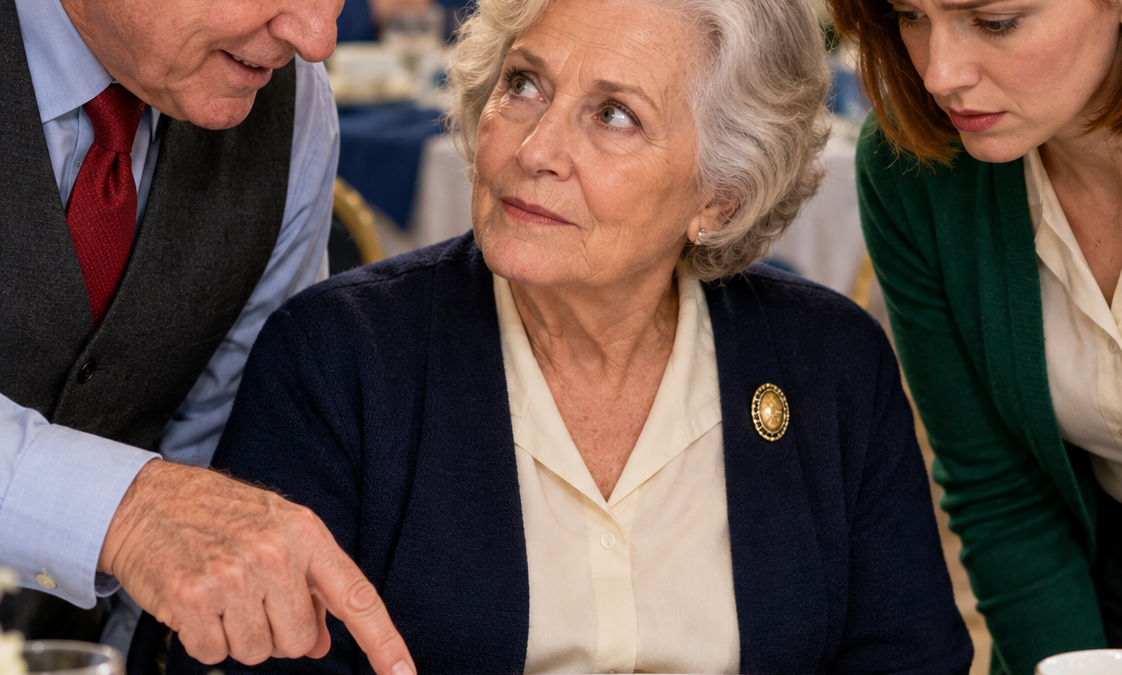
Complete story · 13 parts · about 53 minutes · ending included
Part 1 · Part 2 · Part 3 · Part 4 · Part 5 · Part 6 · Part 7 · Part 8 · Part 9 · Part 10 · Part 11 · Part 12 · Part 13
Part 1 of 13
“Her memory’s slipping, folks. Fifty-seven years she did the Sunday crossword in ink, and she hasn’t finished one since August. I’m the one holding it together now.”
Wayne Tolliver’s voice reached us before we cleared the diner doorway.
It was Sunday, September 27, a little after twelve fifteen. We’d come from the Lutheran service. Tara, my wife, was on my left, and our ten-year-old daughter, Kinsley, walked between us holding her colored bulletin.
Wayne sat at the long table near the back, cutting my mother’s meat into pieces small enough for a toddler. He held her plate steady with two fingers while he worked the knife.
Mom laid her fork across the rim.
She didn’t speak.
Shirley Boese leaned forward from the opposite side, her Sunday hat still pinned in place.
“Bless her heart.”
The two prayer-circle ladies nodded. One paused with her spoon halfway to her mouth, watching Wayne.
My mother was seventy-eight. She’d managed eighty acres east of Erie for decades. Wayne talked about her over a pork chop as though she weren’t sitting there.
Kinsley saw Grandma and started walking faster. I caught the back of her sweater gently enough that she barely slowed.
We stopped at the end of the table. All three of us stayed on our feet.
“Grandma, are we still doing our crossword this afternoon?” Kinsley asked. “I found a seven-letter word on the bulletin.”
Mom lifted her eyes to Kinsley. Her hand moved an inch toward the empty chair nearest her.
“Grandma’s tired, sweet pea,” Wayne said.
“She can tell me,” Kinsley answered.
Tara rested her palm between Kinsley’s shoulders. Lunch orders rang out behind us, but the ladies had stopped eating.
Wayne put down his knife and rose from his chair. He straightened his jacket, then planted one hand on my shoulder.
He gave Shirley a smile that included everyone at the table.
“Don’t take it personal, Craig. Some Sundays she doesn’t know you came. I do the remembering for both of us now.”
His thumb pressed once into the seam of my good shirt.
“Copy that,” I said, the way I answered the county radio twenty times a shift.
Wayne let his hand fall. He sat back down, settled his napkin on his knee, and addressed the women as if he’d been interrupted by a waitress.
“I nursed my Bonnie to the end in Iola. I know the signs.”
Shirley patted his hand. “You’ve been such a blessing to Joan.”
My mother picked up her fork. She nudged one piece of meat away from the others and looked at Kinsley.
“I saved you the Sunday puzzle,” Mom said. “It’s at home.”
Kinsley’s bulletin bent in her fist.
Wayne reached for his coffee. His key ring lay near the saucer, with my mother’s car key hanging from the same metal loop as his pickup key.
Since August, every time I’d offered to bring Mom anywhere, Wayne had said, “I’ll drive you, honey.”
He’d said it to her, though I was the one who’d asked.
Mom had married him two Novembers ago. She still used Lindholm as her last name, and the home place remained in her name alone. Her parents had given her the house and eighty acres when I was twelve. Harold Lindholm, my dad, had farmed that ground until he died.
Nobody in our family needed a courthouse search to know who owned it.
I watched Wayne move the keys farther from Mom’s plate when the waitress came to collect dishes.
“We’ll see you later,” Tara said.
Mom tipped her chin to her granddaughter. “Bring your pencil anyway.”
“Ink,” Kinsley said. “You always say ink.”
“Then bring a pen.”
Kinsley broke into a grin and held it until we reached the stools at the counter, where she climbed onto the middle one and flattened her bulletin under both elbows.
Tara sat on her other side. I chose the end stool, with a view of the register.
The waitress brought menus. Kinsley opened hers without looking at the pictures, then asked whether she could order toast instead of lunch.
“You can have half my sandwich,” Tara said.
“I’m not hungry.”
“You don’t have to finish it.”
I ordered coffee. When the waitress set it down, I adjusted the cup by its handle and left it there.
Behind us, Wayne was telling Shirley something about appointments. I could hear his voice, pleasant and steady, but not Mom’s.
I sat with my back to her table, fifty years old and her only son.
The register rang.
Wayne had come up to pay for his table. Mom waited a few steps behind him, her purse hooked over her forearm. He counted bills from a silver money clip and handed them to the cashier.
He saved every receipt in the clip until month’s end, then entered the amounts in a ledger, a habit from his crop-insurance days.
As he pressed the clip shut, a small white receipt came loose and dropped near the base of the register.
Wayne didn’t see it.
“All settled, Joanie, honey,” he said, offering my mother his elbow.
Mom needed no help walking. He guided her through the door anyway, his palm hovering an inch from her back.
Kinsley climbed off her stool and crouched in front of the register.
“Dad, it’s got Grandma’s name on it.”
She stood with the receipt pinched by one corner. The cashier was checking another customer’s bill.
I accepted it from Kinsley and read the print.
COTTONWOOD PHARMACY — IOLA, KS — SEP 01 — JOAN LINDHOLM — QTY 30 — CASH $11.80.
My mother had never used a pharmacy in Iola. She went to Prairie Drug in Chanute, where the pharmacist knew her by name.
I put the receipt behind my county ID in my wallet and said nothing. Outside the front glass, Wayne lifted two fingers off the steering wheel at me. I raised two back.
Wayne kept every receipt. He’d lost this one.
Part 2 of 13
“Your stepdad called me last night. Says you run that grader past their place every week to keep tabs on them. I’m moving your crew to the west district through November. Don’t make me write it up.”
The road supervisor sat behind his desk in the Neosho County Road & Bridge shop on East Fourth Street in Erie. By the clock above his filing cabinet, it was 6:50 on Monday, September 28. My shift had started twenty minutes earlier.
“Copy that,” I said.
He rubbed a thumb along the edge of a work order and didn’t look up.
I watched him square the corners against his blotter. He hadn’t asked why I drove that road. The county had assigned it to me, and I’d made that same run Friday.
In the equipment bay, I unhooked the east-route grader key from my belt. The brass tag had worn almost smooth. I hung it in the cabinet and closed the glass door.
By seven, my crew had a west-district assignment.
At noon I ate half a ham sandwich in my parked county truck and called the farmhouse. The phone rang four times before Wayne answered.
“Craig, son. What can I do for you?”
“I’d like to speak to Mom.”
“She’s napping. And son — Sunday visits get her mixed up. No more puzzles with the girl for a while.”
I looked at the sandwich on my knee. Kinsley had sharpened three pencils after breakfast Sunday so she could work the crossword with Grandma.
“Tell her I called.”
“Sure will. You get some rest yourself.”
He ended the call. I set my phone in the cup holder and finished lunch without tasting much of it.
That evening at our house in Erie, I pulled the receipt from behind my county ID and handed it to Tara. My wife had come home from her school nursing job, and her badge was still clipped to her sweater.
She flipped it over under the kitchen light.
“Maybe her doctor sends things there.”
I went to the refrigerator and lifted down the magnet Mom gave us last year. Her emergency numbers were printed on it in her careful handwriting: Dr. Mehta and Prairie Drug. Both were in Chanute.
No Iola.
Tara checked the names, then passed the receipt back. “You haven’t asked her about it.”
“Wayne picks up.”
“Then call when you know she’s alone.”
Kinsley’s spelling homework lay at the far end of the table. She’d written CROSSWORD across the top of a spare page and circled the letters she wanted to ask Grandma about.
“Our girl thinks she did something wrong,” Tara said.
I smoothed the receipt with my thumbnail. The paper curled again as soon as I let go.
“Put it away for tonight,” Tara said. “Please.”
I returned it to its place in my wallet, behind the county ID.
On Tuesday, September 29, I ran the grader along a gravel section-line road twenty miles from the home place. A school bus had left shallow ridges along the shoulder. I angled the moldboard and brought loose rock back toward the crown.
A field gate went past my right-side mirror, one hinge lower than the other. Dad would have spotted that before he looked at the house beyond it.
We buried Dad in March 2021. Mom met Wayne at a church potluck in April 2024. When I asked what she knew about his past, she said, “Don’t you dare run some background check on him.”
I obeyed. I hadn’t even typed his name into a search box.
At the next driveway I raised the blade, waited for a pickup to pass, and lowered it again. The road would hold until the next hard rain.
My phone lit up on the kitchen table at 5:40 that evening. The screen said PRAIRIE DRUG.
“Craig Lindholm?”
“Speaking.”
“This is Robin Kepley, the pharmacist at Prairie Drug in Chanute. You’re the second contact on your mother’s file. She listed you back when Harold was alive.”
I pulled a chair out but stayed standing. “Is Mom all right?”
“I called the house this morning. Wayne answered, so I only left a message asking Joan to call me.”
The refrigerator motor clicked off. I could hear someone speaking at the pharmacy counter on Robin’s end, then a door closing.
“Your stepfather came in yesterday,” she continued. “He wanted your mother’s sleeping pill eight days early. Said he ‘lost the bottle.’ I told him it was too early and insurance wouldn’t cover it. I did not fill that request.”
I gripped the chair back. “Have you spoken to her?”
“Not yet. I called Dr. Mehta. I can tell you what our own records show, since you’re her listed family contact.”
Robin’s voice became deliberate. “Prairie Drug filled the prescription four times. June sixteenth, July fourteenth, August eleventh, September eighth. Each pickup was signed W. Tolliver.”
With the phone in my left hand, I opened my wallet in my right and drew out the receipt. I flattened it against the table.
“Cottonwood Pharmacy, Iola. Her name. September first.”
Robin was quiet for a beat.
“I can’t talk about another pharmacy’s records, Mr. Lindholm. Her doctor can.”
The cash amount at the bottom was eleven dollars and eighty cents, with no insurer listed.
“Then bring that receipt too. Dr. Mehta wants to see your mother tomorrow at nine, and bring every bottle in that house, whichever pharmacy is on the label.”
She lowered her voice.
“Can you bring her yourself, just you?”
Part 3 of 13
Wayne’s pickup was gone when I reached the home place at 7:20 Wednesday morning, September 30.
Every week he drank coffee in Parsons with retired crop-insurance adjusters from seven until eleven. I had taken a vacation day, and I meant to have Mom home before he was.
Mom was at the kitchen table, a blue pen in her hand and Harold’s worn crossword dictionary within reach. Sunday’s puzzle lay flat beneath her palm. Only a few squares had letters.
She wrote 9/27 in the top right corner.
“Let me check my corners first,” she said.
Mom carried the newspaper to Harold’s rolltop desk. She opened the bottom drawer. From where I stood, I could see a thick stack of old Sunday pages inside. She set the newest one on top.
“With the others,” she said. “Nobody opens Harold’s desk but me.”
She shut the drawer and faced me.
“You didn’t come out here to inspect my crossword.”
“Dr. Mehta asked to see you.”
“Then I’ll go.”
“Robin said bring every bottle.”
Mom crossed to the kitchen cabinet. She checked each label before placing the medicine in her purse. I saw Prairie Drug in Chanute on some and Cottonwood Pharmacy in Iola on others. She looked over the shelf once more, then pulled the zipper closed herself.
“Did you tell Wayne?” she asked.
“No.”
“Good. I’d rather speak to the doctor without a running commentary.”
At nine, Mom sat across the desk from Dr. Mehta in Chanute. I took the chair at Mom’s right because she had asked me to stay.
I brought out the receipt from my wallet and handed it to Dr. Mehta. The doctor studied the Iola line at the top and returned it. I tucked it behind my county ID.
“Tell me about Iola,” Dr. Mehta said.
“I went once in August for my sinuses,” Mom answered. “Wayne did the talking.”
Dr. Mehta opened Mom’s chart. One by one, she copied the information from every label and counted the pills, writing each total beside the matching entry. Mom watched without interrupting, her purse open on her knees.
“The sleeping pill stops today,” the doctor said. “I’m canceling the rest of my refills and marking the Iola prescription discontinued.”
She sealed the bottles in a bag and gave it to Mom. “If the county asks for this, turn it over unopened.”
Mom passed the bag to me. “You hold it, Craig.”
I set it on the floor between my shoes, away from the legs of the desk.
Dr. Mehta printed a visit summary. One line read: “Discontinued — Iola walk-in Rx, filled 8/4, 9/1.”
Mom examined that line, folded the page once and stored it in her wallet. She fastened the clasp.
The doctor looked from Mom to me.
“I’m required to report this to the state.”
“Do what you’re required to do,” Mom said.
Before we left, Dr. Mehta called the Kansas Department for Children and Families from her office to make the report. I carried the bag out without opening it.
At 10:15, we entered Prairie Drug in Chanute. Robin Kepley, the pharmacist who had called me, came to the counter. Mom gave permission for her to show us the pickup records.
Robin angled her monitor so we could both see.
June 16. W. Tolliver.
July 14. W. Tolliver.
August 11. W. Tolliver.
September 8. W. Tolliver.
Four dates, each bearing the same signature. Mom’s eyes stayed on that column.
“I never signed for my own medicine?” Mom asked.
“Not on these four pickups,” Robin said.
Her fingers moved across the keyboard. She entered a note into the file while Mom watched: “no early fills; call the patient.”
I kept the bag in my hand until we were back in the truck, then placed it behind my seat. Mom fastened her seat belt and looked out at Main Street.
“Wayne’s not on my checking, if that’s what you’re thinking. Your dad said never put a man on your checking or your deed.”
“I remember.”
“Harold didn’t give advice twice.”
I had Mom back at the farmhouse by 10:45. Wayne’s pickup had not come home. She reached for the door handle, then paused.
“Let me talk to Wayne myself. Don’t you start anything.”
“I won’t.”
Mom got out, purse on her arm, and walked up the steps. I waited until she was inside, then drove away with the sealed bag in the truck.
By 12:30, I was at the Register of Deeds in the Neosho County courthouse in Erie. The clerk brought up the home place by its owner’s name and let me see the recorded documents.
The last transfer was dated 1988. Mom’s parents had deeded the farmhouse and eighty acres to Joan E. Lindholm. There was nothing later changing ownership.
I wrote the date in my pocket notebook, the same kind I used for road measurements. Then I closed it and went home.
At 6:15 that evening, someone knocked on my front door in Erie.
A Neosho County sheriff’s deputy stood on the porch, cap in one hand. His voice was polite and flat.
“Your stepfather called it in. Says you took his wife out of the house while he was gone and filled her head. It’s her house and she’s a grown woman, so this is a courtesy visit. But he wants it on record, and I’m quoting.”
“Tell the boy he’s done coming around.”
Part 4 of 13
“Craig Lindholm? This is Investigator April Ruhl with the Neosho County Sheriff’s Office.”
It was 8:10 Thursday morning, October 1. I stood at the utility sink in the Road & Bridge shop in Erie, my phone balanced on the metal shelf while water ran over my hands.
“The state sent our office a written report about your mother,” April said. “I also have the deputy’s note from your stepfather’s complaint Wednesday night.”
I shut off the faucet.
“I’d like you to come in and tell me what’s happened.”
“My lunch break’s at noon tomorrow.”
“That’ll work.”
After the call, I dried my hands on a shop towel. On the wall, the route board still showed my crew in the west district. Somebody had drawn a line through my old east-road assignment.
Friday, October 2, I went to the Sheriff’s Office in Erie at noon.
April waited until I sat down before she uncapped her pen.
I set a photocopy of the receipt in front of her and told her it had slipped out of Wayne’s money clip at the diner on Sunday. The original remained in my wallet, behind my county ID.
April studied the page without touching the bag I’d put on the corner of the desk. Dr. Mehta’s seal was intact.
“Start with the phone call,” she said.
“Tuesday. Five-forty in the evening. Robin Kepley, the pharmacist at Prairie Drug, called me. Wayne had asked for Mom’s sleeping pill eight days early. Said he’d lost the bottle. Robin turned him down and phoned Dr. Mehta.”
April wrote down the time.
“Wednesday I drove Mom to Chanute for a nine o’clock appointment. She brought every bottle from her kitchen cabinet, the Iola ones too. Dr. Mehta logged each label and count, stopped the pill, and packed them into this bag. The doctor told us she was reporting it all to the state.”
April moved the bag to her side of the desk.
“Afterward, we went to Prairie Drug. Robin showed us four pickup entries. June sixteenth, July fourteenth, August eleventh, September eighth. Every one signed W. Tolliver.”
“Did you receive those records?”
“No. I saw them on her screen.”
She wrote another line, then waited.
“I went to the Register of Deeds Wednesday afternoon. Nothing new had been recorded on the home place. The last deed was from 1988, when Mom’s parents gave it to her.”
April placed her pen across the legal pad.
“For the pharmacy records and the state prescription database, I need a search warrant signed by a judge. I’m starting that process. I can’t just ask a pharmacist to print out somebody’s information for me.”
“Understood.”
“The house is in her name only? Not his?”
“Hers alone. Wayne’s not on any of her accounts, either.”
She looked at the photocopy again. A dark stripe from the copier ran through the bottom margin; the name and amount were readable.
“Then the house is what he’s after. If paper shows up, I want to see it before anybody signs. And don’t confront him. Men like this speed up when they’re spooked.”
“Copy that.”
“Write everything down. Dates.”
I pulled my work-order notebook from my shirt pocket. Its columns were headed mileage, material, hours, and repairs. April shifted her pad aside to give me room.
On the first blank page I wrote Sunday, September 27. Diner in Chanute, 12:15 p.m. Wayne said Mom’s memory was slipping in front of Shirley Boese and the prayer-circle ladies. He answered for her when Kinsley asked about the crossword. The receipt fell at the register.
Under Sunday went Monday, September 28. The supervisor moved my crew west through November because Wayne had called him. At noon Wayne claimed Mom was napping and put an end to the puzzles with Kinsley.
I added Tuesday’s call from Robin, then Wednesday: Dr. Mehta, Prairie Drug, the Register of Deeds. I recorded the deputy’s visit to my house at 6:15 p.m., including the sentence Wayne wanted delivered.
The pencil left a shallow dent through the next page.
April kept the photocopy. The bag remained with her when I stood to leave. I put the notebook in my pocket and checked that the original receipt was still behind my ID.
That afternoon, I was back on the grader where the county had sent me. I worked the crown of a gravel stretch while an empty grain truck passed in the opposite lane.
Twenty miles east, the road in front of Mom’s farm belonged to another crew.
Monday, October 5, the Road & Bridge shop was already bright at 6:30 a.m.
The supervisor handed out the November work orders. I collected mine and went to the table where the foremen checked their assignments.
Beside me, the east-district foreman ran a finger down his work order, stopped halfway, and frowned.
“Isn’t this your mom’s road? Some land outfit wants three new entrances on the east line, after the twentieth. Survey flags are already up. Supervisor said keep it off your sheet.”
He flipped to the application stapled at the back.
Nothing had been flagged along that line on my last grader pass, Friday, September 25.
I held the page flat against the table with my thumb.
The foreman didn’t hurry me.
I knew every driveway along that road. I’d graded past the Lindholm mailbox for years, watching the same eighty acres through planting, harvest, and winter.
Now somebody wanted three ways in.
I started at the top.
“Culvert Installation Application.”
Dated 9/14.
Name: “Redbud Land Partners, LLC.”
Property Owner Signature: “Wayne D. Tolliver.”
In the margin, handwritten: “Install after Nov. 20 closing — 3 tracts.”
Wayne had already promised to sell Mom’s farm.
Part 5 of 13
Monday, October 5, the minute county offices opened, I called human resources from the Road & Bridge shop in Erie. I wanted my side on file before Wayne took his version any higher.
The November work orders were still spread across the table. I asked HR to log a family conflict of interest. A culvert application concerned Mom’s farm, and her husband had signed it as owner.
I gave HR my name, job title, and the date, making clear I wasn’t asking for the assignment. Wayne’s private call to the supervisor had already moved my crew elsewhere.
The east-district foreman walked past carrying his clipboard. The application was stapled to the back of his work order. I lowered my voice and finished with HR.
Afterward I entered the time in my work-order notebook. Underneath, I wrote COUNTY HR.
At eight that evening, the phone rang at home. Tara was rinsing Kinsley’s lunch container at the sink. I saw Wayne’s name on the screen and stepped into the hall.
“Craig, son.” His voice had the same easy sound it had at the diner. “You and that doctor sent the state into my kitchen this afternoon. I sat right there. I said, ‘She’s fine, aren’t you, Joanie?’ And Joanie told that lady herself — she’s fine.”
I’d spent that part of the day grading gravel out west. Until he called, I hadn’t known anyone from the state had visited the farm.
I gave him no answer. April had warned me that men like him speed up when they’re spooked.
When he hung up, I wrote 8:00 p.m. and recorded his words.
Tara appeared in the hall with a dish towel. I showed her the entry. She pressed her lips together and wound the towel tight around one hand.
Tuesday, October 6, I filed an open-records request with the county clerk in Erie, who maintained the county’s files. I asked for the September 14 Culvert Installation Application.
I included Redbud Land Partners, LLC, and the location of the home place. On my way out I watched the clerk place my request with the day’s incoming work.
Thursday, October 8, I picked up three copies at the courthouse.
The application matched the one the foreman had shown me. Wayne D. Tolliver had signed as property owner. The margin specified installation after the November 20 closing.
I put all three copies in a folder, then met April Ruhl at the Sheriff’s Office during lunch.
April took one copy while I pointed to Wayne’s signature, then slid the page into her case file.
“Hold onto it. If he learns you’ve seen it, he’ll find another way to get her name on something.”
“The county gave me three,” I said. “That one stays with you.”
I carried the remaining two out to my truck and locked both in the glove box.
Friday, October 9, Kinsley worked a school word puzzle at our kitchen table after supper. She left one answer blank and drew a question mark beside it. The eraser had worn a gray patch through the page. She used to save the hardest clues for Sunday afternoons.
On Saturday morning, October 10, I called Prairie Drug in Chanute. Robin Kepley answered. I told her my name and asked whether she’d heard from Mom.
“Joan came in yesterday with Wayne,” Robin said. “She signed to remove you as a contact. I’m sorry, Craig. I can’t discuss your mother with you anymore.”
I stayed on the line a moment.
“Thank you for telling me.”
I set the phone face down. On the refrigerator, Mom’s magnet still listed Prairie Drug in her own handwriting.
Sunday, October 11, we attended the Lutheran service in Chanute. Afterward, Tara and I stood at the back of the fellowship hall during coffee hour. Kinsley was with us when Wayne approached Shirley Boese and the other two prayer-circle ladies.
He carried a paper cup and spoke loudly enough for the closest tables.
“Pray for Joanie’s boy. He called the state on her — wants her in a home so he can get the farm early. Some nights she can’t remember Harold’s name.”
I held my cup by the rim. Eleven days earlier, Dad’s crossword dictionary had sat beside Mom’s blue pen on her kitchen table.
Tara watched Shirley reach into her handbag for the prayer list.
Shirley wrote my name carefully. She never glanced our way. One of the women moved her chair closer.
Wayne bent until his mouth was close to Shirley’s ear. He said something I couldn’t hear. Shirley looked up at him and drew a line across the bottom of the list.
Tara’s sleeve brushed mine as she stepped closer.
At two that afternoon, Kinsley and I walked up the farmhouse porch steps. She held a new crossword book flat against her chest with both arms.
Mom opened only the screen door. Wayne stood behind her inside the house. His hand was on the back of a chair.
“I brought this for our Sundays,” Kinsley said.
Mom looked at the book, then directly at me. She held the metal frame without opening the door any wider.
“Don’t come out here again until you can respect my husband.”
I kept quiet. Kinsley hugged the book tighter.
Mom shut the door. The latch clicked into place.
Kinsley followed me down into the yard. Both copies of the application were still in my truck’s glove box.
The crossword book stayed closed.
Part 6 of 13
Wednesday, October 14, our mail held a water bill, Kinsley’s school fundraiser, and grocery coupons.
Nothing from Wayne.
Tara returned from work with news that church families had received invitations to Mom and Wayne’s second-anniversary supper.
I checked the envelopes once more before putting them beside the telephone. Wayne had asked those church ladies to pray against me on Sunday. Now he was inviting them to supper.
Kinsley sat at the kitchen table with the crossword book she’d taken to the farm Sunday. It lay unopened beside her homework. A sharpened pencil rested across the cover.
“You can start one without Grandma,” Tara said.
“We do the hard ones together,” Kinsley answered.
She zipped the pencil into her pouch.
At the road shop Friday, October 16, I was checking a grader’s cutting edge when April Ruhl called at ten.
“The search warrant for the Iola records is waiting on a judge,” she said. “Until then, I can’t see a page of them.”
The air compressor started up at the far wall. I went into the empty parts room to hear her better.
“What about the visit from the state?”
“Your mother told the state she’s fine. I can’t make her a victim if she says she isn’t one.”
I looked through the glass at the equipment bay. A loose bolt lay on the floor under the grader, right where somebody could roll a tire over it.
“Wayne signed that county application,” I said.
“I have your copy. I’m keeping it with the report.”
“He’s still living in her house.”
“I know, Craig.”
April gave no date for the judge’s signature. I didn’t ask for one. When the call ended, I picked up the bolt and put it in the scrap bin.
The rest of my shift went to a shoulder repair west of Erie. We spread gravel beside a culvert where rain had eaten away the edge. I checked the grade with a folding rule and wrote the load totals in my notebook.
I parked the county truck in its assigned space at three. My figures were straight. So was the route sheet.
Tara went grocery shopping in Chanute on Saturday, October 17, while Kinsley and I stayed home in Erie.
By evening, the bags were unpacked and Kinsley had gone upstairs. Tara set an invitation on the table, beside the unopened crossword book.
“Shirley stopped my cart at the grocery store at ten this morning,” she said. “Right by the canned vegetables. She showed me this. I asked to bring it home.”
A thin gold border ran around the cream paper. I kept my hands flat on the table while Tara turned it toward me.
Wayne & Joan — Two Years — Saturday, November 7, 5:30 p.m., Fellowship Hall. Supper provided.
I’d stood at the back of that hall six days earlier, between the long tables and the serving window. I could picture Shirley at the far end, passing plates to the other ladies.
“Shirley said Wayne had been talking to her after church last Sunday,” Tara continued.
“What did he say?”
Tara put a finger against the edge of the invitation.
“She’s had a few good days. That’s when we’ll do the paperwork.”
Tara said it slowly, like a nurse reading back an order. I remembered Wayne leaning toward Shirley after he got my name onto the prayer list.
“Did Shirley know what paperwork?” I asked.
“She didn’t say. She thought he was being careful with your mom.”
Through the window over the sink I could see the dark shape of our truck in the driveway. Two copies of the culvert application were in its locked glove box. Mom still hadn’t seen either one.
Tara moved the invitation nearer the salt shaker. Then she rested both palms on the back of a chair.
“She chose him, Craig. Let it go before it costs you your mother for good.”
I started to speak, then ran my thumbnail along a nick in the tabletop. Kinsley had been standing beside me when Mom latched the screen door.
Tara went to check the back-door lock. I rinsed two coffee mugs and left them upside down in the dish rack. Neither of us turned the invitation over.
Kinsley brought her spelling homework to the table at two on Sunday, the hour she used to spend with Grandma. She asked Tara to check a word instead of calling the farm, as she’d done so many afternoons before. The phone remained on its hook.
When I returned to work Monday, the route board hadn’t changed: west district through November. I signed the sheet and went where the supervisor sent me. The east road wasn’t mine to grade.
I came home Tuesday, October 20, with dust along the cuffs of my work pants. At 4:05 p.m. my phone lit up on the kitchen counter.
Prairie Drug.
I answered before it could ring again.
“Craig?” Mom’s voice was low and steady. “Robin let me use her phone. My appointment’s at the beauty shop next door; Wayne’s at the feed store.”
I pressed the phone closer to my ear.
“I did the Sunday puzzle, Craig. Two Sundays running. In ink. Five in the morning, before he’s up.”
Mom paused. Behind her, a cash register chimed.
“Robin printed out her dates. I laid them next to Dr. Mehta’s paper. He told me the Iola pills were instead of hers. He picked up both, Craig. August and September. Both places. Wednesday he goes to Parsons. Come get me at seven.”
“I’ll bring something you need to see.”
Part 7 of 13
Mom was already coming down the farmhouse steps when I pulled in, her purse clasped shut and her coat over one arm.
“Wayne left for Parsons,” she said. “He’s back by eleven.”
Wednesday, October 21, I had the morning off. It was seven. Mom climbed into my truck without waiting for help.
Before I started the engine, I reached into the glove box. Two copies of the county culvert application lay there. I gave Mom one.
She followed the lines with a fingertip. Redbud Land Partners. Three entrances on the east line. November twentieth closing.
Then she reached the signature.
“He signed as the owner. Of my father’s land.”
Her thumb stayed beside Wayne’s name. After a moment, she creased the page.
“Did you get this through your job?” she asked.
“County clerk. Open-records request.”
“Good. That’s the proper way.”
She returned the application. I put it in the door pocket, leaving the spare where it was.
Prairie Drug opened at eight. Robin Kepley met us at the counter in Chanute. Mom set her purse on the shelf and asked for the contact form.
“Put Craig first,” she said. “Leave Wayne listed.”
Robin held her pen still.
“He checks things,” Mom explained. “If his name comes off, he’ll find out at this counter the next time he asks about me.”
“Your file, your decision,” Robin said.
Mom signed and asked Robin to keep the existing warning on her record.
“No early fills; call the patient,” Robin confirmed.
She printed the pickup log, four Prairie Drug dates with W. Tolliver beside each.
“Those are our records,” Robin said. “I can’t give you Cottonwood’s.”
“I know,” Mom answered.
On a sheet Robin supplied, Mom requested the record of her August fourth visit to the Iola walk-in clinic. She directed it to my Erie address and signed.
“Wayne empties our mailbox,” she said.
I folded the request for mailing.
At the Chanute post office, I sent it certified. The clerk handed me the tracking slip, and I put it in my notebook.
Back in the truck, I drew the original receipt from behind my county ID.
“This fell out of Wayne’s money clip at the diner register September twenty-seventh. Kinsley picked it up.”
Mom examined the print without speaking.
“Kinsley saw my name?”
“Yes.”
Mom pulled a folder from her purse and clipped the receipt inside.
“This stays at your house,” she said. “He doesn’t go there.”
Mom kept it on her knees all the way to Erie.
April Ruhl met us at the Sheriff’s Office at 9:15. I sat by the wall while Mom described the clinic visit, the prescriptions, the things Wayne said about her memory, and the party he had planned in the fellowship hall for November seventh. April wrote down the dates.
Mom handed over the printed pickup log.
“He told the church he nursed his first wife to the end in Iola. He’s never once taken me to a grave. Who was Bonnie?”
April added Bonnie’s name to her notes.
“I’ll follow up on that,” she said.
Mom sat with her hands resting on the chair arms. April turned to a clean page.
“If he puts a deed in front of you, don’t sign it and don’t tear it up. Read it, and hand it to me. For an attempt, he has to try.”
Mom nodded.
“He told the whole church I’m slipping. They’ll hear different from me, in the same room.”
She looked directly at April.
“Bring your mother — she’s in my quilting group. Wayne won’t know you.”
“I’ll be there with her,” April said.
April put her pen aside.
“If he smells anything, he won’t hand it to you. He’ll smile, skip it, and wait — and you’ll still be living with him.”
“Then I’ll make sure he doesn’t smell it,” Mom said.
On the drive back, Mom asked me to stop at our house. She handed me the folder at the kitchen door, and I put it in the cabinet above the telephone.
I returned her to the farmhouse at 10:40. Wayne’s truck was gone. Mom walked up the steps carrying only her purse.
Thursday afternoon, October 22, April reached me at 4:30. My work-order notebook was open on our table.
“I called Allen County about him. There’s a complaint from 2023, closed as civil. I’ve asked them to give the woman who made it your number. That’s all I can tell you.”
I wrote the date and time below her words.
In 2024 Mom told me, “Don’t you dare run some background check on him,” and I never did. April needed a single day.
An Iola number lit up my phone at 7:40 Saturday evening.
“This is Tammy Riggs. A deputy said you’d want to hear about Wayne Tolliver.”
Her nursing-home kitchen shift had ended an hour earlier. We settled on two o’clock Sunday, at her place in Iola.
Tammy opened the door before I knocked and led me past the stove to her table. She sat down across from me and nodded for me to go first.
“On September twenty-seventh, at the diner after church, Wayne told the prayer circle, ‘I nursed my Bonnie to the end in Iola.’ He called my mother’s memory ‘slipping.’ Now he’s holding an anniversary supper November seventh.”
When I finished, Tammy pushed the sugar bowl aside.
“He stood up at their second anniversary supper and told the room Mom was slipping. Then Mom signed her house over to him, right there. October 8th, 2022. Forty-some people clapped. Later he slid her the sale paper at the kitchen table and said it was for taxes. She signed that too. He sold it in eight weeks. When we went to the sheriff that January, the deputy said, ‘She signed it in front of a whole room, smiling. That’s civil.’ He divorced her in Allen County in February 2024. And Mom’s not dead, Mr. Lindholm. She’s in the nursing home on the east side of town.”
Part 8 of 13
Ten days before Wayne’s party, on Wednesday, October 28, Mom was in my truck by seven while he drank coffee in Parsons.
She had kept her routine at the farm on Monday and Tuesday, and my grader had stayed west of Erie. Wayne noticed nothing.
I told her what Tammy Riggs had said in Iola. Bonnie was alive in a nursing home. Wayne had used a second-anniversary supper to get her house signed over.
Mom watched a grain truck pass, its tires rattling loose stones along the shoulder.
“Invite her,” she said.
I took the county application from the door pocket and gave it to Mom. She held it on her lap as we drove to Chanute.
The clock in Steve Ostrander’s law office showed 8:30. Mom handed him the copy she’d read the week before, with Wayne’s name under Property Owner Signature.
Steve checked the September 14 date and the handwritten instruction about three entrances after the November 20 closing. He placed the page in his file.
“This stays with me,” he said.
Mom sat straight across from his desk.
“I want a new will. The farm goes to Craig. Wayne gets nothing.”
Steve drafted the will while we waited. Mom went over every page, her finger moving down the legal description.
Two members of Steve’s staff witnessed her signature. The notary completed the self-proving affidavit. Mom capped the pen herself.
“Until a judge signs a divorce, Kansas still gives a husband a portion,” Steve said. “Six percent after two years, topped up to as much as a hundred thousand dollars. The will alone can’t cut that.”
“So if I die before the divorce, he still gets a share of my father’s farm, will or no will.” Steve nodded. “Then we file,” Mom said.
“I can file Monday and have a judge sign a no-notice order that afternoon.”
Mom shook her head.
“And Tuesday a deputy hands it to him, and he calls off Saturday, tells that land company to wait, and finds another kitchen table for me to sign at. Like Bonnie.”
Steve took off his glasses. He had no quick answer.
“April needs him to put it in front of you,” I said. “In front of a room. That’s the attempt.”
“And your pills?” Steve asked Mom.
“Stopped since September 30th. April has every bottle. Robin won’t fill anything early, and Craig’s first on her list.”
Steve began preparing the petition and the motion for a temporary order to file Monday, November 9, after the supper.
“The earliest a judge can hear the divorce is sixty days after filing,” he said.
Mom was back at the farm at 10:40, twenty minutes before Wayne was due home.
I called Tammy at 7:30 Thursday evening, October 29, with the date, the church, and Mom’s invitation.
“Saturday’s my kitchen shift,” she said. “I get off at six-thirty. I’ll be there.”
I entered her words in my work-order notebook.
Wayne held court near the fellowship hall doors at church coffee hour on Sunday, November 1, greeting people as though he’d built the place himself.
“Saturday we’re settling the home place, folks, so nobody can ever take it out from under her. Bring your appetite.”
Shirley Boese smiled over her paper cup. Mom stood beside Wayne, her purse against her hip, and said nothing.
Courtney Ensz, the bank teller from Erie, passed behind him with a saucer in her hand. Wayne turned toward her.
“Bring your stamp, Courtney. Just a formality.”
April had told me a notary checks only who signs and whether she signs willingly, not what the paper says. With Bonnie, a smiling room had been enough to make it civil. I was a few steps from the coffee urn. Beside Shirley, Tara filled a cup.
Wayne reached inside his vest and drew out a bank envelope. He took a typed page folded in three from it, let Shirley see the top line, and returned everything to his pocket.
Shirley leaned toward Tara.
“He’s got it typed up already.”
Tara crossed to me with her untouched coffee.
“Shirley thinks that’s Saturday’s paperwork,” Tara said.
I watched Wayne offer his arm to Mom. She took it, and they moved toward the serving window.
An envelope from the Iola walk-in clinic reached our mailbox in Erie on Monday, November 2, addressed to Mom at our house as she’d requested.
At the kitchen table I unfolded the August 4 record. Beneath the clinic heading were the words she’d been waiting to see.
“Reason for visit: sinus congestion. History per husband: patient confused at night, not sleeping.”
The history had come from Wayne. Mom had gone for her sinuses.
I clipped the record into Mom’s folder with the receipt, added the spare application from my glove box, and slid it all back into the cabinet.
My phone rang at 3:45 on Tuesday, November 3, after I’d come home from the road shop.
“Craig? It’s Mom. Robin let me call.”
I read her the record line by line, starting with the date.
Mom let me get to the end without a word.
“Bring it Saturday,” she said. “I’ll read it myself.”
I gave April a copy of the record at the Sheriff’s Office at noon Thursday, November 5. She put it with the culvert application and the pharmacy pickup log.
“Steve files Monday morning,” I said. “After the supper.”
“Then nothing changes before Saturday,” April said.
The telephone rang at 8:12 that evening. Wayne’s name appeared on the screen. He hadn’t called me since October 5.
“Craig, son. Your mother wants you at table one Saturday. Bring the girl. You’ll smile for the pictures, and we’ll put all this behind us.”
“Copy that.”
I hung up and opened the cabinet. The record, the application, and the receipt were all in Mom’s folder.
Out in the driveway, I laid it on the passenger seat, beside my church jacket.
I locked the truck.
Part 9 of 13
At 5:30 Saturday, November 7, Wayne’s vest pocket still held the typed paper he’d shown Shirley. Under the serving window of the Lutheran fellowship hall in Chanute, a sheet cake said in blue icing, “2 Years — Wayne & Joan.”
Forty guests had taken their places at the long tables. Shirley Boese’s prayer circle occupied one end, with church families along the wall. Three of Wayne’s coffee friends from Parsons had come in jackets and polished shoes.
Courtney Ensz sat near the aisle with a zippered pouch beside her chair. She was a teller at the bank in Erie and a notary public. Wayne had asked her to bring her stamp after church the previous Sunday.
At the next table, April Ruhl sat with her mother, one of Mom’s quilting friends. April had no badge on her sweater. Wayne didn’t know what the county investigator looked like.
Mom and Wayne sat together on the far side of table one. Tara and I took the chairs opposite them, and Kinsley settled at the end, close enough to reach Grandma’s hand.
Tara’s purse rested beneath our table, between her shoes and mine.
Inside was Mom’s folder: the clinic record, the culvert application copy, and the Iola pharmacy receipt. Tara had closed the clasp herself. I knew exactly where to reach.
I left it alone.
Brisket came out in deep pans. Wayne stood to let a church lady fill Mom’s plate, then sat and moved her napkin nearer her elbow.
Mom lifted her knife and cut her own meat.
Kinsley watched from the end chair, one finger beneath the stiff collar of her church dress. On ordinary Sundays she would have been at the farm with Grandma, arguing about a crossword answer.
Wayne’s friends raised their cups toward him. He answered with two fingers and a smile. People stopped by to touch his shoulder or thank him for hosting supper.
Nobody asked Mom about the home place while I could hear.
She ate half a roll and straightened the fork beside her plate. When Wayne leaned over to move her water glass, she put one hand around it and kept it where it was.
He smiled for the people going by.
One table over, April’s mother was finishing her meal. April kept her back to the wall and her hands in view. She looked like somebody who had come along for a good dinner.
At the road shop I’d spent the week checking November routes. None took me past Mom’s farm. I couldn’t tell which of these forty people would believe her.
The ladies started clearing dinner dishes. Plates went into plastic tubs, and a damp cloth traveled down the long surface in front of Shirley.
Mom passed hers to the woman collecting them and laid her napkin across the empty place.
Tara rested her hands in her lap. The purse still pressed against my shoe.
At 6:30, Wayne rose and walked to the microphone at the front of the hall.
A chair leg scraped near the doors, then somebody turned down the kitchen faucet. Wayne waited until every face was pointed his way.
“Two years ago this old widower got a second chance.”
He smiled at Mom. Her hands lay folded near the cleared place in front of her.
“Most of you know Joanie’s memory is slipping. Fifty-seven years she did the Sunday crossword in ink, and she hasn’t finished one since August. So tonight, while she still has her good days, we’re settling the home place — so nobody, nobody, can ever put her in a home and take it.”
Shirley lowered her chin as if she were listening to the sermon. April’s mother put her cup down.
Wayne came back to table one and tucked the microphone under his arm.
He reached into the bank envelope inside his vest and slid out a paper folded in three. Then he produced a pen with “anniversary pen” engraved along its barrel.
Wayne laid both in front of Mom and squared the paper to the edge of the table.
Courtney stood, picked up the pouch, and came toward us. At Wayne’s side she unzipped it. I could see the notary stamp inside.
Forty guests applauded.
Wayne lifted the microphone again, turned to me, and smiled into it.
“No hard feelings, son. Craig fixes potholes; I fix problems. I do the remembering for both of us now.”
Tara’s knee pressed mine under the table. Kinsley had stopped trying to loosen her collar. She was staring at the pen.
Mom looked at the folded paper. The blank back faced upward. She made no move toward it.
Wayne nodded to his Parsons friends as the applause died away. Courtney stayed at his elbow, her open pouch hanging from one hand. There was no chair waiting for her.
Mom picked up the pen, uncapped it, and set it down beside the paper.
“Let me check my corners.”
Wayne laughed and glanced out at the guests.
“Honey, it’s just the form.”
He pushed the paper an inch closer to her.
Mom kept her hands on the tabletop. I could see the thin blue veins beneath her skin. She’d marked up newspapers with those same fingers since I was a boy.
April watched Mom from her chair and didn’t get up.
I reached under table one, opened Tara’s purse, and took out the folder. The copy of the culvert application lay on top, Wayne’s signature visible near the bottom.
I stood, walked around the table to Mom’s side, and set it in front of her, next to the folded paper.
“Take your time, Mom. You always did these in ink.”
Part 10 of 13
Mom drew the folded paper toward her. Wayne kept the microphone near his chest, its cord hanging against the white tablecloth.
I was still standing at Mom’s shoulder. Across from us, Tara sat with her hands together beneath the table. Kinsley leaned forward but stayed in her chair.
At 6:50, the room was quiet enough to hear Mom ease apart the creases.
She laid the page flat. The pen Wayne had given her rested beside her water glass, uncapped.
Courtney stood a step away, her notary pouch open at her waist. She glanced at the signature space near the bottom, then at Mom.
Mom lifted the page toward the overhead light.
“Joan E. Lindholm quitclaims to Wayne D. Tolliver … the following described real estate in Neosho County … for the sum of one dollar.”
Her voice carried to the back wall. She went through the description line by line, never asking Wayne to help her with a single word. At the end, she lowered the deed and put her finger on the grantee’s name.
“Not ‘us,’ Wayne. You. Harold said never put a man on my deed.”
A man at the Parsons table stopped with his coffee halfway up. Wayne smiled at the guests, though nobody had asked him a question. He tipped the microphone toward Mom as if her words had been too soft.
“Joanie, honey, you’re confused. That’s just the form the bank needed. It keeps the place safe for all of us.”
Mom moved his pen out of the way with one fingertip.
The culvert application lay on top of the folder I’d brought. She drew it free, turned it upright, and found the date above his signature.
“Redbud Land Partners. Property owner: Wayne D. Tolliver. September 14th. ‘Install after November 20 closing — three tracts.’ Which bank is that, Wayne?”
The only sound from the serving window was a faucet being shut off. Shirley stared across the hall, her paper dessert plate still in her hand.
For one second Wayne’s thumb covered the microphone switch. Then he took two steps into the aisle and faced the guests.
“The doctors gave her those pills, not me. I just drove her. You all know how she forgets.”
He made a small, helpless gesture with his free hand.
Mom opened the folder herself. She left the application on the table, smoothed the clinic record against the tablecloth, and read from the top.
“Iola. August 4th. ‘Reason for visit: sinus congestion. History per husband: patient confused at night.’ I came in for my sinuses, Wayne. You came in for a sleeping pill.”
Courtney looked down into the pouch. The round stamp was still there, unused.
Mom slid the record beside the deed and took out the narrow white slip clipped inside the folder. It had dropped near the diner register that Sunday, and Kinsley had crouched for it after Wayne guided Mom out the door.
Lifting it by one corner, Mom turned the receipt outward, toward the women at the far end.
“This fell out of your money clip after church on September 27th. Cottonwood Pharmacy, Iola, September 1st. I was home. You were in Iola.”
A fork hit the floor behind me. Its handle skated beneath a chair, but nobody bent to get it.
Courtney pulled the zipper across her pouch.
“I can’t notarize this, Wayne.”
She held the closed pouch at her side.
Shirley rose from the prayer-circle table, dessert plate in both hands. One of the ladies pushed her chair back to let her through.
At table one, Shirley set her plate down and sat in Wayne’s empty place beside Mom.
“Wayne, you had my circle praying against her own boy. You told us she couldn’t remember Harold’s name.”
Kinsley reached across the tablecloth and took Grandma’s hand. Mom turned her palm up to hold on. Tara drew the anniversary pen away from their joined hands, leaving the deed where Mom could reach it.
Mom looked toward Wayne.
“‘I do the remembering for both of us now.’ You did, Wayne. The pharmacy remembered too. So did I.”
Mom folded the deed in three along the creases it already had. She turned to the next table and held it out.
“Investigator Ruhl, I believe this belongs to you now.”
April got to her feet beside her mother, opened an evidence envelope, took the deed from Mom, and slipped it inside.
“Mr. Tolliver, I’ll be in touch.”
Wayne’s face went slack as his eyes traveled from Shirley to the other prayer-circle ladies and found none of the old nods waiting for him.
He held the microphone another moment, said nothing, and set it down beside Shirley’s plate.
The wall clock was a little past seven. April remained standing with the envelope, while Mom collected the record, the application, and the receipt into her folder. Courtney kept the pouch against her hip.
A hinge squeaked over by the entrance.
The outside door opened. Tammy Riggs came in wearing the apron and kitchen shoes from her nursing-home shift. She walked past the last tables, straight toward the front.
I recognized her from our meeting in Iola. I moved back to give her room beside table one.
Tammy stopped where the whole hall could see her.
“He told you she was slipping, didn’t he? He told forty people that about my mother. October 8th, 2022. She’s alive, everybody. He told you she died.”
Part 11 of 13
Saturday night, November 7, Mom kept both hands flat on her folder the whole drive home from Chanute. “I won’t spend tonight at the farm with him there,” she said.
At our house in Erie, Tara turned down the guest-room bed. Kinsley set a glass of water on the nightstand.
“Stay as long as you need,” Tara said.
Sunday, November 8, the Lutheran church had empty space around Wayne in the third pew. His usual friends passed him.
Mom sat with us. Wayne left through the side door before the last hymn.
At coffee hour Shirley filled Mom’s cup herself. Then she brought us to the prayer-circle table, took a folded sheet from her purse, and found my name.
“I put you here because he asked,” she said.
Her pen drew a single line through Craig Lindholm. She put the list away.
Mom drank half her cup before we went home. She slept in our guest room Sunday night, too.
Monday, November 9, on my lunch hour, Steve Ostrander met us at the Neosho County courthouse in Erie. He filed Mom’s divorce petition and a motion for temporary orders while she stood beside him at the clerk’s counter.
That afternoon the judge signed an order without giving Wayne advance notice. Only Mom could occupy the home place. Neither spouse could sell or transfer any property.
“He can ask the court to change this,” Steve said. “Until then, it stands.”
Mom slipped the order inside her folder. She stayed with us a third night.
Tuesday, November 10, I took the day off and drove Mom out toward the farm. We waited in my truck while a sheriff’s deputy served Wayne at the porch.
Wayne came out carrying two suitcases, one in each hand. He loaded them into his pickup, looked once toward our windshield, and drove away.
I learned later that Wayne had checked into a motel in Chanute.
Steve emailed a copy of the order to Redbud Land Partners at the contact address printed on the culvert application. Another copy went by certified mail.
That afternoon April Ruhl called Mom, not me. I sat beside her at our table while she put the call on speaker.
“Cottonwood Pharmacy’s signature pad shows W. Tolliver both times,” April said. “August fourth and September first. Your case file is with the Neosho County Attorney now. I’ve also called the Allen County Sheriff.”
My phone lit up with a text from Tammy Riggs.
“They reopened Mom’s.”
I showed it to Mom. She reached across the table and laid her palm over my phone for a moment.
That evening I carried her bag inside. Mom locked the door behind me.
Thursday, November 12, Steve called the farmhouse after my shift. Mom put him on speaker.
“I’ve received a copy of Redbud’s letter to Wayne,” he said. “I’m going to read you the relevant parts.”
The company was canceling its option to purchase the eighty acres and farmhouse for $436,000.
I wrote 436,000 on the back of my route sheet. Wayne’s deed had said one dollar.
“They put it in lawyer talk, Joan, but it comes down to this: Wayne doesn’t own your place, you never signed on to sell, and the judge has it frozen,” Steve said. Mom covered her mouth with one hand, and it took me a second to see she was laughing.
Redbud demanded its $7,500 option payment back within ten days. It was also withdrawing the culvert application for the three entrances along the east line.
“Where’s the deed now?” Mom asked.
“Still in an evidence envelope at the Sheriff’s Office,” Steve said.
Mom pulled Prairie Drug’s number from her address book. She called Robin Kepley and asked to remove Wayne from her file and pickup list.
“Both?” Robin asked.
“Both,” Mom said.
Robin confirmed the changes before the call ended.
Friday, November 13, at 3:00 p.m., Steve called me just as I finished my shift at the road shop.
“Wayne has a new lawyer,” he said. “He’s filed a motion to dissolve the temporary order.”
I leaned against the closed door of my county truck.
“He swears your mother ‘lacks the capacity to bring this action’ and ‘has not completed her Sunday crossword since August.’ For medical support, he points to the walk-in visit on August fourth. The judge set a hearing for Monday, November twenty-third.”
“Wayne said that in church, too.”
“This time he signed his name to it,” Steve said. “The only doctor’s paper he has repeats what he himself told them. Bring me whatever your mother can document.”
Friday evening, November 13, Kinsley came with me to the home place. Mom had the Iola clinic record out of her folder on the kitchen table, and I told her what Wayne had put in his statement about her crossword.
“Grandma,” Kinsley said, “where are all your old puzzles?”
Mom led us to Harold’s rolltop desk.
“Nobody opens Harold’s desk but me,” she said.
She opened the bottom drawer and lifted a thick stack of newspapers. Each Sunday crossword had a date written in ink at one corner. The oldest went back to the first Sunday after Dad’s funeral, nearly three hundred in all.
I had seen that drawer open once, in September. I had never known how far the dates reached.
Kinsley spread the pages in batches beside the clinic record. I gathered the finished ones as she worked.
Ink filled every square through August 2, two days before the Iola appointment where Wayne spoke for Mom.
Then Kinsley found blanks.
The earliest unfinished pages were dated August 9, August 16, August 23, and August 30.
The others carried September 6, September 13, September 20, September 27, and October 4.
Those were the only unfinished crosswords.
From October 11 onward, every puzzle was complete again, including the one Mom had dated the previous Sunday.
Kinsley looked up from the table.
“Grandma didn’t forget anything. Somebody took her Sundays.”
Mom put those nine pages face up on top of the stack and placed the whole stack in my hands to take to Steve.
Part 12 of 13
Monday, November 16, I was eating lunch beside my grader on a west-district road when Steve called. Wayne had sworn Mom hadn’t finished a Sunday crossword since August, so Steve had filed copies of every one she’d dated since March 2021, alongside Dr. Mehta’s letter stating she had capacity.
Friday, November 20, the day Redbud’s $436,000 deal would have closed, Steve phoned again after my shift. Wayne’s lawyer had withdrawn the motion to dissolve the temporary order. Monday’s hearing was off the calendar.
Saturday, November 21, at ten, Wayne backed his pickup to the home place for his recliner and fishing gear. The lawyers had arranged the visit. I stood on the porch while he carried out a tackle box, his rods, and finally the chair, its wooden feet scraping the threshold.
He looked at nobody.
Before leaving, Wayne went into the kitchen. From the doorway I watched him work Mom’s car key off the ring that held his pickup key. I recognized the pair from the diner in September, beside his coffee saucer. He placed hers on the counter without speaking.
Mom picked it up. Wayne drove away.
At the kitchen table, Mom rested a hand on Harold’s worn dictionary. The cloth along its spine had rubbed pale. I pulled out the chair opposite her.
“Harold and I did the Sunday crossword together for fifty-two years,” she said. “Whenever I got too sure of an answer, he’d check my corners.”
“That sounds like Dad.”
“He’d make me look at the word going the other way. If I was wrong, he never took the pen out of my hand.”
Mom looked past me to the window. Outside, the bare patch where Wayne had parked was marked by fresh tire tracks.
“The Sunday after Harold’s funeral, I put the date in the top corner in ink. I kept doing it each week, so I’d know I was still all here.”
I thought of the pages Kinsley had sorted beside the clinic record. They covered more than five and a half years of Sundays, kept in a drawer nobody but Mom ever opened.
“You never expected anyone to need those,” I said.
“I wanted them. I liked seeing all the dates in a row.”
She drew the dictionary closer.
“What about October fourth?” I asked.
“I sat there with the page in front of me and couldn’t make myself pick up the pen. I was mad at Wayne for telling Shirley I hadn’t finished one since August.”
Mom pressed her lips together. “I put it away. Then the next week I got up at five and filled every square before he was awake.”
She reached for her coat hanging over the chair.
“Get your coat, Craig. I’m driving.”
Saturday, November 21, at 11:30, Mom parked her own car outside Prairie Drug in Chanute, with me in the passenger seat. She’d kept a steady pace on the gravel road and slowed for the washboard section before the highway. An apple pie rode in the back on a folded dish towel, its crust still warm when she lifted it out.
Prairie Drug closed at one on Saturdays. Robin Kepley was at the counter, slipping a receipt into a customer’s paper sack. Mom waited until the customer left, then set the pie in front of her.
“What’s this for?” Robin asked.
“For you. You made that call to Craig when nobody at my house would listen.”
Robin glanced toward me. “I’m glad you came in, Mrs. Lindholm.”
“There’s one more thing.”
Mom took an emergency-contact card from her own wallet and flattened it on the writing shelf. My name was first. Beneath it she carefully wrote Kinsley Lindholm and paused to let the ink dry.
“She’s ten,” Robin said.
“I know. It’s for me to carry, not for your file.”
Robin checked the contact screen on her computer. “Craig stays first.”
“That’s right.”
“Is there anyone else?”
“Harold said never put a man on my checking or my deed. He never said a word about granddaughters.”
Mom tucked the card back into her wallet and nudged the pie dish an inch closer to Robin.
“Don’t let it sit here getting cold.”
“We’ll have it with lunch,” Robin said.
Mom thanked her and walked ahead of me. Outside, she opened the driver’s side and reached over to unlock my door.
On the drive home, Mom kept her window cracked an inch. A grain truck passed us on the highway. She watched the mirror until it had cleared her rear bumper, then spoke.
“Thanksgiving’s here this year. Bring the good pens. And Craig — next time somebody calls you about me, you come get me that same day.”
“I will.”
“Kinsley can help me set the table. Ask Tara if she wants to bring anything.”
I watched Mom turn toward the farmhouse, signaling even though there wasn’t a car behind us. She parked in her usual place and switched off the engine. Before I got my belt undone, she was halfway up the steps.
Saturday night, November 21, my phone rang a little after seven. Tammy Riggs had just come off her nursing-home shift in Iola. I stood beside the kitchen sink in Erie while Tara put away the supper dishes.
“Shirley told me what your mother read,” Tammy said. “I told Bonnie all of it. The deed, what the Iola clinic wrote down, what he told those church ladies. She wanted to hear every part.”
The glass I’d been drying tapped the counter. Four years earlier, Bonnie had sat through Wayne telling a roomful of guests her memory was slipping. This time, a whole fellowship hall had watched my mother answer him with his own paperwork.
“What did Bonnie say?” I asked.
“Mom wants to meet her. Thanksgiving morning, if she’ll come.”
Part 13 of 13
At 9:00 Thanksgiving morning, Mom turned her car into the nursing home parking lot on the east side of Iola. Wayne had told the church ladies he’d nursed his wife to the end in this town. I rode in the passenger seat holding the box of good pens. Kinsley sat in back with a pumpkin pie in its carrier.
Mom parked beside a delivery van, selected a blue pen, and tucked it into her coat pocket.
“Is that for Bonnie?” Kinsley asked.
“I thought she might like it,” Mom said.
At the front door Tammy Riggs was waiting in a kitchen apron dusted with flour. Behind her, breakfast trays rattled on a cart.
“An Allen County investigator sat with my mother for a full hour Monday,” Tammy said quietly. “She asked him to close the door.”
“Did she do all right?” Mom asked.
“She did the talking this time. Her own words.”
Tammy held the door for Kinsley. The hallway smelled of coffee and toast.
Bonnie sat by the dayroom window in a wheelchair, a plaid blanket across her knees. A large-print crossword book rested open on her lap, and she held a sharpened pencil.
“Well,” Bonnie said when she saw us. “I asked for company. Somebody took me seriously.”
Tammy introduced Mom. I stayed beside Kinsley and the pie.
Bonnie looked at Mom for a long moment.
“You kept Lindholm.”
“I did,” Mom answered.
“Good name?”
“Harold gave it to me.”
“That’ll do.”
Mom drew a straight-backed chair closer. Their knees nearly touched. Outside, a sycamore stood bare.
“I was married to him,” Bonnie said. “I expect you already know.”
“Enough to come here,” Mom said.
Bonnie tapped the page. “He told forty people I was slipping, too.”
“Were you?”
“Not then.”
Her pencil came to rest across her lap. “The investigator asked for the date. October eighth,” she said. “I remembered the cake, too. Lemon. I wanted chocolate.”
She shook her head at that and pointed to the grid.
“Five letters. An herb in the stuffing.”
Bonnie wrote THYME across the squares and checked the crossings.
“Every November they get ambitious with the food clues,” she said. “In July it’ll be a grill.”
Mom smiled and reached into her pocket. She placed the blue pen across the open crossword book.
“Ink. So nobody can tell you it wasn’t you.”
Bonnie picked it up, tested the point along the margin, then wrote Thursday, November 26 in the top corner.
“Do I have to give it back?” she asked.
“No.”
“That’s a better visit than most.”
Kinsley stepped forward with the pie. “I made the crust with my mom. Grandma did the filling.”
“Did everybody get along?”
“Mostly.”
One edge of the pie crust had been pinched into uneven ridges.
“Looks homemade,” Bonnie said. “I trust a pie that isn’t trying to fool me.”
Tammy set it on the dayroom table.
I brought over another chair. Kinsley leaned toward the open book, and Bonnie turned it so they could see the next clue together.
That afternoon at the home place, Tara cracked the kitchen window above the sink. Mom sat at the head of the table, with Kinsley passing the rolls. A covered casserole from Erie stood beside the turkey platter.
Harold’s worn crossword dictionary rested on the sideboard. The rest of the good pens lay in their box near the salt shaker.
Tara spooned out the green beans. In her lap, Kinsley counted the letters in THYME on her fingers.
“April called Tuesday,” Mom said. “The Neosho County Attorney’s Office is reviewing the case. They’ll tell me before anything is filed.”
Mom took another good pen, walked to the calendar beside the telephone, and turned the page to January. She wrote: Divorce hearing, Friday, January 8.
After the meal, I rinsed the dishes while Tara dried a plate. Mom was back at the table, closing the lid on the box of pens.
Tara looked at me.
“Should you have confronted him the day Robin called?”
“I wanted to.”
Mom spoke from the table.
“That week, I’d have taken his side.”
Sunday, November 29, Kinsley and I came to the home place after church. Mom was already at the kitchen table.
Kinsley spread the Sunday crossword between them, her pencil freshly sharpened, Mom’s pen uncapped beside the page.
Mom read the clues aloud. Kinsley entered the answers. Mom went over each correct word in ink. Harold’s dictionary was on the sideboard, close enough to fetch, but Kinsley kept working the crossings.
“Fourteen across,” Mom said. “A small road that leaves the highway.”
“Lane,” Kinsley answered.
“Check the squares.”
“Four.”
“Then put it down.”
I sat opposite them with coffee and the farm-market page. Outside, a pickup bounced over the washboard stretch of county road.
At one difficult clue Kinsley covered the row with her sleeve. Mom leaned back and let her work through the possibilities. I kept my eyes on the market prices, though I could hear her pencil scratch, stop, and scratch again.
A few minutes later, two answers disagreed.
“That’s how you check the corners,” Mom said. “Go the other way.”
Kinsley erased a letter and tried another. Mom waited before tracing it.
We ate leftover turkey sandwiches at the table, then pushed the plates aside. At two, my daughter filled the last answer, and Mom wrote over it in blue.
Mom dated the corner in ink and handed Kinsley the pen.
THE END
More stories
My Sister Gave Mom’s Bedroom to Her In-Laws and Put Mom on a Cot in the Sewing Room, Then Threw Them a Party, Until Mom Showed Everyone the Credit Cards Opened in Her Name.My boss gave his daughter until Friday to leave her home after 16 years—then the folder he left on my counter helped stop his auctionMy fiancé demanded my $210,000 for a house I wouldn’t own—Then bank records exposed who paid for my ring, and prosecutors charged him with identity theft.My brother-in-law claimed our 60-year-old store at my husband’s funeral lunch — Then a hidden envelope helped me reclaim it, and a judge ordered him to repay $23,780.My daughter-in-law gave me 30 days to leave my house at Sunday dinner—then her own realtor read a county record aloud, and her planned sale collapsed.My HOA president sent two men with shovels into my late husband’s memorial garden and fined me $2,400—Then her own financial records cost her the presidency.








