My husband left his son the $1.2M lake house and me his old feed store. At the funeral lunch, my stepson laughed, not knowing the lake road crosses my lot.
Complete story · 7 chapters · about 29 minutes · ending included
Chapter 1 · Chapter 2 · Chapter 3 · Chapter 4 · Chapter 5 · Chapter 6 · Chapter 7
Chapter 1
Dane tapped his glass in Trinity Lutheran hall, facing thirty guests after his father’s funeral.
“The lake house to my son, Dane Gunderson,” he read from his copy of Marvin’s will. “The feed store business and stock to my wife Joni.”
Dane laughed.
“You got a pile of rusted scrap and chicken feed. Enjoy it.”
My fork was still in my hand.
A piece of ham sat on the end of it.
“Eat your ham, Dane.”
I set down the fork and folded my napkin.
Heat climbed my neck, and I wanted my hands to stop shaking.
Dane held the paper high enough for the people near the kitchen to see.
Nobody had asked him to read it.
We had buried Marvin that morning, five days after he died.
I still had the cemetery mud on my shoes.
“Dad knew how to divide things,” Dane said. “He knew who could handle what.”
A man at the next table lowered his coffee cup without drinking.
I pressed the crease in my napkin with my thumbnail.
For seventeen years, I had run the counter at Gunderson Feed & Seed.
I knew which farmers needed their feed before milking and which paid after harvest.
Marvin had written my name on the lunch sack he brought me most mornings.
Dane had called me Joan before we left the cemetery.
Now he did it with an audience.
“Don’t look so worried, Joan,” he said. “There’s probably enough in the till for groceries.”
“My name is Joni.”
He grinned toward the nearest table.
“Same lady either way.”
Someone moved a chair, making a long scrape against the hall floor.
I looked at Marvin’s empty place beside me.
I had asked for that chair before the food came out.
Nobody had moved it.
His place setting was still there, with the fork resting on a paper napkin.
Dane put his copy of the will beside his plate.
A corner touched the mustard.
He wiped it with his thumb and looked annoyed at the stain.
I stood with my plate.
“You haven’t finished,” he said.
“I’m finished.”
I carried the ham to the kitchen pass-through.
My knees felt loose, so I rested my free hand against the counter.
Behind it, a volunteer lifted the lid from another pan of potatoes.
“More coffee, Joni?”
“No, thank you.”
The volunteer took my plate without asking about the food left on it.
I was thankful she let it go.
I stayed there while a tray of cups passed through the opening.
Then I straightened the stack of dessert plates beside the coffeepot.
There was nothing wrong with the stack.
Lining up the edges helped steady my fingers.
From the hall, I heard Dane talking about the lake house.
“Million-two appraisal,” he said. “Dad kept that place up.”
Marvin had also kept the store furnace running through February.
He had replaced the loading door when the bottom rotted.
I had held the door level while he tightened the hinges.
Dane had never asked what that cost.
I took my purse from beneath my chair.
The funeral program had slipped halfway out, showing Marvin’s picture above the fold.
I tucked it inside before Dane could set anything on it.
He was standing now, fishing his truck keys from his pocket.
I went to the coat rack near the entrance.
My barn coat hung beside the black sweater I had worn at the cemetery.
The coat had a worn cuff and a feed ticket in its pocket.
I put it on over my funeral dress.
Dane raised his keys.
“Let’s go out to the lake,” he said. “I’ll lead everybody over to see what Dad really built.”
Several people looked at me before reaching for their coats.
I fastened mine without helping them decide.
Outside, the October wind pushed a paper cup along the curb.
Dane climbed into his truck and started it.
I stood beside my car while people backed out of their parking spaces.
One driver waved another into the line.
Eight cars lined up behind Dane’s truck.
I pulled through the side exit before Dane reached the street.
The store was on Highway 23.
I drove there with my purse open on the passenger seat.
At the office door, I missed the lock with my key.
I steadied my wrist against the frame and tried the key once more.
Inside, Marvin’s work shirt still hung on the hook behind his chair.
I touched the sleeve, then went to the wall.
His survey map was pinned above the filing cabinet.
I had looked past it for years while answering the phone.
That morning, while we waited for the funeral car, Dane had mentioned the store road.
He had called it his shortcut.
Now I wanted to see where Marvin had drawn the line.
I pulled out the thumbtacks and laid them on the cabinet.
The map curled toward the wall.
I held the paper open against my coat and found the store lot.
Then I followed the road with my finger.
Marvin had marked it in pen.
A truck engine sounded outside.
Through the office window, I saw Dane turn in from the highway.
The cars followed him past the feed sign.
I carried the map outside.
My good shoes sank into the dirt at the entrance, before the pavement began.
I stood in the road with my barn coat open over my funeral dress.
Dane stopped his truck a few yards away.
The cars behind him stopped too.
I hadn’t planned a speech.
I wanted him to wait while I looked at what Marvin had left on that wall.
The wind lifted a corner of the survey.
I caught it against my chest, then flattened the paper with my palm.
Beside the road, in Marvin’s cramped handwriting, was a note.
“license — renew 12/31 — L.K.”
I knew the shape of his capital L.
I had seen it on feed orders and grocery lists.
I did not yet know what Marvin meant by that note on the road.
You may also like
My late husband’s brother charged his wife’s 17 relatives $2,400 to spend Thanksgiving at the hunting cabin I inherited. I found the rental listing with my porch on it.
On Christmas Eve, my dad thanked my brother for paying his $31,400 knee surgery and gave him Grandpa’s watch in front of 22 relatives. His card was in my purse.
At Mom’s 75th birthday dinner, my brother told 22 relatives I let scammers take her $40,000. Then Mom called the number that texted her, and his jacket started ringing.
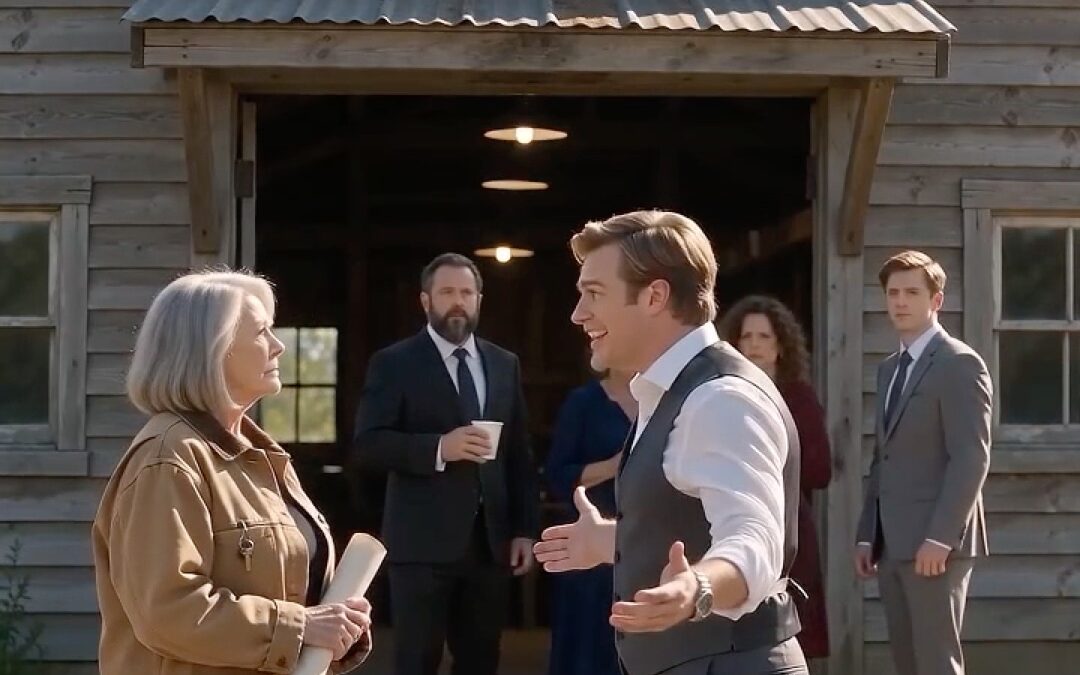
Dane lowered his window and leaned out of his truck.
“Move, Joan. That’s my road now.”
Picking up where the Facebook post left off
Chapter 2
At 8:10 Monday morning, a dump truck stopped across the store’s unloading entrance.
Another carried gravel over the culvert toward Heron Point.
I heard the concrete crack from behind the counter.
My feed delivery had just arrived from Highway 23.
The driver leaned out of his cab and pointed at the truck blocking him.
I came outside in my barn coat.
A piece of the culvert’s rim lay in the ditch.
Water trickled around it instead of through the opening.
The loaded truck kept going.
Dane stood near the road, pointing the next driver toward the lake.
He had watched me carry Marvin’s map back inside on Saturday.
Now he waved a truck across the same ground.
The feed driver shut off his engine.
“I need that space,” the driver said.
Dane raised one finger without looking over.
“Be out of your way in a minute.”
The driver glanced at me.
I stayed beside the loading door.
At nine, the feed was still on the trailer.
The dump trucks moved forward, backed up, and waited for one another.
Their tires carried gravel across the lot.
Dane left in his pickup while another load came through.
The feed driver checked his delivery sheet against the steering wheel.
“You usually get me unloaded before this,” he said.
“I know.”
I was embarrassed, although I hadn’t invited those trucks.
The driver had other stops.
I had customers expecting what was sitting on his trailer.
At 10:10, the last dump truck cleared the entrance.
Two hours had passed.
Before I opened the loading door, I went to the farm gate.
Marvin had hung it years earlier to close the lake crossing.
It folded back along the fence when we weren’t using it.
I lifted the bottom rail free of the weeds and swung it shut.
The hinges squealed.
I threaded the chain through the latch and snapped the padlock closed.
My hands were steady when I pulled on it.
Then I went inside for the spare key.
The feed driver was lowering the trailer ramp when Dane returned.
Dane stopped his pickup in front of the gate.
He looked at the chain, then at me.
“What’s this supposed to be?”
I held out the key.
“Lock it after crossing.”
The driver stood beside us with his delivery sheet.
Dane made sure the driver could hear.
“Joan’s learning to run the place,” he said. “We’re having a little training day.”
“Joni.”
Dane took the key between his thumb and forefinger.
He turned it over as if I had handed him something dirty.
“You expect me to get out and open this whenever I come through?”
“Yes.”
He looked toward the driver for a smile.
The driver studied the chain.
“This road goes to my house,” Dane said.
“The culvert is cracked.”
“It’s a culvert. Dad drove equipment over it for years.”
I pointed toward the ditch.
Dane didn’t look.
He walked beneath the loading awning, where the cracked-corn bin stood open.
He dropped the key into it.
I heard one small tap before the corn swallowed it.
“There,” he said. “You can keep track of it.”
The feed driver lowered his delivery sheet.
Dane looked pleased with himself.
“Open the gate.”
“Find your key.”
His grin disappeared.
I went to the loading door and pulled it up.
Behind me, Dane kicked at a loose stone.
The driver brought the first bags off the trailer.
Neither of us said anything until Dane’s pickup started.
When I turned, he was driving back toward Highway 23.
The corn bin remained open.
I found the key near the front corner and set it on the counter.
By closing, a yellow kernel was still caught inside its loop.
I brushed it out before locking the store.
Tuesday, October 13, I ate my sandwich at the office desk.
My phone lay beside Marvin’s old adding machine.
I searched the lake house address.
Dane had talked about its appraisal at the funeral lunch.
I wanted to know whether he was already selling it.
A listing appeared with a photograph taken from the water.
“Coming soon.”
The price was $1,349,000.
I put down my sandwich.
Marvin’s dock was in the picture.
So was the porch chair he had repaired in August.
I moved through the photographs until I reached the description.
One sentence named the road across my lot.
“paved private drive from Highway 23, second access by North Shore Lane, a town road”
I took a screenshot showing the price and description.
Then I saved the photograph of the entrance.
The store sign stood at the edge of it.
Dane hadn’t cropped out Marvin’s business.
He had included it in the approach to something he wanted to sell.
I felt angry enough to call him.
Instead, I set the phone down and finished my sandwich.
At 2:18, an email arrived from Dane.
He had sent it to the lake association and copied me.
The subject named the November 7 fall meeting.
I opened it at the counter.
Dane had submitted a motion to “declare the Gunderson road a lake road and order the gate removed.”
I put my palm flat beside the keyboard.
A second message followed beneath his.
Merle Siebert had replied that he seconded the motion.
I knew Merle’s name from feed tickets and association notices.
He was the president.
He hadn’t come to look at the cracked culvert.
He hadn’t asked me about the gate.
I printed the messages and laid them beside the key.
The association had forty members.
I pictured folding chairs, Dane standing at the front, and my gate on the agenda.
Could forty neighbors vote it off my own land?
I looked through the office doorway at Marvin’s survey map.
I had pinned it back where it belonged.
His note was still there beside the road.
I didn’t know what paperwork he had meant.
The phone rang before I could reach for the map.
The screen showed Leann Kleist, our insurance agent.
You may also like
At my 71st birthday lunch, my son-in-law told 18 relatives I’d signed a power of attorney online to sell my $640,000 lake house. That Tuesday I was in surgery.
At my granddaughter’s wedding, my daughter-in-law told 120 guests the $8,000 dress came from a Philadelphia boutique. I’d sewn every stitch of it myself.
At my 70th birthday, my son told 40 guests I’d outlived my usefulness. That morning a realtor had emailed me photos of my own house, listed for $289,000.
I answered beside the printed motion.
“Joni, Marvin’s road license expires December 31. I’m bringing the binder tomorrow.”
Chapter 3
Leann set a blue binder beside the cracked-corn key on Wednesday, October 14.
She opened it on the feed store counter.
“Eight licenses,” Leann said. “One for each year, 2019 through 2026.”
I pulled my glasses from my coat pocket.
The pages were separated by tabs marked with years.
Leann turned to the oldest one and placed a finger above the signatures.
“Permission only. Not an easement.”
Marvin had signed beneath those words.
Dane’s name was beside his.
I knew Marvin’s handwriting from seventeen years of notes left by the register.
Dane’s signature had a long tail that crossed the printed line.
Leann turned the pages.
The same names appeared beneath the same language.
By the time Leann reached 2026, I had stopped touching the key.
“He signed each year?”
“Yes,” Leann said. “Dane signed each year.”
I bent closer to the current license.
The paper said the permission ended December 31 unless the store lot’s owner renewed it in writing.
It covered the road across our property.
The road Dane had called his on Saturday.
Leann brought out a printed email.
“January eighth of this year,” Leann said. “Dane sent this to me.”
The message was short.
“Signed Dad’s road paper again. Same as every year.”
I looked from the email to the signature on the current license.
My stomach tightened.
Dane had taken the key from me in front of the delivery driver.
He had dropped it into the corn knowing he had signed this paper.
“Why didn’t I have these?”
“Marvin and I handled them,” Leann said. “I kept the binder at my office.”
“Since 2019?”
“Yes. We drafted the form that year.”
Leann straightened the pages against the binder rings.
“Per the policy, the insurer required written terms for people crossing the store lot.”
I had handled feed orders, invoices, and the register.
Marvin had taken the insurance calls in the office.
When Leann came by, I usually kept working at the counter.
“Nothing was in the will.”
“A license isn’t recorded with the Register of Deeds,” Leann said. “It wouldn’t appear there.”
Leann laid a renewal form beside the email.
“The policy needs your signature as the new owner,” Leann said.
“The road paperwork needs to be settled before December thirty-first, too.”
I kept my hands beside the form.
“Settled how?”
“A renewed license or a signed letter ending it. You own the lot now, Joni.”
Marvin and I had held the store property as survivorship owners since 2012.
His death had left it to me.
I knew that much already.
I hadn’t known this road needed anything from me.
Leann tapped the blank signature line.
“Your decision,” Leann said. “Your signature.”
A customer’s tires crunched across the lot.
I closed the binder while I rang up dog food.
Leann waited near the office doorway until the customer left.
Then I carried the paperwork inside.
The survey map hung above the filing cabinet.
I pointed to Marvin’s note beside the road.
“That’s your name?”
“The initials, yes,” Leann said.
I had thought the December reminder concerned the association’s snowplow permit.
I paid that every winter.
There had been no reason for me to look for something else.
Leann stood beside Marvin’s chair without moving his work shirt.
“I’ll leave the binder,” Leann said. “Call me if you need anything explained.”
After Leann left, I sat at the desk.
The renewal form lay on top of the printed motion to remove my gate.
I moved it aside and called Dane.
He answered over the sound of another man’s voice.
“What now, Joan?”
“The license ends December thirty-first.”
Dane laughed.
“Dad’s insurance paper? Thirty years of driving it makes it mine.”
“You signed it.”
“Dad put things in front of me. I signed them.”
I looked at his email.
Same as every year.
“Leann brought the binder.”
“Good for Leann. Tell her I said hello.”
I lowered the phone toward my shoulder for a moment.
I was angry, and I didn’t trust myself to stay brief.
Dane kept talking.
“You can bring your little folder to the meeting. We still need that gate gone.”
I ended the call.
Then I put the phone beside the eight years of signatures.
That night, I stayed at the store to finish the winter orders.
The office light reflected in the dark window.
I had just clipped a delivery address to an order when my phone buzzed.
Someone had sent me Dane’s post in the community group.
He had written that his stepmother was “holding a grieving son’s road hostage.”
Below it was a photograph of my closed gate.
He hadn’t included the broken culvert or the trucks blocking my delivery.
My face grew hot as I read the comments.
People I recognized were asking why I couldn’t leave things alone.
The store phone rang.
A regular wanted to cancel a winter order.
“I don’t want to get in the middle,” the customer said.
I wrote “canceled” across the sheet.
An email arrived while I was putting down the receiver.
Another regular asked me to remove an order from the schedule.
Then a third cancellation came by text.
Three regulars.
I laid their order sheets beside one another.
I had counted on that business through the cold months.
My hands shook when I unclipped the delivery addresses.
Dane’s post was still open on my phone.
Signing the renewal might stop the calls.
I looked at the blank line and imagined explaining those lost orders to Marvin.
Then I looked at Dane’s signature beneath “Permission only. Not an easement.”
He had known what the paper said before he stood up at the funeral lunch.
You may also like
On Thanksgiving, my daughter threw wine in my face in front of 14 guests. The $38,000 piano she brags about is still in my name.
At my grandson’s 18th birthday dinner, my son told 22 relatives the $41,000 college fund I built would go to his stepson instead. He forgot whose name is on it.
At his brother’s food truck opening, my husband thanked our $60,000 home loan in front of 40 people. I never signed it because I was in surgery that day.
I opened the binder and slid the renewal form back inside, unsigned.
“Not this year.”
Chapter 4
I opened Ingrid Elling’s email at the counter on Monday, November 2.
The association’s lawyer had written to Dane and me.
The subject named the November 7 meeting.
“I am requesting copies of any documents concerning use of the road across the store lot,” Ingrid wrote.
The deadline was Friday, November 6.
Dane’s motion was on Saturday’s agenda.
I printed the email and put it inside the blue binder.
Then I checked the recipient line.
Dane had received the same request.
He could send Ingrid the papers he had signed.
I wondered whether he would.
The bell over the door rang while I was closing the binder.
Merle Siebert came in carrying an empty layer-pellet bag folded under his arm.
He set it on the counter with the feed label facing up.
“Same kind,” Merle said.
I pulled an order slip from the pad.
“One bag?”
“That’ll do.”
Merle looked at the binder before looking toward the window.
The gate was visible beyond the parking spaces.
“Forty members, Joni. Most of them like Dane. Take the gate down.”
I stopped writing.
“It’s on my property.”
“I know where it stands.”
Merle flattened the empty sack with his palm.
“I’m trying to save you an unpleasant morning.”
“You seconded his motion.”
“Yes,” Merle said.
He didn’t offer anything after that.
The register drawer was open beside me.
I pushed it shut before asking another question.
“Have you read these?”
I rested my hand on the binder.
Merle glanced at the blue cover.
“Dane says his dad needed something for the insurance.”
“That’s what Dane says.”
“There’s a lawyer looking at it now,” Merle said. “But neighbors have to live here afterward.”
My neck felt hot beneath my collar.
I wanted Merle to ask what had happened to my culvert.
Instead, he reached into his pocket for his wallet.
I rang up the pellets.
Merle took the receipt and waited while I brought the bag from the stack.
At the door, he stopped.
“Think about what I’m telling you.”
“I heard you.”
Merle carried his feed outside.
I watched his car pass the closed gate on the way to Highway 23.
Then I went into the office and opened the store ledger.
I knew what we took in.
I also knew what remained after inventory, heat, repairs, and insurance.
If the members sided with Dane and he sued, I would need a lawyer.
Hiring one would cost more than the store cleared in a year.
I was frightened, and I said it aloud in the empty office.
“I can’t afford a lawsuit.”
The canceled winter orders were still clipped together in the drawer.
I left them there and pulled the ledger closer.
I checked the coming bills against the balance.
Merle could leave with a bag of pellets and forget the conversation.
I had to lock this building at night and come back in the morning.
By Friday, November 6, I had put Ingrid’s request beside the register.
Leann arrived with a document envelope and a stack of copies.
We checked the pages against the binder on the counter.
2019 through 2026.
Eight licenses, with the signatures visible.
The printed January 8 email went on top.
Leann wrote Ingrid Elling’s name across the envelope.
“I’m taking these to the office,” Leann said. “Today is the deadline.”
“Will Ingrid read them?”
“I can make sure they’re delivered. I can’t promise when they’ll be read.”
I pressed the metal rings closed.
Leann checked the envelope flap before sealing it.
“Per the policy, I still need your signed letter before December thirty-first.”
“You’ll have it.”
Leann tucked the papers beneath her arm and went to the car.
I watched until Leann turned onto the highway.
Then I sat at the office computer and opened Dane’s listing.
The price still read $1,349,000.
I printed the page with the description and waited beside the machine.
The paper came out with the lower edge curled.
I smoothed it against the desk.
I found the sentence naming North Shore Lane as another way to the house.
I drew a box around that sentence.
Dane had advertised another way into the lake house.
I put the listing in a folder for Saturday.
That afternoon, another email arrived on the association list.
Dane had printed a petition.
He attached a photograph of it beside his printer, with space for signatures.
The heading demanded removal of the gate.
Beneath the picture was his invitation to his friends.
“Come watch Joan fold.”
I stared at the name.
He could type Joni.
He had seen it on the will and in Ingrid’s email.
I printed the message and placed it beneath the listing.
My fingers caught on the folder tab.
I tore a small piece off before setting it down.
Leann called near closing.
The documents had been delivered to Ingrid’s office.
There was no answer about the road yet.
After we hung up, I checked the meeting notice.
Ten o’clock Saturday morning.
I laid it beside my keys.
Would Ingrid read the binder pages before Dane got his vote?
On Saturday, November 7, I dressed before the store’s usual opening time.
I chose a plain sweater and put my reading glasses in the pocket.
In the office, I lifted Marvin’s survey map from its thumbtacks.
I folded it along the old creases and laid it beside the folder.
The gate key was on the counter.
I put it on my ring.
My phone buzzed while I was buttoning my coat.
You may also like
Eleven days after I gave birth, my husband’s sister moved into my nursery and told 9 relatives she’d raise the baby. My doorbell camera heard what she said at my door.
At their housewarming, my son-in-law told 35 guests they bought the house with zero help and I came for the free food. I hold their mortgage.
My ex-husband’s new wife sat in the mother-of-the-bride seat and told 120 guests she paid for the wedding. Every one of the 14 vendor receipts has my name.
Dane’s name appeared above a message.
“Bring bolt cutters. You’ll need them.”
Chapter 5
Dane waved his realtor’s flyer above forty members seated on folding chairs.
It was ten o’clock, Saturday, November 7, at the town hall.
I sat in the back row with Marvin’s survey map across my knees.
Dane stood beside the front table.
He read his motion to “declare the Gunderson road a lake road and order the gate removed.”
Then he lowered the paper and looked toward me.
“That road’s been ours for thirty years. It’s an easement.”
A man near the aisle nodded.
Dane lifted the flyer again.
“She’s landlocking a grieving son. There’s no other way in.”
My fingers tightened around the map.
The paper crackled, and someone turned to look.
Dane pointed at the photograph of the lake house.
“I have a spring buyer waiting. She expects to reach the place without begging Joan for a key.”
I watched Ingrid arrange the papers in front of her.
The blue binder sat beside Ingrid Elling’s legal pad.
Merle was seated at the other end, holding the agenda.
“The documents came in yesterday,” Ingrid said. “They need to be addressed before this motion proceeds.”
Dane put down his flyer.
“It’s a road, Ingrid. You can see it from the highway.”
Ingrid opened the binder.
“The language governing its use is in writing.”
Ingrid removed the current license and held it flat.
“Permission only. Not an easement or right of way. Ends December 31 unless renewed in writing by the owner of the store lot.”
Nobody beside the aisle was nodding now.
Ingrid placed that sheet on the table and turned to the oldest tab.
“This is the 2019 license. Marvin Gunderson signed it. So did Dane Gunderson.”
Ingrid read the date beside Dane’s signature.
Then Ingrid turned to 2020 and read that signature date aloud.
I watched Dane pull his flyer closer to his chest.
Ingrid continued with the dates on the 2021 and 2022 licenses.
A chair creaked near the front.
The 2023 date followed, then 2024.
Dane opened his mouth, but Ingrid was already turning the page.
Ingrid read the date on the 2025 license.
Finally, Ingrid returned to 2026 and read Dane’s signature date from that sheet.
Eight years.
His name beneath the permission he had told the room was ownership.
Dane gave a short laugh.
“Dad made me sign insurance junk. It didn’t mean anything.”
Ingrid rested a finger beside the current signature.
“Are you disputing that this is your signature?”
Dane glanced toward Merle.
“I never signed a thing about that road.”
My face grew hot.
He had just offered an excuse for signing it.
Now he was denying the signature in front of the same people.
Merle lowered the agenda.
Ingrid took the printed email from the binder.
“This was sent by Dane Gunderson to Leann Kleist on January eighth, 2026.”
Dane shifted his feet.
Ingrid read it without looking up.
“Signed Dad’s road paper again. Same as every year.”
The man near the aisle leaned back in his chair.
Dane pointed at the binder.
“That’s what I’m saying. Dad’s paperwork.”
Ingrid put the email beside the licenses.
“The message identifies it as road paperwork.”
Dane looked down at his realtor’s flyer.
“North Shore Lane is gravel. Nobody actually drives that.”
Merle reached for his phone.
I could see his thumb moving over the screen.
Dane was watching Ingrid and didn’t notice.
“The house has another access?” Ingrid said.
Dane spread his hands.
“You’d send people three-point-six miles down a gravel town road when there’s pavement right there?”
Merle held up the phone.
“Your listing says, ‘paved private drive from Highway 23, second access by North Shore Lane, a town road.’”
Dane stopped moving his hands.
Merle looked directly at him.
“You wrote that, Dane. I withdraw my second.”
Dane’s cheeks reddened.
“Merle, come on.”
“Does anyone else second the motion?” Merle said.
I heard the wall clock above the coat hooks.
Nobody raised a hand.
“The motion dies,” Merle said.
I loosened my grip on the map.
A small tear had started along one folded corner.
Ingrid drew the licenses into a stack.
“For clarity, the association cannot vote itself a road across private land,” Ingrid said.
Dane pulled out a chair but didn’t sit.
“Thirty years ought to count for something.”
“Use by permission does not become a prescriptive easement under Wisconsin law,” Ingrid said.
“These signed licenses document permission. Permitted use does not start a twenty-year prescriptive period.”
Ingrid moved the listing closer to the binder.
“The lake house also has access by a town road. It is not entitled to an easement of necessity.”
Dane stared at the photograph on his flyer.
“The store lot belongs to Joni Gunderson,” Ingrid said. “After December thirty-first, continued use requires written renewal by its owner.”
I stood.
My knees pressed against the chair in front of me.
I waited until the person ahead moved it forward, then stepped into the aisle.
Dane looked toward the back row.
I folded Marvin’s map along its old creases.
“After December thirty-first, you’ll need my signature, Dane.”
He flattened the flyer against the table.
The price was still printed above the photograph.
I thought of the woman expecting a paved drive in spring.
What would Dane’s buyer do when she heard?
Merle called for a short break.
People stood, reaching for coats and moving into the aisle.
I carried the map and my folder toward the door.
Merle followed me to the coat hooks.
He had his phone in one hand and the agenda in the other.
“I should have read the papers before I seconded that,” Merle said.
I waited with my coat over my arm.
Merle looked toward Dane at the front table.
You may also like
At our Labor Day cookout, my son-in-law called my gift pathetic in front of 12 relatives. The truck he drives to every job is leased in my name.
My son’s wife texted 22 relatives that Thanksgiving was “couples and kids only” this year. The lake lodge she rented for it was booked on my credit card.
At our 45th anniversary dinner, my son’s wife handed me a senior-living brochure in front of 14 guests. I’ve paid her $1,900 mortgage for six years.
“Will you renew it?”
“I won’t renew it.”
Chapter 6
On Tuesday, November 10, I found the board’s notice in my email.
Dane’s road motion had been struck.
His name had also been removed from the road committee.
I printed the notice at the office desk.
The page curled against the survey map I had brought home from the meeting.
I laid the paper flat beneath the stapler.
Then I opened the community group.
Dane’s post about his grieving son’s road was still there.
Merle had answered it with a screenshot of the lake house listing.
The sentence about North Shore Lane was visible beneath the photograph.
“This is the second access Dane advertised,” Merle had written. “The board will not pursue removal of Joni’s gate.”
I set my phone beside the keyboard.
By lunchtime, Dane’s post was gone.
I checked the store’s winter schedule before going back to the counter.
The canceled orders were still missing from it.
Taking down a post hadn’t put them back.
Later that week, Dane forwarded an email from his realtor.
There was no greeting above it.
The buyer had withdrawn her letter of intent.
I recognized the phrase because the realtor had used it plainly.
The woman waiting for a spring purchase was no longer proceeding.
Below that was the revised asking price.
$1,060,000.
The description would specify gravel access only.
I compared it with the old listing in my folder.
The house had been appraised at $1,200,000.
Now it was offered for $140,000 less than that.
I put the pages together without writing anything on them.
Dane came to the store that afternoon.
He parked near the loading door and stayed in his pickup a while.
I could see him looking toward the gate.
When he came inside, he carried a printout of the realtor’s email.
He laid it on the counter.
“You saw this.”
“Yes.”
Dane tapped the new price.
“This is what that meeting did.”
I moved a customer’s receipt out from under his paper.
Dane watched my hands.
“The buyer’s gone,” he said. “The agent says we have to start over.”
I waited.
He pulled the email back toward himself and folded it.
“You don’t need that road closed. You’ve got the gate. Everybody knows it’s yours.”
“The paper says so.”
“Fine. The paper says so.”
Dane looked around the store.
There was nobody for him to laugh with.
He lowered his voice.
“Sign just one more year.”
The blue binder was beneath the counter, where I had kept it since Saturday.
I brought it up and set it beside the register.
“The answer is in the binder.”
Dane rested his fingers on the cover but didn’t open it.
“You’d really do this over a key?”
I thought of the cracked corn caught in its loop.
I also thought of his voice carrying across the funeral tables.
I didn’t answer.
Dane picked up the realtor’s email.
He waited long enough that I could hear the office printer finish a page.
Then he left.
I kept my hands on the counter until his pickup reached the highway.
My stomach hurt, but I hadn’t reached for a pen.
The regular who had canceled by telephone came back the following week.
He stood beside the stack of order forms with his cap in his hands.
“Can you still get my winter feed?”
“Yes.”
He named what he needed while I wrote it down.
Before paying, he looked toward the road.
“I should’ve asked you.”
I passed him the receipt.
The customer who had canceled by email came in another morning.
The third arrived before closing a few days later.
I took their winter orders and put the delivery addresses back on the schedule.
Three regulars had returned.
I was relieved enough that I checked the totals with the adding machine.
Then I called the supplier and placed the order.
On Thursday, December 31, Leann came through the door carrying her document case.
Snow was packed into the grooves of her boots.
I had the signed letter ready on the counter.
The date appeared above my name.
The letter said I would not renew the road license when it ended that night.
Leann checked the signature and made a copy for me.
“Per the policy, this completes the road paperwork,” Leann said.
Leann filed my signed letter with the insurance records.
I put my copy inside the blue binder.
The unsigned renewal form was still there.
I left it where it was.
At noon, I drove out for groceries.
Near the turn for North Shore Lane, I stopped behind Dane’s trucks.
The lead driver signaled and turned onto the gravel town road.
The next truck followed.
I waited until the crossing was clear, then continued toward town.
Their written permission across my lot would end at midnight.
They had already started using the other way in.
Back at the store, I carried my groceries into the office.
The gate key knocked against the desk when I set down my ring.
What would I do with a road that was only mine?
I moved the survey map aside to make room for the binder.
A drawer caught against my knee.
I pulled it open to tuck away the loose thumbtacks.
Marvin had kept pencil stubs and small hardware in an old metal tray.
I lifted it to clear a space.
Something underneath scraped against the wood.
A spare key ring lay at the back of the drawer.
I drew it out by a faded string tag.
You may also like
For 4 Christmases my son-in-law said the table was full. This year I counted 22 guests through the window of the house I rent to him.
At my son’s engagement party, his fiancée told 30 guests I was too cheap to invest in their future. Her fund was under an Indiana cease-and-desist order.
At our Fourth of July cookout, my granddaughter asked why I’d stopped helping with nursing school. I’d sent $300 every month to the account her aunt set up.
The gate key hung from the ring.
In Marvin’s handwriting, the tag read, “Joni — the gate.”
Chapter 7
“Hold that corner,” Leann said. “The red’s still wet.”
It was Saturday, January 2, 2027, and the store sign lay across our worktable.
I steadied the board while Leann lifted the brush from the last letter.
We had brought it inside so the paint could dry in the heat.
“Gunderson Feed & Seed.”
Marvin had painted the name years ago.
The red had faded until the letters nearly matched the bare wood.
I had meant to fix that before winter.
Then there had been the funeral, the gate, and the meeting.
I dipped my brush and filled a thin place in the G.
Leann leaned over the board to check the edge.
“You’ve got paint on your cuff,” Leann said.
“It’ll match the other stains.”
Leann smiled and put the lid beside the can.
We left the sign flat near the back of the store.
I washed my hands in the office sink.
A line of red stayed beside my thumbnail.
When I returned to the counter, a pickup was pulling into the lot.
A girl climbed down from the passenger side carrying a folded supply list.
Her grandfather followed, buttoning his coat.
The bell rang above them.
“Morning, Joni,” the grandfather said.
“Morning.”
The girl spread the list on the counter.
“I need chick starter,” the girl said. “It’s for my 4-H project.”
I checked the order pad.
The winter feed deliveries filled the pages behind it.
This was the season’s first chick-starter order.
“Brooder ready?”
The girl nodded.
“Grandpa helped me check it yesterday. I wrote down what I need.”
The grandfather stood back while I looked at the list.
The girl had drawn small boxes beside the supplies.
I marked the chick starter and brought a bag to the counter.
The grandfather reached for his wallet.
The girl reached for it too.
“You said I could pay.”
“I said you could handle the money,” the grandfather said.
I turned Marvin’s old register slightly toward the girl.
“Want to ring it up?”
The girl looked at her grandfather, then back at me.
“Can I?”
“Stand here.”
I moved aside.
The girl planted her boots where mine had been and studied the keys.
I wrote the price on the order slip and pointed to the buttons.
The girl pressed carefully.
When the drawer opened, her grandfather stepped back to let her count.
I waited while the girl checked the change against the amount on the slip.
“Is that right?”
“Yes. Give him his receipt.”
The girl tore it neatly and held it out.
The grandfather accepted it without reaching past her.
While they checked the rest of the supply list, I went into the office.
Marvin’s spare key ring lay beside the blue binder.
I carried it to the hook by the door.
The faded tag turned toward me as I hung it.
“Joni — the gate.”
I left the writing facing out.
Then I took the survey map from the desk.
The small tear from the meeting had started to spread.
I put clear tape along the back before lifting it to the wall.
The old thumbtack holes were easy to find.
I pinned the corners and smoothed the creases with my palm.
Marvin’s road note was visible beside the line across the lot.
I straightened the bottom edge and went back to the counter.
The grandfather reached for the feed bag.
“I’ll get it,” I said.
I carried it outside while the girl held the door.
The gate stood open for store traffic.
Snow lay along the fence, and the road had been plowed down to its pale surface.
I set the bag in the pickup bed with the label facing up.
The girl tucked the supply list into a coat pocket.
“Could I bring somebody from my club next time?” the girl said. “They need feed too.”
I glanced toward Leann, who had followed us outside.
Leann rested a hand on my shoulder.
“They’re asking you, Joni,” Leann said.
My throat tightened, and I needed a moment before I could answer.
I wanted my work to count while I was still standing there doing it. I turned back to the girl.
“Come Saturday. Bring your list.”
The girl nodded and climbed into the pickup.
Leann gave my shoulder a squeeze before heading inside.
The grandfather shut the passenger door and raised his receipt toward me.
“We’ll see you Saturday.”
I stood clear while he started the engine.
The girl waved through the window, holding the folded list against the glass.
You may also like
At his company’s Fourth of July picnic, my granddaughter’s husband told his boss I was the relative they all pay for. I own 10% of that company.
On Thanksgiving, my daughter-in-law threw my late husband’s tackle box in the trash in front of 14 relatives. Inside was $31,000 in savings bonds for her kids’ college.
At her wedding, my daughter skipped our father-daughter dance in front of 150 guests. On Monday her lender needed my signature on the $40,000 gift letter.
I raised my hand and waved them out through the open gate.
Then I turned toward the store and walked back up my road.
THE END
More stories
Eleven days after I gave birth, my husband’s sister moved into my nursery and told 9 relatives she’d raise the baby. My doorbell camera heard what she said at my door.
At my grandson’s 18th birthday dinner, my son told 22 relatives the $41,000 college fund I built would go to his stepson instead. He forgot whose name is on it.
At their housewarming, my son-in-law told 35 guests they bought the house with zero help and I came for the free food. I hold their mortgage.
At his brother’s food truck opening, my husband thanked our $60,000 home loan in front of 40 people. I never signed it. I was in surgery that day.
On Thanksgiving, my daughter threw wine in my face in front of 14 guests. The $38,000 piano she brags about is still in my name.
For 4 Christmases my son-in-law said the table was full. This year I counted 22 guests through the window of the house I rent to him.
You Might Also Enjoy




