On Thanksgiving, my daughter told 31 relatives I was too confused to handle money and had filed for guardianship. In June she’d had me co-sign her $38,000 car loan.
Complete story · 10 chapters · about 39 minutes · ending included
Chapter 1 · Chapter 2 · Chapter 3 · Chapter 4 · Chapter 5 · Chapter 6 · Chapter 7 · Chapter 8 · Chapter 9 · Chapter 10
Chapter 1
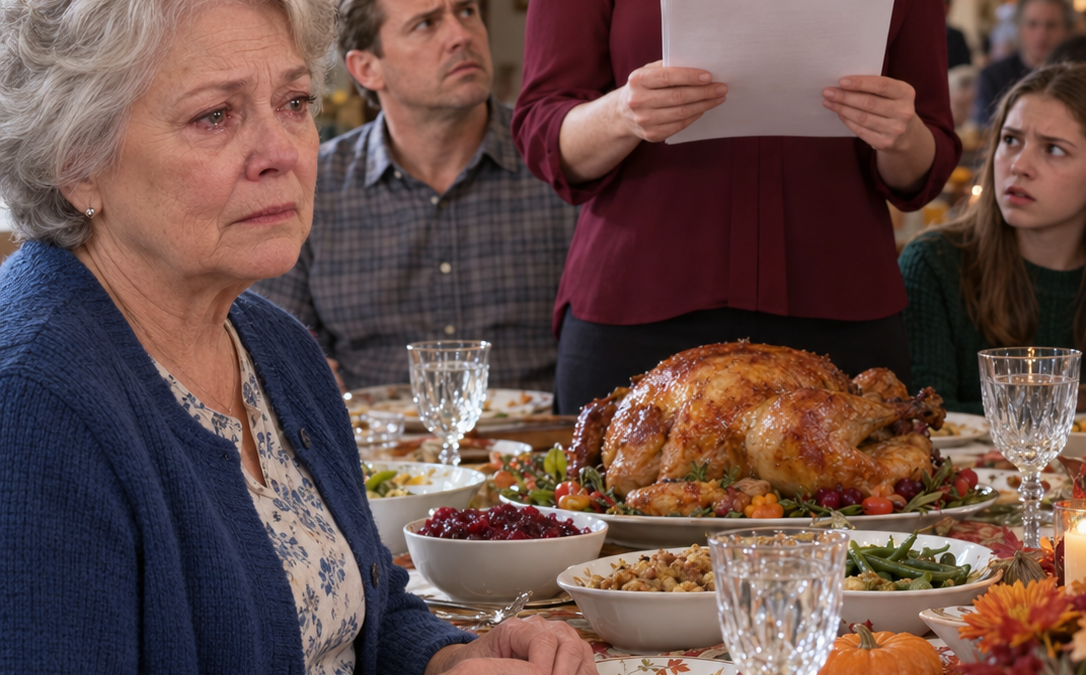
Nikki stood beside my Thanksgiving turkey, reading from a stapled petition.
“Since approximately January 2025, my mother has been unable to manage her finances.”
The 31 relatives gathered in my house stopped passing the food.
My daughter lifted her eyes from the paper.
“Mom can’t even count change anymore. She shouldn’t be signing anything.”
Nikki said it warmly, as if offering to carry a heavy dish.
I sat with my hands folded beside my plate.
Humiliation heated my cheeks, and I made my hands stay steady.
A relative by the kitchen entrance stopped serving and set the spoon down.
Nobody told Nikki to stop.
I had cooked that turkey in the house I had paid off.
That morning, Nikki had said the skin looked perfect.
Now my daughter stood over it, telling my family I couldn’t count.
“The gravy’s getting cold,” I said.
Behind Nikki, my old grocery store name badge hung on the fridge.
Frances — 38 Years.
Through the dining room window, I could see Nikki’s silver SUV in my driveway.
A strip of afternoon sunlight lay across the hood.
I looked at the vehicle, then at the stapled pages.
January, Nikki had said.
I counted back through the months until I reached June 10.
Tuesday.
The day I had signed for that SUV.
Darin sat across from me, staring at his plate.
My son-in-law had barely touched his food.
A piece of turkey rested against the edge of his fork.
He had driven me to the credit union that June morning.
Now he wouldn’t look toward the window.
Nikki straightened the petition against the table.
“Please eat,” Nikki said. “I didn’t want this hanging over the holiday.”
My sister reached for the rolls.
The basket traveled past me without anybody offering it.
I wasn’t hungry, but I noticed.
I had spent thirty-eight years watching hands pass money across a counter.
You learned to notice what people reached for and what they avoided.
Nikki placed the papers beside the carving platter, away from the gravy.
That bothered me more than I expected.
My daughter had chosen a clean, dry place for them.
Nikki had known where those pages would go before walking into my dining room.
“Mom can still enjoy being with family,” Nikki said. “That’s what matters today.”
I was sitting close enough to touch the petition.
Nikki spoke about me to the people beyond my chair.
My sister glanced at me, then lowered her eyes.
I wanted somebody to ask what had happened in January.
An unpaid bill.
A missing check.
An afternoon when I hadn’t known where I was.
Anything that explained why my daughter had brought court papers to Thanksgiving dinner.
Nobody asked.
At the opposite end, somebody’s seat gave a short squeak.
Someone said the turkey was good.
Then the serving dishes began moving again.
I unfolded my hands and picked up my fork.
My thumb trembled against the handle.
I was hurt, and I didn’t want Nikki explaining that to the room, too.
Across from me, Darin cut his turkey into smaller pieces.
Nikki leaned down beside his chair.
“Would you pass Mom the potatoes?” Nikki said.
He handed me the bowl without lifting his head.
I took a spoonful because he was still holding it out.
The food had gone lukewarm.
Through the window, the SUV’s windshield caught the light.
On June 10, Nikki had wanted my signature.
At Thanksgiving, Nikki said I shouldn’t sign anything.
Those facts belonged beside each other.
I didn’t need somebody to arrange them for me.
Why would a daughter who said her mother couldn’t sign anything have her sign for a $38,000 car?
I looked at Darin.
He set down his knife.
I waited, hoping Darin would finally say something.
Instead, he reached for his water.
I was angry with him then.
Darin knew where we had gone that Tuesday.
He had waited while I signed.
My daughter’s husband went on eating, apparently undisturbed by what Nikki had said.
When people began carrying plates into the kitchen, I stood.
Nikki’s hand moved toward my elbow.
“I’ve got it, Mom,” Nikki said.
I kept my plate level and walked around the end of the table.
My knees felt stiff from sitting.
That was ordinary.
I hated knowing somebody might watch the way I walked and call it proof.
At the sink, I scraped my plate into the trash.
A relative handed me a stack of smaller dishes.
Nikki stepped between us and took them.
“Mom needs to sit,” Nikki said.
I had been on my feet since morning, cooking for those people.
My daughter had watched me do it.
Now Nikki carried the dishes past me, smiling at the doorway.
I wiped my palms with the kitchen towel.
The kitchen smelled of roasted onions and coffee.
I had planned to put the pie out after clearing some counter space.
I lost track of the pie server for a moment.
Then I saw it beside the cooling rack.
My stomach tightened.
I resented having to notice an ordinary thing like that.
From the dining room came a low conversation I couldn’t make out.
Nikki returned for the petition.
My daughter lifted it by the stapled corner and checked beneath it for moisture.
I watched the papers leave my table.
Nikki had read one sentence aloud.
I wanted to know what the rest said.
My daughter tucked the petition against her side before I could see another line.
“We’ll get through the paperwork,” Nikki said.
I looked past Nikki toward the dining room window.
That silver SUV was still sitting on my driveway.
I remembered the desk where I had signed.
I remembered the loan number, too.
Nikki noticed where I was looking and stepped closer.
“The hearing is in January,” Nikki said.
You may also like
At my 68th birthday in the church hall, my son-in-law informed 40 guests I had skipped paying the caterer. My grandson’s phone video showed him canceling my $1,200 order.
My husband left his son the $1.2M lake house and me his old feed store. At the funeral lunch, my stepson laughed, not knowing the lake road crosses my lot.
My late husband’s brother charged his wife’s 17 relatives $2,400 to spend Thanksgiving at the hunting cabin I inherited. I found the rental listing with my porch on it.
My daughter glanced around my kitchen, then smiled at me.
“Don’t worry, Mom. The house will be handled.”
Picking up where the Facebook post left off
Chapter 2: The Words On My Phone
Nikki opened my kitchen drawer and lifted out my spare house key.
My checkbook lay underneath, beside a pencil and a packet of stamps.
My daughter picked that up, too.
“Those stay here,” I said.
Nikki slipped the key into the pocket of her coat.
“Until the judge decides,” Nikki said.
My sister stood near the counter with a pie dish.
“She’s only trying to help, Fran.”
I looked at my sister.
Nobody had asked whether I wanted help.
Nikki tucked the checkbook into her purse, between a wallet and a folded scarf.
I could still see the blue cover.
I wanted to reach across and take it back.
My daughter pulled the zipper closed before I moved.
“You can call if you need anything,” Nikki said.
“It’s my checkbook.”
“And you know where it is.”
Nikki said that softly enough that my sister leaned closer to hear.
Then my daughter smiled toward the relatives putting on coats.
“Mom shouldn’t have to worry about this today.”
I had known where the checkbook was before Nikki opened the drawer.
I had known where the spare key was, too.
Now I would have to ask my daughter for things that belonged to me.
My hands started shaking.
I pressed my palms against the counter.
My sister set the pie dish down and reached for her coat.
“I’ll get that another day, Fran,” my sister said.
I nodded toward the dish.
That was easier than answering the part about helping.
Brynn appeared in the kitchen doorway with her jacket hanging from one shoulder.
My granddaughter looked from Nikki’s purse to my face.
“Grandma, are you really confused?”
The question carried into the dining room.
A relative stopped pulling on a glove.
I wanted to answer Brynn before anybody else could.
“No,” I said.
Nikki turned toward the doorway.
“Brynn, go wait in the car.”
“But Grandma said—”
“Your dad’s outside. Go.”
My granddaughter stayed where she was.
Brynn’s eyes were bright, but my granddaughter didn’t cry.
I hated that a child had to study my face for an answer.
“I know what day it is,” I said. “And I know you.”
Nikki lifted Brynn’s loose jacket shoulder into place.
“We’re leaving,” Nikki said.
Brynn looked back at me before following Nikki into the hall.
I wanted to offer my granddaughter leftover pie.
Instead, I stood beside the open drawer while the front door closed.
The pencil had rolled into the space where my checkbook belonged.
I pushed the drawer shut.
Relatives came through the kitchen to say goodbye.
Someone thanked me for dinner.
Another person touched my shoulder without meeting my eyes.
I answered with the words I usually used.
Drive safe.
Take some turkey.
Your dish is on the counter.
I didn’t want anybody leaving with a story about how I had fallen apart.
By the time the last guest left, the coffee had cooled in the pot.
I locked the front door.
Then I remembered the key in Nikki’s pocket.
My daughter could let herself into my house whenever she chose.
That frightened me more than I wanted to admit.
I checked the lock anyway.
In the kitchen, I covered the leftover turkey and put it in the refrigerator.
My name badge was still hanging on the door.
I touched the plastic edge with one finger.
Thirty-eight years at a register, and nobody in that room had asked me a question.
They had listened to Nikki.
I left the dishes soaking, then took the chair at the kitchen table.
My phone rested beside the salt shaker.
I picked it up and opened my messages.
There were ordinary things from Nikki.
A question about dinner.
A request to keep Brynn after school.
An instruction to leave something by the door.
I scrolled back through the fall.
I was looking for the message about the car payment.
I remembered paying it.
What I couldn’t remember was exactly how Nikki had asked.
September 3.
I stopped with my thumb above the screen.
“Can you cover the $656.84 payment today? I’ll make it up to you.”
Under that was another message.
“You’re the only one in this family who’s good with money.”
I kept the phone flat on the table.
The words were easier to look at that way.
In September, Nikki had needed me to understand the amount and pay it.
At Thanksgiving, my daughter had told my relatives I couldn’t count change.
I felt angry enough that my jaw hurt.
I opened the bank app.
My password worked.
My account appeared.
I selected the transaction history and moved back to September.
I didn’t hurry.
I wanted the actual entry, with the date and amount visible.
There was the payment.
$656.84.
September 3, 2025.
I had paid it that afternoon, the same day Nikki asked.
I set the phone down beside my empty water glass.
For a while, I listened to the refrigerator running.
My daughter had carried my checkbook out of this kitchen.
Nikki had left the messages on my phone.
How could Nikki tell a judge I couldn’t handle money after asking me to pay her car note?
I opened the conversation again and took a screenshot of the request.
Then I returned to the bank entry and captured the payment.
I checked the saved images in my photos.
The amount was clear.
You may also like
On Christmas Eve, my dad thanked my brother for paying his $31,400 knee surgery and gave him Grandpa’s watch in front of 22 relatives. His card was in my purse.
At Mom’s 75th birthday dinner, my brother told 22 relatives I let scammers take her $40,000. Then Mom called the number that texted her, and his jacket started ringing.
At my 71st birthday lunch, my son-in-law told 18 relatives I’d signed a power of attorney online to sell my $640,000 lake house. That Tuesday I was in surgery.
So were Nikki’s words about who was good with money.
The request and the payment carried the same date: September 3.
Chapter 3
“Frances Kruse?” the deputy said, holding a stapled packet outside my door.
It was Monday, December 1.
I kept one hand on the doorknob and took the papers.
“Yes.”
“These are for you,” he said.
My name appeared beneath the heading for the Iowa District Court for Black Hawk County.
I recognized Nikki’s name farther down.
The deputy waited while I moved the packet out of the wind.
“Is there a court date?” I said.
“January 12. Nine in the morning,” he said.
I found the hearing notice near the front.
Under it was an order appointing an attorney to represent me.
Gretchen Palmer.
The appointment order was dated November 21, the day Nikki filed.
My daughter had already taken this to court before serving Thanksgiving dinner beside me.
I looked up, but the deputy was waiting to leave.
“All right,” I said.
I closed the door and stood in the entry with the packet against my chest.
My heart was beating hard.
At Thanksgiving, I had seen Nikki’s copy from across the table.
Now I had my own.
I carried it into the kitchen.
The drawer beside the sink still held my pencil.
I took it out and sat where I had found Nikki’s September messages.
The petition asked for a guardianship and a conservatorship.
Nikki wanted to be appointed conservator.
I knew enough to understand that my daughter wanted authority over my money.
The house appeared on a list of property.
Estimated value: $214,000.
I rested the pencil beside that number.
My kitchen was part of that estimate.
So was the dining room where Nikki had announced I couldn’t count.
I had paid for the house over years of standing at a register.
Seeing it listed in my daughter’s petition made my stomach hurt.
Farther down, I found a sentence that stopped me.
“Respondent refuses all assistance.”
Respondent meant me.
I said the sentence aloud to the empty kitchen.
Nikki had sworn to it.
My daughter hadn’t written that we disagreed about the house.
Nikki had described refusing help as another thing wrong with me.
I thought about the checkbook leaving in Nikki’s purse.
I had asked for it back.
That much was true.
I hadn’t asked anybody to take over.
I placed the pages in order and kept going.
There was the claim about when my trouble had started.
“Since approximately January 2025.”
I circled those words with the pencil.
Then I wrote June 10 in the margin.
The figures came out straight.
I had spent too many years writing amounts on small slips to waste space.
January was before June.
Nikki could put whatever words my daughter wanted around those months.
The order wouldn’t change.
I looked toward the driveway.
The space where the silver SUV had stood was empty.
My memory of signing for it wasn’t.
I remembered sitting at the credit union with the papers before me.
I remembered Nikki taking the copies home.
At the time, keeping them together had seemed practical.
Now I wanted to see what my daughter had kept.
I found Gretchen Palmer’s contact information in the packet and copied it onto a clean sheet.
Under the number, I wrote the hearing date and time.
January 12.
9:00 a.m.
Then I put the petition beside my phone.
I was scared of going into a courtroom.
I was more scared of letting Nikki’s pages be the only ones there.
By Tuesday morning, December 2, I had my questions ready.
I called Gretchen’s office from the kitchen table.
“My name is Frances Kruse,” I said. “The court appointed Ms. Palmer for me.”
The person answering found my name.
We booked a meeting for December 9.
I wrote the appointment beneath the hearing date, leaving room between them.
“Should I bring the petition?” I said.
“Yes,” the person said. “Bring the papers you received.”
I added that to my list.
Then I looked at June 10 in the margin.
I called the credit union and asked about getting copies.
I explained that I had co-signed an SUV loan there in June.
When asked for the loan number, I gave it.
There was a pause while the employee checked.
My fingers tightened around the pencil.
I wasn’t struggling to remember.
I was waiting for somebody to tell me I could have my own papers.
The employee explained how to make the request.
I wrote down what I needed, put the petition away, and got my purse.
At the credit union that afternoon, I stood at the counter with my identification.
“I need copies of everything I signed on June 10,” I said.
The employee checked the information I provided.
“Do you have your copies at home?”
“My daughter took them.”
“Just the loan agreement?”
“The rest, too.”
I didn’t know exactly what the rest included.
That was why I had come.
What exactly had I signed that day, and what had Nikki taken home?
The employee placed a request form on the counter.
“The archived papers take four business days,” the employee said.
I had wanted to carry them out that afternoon.
Instead, I pulled the form closer and uncapped the pen.
In the space for the records requested, I wrote in neat cashier’s print.
Complete June 10 loan file. Copies of everything I signed.
I checked the date before signing my request.
You may also like
At my granddaughter’s wedding, my daughter-in-law told 120 guests the $8,000 dress came from a Philadelphia boutique. I’d sewn every stitch of it myself.
At my 70th birthday, my son told 40 guests I’d outlived my usefulness. That morning a realtor had emailed me photos of my own house, listed for $289,000.
On Thanksgiving, my daughter threw wine in my face in front of 14 guests. The $38,000 piano she brags about is still in my name.
Then I slid the form across the counter.
“I want the full file,” I said. “Include the pages before my signature.”
Chapter 4: The Sealed Envelope
“Please pray for my mom as we face her decline.”
Nikki had posted those words above a picture of me.
It was a photograph from an ordinary afternoon in my kitchen.
I was smiling in it.
Someone had cropped out the dish towel in my hand.
I stood by the counter and read the comments beneath it.
People offered prayers.
A few told Nikki that caring for a parent was hard.
My daughter thanked them.
I wanted to write that I had cooked Thanksgiving dinner.
I wanted to ask whether anybody had called me before deciding I was declining.
My thumb hovered above the place for a comment.
Then I put the phone down.
I didn’t want to defend myself beneath my own photograph.
That afternoon, I folded the clean kitchen towels and put them away.
I had to open the drawer beside the sink to get a rubber band.
The space where my checkbook belonged was still empty.
I closed it harder than I meant to.
My phone sounded while I was putting potatoes in the pantry.
Nikki’s name appeared.
“Brynn won’t be coming for Sunday dinner until things are settled.”
I stood holding a potato against my apron.
My granddaughter hadn’t filed anything.
Brynn hadn’t taken my key or told people I couldn’t count.
Now my daughter was keeping Brynn from my table.
I typed a question asking what dinner had to do with court.
Then I erased it.
I was afraid Nikki would answer by keeping Brynn away longer.
That fear made me angry with myself.
I put the potato down and sat until my hands steadied.
On Sunday, I made less food.
I still took down the bowl Brynn liked before remembering.
I put it back on the shelf.
The phone rang while I was wiping the counter.
I didn’t recognize the number.
“Grandma?”
“Brynn?”
“I’m using my friend’s phone.”
I pulled out a chair.
“Are you okay?”
“Yes. Can you talk?”
“I’m here.”
For a few seconds, I heard voices somewhere behind my granddaughter.
Then Brynn said something I hadn’t expected.
“Mom practiced it.”
I gripped the edge of the table.
“Practiced what?”
“That speech. Before Thanksgiving dinner.”
“The part about me?”
“Yes.”
My granddaughter’s voice got smaller.
“Mom kept saying the words from the paper in the car.”
I looked at the place where Nikki had stood beside the turkey.
“In the car,” Brynn said. “Before we even came inside.”
I had known Nikki brought the petition on purpose.
Hearing that my daughter had rehearsed it hurt differently.
I had been checking the oven while Nikki practiced telling people I couldn’t manage.
“Was I supposed to tell you?” Brynn said.
“You can tell me things.”
“I didn’t like it.”
“Neither did I.”
Brynn asked what I had made for dinner.
I told my granddaughter, and for a little while we talked about food.
That was easier for us.
Before hanging up, Brynn said, “I still want to come.”
“I know.”
I stayed in the kitchen after the call ended.
The meal was ready.
I wasn’t hungry.
On Monday, December 8, I put my identification in my purse before leaving for the credit union.
I had spoken to Gretchen by phone about the records.
She had told me not to mark anything and to bring the papers as they were.
At the counter, I gave my name and said I was picking up the copies.
The employee brought out a manila envelope of certified copies.
The flap was sealed, with a certification stamp running across it.
The employee checked my identification, then listed what was inside.
“The contract, the Notice to Cosigner, and the four-page joint application.”
I rested my hand on the envelope.
“That’s the June 10 file?”
“Yes.”
I carried it to a chair away from the counter.
The envelope felt heavier than I expected.
I remembered the Notice from the day I signed.
I had read it at the credit union and understood that co-signing meant I could be responsible for the debt.
I hadn’t signed because I thought my name was decoration.
I had signed because my daughter needed me.
That was what I regretted while sitting there.
I wanted to know what Nikki had written on the application.
I wanted to see the pages I had never been shown.
But the flap was sealed, and the stamp crossed it.
I wasn’t going to break that seal.
Before I left, I called Gretchen.
“Don’t open it; we open it together so Nikki can’t claim you altered it,” she said.
I looked down at the envelope.
“All right,” I said.
I slid it into my purse without bending the corners.
I had spent days wanting these papers.
Now I was frightened of what they might contain.
I was also relieved that I wouldn’t have to face them alone.
Outside, I reached for my phone to check the time.
A message from my daughter was waiting.
I stood beside my car with the manila envelope pressed against my side.
What was on the application pages Nikki had never shown me?
You may also like
At my grandson’s 18th birthday dinner, my son told 22 relatives the $41,000 college fund I built would go to his stepson instead. He forgot whose name is on it.
At his brother’s food truck opening, my husband thanked our $60,000 home loan in front of 40 people. I never signed it because I was in surgery that day.
Eleven days after I gave birth, my husband’s sister moved into my nursery and told 9 relatives she’d raise the baby. My doorbell camera heard what she said at my door.
I looked at the screen.
“If you fight this, the judge will see the real you. Don’t embarrass yourself.”
Chapter 5: The Words On Page Three
Gretchen cut through the credit union’s seal with a letter opener.
The manila envelope rested between us on her desk.
“We’ll open it together,” she said.
It was Tuesday, December 9.
Gretchen lifted the flap and removed the certified copies.
She kept the pages in order, then placed the application in front of me.
“Page three,” Gretchen said, turning it toward me.
My attorney placed a finger beneath a typed note.
Under Gretchen’s finger, I saw Nikki had described me as the co-signer who managed her own money.
Gretchen read slowly.
My mother is co-signing. She handles all her own finances and is sharper with numbers than I am.
I leaned closer.
“That was in there?”
“Yes,” Gretchen said. “In the loan application.”
I hadn’t seen that part at the signing.
Nikki had filled out the application online.
At the credit union, I had read the contract and the Notice to Cosigner.
The application had been turned to the last page for my signature.
Now I could see what my daughter had written before I arrived.
My throat tightened.
Nikki had known I could handle my money.
My daughter had put it in writing while asking me to help buy a car.
“Can you use that?” I said.
“Yes.”
Gretchen moved the petition beside the application.
My pencil circle and note remained in the margin.
“Your daughter has the burden of proof,” Gretchen said.
I kept my hands in my lap.
“What do I have to prove?”
“Nikki must prove the impairment claimed in this petition. The standard is clear and convincing evidence.”
Gretchen tapped the date on the application.
“We will ask about this.”
I looked at Nikki’s note.
My daughter’s confidence had frightened me more than my answers.
The words on page three gave Gretchen something specific to ask.
“What happens if it’s dismissed?” I said.
“The court can assess costs against Nikki. Attorney fees can be charged for good cause.”
“Even though the court appointed you?”
“Yes.”
Gretchen didn’t promise a result, and I was grateful.
Gretchen asked to see the payment messages.
I opened the screenshots and passed my phone across the desk.
My attorney examined the request and the payment.
“Same amount,” Gretchen said. “Same date.”
“The date shown on the message,” I said.
“And you paid it.”
“That afternoon.”
Gretchen arranged the records while I checked my separate sheet of questions.
I had written down whether I would be allowed to speak.
I asked it anyway.
“Yes,” Gretchen said. “This is your case.”
My eyes stung.
I reached into my purse for a tissue and waited until I could answer.
“Good.”
Gretchen made copies, then marked the loan file, the text and the petition as exhibits.
I watched my attorney put Nikki’s words beside one another.
The petition’s starting point.
The loan application.
The later payment request.
I didn’t need to recall a kitchen argument.
The dates were on the records.
Before I left, Gretchen showed me the message going to Nikki’s attorney.
The exhibits were attached.
Gretchen offered Nikki the opportunity to withdraw the petition.
“Will Nikki see these?” I said.
“Her attorney will discuss them with her.”
I thought about my daughter reading the note again.
Part of me still wanted Nikki to stop.
I wanted my checkbook back.
I wanted Brynn at Sunday dinner.
I wanted to answer the door without fearing more papers.
“Send it,” I said.
Later that week, Gretchen called while I was putting away groceries.
I left the bread.
“Your daughter is proceeding,” Gretchen said.
My stomach tightened.
“After seeing it?”
“Yes. Her attorney relayed her response.”
I pulled out a chair.
Gretchen read Nikki’s words.
“She signs whatever I put in front of her. That’s the problem.”
I looked at the petition lying beside my phone.
Nikki had found a way to make helping my daughter sound like proof against me.
“I read what I signed,” I said.
“Then answer that when you’re asked.”
“What if I get nervous?”
“Take your time. Listen to the question. If you don’t understand it, say so.”
I flattened my palm on the table.
I was afraid a rattled answer on the stand would give the judge doubt to weigh.
Nikki still had to prove what she had sworn.
But I knew how quickly fear could make my words come out wrong.
My daughter could watch me stumble over a question and ask the judge to see meaning in it.
“Don’t guess,” Gretchen said. “And don’t answer a different question because you wish they’d asked it.”
I wrote that on my question sheet.
Then I asked Gretchen to explain how the hearing would work.
Knowing where I would sit helped.
Knowing I might have to face Nikki while answering did not.
My sister later called about a family lunch.
I thought the invitation was for a holiday meal.
Then my sister mentioned the hearing.
“Nikki’s booked somewhere for afterward,” my sister said.
“After court?”
“Yes. Nikki asked us to come.”
My daughter was inviting relatives to watch.
Then Nikki expected the family to eat lunch together.
I wondered where my daughter intended to seat me.
“I haven’t agreed to lunch,” I said.
My sister didn’t argue.
After hanging up, I stood in the kitchen with the phone against my chest.
Could I stay steady on the witness stand with my daughter watching?
I looked at the fridge.
My old name badge still hung where I could see it from the table.
I took it down and rubbed a thumb across the plastic.
The fastening pin had always been stiff.
I opened it carefully.
My coat hung by the back door.
I brought it into the kitchen and pinned the badge inside, where the lining would hold it.
Frances — 38 Years.
It would be there on January 12.
You may also like
At their housewarming, my son-in-law told 35 guests they bought the house with zero help and I came for the free food. I hold their mortgage.
My ex-husband’s new wife sat in the mother-of-the-bride seat and told 120 guests she paid for the wedding. Every one of the 14 vendor receipts has my name.
At our Labor Day cookout, my son-in-law called my gift pathetic in front of 12 relatives. The truck he drives to every job is leased in my name.
I closed the coat over it.
“Ask me under oath, Nikki,” I said.
Chapter 6: The Words On The Record
At 9:00 a.m. on January 12, Nikki stood to take the oath.
I sat beside Gretchen, with the exhibit folder between us.
The judge had granted Nikki’s written request to let twelve relatives sit behind her.
Darin was in the last row.
My son-in-law had chosen a seat near the aisle.
I could see his hands resting on his knees.
My sister sat closer to Nikki.
When I turned, my sister gave me a small nod.
I faced the judge before I had to decide whether to return it.
My mouth was dry.
The room was colder than I expected, and I had kept my coat on.
Gretchen opened the folder.
“Listen,” my attorney said quietly. “You don’t need to answer from here.”
I nodded.
Nikki settled into the witness chair and smoothed the front of her clothes.
My daughter looked toward the family before facing the attorney asking questions.
“Tell the court what concerns you about your mother,” Nikki’s attorney said.
Nikki held her hands together.
“Since January, Mom can’t follow paperwork or handle her own money.”
I pressed my shoes against the floor.
Hearing that sentence under oath hurt worse than hearing it beside my turkey.
Here, someone was making a record of it.
Nikki’s attorney asked about household expenses.
“I’ve been paying her bills since spring. She can’t balance a checkbook.”
Gretchen wrote something on a pad.
I stared at the edge of the table.
My checkbook was still with Nikki.
My daughter had taken it on Thanksgiving, then come here claiming to have managed my bills since spring.
The words rose to my mouth, but I kept my hands flat on my thighs.
Gretchen had told me to wait.
Nikki’s attorney continued with questions about the help my daughter believed I needed.
My name came up repeatedly.
I felt exposed sitting there while Nikki described me as someone who couldn’t be trusted with a bill.
Nobody asked me anything yet.
When the attorney finished, the judge turned toward Gretchen.
My attorney stood and took the application from the folder.
I moved my purse farther beneath my chair so Gretchen could pass.
The small task steadied me.
I knew where my feet belonged.
I knew which papers my attorney was carrying.
Gretchen handed Nikki a copy of the joint application.
“Please turn to page three,” Gretchen said.
Nikki separated the pages with a thumb.
“Do you recognize this application?” Gretchen said.
My daughter looked at the paper.
“Yes.”
“For your vehicle loan?”
“Yes.”
“Dated June 10, 2025?”
Nikki glanced toward her attorney.
“Yes.”
Gretchen waited until Nikki looked down.
“Please read the typed note.”
My daughter moved the page closer.
“The note about Mom?”
“Yes. Read it aloud.”
Nikki began in the same clear voice used for the earlier testimony.
“My mother is co-signing. She handles all her own finances and is sharper with numbers than I am.”
My daughter’s voice dropped on the last words.
“Sharper with numbers than I am” barely reached our table.
Gretchen stayed beside the witness chair.
“A little louder for the record, please.”
Nikki repeated the last part.
I heard a coat rustle behind me.
I didn’t turn.
“Those words were entered in June,” Gretchen said. “After the January you described?”
“Yes, but—”
“January 2025?”
“Yes.”
My daughter pressed the application against the ledge in front of her.
“She has good days and bad days. June was a good day.”
Gretchen returned to the table for the next exhibit.
My attorney placed the application down beside the petition.
I looked at Nikki while the judge examined the court’s copy.
My daughter stared past me toward the gallery.
I couldn’t tell which relative Nikki was trying to reach.
Darin hadn’t moved from the last row.
Gretchen picked up the Notice to Cosigner.
“Do you recognize this document?” Gretchen said.
Nikki looked at the page.
“Yes.”
“Your mother’s Notice to Cosigner, signed June 10?”
“Yes.”
My name sat at the bottom of the Notice, in my own handwriting.
I remembered reading the Notice and understanding that I could be responsible for the debt.
Nobody had needed to explain whose name I was writing.
“Your mother co-signed your loan that day,” Gretchen said.
“Yes.”
Gretchen gave the judge time to look at the signature.
My daughter shifted in the witness chair.
“Like I said, June was—”
“I have a question about September,” Gretchen said.
My attorney returned to the table and brought up the message exhibit.
For a moment, the screen showed only the border of the saved image.
Then the conversation appeared.
September 3.
Nikki’s name.
The request for $656.84.
My face grew hot when the words became large enough for the room to read.
I had answered that request in my kitchen.
Now the family could see what my daughter had asked of me.
“Is that a message you sent your mother?” Gretchen said.
“Yes.”
“Please read the sentence beneath the payment request.”
Nikki looked toward the judge.
Gretchen waited.
“You’re the only one in this family who’s good with money,” Nikki said.
My daughter stopped there.
The message remained on the screen.
I could hear someone moving a foot against the floor behind me.
Gretchen let the words stay visible.
“September third was after June tenth?” my attorney said.
“Yes.”
“And you asked your mother to cover your payment?”
“Yes.”
Nikki’s attorney picked up a pen, then set it down.
I watched the judge look from the exhibit to my daughter.
Would the judge believe “good days” over Nikki’s own words?
My hands had begun to shake again.
I tucked them beneath the edge of the table.
Nikki saw the movement.
You may also like
My son’s wife texted 22 relatives that Thanksgiving was “couples and kids only” this year. The lake lodge she rented for it was booked on my credit card.
At our 45th anniversary dinner, my son’s wife handed me a senior-living brochure in front of 14 guests. I’ve paid her $1,900 mortgage for six years.
For 4 Christmases my son-in-law said the table was full. This year I counted 22 guests through the window of the house I rent to him.
My daughter’s eyes stayed on me as her attorney rose.
“I ask that Frances Kruse testify,” Nikki’s attorney said, “so the court can see her for itself.”
Chapter 7: The Witness Who Spoke
“Mom asked me for help. We decided this together.”
Nikki was still in the witness chair, with the September 3 message on the screen.
Gretchen lifted the sworn petition from our table.
“Decided to seek a conservatorship together?” my attorney said.
“Yes,” Nikki said. “Mom gets upset when things become official.”
Gretchen opened the petition to the marked page.
“I’m going to read what you submitted to this court.”
My daughter adjusted the application resting in front of her.
Gretchen read slowly.
“Respondent refuses all assistance.”
My sister lowered her head in the gallery.
“Respondent is your mother?” Gretchen said.
“Yes.”
“And you swore this statement was true?”
Nikki looked at her attorney.
“Yes.”
I kept my hands beneath the table.
My daughter had told the judge that I wanted this.
The papers said I refused it.
I watched Gretchen leave the petition open.
“Let’s return to the application,” my attorney said.
Nikki’s shoulders stiffened.
“You described your mother as handling her own finances and being sharper with numbers than you.”
“The loan officer told me what to type. I just needed the car.”
Nikki said it quickly.
I stared at my daughter.
Nikki had needed the car.
I had needed my family to hear what was happening.
For weeks, my relatives had listened to only one of us.
Gretchen turned toward the gallery.
“Your Honor, I’d like to call Darin Petersen as a witness.”
Nikki’s shoulders went still.
Darin stood when the clerk called his name and walked to the witness chair.
My son-in-law took the oath, then sat.
He kept his knees close together.
Gretchen waited until he faced forward.
“Were you present at the credit union on June 10, 2025?”
“I drove her there. I sat beside her at the loan desk. She read the contract and the notice and asked about the rate twice. Nikki, stop.”
The last words came out louder.
Nikki’s mouth opened.
The judge told Darin to direct his answers to the court.
My son-in-law nodded.
I had waited since Thanksgiving to hear him say what he knew.
Now my eyes were filling, and I resented that my face was showing it.
I wanted to watch without wiping my face.
Gretchen moved closer to the witness chair.
“You were seated beside Frances at the loan desk?”
“Yes.”
“And you saw her read the contract and the notice?”
“Yes.”
“Did she ask questions about the rate?”
“Twice.”
Darin looked down at his hands.
Gretchen asked whether he had seen me struggle to understand the papers.
“No,” he said.
I remembered that desk.
I had needed to understand what a missed payment could mean for me.
I had asked about the rate twice.
My son-in-law’s voice was quiet again.
Nikki’s attorney asked whether Darin had been beside me at the loan desk.
“Yes,” he said.
He answered without looking toward his wife.
When the judge excused him, Darin returned to the gallery.
My sister moved a purse from the bench.
My son-in-law continued to the last row.
Then Gretchen turned toward me.
“Frances Kruse.”
I drew my feet back beneath the chair.
My knees shook when I stood.
I hated that Nikki could see it.
I walked to the witness stand, took the oath, and sat.
As I settled my coat, my fingers touched the badge pinned inside it.
The plastic edge was familiar.
I left my hand there for a second, then rested it in my lap.
Gretchen stood where I could see my attorney without turning.
“Did you ask Nikki to file this petition?”
“No.”
“Did you agree that your daughter should control your finances?”
“No.”
I heard paper moving at Nikki’s table.
I kept my eyes on Gretchen.
“Do you remember co-signing the vehicle loan?”
“Yes.”
“What was the amount?”
“$38,000.”
“The term?”
“72 months.”
“The annual percentage rate?”
“7.49%.”
“And the monthly payment?”
“$656.84.”
I hadn’t brought notes to the stand.
The numbers belonged to a debt I had agreed to cover if Nikki didn’t.
I had made sure I understood them.
Gretchen let me finish before asking another question.
“Why did you pay the September installment?”
“Nikki asked me.”
“Did you understand what you were paying?”
“Yes.”
My daughter shifted in her chair.
I looked directly at Nikki.
“I counted change for thirty-eight years, Nikki. I still can.”
Nikki looked down.
I put my hands together in my lap.
The attorney across from Gretchen rose to ask me questions.
I listened to each one before answering.
When asked whether I ever forgot things, I said yes.
When asked whether paperwork could be difficult, I said I took time with it.
My throat felt tight, but I didn’t guess.
I didn’t try to answer the next question before it came.
At last, the judge said I could return to my seat.
Gretchen moved the exhibit folder to give me room.
I sat carefully.
What would the judge rule, and what would it cost Nikki?
The judge looked through the papers on the bench.
No evaluation had been filed, and the judge said the record was sufficient to rule.
I watched a page turn.
Then the judge faced our table.
“The petitioner has not established the claimed impairment by clear and convincing evidence.”
My daughter lifted her head.
You may also like
At my son’s engagement party, his fiancée told 30 guests I was too cheap to invest in their future. Her fund was under an Indiana cease-and-desist order.
At our Fourth of July cookout, my granddaughter asked why I’d stopped helping with nursing school. I’d sent $300 every month to the account her aunt set up.
At his company’s Fourth of July picnic, my granddaughter’s husband told his boss I was the relative they all pay for. I own 10% of that company.
I gripped the edge of my chair, waiting for the rest.
“The petition is dismissed. Costs will be assessed against the petitioner.”
Chapter 8: The Debt After Court
“$3,840,” Gretchen said, pointing to the amount in the written order.
I leaned over the page before leaving the courtroom.
The guardianship and conservatorship petition was dismissed.
For good cause, the court had charged Nikki the costs and attorney fees.
“That’s charged to my daughter?” I said.
“Yes,” Gretchen said.
I looked at the figure again.
Nikki had brought my house into court with an estimated value beside it.
Now my daughter had an amount beside her own name.
I put my copy of the order into the folder Gretchen gave me.
My fingers were stiff, and I had trouble getting the corners lined up.
My attorney waited.
Nobody reached over to finish it for me.
In the courthouse lobby, Darin stood near a bench.
My son-in-law stepped forward when I came through the doors.
“These are yours,” he said.
He held out my spare house key and the blue checkbook.
I took the key first.
The metal felt cold against my palm.
Then I slid the checkbook into my purse.
“Thank you,” I said.
Darin looked toward the courtroom doors.
“I should have brought them sooner.”
“Yes.”
He nodded without making an excuse.
My sister stood with the relatives farther down the lobby.
Someone was looking at a phone.
Another person had a coat folded over an arm.
They had come expecting to see Nikki put in charge.
Now they seemed unsure where to stand.
My daughter walked out carrying her purse against her side.
Nikki passed the relatives alone.
My sister opened her mouth, but my daughter kept walking.
Nobody followed Nikki to the outside doors.
Darin watched until they closed.
“The lunch is cancelled,” he said.
“All right.”
I hadn’t wanted that lunch.
Still, hearing it was cancelled made my stomach tighten.
Nikki had planned a meal around taking control of my life.
My daughter wouldn’t have to explain that plan across a restaurant table now.
I buttoned my coat.
Gretchen handed me a card with the office number, although I already had it.
“Call if there’s a question about the order,” my attorney said.
I put the card in my purse beside my checkbook.
At home, I placed the spare key in the kitchen drawer.
I opened the blue cover and found the place where I had stopped recording checks.
The familiar columns made my eyes sting.
I had missed being able to reach into a drawer without asking anybody.
For a while, I sat with the book open.
Then I remembered the car.
Winning in court hadn’t changed the loan papers I signed in June.
The next morning, I called the credit union.
I gave the loan number and asked how to remove my name.
The answer was plain.
I couldn’t simply take it off.
A dismissal in court didn’t release me from the debt.
As long as that loan remained, I could still be responsible for it.
I rested my forehead against my hand.
“I understand,” I said.
I had kept my house.
I still had to deal with the promise I made for Nikki’s car.
At the kitchen table, I opened a message to my daughter.
I wrote that my name was still on the loan.
Then I told Nikki what I wanted done.
“Refinance the car in your name alone or sell it and pay off the loan.”
I checked the amount of the monthly payment against the file.
I wanted nothing in my message that Nikki could call confused.
Then I sent it.
My daughter answered later.
“I have court fees to deal with now.”
I read the response with my checkbook beside me.
I didn’t offer to pay them.
“The car loan needs to be resolved,” I wrote.
Nikki didn’t answer that message.
I kept a copy with the loan records.
Through the rest of January, I checked the account.
I wanted to know if a payment was missed before another request arrived.
I disliked having to do it.
But I understood what my signature meant, and I wasn’t going to ignore it.
In February, Darin called.
“The refinance was turned down,” he said.
I sat at the table.
“Is Nikki selling it?”
“Yes.”
He didn’t offer details, and I didn’t ask what the replacement would be.
I wanted the loan paid.
Until that happened, a conversation about selling wasn’t enough.
Later that month, a letter arrived from the credit union.
I recognized the return address before opening it.
Inside was confirmation that the car loan was paid in full.
I checked the loan number.
It matched.
Then I called to confirm the account was closed with nothing owed.
The employee said it was.
Only then did I put the letter down.
My shoulders ached, and I finally let them drop.
The car was sold, and the debt was finished.
I laid the confirmation beside the dismissal order.
Then I looked toward the dining room.
Would the relatives who sat behind Nikki ever come back to my table?
My sister hadn’t called to ask about dinner.
The pie dish was still in my kitchen.
I was rinsing a cup when my phone rang in the other room.
By the time I dried my hands, the call had gone to voicemail.
My sister’s name was on the screen.
You may also like
On Thanksgiving, my daughter-in-law threw my late husband’s tackle box in the trash in front of 14 relatives. Inside was $31,000 in savings bonds for her kids’ college.
At her wedding, my daughter skipped our father-daughter dance in front of 150 guests. On Monday her lender needed my signature on the $40,000 gift letter.
At my 60th birthday dinner, my son toasted me in front of 20 relatives. That morning, an insurer emailed me about the $500,000 policy I never signed.
I pressed play.
“Fran, I owe you an apology. Can I come over?”
Chapter 9: The Pie Dish Came Home
My sister stood on my porch holding the pie dish I’d lent her.
“Can I come in, Fran?”
I stepped aside and took the dish before my sister dropped it.
The glass was cold from the car.
In the kitchen, I set it on the counter.
Then I took my sister’s dish down from the shelf.
“This one’s yours,” I said. “From Thanksgiving.”
My sister looked at it without reaching.
“I remember.”
I pulled out a chair.
My sister sat with a purse on her lap.
My sister looked down at her purse, and I waited.
I put the kettle on because my hands needed a task.
Then my sister spoke.
“I said Nikki was only trying to help.”
“Yes.”
“I was wrong.”
I stayed beside the stove.
“I asked for my checkbook,” I said. “You heard me.”
“I did.”
My sister’s face reddened.
“I should have listened to you.”
I wanted that apology.
Hearing it didn’t make Thanksgiving disappear.
My sister had watched Nikki take my things and told me to accept it.
I poured hot water into the cups.
“Next time, ask me,” I said.
“I will.”
We drank our tea at the kitchen table.
My sister asked about the house, and I said it was still mine.
Then we talked about the dishes we’d been meaning to exchange.
It was an ordinary conversation, but I was tired when it ended.
At the door, my sister held the right pie dish against her coat.
“Thank you for letting me come.”
I nodded.
I wasn’t ready for much more than that.
Over the next few days, two cousins called.
The first apologized for sitting behind Nikki in court.
“I thought Nikki knew what was happening,” my cousin said.
“You could have called.”
“I know.”
The second cousin asked whether I wanted to talk about the hearing.
“Not today,” I said.
“All right. I’m sorry, Fran.”
I didn’t have to comfort either caller.
That helped.
A little later, I looked for Nikki’s prayer post.
I hadn’t planned to check it.
I was on my phone when I remembered the photograph of me beneath those words.
The post was gone.
I looked through my daughter’s recent posts far enough to be sure.
No picture from my kitchen.
No request for prayers about my decline.
I put the phone down.
I was relieved people couldn’t keep adding comments beneath it.
I still wished Nikki had corrected what my daughter told them.
Nobody sent me a correction.
That week, a woman from the church quilting group called.
“We’re meeting Thursday,” the woman said. “Would you come?”
I had stopped going while the petition was hanging over me.
I hadn’t wanted to sit in a room wondering who had seen Nikki’s post.
“What are you working on?” I said.
The woman described the fabric spread across the tables.
I could picture the scissors and the bags of scraps.
“We’ve got a chair for you,” the woman said.
“I’ll come.”
On Thursday, I carried my sewing bag inside and put it beside an empty seat.
Someone passed me a stack of fabric.
Another woman asked whether I wanted coffee.
Nobody asked me to explain my bank account.
I sat down and checked the pieces I had been given.
It felt good to have something small and useful to do among people.
As March went on, my sister called about Easter.
“Would you want it at your house?” my sister said.
I looked toward the dining room.
The table had been cleared since Thanksgiving.
I still remembered where the petition had rested beside the carving platter.
“Yes,” I said.
“What should I bring?”
We talked about food.
My sister wrote down what I planned to make.
Other relatives called about dishes they could contribute.
Nobody asked Nikki to host.
I didn’t ask anybody to explain that choice.
I put Easter on my calendar and began a grocery list.
There would be people at my table again.
Darin started bringing Brynn for Sunday dinner.
My granddaughter came through the door with a school bag and hungry questions.
“What are we having?”
“How long until it’s ready?”
“Can I help?”
I answered those gladly.
Darin took his coat off and stayed.
Nobody made a speech about our getting together.
Brynn talked about school while I finished cooking.
My son-in-law carried dishes to the table when I asked.
One Sunday, while Brynn was washing up, Darin stood beside me at the counter.
“Nikki hasn’t mentioned ‘sharper with numbers’ since the hearing,” he said.
I kept peeling a potato.
“I haven’t forgotten it.”
“I know.”
Darin picked up the bowl of peels.
My son-in-law didn’t ask me to make things easier for Nikki.
I was grateful for that.
I wanted these dinners to keep happening.
I also wanted to be allowed to remember why they had stopped.
By the end of March, Brynn was opening the silverware drawer without asking where things belonged.
My granddaughter knew which glasses I used for dinner.
I liked hearing the cupboard doors while I worked at the stove.
What would I teach Brynn now that my granddaughter was back?
I had recipes written on cards and sewing things in a basket.
Brynn had other plans.
That Sunday, my granddaughter carried plates to the kitchen table.
You may also like
At the hospital’s 100th anniversary gala, my daughter-in-law told 300 guests I was just the family babysitter. Ten minutes later, the keynote speaker called my name.
At my son-in-law’s promotion party, he handed me a valet ticket in front of 40 coworkers and called me ‘just a trucker.’ My 8-truck order was on his desk.
While I was at my husband’s grave on our 40th anniversary, my son-in-law sold his 1971 pickup for $900. The title was in my purse.
Brynn set two places, then pulled out the chair beside mine.
“Grandma, where do you keep the old cash drawer tray?”
Chapter 10: The Change We Kept
“Bottom cupboard, behind the mixing bowls,” I said.
On Sunday, March 29, 2026, Brynn pulled out my old plastic cash drawer tray.
The pot roast was in the oven.
My granddaughter set the tray on the kitchen table beside the dinner plates.
“Coins?” Brynn said.
“Jar by the cupboard.”
Brynn brought it over and unscrewed the lid.
Pennies spilled against nickels and quarters.
I moved the plates aside while my granddaughter sorted the money into compartments.
The plastic had scratches along the bottom.
I ran a finger over one while Brynn examined a dime.
“Can we use real bills?”
I took my wallet from my purse.
“A few.”
Brynn flattened the bills beside the tray.
Then my granddaughter pulled a scrap of paper closer.
“What do I subtract?”
“Start with the price,” I said. “Count up to what the customer handed over.”
I wrote $2.40 on the paper.
“Pretend I give you five dollars.”
Brynn reached for a pencil.
“Try it with the money.”
I put a dime in my palm.
“Two fifty.”
Then I added quarters.
“Two seventy-five. Three dollars.”
I laid dollar bills beside the coins.
“Four. Five.”
Brynn looked from the price to my hand.
“So I don’t have to figure it out before I start?”
“Just know where you’re going.”
My granddaughter pushed the money back into the tray.
“Let me.”
I watched Brynn count through the same pretend sale.
A quarter slipped under the edge of the paper.
My granddaughter retrieved it and continued.
I kept my hands on my side of the table.
When Brynn finished, the money was right.
The oven timer sounded.
I went to check the roast while my granddaughter wrote another price.
Steam warmed my face when I lifted the lid.
Behind me, coins clicked into the plastic compartments.
“Grandma, where’s your badge?”
“In my coat.”
“Can I wear it?”
“Yes.”
By the time I returned to the table, Brynn had unpinned it from the lining.
My granddaughter held it with the name facing up.
Frances — 38 Years.
I reached to help with the fastening, then stopped.
Brynn worked the pin through the sweater carefully.
“Straight?” my granddaughter said.
“A little higher on that side.”
Brynn adjusted it and sat upright.
I handed over a ten-dollar bill.
“The sale is $6.73.”
My granddaughter looked at the tray.
I waited.
Brynn picked up a penny.
“Six seventy-four.”
Another penny followed.
“Six seventy-five.”
Then came a quarter.
“Seven dollars.”
Brynn added dollar bills, counting as each one reached my palm.
“Eight. Nine. Ten.”
I looked at the money.
$3.27 in change.
No mistake.
“Right,” I said.
Brynn grinned and touched the badge.
My eyes stung.
I set the change beside the ten so my granddaughter could see it together.
At the refrigerator, I took out the milk for dinner.
The paid-in-full letter hung where my name badge used to be.
Brynn looked up from the tray.
“That’s the car paper?”
“Yes.”
“Nothing left to pay?”
“Nothing.”
My granddaughter nodded, then went back to arranging the coins.
I put the milk on the counter.
When I returned, Brynn had moved the price paper to my place.
“You make up the next one,” my granddaughter said.
I sat down and tried to think of a price.
Brynn set her palm on my shoulder and stayed beside me.
“I missed having somebody wait for my answer.”
My voice faltered as I finished the sentence.
Brynn pulled out the chair next to mine and sat.
I wiped my cheek with the corner of a napkin.
My granddaughter left the paper in front of me.
I wrote $1.89.
Then I took a five from my wallet and handed it across.
“That’s my purchase.”
Brynn put the bill above the compartments.
“Coins this time?”
“Go ahead.”
I held out my hand.
My granddaughter placed a penny in my palm.
“One ninety.”
A dime followed.
“Two dollars.”
Brynn began adding quarters.
“Two twenty-five. Two fifty.”
The coins were cool against my skin.
“Two seventy-five. Three.”
I kept my palm open.
“Three twenty-five. Three fifty.”
My granddaughter checked the five lying above the tray.
“Three seventy-five. Four.”
The roast could stay in the oven a little longer.
“Four twenty-five. Four fifty.”
Brynn placed another quarter on the small stack in my hand.
“Four seventy-five.”
You may also like
For three years I sent Mom $400 a month. At the Fourth of July cookout, my sister told 25 relatives I’d never given Mom a dime, and Mom nodded.
At my son’s fire captain pinning ceremony, my daughter-in-law sent me to the back row in front of 50 firefighters. Then the chief read out my name.
At my son’s 40th birthday in a packed taproom, my daughter-in-law tied a server’s apron on me in front of 60 guests. She didn’t know I own the brewery.
I waited while my granddaughter chose the last coin.
“Five dollars, Grandma.”
THE END
More stories
At my 68th birthday in the church hall, my son-in-law informed 40 guests I had skipped paying the caterer. My grandson’s phone video showed him canceling my $1,200 order.My husband left his son the $1.2M lake house and me his old feed store. At the funeral lunch, my stepson laughed, not knowing the lake road crosses my lot.At my granddaughter’s wedding, my daughter-in-law told 120 guests the $8,000 dress came from a Philadelphia boutique. I’d sewn every stitch of it myself.At my 70th birthday, my son told 40 guests I’d outlived my usefulness. That morning a realtor had emailed me photos of my own house, listed for $289,000.At Mom’s 75th birthday dinner, my brother told 22 relatives I let scammers take her $40,000. Then Mom called the number that texted her. His jacket started ringing.At my 71st birthday lunch, my son-in-law told 18 relatives I’d signed a power of attorney online to sell my $640,000 lake house. That Tuesday I was in surgery.
You Might Also Enjoy




