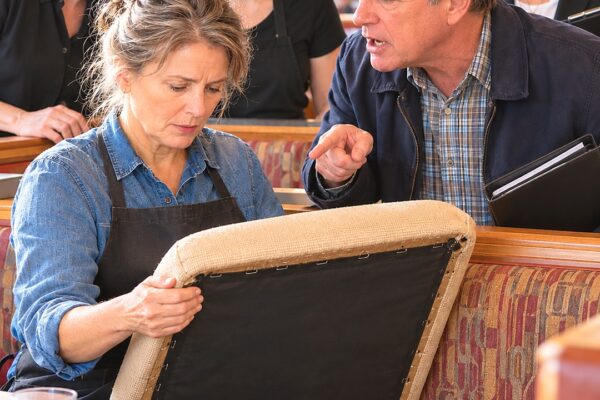
My Daughter Tossed My Button Card—Then the Repair Table Kept Working Without Her
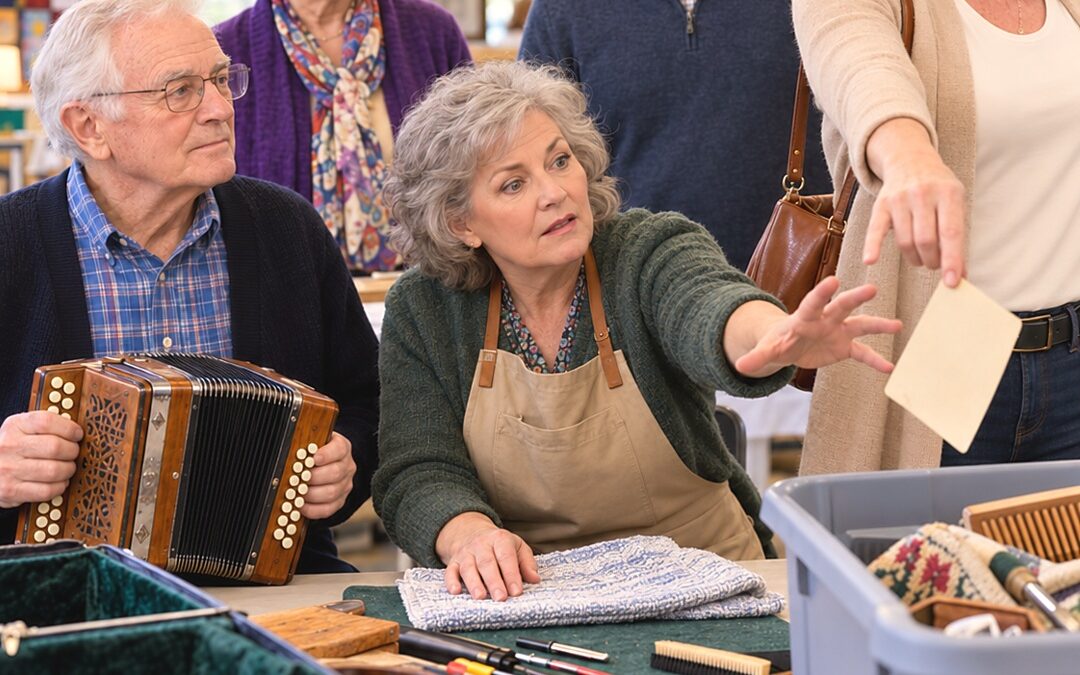
Part 1 — THE BUTTON CARD
Gwen dropped my accordion's button card into the donation bin and said, 'Dad, broken things stay in the bin.' Russ kept counting the money they expected me to hand over Friday. Bess picked the card out without folding it.
We were all downstairs by ten on Monday, October 19, twenty-two adults around the long repair table and the display tables beside it, with coffee in foam cups and instrument cases tucked under chairs.
My eldest daughter had made sure the donation bin sat where everybody could see it.
The card was one sheet of cream paper I had drawn by hand years ago, with rows of circles for the bass buttons on my small accordion and pencil marks that helped me find the lower notes when a room got noisy and my ears stopped giving me much help.
It was worn through at one corner from my thumb.
Bess held it by the edges and laid it flat on the repair table.
“Still works,” she said.
Gwen pushed the bin back under the display table with her shoe.
“It’s paper, Dad.”
“So are checks.”
Russ, my younger son, had a yellow legal pad open in front of him and kept making short marks beside figures he had already written before I arrived.
He had spent most of the past month talking about a music shop he and Gwen wanted to promote after the community project, and both of them spoke about my money as though Friday had already been settled.
Nadine Owings, the club director, stood near the coffee urn with her folder against her hip.
Bess pulled out the chair at the end of the repair table and tapped the tabletop twice so I would turn toward her before she spoke.
“You brought the little one?”
I lifted my button accordion from its case.
She waited until I had both hands on it, then moved the card a few inches closer to the instrument so I could compare the marks with my fingers in place.
“Show me where you lose the bass.”
I put my left hand through the strap.
“Low end, mostly.”
She had worked hourly for me years ago, back when I still took repair jobs every week, and she knew I missed low voices sooner than higher ones now.
She did not lean close and start shouting.
She used the table, the card, and my hands.
I played a short run.
The third bass note dragged.
Bess touched the outside of the casing, then motioned for me to play it again.
I did.
She put two fingers on the bellows frame and nodded once.
“Feel that?”
I played the note a third time and felt the slight hitch under my palm.
“I do now.”
Gwen had come around the end of the table.
“Dad, this is exactly why we wanted the display clean. People are coming Friday. They don’t need old worksheets spread around.”
Bess slid the button card back toward me.
“He’s using it.”
Gwen said, “He can use a fresh one.”
“I can use this one.”
My voice caught on the last word.
One tear reached the crease beside my nose before I got my handkerchief out, and Bess turned to the accordion instead of watching me.
The card had grease shadows at two pencil circles from years of work.
I ran one finger along the worn corner after I put the handkerchief away.
“Thank you,” I said.
“You’re welcome.”
Russ stopped marking his pad.
“We can do family keepsakes later. We need to talk about Friday.”
Nadine shifted her folder to the table.
“What about Friday?”
Russ pointed his pen toward me.
“Dad’s contribution. Six thousand eight hundred forty. Gwen and I have the launch pieces lined up, and we need to know the amount is firm.”
I could hear him because he was facing me.
The exact number carried fine.
“I have six thousand eight hundred forty dollars of my own set aside for repair work here. It stays mine until I see repairs I’m willing to fund.”
Russ leaned one hand on the legal pad.
“We’ve built Friday around that money.”
“You built Friday around money you don’t have.”
Gwen turned from the display table.
“We have finished instruments.”
“Then showing me should be easy.”
Russ closed the legal pad.
“We’re already past the proving stage.”
“I’m not.”
Bess set my accordion on a folded towel and reached for her screwdriver roll.
She was volunteering that Monday because she had agreed to help the club check instruments before the Friday pickup.
No wage had been promised to her for that day, and she had not asked me for one.
She opened the casing while Gwen and Russ moved to the display area.
I watched Bess work for several minutes, mostly by watching where her fingers paused.
When she found the drag, she took my hand and placed one fingertip against the edge of the mechanism.
“Press this bass button.”
I pressed it.
A thin piece inside hesitated before returning.
“Feel it there?”
“I do.”
She wrote a small note on a plain work slip and placed it under the strap.
Ellis Vann came from the check-in end carrying the first tray of instruments marked finished.
There were six of them, each with a DONE tag already hanging from the handle or case latch.
He set the tray on the table between Bess and me.
“Russ wants these ready for the display side.”
Bess wiped her fingers on a shop cloth and looked across the tray.
I reached for the nearest case.
A length of old transport cord was still tied around its handle and through the latch, the same kind people use to keep a tired case from opening in a car trunk.
I took my pocketknife out and cut the cord before I checked the latch.
The knot fell onto the table.
Ellis watched it land.
“That one came in tied,” he said.
“I figured.”
The tag hanging from the handle said DONE in thick black marker.
I opened the case.
Inside was a concertina with dust settled along the grille and a loose strap screw that had not been turned recently.
Bess did not touch it yet.
She looked at Ellis.
“Who checked this one?”
Ellis rubbed the side of his coffee cup with his thumb.
“I brought the tray.”
“That wasn’t my question.”
Russ came over from the display table.
“We’re trying to keep this moving.”
I lifted the concertina enough to see underneath it.
A folded intake slip was still in the bottom of the case.
No work notes had been added.
“Moving where?” I asked.
Russ pointed toward the adjacent display.
“Finished section.”
“After somebody checks it.”
Gwen said, “Dad, all six were already processed.”
“By whom?”
She gave Russ a quick glance.
Russ said, “We have volunteers. You know how these projects work.”
“I know how repair work works.”
Bess loosened the concertina strap screw with two fingers and let it wobble where we could see it.
“This wasn’t finished.”
Ellis drew the tray an inch back toward himself.
“I can put that one aside.”
“All six stay here,” I said.
Russ turned toward Nadine.
“We’re going to lose the morning if every tag becomes a hearing.”
Nadine came over and read the tags without removing them.
“If Harlan is reviewing the work before deciding on his funding, he gets to review the work.”
Gwen said, “The funding was for the Friday launch.”
“No,” I said. “You hoped it would be.”
She started to answer, then stopped when one of the other volunteers moved a chair behind her and the legs scraped the floor.
I kept my attention on the tray.
The second case held a small accordion with one button sitting higher than the rest.
The third had a shoulder strap twisted under the case lid.
Bess opened only enough to inspect without starting repairs.
Russ stayed beside us.
“You’re turning presentation work into a shop inspection.”
I told him yes.
Russ said that was not what they had planned.
I said I knew.
Nadine put her folder down near my elbow.
“What do you need to make a fair decision?”
I told Nadine I needed time with the instruments and somebody qualified to inspect them.
Bess said, “I can finish my volunteer hours today. I can’t give you the rest of the week for free.”
I told Bess I was not asking her to.
Gwen stepped closer.
“Dad, don’t start hiring people into a club project.”
“I can pay for an inspection before I decide what I fund.”
“That makes it look like you don’t trust us.”
I checked the raised button on the second accordion with the pad of my finger.
“It makes it look like I’m checking a raised button.”
Russ exhaled through his nose and went back to the display table.
Bess took the intake slip from the first case and compared it with the tag.
Ellis stayed where he was.
I asked him when the DONE tags had gone on.
“This morning.”
I asked what time.
Ellis said it had been about nine.
Bess turned one of the tags over, then another.
“These aren’t my completion tags.”
— continue reading from here —
Gwen cut in before I could ask the next question.
“We made a clean set so the table wouldn’t look like a repair bench.”
I turned toward Ellis.
“Who told you to put them on?”
Gwen said, “Dad, we don’t need to turn this into—”
“Yes, we do. Ellis?”
Ellis set his cup down on the far edge of the table.
“Russ told me at nine to tag six as done.”
Russ stayed by the display table, close enough to hear.
He did not deny it.
I took the legal pad from beside my chair only because it was mine, not Russ’s, and wrote the time beside the first instrument number from the intake slip.
Nadine watched me write.
Nadine reached for the tags.
“These come off now.”
Ellis removed all six DONE tags and stacked them beside Nadine’s folder instead of throwing them away.
Bess and I had not finished checking every instrument, so Nadine wrote HOLD — UNVERIFIED on six plain cards and Ellis attached one to each case.
“No pickup on any of these until the status is corrected,” Nadine said.
Ellis took the six intake slips to the check-in table, where the owner contact numbers were kept.
He called each affected owner before anyone left for lunch and told each one the DONE notice had been withdrawn, the instrument was on hold for inspection, and the club would give a corrected status before pickup.
I heard the same plain correction six times from across the room.
When he finished the last call, he brought the slips back and laid them beside Nadine’s folder.
I checked the remaining cases with Bess beside me.
We did not repair them.
We checked whether the former DONE tag matched the actual condition in front of us.
Two needed closer inspection before anyone could call them complete.
One might have been fine, though Bess wanted to test it longer.
The last had a case latch problem that could have been case work rather than instrument work, and I left that distinction alone until somebody could verify what the owner had asked for.
By twelve-thirty, the six instruments were still together on the repair table, each carrying a HOLD — UNVERIFIED card.
Russ had moved his legal pad to the display side.
Gwen had rearranged donated music stands twice.
The donation bin stayed under the display table.
My button card stayed inside my case.
Nadine brought over two sandwiches wrapped in waxed paper and set one near Bess.
Nadine said the sandwiches were from the club kitchen.
Bess looked at the clock.
“I have another job this afternoon.”
I asked whether she could give me three short sessions at ten on Tuesday, Wednesday, and Thursday to inspect and repair what could reasonably be handled in that time.
“Sixty dollars each, before I open my tools,” Bess said. “And when the session is over, it’s over. If something needs more time, I stop.”
“That works. One hundred eighty from me, separate from the six thousand eight hundred forty.”
Gwen turned from the display.
“You’re paying her personally now?”
“For these three sessions.”
Bess looked toward Nadine.
“I’m not taking over the project, and today is the only day I’m volunteering.”
Nadine nodded.
Russ came back to the table.
“You’re spending money before deciding where the project money goes.”
“I’m paying for three short sessions so I can see what the work actually needs.”
Gwen said, “You could just ask us what was completed.”
I reminded Gwen that I had.
She moved her mouth as though another answer was ready, then picked up the empty sandwich wrapper and carried it to the trash.
Bess wrote Tuesday, Wednesday, and Thursday at ten on one page of her pocket calendar.
“Bring the sixty before we start each day.”
“I will.”
Nadine took a chair beside me.
“What happens to the six thousand eight hundred forty between now and Friday?”
“It stays where it is.”
Russ repeated the word as a question.
“It stays mine until I decide whether the work earns it.”
“We’ve already told people we’re launching Friday.”
I told him to launch what they actually had.
Gwen came back from the trash can.
“You’re embarrassing us over six tags.”
I slid the first intake slip under its case handle.
I said I was checking six instruments.
Bess finished her sandwich and stood.
“I can give you ten more minutes today.”
“Use them on whichever one worries you most.”
She chose the accordion with the raised button.
Ellis had gone back to check-in, and the room had thinned around the coffee urn as people started packing up their own volunteer jobs.
Bess removed the grille and placed two screws in a parts cup.
She showed me how the button stem sat and had me press it.
I pressed.
The button went down and came back slowly.
I could see the delay even before I felt it.
Bess put the grille back without adjusting the mechanism.
Bess said she would deal with it Tuesday.
I nodded.
She packed her screwdriver roll.
Across the basement, Russ was talking with Ellis beside the check-in table.
Gwen had started putting display cards into clear holders.
Nadine remained by the six instruments.
I carried my accordion case from the end chair to the shelf under the repair table and took the button card out before setting the case down.
The corner Gwen had grabbed was bent upward a little.
I smoothed it against the tabletop.
Bess zipped her bag.
“Keep that flat,” Bess said.
I said I planned to.
She rested one hand on the back of the chair, ready to leave.
Ellis called my name.
He had gone back to the six HOLD instruments and was carrying one of those same cases toward us, the plain HOLD — UNVERIFIED card hanging from its handle.
In his other hand he carried the removed DONE tag that had been on it that morning.
He set the case on the cleared end of the repair table.
“This is one of the six. I want you to see what the tag was covering.”
Bess put her bag back on the chair.
Ellis opened the shallow parts tray inside the case.
A long narrow spring lay in it, dark with age, beside the old work slip.
Bess lifted the accordion from the case and pressed the related button once.
It went down and stayed there.
She released it from underneath with one finger, then pressed it again.
The button stuck a second time.
Nadine took the removed DONE tag from Ellis and laid it beside the HOLD card without putting it back on the case.
The instrument stayed on hold.
I left the button card flat on the table.
Ellis brought me an accordion marked finished that still had its old spring in the tray.
Part 2 — THE PARTS TRAY
Tuesday morning, I laid sixty dollars on the repair table before Bess unzipped her tool bag.
She counted it once, folded the bills together, and put them in her purse.
“Now I’m working.”
Nadine was already at the far end of the basement with the six HOLD — UNVERIFIED instruments lined up where we had left them Monday, while the old DONE tags sat separately beside her folder.
None hung from an instrument.
I set my button card flat under the lid of my own accordion case, with the bent corner smoothed against the cardboard pocket.
My little accordion stayed under the table.
The six customer instruments stayed on top.
Bess checked the wall clock and reminded me that this was the short session we had agreed on, with no extra work added after the clock ran out.
“If somebody brings me extra work, I say no.”
I told her she could say it to me first.
“That would save travel.”
She opened the case Ellis had brought back at the end of Monday.
The HOLD card still hung from the handle.
The removed DONE tag stayed with Nadine, not with the case.
Bess pressed the button that had stuck twice Monday, then opened the grille.
I stood on her left where I could see her hands.
She lifted the old spring from the shallow tray and compared it with the spring still fitted inside.
I asked whether the loose one really was the old spring.
“It is.”
I asked why the button still stuck.
Bess moved the button with one finger and watched the return before answering that a spring lying in a tray proved very little by itself.
“This one has a return problem right now. That’s what matters.”
She removed the fitted spring and set it beside the loose one.
I could see one had a cleaner bend, though Bess chose neither until she had checked the linkage underneath and moved the button through its full travel again.
I reached toward my own accordion case and asked whether she wanted mine on the table too.
“No. Yours can wait. We’re spending this session on the hold instruments.”
That suited me.
The button card stayed flat.
Bess worked the stuck button again, then had me place a fingertip against the outer end while she moved the mechanism from inside, and the delay came through my finger before I could hear anything useful from it.
“That’s the part I want you to notice.”
I nodded.
She returned to the spring.
Gwen came down the basement steps carrying two empty display holders.
She crossed behind me and stopped at the parts side of the table.
“We need this cleaned up before people start coming through.”
I told her people were not coming through now.
She picked up the shallow parts tray from beside Bess.
Bess still had one hand inside the accordion.
“Put that back.”
Gwen held the tray against her sweater and said she needed one decent display of what repair work looked like.
“That tray is part of this repair.”
“It’s full of old pieces.”
Bess withdrew her hand and closed her tool roll halfway.
“Gwen, put it back.”
Gwen looked toward the display table and mentioned the empty holders over there.
Nadine came from the other end.
“Return it now.”
Gwen carried the tray to the display table anyway.
She set it inside one of the clear holders, spread the old spring and two small pieces apart with a fingertip, then turned the holder toward the room.
Bess checked the clock again.
I went after the tray.
Nadine got there first.
She lifted the whole tray out of the holder and brought it straight back to Bess.
“The same tray.”
Bess checked the pieces against the work slip and accounted for the spring and the small washer.
Gwen followed Nadine back.
“I only moved it twenty feet.”
“You moved a needed part out of my work area.”
Gwen pointed out that it had come right back.
“The working slot didn’t.”
Bess set the washer beside the instrument.
I looked at the clock and saw that enough of the session had gone that she no longer had room for the next check she had planned.
I asked whether she could stay a little longer.
“No.”
I nodded.
Bess went back to the return mechanism.
Gwen told me I was paying for an hour and letting Bess quit with work sitting on the table.
Bess kept her eyes on the accordion.
“I’m being paid for the time we agreed on. I stop when it ends.”
I told Gwen that was the agreement.
Gwen picked up the empty display holder and carried it away.
Bess fitted the spring she had chosen, tested the button several times, then put the grille back on and handed the instrument to me without removing the HOLD card.
“Press it.”
I did.
The button came back cleanly.
I pressed it again, slower this time.
It returned, but Bess took the accordion back before I could call it finished.
“One good check doesn’t clear it.”
I asked what else she wanted.
She wanted it played, rested, and checked again, which we no longer had time to do in Tuesday’s paid session.
I glanced toward the display table where Gwen had left the empty holder.
Bess saw me do it.
“Don’t buy the missing time from me after somebody wastes it.”
“I won’t.”
She said the instrument would remain on hold.
I asked whether Wednesday would be soon enough to finish the check.
“If it fits Wednesday’s session. Otherwise it waits.”
She packed the tools she had used.
At the end of the paid session, the button returned cleanly, but the instrument stayed on HOLD because Gwen’s tray move had cost the next working slot.
Bess closed her bag at the agreed time.
Nadine kept the six HOLD instruments together.
I put my own accordion case back under the table with the button card still flat inside.
By early afternoon, Russ had replaced Monday’s legal pad with a stack of pickup cards and was writing on one at the check-in table while Ellis sorted owner slips beside him.
The Friday review was still written across the general pickup notice.
Russ pulled one card from the stack.
“Toby Senn can come Wednesday.”
Ellis stopped sorting.
“His instrument is still on hold.”
“I know. I’m changing Toby’s pickup.”
Nadine came over with the owner slips.
“The general Friday review hasn’t changed.”
Russ said Toby wanted his instrument, and Wednesday would let him see where it stood.
Nadine took Toby’s card and drew a line through the pickup wording.
“He can come Wednesday for a status check. That does not promise release.”
Russ said, “You can write whatever makes you happy.”
“I’m writing what is true.”
She put the corrected card beside Toby’s owner slip.
Ellis took that version and called him.
He told Toby directly that his accordion was still HOLD — UNVERIFIED, Wednesday was only a status check, and the general Friday review remained in place.
Then he held the receiver toward me.
“He wants you.”
I took it.
“Harlan, why’d my pickup card change if my accordion is still on hold?”
“Russ moved your date. Nadine corrected the notice. You’re not cleared to take it home.”
“So what am I coming for Wednesday?”
“To see where it stands. Bess will be working, and I’ll be there.”
Toby asked whether he could take it if Bess cleared it.
“Yes. If it clears.”
“And if it doesn’t?”
“It stays here, and Friday’s review is still Friday.”
He paused.
“I’d rather see it than get another card.”
“Then come Wednesday.”
“All right. I’ll come.”
I handed the receiver back to Ellis.
Ellis gave Toby the time Bess and I already had, repeated that there was no promise of release, and when the call ended, he put Toby’s corrected card with the owner slip.
Russ returned before Ellis had finished stacking the papers.
“Toby knows?”
“Still on hold. Wednesday is a status check, and the Friday review stays the same,” Ellis said.
Russ pulled the corrected card out, read it, and put it back with Toby’s owner slip.
He went toward the display table.
My own accordion case was still under the repair table, and the button card inside had stayed flat.
Bess and Toby would both be back Wednesday.
Russ came up behind me with both hands empty.
I turned so I could hear him without making him repeat himself.
He nodded toward the check-in table.
“That card wasn’t my wording.”
I reminded him that he had changed the pickup.
“I told Ellis to handle the cards.”
Ellis was close enough to hear that.
He stopped sorting.
Russ said the pickup cards were already out of his hands.
Part 3 — THE LOW NOTE
Wednesday morning, I put sixty dollars on the repair table before Bess opened her bag.
She counted it, tucked the bills together, and put them in her purse.
Tuesday's sixty had already been paid, and Wednesday's was now paid before work.
Thursday's sixty was still in my wallet.
The six HOLD — UNVERIFIED instruments were lined up along the table when Toby Senn came down the basement steps before ten with his cap folded in one hand, early for the status check Russ had moved to Wednesday, and Russ followed him in from the check-in side.
“You beat us to it, Toby.”
Toby held up the corrected card Ellis had given him.
“This says status check. Yours said pickup.”
Russ took the card, read Nadine’s handwriting, and handed it back.
“It’s paperwork. Your accordion’s been worked on.”
Toby looked at me.
“Can I take it home if it plays?”
I said it had to be cleared first.
Russ pulled Toby’s case from the six and set it on the open end of the table.
“It was basically done Monday.”
The HOLD card still hung from the handle.
Bess had not touched her tools yet.
She pointed to the card.
“Then it stays on hold until I check it.”
Russ stepped aside with both palms open.
“Check away.”
Toby opened the case himself.
He kept one hand on the lid and waited while Bess checked the owner slip against the HOLD card, then moved back enough to give her the end of the table.
When Toby lifted his accordion from its case, I saw a worn bass strap and a row of low buttons sitting even under his fingers.
Toby put it on and played a short tune I recognized from club nights.
The melody came through clean enough to me.
Bess stopped him with one raised finger.
“Again, but take the bass down slow.”
Toby played the lower row one note at a time.
I heard the first two.
On the third, I heard air and enough tone that I thought the note was there.
Toby played it again.
“What do you hear?” Bess asked me.
“Sounds fine.”
She turned toward Toby.
“Play the note above it.”
He did.
That one filled the room better.
Then she had him go back down.
The lower note came out weak and late, though most of what reached me sounded like bellows noise.
Russ said, “That’s an old accordion. They don’t all sing like a piano.”
Bess asked Toby to play the same low note while she watched his left hand instead of the keyboard side.
The note lagged again.
Toby kept the instrument against his chest.
“It didn’t do that before I brought it in.”
Russ said the room was noisy and Harlan had just cleared it.
I had.
I reached for the HOLD card.
Bess put two fingers on the case handle before I could remove it.
“No.”
Russ said, “He just listened to it.”
Bess looked at me.
“You heard enough to clear that note?”
I wanted to say yes because I had already said it sounded fine.
Instead I asked Toby to play the low note once more.
He did.
I heard the breath of the bellows and a low sound under it, but I could not tell whether the note started when his finger did.
Bess moved around the table and stood where I could see her face.
“Don’t clear what you can’t check.”
Russ made a short sound through his nose.
“We’re turning one weak bass note into a federal case.”
Toby took the accordion off.
“I’m not taking it if she says it isn’t checked.”
Bess nodded toward the case.
“Good. Put it back.”
Russ told Toby he could probably play it all week without noticing.
Toby set the accordion into the case.
“I noticed standing here.”
Bess left the HOLD card attached.
I put my hand back on the table.
“That stays.”
Russ looked at me.
“You already called it good.”
“I called it good too soon.”
Toby closed the lid.
Bess asked him to leave the case open enough for her to work when his turn came, then checked the wall clock again.
His early arrival had not changed her start time.
At ten, she opened her tools and told Toby she would check the low note while he was there, though she would not promise that his accordion would leave the basement that day.
Ellis came over from the check-in table carrying the Monday owner slips under one arm.
“Toby got the corrected card?”
Toby held it up.
“I got this one.”
I asked Ellis to give him the short version.
“I put DONE tags on six instruments Monday before they were verified. Russ told me at nine.”
Russ said, “We covered this.”
“We did,” Ellis said. “Nadine removed all six that morning, put them on HOLD — UNVERIFIED, and I called every owner before lunch. I should not have tagged them DONE.”
Toby tapped his corrected card against his palm.
“That’s what I remember. Mine was on hold.”
Nadine took the owner slips from Ellis and set them beside her folder.
“The Monday corrections stand. Nothing leaves because somebody preferred the old wording.”
Russ turned away.
Bess had Toby play the low note again while she watched the bellows and listened close to the grille.
She did not open the instrument immediately.
She had him repeat the note at softer pressure, then stronger pressure.
The tone appeared only after he pushed harder.
Bess pointed at the HOLD card.
“This stays.”
Toby said he was fine with that.
Russ left the repair side and went to the display table.
The clear holder Gwen had used Tuesday was empty.
Bess worked through the rest of her paid session without letting Toby’s early arrival turn into extra unpaid time, inspecting the low side, making one adjustment, closing the instrument, and testing it again with him before the agreed session ended.
The note improved, but she would not clear it yet.
Toby asked whether he should come back Friday.
Nadine said the general Friday review still stood.
Toby put his cap on.
“Then I’ll come Friday.”
He left his accordion on the HOLD table.
After he went upstairs, I sat beside Nadine with my own accordion case under my chair.
My button card was still flat inside it.
The six thousand eight hundred forty dollars was still mine and still untransferred.
I asked Nadine what a real six-week repair project would look like if the club ran it instead of using the money for Gwen and Russ’s launch plans.
Nadine pulled her folder closer and, while Bess wiped down her tools at the other end of the table, described a defined repair table with actual repair work and someone responsible for what left it.
Nadine asked whether Bess would consider a paid six-week pilot if the club held the project money and paid for repair work and parts through the project.
Bess did not answer right away.
She zipped one pocket, then left the main bag open.
“I’ll consider a six-week pilot. Paid work. Defined hours. I’m not being handed a permanent job, and I’m not taking responsibility for whatever somebody tags when I’m not here.”
Nadine said that was reasonable.
I asked whether the club could keep the repair table separate from the display side.
Nadine said yes.
Russ had come halfway back across the room.
“So now the money goes to Bess?”
I turned toward him.
“No money went anywhere today.”
“You’re setting it up.”
“I’m asking what the work would be.”
Russ said Gwen had already built Friday around the store launch.
Nadine told him Friday could still be Friday without pretending the project money had been transferred.
She kept my name off the project page in her folder and left the amount as a proposal while we talked.
He asked whether I was really going to pull the full amount away from them over tags and one bass note.
I told him the money had never been theirs to pull away.
Bess closed her bag.
“If there is a pilot, I want the terms before I start it.”
Nadine said she would put the six-week scope in plain language for Thursday.
I said I would come in person.
Russ asked whether that meant I had decided.
“It means I’ll read it Thursday.”
He walked back to the display side.
Nadine kept her folder open and began marking the points she and Bess had discussed without asking me for a check.
I brought my own accordion case onto the table after Bess had finished packing.
The worn button card slid a little inside the lid.
I flattened it with my fingertips.
Bess looked at my little accordion.
“You want to try yours before I go?”
I put it on.
The bass drag from Monday was still there, but I could find it because I knew what it felt like under my hand.
I played the same short run.
Bess listened, then pointed toward Toby’s closed case on the HOLD table.
“You were ready to clear his.”
“I was.”
“What did you hear?”
“Enough tone that I thought it was working.”
She asked whether I had heard when the low note actually started.
I rubbed my thumb along the edge of my own bass strap.
“No.”
Bess picked up Toby’s accordion again and opened the bellows just enough to move air.
She pressed the low button once.
The sound reached me late.
I started to say the note was better.
Bess asked me to put my palm against the bellows before I said it was fixed.
Part 4 — THE BELLOW
Thursday morning, I put the last sixty dollars on the repair table before Bess opened her bag.
She counted it, put it away, and checked the clock.
“That makes all three sessions paid.”
“It does.”
That brought the three short sessions to one hundred eighty dollars from my own money, separate from the six thousand eight hundred forty dollars that still had not moved.
Toby’s accordion was already on the table with its HOLD — UNVERIFIED card attached.
My own small accordion stayed in its case beside my chair, with the button card flat inside the lid.
Bess opened Toby’s case and had me stand on the bass side.
“Yesterday you heard enough to call this good.”
“I heard a note.”
“You heard part of one.”
I cleared my throat and put my hand on the edge of the table.
“I can hear more than you think I—”
The sentence stopped before I finished it.
Bess waited.
I looked at Toby’s accordion.
“Do it again.”
She lifted the instrument, opened the bellows a few inches, and pressed the low button while I listened.
A weak note came after the rush of air.
I started to say it was there.
Then I put my palm against the bellows as she had asked me Wednesday.
She pressed the button again.
The bellows moved under my hand before the tone settled.
I took my hand away, cleared my throat once, and put it back.
“Again.”
Bess did it again.
This time I watched her finger and felt the bellows at the same time.
The note arrived late.
“All right.”
She gave me the accordion.
I pressed the low button myself and opened the bellows carefully.
The delay was easier to feel than hear.
Bess asked what I had now.
“Air first.”
She nodded.
I put the accordion back on the towel.
Russ came down from the display side while Bess was checking the bass row.
He stopped beside us and looked at the HOLD card.
“Still this one?”
“Yes,” Bess said.
Russ leaned over Toby’s accordion.
One of the low buttons had a little side play under his fingertip.
“That’s your problem.”
Bess told him to leave it alone.
Russ pressed the loose button down, twisted it slightly with two fingers, then worked it up and down until it sat straighter.
“There.”
He played the low note.
It sounded stronger from where I stood.
Russ looked at me.
“You hear that?”
“I hear more note.”
He held the instrument toward Bess.
“Then clear it.”
Bess took it from him.
She pressed the same button twice without playing, then opened the bellows and sounded the low note.
The first try came through.
On the second, the button shifted under her finger and the note thinned behind the air.
She put the accordion on the table and pressed the button while I kept my palm on the bellows.
The movement came first again.
Russ heard the breath of air too.
Bess asked him to press the button.
He did.
It rocked sideways.
“It needs more than being reseated by hand.”
Russ said he had just made it work.
“You made it work once.”
“Twice.”
“Then it failed again.”
Russ looked at me.
“This is getting too fussy.”
I did not answer for Bess.
The HOLD card stayed attached to Toby’s case.
Russ told her Toby could try it himself Friday before the group review.
“He can try it. He can’t take it unless it clears.”
Russ said Friday would settle it.
Bess checked the clock and returned to the work she could finish inside the paid session.
She did not extend the time because Russ had handled the button.
When the session ended, Toby’s accordion was still with the other HOLD instruments.
Bess closed her tools.
The three short sessions I had hired her for were finished.
The pilot was still a separate decision.
Nadine was waiting with her folder at the end of the table.
She had written out the six-week terms we had discussed Wednesday in plain language.
Bess read them standing up.
The repair table would be paid work for six weeks, with defined hours agreed in advance, repair work and needed parts paid through the club project, and no promise that the arrangement continued after the pilot.
Bess tapped one line.
“I decide whether a repair fits the paid time I have. If it doesn’t, it waits or gets scheduled.”
Nadine said yes.
Bess asked who could mark an instrument ready.
Nadine said the paid repair table would clear its own work, while anything outside that table stayed under club review until somebody qualified checked it.
Bess read the page again.
“I can work under that.”
I asked whether she was accepting the six-week pilot if I funded it.
“Yes. The pilot. Paid hours. Six weeks.”
She closed the folder and handed it back to Nadine.
Nadine asked whether Bess wanted any promise about how many instruments would come through the table.
“No. Promise me the hours and let the work be the work.”
I asked what happened if more instruments came in than she could finish.
“They stay waiting. I don’t make DONE tags to make the table look busy.”
Nadine wrote one short note in the margin.
Russ, still within earshot, said the club needed something people could see happening Friday.
Bess zipped her bag.
“They can see me work.”
He asked whether she planned to spend six weeks inspecting things nobody could hear were wrong.
Bess looked at Toby’s case.
“Harlan heard that one wrong yesterday.”
I said, “I did.”
Russ glanced at me, then away.
No one called the pilot a permanent job.
I picked up my coat.
“I’m ready.”
Nadine and I left the basement together.
We handled the transfer in person that afternoon.
She had the club project paperwork with her, and I had the funds I had kept uncommitted all week.
I read the project line before I moved anything.
It named the six-week paid repair pilot, with Bess’s work and project parts under the club, not Gwen and Russ’s store launch.
I transferred the full six thousand eight hundred forty dollars into the club project.
The confirmation showed the transfer completed while I was still there.
I asked whether Gwen or Russ could redirect it to the launch.
“No. The club received it for this project.”
Nadine gave me the project receipt, and I folded it once into my wallet.
“That opens the table Friday,” she said.
“Yes.”
“The three sessions you already paid Bess are separate.”
“Yes.”
Nadine put her copy of the confirmation in her folder.
By the time we returned to the basement, Gwen and Russ were both there.
Gwen was moving display holders into a straight row.
Russ had Toby’s owner slip in his hand.
Nadine set her folder on the repair table.
“I need both of you here.”
Gwen turned.
Russ came over slower.
I stayed beside Nadine.
“The six thousand eight hundred forty has been transferred to the club repair project for the six-week paid pilot,” Nadine said.
Gwen stared at me.
“You actually moved it?”
“Yes.”
Russ put Toby’s slip down.
“You said yesterday you were only reading terms.”
“I read them today.”
“And then you gave her all of it.”
“I funded the pilot.”
Gwen walked around the end of the table.
“You knew what Friday was supposed to launch.”
“I knew what you wanted Friday to launch.”
“You could have funded both.”
“I chose the repair project.”
Russ asked Nadine whether the transfer could be reversed.
Nadine said Harlan would have to ask for that himself.
Gwen came closer to me.
“Then reverse it.”
“No.”
“You haven’t even opened the pilot.”
“It opens Friday.”
Russ said they had spent the week building the display around my contribution.
“We planned around what you told us.”
“I told you I had money set aside if the repair work proved real. I did not promise it to the store launch.”
Gwen pointed toward the HOLD table.
“You’re moving the whole amount over one bad week.”
“The six instruments were tagged done before they were verified. Toby is still on hold, and Wednesday I cleared his low note too early myself. The work needs the repair table.”
Gwen said the store launch would bring more attention to the club.
“Maybe it would.”
“Then why do this?”
“Because attention does not finish an instrument.”
Russ tapped Toby’s owner slip against the table once.
“And Friday?”
“I’ll be there. I’ll explain my part too.”
Gwen said, “You can still fix it before then.”
“The money is already with Nadine, and I’m not reversing it.”
Gwen turned toward Nadine.
“You’re really going to open that table tomorrow after he does this?”
Nadine said the money had been received for the pilot and the table would open under the terms Bess accepted.
Russ picked up Toby’s owner slip again.
“At least let Toby settle his own instrument before you make a show out of this.”
Nadine said Toby was already coming Friday under the same HOLD status he had accepted.
Russ looked toward Bess, who was still at the repair end beside the paid table.
“You heard all this?”
Bess rested one hand on the table.
“I heard enough.”
Gwen told her the pilot was replacing work the family had planned.
Bess said she had accepted paid repair hours, not the family’s plans.
Russ asked whether she planned to start first thing Friday.
Bess looked at Nadine.
Nadine asked Bess what time she wanted her paid table open on Friday.
Part 5 — THE PAID TABLE
“Ten,” Bess said Thursday when Nadine asked what time she wanted the paid table open.
So at ten Friday morning, all twenty-two people who had been in the basement Monday were back around the same repair table and the display beside it.
Nadine had cleared one end for Bess’s six-week paid pilot, and the six customer instruments still carried the HOLD — UNVERIFIED cards they had worn since Monday.
My own accordion case sat beside my chair with the button card flat inside the lid.
Toby stood at the end of the table with his cap in one hand while Russ brought over Toby’s owner slip.
The slip was not a clearance.
Russ set it beside the case.
“Try it now.”
Toby opened his accordion and put it on.
Russ pointed to the low button he had reseated Thursday.
“That’s the one. I fixed the play in it.”
Bess stood on Toby’s other side with her hands off the instrument.
“Play it before anybody calls it fixed.”
Toby worked through the bass row.
The first low note came.
The next one came late.
On the third pass, the loose button shifted under his finger and stayed down until he nudged it from the side.
Russ leaned closer.
“Again.”
Toby played it again.
The button returned once, then hung on the next try.
The room had enough people in it that I lost part of the low tone under chairs moving and a cough near the coffee table, but I could see Toby’s finger come up while the button stayed low.
I stepped forward before Russ could speak.
“Wednesday I said that instrument sounded good enough to clear.”
Toby looked at me.
I kept going.
“I was wrong. I heard enough of the note to think the whole thing was working, and I said so before I checked what I could actually hear.”
Bess did not touch the accordion yet.
I put my palm lightly against the bellows while Toby pressed the low button once more.
The air moved before the tone settled.
“That’s what I missed.”
Russ said, “And I reseated the loose button yesterday.”
“You did.”
“It worked when I did it.”
“It did, and then it failed again.”
Toby took the accordion off and set it back in the open case.
“I’m leaving it here.”
Bess checked the button herself, then left the HOLD card attached.
No one replaced it with anything else.
Gwen stood beside the proposed display table with a narrow sign clipped to the front edge.
She had been using the display to show what she and Russ called the completed side of the week.
I turned toward her and Russ.
“Monday you told people we had finished instruments.”
Gwen said they had completed work on several.
“How many were verified finished when the six DONE tags went on?”
She did not answer at once.
Russ said, “The work was farther along than it looked.”
“That isn’t the question.”
Ellis stood near the check-in table.
Russ looked at him, then back at me.
“None of those six had been verified finished when Ellis tagged them.”
Gwen said, “We should not have presented them as completed.”
I asked her to say it so the people who heard Monday could hear Friday too.
She faced the room instead of me.
“The six instruments with DONE tags Monday had not been verified complete.”
Russ added, “The completion claim was too broad.”
Ellis stepped away from check-in.
“I put those tags on without checking the instruments. Russ told me at nine Monday to mark the six DONE, and I did it.”
One of the older volunteers asked whether the owners had ever been left with that bad status.
Ellis shook his head.
“Nadine removed all six DONE tags Monday. I called every affected owner before lunch and told them the instruments were HOLD — UNVERIFIED.”
Nadine lifted the folder from her table.
“That correction has been in place all week.”
Toby closed his case but left it on Bess’s side.
Russ picked up Toby’s owner slip and carried it back to check-in.
He slid it under the other papers instead of leaving it near the instrument.
Gwen turned from the display.
“Fine. The tags were wrong. That still doesn’t mean Dad had to move all six thousand eight hundred forty dollars away from what we planned.”
Several heads turned toward me.
Russ came back from check-in.
“You can still ask Nadine to send it back. We asked you yesterday.”
I took the folded receipt from my wallet and held it long enough to confirm the project line, then put it back.
“The transfer is done.”
Gwen said, “You can reverse a decision.”
“I can. I’m not.”
She pointed toward the display side.
“We built Friday around your contribution.”
“You built it around what you expected me to do.”
Russ said the pilot did not need the whole amount to open.
I told him the six-week project was already funded under the terms Nadine and Bess had accepted Thursday.
Gwen asked whether I wanted everyone there to believe a repair table mattered more than the family plan.
I looked at the same people who had watched her drop my button card into the donation bin Monday.
Then I looked back at Gwen.
“My money stays with the work, Gwen. You're welcome to help.”
Gwen unclipped her own proposed table-name sign and held it over the display table as if she meant to set it down, but every open spot had something on it.
She let the sign hang from one finger at her side.
Nadine opened her folder.
“Then the paid table opens now.”
Bess moved her tool bag onto the cleared end of the repair table.
Nadine placed the pilot sheet beside her, with the six-week terms already accepted and the project confirmation behind it.
Bess read the top line once more, then set out only the tools she needed for Toby’s instrument.
She did not touch the display sign.
Toby moved his case in front of her.
“Mine first?”
“You’re here.”
He sat down beside the table.
The other HOLD instruments stayed where they were.
Nadine told the room the pilot was funded for paid repair work and project parts, separate from the three short sessions I had already paid for.
Russ said, “So this is what everybody came to see?”
Nadine answered that the Friday review was still happening, and the pilot table was now part of it.
Gwen put her sign on a chair after one of the volunteers moved a coat.
She asked Nadine whether the club was really going to let a donor redirect the whole project after a family disagreement.
I said, “Don’t put that on Nadine. I chose where my own money went.”
Gwen turned toward me.
“And you chose against us.”
“I chose the repair project.”
Russ said the club had relied on him and Gwen to coordinate the season.
Nadine closed the folder halfway.
“That brings us to the review.”
She asked the people who had handled the week’s work to stay around the table.
Nobody left.
The review started with Monday.
Nadine turned to Ellis.
“I put six DONE tags on without checking because Russ told me to. You removed all six that morning, and I called every affected owner before lunch.”
Nadine asked Russ why he had moved Toby’s pickup while the HOLD status remained.
Russ said Toby wanted his instrument and he thought a Wednesday check could settle it.
I reminded the room that Nadine had changed the card from pickup to status check.
Russ said, “Yes.”
Nadine asked Gwen why she had taken Bess’s active parts tray Tuesday.
Gwen said she wanted a repair display and should not have taken a tray that was still in use.
Then Nadine looked at me.
“And Wednesday?”
“I cleared Toby’s low note too early because I thought I heard enough. Bess stopped the release.”
Toby said, “That’s what happened.”
Nadine wrote one line in her folder.
Russ asked whether they were all going to lose their places over a week where mistakes had already been fixed.
Nadine said the club was reviewing next season’s funding and coordination roles, not anybody’s outside work and not anyone’s family relationship.
The people around the table talked it through in front of us.
Two volunteers said Russ had pushed completion before verification.
Another said Gwen had treated the repair work like display material Tuesday.
Someone else pointed out that both of them had kept pressing for the funding after the six instruments went on HOLD.
Gwen said, “We were trying to keep the project moving.”
Nadine said the problem was what they had called movement.
Russ asked what the decision was.
Nadine looked around the table one last time.
“The club will not put Gwen or Russ in next season’s funding or coordination roles.”
Gwen’s sign was still on the chair beside her.
Russ asked whether that was final for next season.
Nadine said yes.
He folded his arms and looked toward the check-in table.
Gwen said, “So we’re just out.”
“Out of those roles next season,” Nadine said. “Nothing more than that.”
I stayed where I was beside my accordion case.
No one asked me to vote.
Ellis gathered the owner slips and returned to check-in.
Russ did not stop him.
Bess pressed Toby’s low button again and had him try it.
It returned cleanly this time.
She still tested it twice more before removing the HOLD card and setting it beside the case.
Toby played the low row himself.
The note started when his finger moved.
Bess handed the accordion back to him.
“That one can go.”
Toby closed the case.
He nodded toward my chair.
“You staying here for the pilot, Harlan?”
I opened my own case.
The button card was still flat inside the lid.
I looked at Bess’s paid table, then at the little accordion I had carried in Monday.
Bess asked whether I was coming back as a customer or bringing my own tools.
Part 6 — ONE MORE NOTE
“Tools,” I told Bess Friday. “If Nadine still wants a volunteer.”
Saturday morning I went back to the basement without asking anybody to make room for me.
Gwen was already there, with her proposed table-name sign still on the chair where she had left it Friday and the clear display holders lined up along the wall instead of across the repair side.
She picked up the sign first.
I stopped beside my chair and watched her unclip the last fastener from the cloth she had used on the display table.
“You taking it down?”
“Yes.”
She folded the cloth once, then again, and set it on the chair under the sign without saying anything about the six thousand eight hundred forty dollars she had wanted me to reverse Thursday.
Instead, she carried the empty holders to the storage shelf first.
Nadine was at the paid table with her folder open while Bess worked with one of the five remaining HOLD — UNVERIFIED instruments in front of her and kept the other four arranged along the wall side of the table.
Toby’s case was gone.
He had taken his cleared accordion Friday.
Russ did not come down Saturday.
Gwen lifted the sign from the chair.
I said, “If you want to help here, ask Nadine or Bess what needs doing. I’m not putting money into another display.”
She tucked the sign under one arm.
“I heard you yesterday.”
“All right.”
She carried it toward the storage end.
Bess looked up from the instrument in front of her.
“If she wants work, I have chairs that need moving before I start the next case.”
Gwen heard that.
She stopped, looked at the chairs, then set the sign on the storage shelf.
“I can move chairs.”
Bess pointed to two that blocked the side of the paid table.
“Those.”
Gwen moved them against the wall.
She did not pull up a chair for herself afterward.
Nadine handed her one of the empty display holders.
“This goes with the rest.”
Gwen took it.
No one asked me for a check.
By ten, the old display side was clear except for one bare table, and Bess’s paid repair table was working without it as she opened the first HOLD case, checked Ellis’s owner slip, and found a loose grille beside a key that did not come all the way back.
Bess worked on the grille first.
I stood far enough back to stay out of her elbows.
Gwen remained near the storage shelf for several minutes, stacking the clear holders so they would not slide.
Then she came to the end of the paid table.
“What else?”
Bess looked at Nadine.
Nadine told Gwen there were intake cards that needed to be put in case order.
Gwen took the small stack.
She did not touch the HOLD cards.
I watched her match one owner slip to a case, then another.
She got the third one wrong.
Bess caught it before the slip reached the case.
“That one belongs there.”
Gwen moved it.
“I see it.”
Bess went back to the loose grille.
The paid table kept moving.
One instrument stayed open in front of Bess while the other four waited with their HOLD cards attached, and when she reached the key that would not return, she pressed it several times before stopping and setting the instrument back down.
Nadine asked whether it would clear Saturday.
“Not yet.”
The HOLD card stayed on.
Gwen glanced at it but said nothing.
I sat beside my own accordion case while Bess kept working.
Gwen finished sorting the intake cards and brought them to Nadine, who checked the order against the owner slips before sliding the stack back across the table.
“These are right.”
Gwen nodded.
She looked toward Bess’s table.
“I’m leaving after I put the cloth away.”
I said, “All right.”
She carried the folded cloth to the storage shelf beside her sign.
When she came back past me, she stopped at my chair.
“I’m not asking you to change the transfer.”
“I know.”
“I still think you handled it wrong.”
“I know that too.”
She rubbed one thumb along the edge of the chair back.
“You really going to work here?”
“If Bess lets me.”
Bess answered from the table.
“I haven’t seen his tools yet.”
Gwen looked at me.
“You heard her.”
“I did.”
She picked up her coat.
I did not ask her to stay.
She went upstairs, and the basement door closed behind her.
Bess kept working on the same HOLD instrument.
The other four stayed lined up beside it.
At noon, none of the five had been released.
Nadine closed her folder for lunch.
I closed my own accordion case.
“I’m going home for something.”
Bess said, “If it’s a display, leave it there.”
“It isn’t.”
I went upstairs with my case.
After lunch I came back carrying my small accordion in one hand and my old canvas tool roll in the other, and Bess was still at the paid table with the same five HOLD instruments, working in a different case while the first waited for a part she had set aside for later.
I put the tool roll on the far end of the table.
Bess looked at it.
“That yours?”
“It was the last time I checked.”
She opened one flap.
My screwdrivers were still in the stitched pockets where I had kept them for years.
The handles had gone dull.
One narrow driver had tape around the middle because I had never found another one that felt right in my hand.
Bess closed the flap.
“You remember how to use them?”
“Some days.”
“That answer I believe.”
Nadine was sorting owner slips at check-in with Ellis.
Neither came over.
I set my own accordion case on the chair beside me and opened it.
The button card lay flat inside the lid.
Bess nodded toward the second HOLD case.
“Start with the grille screws. Don’t adjust anything underneath until I check it.”
I unrolled my tools.
The first screw came out clean.
The second one fought me.
I changed drivers instead of forcing it.
Bess watched from the other side of the table while she worked on another instrument.
“You used to teach that part.”
“I used to have younger fingers.”
“You still have the screwdriver.”
I loosened the second screw.
The grille lifted.
I set both screws in a cup and stopped there.
Bess came over and checked the inside before telling me what she wanted next.
I followed her lead.
We worked that way through the early afternoon, one small task at a time, with Bess sometimes giving me the next step and me sometimes telling her what I thought I saw before I touched anything and waiting until she agreed.
When I could not hear a low response clearly, I put my fingers where I could feel the motion instead of guessing from the sound.
The HOLD card stayed attached to the case.
At one point Gwen’s bare display table stood behind us with nothing on it except two folded chairs leaning underneath.
I cleaned an old screw, replaced it in the grille, and handed the driver back to my left hand.
Bess checked the key return.
“Better.”
“Clear?”
“No.”
I put the screwdriver down.
Near the end of the afternoon, Bess closed the customer case we had been working on and left its HOLD card in place.
It needed more work Monday.
The other four were still HOLD too.
Nadine gathered the slips and put them back at check-in.
I rolled my tools slowly, leaving one screwdriver out.
Bess looked at my open accordion case.
“Your turn?”
I lifted my small accordion onto the table.
The bass drag from Monday was still there.
I had spent most of the week touching other people’s instruments, listening where I could and using my fingers when the low sounds blurred together, so when I lifted my own onto the table it felt smaller in my hands than I remembered.
I took the button card from the lid.
The worn corner caught against my thumb.
I set the card beside the accordion and put my left hand through the strap.
The first bass button came back normally.
The second did too.
The third dragged.
I knew that one.
Bess stood across from me.
“You want me to open it?”
“Not yet.”
I played the short run from Monday.
The low part blurred together in the room.
I stopped.
Bess waited.
I played it again and lost my place on the lower row.
The card sat beside my elbow with the pencil circles facing up.
I reached for it.
My fingers folded the top edge toward the bottom as if I meant to put it away inside the case.
The crease started through the blank margin.
I pressed it another inch.
“I used to do this without—”
My hand stopped.
I opened the card again before the crease reached the middle.
The worn corner had curled upward.
I smoothed it against the table with the side of my thumb.
One eye watered enough that I wiped under it with the heel of my hand.
I cleared my throat.
Bess did not reach for the accordion.
I pushed the card across the table toward her.
“Hold it flat for one more note.”
She put one hand near each edge without covering the pencil circles.
I set my fingers on the bass buttons again.
Bess held the button card flat while I tried the small instrument again.