I saw the market president order two volunteers to carry my 66-year-old mother’s table to the curb—then the borough’s signed map restored Table 1 before 150 shoppers.
Complete story · 7 parts · about 28 minutes · ending included
Part 1 · Part 2 · Part 3 · Part 4 · Part 5 · Part 6 · Part 7
Part 1 of 7
“The state got a complaint this week, folks. A little girl got sick on apple butter from this corner last Saturday.”
Stacy Lenker’s voice came through my phone at 8:31 a.m. on Saturday, October 10, 2026, amplified by a handheld loudspeaker for about 150 shoppers on the square in Lewisburg, Pennsylvania.
I sat in the driver’s seat of a district bus parked in the high school lot. The girls’ soccer team hadn’t boarded yet. Departure was nine. Their away game started at ten-thirty.
On the market page’s livestream, the board president held the loudspeaker in one hand and filmed with her phone in the other. She was fifty-two and owned the gift shop on Market Street.
The camera swung toward the big elm.
“Nineteen years at that corner, and she still can’t read a label.”
A man halfway across the picture stopped with a shopping bag against his leg. Other faces turned toward the apple butter.
My mother stood behind a table beneath the branches. A beige elastic bandage covered her right wrist.
At sixty-six, she was being shown to the whole market like something people ought to avoid.
Mom spoke into the gap.
“I wasn’t here last Saturday, Stacy.”
The answer came over the loudspeaker.
“Then your jars walked over here by themselves.”
My mother straightened one jar with her left hand.
“It’ll keep.”
Last Saturday, she had sat at home icing that same wrist, and I had brought her soup at noon. She had sprained the wrist on Thursday, October 1; I had driven her to the walk-in clinic.
“Tell them that,” I said to my phone.
The livestream kept going. Nobody on the square could hear me.
I knew the sound of her voice across a kitchen. Over the stream, I had to strain to catch her words beneath the amplified answer. The people around her heard both.
A girl in a soccer sweatshirt came out of the school with a bag over her shoulder. I checked the bus door, then brought the screen closer.
There was still time before departure, but I wasn’t allowed to leave. I drove for the school district, including the Saturday sports runs, and I couldn’t abandon the bus while I was on duty.
By then, Mom had turned away from the camera to watch Larry Boyer approach with another volunteer.
I recognized the retired plumber before I saw his face clearly. He was seventy-three, and he helped set up the market tables. These were the same two men who had put hers in place at seven-thirty.
Now each took an end.
“Watch your wrist, Robin,” the older man said.
She stepped clear.
That small courtesy was all he offered her.
I moved forward in my seat.
“Leave her table alone,” I said.
A folding leg caught in the grass. The men paused, and my mother reached with her unwrapped hand to steady the jars.
“Easy,” she told them.
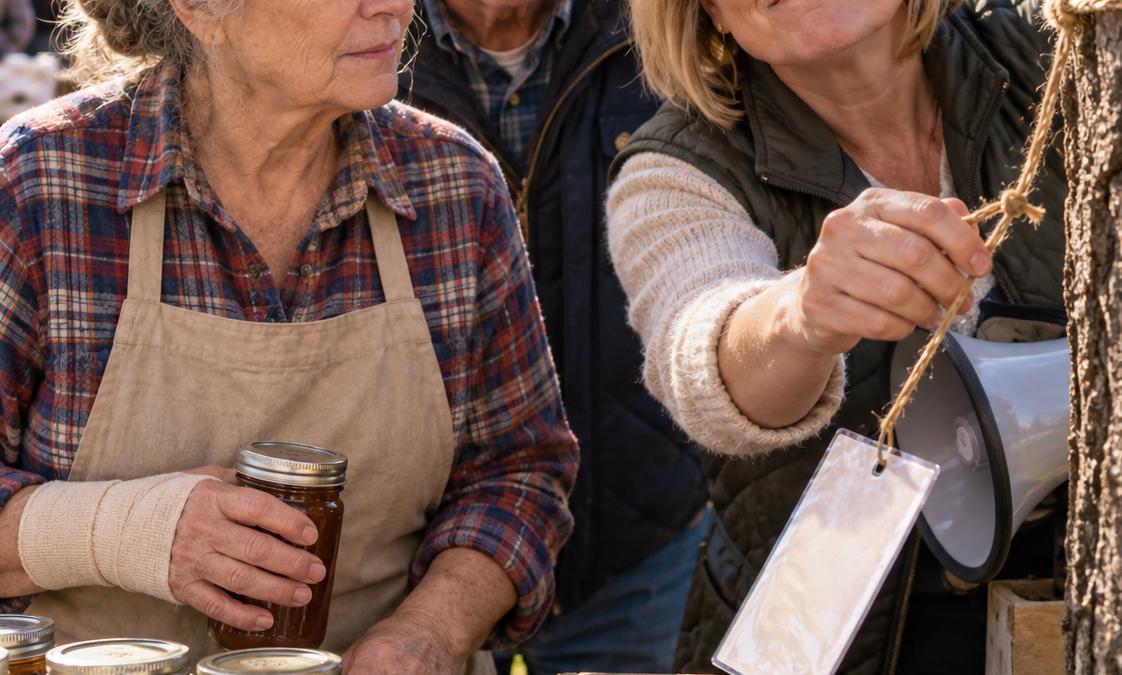
The camera dipped. I could see shoes, a strip of grass, the bottom of her apron. Then the picture rose enough to show a laminated card hanging from the elm by jute twine.
“TABLE 1” was printed across the front.
Tucking the loudspeaker under her arm, Stacy yanked the card off the tree. An apple crate stood at my mother’s feet.
With a flat clack, the card landed in the crate. The camera stayed there long enough for me to see the loose twine settle across the rim.
“Clear the corner, please,” the president said.
The volunteers lifted again. As the table tilted, the jar lids faced the camera.
“9/24.”
“9/30.”
My mother’s grease-pencil dates. I could make out the slash in each one.
Mom walked beside the load, one palm flat against the nearest row. Neither man put his end down until they reached the curb.
People had to step around her stock to get past.
I checked the time.
It was 8:43.
The team was gathering outside the school. On the screen, she stood where the volunteers had left her.
By 8:55, a candle table stood under the elm.
Exactly where hers had been.
“Hand-poured” appeared on a tablecloth hanging over the edge. A young woman I didn’t know stood behind the display. Stacy reached into the frame and smoothed the cloth for her.
The camera moved toward an info tent. Pam Reitz, the market treasurer, bent over a clicker counter. Then a player stepped onto the bus, and another followed.
I counted them as they climbed aboard. Twenty-two.
Before I pulled out, I closed the livestream and sent my mother a text.
“Go home. I’ll be there by one-thirty.”
Then I turned my phone off.
The last girl sat down. I checked the aisle and drove them away.
At 1:30 p.m., I walked into my mother’s kitchen, six blocks from the square.
The apple crate sat on the floor with the card still inside. Forty jars for the St. John’s church fair order stood filled and capped on a kitchen shelf. A copper kettle rested upside down on the stove.
On Thursday, she had been lifting that one, empty, to wash it when her wrist gave.
She stood at the counter.
“Did you eat?” my mother asked.
“I brought you soup last Saturday.”
“I remember.”
“At noon.”
She took down a mug with her good hand.
“Coffee?”
I hadn’t come for a cup. But she was waiting for my reply in her own kitchen, after the loudspeaker had spoken over her all morning.
“Yes,” I said.
A discharge paper was held to the fridge by a magnet. I recognized the printed heading from the clinic.
Mom kept getting the coffee ready.
Taking the paper down, I read it aloud.
“Date of visit: 10/01/2026. No lifting over 10 lb for 10 days.”
“Mom, you weren’t even on the square last Saturday,” I said. “Whose apple butter made that little girl sick?”
She poured the coffee and said, “I know where I was, honey.”
Part 2 of 7
I started a screen recording on my phone at Mom’s kitchen table that night, then pressed play on the livestream on the market’s page.
“Happy Saturday, October third, folks!”
When the camera swung past the elm, the grass was bare, no table, on the very Saturday Stacy said Mom’s apple butter made a little girl sick.
Stacy held her phone out selfie-style, her face filling most of the frame above the narrow strip of market behind her.
Then Stacy turned, still talking, while white canopies slid across my screen in a row.
The trunk came next, rough bark giving way to empty ground beneath its branches.
I let the livestream run until the tree passed out of sight, then paused with bare grass still showing behind her shoulder, her mouth caught open mid-word.
“Four-ten.”
I saved the recording.
At the sink, Mom rolled a white mug beneath the tap with her left hand, keeping the handle clear of her bandaged right wrist. Her back stayed toward me.
“She’s behind her shop counter by eight-thirty. She never walks the tables,” Mom said.
“How do you know that?” I asked.
“Nineteen years, honey,” Mom said.
I photographed the inspection report under the apple-shaped magnet on the fridge, stepping close so the inspector’s slanted signature on the last line came out sharp on my phone.
“No violations observed. — J. Hoover”
The laminated card lay in the apple crate on the floor, with one bent corner lifted away from the wooden bottom.
I reached down and gripped it by the narrow edge, my thumb already in place to turn it over, with the clear covering stiff between my fingers.
Mom took it out of my hand, leaving a wet mark from her left palm on the plastic.
“Leave the back alone,” Mom said.
She dropped it into her apron pocket, pushing the bent corner below the hem, then sat down across the table from me.
I opened the share button on the recording.
The posting window showed Stacy’s smiling face at the top, an empty white caption box under it, and a send arrow waiting.
Mom laid her good left hand over the screen.
“We don’t settle things on the internet, Andrea,” Mom said.
I pressed the side button, and the phone went dark beneath Mom’s fingers.
At 9:12 p.m., Stacy’s text lit up Mom’s phone on the kitchen table.
“Don’t come Saturday. If you set up, I’ll have the police walk you off the square.”
Mom picked up her cell, tilted it slightly toward herself, and held it close enough to read the message.
She turned the phone face down.
The tap dripped into the basin. Behind the refrigerator door, the motor hummed without stopping.
I emailed the borough office on Sunday night from the couch at my own place, typing on my phone to ask to see the map for Mom’s table and adding my cell number at the bottom.
My phone rang between bus routes on Tuesday from an unfamiliar caller, and I answered.
It was Brad Zimmerman, the assistant borough manager.
“I was out yesterday. Your mother’s name is on the map I signed. Come in at ten,” Brad said.
“I’ll be there,” I said.
At ten, Mom and I joined Brad in his borough office as he took the map out of his 2026 folder and spread it flat on his desk.
Numbered boxes filled the open sheet in rows, with a circle drawn for the elm near the edge.
Brad read the line for Mom’s table aloud.
“R. Kline — apple butter”
“Take a picture of that,” Brad said.
I photographed the map with my phone.
“Did you ever withdraw from Table 1, Mrs. Kline?” Brad asked.
“No,” Mom said.
Mom pressed the purse strap down and kept the leather flat on her knee.
Brad set the application next to the map and read the lines back to back.
“Applicant 1: Stacy Lenker (must be present at event)”
“Applicant 2: Pam Reitz”
“Application Approved — vendor placement per attached site map.”
Brad picked up the change request and read aloud.
“Table 1: Kayla Lenker (replacing R. Kline).”
Then he tapped his pen on the blank line at the bottom of the printout, where his “Approved” should have been, the point clicking hard against the desk.
“And the complaint?” Mom asked.
“She attached it,” Brad said. “That’s the state’s business, not mine. I haven’t opened it.”
“Then I’ll ask the state,” Mom said.
“Nobody moves a table on this map without this office,” Brad said.
Mom showed Brad Stacy’s text on her phone.
She went out to the car to call the state.
I sat on the waiting bench in the hall, the space beside me empty, and typed the name Brad had just read, “Kayla Lenker,” into my phone.
The search results showed her candle shop page, and I opened it.
I found the post pinned above everything else she had shared.
“Big news! Starting Saturday, Oct. 10, find my candles under the big elm on the square!”
I looked at the date the post went up.
“September 28,” I said to nobody. “Before Mom’s wrist. Before anybody complained.”
Part 3 of 7
Mom turned her phone face down on her knee before I had the car door shut.
“The state’s looking into the complaint. They won’t tell me who filed it. An inspector will call me back.”
“Did they say when?” I asked.
“No,” Mom said.
I started the car and didn’t put it in gear.
“You weren’t even there on the third,” I said.
“They didn’t ask me where I was,” Mom said.
I opened Kayla’s post on my phone.
“September 28. That’s when this went up,” I said. “You hadn’t hurt your wrist.”
Mom set her own phone face up again on her knee.
“Send me that,” Mom said.
I sent a picture of the announcement, with the date above the promise of candles under the elm.
“Keep yours, too,” Mom said.
On Wednesday, October 14, during my lunch break, I opened the market’s page and tapped the livestream from October 3.
“This video isn’t available”
I played the recording on my phone and stopped it on Stacy’s frozen face at “Four-ten.”
“They took down October 3. I still have mine,” I texted Mom.
“Don’t lose it,” Mom answered in a message.
Back at the start, I let Stacy say the date before I hit pause.
“I’ll bring this Saturday,” I typed. “They can see what was under that tree.”
“Save the part where she says what day it is,” Mom wrote back.
At four, Stacy’s post was pinned at the top of that same page.
“For the safety of our families, Robin Kline will not be returning this season.”
I put the phone in my pocket without reading the comments.
At six that evening, Mom opened the email from the St. John’s church fair committee on her phone at the kitchen table and read one phrase out to me.
“Until this is cleared up.”
“Forty jars. Three hundred sixty dollars.”
These were the forty jars Mom filled and capped on October 1, the day she sprained her right wrist pulling the empty copper pot off the stove to wash it.
I read the clinic slip still on the refrigerator.
“No lifting over 10 lb for 10 days.”
“Thirteen days,” I said.
From the kitchen, Mom took the jars down to the basement shelf one at a time, the beige bandage still around her wrist.
Every lid already showed October 1, written in the grease pencil that lay on the counter.
I reached for the next jar.
“I’ve got it, Andrea,” Mom said.
I sat down on the top step of the basement stairs and counted the jars as Mom carried each one past me.
“Ten.”
Mom took another jar downstairs.
“Twenty.”
Back upstairs, Mom picked up the next one.
“Thirty.”
For the last one, she pressed the jar to her chest with her left arm and held the bandaged right wrist clear of the rail as she passed me.
“Forty,” I said.
In the kitchen, Mom took the laminated TABLE 1 card out of her apron pocket and laid it on the windowsill above the sink with the side she told me to leave alone turned down.
“Maybe it’s time I let that corner go, Andrea,” Mom said, facing the sink.
I lifted the pencil from the counter and put it away in the drawer.
Brad called Mom at 2:20 on Thursday while I was in her kitchen between bus routes, and she put him on speaker.
“I’m writing my decision on Stacy’s paperwork for Table 1, and I just opened her attachment for the first time,” Brad said. “Her change request needed a reason. She attached the state complaint. Can you both come in at four-thirty?”
“We’ll be there,” Mom said.
“I saved the recording from October 3,” I said. “The livestream was gone when I looked for it again yesterday.”
“Bring your phone with you when you come in,” Brad said.
Brad opened his 2026 folder with one printout face down on top while Mom and I sat across from him.
“Tuesday afternoon I emailed Stacy and asked why Table 1 changed when this office never approved it,” Brad said. “Tomorrow I send my decision to both applicants. Saturday morning I’ll be at the elm by eight-thirty.”
“If you set up before I get there and she calls the police, they’ll treat it as a vendor dispute, and you’ll be the one asked to leave,” he told Mom.
“I’ll wait for you, then,” Mom said.
Mom’s hand went to her purse, where Stacy’s text was still on her phone, and stayed there.
Brad turned the printout around and slid it to Mom.
“This is what she attached,” he said.
Mom put on her reading glasses and read the first line aloud.
“Name: The Harnish family.”
Leaning over Mom’s shoulder, I said the complaint out loud.
“Our 6-year-old was sick all night after apple butter we bought Saturday, October 3, at the stand under the big elm.”
“October 3. I brought you soup that day,” I said.
Mom read down to the last line without a word.
Reaching into her purse, Mom took out the paper bag from Stacy’s gift shop, with the jar rags inside, and set the bag next to the printout.
Brad turned to his computer and forwarded Stacy’s email and the attachment to the state while Mom and I watched.
He leaned across the desk, put one finger on the line beneath the name, and turned the bag over.
“Contact email for the Harnish family — same as the bottom of that bag, Mrs. Kline. She figured the state keeps names private. It does. She’s the one who sent it to me.”
Part 4 of 7
At four o’clock on Friday, October 16, Mom’s phone buzzed on her kitchen table with an email from the borough office, subject line: Table 1 decision. I was sitting there after driving straight from my afternoon school bus route.
“Read it to me. My glasses are upstairs,” Mom said.
It came from Brad Zimmerman and was addressed to Stacy and Pam, with Mom copied.
I read it aloud to Mom.
“Your change request of October 10 is denied. Table 1 stays with R. Kline under the approved site map. Please confirm to me by 8:00 a.m. Saturday that Table 1 is clear. If Table 1 isn’t clear by eight, I’ll post the notice myself. I’ll be at the elm by 8:30.”
“Pam’s on it too,” I said.
“Pam has a choice to make, then,” Mom said.
I set Mom’s phone back down between us, face up, next to the salt shaker.
At 6:12 that Friday evening, Mom’s phone buzzed a second time where I had left it.
Stacy had hit reply-all, so her answer went to Brad and Pam, with Mom copied.
I held the phone closer and read the new message out loud.
“The borough doesn’t run my market. Kayla is under the elm tomorrow. See you at eight.”
Mom reached for the phone and turned it so the screen lay against the wood.
At eight, Stacy’s post went up on the market’s page, and I read it on my phone.
“Harvest Saturday on the square! Going live at 8:15, and at 8:30 meet Kayla’s candles under the big elm!”
Mom unhooked her apron from beside the back door and spread it flat across the table.
The TABLE 1 card came next, off the windowsill above the sink, and Mom laid it on the apron with the back turned down, the side she had once told me to leave alone.
“The report. Don’t fold it,” Mom said.
I slid it out from under the apple-shaped magnet on the refrigerator and set it beside the card.
Then she pulled the paper bag from Stacy’s gift shop, jar rags inside, out of her purse and rested it on the report.
That afternoon I had carried the apple crate up from the basement shelf and left it by the door. Mom lifted one jar out, turned it until 9/30 on the lid faced up, and put the jar back with the others.
I plugged my phone into the charger by the toaster and opened the recording, set back to the start.
“She said eight,” I said. “If you get to that tree ahead of Brad and she calls the police, you’re the one walking away.”
“Eight-thirty, then. Not one minute before. Stay with the wagon,” Mom said.
“And if Stacy gets on the loudspeaker first?” I asked.
“Let her finish,” Mom said.
She tucked the card into her apron pocket. By the time Mom turned off the kitchen light, nothing had come from Pam.
On Saturday morning, October 17, we were on Market Street, six blocks from the square, where Mom pulled the wagon by its handle with her good hand while I pushed from behind; our folding table, the crate of jars and the bag rode on the wagon, with the report lying across the bag.
At 8:15 a.m., I opened the market’s livestream on my phone as we walked along Market Street.
Stacy’s phone stood on a tripod in front of the info tent, its lens on Stacy with the loudspeaker in her hand. One step behind her, Pam held the tally counter, inside the picture, and shoppers crowded both sides of the tripod, facing Stacy.
“Pam’s clicker says a hundred and fifty of you already, folks!”
Stacy’s tent had its back to the elm, so over her shoulder the livestream showed Kayla behind a table of candles beneath its branches.
“Thirteen minutes to the curb,” I said.
I locked my phone and put it in my jacket pocket.
At 8:28, we stopped the wagon at the curb where Larry and the other volunteer had set Mom’s table down last Saturday.
Larry Boyer stood beside the volunteers’ hand truck a few yards from us, pulled one of its straps tight and never looked our way.
Over at her tent, Stacy spotted Mom at the curb and raised the loudspeaker to her mouth.
“Robin, you were told. Nobody here wants to explain a sick little girl to the state,” Stacy said.
“The borough’s fine with it, folks. Kayla’s set up by the big tree. Let’s give her a good welcome,” Stacy told the crowd.
A few shoppers near the curb turned and looked at the beige bandage on Mom’s right wrist.
“Leave the table. Keep the bag here,” Mom said.
I pulled my phone back out and read the time on the lock screen.
“Eight-thirty,” I said.
Mom put the wagon handle in my hand, picked up the report from the top of the bag and walked straight across the grass to the elm.
There, Mom drew the card out of the apron and tied it to the trunk by its old jute twine, its back to the bark.
Mom stood next to the candle table with the inspection report in her left hand. Brad wasn’t there.
Part 5 of 7
At 8:31, Brad Zimmerman came off Market Street with the borough folder against his chest, and the notice inside it already carried his signature.
Stacy left the info tent with the loudspeaker and planted herself at the candle table, close enough to tear down anything Brad taped there.
About 150 shoppers filled the grass from the booths to the elm, and the first of them stood an arm’s length from Mom.
Brad took the notice out of the folder.
Against the tablecloth, he taped the top corners in front of Kayla’s candles.
“Table 1 is assigned to Robin Kline under the 2026 site map approved April 2. The change requested on October 10 is denied. B. Zimmerman, Borough Representative,” Brad read.
At the last word of the notice, Kayla took both hands off the candles.
She stepped back once.
Mom lifted the inspection report high enough for the front row to see it and faced the printed side toward Stacy.
“The state read my labels on September twenty-ninth, Stacy. No violations,” Mom said.
I left the wagon at the curb.
Three steps onto the lawn brought me right up to the nearest shoppers.
I raised my phone over my head and turned it around for the crowd.
The recording played from the start at full volume.
“Happy Saturday, October third, folks!”
I dragged the bar to 4:10.
On my screen, the camera swung past the corner by the elm: bare ground, no table.
Before the clip ended, Stacy brought the loudspeaker to her mouth.
Phones went up among the shoppers.
The people closest to me aimed theirs at mine.
Farther back, others trained their cameras on Stacy.
When the sound cut off, the lenses beside me settled on her.
“That video is gone. You could have filmed that any Saturday,” Stacy said.
“It was up Saturday night. By Wednesday lunch it was gone. It’s your voice saying October third,” I said.
Mom raised her right wrist in its beige bandage next to the report in her left hand.
“This was October first,” Mom said.
“I didn’t file anything. A family emailed me, and I passed it along,” Stacy said.
Brad opened the folder to the printout of the complaint Stacy had attached to the request to replace Mom at the corner.
“Our 6-year-old was sick all night after apple butter we bought Saturday, October 3, at the stand under the big elm. Name: The Harnish family. Contact email:” Brad read, and spelled out the address one character at a time.
Mom walked back to the wagon for the gift shop bag.
On top of the apple crate, she flipped it upside down.
She turned the words on its bottom out to the crowd.
“Your shop prints it on every bag, Stacy,” Mom said.
Mom crossed to Kayla’s table with the report in her other hand.
She held the printed line under Stacy’s eyes.
Brad turned one page to Stacy’s reply to the email denying the change she had requested on October 10.
“Friday, 6:12 p.m., from Stacy Lenker to this office: ‘The borough doesn’t run my market,'” Brad read.
Larry Boyer left the hand truck at the curb.
He walked straight through the crowd and stopped at Kayla’s table.
The notice separated Larry from Stacy as he faced the woman who had told him to carry Mom’s folding table away.
“‘Nineteen years at that corner, and she still can’t read a label,'” Larry said. “You said that into this mic, Stacy. I carried her table off for you.”
The square went quiet.
Nobody answered Larry, and not one voice in the crowd spoke up for Stacy.
I pushed my phone into my jacket pocket to free both hands.
One end each, Larry and I lifted Mom’s folding table off the wagon.
We carried it up to the elm together, where Mom stood waiting by the trunk.
Under the branches, Larry and I opened the legs.
The apple butter table went up two feet from the candles.
Somebody in the front row started clapping.
More of the crowd joined in as Larry and I set it level.
Even the shoppers holding phones up found a way to clap along, one palm against the back of the other hand.
At 8:50, Brad took a blank borough form out of the folder.
“This application stays approved only if this market runs to the map on file, and Applicant 1 signs the change,” Brad said.
Pam came over from the info tent.
Brad held the sheet out to her, and Pam took it from his hand.
On the corner of Kayla’s table, Pam signed the Applicant 1 box.
She added one line under her name that gave Kayla the space at the far end of the row.
Pam passed the form back to Brad.
Brad wrote his approval beneath her line and signed it on top of the folder.
“Applicant 1: Pam Reitz. Table 24: K. Lenker — candles. Approved,” Brad read.
Kayla packed everything into a box.
She folded her table flat and set the box on it.
Down the length of the row, Kayla carried both to Table 24 and never once looked at her mother.
“Robin, you going to let Kayla stay?” a man near the back of the crowd called out.
Stacy lowered the loudspeaker until it pointed at the ground.
“This is my mother’s market,” Stacy said.
“Read the map, Stacy. My name’s still under the elm,” Mom said.
Part 6 of 7
Stacy held the loudspeaker out to Pam at nine in front of about 150 shoppers.
Pam took it, handed her clicker to Larry, and said, “Well, now. Table 1 is open, folks. Apple butter’s back.”
Stacy grabbed her purse off the chair at the info tent and left the square by Market Street.
I checked the time.
“Nine-oh-four,” I said.
Larry counted the people coming up to the folding table.
“Twenty-eight so far, Robin,” Larry said.
Customers lined up by the tree. Mom handed the jars over with her left hand.
I made change from the cash box.
One of our regulars bought two jars.
“Are you keeping this corner now, Robin, or will we have to look for you at the curb next Saturday?” the shopper asked.
“I’m staying right here,” Mom said.
At 12:30, Mom worked the twine loose and lifted the card from the trunk, its back turned to the bark.
Mom dropped it in the apron pocket.
At home that afternoon, Mom laid the card on the windowsill above the sink.
The back faced down.
Pam’s voice came out of Mom’s phone on speaker Monday night.
“Four to one, Robin. The board met at the fire hall at seven, and Stacy’s out. I’m acting president till they hold a vote in the spring,” Pam said.
Beside the grease pencil, Mom set the phone face up on the counter.
“What changes on the borough paperwork, Pam?” I asked.
“My name is in the Applicant 1 box now. Table 1 stays on the map. Next Saturday, your mother will be selling under the elm,” Pam said.
“Stacy cast the only vote for herself,” Pam added.
Mom ended the call.
A text from Pam lit up Mom’s phone on the counter Tuesday afternoon. Mom tipped the screen toward me.
“The borough turned down Stacy’s sidewalk sale on Market for Saturday, December 5. Their letter says her Oct. 10 email gave them false information and she ignored their Oct. 16 email. Whole street knows by now,” Pam’s text read.
That was the first Saturday in December, the gift shop’s biggest day of the year.
Another text arrived.
“Stacy filed for that sidewalk sale back on September 8,” the second text read.
“Six weeks she waited on that permit, and now the no is in writing,” I said.
“She has her shop,” Mom said.
Mom put her phone face down on the counter.
I was eating lunch at Mom’s kitchen table between my morning and afternoon school bus routes when Mom’s phone buzzed at 11:00 on Thursday.
An email had come in. Mom read the screen.
Across the table, Mom slid her phone to me.
“Re: Food safety complaint received October 5, 2026. Status: closed, not substantiated. Basis: routine inspection of September 29, 2026, no violations observed, and information forwarded by the Borough of Lewisburg on October 15. Janet Hoover, Food Safety Inspector, Pennsylvania Department of Agriculture,” the email read.
“Not substantiated,” I read. “Do you want me to call St. John’s about the forty jars, or wait for the fair committee?”
“They’ll have to call,” Mom said.
At 2:00, the house phone on the wall rang.
Mom took the call at the counter.
“You want the order back for the St. John’s fair? Forty jars of apple butter at nine dollars a jar?” Mom asked.
“Three-sixty,” I said.
“All 40, Saturday morning. They’ll be ready,” Mom said.
After hanging up, Mom wrote “St. John’s, 40, Sat.” on the pad by the phone.
By the back door, I took my keys off the hook.
I left for my afternoon route.
At the red light on Market Street, from the driver’s seat of my school bus, I watched Kayla carry a cardboard box of candles out of Stacy’s shop to her car.
The shelf was bare.
A second box came out.
Kayla put the boxes in her trunk.
The light turned green.
I drove on with my kids.
After my route, I carried the 40 jars Mom had kept back from the market up from the basement shelf, ten at a time, in the apple crate.
Row by row, they covered the kitchen table.
I started labeling them for the St. John’s fair. Mom stood at the sink.
Someone knocked on the back door at seven.
Pushing my chair back, I opened the door.
Kayla stood on the step.
“What do you want?” I asked.
“I took every candle off the shelf in my mother’s gift shop this afternoon,” Kayla said. “They’re in my apartment now.”
Kayla came inside.
“Should I keep Table 24 next Saturday, Mrs. Kline, or do you want me to give it up and leave the market?” Kayla asked.
“Say what you came to say about Mom’s spot,” I said.
Kayla looked at the rows of jars, then unlocked her phone and held the screen out to Mom and me.
“Robin’s retiring. The elm corner is yours starting Oct. 10. Don’t bring it up with her, she’s touchy,” the text from Stacy read.
The text was dated Sunday, September 27.
“Honestly, Mrs. Kline, Mom told me in September you were retiring,” Kayla said. “I thought the complaint was real.”
Mom reached up and took the card off the windowsill. For the first time in front of anyone, Mom turned it back side up and laid it in Kayla’s hand.
On the back, in faded blue ballpoint, was one line.
“The elm corner is Robin’s for as long as she wants it. — Dot G., May 5, 2007.”
“That’s Grandma’s handwriting,” Kayla said.
Part 7 of 7
The 40 jars had been promised to St. John’s, and the van was due at nine.
Larry carried the folding table off the volunteers’ cart at 7:30 and set it up under the elm for Mom, though nobody had asked him to.
“Table 1, Robin,” Larry said.
Before he left, he gave the far edge a push.
Nothing rocked.
I had no Saturday route that week, so I was the one setting the jars out in rows.
Mom stood with her right wrist bare; the beige bandage was gone.
With that right hand, Mom lifted a jar and turned its lid to face the street.
Across the metal, the date showed in the same small figures as the rest of Mom’s stock, dark enough to read from the customer side.
Behind Mom, the 40 jars for St. John’s waited, ten to a box, in four cardboard boxes.
Near the cash box, I laid the paper sacks flat and tucked their handles underneath.
Down at Table 24, the last spot on the map, Kayla unfolded her own table and set out her candles.
The taller ones stood behind the shorter ones, with open cloth between the groups and room at the front for a customer to choose.
Kayla walked up the row to the elm with a folded ten-dollar bill in her hand, the first buyer of the day.
“I’m keeping Table 24, Mrs. Kline,” Kayla said. “Grandma would want it that way.”
Kayla put down the ten, and I gave her one dollar back.
At the table, Mom offered Kayla a jar, and Kayla took it; on the lid, in Mom’s grease pencil, it said “10/22.”
“That’s from Thursday,” Mom said.
Kayla carried the jar back to Table 24 along the row and set it beside her candles.
Up front sat the apple butter, its label facing the aisle.
The white van from St. John’s stopped at the curb by the elm at nine.
A gray-haired man in a church fair cap climbed down and swung the rear door open.
“All forty, Robin?” the driver from St. John’s asked.
“All forty,” Mom said.
“Bring them over to me,” he said. “These jars are for the church fair, and the committee is counting on us to collect the full order.”
I carried the boxes to the van one at a time, and the driver slid each one onto the back seat.
Every lid in those boxes said “10/1” in Mom’s handwriting.
“That’s the lot, forty jars on Saturday morning, just like Mom promised,” I said.
“Thank you for keeping them for us, Robin,” the driver said.
Pam wrote “St. John’s van, 9:02” in the vehicle log at the info tent.
He shut the back, slid behind the wheel, and buckled his belt.
The van pulled away down Market Street.
Mom drew the grease pencil from her apron pocket and held it out with one jar from the batch I had stirred on Friday night while she watched.
There was no date on the metal yet.
“Your batch, your date,” Mom said. “Next fall the kettle’s yours.”
I wrote “10/23” on the lid, the first date in my handwriting on one of Mom’s jars.
“I thought forty-four was too late to start at your stove, Mom,” I said.
When I handed the pencil back, Mom studied the lid.
My numbers were larger than Mom’s, and the twenty-three stood farther from the slash than I had meant it to.
“Leave it as you wrote it,” Mom said. “Dot gave me this corner when I was past your age, and my early writing was worse.”
I set the jar in the front row, with my date facing the street.
The card came out of the same pocket when Mom reached in again.
Kayla had given it back to Mom on Thursday night before leaving by the back door, and Mom had kept it there since.
Blue ballpoint had faded unevenly; some letters held their color, while others were thin enough for the white underneath to show through.
“Why didn’t you hold up the back last Saturday, Mom? The whole square was standing right there,” I said.
Mom waited until the nearest shopper had moved on.
“That was Dot’s word to me, not the borough’s,” Mom said. “I wasn’t going to shame her girl with it on the square.”
I moved the empty sacks clear.
Mom laid the card flat on the table, back side up, and used the pencil to write one line under Dot’s ballpoint.
“Then Andrea’s. — R.K., Oct. 24, 2026.”
Below the blue ink, the fresh black strokes reached almost to the edge.
My name started beneath the end of Dot’s sentence, and the year sat near the corner.
A promise from 2007 was still easy to make out.
The twine ends had tangled in the pocket, and Mom worked them straight.
Mom tied the card back on the trunk, and this time the writing turned out toward the square.
Anyone walking past could read both lines together now.
“Will it keep, Mom?” I asked.
Mom tightened the twine, patted the card once, and said, “It kept.”
THE END
More stories
My husband hid my sister’s letters for 7 years — Then a mailman brought envelope “#29,” and he was served divorce papers at work with employees and customers present.My sister’s new mother-in-law charged $6,400 to my sister’s card for her own trip—then the check-in agent announced that all three tickets had been canceled.My ex-husband told his new wife $1,150 monthly supported our son—until I read the state’s closing letter beside his birthday cake, and she told 30 guests she’d filed for divorce.My Sister Gave Mom’s Bedroom to Her In-Laws and Put Mom on a Cot in the Sewing Room, Then Threw Them a Party, Until Mom Showed Everyone the Credit Cards Opened in Her Name.My boss gave his daughter until Friday to leave her home after 16 years—then the folder he left on my counter helped stop his auctionMy sister-in-law called me “the hired help” while taking my 74-year-old dad’s phone — Then six lock codes exposed her secret rental, and she canceled before 14 guests.








