I was 48 when his nephew claimed Norman died August 12 and called me “the lawn girl who thinks she’s family” — Then a September 19 postmark led to a summons for his false report
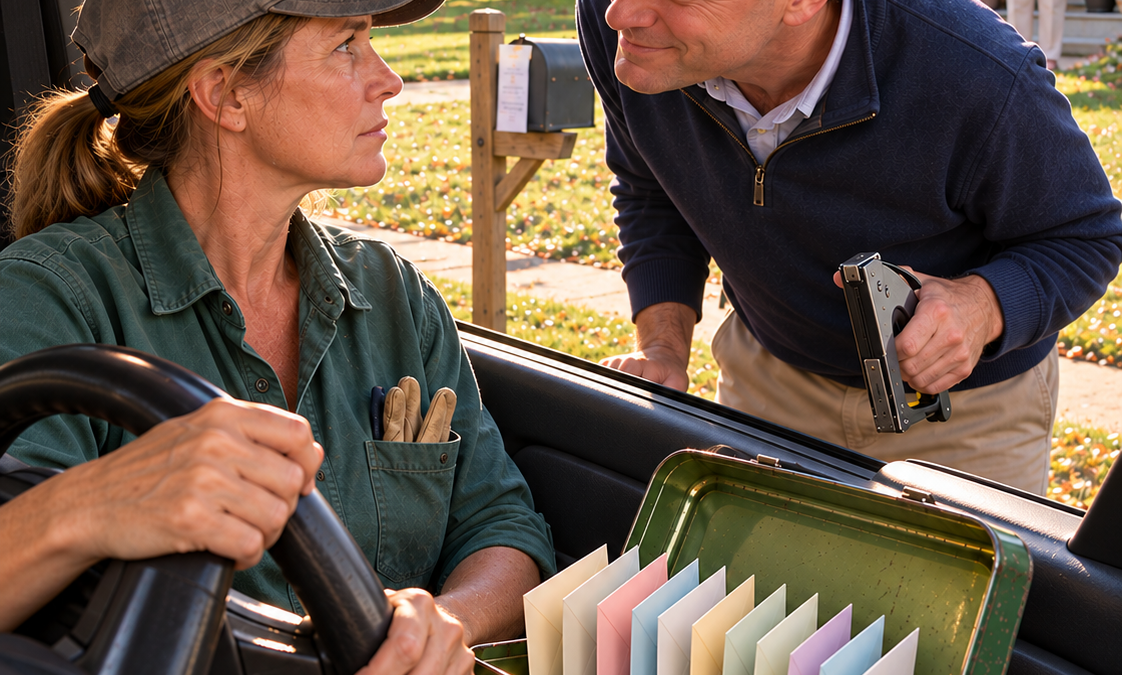
Complete story · 7 parts · about 33 minutes · ending included
Part 1 · Part 2 · Part 3 · Part 4 · Part 5 · Part 6 · Part 7
Part 1 of 7
The staple punched through the memorial flyer and bit into the wooden post beside Norman Albrecht’s mailbox. Randall pressed the corners flat with his palm, making sure the announcement could not blow away before Saturday.
At 4:30 p.m. on Monday, September 21, 2026, I was driving down Orchard Street in Hammonton, New Jersey, with my mower trailer rattling behind my pickup.
The flyer read:
“Celebration of Life — Norman F. Albrecht — 1945–2026 — Saturday, September 26, 2 p.m., on his front lawn”
A For Sale sign stood near the red maple Norman had planted years ago. The bottom of the sign was already surrounded by grass that needed cutting.
I slowed at the curb.
Randall Albrecht stepped away from the mailbox post. He was fifty, Norman’s nephew, and sold car insurance in Voorhees. I had seen him at the house before, usually on holidays. He had never been particularly interested in the lawn.
His eyes followed my truck.
“Keep rolling. You’re the lawn girl who thinks she’s family.”
Joan Fanucci stood on her porch next door, a small pot of yellow mums near her feet. She heard him. Her gaze dropped to the flowers.
I kept my hands on the steering wheel.
“Next yard.”
The mower trailer creaked as I turned into Joan’s driveway.
She didn’t say anything.
On Saturday, August 15, Randall had stood in Norman’s living room among cardboard boxes and stopped me at the door. “He passed Wednesday. Some place out of state. Cremated, no service.” Then he walked me down into the yard, where Joan could see us, and called me the lawn girl for the first time. There had been no obituary because Randall said Norman “didn’t want a fuss.” He never named the state, and without it I couldn’t even request an uncertified copy of the death certificate. On Wednesday, August 19, a Hammonton police officer came to my house after Randall reported me for harassing the family at “my late uncle’s” house. “Stay away from that house, ma’am,” the man said.
Joan’s lawn took half an hour.
I cut around the flower beds, trimmed along the walkway, and went over the strip beside her garage. The mower caught a small branch near the back fence. I stopped, pulled it free, and finished the pass.
Joan stayed on the porch.
She had been my Monday customer for six years. I knew where she kept the garden hose and which side gate stuck after rain. She knew I arrived after four and never left clippings on her sidewalk.
Usually, she came out to ask about the weather or tell me what the schoolchildren on her old block had been doing.
That afternoon, she watched me work without speaking.
When the engine stopped, I knocked the clippings off the string trimmer and loaded everything back on the trailer. Then I walked to the passenger side of my pickup.
The tin lunchbox sat on the seat.
My father had owned it. It was green, dented along the bottom, with a latch that needed a firm push. After he died, I kept it because I couldn’t think of anything else to do with it.
Inside were eleven birthday cards from Norman, one for each September from 2015 through 2025.
I took over his Thursday mowing in April 2015, and that September the first card came. Each year one arrived the day before my birthday, always handwritten. None had a return address.
The sealed envelope was also inside. Norman’s slanted watchmaker’s print covered the front:
“Keep this for me. — N.A.”
I had never opened it.
The lunchbox could wait on the seat. I closed the door and checked the trailer hitch before returning to Joan’s porch.
She came down the steps with my check and a copy of the flyer.
“The Altar ladies wanted a Mass for him. Randall says Norman didn’t want church, says they scattered him off Brigantine, so he’s doing it on the lawn. He left one in every storm door, hon. He says you shouldn’t come Saturday.”
I took the check.
“Did you ask Randall about the church?”
Joan adjusted the edge of her cardigan.
“We did. The ladies asked about the funeral home, too. He said there wasn’t one.”
She looked toward Norman’s house. The sale sign leaned near the tree, while the flyer stayed stapled to the post.
“Agnes was with the Altar Society for years,” she added. “They wanted him to have a Mass.”
I folded my check once and put it in my shirt pocket.
“Saturday’s a workday.”
Joan glanced at the flyer in her hand.
“I thought you’d like to know, hon.”
“Thank you.”
She gave me the paper.
I returned to my pickup and set the flyer on the seat beside the lunchbox. Through the windshield, I could see Randall farther down Orchard Street, pushing another copy into a storm door.
I checked the time on my dashboard.
Five twelve.
My last Monday job was finished. The mower was secured, the trailer lights worked, and the check was in my pocket. I started the engine and pulled away.
There was no reason to drive past Norman’s house again.
At 5:40 p.m., I parked outside my house on Third Street.
My pickup needed an oil change, and the trailer had a loose reflector. I had written both things on the small work calendar hanging beside my kitchen door. Tuesday was my birthday, but the schedule still had two estimates and a regular customer to call.
I walked to the mailbox.
The electric bill was folded around a store flyer. Beneath them sat a square, cream-colored envelope.
My hand stopped.
I knew the handwriting before I touched it.
Each line slanted slightly to the right. The capital N had a long first stroke, and the final letters of the last name always seemed to run downhill.
Norman’s watchmaker’s print.
My name was written across the front.
Shelly Booker.
There was no return address.
He had never included one.
I took the envelope out and turned it over. The flap was sealed. A round postmark crossed one corner, but the ink had smeared badly. I could make out the date and the state.
SEP 19 2026.
PA.
Picking up where the Facebook post left off
The town’s name was blurred into a dark patch.
I stood at the box with the folded bill tucked beneath my arm. A car went past at the end of the block. Somewhere behind the houses, a dog barked.
The memorial notice was waiting in the cab of my pickup.
I went back to the truck and retrieved it. Then I spread it across the hood and laid the new mail on top.
His writing, not a stranger’s, filled the front.
Mailed September 19.
Randall had him dead on August 12.
Thirty-eight days after Norman Albrecht died, he remembered my birthday.
Part 2 of 7
My folding knife went under the flap of the envelope while I stood at the hood of my pickup. Inside was a cream-colored card filled with Norman’s handwriting.
“Happy 48th, Shelly. The maples turned early this year — don’t let anyone bag the leaves in plastic. I’d call, but my phone’s gone and your number was in it. Doctor says I’ll be home soon. — N.”
My thumb stopped beneath the last two sentences.
His phone was gone, my number with it, and he promised the stay was nearly over. Norman thought he was somewhere for a while, waiting to return to his house and his ordinary Thursday schedule.
The card had no date. But the words Happy 48th told me he had written it recently. Tomorrow I would turn 48. Last year’s card had said 47th.
I held the paper by its edges.
The maple leaf had been drawn in the same careful way Norman used to mark measurements on scraps of paper at his workbench. The lines were shaky, but each point had been finished.
I brought the tin lunchbox into the house and put it on the kitchen table.
Eleven old cards lay inside, one for each September from 2015 through 2025. I placed the new card on top of them. It was the twelfth.
The opened envelope went in with the card, beside the sealed one Norman had entrusted to me years earlier.
I closed the lid.
The flyer had already gone back onto the passenger seat of my pickup. I didn’t need to look at the announcement again.
That evening, I sat down and scrolled through my phone.
The first conversation was saved under Mr. A.
I opened the thread and found my outgoing text from Thursday, August 13, after I had finished Norman’s lawn.
“Lawn’s done, Mr. A. Hope you’re feeling better. Same time next Thursday?”
The reply came the following afternoon.
Friday, August 14, 4:12 p.m.
“No more mowing. Don’t come by. N.”
I checked the time stamp.
Two days after August 12.
The card said Norman’s phone was gone. Somebody else had been typing on it.
A second conversation sat below the first. That contact had no saved name.
Randall’s text, dated Monday, August 17, said:
“I’m Norman’s power of attorney. Stay off his property or I call the cops.”
In August, I had taken that to mean Randall was handling the estate and had used the wrong words.
I turned the phone facedown.
At 8:05 a.m. Tuesday, I sat at the kitchen table with my phone and called the Hammonton police non-emergency number.
An officer answered.
“I’m Shelly Booker. I got a birthday card from Norman Albrecht yesterday, postmarked September 19.”
“One moment, ma’am.”
Keys clicked in the background.
“Ma’am, the family told us he passed. There’s a harassment report with your name on it. Anybody can mail a card.”
“Did Randall Albrecht file it?”
“I can’t discuss that with you.”
“All right. Thank you.”
The call ended.
I kept the phone in my hand.
The For Sale sign had gone up in Norman’s front yard on Tuesday, September 8. On Monday, September 14, while mowing Joan’s lawn, I had copied the realtor’s number from the sign onto the work calendar by my kitchen door. I thought the buyers might need a lawn service.
Next, I called the listing agent.
A woman answered.
“I’m calling about the house on Orchard Street. I’d like to know who has the authority to sign.”
“Are you the buyer?”
“No.”
“I’m sorry. I can only discuss the property with the seller’s representative.”
“Thank you.”
She disconnected.
At 11:20 a.m., I was working in a client’s yard across town when my phone vibrated in my shirt pocket.
Randall’s number appeared on the screen.
“Call my realtor again and I’ll file for a restraining order. Last warning.”
I put the phone away.
The mower was still running. I finished the strip along the fence, shut off the engine, and pulled a weed tangled around the trimmer head.
The customer had asked me to leave the grass clippings in the yard waste bin. I emptied the mower bag, secured the gate, and drove to the next job.
At 7:30 p.m., someone knocked on my front door.
Joan stood on the step holding one cupcake with a single candle in it.
“Norman always told me your birthday, hon.”
“Come in, Joan.”
She looked past me toward the kitchen.
“I didn’t know whether you’d be working late. I thought I’d bring this before the evening got away from me.”
“Thank you.”
Joan stepped inside and placed the cupcake on the counter.
She kept her cardigan buttoned, although the house was warm.
“Have you eaten?”
“Not yet.”
“Well, don’t let me keep you from supper.”
“I haven’t started.”
Her gaze settled on the tin on the table.
“Is that where you keep his cards?”
“A new one just came.”
“Can I see it, hon?”
I went over and opened the lid. The card lay on top of the older ones.
I lifted it out and handed it to Joan.
Her fingers took the edges carefully.
She read the front, then opened the card.
I watched her eyes move down the lines.
When she reached the sentence about Norman’s phone, her hands began to shake.
“Good heavens.”
Joan lowered the card.
“His doctor says he can leave soon?”
“That’s what he wrote.”
“Then he’s not…” She stopped and looked at the paper again. “He thinks he’s coming home.”
“I don’t know where he is.”
Joan pressed her lips together.
“Does Randall know he sent this?”
“I couldn’t tell you.”
She looked toward the window facing Third Street.
“Hon, I need to tell you something.”
I held out my hand. Joan returned the card to me.
“Last Sunday, September 20, I went through the open house next door. I wanted to see Norman’s kitchen one last time.”
I slipped the card back into the tin.
Joan pulled out the chair opposite mine.
“I hadn’t been inside since Randall started clearing things out. Agnes still felt close in there.”
She rubbed her palms together.
“The realtor was there. I asked about the sale, and she told me, ‘Cash buyer. Offer’s in — papers get signed Monday the twenty-eighth.'”
“Monday?”
“September 28, hon. She said the paperwork was nearly ready.”
“Did she say who was buying?”
“No. She wouldn’t give me a name.”
Joan glanced at the card.
“I didn’t think it was right to ask too many questions. Randall was handling things, and I thought the house was simply being sold after Norman passed.”
She adjusted the cuff of her cardigan.
“But there was something else.”
I waited.
“The realtor explained why Randall could sign. I asked if the estate had to go through the courts first. Apparently not.”
Joan leaned forward, her hands resting on the table.
“She said, ‘He’s got power of attorney, so he signs for Mr. Albrecht. No probate.'”
My mother’s kitchen came back to me.
The day after she died in 2021, I had called her bank to ask what happened to the authority she had given me. The woman on the phone had said, “Your power of attorney ended when your mother passed.”
I looked at Joan.
“Joan, a power of attorney dies with the person. Randall’s selling the house of a man who’s alive.”
Part 3 of 7
“Shelly Booker has been harassing my family and now my uncle’s buyers. There’s a police report. Please don’t hire her or let her on your property.”
Randall posted it at 7:02 a.m. on Wednesday, September 23, to the Orchard Street Neighbors group text, where I belonged only because I cleared the whole street’s snow every winter.
My phone lit up beside the coffee cup on my kitchen counter.
I opened the replies. Nobody asked what I had done. A few people had already reacted with a thumbs-up. His post sat above the morning greetings and a photograph of someone’s new driveway.
By 9:15, two customers had canceled.
One wrote, “Sorry, hon. Can’t have police trouble at my house.”
I typed my reply.
“Next yard.”
The third cancellation arrived before 10:30, with the fourth close to noon.
All four got the same reply.
By lunchtime, four of my nine regular clients were gone. After eleven years, those names came off my route. They took the fall leaf cleanups and the snow contracts with them.
I set the phone down next to the calendar.
A private message arrived from Joan.
“Realtors get things wrong. I can’t go against his own blood over a card. Please don’t come Saturday.”
I didn’t answer.
At 1:15 p.m., I sat alone in my pickup in the hardware store parking lot. The engine was off, and the afternoon sun had made the steering wheel warm.
My phone rang.
“Hello?”
“This is Officer Danielle Marino with the Hammonton Police Department.”
“Yes, Officer.”
“Randall Albrecht says you contacted his realtor and his buyers. If you show up at that memorial, he’ll sign a harassment complaint, and I’ll have to take it.”
Her voice was calm. She didn’t raise it or rush through the warning.
“Yes, ma’am.”
Neither of us hung up.
I waited.
Then the line went dead.
The tin lunchbox was on the passenger seat, where it had ridden for years. I pulled it closer and opened the lid.
On top of the eleven older cards rested the birthday card and the envelope it came in. Beside them lay the one from 2019, still sealed.
My thumb settled on the handwriting.
“Keep this for me. — N.A.”
I remembered the afternoon Norman had handed it to me. We had been standing at his workbench, and he had pressed the envelope into my palm.
“Don’t open it unless I ask.”
I had kept it through seven years of birthdays, lawn jobs, snowstorms and everything else. Norman was alive. He could still ask.
The lid closed.
Nothing inside had been disturbed.
That evening, I brought the tin indoors and left it by the stove.
Four names on my schedule now had lines through them. Thursday had been Norman’s day for eleven years. I had no reason to change that part of my week yet.
At 9:40 p.m., I went back outside to the toolbox in my pickup and brought in the loupe Norman had given me years earlier.
He used to keep one near his watch parts. It became mine the day I complained about a splinter I couldn’t get out of my finger.
“You’re looking at the wrong end of the problem, Shelly.”
He had put the little magnifier in my hand and shown me how to use it.
At the table, I lifted the envelope from the tin beside the 2019 one.
The round postmark was still smeared across the upper corner. I placed the loupe over the ink and adjusted it until the blurred letters separated.
ORIOLE GAP.
I moved the glass slightly.
The ink stayed clear.
Under the town name sat the part I had already read: SEP 19 2026, PA.
I typed the name into my phone.
Oriole Gap, Pennsylvania, had about two thousand people. Just one place there housed elderly residents.
Bramblewood Commons: Personal Care & Secured Memory Care.
I opened the listing.
It was about two hours from Hammonton.
If Norman had written that card, he was somewhere in that town.
I returned the envelope to the tin and closed the lid.
Then I pulled up my Thursday schedule.
My remaining customers still needed their lawns cut. I sent each one a message.
“Thursday’s work moves to Friday. Same time.”
No explanation went with it.
At 10:20 a.m. on Thursday, September 24, I stood at the front desk of Bramblewood Commons.
The lobby was bright, with flowers arranged in a glass vase on the desk. A receptionist sat behind a computer. A visitor book lay open near her keyboard.
“Good morning,” she said.
“I’m looking for Norman Albrecht.”
“Could you give me his full name?”
“Norman F. Albrecht. I’m Shelly Booker.”
Her hands moved over the keys.
I waited while she checked the computer.
“He’s a resident on our Linden wing. It’s a secured wing, and there’s a note about a police report in his file with your name on it. Anyone flagged that way waits for our director to go over it with him, and she’s out till Monday.”
I kept my hands on the counter.
“Is there a way I can leave him a note?”
“Certainly. You can sign our visitor book, and I’ll make sure the director receives it.”
The book faced me. I wrote my name and the date on the next available line.
The receptionist swiveled to pull a leaflet from the rack behind her.
I turned the book back two pages.
A handwritten entry stood between two other visits.
“9/13 — R. Albrecht — visiting N. Albrecht — Linden 12”
My finger stopped on the date.
Randall.
September 13. Eleven days ago.
Norman’s nephew had visited him in the Linden wing.
The receptionist returned and placed the leaflet in front of me.
“Here’s some information about our visitor procedures. The director will be able to review your request when she returns.”
A state elder-protection hotline number was printed near the bottom.
“Thank you.”
She turned back to her computer.
I took the leaflet and copied the entry onto its blank back, dash for dash.
The receptionist glanced up.
“Is there anything else you’d like us to pass along?”
“His nephew told our whole street he died in August.”
Her hands stopped above the keyboard.
Slowly, she looked at me, then at the leaflet.
For a few seconds, neither of us spoke.
Only one person had ever reported me to the police.
The receptionist pulled a form from a drawer.
“What you just told me, I’ll include for the director. Is that all right?”
“Yes.”
She wrote my words down.
I took a small piece of paper from my jacket and wrote:
“I got your card. — Shelly”
The receptionist held out her hand.
I gave her my note.
She clipped it to the form and checked my name in the book.
“The director will have this Monday morning.”
“Thank you.”
I picked up the leaflet. My copied line was on the back, and the hotline number showed on the front.
She resumed typing.
I walked toward the exit.
Through the glass panel of the activity-room door on the Linden wing, I saw Norman at a table with a tray of watch parts in front of him. His cardigan was buttoned to the neck.
He looked up and saw me.
Then Norman raised his wrist and tapped twice on the face of his watch, the way he had greeted me every Thursday since 2015.
You’re late, Shelly.
Part 4 of 7
“I need to report an eighty-one-year-old man whose nephew is telling everyone he’s dead.”
Monday morning was coming whether anyone checked on Norman or not.
At 9:10 p.m. on Thursday, September 24, I spread the paper in front of me and dialed the number on my phone.
I gave the call taker Norman Albrecht’s name, Bramblewood Commons, and the Linden wing. I told her about the birthday card and that Randall had told our street Norman died on August 12.
Keys clicked over the phone.
“Someone will see him within seventy-two hours. I can’t tell you what they find — you’re not next of kin.”
My pen stopped above the leaflet.
Not family.
“Can I have the case number?”
She read it to me.
Beneath the hotline, I wrote it on the front.
“Thank you,” I said.
“You’re welcome.”
The call ended.
Their deadline ran through Sunday night; the memorial was Saturday, and the house papers got signed Monday morning.
At 9:00 a.m. Friday, September 25, the tin lunchbox rode on the passenger seat of my pickup to the Hammonton police station.
Before going in, I lifted out the postmarked envelope.
No one else was there except the desk officer.
I slid the card out, laid it on the counter, and held up my phone with Randall’s text from August 17 on the screen.
“Norman Albrecht is alive,” I said. “He’s at Bramblewood Commons in Pennsylvania. Randall told everyone here he died August twelfth.”
He glanced from my phone to the handwriting.
“May I copy this?”
“The card, yes.”
He carried it to a copier near the back wall.
I kept the envelope.
A sheet slid out of the machine. He came back, handed the card to me, and kept the photocopy.
“The family says he passed. Cards get mailed late. You’re named in a harassment report — I’ll add it to the file.”
“He’s at Bramblewood now.”
His expression stayed flat.
“I’ve added what you brought.”
I slipped the card into the envelope.
Nothing else I said from that side of the counter was going to make him drive two hours into Pennsylvania.
I left.
Friday evening, an index card sat in front of me on my kitchen table.
Randall had already said what he would do if I appeared Saturday.
If he called Officer Marino, I wanted five things where I could reach them without digging through my phone or trying to remember dates while somebody accused me of stalking.
I wrote:
The postmark. ‘My phone’s gone.’ Aug. 14, 4:12 p.m. Randall’s text. Visitor book: 9/13, Linden 12.
Five lines, and nothing on them I couldn’t prove.
I put down the pen and called Joan.
She answered on the fourth ring.
“Shelly?”
“If Bramblewood won’t confirm it to the officer, I’m the woman the police already warned who crashed a memorial. He signs his complaint, and Monday the house is gone.”
A small sound came through the phone.
“Then don’t come.”
“I won’t set foot on the property, Joan. Public sidewalk.”
She was quiet long enough for me to hear the hum of my refrigerator.
“I’ll be there. I don’t know what I’ll do.”
“Okay.”
“Shelly, hon.”
“Yes?”
Another pause.
Then Joan said, “Be careful.”
“I will.”
We hung up.
At 2:12 p.m. on Saturday, September 26, I parked at the curb in front of 212 Orchard Street.
My mowing rig was still hitched behind the pickup.
Norman’s cards stayed shut in the tin, up front in the cab.
Zipped into my jacket pocket were the envelope with the card inside, the leaflet, and my list.
My phone was in my hand.
I walked to the mailbox and stopped on the public sidewalk.
Forty folding chairs filled Norman’s front lawn.
Every seat was taken.
A guest book lay open on a small table. An easel held a photograph of Norman sitting at his workbench with a loupe tucked into one eye.
Joan sat in the front row.
The tray of ziti rested across her lap.
Randall stood in front of the chairs.
I had arrived in the middle of his eulogy.
“Uncle Norman passed on August twelfth. At the end he didn’t know any of us. He wanted no church and no fuss, so we say goodbye right here, on his lawn.”
Nobody turned toward me.
I kept to the mailbox.
His next sentence had barely started.
Then he stopped.
His attention had gone to the street.
One hand rose.
He pointed straight at me.
Forty people followed his finger.
“There she is. You’re the lawn girl who thinks she’s family, and you came anyway.”
Joan’s hands tightened around the pan of ziti.
I didn’t step off the concrete.
Randall took out his phone.
He dialed in front of everybody.
“She’s here again. At my uncle’s memorial.”
A few people craned their necks past me to see the pickup and its trailer.
I put my phone into my pocket.
Randall kept talking to whoever had answered.
I couldn’t hear the rest.
He hung up and didn’t move.
Nobody resumed the memorial.
At 2:20 p.m., a police cruiser pulled up.
Officer Marino got out from the driver’s side. Her partner, a man, stepped out on the other side.
Randall walked across the lawn but stopped at its edge.
He pointed again.
“That’s her. She’s been stalking my family for six weeks.”
Officer Marino looked at Randall.
Then her attention settled on me.
Her eyes dropped once to my shoes on the sidewalk.
Marino’s partner waited by the cruiser.
Randall took another half step, still on the grass.
“She was warned.”
Officer Marino raised one hand.
“Mr. Albrecht, wait there.”
He stopped.
Marino turned to me.
“Ms. Booker.”
“Yes, ma’am.”
“You understand what I told you Wednesday.”
“I do.”
On the lawn, forty people had twisted in their seats toward the street.
Joan still had the tray across her knees.
Where Marino had stopped him, Randall folded his arms.
Against my side, the edge of my list pressed lightly.
The leaflet was behind it.
Neither one was what I reached for.
I pulled the zipper open and took out the envelope.
One step brought me closer to Marino without leaving the sidewalk.
I held the postmarked side up at the level of her eyes.
“Before you write me up, Officer — read the date.”
Part 5 of 7
“September nineteenth, twenty twenty-six. P-A.”
Thirty-eight days separated that postmark from the death Randall had just announced to forty people.
Marino straightened up from it and looked at me.
I slid the card out without giving up the envelope.
“Happy 48th, Shelly. The maples turned early this year — don’t let anyone bag the leaves in plastic. I’d call, but my phone’s gone and your number was in it. Doctor says I’ll be home soon. — N.”
My voice carried toward the forty chairs.
“I turned forty-eight on Tuesday.”
Randall stepped to the edge of the grass.
“Officer, my uncle passed on August twelfth. That card’s old. She’s kept it for years — or she wrote it herself.”
The paper stayed between my fingers.
I pulled out my phone and opened Norman’s thread.
The Aug. 14 text was still there under my message about his lawn.
No more mowing. Don’t come by. N.
4:12 p.m.
I held the screen where Marino could see it.
“Two days after the day you just told everybody he died, his phone told me to stay away. Who had his phone, Randall?”
No answer came from the lawn.
I switched to the separate thread from August 17 and showed Marino Randall’s text.
Her eyes moved over the sender’s information.
“That’s the number you called us from today, sir.”
His arms came apart.
She kept looking at him.
“And a power of attorney ends when the person dies. So which is it?”
His mouth tightened.
He said nothing.
My list pressed against my jacket. I glanced down once at the next line through the open zipper, then put my phone away.
“Bramblewood Commons,” I said.
Marino took out her own phone.
She searched for the number, tapped it, and held the phone to her ear.
Nobody on the lawn could hear the other end.
“Officer Danielle Marino, Hammonton police. I’m calling about Norman Albrecht.”
A pause followed.
“Norman Albrecht,” Marino said again.
Another pause.
“Resident.”
Several heads in the first row swung to Randall.
She listened.
“Linden wing, room twelve.”
Joan’s hands came off the foil pan.
“He’s fine.”
Randall’s eyes went to the house.
“He’s in the activity room.”
Marino waited through one more answer.
“Admitted August twelfth.”
A chair leg scraped the grass.
Randall shifted his weight onto his back foot.
She spoke into her phone again and read off her callback number.
“Have him call me if he wants.”
She ended the call and lowered her phone.
My fingers found the leaflet in my jacket pocket.
I took it out and turned it over.
The line I had copied Thursday at Bramblewood was still in my handwriting.
“Nine-thirteen. R. Albrecht. Visiting N. Albrecht. Linden twelve.”
The room matched.
He had signed that book a month and a day after the date he gave for Norman’s death.
Marino faced him.
“Did you sign in to see him on the thirteenth?”
“He’s as good as gone. He doesn’t know anybody. I’m the only family he’s got.”
Her voice stayed level.
“August twelfth. The day you told these people he died.”
The leaflet went back into my jacket.
A soft bend came from the aluminum tray.
Joan lowered the ziti onto the grass and stood.
Nobody stopped her.
She walked to the easel.
Norman’s photograph still showed him at his workbench.
Joan turned the photo face down where it stood.
Then she faced Randall.
“Randall, you told me you scattered him off Brigantine. I baked you a ziti. The realtor told me Sunday you sign for him. Shelly told me Tuesday what that meant, and I sat down in that chair anyway. I’m sorry, Shelly.”
The first folding chair closed.
Then another.
The rest of the front rows stood and collapsed theirs.
On the small table, the guest book still lay open.
Randall lifted a hand toward them.
“Hold on. You don’t understand what condition he’s in.”
The rows kept emptying.
I stayed beside the mailbox.
“You stood on this lawn in front of this whole street and told me, ‘You’re the lawn girl who thinks she’s family.’”
His eyes fixed on me.
For once, the crowd was looking at him the way they had looked at me.
Marino held out her hand.
“Driver’s license, sir.”
He reached for his wallet.
Thumbing the ID free, he passed it to Marino.
She kept it in her hand.
“Your report on August eighteenth said your uncle was deceased. Today you called us again. Stay right here.”
“What are you saying?”
“I said stay right here.”
Randall glanced past her at the cruiser.
Marino’s partner was still beside it.
On the grass, more people rose from their seats. Nobody came toward me.
The other officer finally stepped away and walked far enough to address everyone on the lawn.
“This gathering’s over, folks. Norman Albrecht is alive.”
The words reached the back row.
A woman there closed her chair.
Another neighbor walked to the folding table, looked at the guest book, and stepped away without touching it.
Joan remained beside the easel.
The tray of ziti sat where she had left it.
Randall’s finger came up and pointed at me again.
“She went all the way to Pennsylvania after I told her to leave my family alone.”
Marino looked at him.
“Mr. Albrecht, I told you not to move.”
His hand dropped.
I did not answer him.
Every line on my list had been said out loud. But Norman was alive, so Randall’s power of attorney still worked, and the house was still set to be signed away Monday morning.
Randall stood at the edge of the lawn, the folded chairs behind him.
Marino still held his license.
Norman’s picture faced the easel instead of the street.
I looked at Randall.
“Dead men don’t mail birthday cards, Randall.”
Part 6 of 7
“He called me himself this morning and said I could tell you.”
My hand stopped over the stack of invoices I had been sorting at the kitchen table.
Monday, September 28, had washed out every lawn on my schedule, so I was home on Third Street when Marino called my cell.
“He asked for your number. He’ll call you when he’s ready.”
“Give it to him.”
Paper moved on Marino’s end.
“A woman from the state’s elder-protection office saw Norman yesterday. The Bramblewood doctor checked him again this morning. It was an infection, the fever is gone, and there is no dementia.”
I sat down.
“He moved today to a regular room that does not lock. The staff had asked for an early review at the start of September, and Randall told them to wait.”
Rain tapped the kitchen window.
Marino went on.
“With the director there, Norman took his nephew’s name off as his contact and wrote yours. He signed a paper taking back the power of attorney and sent it to his bank.”
My palm flattened against the table.
“Then he called the realtor himself and told her, ‘I’m alive and I’m not selling.’ There’s no signing today.”
The invoices stayed where they were.
I looked at the date on the calendar over my counter.
September 28.
The day the papers were supposed to be signed.
Marino turned another page on her end.
“I’m writing Randall a summons for a false report to police. The August eighteenth complaint and Saturday’s call are both in it.”
My chair gave a small creak when I leaned back.
“He checked him in on August twelfth, then picked that day to call him dead. Nobody visits a dead man. To the bank and the realtor, Norman was alive.”
“What did Norman say?”
“He asked to see his file.”
Marino paused.
“His admission papers say ‘no other family or friends to contact.’ The memory screening was done on August tenth, while he had a fever.”
I looked through the glass over my sink.
Water ran off the gutter and struck the concrete below.
“He read that himself?”
“Yes.”
Nothing else needed filling in.
Tuesday morning, September 29, Joan’s grass was still wet around the edges when I unloaded my mower.
Her Monday cut had moved one day because of the rain.
I was halfway along the side yard when a car stopped next door.
The realtor got out.
She crossed Norman’s lawn, gripped the For Sale sign with both hands, and worked it loose from the ground.
I kept the mower on Joan’s side.
The listing agent laid the sign across her back seat.
Near Norman’s mailbox, Joan walked to the post.
The flyer from the memorial was still stapled there.
She caught one corner and pulled.
Paper tore around the staples.
Joan folded the flyer once and carried it back toward her house.
I turned the mower at the property line.
Neither of us said anything.
Friday, October 2, I was sitting in my pickup between two yards when my cell rang.
The number was from Pennsylvania.
“Shelly.”
I knew the voice.
“Mr. A.”
“Ninety-five hundred, Shelly. Out of my savings on September third. His lawyer put back every dollar this morning. I didn’t ask him to. Putting it back doesn’t make it not taken. Marino says it stays in her file.”
My mower trailer sat in the mirror behind me.
I kept my hand on the steering wheel.
Norman’s voice sounded thinner than it had across his front yard, but the words came clean.
“Are you still at Bramblewood?”
“Yes.”
A short pause followed.
“Come Sunday. Bring the lunchbox.”
Saturday morning, October 3, my phone showed a new message in the Orchard Street Neighbors group text.
Joan had posted it.
“Norman is alive. Shelly was right. Randall lied to every one of us, and I let him.”
A notice appeared underneath.
He had been removed from the group.
Before noon, the four clients who had canceled on Wednesday, September 23, each texted me.
They wanted me back.
I answered each one with a day and a time.
That afternoon, six households came onto Norman’s yard carrying rakes.
The red maple had dropped enough leaves to cover most of the grass beneath it.
I stayed on the sidewalk and passed paper leaf bags over the curb from my pickup.
Joan took one, shook it open, and planted it beside her rake.
“Not plastic. He wrote that.”
“I remember.”
They worked down the lawn while I kept the bags coming.
Nobody made a speech.
Sunday, October 4, the tin lunchbox rode on the passenger seat all the way to Pennsylvania.
At exactly 1:00 p.m., I walked into Bramblewood Commons carrying it.
The receptionist checked my name.
“The hold on your visits is gone.”
She pointed down the main hall.
“His room is off there now. Door’s open.”
No locked Linden door waited at the end.
I followed the hall until I found Norman.
He sat at a table by the window.
A tray of watch parts rested in front of him.
His hands were above the tiny pieces, one finger holding a gear steady.
He looked up.
“You’re late, Shelly.”
I checked the clock on the wall.
One minute past.
“Traffic.”
“Poor planning.”
That sounded more like him than anything I had heard all week.
I set the lunchbox on the table and opened it.
Norman moved the tray far enough aside to make room.
The cards lay inside in order.
He counted them.
“Twelve.”
“That’s right.”
His gaze dropped farther into the box.
The 2019 envelope lay beneath them.
“Still have it?”
“You said don’t open it unless you asked.”
Norman looked at me.
“I’m asking.”
My hand lifted it out.
Seven years had softened its corners, but the seal was still closed.
Keep this for me. — N.A.
I worked a thumbnail under the flap.
Inside, the paper had been creased in thirds.
I unfolded it on the table.
A date sat near the signature.
March 14, 2019.
A notary’s stamp was beside it.
Then I read the first lines.
“New Jersey Advance Directive — Proxy Directive. I, Norman F. Albrecht, designate Shelly Booker as my health care representative.”
At the bottom, below the formal print, Norman had added one sentence in his own handwriting.
“Because she’s the one who shows up. — N.A.”
Part 7 of 7
Norman signed the discharge paper and pushed it back across the Bramblewood front desk.
“Put down that I walked out of here myself,” he said.
Saturday, October 10, started with his bag at his feet and me standing beside him.
The receptionist checked the page.
“You’re free to go, Mr. Albrecht.”
“Been waiting to hear that.”
Outside, I took the bag while Norman climbed into my pickup.
The tin lunchbox sat on the seat between us.
Two hours later, I turned onto Orchard Street.
His house came into view, and Norman leaned forward.
The yard had been cleared of leaves. Near the sidewalk, one narrow hole in the grass marked the place where the For Sale sign had stood.
I parked at the curb.
My boot crossed onto Norman’s grass as I carried his bag toward the porch.
Joan was waiting at the top of the steps with a tray of ziti in her hands.
“This one’s for the living, Norman.”
He looked at the tray, then at her.
“Better use.”
Joan gave it to him.
“Welcome home, hon.”
She walked across her yard and went into the house next door.
The baked ziti went onto the porch bench.
He stayed beside it while I set his bag near the front door.
“January twenty-first, 2019,” he said. “Martin Luther King Day. Six in the morning. I went out for the newspaper and slipped on the ice.”
“I remember.”
“You were clearing snow.”
I could still picture my shovel lying across the end of his driveway.
“You found me before anybody else was awake. Sat right there on the ice with me until the ambulance came.”
“That part I remember too.”
Norman rubbed one hand over the porch rail.
“Agnes had been gone two winters by then. Died in 2017. There wasn’t anybody in that house who was going to hear me.”
A car passed at the end of Orchard Street.
He watched it go.
“March came. I went to the lawyer and signed two papers.”
I waited.
“One handled the money. Randall got that one.”
His mouth tightened at one corner.
“I figured blood keeps the money straight.”
I looked toward the street.
His knuckle rapped the wood.
“The other paper was for care. If I couldn’t speak for myself, somebody had to.”
“Why me?”
“You showed up.”
He glanced at the driveway.
“That morning on the ice wasn’t the first time. It was just the day I decided I ought to put it on paper.”
My hands stayed in my jacket pockets.
His eyes came back to me.
“I wrote ‘keep this for me’ so you’d keep it, not read it. Should’ve handed my doctor a copy too.”
“That would’ve saved some trouble.”
“Quite a bit.”
I glanced at the yard, then back at him.
“Why did you mail my birthday card from there?”
He gave me the same look he used to give a mower blade that needed sharpening.
“I figured I’d be home before then. When I wasn’t, I wrote the card like always.”
Three days later, I stood in the hall outside an open exam-room door at the Hammonton clinic.
Inside, Norman sat at the end of the exam table with a new proxy directive in front of him.
Tuesday, October 13, was printed near the top.
Two nurses stood nearby.
Norman signed his name and wrote the date.
Below his entry, a nurse completed her witness line.
The second took the pen next and added her signature.
I stayed outside the doorway.
Nobody handed me a pen.
One nurse carried the signed paper to the scanner while Norman remained in the room.
A minute later, she returned with the original and a copy.
He kept the page.
The nurse stepped into the hall and handed the copy to me.
I carried it to my pickup and put it in the glove box.
That afternoon, a technician stood in Norman’s kitchen fastening a landline phone to the wall.
When the installer finished, Norman picked up the receiver and listened.
“Works.”
He hung it back in place.
At the counter, Norman wrote my number and Joan’s on a slip of paper.
A piece of tape held the slip beside the phone.
After that, he sat at the kitchen table, opened his checkbook and began writing checks for his monthly bills.
I stood near the sink while he filled in another date.
Once, without looking up, Norman said, “No more powers of attorney. Not for blood, not for anybody. A phone nobody can carry off.”
Almost eight weeks later, my shovel scraped pavement at 6:10 a.m. on Saturday, December 5, as I cleared Norman’s driveway in the season’s first snow.
The porch light came on.
Norman opened the storm door.
Two mugs of coffee filled his hands, with a new envelope held against one of them.
I planted the shovel beside the driveway.
He stepped far enough out to pass me one mug.
Steam rose between us.
He kept the sealed packet in his other hand.
His handwriting covered the front, shaky in the same way it had been seven years earlier.
He held it toward me.
“Same as before. Keep this for me.”
I took it.
The paper inside was no mystery.
I had stood in the clinic hallway and watched him sign it on October 13.
The seal stayed closed.
“You know,” I said, “showing up for somebody all those years doesn’t mean I needed a title for it.”
Norman sipped his coffee.
“No.”
He looked at the snow covering the rest of the driveway.
“Still need that finished, though.”
“I noticed.”
I went back to my shovel.
Later that morning, I sat behind the wheel of my pickup.
My dented green lunchbox was beside me.
I opened it.
Twelve cards rested inside with the 2019 envelope.
I set the sealed packet on top and closed the lid.
This time I knew exactly what I was keeping.
THE END
More stories
My husband hid my sister’s letters for 7 years — Then a mailman brought envelope “#29,” and he was served divorce papers at work with employees and customers present.My sister’s new mother-in-law charged $6,400 to my sister’s card for her own trip—then the check-in agent announced that all three tickets had been canceled.My ex-husband told his new wife $1,150 monthly supported our son—until I read the state’s closing letter beside his birthday cake, and she told 30 guests she’d filed for divorce.My Sister Gave Mom’s Bedroom to Her In-Laws and Put Mom on a Cot in the Sewing Room, Then Threw Them a Party, Until Mom Showed Everyone the Credit Cards Opened in Her Name.My boss gave his daughter until Friday to leave her home after 16 years—then the folder he left on my counter helped stop his auctionMy brother-in-law used a $180 drill in Mom’s purse to push care-home papers—Until the store owner checked his cameras and my sister tore up the forms.








