My boss gave his daughter until Friday to leave her home after 16 years—then the folder he left on my counter helped stop his auction
Complete story · 7 parts · about 30 minutes · ending included
Part 1 · Part 2 · Part 3 · Part 4 · Part 5 · Part 6 · Part 7
Part 1 of 7
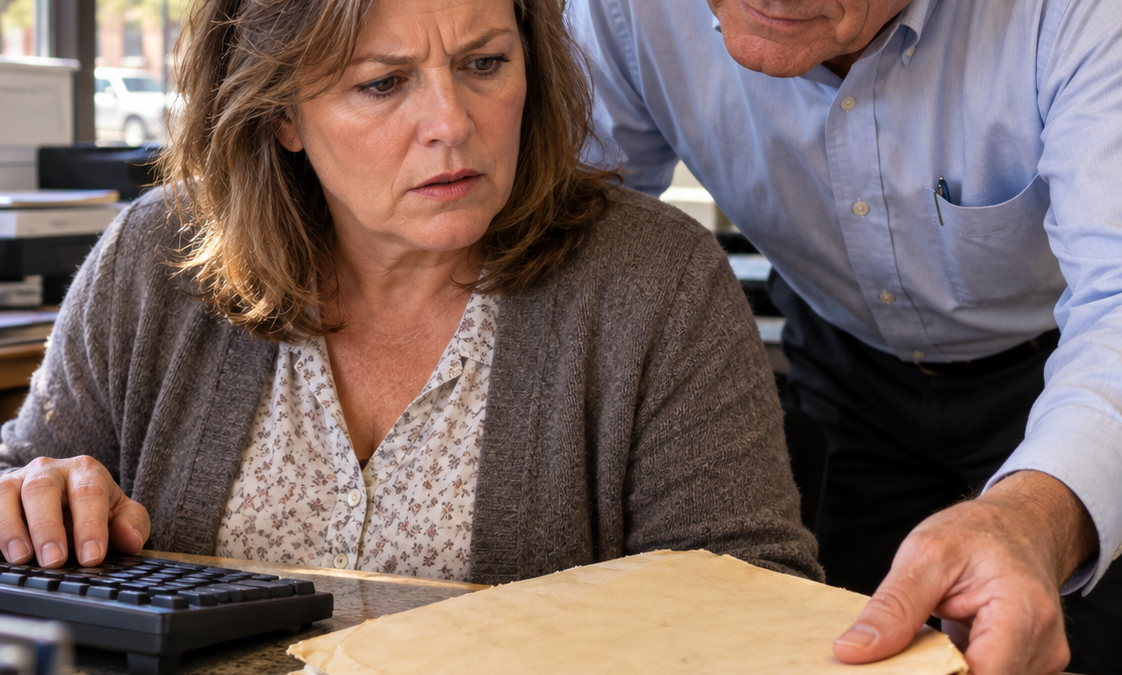
At 7:40 a.m. on Tuesday, September 15, 2026, Darrell Tackett set an auction contract and a faded 2019 folder on my counter and started reading me a flyer for Saturday’s sale of his mother’s home.
Opal Tackett had died yesterday morning.
I sat at the keyboard while he stood behind my chair.
“Absolute auction — Saturday, September 19, 10 a.m., on site. 1920 farmhouse and 40 acres. Offered by the family of Opal Tackett.”
His signature was on the contract. A time box near the bottom read “9/14/26 4:40 p.m.” The seller entry named the estate; he’d signed there and on the auctioneer line.
The 2019 folder was labeled “TACKETT FARM — 2019.” I left it closed and typed as far as the acreage.
Then I stopped.
“Tara lives out there, Darrell.”
He spoke directly over my shoulder.
“She ran off sixteen years ago. She can run off again by Friday.”
I stayed at the keyboard.
“Packed one duffel bag and never looked back.”
That was the account he’d given me. Tara had worked the auction floor in 2009 and 2010, when I was still learning the counter. We still said hello in town. Now her father was giving her until Friday, and the place she lived was halfway across my screen.
Darrell waited for me to finish.
“I’ll ring it up.”
For seventeen years, that had been my answer at Tackett Auction & Realty. I took the payments, kept the books, and made sure the office had the right papers on file. My name was Dawn Lusk. People on the courthouse square in Searcy called me when they needed a receipt, even if somebody else had taken their money.
He went to his desk in the same office. We were alone.
“Put absolute in bigger type,” he said.
“How big?”
“Make it the biggest thing on there.”
I enlarged the word. It pushed the family line farther down the page.
Darrell called Little Red Abstract & Title and ordered a rush title search on the farmhouse and forty acres east of town, in White County.
“The auction’s this Saturday,” he said. “I need it before then.”
He listened with a pen poised over his desk.
“For the buyers’ bank. I just need it to say clean.”
I had a space in the office records for that report. So far, there was nothing to put in it.
His next call was to the local radio station. He booked nine hundred dollars in ads, starting at six Friday morning.
“Lead with absolute,” he said. “Don’t bury that under the address.”
When he hung up, I asked, “Same wording as the flyer?”
“Use exactly what I gave you.”
The family line at the bottom named only Opal Tackett. He hadn’t supplied anyone else’s name.
“Order a hundred color flyers,” Darrell said. “Call the print shop on the square. Tell them rush.”
“Do you want eleven by seventeen, card stock?”
“Yes.”
I made the call from my counter. The price was three hundred sixty dollars, with pickup at seven Thursday morning. I held the line and looked over at him.
“Do it.”
“Nine hundred for radio. Three-sixty for printing,” I said.
“You’ve got it.”
I entered the charges separately. The new flyer came out as a proof onto a printer tray beside my counter. Darrell could check it before I sent the file to the shop.
A message slip lay on his desk, within reach of his pen. I’d written it Monday: “Red Bluff Farmers Bank — call back re: renewal.”
“That’s yesterday’s,” I said.
“I see it.”
The company had a hundred-eighty-thousand-dollar note with that bank. I kept it on the books. It was due in full September 30.
I didn’t know what the caller wanted beyond the message I’d taken. Nothing had come through me saying what a renewal would require.
Darrell folded the slip and put it into his shirt pocket. He pressed it down until none of my writing showed.
“Anything else for the printer?” I asked.
“Go with whatever images of the property we’ve already got.”
The faded folder sat shut beside the contract.
He stood to leave for Larkspur Funeral Home to pick a casket.
“Connie’s bringing Mother’s pictures tomorrow for the slideshow. Scan them for Larkspur. And use the farm photos in that old folder.”
I pointed at the time box.
“You signed both lines? At four-forty yesterday?”
“Executor signs for the estate. Print the flyer.”
Darrell walked out. His car keys were still on his desk.
I opened the old folder to find a farm photo. A work order lay on top, dated May 14, 2019, in Darrell’s handwriting.
“Contents auction — owner moving to Pecan Hollow Care Center June 1.”
Underneath was a proof flyer for a sale of everything inside the farmhouse. Across it, a red stamp read CANCELLED.
Picking up where the Facebook post left off
I recognized the handwriting below it before I reached my initials.
“Cancelled per Mrs. Tackett by phone 5/14/19. She asked me to read her every line. — DL”
The D had the little hook I still put on it. My fingers held the sheet by its lower corners.
I’d forgotten the call. There had been thousands of orders across that counter in seventeen years, and this one hadn’t gone ahead. Until I saw my initials, I wouldn’t have been able to give anyone the date.
Now I remembered Mrs. Tackett on the telephone that afternoon. Her voice had been completely calm. I had gone through every line with her and marked the cancellation when she requested it.
The front door opened.
Darrell came back for the keys. He stopped at my counter when he saw the red stamp on the old proof in my hand.
“That’s the old one. Mother wanted it sold. She told me so. Print the new one.”
Part 2 of 7
“Locks changed at Mother’s. New key’s in the box on the porch post, code 0919. Put it on Friday’s preview sheet.”
Darrell’s text lit up my phone at 2:15 p.m. on Wednesday, September 16, 2026. His mother’s funeral was tomorrow.
At my counter, I pulled a showing schedule for buyers out from under a pad. Friday’s preview sheet had a space for access instructions.
The farmhouse was east of town. Tara would still be at work at the county road shop, with no way of knowing yet that her key wouldn’t fit when she got home.
My pen stopped above the blank.
Then I copied 0919 there, writing the zero as carefully as the other digits. Someone coming from our office would have what they needed to get inside.
I set it beside my phone.
Since 2009, I’d kept one rule at Tackett Auction & Realty: no listing went up on the company website until a valid contract was on file. A signature alone hadn’t finished this one.
Darrell was still out. I called him from my counter.
“Do you have letters from the court yet?”
“Mother’s will names me. Fine — keep it off the website. I’ll hand the flyers out Thursday myself. Half my Saturday bidders will be at that lunch.”
He meant the meal after the funeral at Larkspur Funeral Home.
“With the family sitting there?” I asked.
“They know what business I’m in, Dawn.”
“Connie hasn’t brought the photographs yet.”
“She’ll come by. Have them ready for Larkspur.”
He ended the call.
Online, the farm still had no listing. I left it that way.
At 3:50 p.m., Darrell walked in carrying a briefcase and an envelope from Little Red Abstract & Title. He stopped across from me, took out a title search, and read page one aloud.
“Owner of record, Opal Tackett. No mortgages of record. Clean.”
His thumb held the bottom corner. He didn’t turn it over.
I reached for an auction file containing the signed contract.
“Six pages?” I asked as he handed them across.
“Clip it in. Don’t waste your afternoon on the rest.”
He stood at my counter while I lined up the edges under a hole punch. A staple pinned the top corner, and I worked it loose with my thumbnail before feeding the sheets in.
As the pages turned, I caught only the bold heading at the top of page three: “Instruments of Record”. I didn’t get to a single line under it. Darrell was waiting with his palm out for the file.
The holes went through cleanly. I clipped all six pages behind the contract and closed the cover.
“Will I need this here tomorrow?”
“I’ll bring it.”
He took the auction file from me and put it into his briefcase. When he left for the day, the whole title search went with him.
No copy stayed with me, and Little Red’s office closed at five.
At 5:10 p.m., Connie Ballard set a photo box on my counter.
Darrell’s younger sister was sixty-two. A corner of the lid had split, and she kept her fingers under it while she slid the bottom toward me.
“I’ll scan them now,” I told her. “You’ll have the originals to take home tonight as soon as I’ve finished with them.”
Her eyes stopped on a flyer proof still sitting in the printer tray.
“He’s telling the whole family Mother wanted it sold.”
I didn’t answer.
A closed 2019 folder lay within reach. I left it shut and said nothing to her about the cancellation sheet.
Connie lifted the lid off the photo box.
“I don’t know how many you’ll need.”
“Enough to run through while people are coming in.”
“Use what you can.”
The scanner’s screen let me check each one. I started with the loose photographs on top.
Connie waited while I saved them for the slideshow. When one came through crooked, I straightened it and tried again.
“Will they be able to see from the back?” she asked.
“These are clear enough to enlarge.”
“All right.”
The next photograph showed Mrs. Tackett sitting on the farmhouse porch steps. Four photo corners held it on an unusually thick board made of two cardboard layers, with yellowed tape sealing the edges.
I slid it free and turned it over.
The back had only “May 15, 2019” in ballpoint.
After scanning it, I fitted the photograph back into its corners.
Connie said, “I took that one May fifteenth, 2019. She asked me to. Leave that one out of the slideshow.”
“I will.”
Without asking why, I returned it to her and selected the other images for Larkspur.
Connie placed the board with the others and took the box home.
I enlarged the scan before closing it.
On the scanner screen, Darrell’s mother sat on the porch steps with a box cutter, slicing the tape on a stack of cardboard boxes that rose beside her shoulder. One flap stood open, and a cut strip curled over her cardigan sleeve while her free hand steadied the pile. Across each carton was a small sticker reading “TACKETT AUCTION & REALTY — PECAN HOLLOW — JUNE 1,” made by the label printer in my own office.
Part 3 of 7
A shiny new lock kept Tara Tackett out of the farmhouse. A black dress she needed for her grandmother’s funeral the next morning still hung in a closet inside.
At 6:30 p.m. on Wednesday, September 16, 2026, I pulled up with a flyer proof on my passenger seat. The road continued east toward the cemetery.
Tara sat on the porch steps in a grease-stained shirt from the county road shop. At forty-one, she still planted her work boots flat when she sat, ready to get up.
“How long have you been out here?” I asked. “Since quarter to six,” she said. “My key won’t fit.”
I’d driven out so she wouldn’t learn about the sale from a flyer at a funeral lunch.
We’d worked together in 2009 and 2010, Tara on the auction floor and me at the counter. After she left for diesel school, we still said hello in town.
“You need to see this while it’s a draft.”
She took the flyer proof and rested it across her knees. Her thumb stopped under Saturday’s date.
“He changed the locks the day before we bury her.”
A stripe of grease ran along her cuff. She folded the sleeve back and handed me the proof.
“Is he giving these to the people coming tomorrow?”
“He said he’d hand them out at the lunch.”
Tara pressed her boot against the bottom step.
“Did he put my name anywhere?”
“He didn’t.”
“I’ve lived here sixteen years.”
No useful answer came to me.
She stood long enough to try the knob once more, then sat down without testing her old key again.
At 6:50 p.m., my phone rang. Darrell’s name filled the screen.
His voice carried even with the speaker off. Tara stopped rubbing a spot on her sleeve.
“Pick up those hundred flyers at the print shop at seven, put one at every plate at Larkspur, and be at Larkspur by eight to run the slideshow. Do that, or clean out your desk,” Darrell said.
“I’ll ring it up,” I said, and ended the call.
He meant seven on Thursday. The pickup was already booked.
Tara waited until I lowered my phone.
“You don’t have to stay,” she said.
“I came out here to talk to you.”
At fifty-one, I had health insurance through that desk. I’d never had to empty it.
“Gran told me in 2019, ‘The house is seen to. The paper’s in my cedar box.’ I never read it.”
“Where did she keep that?”
“In the hall closet.”
The front door stood between us and everything Tara had come home to get.
“Why haven’t you called the sheriff’s office?” I asked.
“Send a deputy after Daddy the night before Gran’s funeral? No.”
My eyes went to a lockbox on the porch post.
Darrell had sent me the combination for buyers. My phone still held his text, but I didn’t need to open it.
The digits were 0919.
I punched them in and took out a key. Tara rose when I held it toward her.
“That opens this?”
“He sent me the code.”
She unlocked the door of her own home and switched on a porch light.
“Gran never let it go dark.”
Tara carried the key into the hall. I followed only far enough to stand just inside the door, with the proof against my side.
She opened the closet and lifted the lid of a cedar box without bringing it out.
An envelope marked “House — Tara” lay on top. Tara took it out and slipped a finger beneath the flap.
“I knew where to look,” she said. “I just hadn’t needed to.”
A deed unfolded between her fingers. She held the bottom steady while I bent close enough to read a stamp: “Circuit Clerk & Ex-Officio Recorder, White County — Instrument No. 2019-03718 — May 21, 2019.”
“May 21, 2019,” I read aloud.
The date sounded familiar. I couldn’t have said why.
Tara kept the deed spread over the envelope.
“I’ll give this to Daddy tomorrow.”
“You could wait until after the funeral lunch and speak in private.”
“Will you be there?”
“Yes. And I’ll bring a 2019 order your grandmother canceled over the phone.”
“Can you get me a copy of his title search before the service?” Tara asked.
“If he finds out I gave you that code, I’m fired, and he’ll call that paper a fake. Anything on record is on page three. That page is in his briefcase. Little Red only gives copies to whoever ordered it, and they’d call him first.”
By eight on Thursday, I had to be at Larkspur for the slideshow.
Tara closed her fingers around the key.
“I’ll put this back in the lockbox at seven-thirty.”
By about 7:15, I was leaving. Tara remained inside with the envelope and the deed, and the porch light stayed on behind me.
At 7:00 a.m. on Thursday, September 17, I collected the flyer order from the shop on the square and carried it to my car.
Ten minutes later, I was alone at my counter in Tackett Auction & Realty.
A 2019 folder lay where I’d left it. I took only the CANCELLED sheet and slipped it into my purse.
The office phone rang at 7:20.
My message pad still held the carbon of Monday’s slip: “Red Bluff Farmers Bank — call back re: renewal.”
The loan officer had called our office because Darrell wasn’t answering his phone. Company loan paperwork came through me.
Our $180,000 note was due Wednesday, September 30. I kept the books; that date was already on my calendar.
“What do you need for the file?” I asked.
The voice on the line said, “I need a copy of the signed listing agreement on Mrs. Tackett’s farm for the company’s loan file. Darrell’s extension rides on that sale. No buyer’s contract by September 30, the note’s due in full.”
Part 4 of 7
I set a flyer on a plate meant for somebody who had just helped bury Opal Tackett. Her farmhouse and forty acres were advertised for Saturday at ten, and my boss had ordered one at each of the seventy places at her funeral lunch.
At 11:45 a.m. on Thursday, September 17, 2026, cemetery dirt still clung to a few farmers’ boots in the reception room at Larkspur Funeral Home. A paper funeral-home fan lay on each chair.
Some relatives had already sat down. I had to reach between their drinking glasses to lay the flyer where their food would go.
“Excuse me,” I said.
A woman drew her elbows in to let me finish. Nobody had asked for what I was handing out.
Darrell had the funeral director set a microphone on a head table facing the room. Then Darrell laid an auction file beside it, with the signed contract and six-page title search still clipped together inside.
“Clean title, right here, if anybody asks,” Darrell said.
The man from Larkspur checked the cord and left. My employer smoothed his tie while people found their seats.
A man near the door started to fold a flyer small enough for a jacket pocket, stopped at the stiff crease and left it beside his glass. Those were the large color ones Darrell had ordered. You couldn’t put one away without making a little production of it.
I finished the last place and straightened.
Darrell beckoned me over to a corner beyond the family table.
“Drove past Mother’s on the way back. Porch light was on. I had that place locked,” he said.
“Maybe the timer,” I said.
A serving spoon struck the rim of a dish behind us. He studied me long enough for the woman holding it to apologize and start again.
I kept my mouth closed.
He had sent that code to me for buyers. Only one person could tell him how Tara had gotten inside, and I stood close enough for him to dismiss me without raising his voice.
Darrell turned away to greet two of the company’s regular auction customers. One had taken off his jacket; the other still held his hat against his belt.
My knees wanted the nearest empty seat. I waited until he was done with them.
“Where do you want me?” I asked Darrell.
“Back table. I’ll call you if I need you,” Darrell said.
From that corner I could see a door opening to the hall. Tara came through in a black dress, holding an envelope marked “House — Tara” tucked under her arm.
Darrell’s attention caught on his daughter. Then his gaze moved across the room to me as I reached the back table.
I pulled out a chair.
Tara approached her father without offering him what she carried.
“Let’s talk after lunch, Daddy,” Tara said.
He didn’t answer. A relative came up beside him, and Darrell reached over his daughter’s shoulder to greet the woman.
Tara stepped back to let her through.
Connie sat with the family up front. With two fingers, Connie turned the flyer at her plate face down and said nothing.
Tara took an empty chair at a side table by the hall door. The envelope stayed in her grasp as she settled, its marked side resting against her dress.
I sat down and lowered my purse onto my lap. The 2019 CANCELLED sheet remained inside.
We had agreed Tara would show her father the paper in private after lunch. She had come prepared to wait for exactly that.
A woman at my table asked me to pass a basket of rolls. I lifted the cloth covering them and offered them down the row.
Someone across from me tore one open, then stopped and set the halves together again. We hadn’t said the prayer yet.
Near the front, Darrell shook hands with another mourner. His voice carried easily without help from the equipment beside him.
The bank needed a buyer’s contract by September 30, or our $180,000 note came due in full.
I put a roll on my plate.
At 12:15, a man stood to say the prayer. Forks rested against dishes while about seventy relatives, neighbors and people who bid at our sales bowed their heads.
Tara lowered her chin with everyone else. Her fingers remained curled around the bottom of what she’d brought.
After the amen, Darrell rose at the head table and took the microphone.
“Thank you for coming to remember Mother,” Darrell said. “Our family appreciates you being here.”
For about two minutes, he spoke about how much he would miss her. I left my food alone and listened for the pause that usually came before he started a sale.
He gestured toward the auction file.
“Mother’s place goes Saturday, ten a.m., absolute. Flyer’s at your plate,” Darrell said.
Then he pointed at Tara.
“And my daughter — she ran off sixteen years ago. She can run off again by Friday. Or her junk goes on the block Saturday with the rest.”
Nobody laughed.
The paper fans stopped moving. A few people looked down at their plates, including the man with the hat.
My hand had closed around my fork without my noticing. I let it go.
Connie’s lunch sat untouched. Beside the door, Tara planted her feet under her chair.
Darrell waited with the microphone near his mouth. Neither of the two bidders he had greeted asked about the house.
Tara pushed back her chair, rose and walked to the front with the envelope in her hands. At the back table, I got up too and picked up my purse.
Part 5 of 7
Tara drew a deed from an envelope marked “House — Tara” and put it into Darrell’s free hand in front of the people he’d invited to Saturday’s sale.
“You’ll want to read this before Saturday, Daddy,” Tara said.
At 12:25 p.m. on Thursday, September 17, 2026, about seventy guests sat watching in the reception room at Larkspur Funeral Home in Searcy.
Darrell glanced at the county recording stamp across the top of the first page and laughed into the microphone.
“That’s an old piece of paper. Mother’s will leaves everything to me, and I’m the executor,” he said.
Then Darrell dropped the deed onto the head table in front of his daughter.
Tara kept the envelope in her grasp. Neither of them bent to retrieve what lay between them.
I reached her side with a purse looped over my wrist. Darrell had sent me to a back table, but he hadn’t told me where to stand.
“A will doesn’t undo a deed that’s on record,” I said.
His laugh stopped. He aimed his next words at me, with the microphone still at his mouth.
“On record where? Anybody can buy a stamp. That paper’s a fake,” Darrell said.
Tara waited for me to answer.
Beside the microphone stand lay the auction file, its clipped contents still in the order I’d left them Wednesday. The title search had come with him, page three and all.
“May I, Darrell?” I asked.
His fingers hovered over the cover. People who paid us to keep their sales straight were sitting close enough to watch him stop me.
Darrell moved his hand aside.
I lifted the auction file. With the bottom supported against my middle, I turned past pages one and two of the six-page title search without disturbing the clip.
Yesterday I had stopped where he’d told me to stop.
Now page three faced me.
A heading, “Instruments of Record,” sat above the entry I had never examined. My finger followed the line so I wouldn’t skip anything.
“Beneficiary Deed dated May 21, 2019, recorded May 21, 2019, Instrument No. 2019-03718, Opal M. Tackett to Tara L. Tackett, Grantee Beneficiary,” I read aloud.
Darrell lowered his chin toward the print.
On the table, Tara’s deed bore the same number: 2019-03718. Nobody needed to take my word for the match. Both were right in front of him.
“Little Red pulled this off the county books for you. You paid for the rush,” I said.
He had no answer ready. His mouth opened, but I waited without supplying anything for him.
Tara stood close enough that her sleeve brushed mine when I adjusted my grip. The envelope remained open, ready for what belonged inside.
I faced Darrell again.
“This farm was Tara’s the minute your mother died Monday morning.”
A chair creaked somewhere behind me. Nobody got up.
Without Saturday’s auction, the company had nothing to show Red Bluff Farmers Bank in thirteen days.
I turned to the sale agreement, still clipped in with the rest, and held it up. A date-and-time box sat beside his signatures. My fingertip stopped beneath 4:40.
“You signed as the seller at 4:40 that afternoon. The company doesn’t sell what the owner hasn’t signed. I’m not ringing this one up,” I told him.
He kept his eyes off the page.
“Mother wanted it sold,” Darrell said.
I steadied what I held against my ribs and reached into my purse. A folded sheet had ridden with me from the office that morning.
Opened out, the 2019 CANCELLED sheet showed a red impression above my handwriting. I laid it beside the deed.
“She canceled your last flyer herself, May 14, 2019. I wrote it down,” I said.
My note faced him: “Cancelled per Mrs. Tackett by phone 5/14/19. She asked me to read her every line. — DL”
Darrell didn’t answer.
His fingers closed around the table’s edge. He still had the microphone raised, but nothing came through it.
Connie rose from her seat among the family.
“You set her duffel bag on Mother’s porch in 2010, Darrell, because she quit the floor to go to diesel school. She didn’t run off. She stayed,” Connie said.
I had done Tara’s separation paperwork. The rest was news to me.
For sixteen years I had believed his version.
Connie turned a chair clear of the people seated alongside it. Then she carried it down the aisle to a side table by the door and sat beside Tara’s empty seat.
Several auction customers folded flyers and laid them down. A man pressed a crease with his thumb, keeping his attention on Darrell.
Tara didn’t leave my side. Her father had the microphone, and Saturday was still hanging on what he would say into it.
I spoke to him loudly enough to be heard through it.
“‘She ran off sixteen years ago. She can run off again by Friday.’ You said that to me Tuesday morning.”
His eyes went to a middle table.
“So is it Saturday or not, Darrell?” an auction customer called.
A nod wouldn’t be enough. Too many people had heard him advertise the property to settle for that.
“The farm’s off Saturday’s sale,” he said into the microphone.
Tara picked up the deed and slid it back into the envelope. Her thumb smoothed the opening after the corner disappeared.
I lowered the folder, keeping the contract and the title search clipped together. The 2019 CANCELLED sheet stayed where I had laid it.
Darrell still stood behind the head table. I set the file down in front of him and said, “You told me not to read the rest, Darrell.”
Part 6 of 7
I typed a form headed “Withdrawal of Property — Tackett farm” at my counter at 8:00 a.m. on Friday, September 18, 2026. Darrell still hadn’t signed, and not one word had passed between us since he put down the microphone.
The office of Tackett Auction & Realty faced the courthouse square. Outside, people were parking for the morning; inside, he stood waiting while I rolled the sheet free.
I placed it before him with the bottom edge turned his way.
He uncapped his pen, bent over, and signed. When he pushed the withdrawal form back, I checked the space he’d filled and took it away.
Seventeen years of work had taught me to make sure the ink was there before I sent a notice.
The company’s auction customers got an email that morning. I put the cancellation in the subject line, where nobody would have to open anything to find out whether to come.
Next I called the local radio station. Its host read the notice on the air before I left for lunch.
Around noon, I drove east to the farmhouse.
Tara’s own locksmith had changed the locks again. The company’s combination lockbox had been taken off the post and left on the top step.
Nobody came to the door while I bent to pick it up.
The metal was warm from the sun. I carried the lockbox to my car and took it back to the office, setting it beside the typewriter.
Saturday passed without an auction.
At church on Sunday, September 20, Connie started toward the pew where I usually saw her. Tara sat farther forward, with an empty place alongside.
Connie stopped at the aisle.
Then she went past the usual row and sat beside Tara. Neither woman turned to see who had noticed.
I was in the congregation, close enough to watch Darrell open his bulletin and keep it spread until the service began.
Afterward, two longtime regulars stopped him in the churchyard. People coming down the walk slowed behind them.
“I’m taking my consignment to an auction house in Beebe, Darrell,” the first customer said.
The other stood alongside. “Mine’s going with his.”
Darrell folded his bulletin along its crease. He didn’t argue or ask either man to reconsider.
I waited for a family to pass before I stepped onto the walk. By then, the two customers had gone through the gate, leaving Darrell where they’d stopped him.
At 9:00 a.m. on Monday, September 21, Darrell opened a letter from Red Bluff Farmers Bank right at my counter.
He drew the contents clear, leaving the torn envelope against his palm.
“They won’t extend the note,” Darrell said. “It comes due in full at the end of the month.”
I waited with a pen above my pad. He kept the bank letter in his hand.
“Advertise the second flatbed truck and my fishing boat,” he told me.
For years, an instruction like that had meant I turned toward the typewriter.
This time I stayed facing him.
Darrell tapped the edge of what he held against his thumb. “Write the 1,260 dollars for the printing and the radio ads into company expenses.”
The hundred flyers and the airtime were the company’s bill now.
I lowered my pen.
“You work for me, Dawn, not for her,” Darrell said.
A receipt tore cleanly from my pad. I wrote “Resigned 9/21/26 — D. Lusk” across it and set it on the counter.
“Not anymore,” I said.
He could have reached what I’d left without moving his feet.
I took the purse from underneath and walked out with nothing else. The office door shut behind me before I stopped.
Only when I reached my car did I add up my October rent in my head.
At 6:00 that evening, I drove out to the farmhouse.
Tara was at her grandmother’s stove, cooking chicken and dumplings the way Opal always had. A spoon rested across a saucer beside the pot.
I stopped just inside the kitchen.
“Come on in, Dawn,” Tara said. “Supper’s nearly ready.”
Before I could choose a place, Connie arrived carrying the photo box. She slid it onto the counter, then went to the cupboard for dishes.
Tara stirred once more and lowered the heat.
“Thank you for the lockbox code,” Tara said. “I punched in 0919 myself Thursday afternoon and walked into my own house.”
I hung the purse over a chair.
Connie set the table for three. Tara filled a plate for me, bringing it over before taking the place nearest the stove.
As we ate, Tara drew a letter from her pocket.
“This came at four-thirty,” Tara said.
The paper went onto the table between Connie and me. Darrell’s lawyer had sent it.
Tara kept a fingertip beside the part I needed to see.
“He’s going to sue to undo the 2019 deed,” Tara said. “For ‘undue influence.’ He says Gran was ‘not competent in 2019.'”
My fork rested across the food. I didn’t pick it back up.
“Now, Darrell—” Connie began, then stopped and shook her head.
Tara got up and took out the photo of her grandmother sitting on the front steps.
“That box sat in the attic from 2019 till I handed it to you Tuesday night, Connie. I never lifted the lid,” Tara said.
Beside the dishes, Tara stood the photo against a drinking glass, then ran a fingertip along the thick board behind it. The yellowed tape had come loose at one corner.
I remembered noticing those sealed edges when I made the scan.
Tara fetched a paring knife from a drawer, then lowered the board face down. Holding one edge steady, she slit the tape and laid the knife next to her plate.
The two cardboard layers separated.
Between them lay an envelope marked “For Tara.”
Tara lifted it out and opened it.
Inside was Opal’s own copy of the 2019 flyer, with pencil in the margin: “May 14 — Called Darrell’s office. Dawn read me every line. Pecan Hollow by June 1. Doctor May 20. Courthouse May 21. Not this house. Not after.”
Pinned to the flyer was a doctor’s letter dated May 20, 2019: “alert, oriented, and fully able to manage her own affairs.”
Part 7 of 7
Darrell meant to undo the deed in court; the doctor’s letter lay on the lawyer’s desk, dated one day before Opal signed. Beside it, the pencil note on the flyer gave the order in which Tara’s grandmother had made her arrangements.
Tuesday, September 22, 2026, and Tara had brought the recorded deed to a lawyer on the courthouse square in Searcy. I sat in the other visitor’s chair with my purse against my ankles.
The lawyer drew the papers closer.
Tara kept both feet planted beneath the seat. When the lawyer reached for a book, Tara caught the corner of the desk as though we might be sent away before finishing.
“I need to know whether Daddy can make me leave while he argues about this,” Tara said.
The book fell open at the Arkansas beneficiary-deed section, and the lawyer followed it line by line with a fingertip.
“When this kind of deed is recorded while the owner is alive, the property passes straight to the named person at the owner’s death. A will cannot change that.”
Beside me, Tara let go of the desk.
“So his mother’s house wasn’t his to promise anybody,” Tara said.
“Correct.”
After that, the lawyer took up the letter from Opal’s doctor, laid it beside the deed, checked the dates, then pointed to the first.
“May twentieth. She signed the next day, with an attorney and a bank notary. That’s the end of ‘not competent.'”
Tara pressed a heel into the carpet.
“What about the other part?” Tara asked. “That I pushed Gran into doing this?”
The lawyer turned the flyer to examine Opal’s pencil note. For a while, only the office clock made any noise.
“This gives me her own account of the steps she took,” the lawyer said. “I’ll send the other attorney a copy of this, too.”
Nobody asked Tara to prove that cooking supper and keeping a house had been a scheme.
I moved my purse out of the way when the lawyer stood.
“May I make copies?” the lawyer asked Tara.
“Yes,” Tara answered. “I want to take the originals home.”
The machine stood against the wall behind us. We waited while the lawyer lifted the lid and lowered it, keeping Opal’s papers separate from the fresh stack.
A narrow strip of pencil near the margin came out faint. The lawyer adjusted the setting and made that copy over.
Tara leaned forward to check the result.
“That’s clear enough now,” Tara said.
Back at the desk, the lawyer wrote a letter to Darrell’s attorney and enclosed the duplicates. The originals went across to Tara, who squared the corners before picking up the stack.
“Will the answer come here?” Tara asked.
“Yes,” the lawyer replied. “I’ll contact you when it does.”
On the sidewalk, we stopped long enough for Tara to settle what she carried securely against her side. My car was parked farther down the square.
“I’ll call you,” Tara said.
That night, over the phone, Tara told me the original deed was back in her grandmother’s cedar box in the hall closet.
On Friday, September 25, the call came while I was at home with my calendar open.
Tara had heard from the lawyer. Darrell’s attorney had sent a reply.
“The sentence says, ‘our client will not pursue any action concerning the 2019 deed,'” Tara reported.
My pen stopped above an empty square.
“That’s what they put in writing?” I asked.
“They sent exactly that,” Tara answered. “My lawyer read me the whole thing.”
I lowered the receiver a little and sat back. Through the window, a neighbor was pulling an empty trash can up the drive.
The calendar stayed open on my lap.
“There’s something else,” Tara said. “The county road shop needs somebody for the parts room. I gave the foreman your name.”
For a moment, I couldn’t find the cap I’d taken off.
“Does he know I’ve never worked around diesel equipment?” I asked.
“I told him what you did at the auction office,” Tara replied. “Keeping orders straight. Checking what came in against what got charged.”
“Seventeen years of it,” I said.
“Monday, September twenty-eighth,” Tara continued. “Eight in the morning, if you want the interview.”
With the receiver tucked under my chin, I wrote on my calendar: “Monday, 8 a.m. — parts room.”
Three days later, at 8:00 a.m., I stood in the shop office while the foreman pulled out a chair.
The interview lasted ten minutes.
“Can you keep track of an order somebody changes after they’ve already asked for it?” the foreman asked.
“If the change gets written down,” I answered.
“Even when somebody’s in a hurry?”
“Especially then,” I said.
Questions about invoices and missing deliveries came next. My answers got easier once we reached work I knew.
The foreman leaned back. “Can you start this morning?”
“Yes,” I answered, setting my purse beneath the chair.
The hourly pay covered my October rent, and the job included the county’s health insurance.
I asked when the coverage began and listened until he finished explaining. At fifty-one, I wanted the answer before moving on.
Then we walked out to the counter where I’d be working.
The foreman showed me the shelves and where to put the delivery slips, then left to get the morning’s work together.
A few minutes later, Tara came from the repair bays in a work shirt, carrying a new key on a small ring.
I stood behind the counter with nothing waiting for my approval yet.
“All I did was read an old woman a flyer over the phone,” I said.
Tara stopped in front of me.
“Everybody calls the one who stays ‘the one who left.’ Gran just needed one person to read her the whole page.”
A truck engine turned over beyond the open doorway. Neither of us raised our voice over it.
“Being tired didn’t mean you wanted to leave her,” I said.
Tara rubbed a dark mark on one cuff with the opposite thumb.
“No,” Tara said. “I just hoped for a night’s sleep sometimes.”
I moved closer as Tara put the new key to the farmhouse into my hand.
“Sunday dinner’s at noon. Gran’s rule,” Tara said.
The little shop ring rested against my palm while I took my keys from my purse. I hooked the shop ring onto my own, worked the metal around until it cleared the split, and put the joined rings away.
Tara walked back to the diesel bay.
The foreman slid the first parts order across the counter, and I read every line before I signed it.
THE END
More stories
My brother demanded our parts manager sign a confession for six missing pumps—Then my 10-year-old son’s bird video showed the whole room who had loaded them.My wife put a $1,200 sticker on my mother’s jewelry box before the funeral—Then Mom’s lawyer made her peel it off with thirteen of us watching.My sister-in-law called me “the hired help” while taking my 74-year-old dad’s phone — Then six lock codes exposed her secret rental, and she canceled before 14 guests.My brother-in-law used a $180 drill in Mom’s purse to push care-home papers—Until the store owner checked his cameras and my sister tore up the forms.My brother handed our 61-year-old mom an apron and called her “kitchen help”—Until his investor read her filing and laid the $250,000 check face down.My nephew’s wife trashed Mom’s pie before 18 relatives—Then a notary opened her book at their housewarming and refused to stamp the deed giving them Mom’s house.








