My brother demanded our parts manager sign a confession for six missing pumps—Then my 10-year-old son’s bird video showed the whole room who had loaded them.
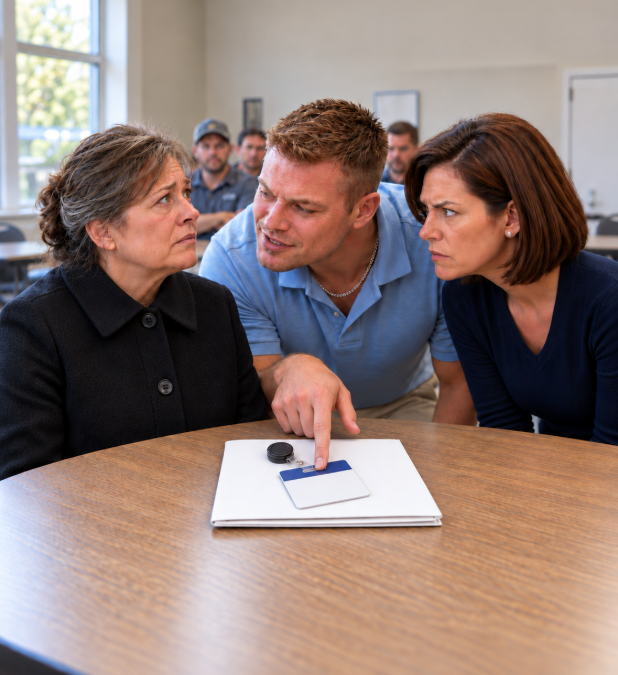
Complete story · 7 parts · about 29 minutes · ending included
Part 1 · Part 2 · Part 3 · Part 4 · Part 5 · Part 6 · Part 7
Part 1 of 7
“You’re done. Clear your desk,” Colby said at 7:52 a.m.
Joyce Kasper had run our parts room for 17 years, and about 20 morning-shift employees heard my younger brother fire her.
Nobody reached for coffee.
It was Friday, May 1, 2026.
We were in the break room at Dry Creek Implement Co., outside Salina, Kansas.
Two sheets had gone onto the bulletin board at 7:45. One said, “6 HYDRAULIC PUMPS — MISSING — $14,600.” The other carried the access line Colby had read aloud at 7:50: “KASPER, J — DOOR 3 — 10:38 PM.”
I watched from my office doorway.
She pressed her lips together, then pointed toward the parts room with a small motion.
“Count it twice, Colby. Let me recount.”
He folded his arms.
“I counted it.”
Her finger dropped.
“Seventeen years doesn’t buy you a key to this building, Joyce.”
My right hand closed around the pencil I had been using on payroll.
He was 39, five years younger than me, and he had been general manager for less than two months.
“Joyce took them,” Colby told the room. “She’s had it in for me since March.”
March 2 came back in one hard piece.
Dad had announced the promotion in front of the staff. Joyce had looked straight at him and said, “He’s not ready, Dennis.”
I could not look at her now.
My eyes went through the open door toward the warehouse.
A swallow nest clung to the steel beam above door three. On the top shelf below it sat Micah’s green-cased tablet, aimed at the nest, its charger cord running down to the outlet on the shelf post.
My son was ten, a fourth grader at Brannock Elementary, and in class that morning.
I believed his science-fair camera was recording birds.
Colby pulled out his phone.
Rusty Pfeifer, our service shop foreman, stood by the coffee maker. At 60, he had been working for Dad almost as long as I could remember.
He looked at the floor.
My brother tapped the number for the Saline County Sheriff’s Office and put the call on speaker long enough to ask for the non-emergency line.
No one interrupted him.
I set the pencil down.
His voice changed when the dispatcher answered. Smooth. Clear. The same voice he used with customers buying expensive equipment.
He gave the company name, the missing inventory and Joyce’s name.
She reached into the pocket of her work shirt and took out a folded scrap of paper.
“Your count says six?”
Colby lowered the phone.
“Yes.”
Joyce unfolded the scrap and glanced at it.
“I closed parts yesterday. I know what was on those shelves.”
“You can tell the sheriff.”
Her thumb ran once over the fold.
I moved to the printer because I knew what would come next.
At 8:01, Colby turned toward me.
“Cut her final check. Now.”
“Printing now.”
The words came out the way they always did when somebody needed payroll, a purchase order or a vendor statement.
My hands knew the job better than my stomach did.
I entered 64 hours at $26.
The printer pulled in a blank check.
At 8:05, it came out: $1,664 gross, less withholding.
I tore it free, checked the amount and carried it to Joyce.
She took it by one corner.
I watched the numbers instead of her face.
“Thank you, Faith.”
My empty hand curled against my skirt.
She folded the check once, then slipped it into her shirt pocket.
Colby had gone back to talking into his phone.
She headed for the small office she used beside the parts counter.
I followed, since Colby had ordered her out and no one else moved.
Her desk did not take long.
A framed picture went into a cardboard box. So did a coffee mug, a small calendar, a pair of reading glasses and the sweater she kept over her chair.
I lifted the box.
She picked up nothing else.
We entered the warehouse together.
Door three sat ahead of us beneath the beam.
She stopped there.
Her attention went to the swallow nest.
Yesterday, Thursday, April 30, Micah had come to work with me after school. She had helped him clip the tablet up on that high shelf for the fair and plug its charger into the outlet.
“Don’t let it fall, bird man,” she had told him. “That shelf’s higher than it looks.”
Now Joyce tipped her chin toward the nest.
“Tell bird man to keep counting his swallows.”
My fingers tightened under the cardboard.
“I will.”
Colby appeared at the break room entrance.
“Rusty. Walk her out.”
Rusty came into the warehouse.
He reached for the box, and I let him take its weight.
She pulled the key ring from her pocket.
The brass tag stamped “PARTS” rested against her palm.
Then the ring dropped into my hand.
A plastic badge followed.
The keys pressed into my skin beneath it.
Rusty settled the box in his arms and headed for the exit.
We walked together a few steps behind him the whole way.
The small brass tag kept clicking against one key.
My hand gripped the badge and the ring hard enough to feel every edge.
The outside door was only a few yards ahead.
Rusty pushed it open with his shoulder, and the box blocked part of the frame.
Joyce turned her head toward me.
“Ask that machine which badge, Faith. I keep two.”
Part 2 of 7
Colby pushed the inventory sheet bearing Joyce’s name across his desk to Deputy Kyle Unruh at 2:00 p.m. on Friday, May 1, 2026.
The summary printout followed.
I stood inside the general manager’s office door. My brother sat behind his desk, with Unruh in the chair facing him.
“Six hydraulic pumps,” Colby said. “Fourteen thousand six hundred dollars.”
Unruh put the papers on his lap.
“You’re reporting these as stolen?”
Across the desk, Colby leaned forward.
“They didn’t walk out of my building.”
“I need your answer for the report,” Unruh said.
“Yes,” my brother said.
I had heard that certainty in front of the morning crew. A deputy was now putting it on paper.
Unruh asked when the shortage had been found. The general manager answered with the time of his count and repeated Joyce Kasper’s name.
“Did you see her remove anything?” Unruh asked.
“No. You’ve got the door record,” Colby said.
His written statement lay unfinished on the desk.
I heard the ballpoint scrape as he pressed hard after flipping the page over to finish. My brother wrote more slowly than he had spoken.
Unruh waited until the pen stopped.
“Please sign that.”
Colby signed beneath his account: the pumps were stolen, and he suspected Joyce.
I watched Unruh collect the statement. The count sheet and the summary went into his folder with it.
“I’ll come back Monday, May 4, at 7:30 a.m.,” Unruh said. “Have a list of badge holders ready. Names included. Then I’ll talk with Joyce in private.”
“Do it in the break room, so the whole crew hears it.”
Still seated, Colby glanced at me in the doorway, then turned to the deputy. “Will you search the Kasper garage?”
Unruh closed his folder.
“I don’t go into anybody’s house without a warrant, Mr. Wendt. One name on a printout won’t get me one.”
Stepping aside, I let him through.
My brother remained in his office.
Deputy Unruh walked across the parking lot to his patrol car. I followed as far as the driver’s door.
“Shouldn’t the badge entry prove it?” I asked.
“A card’s not a hand, ma’am. That log tells me which card.”
Unruh took out his phone at 3:00 p.m. I stood by the car as he called Joyce.
His questions were short. Nobody inside the dealership could hear the answers.
Before getting in, Unruh told me she had agreed to meet him here Monday morning.
I returned to the building.
At 3:30 p.m., I sat at my desk to reconcile the April fuel-card statement. Fuel card 4 was issued to Colby’s pickup.
I matched the charges against the receipts until I reached the last entry for Thursday, April 30.
“4/30, 11:14 PM, LINDSBORG KS, $71.20”
My brother’s wife, Lacey, grew up in Lindsborg, where her parents still lived. Colby must have driven down to see them.
I put a note bearing a single “?” on the line. He could bring me the receipt, the same as anybody else.
The statement went into the April folder atop my desk.
Directly underneath, I found the repair slip. The back warehouse camera had been broken since Monday, March 16.
In the approval space beside the $1,200 estimate, “next quarter” appeared in Colby’s handwriting.
I closed the cover.
Micah’s green-cased tablet was still on the top shelf at door three when I climbed the step ladder at 4:00 p.m.
I unplugged the charger first.
Lifting the device down, I put it in my purse without waking the screen.
Afterward, the cord followed.
I carried the purse back to my office to bring home to Micah.
Colby stood behind my chair at 4:15, his phone at his ear.
“Shut off Joyce’s badges,” he told me. “Print the names for the deputy.”
I opened her account on the computer.
The screen faced me. My brother looked away from it, toward the office door.
“I know I still owe you,” Colby said into the phone. “I’m not asking you to stop building.”
I kept my eyes on Joyce’s name.
Under it were two lines: 117 and 117-S.
Because I ran the badge system, every long-time manager’s spare badge sat sealed in a named envelope in my locked desk drawer.
I shut off both credentials.
Colby was still talking to the builder of his new house. My hand lay flat on the mouse; the door-by-door lines remained unopened.
My printer produced a single page of names.
I handed it to Colby.
Rusty Pfeifer wiped his hands on a shop rag when I entered the service shop at 8:30 a.m. on Saturday, May 2.
“Your office locked Thursday after five?”
Before I could answer, Rusty turned and walked off.
At 4:30 on Thursday, April 30, I keyed my desk drawer shut. Then I took Micah home.
My office opened onto the break room, where I could see straight across the warehouse to door three.
Joyce had told me to ask which badge. Rusty had asked about a lock.
At 9:40 a.m., I opened the detailed log for Thursday, April 30, on my computer.
I found the entry for 10:38 p.m.
Then I took out my key and unlocked the drawer.
Only Colby and I had keys to it. Dad had handed him the second key at the staff meeting on Monday, March 2.
The envelope marked “117-S KASPER — SPARE” was still inside, beside the key ring and badge 117.
I had sealed it with brown packing tape.
Someone had slit that tape across the flap. A strip of clear tape covered the cut.
I left the envelope in the drawer.
At 9:50, I photographed it with my phone. The picture showed the brown edges beneath the clear strip.
I made two paper copies of the April 30 entries.
One sheet, folded, went into my purse; the other stayed in my hand with the 10:38 p.m. line facing up.
“04/30 10:38:14 PM — DOOR 3 — CREDENTIAL 117-S (SPARE — OFFICE DRAWER) — GRANTED.”
Part 3 of 7
“Where was your key to my drawer the night of Thursday, April 30?” I asked Colby from his doorway at 11:20 a.m. on Saturday, May 2.
He remained behind his desk as I turned my own key over in my fingers. The copies of the detailed log lay folded in my purse.
Colby held out his hand.
“GM holds the keys now.”
I put the key in his palm.
He closed his fist around it.
“Anything that opens in my building, I need access to,” Colby said.
“Yours worked fine already.”
His desk calendar lay open between us. He looked down at the appointments.
“I’ve got work, Faith.”
My purse hung from my shoulder. I left the copies inside and returned to my office.
At 1:00 p.m., I sat at my computer with an email from Colby open on the screen.
He had sent it to four farm-equipment dealers in the region. I was copied.
“Joyce Kasper was terminated May 1 for theft of inventory. A sheriff’s report is on file.”
His name appeared beneath the message, followed by General Manager, Dry Creek Implement Co.
I knew the businesses in the address line. We called them when a customer needed a part we couldn’t get before planting.
Joyce’s name had just gone to every place nearby that might hire her.
For seventeen years, she had answered our parts phone. Now somebody at each of those counters could say they’d heard from her last employer.
I clicked Reply.
The empty box opened below the email. I had nothing to send those dealers, only a question my brother hadn’t answered.
At 2:00 p.m., a locksmith knelt at my desk drawer to change the lock.
Colby stood in the doorway. I watched from the window, where I could see the man’s tools but not his face.
“Do you want a second key?” the locksmith asked him.
“No. Just the new key.”
My brother checked the time on his phone.
I could hear the screwdriver turning. The drawer remained shut through the work; nobody removed anything from inside.
When the locksmith stood up, he dropped the single key into Colby’s hand.
My brother put it in his pocket.
I returned to the desk after they left. My chair fit beneath the same worn edge, and I could still reach the phone from the keyboard.
At 4:00 p.m., I called the Saline County Sheriff’s Office non-emergency line from my desk.
The woman who answered asked whom I needed.
“Deputy Unruh,” I said. “This is Faith Hiebert at Dry Creek Implement.”
“He’s off until Monday, May 4. He’ll be at your dealership at 7:30 a.m.”
I asked her to take a message.
“Please tell him I have information about the badge record. He can call me at this number.”
She read the digits back for my confirmation.
“Yes,” I said. “That’s right.”
I hung up and left the ringer on.
At 6:00 p.m., I pulled a copy from my purse at Dad’s kitchen table.
He sat across from where I stood. I laid the paper in front of him with the entry facing his chair.
“Someone used the spare badge from my drawer,” I said.
Dad read down to the line.
I kept my purse on my shoulder. He could ask me where the spare belonged, or who had a key, and I could answer.
He set the paper down on the table.
“Your brother says you probably left the drawer open. He runs it now, Faith. You print the checks.”
I slid the empty chair back into place.
Dad took off his glasses.
“I can’t keep going down there to settle things.”
“You don’t have to go down there.”
He rubbed the bridge of his nose.
“Then let him do his job.”
At 8:15 p.m., I tried Dad again from my kitchen counter, with a call this time.
“Joyce got her last check from me on Friday, May 1, and I shut off both her badges,” I said into the phone. “Now Colby’s told four dealers she stole.”
Micah stepped into the doorway.
“You fired Miss Joyce?”
I turned toward him with the phone still at my ear.
“I only printed the check,” I said.
He hugged the green-cased tablet to his chest.
I had carried it home in my purse the day before. Joyce had helped him clip it to the high shelf beside door three for his school project.
“Micah,” I said.
My son walked to his room and shut the door.
Dad was still on the line. I held the phone against my ear, but I didn’t give him anything else to answer.
At 7:40 p.m. Sunday, May 3, Micah sat opposite me, markers and glue sticks spread across our table at home.
He was working on his science-fair poster. The green case lay in front of him, and he scrubbed through the time-lapse with his thumb.
From my chair, I could make out the nest. He stopped adding to the poster and brought the screen closer.
Micah said, “Some truck ruined my nest, Mom. It all went bright.”
He turned the tablet toward me.
Below the nest, I could see the top of the receiving doorway. I leaned forward to look at the lower edge.
“How does the picture show door three at all?” I asked.
“Miss Joyce had it aimed too high. The nest was half off the bottom, so I tipped it down.”
Like Joyce, I had thought it watched only the nest on the beam.
My son held the screen steady for me.
I took the green case from his hands and dragged the time bar back to 10:36 PM, Thursday, April 30.
Then I moved forward to the frame stamped 10:38 PM.
On the screen, the shutter rose and the motion lamp switched on, revealing my brother at the reader with a white card still raised in his hand. Behind him, a gray pickup with a dented rear door was already backed up to door three.
With his ball cap on backward, Colby lifted the first crate of pumps.
Part 4 of 7
My brother came back to door three for a second crate, then a third.
I sat at my kitchen table and let the frames run. His pickup filled the lower part of the picture. The swallow nest showed above him.
On the frame stamped 10:47 PM, the shutter rolled down.
The paper statement was in the April folder at my office, my “?” sticky note on one line since Friday, May 1. I opened the fuel-card account on my laptop and found the same line: fuel card 4, Lindsborg, 11:14 PM, $71.20.
That was twenty-seven minutes after the shutter came down.
The card belonged to his pickup. I left the charge on one screen and the last frame on the other.
At 9:00 p.m., I copied the footage to the computer and a USB drive. I put the drive, the tablet, its charger and an HDMI cable in my purse.
“Is Uncle Colby in trouble?” Micah asked from the hallway.
I turned toward him.
“Go brush your teeth.”
He went to the bathroom.
Colby set the break room chairs in rows at 7:00 a.m. on Monday, May 4. I watched from my office door as he put two boxes of donuts on the counter and laid a typed page face up at the front table, before one empty chair.
“STATEMENT OF ADMISSION: I, Joyce Kasper, admit taking six hydraulic pumps and agree to repay $14,600.”
He placed a pen beside the admission form.
Colby called through my doorway at 7:10 a.m., “Print two more of those, Faith.”
“Printing now.”
I sat at my desk by the printer. He left before I selected the file.
The detailed log came out in three copies. I ran the fuel-card statement three times and clipped everything into the April folder. No admission form came out of my printer.
I had turned over the same risk all night: if the clock on the tablet was off, Colby would say I had opened the drawer myself on Thursday, April 30, since my key fit it too.
My brother had taken that key when I asked about his. Now he had asked me for copies of a confession.
I checked the bottom of each sheet for a cut-off line. The figures were legible. I shut the cover over them and carried everything out to the crew.
The payroll table was mine, and I rested one hand on the April folder, with my purse at my feet.
Colby greeted the crew as they came in. He told one man the coffee was fresh and directed a second toward an open seat. Men who ordinarily ate standing at the counter sat facing the front table.
“Pull those chairs in,” he said. “We need the aisle clear in my building.”
Someone moved a seat out of the doorway. My brother thanked him and checked the space between the rows.
Deputy Unruh came in at 7:25 a.m. He stopped inside the entrance and looked at the people taking their seats.
“I’ll talk to Ms. Kasper privately, sir,” Unruh said to Colby.
Colby smiled as if he hadn’t heard. “You’ll want a view of the whole room.”
My brother walked him to a place to stand against the rear wall. The deputy remained there as the last employees came through the door.
I got no moment alone with Unruh. I didn’t want one; Joyce had been accused in front of these people, so she had to be cleared in front of them.
The donuts were within reach of the front row. Nobody got up for one.
Dad sat down at the front table at 7:28 a.m. He lowered himself carefully and rested his glasses on the surface before him.
“Coffee’s fresh,” Colby told him.
“I’m fine.”
My father smoothed the crease in his trouser leg. His collar had folded under on one side, and he hadn’t fixed it.
At 7:29 a.m., I saw Joyce through the open warehouse door. In her church coat, she walked past door three and looked up at the swallow nest for one second.
Joyce stepped inside.
Colby pointed her toward the empty chair. She sat in front of the admission form with her coat still buttoned.
I counted thirty-eight people in the break room, me included; both shifts had been called in. Rusty sat on the chair nearest the door with his cap on his knee.
From the payroll table, I could see the pen near Joyce’s sleeve. She left her elbows below the edge of the table.
My brother stood at the front with the summary printout. He straightened the top edge against his shirt and looked out over the rows.
At 7:32 a.m., Colby read aloud, “KASPER, J — DOOR 3 — 10:38 PM.”
I had heard him use that line to fire her. The people facing him had heard the accusation or had come to work with the parts manager already gone.
He slid the admission form across the table to Joyce.
“Nobody in this county is hiring a fifty-six-year-old thief, Joyce. Sign it, and I’ll ask the deputy to go easy.”
Unruh spoke from the back of the break room. “Ma’am, you don’t have to sign anything.”
A few people looked down at the floor.
Dad gave Colby one nod.
I kept my eyes on the April folder. My thumb covered the tab where I had written the month.
Joyce didn’t touch the pen. Her eyes came across the room to me.
“Did you ask the machine, Faith?”
I drew my purse toward my chair. Inside was the green case she had helped Micah clip on the high shelf beside door three.
I stood, lifted out the tablet and the HDMI cable, and walked to the TV on the wall.
Part 5 of 7
I plugged the HDMI cable into the TV at 7:41 a.m.
Colby said, “The back camera’s been down since March, Faith. Sit down.”
I opened the frame stamped 10:36 PM on Thursday, April 30.
The swallow nest filled the upper part of the picture. Below the beam, the view reached the concrete floor and the bottom of the closed shutter.
Joyce had helped Micah clip the green-cased tablet onto the high shelf. He had tipped the angle down after she’d left. His adjustment had brought door three into view.
I started the time-lapse.
The tablet lay under the TV, its HDMI cable rising to the screen.
Dad shifted in his chair as the first frames played.
10:38:14 PM appeared as the shutter rolled upward and the lamp came on. Colby stood outside at the reader, the white card he had just swiped still in his raised hand. His face was small at that distance, but his profile, the tilt of his body, and his arm were clear. The gray pickup sat tight against the bay, its dented rear door and one corner of its bed visible.
Someone in the second row leaned sideways for a better view.
I left the controls alone.
The first crate rose against the edge of the pickup bed.
“One,” a man near the aisle said.
Colby appeared beneath the beam again. His shirt pulled across his back as he lifted the load.
“Two,” someone farther back said.
The frames advanced in their little jumps. A boot changed position. The crate cleared the tailgate.
“Three,” a voice said from the front row.
Joyce sat before the admission form. Her coat was still buttoned, and her feet were together beneath her chair.
Colby’s recorded figure bent out of view.
“Four,” several people said.
A bare lower shelf marked where stock had been. The next load crossed the bright rectangle beneath the nest.
“Five,” the crew counted.
Colby’s summary printout had sunk to belt level at the front of the break room.
The last crate went into the pickup.
“Six.”
Nobody counted higher.
I let the recording reach 10:47 PM. The shutter descended across the opening. The nest stayed above the closed panels.
Dad sat at the front table. His glasses lay where he had put them.
I stopped the playback on that frame.
The aisle gave me a clear path to the payroll table. I took the April folder from the surface and opened the cover.
My purse rested at my feet.
I held up the detailed log with the badge number facing the rows of chairs.
“Credential 117-S. Joyce’s spare. From my desk drawer. On Thursday, you and I had the only keys.”
Colby kept the paper in one hand. Only the card appeared on that log line, with no person’s name. The number identified the spare credential.
Dad had given him the second drawer key on Monday, March 2. I had watched the transfer at the staff meeting.
The deputy stood against the back wall with his notebook.
I looked at Unruh.
“You said a card’s not a hand. That’s the hand.”
Colby answered before I lowered the log.
“It’s a kid’s toy. The clock on those things is garbage.”
I raised the fuel-card statement.
“Fuel card four. Your truck. Lindsborg, eleven-fourteen. Twenty-seven minutes after that door closed.”
The charge had been $71.20. My question mark was still beside the entry, where I had put the note on Friday, May 1.
Colby looked toward the rows.
“I was moving our own stock to a customer. I just hadn’t written the ticket.”
Unruh turned a page in his notebook.
“Friday you signed a statement saying they were stolen, sir. By Ms. Kasper.”
The pen by the form had not moved. Joyce’s palms rested on her knees.
Rusty stood from the chair nearest the door with his cap in his hand.
“Thursday, five after five, I saw you walk out of Faith’s office with the light off, Colby. You said you were grabbing a pen. I let it go. I’m done letting it go.”
Colby’s fingers trembled against the summary printout. I had locked my drawer at 4:30 p.m., thirty-five minutes before Rusty’s sighting.
The April folder pressed against my side. I pulled one copy of the log and one copy of the statement from the clipped stack.
The USB drive from home was inside my purse.
I took it out.
The crew’s knees drew back from the aisle as I walked to the back of the break room. My brother remained at the front.
I gave Unruh the drive and the copies.
The deputy held the papers against his notebook. I opened the photo of the slit envelope on my phone and showed him the brown tape cut through beneath the clear strip.
He examined the photo.
“Leave that tablet just how it is, Ms. Hiebert. I’ll copy the original file Tuesday.”
I put my phone away.
Nobody touched the device under the TV.
I turned to Colby.
“You said, ‘Seventeen years doesn’t buy you a key to this building, Joyce.’”
The clock above the bulletin board read 8:04 a.m. My brother lowered the page to his side.
I looked at him.
“You borrowed her badge, Colby. You can’t borrow her seventeen years.”
Part 6 of 7
Dad rose from the front table at 8:05 a.m. He held out his hand to Colby.
“Keys and badge, Colby,” Dad said.
I stood at the back of the break room, with the crew between us.
Colby set both items down in front of Dad. He didn’t speak.
Joyce sat before the admission form he had printed for her. She hadn’t signed the line agreeing to repay $14,600.
“I’m running it again till I find somebody who counts,” Dad said.
He picked up what Colby had surrendered. I came forward through the aisle.
Dad slid the new drawer key off Colby’s ring and put it in my hand.
This time I didn’t let it go.
Colby kept his hands at his sides.
I returned to my office. At 8:10 a.m., I shut off his badge in the access system.
My screen now showed DISABLED beside his name.
The tablet still rested on the shelf under the TV. Unruh had the USB drive and the copies at the back wall.
I left the recording alone.
At 8:20 a.m., I saw the deputy lead Joyce into the small conference room. He closed the door.
I couldn’t hear their conversation from my desk.
My phone rang at 2:30 p.m. I picked up the receiver.
“I told Ms. Kasper this morning she’s no longer a suspect,” Unruh said. “After the meeting, Colby gave me the buyer’s name.”
I pulled a pad toward me.
The deputy said he had driven to Hallgren Tractor Repair in Lindsborg. Colby had hauled the pumps there the night they disappeared from our warehouse.
I wrote the business name beneath the date.
“The owner handed over a text Colby had sent Thursday, April 30, in the afternoon: ‘Surplus pumps. Cash only. Tonight.’ He said he paid $8,500 cash. His words were, ‘Your GM told me it was surplus off the books.’”
I had handled the fuel statement with the $71.20 charge for card four. Colby had driven the stolen stock south, and I had filed the company’s gas bill for the trip.
Unruh said the pumps had already been installed and sold to farmers for planting. We wouldn’t be unloading the crates back onto our shelves.
“Colby says he gave the builder of his new house all $8,500 on Friday, May 1. The man’s local. He’d threatened to walk off unless he got money right away. Your brother still owes him $3,300.”
I added $8,500 and $3,300 to the pad under the repair shop’s name, one per line.
The builder had received the cash before I had finished that day’s paperwork. Joyce had gone home with a final check and an accusation my brother had signed.
“I’m sending the file on theft and false reporting to the Saline County Attorney.”
I thanked him and hung up.
My pad sat beside the telephone. I left the figures where I could see them and opened payroll.
Dad handed Colby a letter on Tuesday, May 5. I read the copy for our records: repay the full $14,600 by Monday, June 1, or face a lawsuit.
Colby held the page by its top corner. I filed our copy with the inventory paperwork.
Unruh copied the original file from the tablet that day. I watched him finish before I brought the device home.
Joyce was coming back on Wednesday, May 6.
I unlocked my desk drawer with the key Dad had given me. Joyce’s warehouse keys with the brass “PARTS” tag rested where I had locked them away after printing her final check.
My fist was clenched around them as I walked down the hall.
Joyce met me at door three at 7:00 a.m. I placed the key ring in her hand.
“I printed your check in four minutes, Joyce,” I said.
She held my gaze a moment, then curled her fingers over the keys.
“And you played that tape in front of all of them.”
I hadn’t come with an answer prepared. My thumb had left a damp mark on the tag.
Joyce slipped it into her pocket and went to work.
Dad had me pay her for the days she had been out. I entered her hours myself and added them to that week’s payroll.
Nobody told Rusty to walk her out this time.
At 9:00 a.m., Dad emailed the same four dealers Colby had contacted. He copied me.
“Joyce Kasper did nothing wrong. My son did.”
I checked the recipients against the original message. Nobody who had received the accusation had been left off the correction.
Dad’s name appeared at the bottom.
I drove past Colby and Lacey’s new house on Friday, May 8, in the morning. A “FOR SALE” sign stood in the front lawn.
I kept my car on the road. The lettering remained visible in my rearview mirror until I reached the corner.
Dad ate lunch at my kitchen table at noon on Saturday, May 9. I sat across from him.
Micah pulled the green case off the tablet to wipe away the swallow droppings. He worked a cloth along the edge of the cover.
Dad looked at the device and said, “That’s a nice one. Who got you that?”
I reached for my glass.
“You did, Grandpa. For my birthday,” Micah said.
Dad set down his fork.
“I was flat on my back with a new knee in January, buddy. I never bought you a thing.”
My glass went back down untouched.
Joyce had brought the wrapped present to my door on Saturday, January 17, with a tag that read “From Grandpa” and had said, “Your dad asked me to drop it off.” I had texted Dad a thank-you, and he, on pain pills in the hospital, had sent back one thumbs-up.
Micah turned the tablet over and tilted it so Dad and I could see the back.
I read the engraving under where the case had been.
“MICAH — KEEP WATCHING THE BIRDS. — J.K.”
Part 7 of 7
Micah tapped the bottom corner of a poster where he had written “Assistant: Miss Joyce K.”
Joyce leaned close enough to read the small letters. She wore her church coat. The cuffs were smooth, with none of the gray dust I usually saw on her sleeves at work.
My son had given his own name most of the space across the top. He had printed Joyce’s credit carefully in the corner, with a period after the K.
“I put you on here,” Micah said.
His poster stood on a display table in the gym at Brannock Elementary. The title read “How Barn Swallows Build a Nest — 1 Day, 1 Frame Every 2 Seconds.”
Joyce followed the pictures from left to right. Micah waited until she reached each box before pointing out the mud along the beam or a piece of grass sticking over the rim.
He knew which pictures needed explaining. Some showed a bird so blurred that only the forked tail gave the shape away. Others caught a beak against the wet edge of the cup.
“You can see the grass right here,” Micah said.
She bent nearer to a frame where the swallows had added a fresh lump of mud. Her coat sleeve brushed the display table, and she drew her arm back before the cuff caught the cardboard.
I checked my phone at 6:30 p.m. on Thursday, May 14. Dad stood beside Joyce and me and read over her shoulder.
Micah had cut the frames from the night of April 30 out of the poster. He had covered the gaps with a label: “Evidence — not shown.”
The missing section stopped her, and his small finger slid across it to the finished nest.
I watched Joyce study the work. She didn’t hurry Micah through the parts about mud or grass. When he pointed to a detail, she looked until he moved on.
My son checked her face after each box. Joyce gave him a small nod, and he went on to the frame below.
The green-cased tablet lay beside the poster. Micah picked it up and handed it to Joyce.
“You got me this. It says J.K. on the back.”
Joyce looked at Dad first. Then she turned to me.
“Your dad was in the hospital. A boy shouldn’t think his grandpa forgot him.”
Dad lowered his eyes to the pictures. He pressed his lips together, then looked at Micah.
I couldn’t get a thank-you out before my son began showing Joyce the controls along the edge. He taught her how to move the recording forward a frame at a time.
Joyce supported the tablet against her palm. Her other hand hovered clear of the screen until Micah pointed out where to press.
Dad bought a cup of lemonade from the PTA table. He carried the cup level across the gym, watching the liquid.
Micah accepted the drink from Dad and tasted it. Dad waited until my son finished before pointing toward the picture Joyce had been studying.
An empty folding chair stood beside his poster. Micah had saved it for Colby.
I had sent Colby a text on Monday night, May 11: “Micah’s fair is Thursday. Come if you want.”
My phone still showed only “Delivered.”
I couldn’t take my eyes off that seat.
In the bottom row, Joyce studied the box with no photograph at the end of Micah’s arrow.
“I left room for the eggs,” Micah said.
I looked at the poster.
“Seventeen years of showing up should count for more than one line on a printout,” I told Joyce.
She pointed at the last box. Micah had written “Next: eggs.”
Her fingertip rested beneath the words, careful not to smudge the pencil.
Joyce swiped her own badge at the card reader to the right of door three at 7:00 a.m. on Friday, May 15.
Micah tipped his head toward the steel beam inside. I stood behind my son.
The swallow nest had dried to a pale ridge now. Joyce brought a step ladder beneath the high shelf beside the opening.
Micah steadied it at the bottom. I checked his shoes against the concrete before Joyce climbed.
She hugged the tablet to her chest, screen in. Micah followed each rung with his eyes.
Her climb stopped high enough for her to look down into the mud cup. She aimed the camera over the rim.
The screen tipped toward us so my son could see from his toes, and I saw four pale eggs inside the dark lining.
Micah counted on his own hand below. He started over with his smallest finger, matching each egg to the picture before closing his fist.
She held still until his heels settled back on the floor. I touched Micah’s shoulder when he leaned forward again.
At the foot of the ladder, he stood straight with both hands gripping the rails.
She fitted the tablet into the clip on the shelf. It held firm when she eased her hand away.
The last time she put it there was April 30. I watched the little picture on the screen settle around the nest.
Micah pointed at the eggs on the display. Joyce adjusted the angle until the bowl showed clearly.
My son nodded.
Joyce looked down at Micah.
“Don’t let it fall, bird man.”
He planted his feet farther apart at the foot of the step ladder. I could see his knuckles lighten against the metal.
Joyce gave the bracket one more tug before reaching for the recording control. Micah watched her fingertip touch the screen.
Door three stood rolled up under the nest, and Joyce’s own badge had opened it.
THE END
More stories
My fiancé demanded my $210,000 for a house I wouldn’t own—Then bank records exposed who paid for my ring, and prosecutors charged him with identity theft.My brother-in-law claimed our 60-year-old store at my husband’s funeral lunch — Then a hidden envelope helped me reclaim it, and a judge ordered him to repay $23,780.My daughter-in-law gave me 30 days to leave my house at Sunday dinner—then her own realtor read a county record aloud, and her planned sale collapsed.My HOA president sent two men with shovels into my late husband’s memorial garden and fined me $2,400—Then her own financial records cost her the presidency.








