My Brother-In-Law Pocketed My Christmas Check While I Mourned — Then My Lawyer Laid Something Down
Chapter 1: The Check Beside My Plate
My brother-in-law took my profit check off my Christmas place setting, sixteen days after my husband’s funeral.
Scott folded it once and put it in his pocket.
“You can have it when you sign,” he said.
His other hand held down a surrender form.
My blue dinner plate sat beside his wrist.
Nine relatives watched from around my dining room.
Renee, my lawyer, sat near the other end.
She had come for Christmas dinner, too.
The check had been mine to examine for perhaps ten seconds.
Scott had brought it into my Fort Wayne home.
He had placed it beside my fork himself.
“Your profit check,” he had called it.
Then he had laid down the other paper.
Now he stood between my chair and the table.
“Please move,” I said.
“You can read it from there.”
“I would like to sit at my own table.”
He shifted, but not enough to give me room.
I pulled my chair sideways and sat down.
The potatoes were still passing when this started.
Someone set their bowl down without taking any.
Near the back window, funeral flowers were drying.
Paul had died December 4, 2024, at fifty.
His funeral had been December 9.
I was forty-seven and still opening sympathy cards.
Before everyone arrived, I had put those cards away.
I hadn’t wanted Christmas dinner held around the envelopes.
Now Scott’s paperwork occupied the space beside my plate.
“What am I supposed to sign?” I asked.
“A clean surrender of the business interest.”
“For how much?”
“It’s on the first page.”
“I want you to tell me.”
“Twelve thousand dollars.”
I read the payment paragraph twice.
The $6,800 distribution was included in that total.
It wasn’t twelve thousand plus the check.
He was counting money already declared payable to Paul’s trust.
“What happens if I don’t sign?”
Scott glanced toward the rest of the table.
“We don’t need uncertainty hanging over the business.”
“That doesn’t answer me.”
“I’m offering you a simple way out.”
I touched the edge of my blue plate.
It had a pale mark along the rim.
Paul always turned that mark toward my chair.
I had done it myself that afternoon.
Then I had moved his usual chair into the kitchen.
I hadn’t been able to leave it beside mine.
Scott leaned over the paperwork.
“I’m trying to finish this before it gets complicated.”
“You said these were routine papers.”
“They are.”
“Giving up Paul’s interest isn’t routine to me.”
My father-in-law put down his fork.
Howard was seventy-four, retired, and still accustomed to deciding.
He had founded the plumbing company.
Scott, his surviving son, now managed it.
“Dana,” Howard said, “accept whatever my surviving son offers.”
I turned toward him.
“Without having the paperwork reviewed?”
“You don’t need to make this unpleasant.”
“Scott brought it to Christmas dinner.”
“He’s the one who has to run things.”
“I haven’t said otherwise.”
Howard looked toward the form, then back at me.
“You’re only an employee.”
I straightened the napkin on my lap.
One corner kept slipping beneath the other.
Nobody corrected him.
A relative moved a glass away from the papers.
Another kept looking down at the serving dishes.
These were people who had eaten in my house.
They had watched me leave meals to answer dispatch calls.
That evening, they seemed interested in their napkins, too.
“I was also Paul’s wife,” I said.
“Of course,” Howard answered.
He sounded impatient that I had mentioned it.
Scott pulled out the chair beside me.
He remained standing behind it.
“Your job doesn’t have to change,” he said.
“Doesn’t have to?”
“If we can get everything settled.”
“Are you saying I lose my job otherwise?”
“I’m saying we need to cooperate.”
I had worked for the company since 2007.
Seventeen years managing the office and emergency dispatch.
Scott was forty-five, two years younger than me.
He had never needed to explain dispatch to me.
He knew exactly what I did after closing time.
He also knew I had answered work questions while choosing Paul’s funeral clothes.
Renee moved her water glass aside.
“Dana doesn’t have to decide during dinner,” she said.
Scott gave her a short, polite smile.
“I’m sure you understand keeping a family business stable.”
“I understand reviewing documents before signing them.”
“This isn’t complicated.”
“Then it can wait.”
He turned back to me instead of answering her.
“I came prepared to resolve everything.”
“You came prepared to have me sign.”
“That’s usually how paperwork gets resolved.”
I pulled the surrender form closer.
Several paragraphs described what the trust would give up.
The release language went farther than the first page suggested.
I couldn’t explain every legal term.
I could recognize words like “all” and “forever.”
“What valuation is this based on?” I asked.
“It’s an offer.”
“Was there an appraisal?”
“We don’t need to spend money on that.”
Renee’s eyes stayed on his document.
Scott tapped the signature line.
“This gives you money now.”
“The distribution is already owed to the trust.”
“It’s included in the total.”
“Then why did you call it my profit check?”
“Because that’s what you call it.”
He reached toward his pocket again.
I moved my plate away from his papers.
“I’m not signing tonight.”
His expression changed before his voice did.
“You get it when you sign.”
He kept his fingers against the pocket.
Renee bent toward the case beside her chair.
Scott noticed and reached for his surrender form.
“Leave your form on the table,” she said.
Chapter 2: The Paper Under His Hand
Scott stopped with his fingers above the page.
“What for?”
“There’s another document you need to read.”
Renee opened her case on the empty chair beside her.
I watched her remove a protective folder.
She was fifty-eight and had known our family for years.
She knew what Howard meant by “only an employee.”
She had seen the work that came with my title.
An earlier Christmas dinner came back to me.
I had been carrying potatoes from this same kitchen.
The emergency phone rang before I reached the doorway.
A woman was crying about water in her house.
It was coming through her downstairs ceiling.
She couldn’t find a shutoff she recognized.
I put the bowl on the counter.
“Are you standing in water?” I asked.
“No. I’m at the kitchen doorway.”
“Stay on the dry floor.”
She kept describing several pipes at once.
I needed something she could compare with her own house.
I knelt beside our kitchen radiator.
Our nearby valve wasn’t her main shutoff.
But its handle gave me something simple to describe.
“Look where the water line enters,” I told her.
“Don’t step into that wet room.”
Paul came into the kitchen and crouched beside me.
“Do you need anything?” he whispered.
I shook my head and pointed toward the potatoes.
He carried them into the dining room.
The caller said she could see a handle.
I asked her to describe the pipe and its location.
We worked through it slowly.
She was frightened enough to keep apologizing.
“You don’t need to apologize,” I told her.
“Just tell me whether the water has slowed.”
When she found the matching shutoff, I stayed connected.
Then I dispatched help and waited for confirmation.
By the time I returned, dinner had gone cold.
Paul took my plate without asking.
He warmed it while I checked the emergency phone.
Howard had been at that dinner, too.
He had watched Paul bring the plate back.
That was one interrupted meal among seventeen years.
There had been evenings, weekends, and ordinary family breakfasts.
The unpaid availability had always been treated as convenient.
I had been convenient for a very long time.
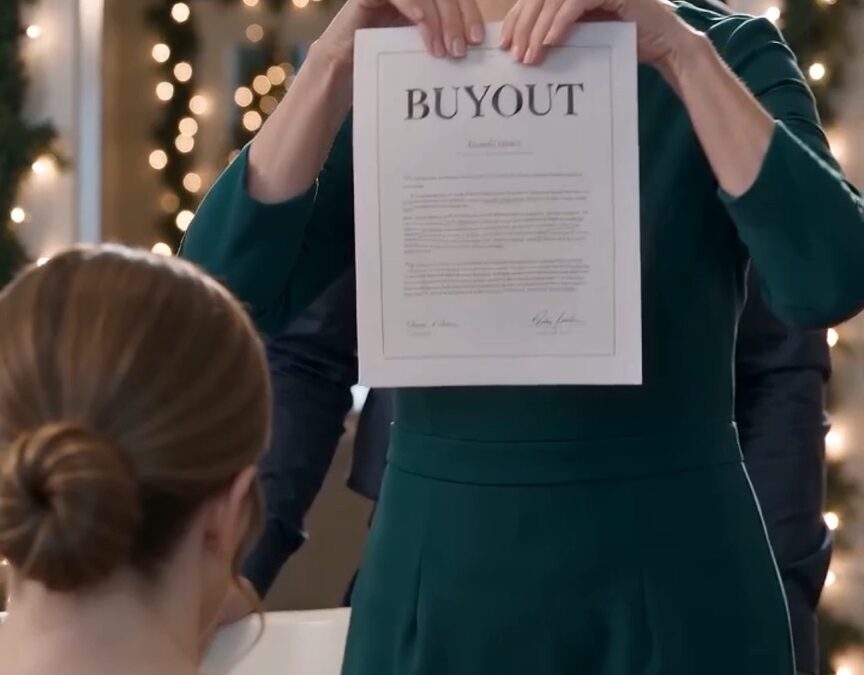
Renee set the folder on my Christmas table.
She placed the agreement directly over Scott’s surrender form.
Then she held its cover flat with both hands.
The word on the front was simple.
BUYOUT.
Scott looked at the company identification beneath it.
His reaching hand stopped.
He pulled it back against his shirt.
“Where did you get that?” he asked.
“From my legal archive.”
“That’s company paperwork.”
“Yes,” Renee said. “It is.”
She had drafted it years earlier.
I hadn’t remembered every detail when Paul died.
On December 18, I had brought her his trust binder.
I carried it inside a canvas grocery bag.
The binder corners pushed against the thin sides.
Renee took the bag before the handles gave out.
We sat at her conference table together.
I put the death certificate beside the binder.
“I don’t know which thing comes first,” I said.
“We’ll separate the things,” she told me.
She divided a legal pad into several categories.
Personal bills went in one place.
Trust administration went in another.
Employment and the company interest each had their own space.
Scott had been talking about all of them together.
Seeing separate headings helped me understand the difference.
Paul’s trust had held his forty percent interest since June 14, 2019.
I was its successor trustee and beneficiary.
His death changed who acted for the trust.
It did not make Scott the owner of that interest.
It also didn’t require me to wait for probate.
Renee reviewed the succession provisions with me.
Then she explained there was a separate company agreement.
She retrieved the original on December 23, 2024.
That same week, Scott mentioned bringing business paperwork.
He called it routine and said it would simplify things.
I called Renee after our conversation.
She was already expected for Christmas dinner.
I asked her to bring the agreement, too.
Scott knew she would be there.
He hadn’t known what she was carrying.
He also hadn’t received a formal trustee demand yet.
That was scheduled for after Christmas.
Now Renee opened the agreement in front of him.
“This was signed June 14, 2019,” she said.
Scott read the first page without sitting down.
“It requires a company purchase after Paul’s death.”
“What kind of purchase?”
“The trust’s interest, through an independent appraisal.”
He glanced at the surrender form underneath.
“That doesn’t mean whatever she wants.”
“No,” Renee said. “It means the contractual process.”
I looked at the page she indicated.
The purchase obligation was already there in writing.
It wasn’t something she had invented that week.
Scott pulled out his chair and finally sat.
Renee gave him a copy to read.
The original stayed beneath her hands.
“Dana acts for the trust now,” she said.
“That needs to be verified.”
“It will be.”
“I haven’t seen any formal notice.”
“You’ll receive the formal demand tomorrow.”
He turned several pages.
For the first time, nobody rushed me to sign.
Renee let him read the purchase provision completely.
Then she showed him the trustee information.
“The trust permits Dana to enforce this,” she said.
“We don’t need to wait for a probate appointment.”
Howard shifted in his chair.
Scott looked toward him, then back at the agreement.
“Who signed this for the company?”
Chapter 3: The Signature He Recognized
Renee turned to the signature page.
Scott leaned closer before she pointed.
He knew his father’s handwriting.
Howard’s signature appeared for the company.
Paul’s appeared in his capacity as trustee.
Scott stared at both for several seconds.
“Dad?”
Howard looked down at his unfinished dinner.
“Yes. I signed it.”
“You agreed the company would buy him out?”
“Buy the trust’s interest,” Renee said.
“After Paul’s death, under the terms you’re reading.”
Scott ignored her correction for a moment.
“You never told me about a mandatory buyout.”
“It was with the legal papers,” Howard said.
“Which legal papers?”
“The company’s.”
Scott turned back to Renee.
“I didn’t sign this.”
“No,” she said. “You didn’t.”
“Then how is this my agreement?”
“It’s the company’s agreement.”
She let him look at the signature designation.
Howard had signed as the authorized managing member.
Back then, he owned the remaining sixty percent.
Paul’s trust held the other forty.
On July 1, 2022, Howard transferred his interest to Scott.
Scott became manager on that date, too.
That transfer didn’t create a different plumbing company.
It changed the owner and manager of the existing one.
“The company’s obligations survived the transfer,” Renee explained.
Scott checked the date again.
“I reviewed the transfer documents.”
“This was a separate agreement in the legal archive.”
Howard looked uncomfortable when she said that.
He had assumed the paperwork had been understood.
Scott had never inspected the separate redemption agreement.
Neither of them had told me about that omission.
It explained why Scott looked so certain earlier.
He had treated my interest as something he could bargain away.
He hadn’t bothered checking what the company already owed.
“Paul should have told me,” he said.
I looked at my husband’s brother across the table.
“Paul isn’t here to answer that.”
Scott lowered his eyes to the copy.
Renee kept the conversation on what could be answered.
“Your counsel can review every page,” she said.
“The demand will include the agreement and trust certification.”
“What about court approval?”
“Not required to establish this successor trustee’s authority.”
“Anyone could say that.”
“And company counsel can verify it.”
She wasn’t offended by the verification request.
I found that useful.
I didn’t have to prove my grief or my loyalty.
I had to supply documents showing the trust’s authority.
That was something I could actually do.
Howard cleared his throat.
“Scott has to keep the place running.”
“I know,” I said.
“He’s responsible for the employees.”
“I’m one of them.”
“You know what I mean.”
“No. I know what you said earlier.”
He folded his napkin and unfolded it.
Renee looked directly at him.
“Dana’s work shouldn’t be dismissed at this table.”
“I didn’t dismiss it.”
“You called her only an employee.”
“She didn’t own the company herself.”
“The trust held an interest,” Renee said.
“And her employment is a separate matter.”
Howard opened his mouth, then closed it.
Renee continued in the same ordinary tone.
“She kept the office and emergency dispatch working.”
“That isn’t how the purchase price gets calculated.”
“But it’s an accurate description of her work.”
I took my water glass in both hands.
I hadn’t realized how badly I needed that said.
Not that I had secretly run everything.
Not that the company couldn’t survive without me.
Just that I had done work they knew mattered.
One relative finally looked up and nodded.
No one made a speech.
Scott slid his surrender form out from under the agreement.
“All right. Let’s separate the money.”
Renee nodded.
“Your proposal doesn’t do that.”
“It’s a settlement offer.”
“It includes a declared distribution in the surrender price.”
“That was part of the offer.”
“An offer Dana hasn’t accepted.”
Scott rubbed the edge of his paper.
The three categories were explained at my Christmas table.
My wages were payment for employment.
The declared $6,800 distribution belonged to the trust.
The redemption price would purchase the trust’s company interest.
One did not replace the others.
Scott reached into his pocket and removed the check.
He laid it beside his own plate.
It was payable to Paul’s trust, not to me individually.
I would deposit it into the trust account.
I would handle it as successor trustee.
Calling it my profit check didn’t change any of that.
“Counsel should check authority before payment,” he said.
“That’s reasonable,” Renee answered.
“But it isn’t conditional on signing your surrender.”
He read the distribution provision again.
The agreement expressly distinguished declared distributions from the purchase price.
He could see the language himself.
“What if the appraisal comes back low?” he asked me.
“Then I’ll read the appraisal.”
“You understand business debt reduces value?”
“Yes.”
“And equipment wears out?”
“I schedule the repair calls for it.”
He looked away.
I didn’t know what the interest would eventually be worth.
I wasn’t going to pretend otherwise.
I wanted someone independent to examine the records.
Scott’s $12,000 proposal had no agreed appraisal behind it.
It wasn’t a contractual option either.
It was what he wanted me to accept.
I stood and picked up the potatoes.
The serving bowl was no longer warm.
Howard followed me as far as the kitchen doorway.
“You could have warned us about Renee.”
I set the bowl on the counter.
“You could have asked me to read things first.”
He glanced back toward the dining room.
Renee was returning the original to its protective folder.
Scott kept his copy and gathered his own papers.
Before leaving, he looked at her.
“Send formal proof of all of it.”
Chapter 4: What Went Out After Christmas
The next morning, I finished clearing the dining room.
Scott’s chair still sat farther back than the others.
I pushed it in before starting the dishes.
The blue plate had a little dried gravy along its edge.
I rinsed it and set it in the dishwasher.
Renee called while I was wiping the counter.
“Are you ready for the demand to go out?”
“Yes,” I said.
She didn’t suggest another family discussion.
We had already tried discussing it at my table.
The formal trustee demand was delivered December 26, 2024.
It included the signed agreement and certification of trust.
It also supplied the documentation supporting my succession.
Renee requested that the company begin the agreed valuation process.
She kept proof of delivery with her file.
I kept a copy in my trust folder.
Then she helped me separate another kind of record.
My work records belonged in their proper place.
My personal employment records were different.
Trust correspondence had its own folder.
For seventeen years, those things had mixed together.
A dispatch note might sit beside a grocery list.
An office question might arrive during a family visit.
A message about Paul’s interest might appear between customer calls.
Now I needed to know which role I was answering in.
I didn’t take customer files home.
I didn’t copy company information for leverage.
I preserved my own pay records and employment messages.
I kept the trustee correspondence Renee sent me.
She was specific about what I should retain.
“Write down Christmas while you remember it clearly,” she said.
“Everything?”
“What happened. What was said. Who was present.”
I sat at the kitchen table with lined paper.
I included Howard’s words exactly.
Then I stopped and read them again.
Part of me wanted to soften what he had said.
I wrote the time and date instead.
At work, Scott became more formal.
He stopped calling trust questions across the office.
Most instructions came by message.
That made them easier to answer carefully.
“Send trust matters through Renee,” I told him.
“Work questions can still come to me.”
“I understand.”
I wanted to believe him.
Mostly, he followed it.
There were still awkward moments near the dispatch desk.
He would begin with something about the company’s future.
I would ask whether it was a work instruction.
If it wasn’t, I referred him to counsel.
He didn’t fire me.
He needed the office functioning during a difficult period.
I needed my wages and time to make decisions.
We could both understand that without liking each other.
The work remained ordinary and specific.
A technician needed a corrected arrival window.
A supplier needed an order confirmed.
A customer wanted to know whether a repair could wait.
I could answer those questions.
I couldn’t answer every question about my own future yet.
One morning, I opened Paul’s old contact entry by habit.
My cursor rested over his name.
I closed the window and finished the service schedule.
At lunch, I sat in my car instead of staying inside.
I ate the sandwich I had packed.
I didn’t check for office messages until lunch ended.
Company counsel acknowledged the agreement on January 3, 2025.
Renee called after receiving the response.
“They recognize it as binding,” she said.
I was folding towels beside the washing machine.
I set a towel down before answering.
“So they agree the company has to purchase it?”
“Yes, under the agreement’s valuation and closing terms.”
“Are we finished arguing?”
“We’re moving to the next stage.”
She explained the difference between acknowledgment and payment.
There were records to review and an appraiser to select.
The company still had to verify my trustee authority.
The purchase price was not yet known.
I wrote those steps down.
Knowing the order kept me from checking constantly.
After counsel completed the authority review, the distribution was paid.
The company issued the separate $6,800 to the trust.
I deposited it in the trust account.
Then I sent Renee the deposit confirmation.
I didn’t send Scott a photograph.
I didn’t thank him for releasing money already owed.
I recorded the payment where it belonged.
There was no surrender attached to it.
That mattered when I balanced the account that evening.
I had needed the money.
But I had also needed the categories kept straight.
Scott’s objections changed after that.
He raised debt, equipment condition, and future performance.
He questioned how much business depended on his own work.
Renee reviewed the concerns with me.
“Are these ways to lower the number?” I asked.
“Some are legitimate valuation questions.”
“How do we know which?”
“We ask for records supporting them.”
That was an answer I could use.
I didn’t have to assume everything was dishonest.
I didn’t have to accept an unsupported claim either.
Howard called after hearing the distribution had been paid.
“Scott says this could become expensive.”
“I expect the appraisal will tell us.”
“He thinks you’re being pushed into a fight.”
I looked at the trust folder on my counter.
“I’m following the agreement you signed.”
“He has people depending on him.”
“So do I,” I said, then stopped.
I was tired of defending ordinary obligations.
Howard asked whether we could talk without lawyers.
“We can talk,” I told him.
“I’m not negotiating without mine.”
On January 10, both sides selected an independent appraiser.
Renee sent the engagement terms for my review.
The first request arrived with them.
The appraiser wanted the company’s complete financial records.
Chapter 5: The Work Behind The Number
The appraiser asked for documents, not family opinions.
That helped until I saw the full request.
There were financial statements and company debt schedules.
There were equipment records and work-in-progress details.
There were questions about compensation and customer concentration.
The company’s accountant handled the financial records.
Scott supplied management information through the proper channels.
I answered questions within my actual work knowledge.
I didn’t pretend to know what a truck was worth.
I could explain why an invoice remained open.
I knew when a return visit belonged to an unfinished job.
I knew which status meant a technician still owed paperwork.
Those details needed explaining during the review.
The appraiser asked how dispatch records matched completed work.
I showed him the authorized company system at the office.
“This changes after the final information comes in,” I said.
“What happens if it hasn’t arrived?”
“The job stays open until we can close it accurately.”
“And if the customer has already paid?”
“That’s recorded separately.”
He wrote down what I said.
Then he asked me to show an example.
I did, using the records we were authorized to review.
Scott stood in his doorway and listened.
He didn’t contradict my explanation.
He knew how much of it I handled.
Afterward, he asked for written workflow instructions.
“For the handoff?” I said.
“Yes.”
“During my scheduled hours?”
He frowned slightly.
“Yes, Dana. During your scheduled hours.”
I opened my calendar.
“Then something else needs to move.”
Before Christmas, I would have taken the task home.
I would have typed after dinner and checked calls between paragraphs.
Now I listed the time it would require.
Scott chose which less urgent filing could wait.
Neither of us enjoyed the exchange.
The answer was still useful.
I began writing instructions another person could follow.
Where supplier confirmations arrived.
How a return appointment should be flagged.
Which information technicians needed before leaving the shop.
How to check access instructions without guessing.
I used plain sentences and current screenshots.
I left customer information inside the company system.
The handoff document explained where authorized staff could find it.
I didn’t write it as proof of my importance.
I wanted someone to be able to use it.
That meant testing the instructions instead of admiring their length.
When office staff asked a question, I checked the document.
If the answer wasn’t there, I added it.
If the wording was confusing, I changed it.
All of that happened on paid time.
At home, I began clearing work things off the counter.
Company forms had lived beside my dish towels for years.
I gathered them into a box.
The next morning, I took the box to the office.
Nothing dramatic happened when I set it down.
Scott asked whether anything needed immediate attention.
I told him which items did.
Then I went back to my desk.
That evening, I could use the entire kitchen counter.
I rolled out dinner preparation without moving service paperwork.
I noticed the difference because my elbows had room.
The appraisal questions continued through counsel.
Some concerned real company liabilities.
Some concerned assumptions about future earnings.
Scott wanted credit for equipment that would need replacement.
He wanted the appraiser to consider his continuing labor.
He wanted the company’s debts recognized fully.
Renee didn’t tell me to argue with all of it.
“The report needs to value the actual business,” she said.
“Not the best version or the worst version.”
“What if the answer disappoints me?”
“We review the reasoning.”
I started a notebook of questions.
I wrote one per line.
When Renee answered, I added the explanation beneath it.
That was better than trying to remember everything.
It also kept me from calling every delay a disaster.
Some delays were people gathering records.
Some were people checking calculations.
I knew from office work how easily an old number traveled.
I wanted the records reconciled before anyone relied on them.
Howard asked to visit during this period.
I told him he could come for coffee.
I also told him we wouldn’t be signing anything.
He arrived without a folder.
He sat at the kitchen table, not in the dining room.
For a few minutes, we talked about the weather.
Then he set his cup down.
“Paul wouldn’t want the company hurt.”
I folded the dish towel beside the sink.
“Paul signed the agreement.”
“That was years ago.”
“So did you.”
“I was trying to prevent family trouble.”
“I understand.”
“Now Scott says this could affect everything.”
“Then the company needs accurate advice.”
Howard looked toward the cleared counter.
“I don’t know why this has become so formal.”
“Because informal meant taking my check at dinner.”
He moved his cup without drinking.
I waited instead of filling the pause.
He finally asked about a private compromise.
“Something before the appraiser finishes,” he said.
“Based on what information?”
“Something everybody can live with.”
“I need the independent number first.”
“You could save a lot of trouble.”
“I’m not signing before I know what I’m signing away.”
He finished his coffee after that.
I rinsed his cup when he left.
Then I opened my notebook and crossed out a question Renee had answered.
The next morning, the appraiser requested one more reconciliation.
It concerned the declared distribution and the company’s final records.
He needed that before completing the report.
Chapter 6: The Figure On The Page
I read the reconciliation request twice.
The $6,800 had already been paid to the trust.
It needed to remain separate from the purchase price.
The financial records also needed to show it correctly.
I asked Renee whether this was an unusual problem.
“No,” she said. “It’s detail that needs checking.”
The company’s accountant supplied the final reconciliation.
The appraiser reviewed it with the other records.
We waited while the report was completed.
Waiting was hardest when work slowed near closing time.
I would finish the dispatch list and look at my phone.
No update.
Then I would check my personal email.
Still no update.
I started leaving the phone in my bag during dinner.
That didn’t make the report arrive faster.
It did keep me from checking between every bite.
The final appraisal arrived March 14, 2025.
Renee asked me to come read it with her.
I arranged coverage at the office before leaving.
I didn’t promise to answer if something happened.
Someone else could handle the dispatch desk for an appointment.
At Renee’s office, I put my notebook on the table.
She placed the report beside it.
The trust’s forty percent interest was valued at $780,000.
I read the figure once.
Then I read the ownership description above it.
Then I went back to the number.
“That’s for the trust’s forty percent?”
“Yes,” Renee said.
“Not the whole company?”
“Correct.”
I smoothed the bottom corner of the page.
It wasn’t curled.
I kept smoothing it anyway.
Scott’s twelve-thousand-dollar proposal had stayed in my head.
I knew it wasn’t based on the agreed process.
Still, it had been the only figure he offered.
The new number came with pages of supporting work.
I needed to understand those pages before anything else.
Renee let me sit quietly for a minute.
Then she walked through the report with me.
Company liabilities had been considered.
The equipment wasn’t treated as though everything were new.
The company’s operating realities appeared in the analysis.
So did the risks and assumptions the appraiser found relevant.
The $6,800 distribution was excluded from the purchase proceeds.
It wasn’t being paid twice.
It also wasn’t reducing the redemption price as Scott’s proposal had tried to do.
I wrote that explanation in my notebook.
“Can he just say no?” I asked.
“He can raise a supported issue under the agreement.”
“And if he says the number is too high?”
“Then the concern needs more than a statement.”
I turned back to the report.
For months, every step had sounded like another possible argument.
Now there was something concrete to review.
Not something I had demanded at my kitchen table.
An independent valuation based on company records.
Scott responded through counsel.
He questioned future performance and owner compensation assumptions.
The appraiser answered those questions with the report’s methodology.
Company counsel reviewed the responses.
Renee sent me the exchange and explained it.
I didn’t enjoy reading Scott’s objections.
I read them anyway.
Some were questions I would have expected any buyer to ask.
The answers mattered more than whether his tone annoyed me.
After that review, the purchase price remained $780,000.
Scott no longer argued that I lacked authority.
He no longer treated twelve thousand as controlling.
His concern became financing the company purchase.
That concern was real.
The agreement required payment at closing.
It didn’t promise the company an easy way to find cash.
It also didn’t make financing my responsibility.
Renee explained the proposed funding structure.
The company would use reserves and a bank loan.
Scott wanted to discuss a different payment arrangement first.
I agreed to meet with Renee present.
He arrived at her office carrying a folder.
For once, he didn’t look certain of the answer.
“The company can’t do this without borrowing,” he said.
“I understand.”
“It changes what we can spend this year.”
“I understand that, too.”
He opened his folder.
“What if you took part at closing?”
“And the rest?”
“Payments afterward.”
Renee asked him to explain the proposed terms.
He described them in broad language.
She requested the details that broad language left out.
Security.
Timing.
What happened if the company missed a payment.
What rights the trust would retain.
Scott shifted in his chair.
He hadn’t brought a complete proposal.
He had brought something he hoped I would agree to first.
“I need to understand it privately,” I said.
He stepped outside while Renee explained the difference.
Taking later payments would mean accepting a new risk.
The trust would depend on the company’s future performance.
I would no longer hold the same interest.
But my money would still rely on Scott’s decisions.
I didn’t want to make that new arrangement.
When he returned, I told him plainly.
“I’m staying with the existing closing terms.”
He closed his folder.
For a moment, he looked ready to argue.
Then he asked Renee what financing confirmation was required.
The bank’s conditions arrived in the next update.
One concerned Scott’s personal guarantee.
Chapter 7: The Pages Before Closing
Scott could choose whether to guarantee the company’s loan.
The agreement hadn’t ordered him personally to borrow.
The bank had set conditions for financing the company purchase.
He wanted the company to complete that purchase.
He eventually agreed to the guarantee.
Renee explained the distinction when I asked.
“His guarantee is part of the financing he chose.”
“It doesn’t change what the trust receives?”
“Not under these closing terms.”
I wrote that down with the other financing information.
I didn’t receive his private banking records.
I received the confirmations needed for the transaction.
The company would combine reserves with the loan proceeds.
Payment would be made at closing.
The documents would identify exactly what the trust transferred.
That was what mattered to my role.
Howard called after hearing about the guarantee.
“He’s taking on a great deal.”
“I know the company needs financing.”
“It affects him personally now.”
“He agreed to the bank’s terms.”
“What else was he supposed to do?”
“That’s between him, his lawyer, and the bank.”
Howard let out a long breath.
I waited.
I didn’t volunteer to lend the trust’s money back.
I didn’t propose a lower price.
Eventually, he asked whether my work schedule was settled.
“Not completely,” I said. “We’re writing the handoff terms.”
He said that was probably sensible.
It was the closest he had come to agreeing with me.
At the office, Scott asked how long I intended to remain.
I had expected the question.
“I’ll finish a paid handoff,” I told him.
“I need enough time to make sure dispatch works.”
“Then let’s list what needs finishing.”
We sat with the document I had been preparing.
We identified tasks, review sessions, and outstanding questions.
We agreed to a clear final workday after closing.
I wanted the agreement in writing.
Scott didn’t argue about that.
It would tell him what he was paying for.
It would tell me when my responsibilities ended.
I went home that evening without company paperwork.
Then I looked through job listings at my own table.
I wanted a daytime dispatch position.
Not a promise that evenings were “usually quiet.”
Not a role where my personal phone became permanent coverage.
I wrote down questions to ask at an interview.
Who covered after hours.
Whether shifts ended at the stated time.
How emergencies were routed when the office closed.
I didn’t apologize for caring about those answers.
I had spent seventeen years learning why they mattered.
Renee called with a proposed closing date.
April 18, 2025.
The date gave me something specific to arrange around.
I checked my work calendar.
I checked the handoff schedule.
Then I asked when we would review the documents.
“Before closing,” she said.
“I don’t want the first look that morning.”
“It won’t be.”
The closing package arrived with enough time for review.
I went to Renee’s office with my notebook again.
Some pages were straightforward once she explained them.
They identified the trust and the interest being redeemed.
They documented company authority and the purchase payment.
Other pages needed careful reading.
Renee marked a release provision.
“This reaches farther than the purchase,” she said.
I leaned closer.
The language could extend to unrelated employment matters.
I wasn’t planning an employment lawsuit.
That didn’t mean the redemption required giving up everything.
“Did the original agreement require this?” I asked.
“Not this broad language.”
“What should it say?”
“It should address the transaction actually being settled.”
She prepared a narrower version.
The release would cover the redemption and related matters.
It wouldn’t become an extra surrender of unrelated rights.
Scott objected through counsel at first.
He wanted assurance that payment finished every possible disagreement.
Renee explained that finishing the purchase was not the same as adding new terms.
The emails went back and forth.
There was no need for me to call Scott.
There was no need to visit Howard.
I kept doing my scheduled work while counsel revised language.
When the corrected draft arrived, Renee reviewed it again.
She compared the version against her proposed changes.
Then she explained what I would be signing.
I asked what happened if payment wasn’t confirmed.
The closing instructions addressed the release of documents.
I asked how the money would reach the trust.
She explained the verified payment process.
I asked where the final records should be kept.
“With the trust administration documents,” she said.
I wrote it all down.
The day before closing, I confirmed the account information through an established contact.
I didn’t rely on an unexpected email.
Renee had warned me about changed wiring instructions.
I followed the verification steps exactly.
That evening, I cleared a drawer for the final records.
Paul’s funeral program was already nearby.
I picked it up, then set it back down.
There was no requirement to sort everything at once.
I laid out my clothes for the next morning.
The folder beside them held the reviewed documents.
All that remained was signing and confirmed payment.
Chapter 8: The Chairs At Closing
I ate breakfast before the closing appointment.
I wasn’t hungry, but I ate anyway.
Then I checked that I had my identification and folder.
I left the company phone out of my handbag.
The office had coverage.
I had arranged it in advance.
The closing room held ordinary chairs and a conference table.
No one had brought food or family photographs.
There were no relatives waiting for me to agree.
Scott sat across from me with company counsel.
Renee sat beside me with the reviewed documents.
Howard wasn’t there.
He no longer owned an interest in the company.
He had no current authority requiring his signature.
The obligation he signed in 2019 was already documented.
His attendance wouldn’t have changed it.
Scott looked at my folder when I sat down.
Then he looked at Renee’s copies.
Nobody mentioned Christmas.
We reviewed the sequence before signing.
The company would purchase the trust’s forty percent interest.
The purchase price was $780,000.
The previously paid distribution remained separate.
The funds would go into the trust account.
Documents would be completed and released under the closing instructions.
I listened to the explanation all the way through.
Then I asked my remaining question.
“Payment confirmation comes before everything is released?”
Renee confirmed the procedure.
Company counsel confirmed it, too.
I didn’t have to accept one person’s hurried reassurance.
Scott signed the company documents in his proper capacity.
His financing had been arranged.
The company was using its reserves and bank loan.
His guarantee supported the loan he had chosen.
He still owned the remaining business.
He still managed its operations.
This purchase didn’t take his company from him.
It required the company to pay the agreed value.
That was different from what he had suggested at dinner.
When my signature page came forward, I read the designation.
I was signing as successor trustee.
Not personally surrendering something for a family favor.
Not accepting an employer’s settlement.
Acting for the trust that held the interest.
I signed where Renee indicated.
Then I checked the next page before signing again.
No one reached across my plate.
No one told me I was making things unpleasant.
The corrected release was in the package.
Renee checked it before I signed.
It covered the transaction we were actually completing.
The unrelated employment language was gone.
After the signatures, we waited for payment confirmation.
I looked at the folder beneath my hand.
Its corner had bent from being pressed so often.
I straightened it and stopped touching it.
Scott checked his phone.
Company counsel reviewed a closing instruction.
Renee put the final-copy envelope beside me.
“Those will be yours,” she said.
I nodded and looked at the envelope.
For months, I had imagined the moment as dramatic.
Instead, it involved chairs, copies, and waiting for verified information.
That suited me better than another family argument.
The payment confirmation came through the established closing channel.
Renee checked it carefully.
The trust had received $780,000.
The documents were released according to the instructions.
The interest was redeemed.
“The purchase is complete,” she told me.
I looked at her before answering.
“Complete?”
“Yes.”
I had expected to cry.
Instead, I asked where to file the payment confirmation.
She smiled a little.
“With these final records.”
I placed it inside my folder.
Scott stood when we did.
He looked as though he might mention Paul.
Then he chose a work question.
“The final dispatch instructions are still on schedule?”
“Yes.”
“And the review sessions?”
“They’re on the handoff list.”
He nodded.
“Good.”
It wasn’t affectionate.
It was clear, and I could manage clear.
Outside, Renee asked whether I felt ready to drive.
“I need a minute first.”
We sat in her parked car.
I held the folder across my knees.
I could see Paul’s signature from the copy inside.
He had signed as trustee when he was forty-four.
He hadn’t known when I would need to use it.
I hadn’t known how much I would need help reading it.
I closed the folder instead of looking again.
“Do I need to reserve money for expenses and taxes?”
“Yes,” Renee said.
“We’ll coordinate that before you make big decisions.”
That answer helped.
The proceeds were real, but so were the responsibilities.
I could make plans without making them that morning.
I stopped for groceries on my way home.
I bought food I wanted instead of whatever was quickest.
At the house, I put the closing folder in its drawer.
Then I took Paul’s funeral program out of the way.
I placed it on the kitchen table for a while.
I made lunch and sat down to eat it.
Nothing required me to call Scott about the trust.
Nothing required me to report my plans to Howard.
Later, the final handoff schedule came from the office.
I compared it with the written arrangement.
The duties matched.
The paid hours matched.
At the bottom was my final workday.
Chapter 9: A Meal Still Warm
I completed the handoff at the company office.
Not at my kitchen table after dinner.
Not during an unpaid weekend between emergency calls.
I demonstrated the dispatch process during scheduled review sessions.
I checked that office staff could locate the current instructions.
When something needed clarification, I added it on paid time.
The work was specific enough to finish.
That mattered because Scott kept thinking of one more question.
Sometimes it was a reasonable question.
Sometimes it was something already answered in the file.
I showed him where to find those answers.
I didn’t make him ask twice to punish him.
I also didn’t promise permanent access to my evenings.
Near the end, he looked up from the handoff list.
“You’ll be available if something small comes up?”
“For a separate paid arrangement?” I asked.
“I meant a quick question.”
“I’m not staying on the emergency rotation.”
He pressed his lips together.
Then he returned to the list.
We finished reviewing it without another argument.
I received all my earned wages.
I checked the final pay record and filed it.
The company materials were returned to their proper places.
The instructions remained available to the people using them.
I didn’t delete records or leave a confusing mess.
I wanted the work finished, not waiting for me.
On my last day, I packed my personal things.
A mug.
A sweater from the desk drawer.
The small items I had accumulated since 2007.
Seventeen years fit into a box with room left.
The work itself stayed there.
A technician stopped beside the desk while I packed.
He needed a customer’s access instructions.
I showed him where the handoff file pointed.
“You put all that in there?”
“Everything they need to find it.”
He checked the information and thanked me.
I closed the box.
Scott stood near the doorway as I prepared to leave.
“The company’s going to be tighter for a while.”
“I know.”
“Cash will be different.”
“I understand.”
He still had work to schedule and customers to serve.
He also had loan payments and reduced reserves.
The bank financing did not vanish after closing.
Those were company responsibilities under his management.
I didn’t offer the trust’s money to ease them.
I didn’t say he could call me anytime.
I said goodbye and carried my box outside.
At home, I put the box on the kitchen floor.
Then I stood beside it for a moment.
Usually, I checked the emergency forwarding first.
That afternoon, I put away groceries instead.
I reached for my phone from habit.
Then I set it on the counter.
The company’s emergency line was no longer my responsibility.
That took time to feel ordinary.
I still woke thinking about the dispatch schedule.
I still noticed plumbing trucks at traffic lights.
Sometimes a ringing phone made me reach too quickly.
Then I remembered I wasn’t assigned to answer.
I let the call remain somebody else’s work.
Renee helped coordinate the remaining trust administration.
We obtained the appropriate financial and tax advice.
The purchase proceeds stayed accounted for in the trust.
I reserved what needed reserving and paid proper expenses.
I made decisions after I understood the numbers.
I didn’t turn the closing into permission to stop paying attention.
The money meant I could choose my next job carefully.
I accepted a daytime dispatch position at an unrelated business.
During the interview, I asked about after-hours coverage.
I asked again when reviewing the offer.
The answer stayed the same.
My shift ended at the stated time.
Someone else handled work outside those hours.
I knew how to dispatch.
I wanted to keep using that experience.
I just didn’t want dinner interrupted by an employer forever.
The first evenings home felt longer than I expected.
I cooked things that required me to remain near the stove.
I stopped choosing meals because they reheated well.
Sometimes I ate in the kitchen.
Sometimes I set a place in the dining room.
There wasn’t a correct room for being a widow.
I used whichever chair I wanted that evening.
Howard called after I started the new job.
He asked how it was going.
“The hours are what they told me,” I said.
“That’s good.”
I waited while he cleared his throat.
Then he said what he had called to say.
“I shouldn’t have called you only an employee.”
I sat down at the kitchen table.
“No,” I said. “You shouldn’t have.”
“I knew you worked hard.”
“That wasn’t what you said at dinner.”
“I know.”
He didn’t ask me to forgive Scott.
He didn’t ask me to help with the loan.
We talked about ordinary things for a few minutes.
I didn’t invite him to another holiday that day.
I hadn’t decided what I wanted yet.
Scott and I communicated only when administration required it.
The purchase didn’t repair our relationship.
It finished the business transaction between the company and the trust.
My employment was finished, too.
I no longer sorted his messages between bites of dinner.
I no longer kept service forms beside the dish towels.
Paul’s belongings took longer to move.
I left his boots alone until I was ready.
I kept his photograph on the kitchen shelf.
The funeral program went somewhere I could easily find it.
It didn’t have to greet me every morning.
One evening, I came home from my daytime shift.
I cooked dinner and put the serving spoon beside the stove.
My phone rested on the counter.
No family company calls were coming to me.
I took my blue dinner plate from the cupboard.
I turned its pale mark toward my chair.
Then I sat down and ate while everything was hot.








