My Husband Brought One Brown Envelope to His Mother’s Dinner Table and Treated Me Like a Fool — Then 22 Relatives Watched Him Answer for What Was Inside
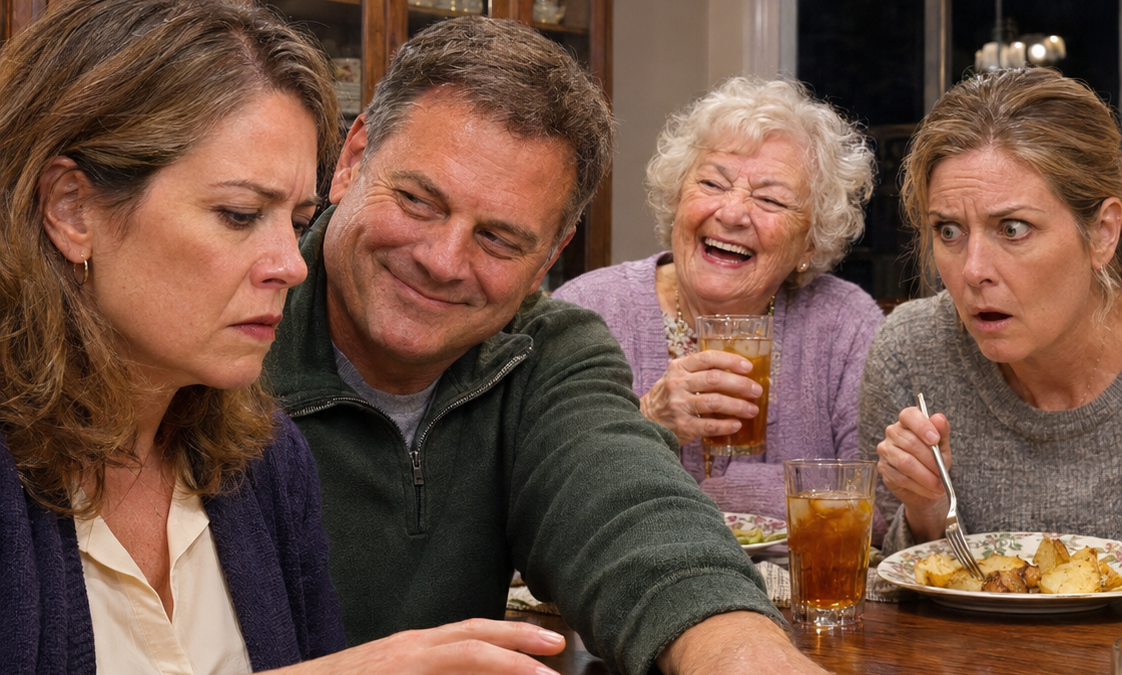
Complete story · 7 parts · about 29 minutes · ending included
Part 1 · Part 2 · Part 3 · Part 4 · Part 5 · Part 6 · Part 7
Part 1 of 7
The brown envelope landed beside my plate with “CLOSING — MON 11/30 10 AM” written across the front in Barry’s marker. Yellow flags stuck out along the edge of the papers inside.
It was 6:10 Sunday evening, November 8, at Barry’s mother’s dining table on Sycamore Court.
I reached for it.
Barry put his whole hand flat across it.
“You hand people towels for a living, Amy. Leave the paperwork to me.”
He smiled when he said it, easy and warm, as if he had given the table something funny.
Peggy laughed.
Across from me, Barry’s older sister, Gina, lowered her fork toward her plate of potatoes.
I pulled my hand back.
“Nice and slow.”
Those were the words I used at Hinkson Creek Physical Therapy when somebody tried to rush a step, a knee bend, a transfer from chair to walker. I had been a physical therapist assistant there for twenty-two years.
The phrase was familiar to Barry.
His smile tightened for half a second.
Then his fingertips tapped the envelope twice.
At Route 63 Truck Center, Barry spent his days doing the same thing for used-truck buyers: lining up paperwork, planting yellow flags, and turning the stack toward the next signature.
Peggy raised her glass of iced tea.
“Monday after Thanksgiving, my son stops being a boarder in his wife’s daddy’s house.”
Beside me, Barry leaned back in his chair.
“Mom.”
“I’m just saying.”
My father, Vern Ostermann, had been gone since 2015. My mother, Norma, died in March 2018. Their one-story brick house on Larkspur Lane had come to me alone.
I had kept their last name when I married Barry in June 2021.
Barry moved into the house.
I never thought of that as making him a boarder.
Peggy apparently did.
Barry’s fingers slid along the top edge of the envelope, his palm still flat on it.
“Closing’s Monday, November thirtieth. Ten in the morning.”
I looked at him. “Three weeks.”
“Plenty of time.” Barry nodded toward the flagged pages. “It’s a refi, babe. Your old seven-nine down to five-nine. Flags are where you sign.”
Back in August, I had agreed to move the old home-equity loan to a lower rate.
Barry had sat across from me with his laptop and said, “I’ll run the application, babe — I do this all day.”
He opened a few boxes for me.
“Just the credit check, babe.”
I signed those.
Nothing else.
Peggy took a sip from her glass.
“Bring Norma’s pecan pie on Thanksgiving. It’s the only thing from that house worth keeping.”
My fork stopped over my plate.
Gina looked down again.
Barry lifted the envelope off the table.
“Mom likes that pie.”
“I heard her.”
Peggy smiled at me over her tea.
“Well, good. One less thing for me to remind you about.”
I finished dinner.
The envelope rode home on Barry’s lap.
At 8:30 that night, he opened the kitchen drawer next to the sink and slid it inside.
“Don’t read it, you’ll just worry. I do this all day.”
I stood by the counter.
“You’re putting my house through a closing.”
“Our house.”
The kitchen had belonged to my parents long before Barry ever ate breakfast there.
I didn’t say that.
The appointment was three weeks away. Whatever Barry thought I could understand, I could sit at the title office and read every page before my name went anywhere.
That was what I planned to do.
I turned toward the stove.
On the shelf above it sat my mother’s recipe box, red tin with NORMA engraved into the lid.
I lifted it down and pried it open.
My thumb moved through the cards until it stopped on the one I wanted.
Norma’s Pecan Pie — Thanksgiving only.
The words were in my mother’s handwriting.
I set the box back on the shelf, carried the card across the kitchen, and clipped it to the fridge.
Tuesday, November 10, I ate lunch alone at my desk at the clinic.
My phone lit up beside my sandwich.
The text was from Peggy.
A photo showed a freshly cut key lying across her palm.
Under it she had written, “Got my key to Barry’s house!”
I put the phone down.
That evening, I waited until Barry had finished talking about a customer who kept missing initials on his forms.
“Your mother sent me a picture today.”
Barry looked up.
“The new key.”
“Oh.”
“You had one cut for her.”
“Yeah.”
I waited.
Barry wiped his mouth with his napkin.
“Mom needs a key to our house, Amy. What if something happens?”
“You could have asked me.”
Barry’s chair scraped back from the table.
“It’s a key.”
I picked up my plate and carried it to the sink.
The envelope remained closed in the drawer beside me.
Thursday, November 12, Barry left after dinner for league bowling.
At 9:20 p.m., I was alone in the house when my phone rang.
The screen said, “Deanna (Riley’s mom).”
Barry’s ex-wife was the mother of his thirteen-year-old daughter, Riley.
She had never called me at night.
I answered.
“Hello?”
“Amy?”
Her words came carefully.
“Yes.”
For a second, all I heard was the faint sound of her breathing.
Deanna’s voice dropped very low.
“Is he home?”
“No.”
“Don’t sign anything, Amy.”
Then she hung up.
Part 2 of 7
“I signed by little yellow flags once.”
Deanna said it when I asked her why, and after that she would not tell me what had happened to her.
At 12:05 p.m. on Friday, November 13, I sat alone in my car in the clinic parking lot with my lunch break ticking away.
I had called her back.
“What do you mean?” I said.
Deanna’s voice stayed low.
“I can’t be the one who tells you.”
I looked through the windshield at the clinic entrance.
“Then tell me what I’m supposed to do.”
“Read every page before that closing.”
A car crossed the far end of the lot.
I said, “Why?”
She paused. That was when she said it.
My fingers tightened around the phone.
“What did you sign?”
“I can’t, Amy.”
“Deanna.”
“Please don’t tell him I called. Riley’s with him every other weekend.”
I waited.
Nothing else came.
“All right,” I said.
The call ended.
At 5:20 that evening, darkness already covered the kitchen windows when I switched on the light.
The pie card stayed clipped to the fridge.
My mother’s recipe box sat untouched on the shelf above the stove.
I opened the kitchen drawer next to the sink.
The brown envelope was exactly where Barry had left it.
“CLOSING — MON 11/30 10 AM.”
I slid it out and lifted the flap.
The first sheet said:
GENERAL WARRANTY DEED.
My name appeared near the top.
So did Barry’s.
I moved down the page until I reached the “Grantor” signature line.
A yellow flag sat beside it.
Barry’s ballpoint words ran across the tab:
“REFI — sign here, babe.”
I photographed the page.
The next paper was the commitment letter from Prairie Line Mortgage.
“Borrowers: Amy Ostermann, Barry Lasater.”
My thumb moved down the screen after each picture.
“Cash-out refinance.”
“Vesting.”
“Amy Ostermann and Barry Lasater, wife and husband, as tenants by the entirety.”
I knew the words separately. Together, they meant nothing useful to me.
Page 2 stopped me.
Three creditor lines ran down the middle.
Mid-Missouri Vehicle Finance, 4418.
Prairie Ridge Card Services, 2086.
Boone Valley Card Services, 7731.
None of the last four digits belonged to an account I knew.
I had no truck loan.
I had no cards with those companies.
Near the bottom was another line.
The $6,850 in closing costs would be added to the loan, with $0.00 for me to bring.
I photographed that page too.
Then I took pictures of the rest.
When I finished, I put everything back exactly where I had found it.
Saturday morning, Barry yanked the drawer open.
He lifted out the packet.
Nothing sat in the order he had stacked it.
“Were you in my envelope?”
I stood at the counter.
“It’s my house, Barry.”
His eyes stayed on me.
Then Barry lowered his voice.
“You back out after I told the whole family, you embarrass my mother at her own table. Don’t.”
“Nice and slow.”
His jaw moved once.
Barry carried the brown envelope outside.
A few seconds later, the truck door shut.
From then on, those papers stayed out there.
That night, Barry sat at the kitchen table holding his phone.
He typed into the Lasater family group chat.
“Thanksgiving at Mom’s — big toast, bring your appetite.”
I kept rinsing my coffee cup.
His phone kept making small sounds.
Later, Barry leaned back and looked at the screen.
“Twenty-two yeses.”
I dried the cup and put it away.
Monday, November 16, I left the clinic at noon.
At 12:15 p.m., I sat in the downtown office of Colleen Brockman, a family lawyer who spent her days sorting out marriages, property and the papers people signed between them.
The envelope still sat in Barry’s truck.
My phone was in my hand.
Colleen held out her palm.
“Show me.”
I opened the photos.
The deed came up first.
Her finger moved down the image.
“Who owned the house before you?”
“My parents.”
“How did it come to you?”
I answered through a dry mouth.
“My mother signed a beneficiary deed in 2016. The house came to me when she died in 2018.”
“Your name alone?”
“Yes.”
Next, she moved to the letter.
“How much is left on the old loan?”
“Twenty-one thousand four hundred dollars.”
Her finger stopped.
“Here’s what the paper says.”
From the phone, she printed the deed photo and the second page of the letter.
The printer hummed behind her desk.
She took the two printouts and laid them side by side.
A red pen came out of the holder by her monitor.
On the first sheet, Colleen drew a red line under the vesting language, right where my name and Barry’s were joined together.
The pen moved to the second sheet.
She marked one more:
“Cash to close from borrower: $0.00.”
Then she pointed to the three accounts listed above it.
“Do you have a truck loan? These cards?”
I shook my head.
“Barry drives a truck.”
Her eyes went to the vehicle loan first.
Then the next two.
Her red pen stayed on the desk.
I said, “He told me this was my old seven-nine down to five-nine.”
Colleen turned the deed toward me.
A yellow tab showed clearly in the photo beside the “Grantor” line. Barry’s handwriting was right there on the flag.
One finger tapped the printed vesting words.
Then she touched page 2.
“Amy, this isn’t the refinance he told you about. Page one deeds your house to you and Barry together. Page two of this letter pays ninety thousand dollars of his truck and his credit cards out of your house—and your name is on the loan.”
Part 3 of 7
“Judgment entered 02/20/2020.”
The line sat at the bottom of Barry Lasater’s divorce docket on Case.net.
Tuesday evening, November 17, I was alone at the kitchen table, typing his name into Missouri’s public court website on my phone.
One result came up.
“Lasater, Barry v. Lasater, Deanna — Dissolution of Marriage — filed 06/17/2019.”
I tapped the case.
The docket opened.
Barry had filed it.
I scrolled to the bottom and found that same judgment line.
A document number appeared beside an older entry.
I tapped it.
Instead of the paper, Case.net gave me a notice: files from a case that old could only be viewed at the courthouse.
I took a screenshot and sent it to Colleen.
Her answer came less than a minute later.
“Don’t sign anything. Don’t tell him yet. Get me that file.”
I set the phone facedown on the table.
Wednesday, November 18, I got home from the clinic at 5:30 p.m.
The garage door was already up.
Light spilled onto the driveway.
My father’s oak workbench sat on Kirk Wehmeyer’s trailer.
The pegboard lay flat beside it.
Kirk was Barry’s fishing buddy, a welder who usually showed up at our house in work boots and stayed long enough to talk boats.
Three empty screw holes remained in the wall.
A pale rectangle marked the place where the pegboard had hung since I was a kid.
I stopped at the open garage door.
Barry had his back to me.
Kirk counted three hundred-dollar bills into Barry’s hand.
“One, two, three.”
Barry folded the bills once and put them in his pocket.
Then Barry laid a scrap of paper on the top edge of the bench and wrote on it.
“Workbench + pegboard — $300 — as is.”
He signed underneath.
Barry handed the receipt to Kirk.
Kirk tucked it into his jacket.
Neither man had seen me.
Barry slapped one palm against the side of my father’s piece on the trailer.
“I never owned a thing in my life. Deanna put me out with one duffel bag. This garage is mine now.”
Kirk nodded once.
He climbed into his pickup.
The trailer rolled backward out of our driveway, carrying the oak workbench and the pegboard with it.
I watched the taillights turn at the end of Larkspur Lane.
Barry finally looked toward the house.
He saw me standing there.
For a second, neither of us moved.
Then he shrugged.
“It’s a dead man’s junk, Amy. It’s our garage now.”
My gaze slid past Barry to the empty wall.
I went inside.
Thursday, November 19, my phone rang at 7:40 p.m.
Peggy.
I answered.
“I gave Barry twelve thousand dollars for your closing fees,” she said. “He texted me the title company wouldn’t wait. You could at least say thank you on Thanksgiving.”
She hung up before I could say a word.
My mother’s recipe box sat on the shelf above the stove.
I took it down.
The lid stayed closed.
The garage light came on when I stepped through the kitchen door.
One stool was left.
I carried it beneath the pale rectangle and sat down.
The recipe box rested closed in my lap.
Nothing covered the screw holes now.
By 9:40 p.m., I was back inside, pulling up Deanna’s number.
I sent her the Case.net screenshot.
“Can you give me your copy of the divorce file?”
Fifteen minutes passed.
At 9:55, her reply appeared.
“I can’t hand you my copy.”
Another message followed.
“19BA-DR00871. Ask the clerk for the petition and the judgment. It’s public.”
Wednesday and Thursday lunches were packed with patients before the holiday; I got thirty minutes to eat on site, and the records window closed at five, when my shift ended.
I sent a text to my clinic manager asking for Friday afternoon off.
Friday, November 20, I reached the Circuit Clerk’s office at the Boone County Courthouse, 705 E. Walnut St., at 1:30 p.m.
A clerk slid a copy request form toward me.
I wrote the case number in the box.
19BA-DR00871.
Under documents requested, I wrote:
2019 divorce petition.
2020 judgment.
“Certified?” she asked.
“Yes.”
The clerk disappeared through a doorway.
I waited at the counter.
When she came back, nine pages were clipped together.
“That’ll be ten dollars and eighty cents.”
I paid the fee.
The clerk removed the clip and stamped each page certified.
Nine pages went into the blue file folder I had brought with me.
I walked into the courthouse hallway and sat on a bench before I ever reached the stairs.
For a minute, both hands held the cover shut on my lap.
I opened it.
The first page carried 19BA-DR00871 at the top.
Petitioner: Barry Lasater.
Respondent: Deanna Lasater.
Filed June 17, 2019.
I moved farther down.
Barry had asked the court to dissolve the marriage.
The filing date stood out in black type.
I turned to the judgment.
February 20, 2020.
The caption still listed Barry as Petitioner.
Deanna was Respondent.
I followed the paragraphs down the certified page until the house appeared.
My finger stopped under one sentence.
“The residence on Wren Hollow Drive, titled to Petitioner and Respondent as tenants by the entirety by quitclaim deed dated February 15, 2019, is marital property. Respondent shall pay Petitioner $64,000.”
Petitioner: Barry Lasater, the man who filed for divorce four months after that deed.
Part 4 of 7
Colleen’s printer pushed out a color print of page one of the deed, with Barry’s yellow flag, “REFI — sign here, babe,” in his own handwriting beside the “Grantor” line.
One signature there would put my house in two names.
Monday, November 23, at 7:00 a.m., I was in Colleen’s downtown office an hour before my 8:00 clinic shift.
From my phone, I had emailed Colleen two of the pictures I had taken of the papers in Barry’s brown envelope, the deed’s first page and the commitment letter’s second page.
The lender’s sheet rolled out next.
I laid both on the desk and squared their corners with my fingertips.
She rapped a knuckle against the yellow flag.
“Your house is yours because your name is the only one on it. Sign that deed, page one, and a judge presumes you gave the house to the marriage.”
I passed Colleen the blue file folder.
She read the judgment line inside, shut the cover, nodded once, and handed it back to me.
“Deanna paid him for exactly that. You can cancel the loan in three days. You can’t cancel a recorded deed.”
My thumb pressed hard against my palm.
She pulled a legal pad closer.
“I’ve drafted your divorce petition. Monday, November 30, before the closing, I’ll e-file it myself from this office.”
I said nothing.
“Until then, don’t sign any page Barry puts in front of you,” she said.
She put a yellow highlighter on the desk.
I uncapped it and marked the exact words “as tenants by the entirety” on the deed page next to Barry’s flag.
On the lender’s page, I striped each of the three payoff lines.
Then I marked “Cash to close from borrower: $0.00.”
I clipped the two highlighted pages together and zipped them into my purse with the blue file folder.
Wednesday evening, November 25, I took the pie card off the fridge and propped the bottom edge against the lid of the red recipe box on the kitchen counter.
Butter softened in a glass bowl while I measured corn syrup, brown sugar, eggs, vanilla, and pecans.
The oven heated.
I rolled out the crust, fitted it into the plate, pinched the rim, and poured in the filling.
My niece, Shelby, was a nurse at the university hospital here in Columbia and the daughter of my older sister in Kansas City, who took our parents’ lake house when I took this house.
Shelby video-called on a break from her shift while the pie baked.
Her hair was pulled back, and a badge strap crossed the shoulder of her scrub top.
I turned my phone toward the counter when she asked what I was making.
Shelby leaned closer to the screen.
“That’s Grandma’s handwriting. Save me a slice, Aunt Amy.”
“I will.”
A timer sounded before we finished the call.
I pulled the pie from the oven, set it on a rack, and washed the mixing bowl while the kitchen filled with warm pecan and vanilla.
Barry was not home when my phone buzzed on the counter.
His message lit the screen.
“Wear the blue dress. Doris is bringing her notary stamp. We sign the deed at Mom’s table tomorrow — Mom wants pictures. I’ll record it Monday at eight, one less thing at closing.”
Doris was Peggy’s next-door neighbor, a notary at an insurance office.
I did not answer Barry.
Instead, I forwarded a screenshot of the message to Colleen.
Soon after, she wrote back.
“If he records it himself Monday at eight, your house is in both names before anyone at the title company reads you a page. Sign nothing tomorrow.”
I put my phone facedown and loosened the foil around the crust.
The filling had begun to set on the rack.
Thursday, November 26, at 4:00 p.m., twenty-two relatives filled two tables pushed together in Peggy’s dining room on Sycamore Court.
I placed the pecan pie next to the turkey and put my purse on the floor against my chair leg.
Peggy was at the head with her phone in her hand for pictures, Gina and Riley were at the far end, and Barry’s seat across from mine was still empty.
Doris parked the notary stamp case by her water glass.
Conversation bounced over bowls, rolls, and serving spoons.
Barry came in from his truck and laid the brown envelope beside the turkey platter.
He sat, pulled out the deed, and put a pen on top.
Peggy lifted her phone.
Barry stood before anyone reached for dessert.
He raised his glass.
“To Mom, to family, and to Monday—when it’s finally OUR house.”
Applause moved from one end of the tables to the other.
Peggy smiled over the top of her phone.
“Took him long enough. A man shouldn’t rent a room in his wife’s daddy’s house.”
Barry laughed.
“Don’t worry about Amy. She hands people towels. I handle the paperwork.”
A few relatives chuckled.
Barry put his glass down by his plate.
He pushed the deed across the table until it lay in front of me, the pen still on top.
“Right by the yellow flag, babe.”
I could see my own typed name under the signature line beside the flag.
Doris opened her stamp case.
The latch clicked.
Around the joined tables, forks stopped moving and chairs went quiet as all twenty-two watched my hand.
Peggy aimed her phone at me.
Barry leaned back with a smile that looked ready for the picture.
I set down my fork, passed my hand over the pen without touching it, stood, and bent until my fingers closed on the strap of my purse.
Part 5 of 7
The blue file folder and the two highlighted pages landed beside the turkey platter before I said a word.
I pushed the deed back toward Barry, the pen riding with it.
Twenty-two relatives stopped passing the rolls.
I put my purse on the floor at the foot of my chair and stayed on my feet.
Barry picked up the deed.
He did not put it down.
I touched the top color print with one finger.
“It isn’t the refi you told me about. Page one puts Barry on my parents’ house. Page two pays his truck and his cards out of it, with my name on the loan.”
Peggy’s phone lowered a few inches in her hand.
Nobody reached for dessert.
Barry glanced at the color print, then looked up at me.
“It’s standard, Amy. Lenders want both spouses on title. You’d know that if you ever read anything.”
I turned the print slightly so the yellow flag faced the room.
His handwriting sat beside the Grantor line.
REFI — sign here, babe.
I pointed to it.
“You wrote ‘refi’ on the line where I give you my house.”
Barry’s mouth tightened.
The brown envelope sat untouched near his elbow.
I turned to the whole family.
“Barry told Kirk he never owned a thing. Deanna put him out with one duffel bag.”
Peggy frowned.
“That’s what happened.”
I picked up the court file and carried it to the far end, where Barry’s sister and daughter sat side by side.
Gina watched me come.
I placed it in front of her.
She did not ask what was inside.
I returned to my chair and took my spot behind it.
Gina opened the cover.
She read to the bottom of the certified court page.
Then she spoke.
“The judgment orders Deanna to pay Barry $64,000 for his share of the house.”
A serving spoon clicked against a bowl somewhere near the middle.
Gina turned one sheet enough to see the date behind it.
“The deed putting Barry on that house was signed in February 2019. He filed for divorce four months later.”
Barry leaned forward without leaving his seat.
“Gina.”
She kept the file open in her hands.
“I sat in that courtroom in February 2020. I said nothing. I’m saying it now.”
Peggy stared at her daughter.
“You knew?”
Gina gave one small nod.
“Mm-hm.”
Barry rapped the deed against the tablecloth.
“That marriage has got nothing to do with this one.”
I did not answer him.
Peggy kept her phone in her right hand and took the two highlighted pages with her left.
Her finger followed the marked payoff lines.
The truck.
The two cards.
Then she reached the bottom stripe.
“Cash to close from borrower: $0.00.”
Her eyes stopped there.
Peggy opened the October text on her phone.
She read Barry’s words to the room.
“Need 12k for closing fees by Friday, title co won’t wait.”
Peggy looked directly at him.
“Nothing’s due at signing, Barry. Where’s my twelve thousand?”
Barry’s thumb bent the edge of the deed.
“The truck was three payments behind, Mom. I was going to pay you back Monday.”
Peggy’s face did not change.
“They wouldn’t wait past Friday, you told me, so I wrote the check.”
“I had to catch up on the truck before the loan went through.”
“You said closing fees.”
“It was part of getting everything handled.”
The pages rose a little higher in Peggy’s hand.
“This says zero.”
Barry looked at me instead of his mother.
“You’ve been carrying this around waiting to embarrass me?”
I rested my fingertips on the back of my chair.
“You brought the papers here.”
His eyes moved past me toward the relatives.
“I put a deed in front of my wife to sign. That happens every day.”
Doris closed the notary stamp case.
The latch made a small metal click.
She set it on her lap and folded both hands over it.
Barry turned toward her.
“Doris, this is still just a deed.”
Doris gave him no answer.
I looked at Barry and spoke slowly.
“You hand people towels for a living, Amy. Leave the paperwork to me.”
No one chuckled this time.
His gaze fixed on me.
I went on.
“Three Sundays ago, at this table, you said that to me.”
The deed crumpled a little in Barry’s fist.
“I left it to you. Then I read it.”
Peggy held the phone and the pages against her chest.
Riley leaned over the open court file in front of Gina without a word.
I said it so both ends could hear.
“Tomorrow morning I’m calling the title company and canceling Monday’s closing.”
Barry shook his head once.
“You can’t just cancel a loan because you got mad at dinner.”
“I’m the only owner. Nothing happens without me.”
“You already agreed to refinance.”
“I said yes only to a lower rate on my existing loan.”
“That’s what this is.”
I pointed toward the payoff print Peggy held.
“That pays $90,000 of your truck and credit cards.”
Barry’s voice sharpened.
“And your old loan. Don’t leave that part out.”
“I’m not leaving anything out.”
“You signed the application.”
“I put my name only in the boxes you opened on your laptop.”
“You knew we were refinancing.”
“I knew what you told me.”
Peggy’s glance went from her son to the marked line on the page she held.
“Barry, you took twelve thousand dollars out of my checking for a bill that never existed.”
“I said I’ll pay you Monday.”
“That wasn’t my question.”
He shifted in his chair but did not rise.
His fingers crept toward the brown envelope, then stopped.
Nobody moved to help him.
I stayed behind my chair.
Barry looked up at me.
“You really think one trip to the courthouse makes you smarter than me about paperwork?”
I met his eyes.
“I read every page, Barry. The house stays in my name.”
Part 6 of 7
Peggy worked a brass key off her key ring before I could get my other arm into my coat. Barry had cut that spare for my Larkspur Lane door and given it to his mother.
The porch light shone over Sycamore Court at 5:10 Thursday evening, and darkness had already filled the yard. Peggy stood just inside the front door and set the key in my hand. I closed my fingers around it.
“This is Amy’s house. I had no business holding a key to it.”
Barry stood on the porch with the brown envelope under one arm, the deed inside. Gina waited out front, then held out a hand toward her brother.
“Truck keys. You’ve been drinking.”
Barry dug them out of his jeans and handed them over without a word. Gina opened the passenger door of her car for Barry, and Riley climbed into the back. Then Gina drove them both to her place. His truck stayed at Peggy’s. Doris and the other relatives were still at the Thanksgiving table inside.
At 9:00 Friday morning, I called Boone Trail Title from my kitchen. The only owner would not sign, I told them, so Monday’s closing was canceled. Prairie Line Mortgage heard the same thing next.
My phone rang at 9:40. The woman who had taken my call told me she had just let Barry know. I thanked her and hung up.
On Saturday afternoon, tires ground over my driveway, and I raised the overhead door all the way. Kirk’s son hopped down from the pickup to wave his father and the trailer back into the garage.
Kirk told me Barry had sold him the fishing boat that morning for $12,000 to repay Peggy. At the handoff, Barry had said he was moving out of “Amy’s house” and admitted Dad’s oak workbench had never been his to sell.
Off the trailer, Kirk and his son carried the bench to its old place against the wall, then brought the pegboard in after it. I stood by the tool shelf and watched them match each screw to the holes Dad had drilled.
Kirk took the receipt from his jacket and laid it flat on the wood top. Barry’s signature was still there, but a dark line crossed out the whole entry:
Workbench + pegboard — $300 — as is
I reached for my wallet. Kirk lifted one hand.
“Barry told me this morning whose it was. Should’ve asked. The three hundred’s between me and Barry.”
My hand came out of my purse empty. Kirk left the receipt where he had put it.
Later that afternoon, Barry carried two bags out to his truck and walked past the pegboard without looking at it. By dark, he had a room at a weekly-rate motel by I-70.
My phone buzzed at 11:30 Sunday morning with the family group chat. Peggy had posted one sentence for the same relatives who had answered the Thanksgiving plan.
“Barry will not be with us Christmas Eve this year until he can answer to Deanna and Amy.”
Deanna pulled up in front of my house at 3:00, and I heard the engine go quiet. Riley ran up onto my porch alone and looked straight at me. Her mother stayed behind the wheel.
“Dad let me stick the yellow flags on Mom’s papers. I was six. I thought it was a game.”
I crouched until our eyes were level and waited.
Riley rubbed both hands down the sides of her jacket. “At my soccer game a few weeks back, Grandma was sitting right next to Mom. Grandma said Dad was finally getting his name on a house again after Thanksgiving.”
Her eyes went back to the car, then to me. “I heard every word. When I got home, I asked Mom to call you.” Her shoe scraped once across the concrete. “I stayed at Aunt Gina’s after Thanksgiving. I made Mom come get me early yesterday, and today I begged her to bring me here.”
Only after Riley finished did Deanna open her door. Deanna came as far as the bottom step and stopped there.
“Thank you for reading them.”
Riley turned back to me. “Are you still making the pecan pie next year?”
“Every Thanksgiving.”
Deanna drove off with Riley. I stayed on the porch until the car was out of sight.
At 9:10 that night, I was at my desk when a text came from Colleen, who was getting my divorce filing ready for the morning.
“Putting the exhibits together tonight. Bring the original 2016 deed at ten. I’ll scan it for the petition, and you keep it for the judge. The Recorder hands the original back after recording. Your mother would have kept it.”
I opened the desk drawer. Mom’s death certificate and the 2018 affidavit for the house were the only papers inside. Then I remembered that Mom always kept the house documents with her pie recipes.
I went to the kitchen and reached above the stove for the red tin recipe box, NORMA engraved across the lid. The card tray sat snug inside.
Every Thanksgiving since Mom died, I had slid out one card and left the rest alone. That night I hooked my thumbs under the tray and lifted it out whole.
The deed lay folded in quarters beneath it. I opened the paper enough to see the Boone County Recorder’s stamp dated May 9, 2016.
Under the deed was a smaller sheet in Mom’s handwriting, the same slant as the pie card. I unfolded the note.
Amy — the house goes to you. Only you. In 1971 I put a man’s name next to mine on my first house and walked out with one suitcase. Keep your name alone on it. — Mom
Part 7 of 7
At 10:00 a.m. Monday, November 30, the hour I was supposed to sign Barry onto my house, I handed my divorce lawyer the 2016 deed. Colleen fed it into the scanner in her downtown Columbia office while I watched from the chair beside her desk. The image crept onto the monitor, one clean edge appearing at a time.
Colleen turned to her computer, opened the petition she had prepared, and attached the image. I leaned close enough to see Mom’s name, mine, and the Recorder’s stamp on the screen without touching anything.
A few clicks brought up the Boone County court’s filing page. Colleen checked each field line by line, then filed the petition electronically, and I saw the confirmation appear.
My lawyer printed a copy of the scan, clipped it to the top of the office file, and left the stack on her desk. Colleen slid Mom’s original deed back across the wood toward me.
I took it in both hands and folded it along the old creases. The edges had softened where Mom had kept it tucked away, but the Recorder’s stamp was clear.
Colleen tapped one finger against the top page of the file.
“Inherited, never retitled. That’s the whole case.”
I put the deed in my purse. She squared the folder beside the keyboard. I stood, settled the purse strap on my shoulder, and left her office.
I received the judgment on Monday, March 15, 2027. The house on Larkspur Lane was my separate property, and Barry did not fight for it. He was still living at the weekly-rate motel by I-70.
On Monday, April 19, 2027, Shelby sat next to me in Colleen’s office. The judgment had become final five days earlier.
The office’s notary stood at the corner of Colleen’s desk while I signed the beneficiary deed. It named Shelby as the only one to receive the house after my death, and it left the title in my name for as long as I lived.
The notary stamped beside my signature and stepped back. Shelby stayed in the chair next to mine, hands folded over one knee, looking down at the ink.
Colleen took the signed deed and sent it to the Boone County Recorder of Deeds to be recorded. When the upload went through, Shelby and I stood.
That evening, I was alone in my kitchen on Larkspur Lane. Mom’s red tin box sat near my elbow, with NORMA engraved on top.
I opened the tin and lifted the tray of cards. Mom’s note lay where I had returned it. I wrote on a blank card with a black pen and slipped it directly beneath her note before lowering the tray.
I closed the lid.
Riley stood at Dad’s workbench on Thanksgiving Day, Thursday, November 25, 2027, with the garage door open into my kitchen. Flour dusted the oak top around the dough, and the rolling pin moved under Riley’s palms in short, careful strokes.
My niece Shelby stood near the end of the bench with the pie card between two fingers. She tipped the card toward the light and read the handwriting aloud.
“Norma’s Pecan Pie — Thanksgiving only.”
Gina came through the kitchen carrying the potatoes and set the bowl near the stove. Deanna unfolded another chair, placed it at the table, and reached for the next one.
I pressed two fingertips lightly against the edge of the dough. Riley stopped rolling and looked at me.
“How many counts before I turn it?”
I moved my hand back from the flour.
“Nice and slow, kiddo. Count to three.”
Riley counted under one breath and turned the dough. The round of dough was not perfect, and nobody tried to fix it.
Shelby handed the card back to me. I put the card back in Mom’s red tin, then took the tin to the counter while Riley made another pass over the dough.
Gina carried the potatoes to the table. Deanna finished setting out the chairs, then brought over the forks.
Riley lifted the dough carefully and laid it into the pie plate. I pressed one loose edge down with my thumb and left the rest for Riley to fix.
The pie went into the oven. Later, when I brought it out, the filling had set and the top had gone dark and glossy around the pecans.
Shelby leaned over the pie long enough to smell the steam, then straightened. Gina nudged the bowl farther from the hot dish. Deanna stacked five plates at my place, and Riley claimed the chair closest to dessert.
On the counter, the red tin caught the light.
Before I cut the pie, I crossed the kitchen, picked up the recipe box, and put it into Shelby’s hands. Shelby looked down at the engraving, then back at me.
I rested my fingertips on the lid.
“Lift the tray when you’re ready. There’s a card for you under Grandma’s.”
Shelby opened the lid and raised the card tray a little. Under Mom’s note, Shelby found the card, read the first line to herself, and folded it.
Then Shelby shut the tin and held it tight to her.
Watching my niece with both arms around the box, I thought of the closing I never went to. A woman who reads every page before she signs is not being difficult; she is keeping what was left to her.
I picked up the knife and cut the first slice. I passed the plate to Riley, Riley sent it to Deanna, Deanna handed it to Gina, Gina moved it to Shelby, and Shelby slid it back toward me.
We kept the plates moving until everyone had pie. Shelby reached for one plate with her free hand, the other arm still pressing the tin to her chest.
I set the pie knife down.
“Some things you keep in your own name. Pie, you pass around the table.”
THE END
More stories
My best friend’s husband swore she slashed 4 tires at 11:30 that night until I read her 11:20 ER arrival line before 80 guests at his own party and a deputy handed him a citation.I stood in pajamas while my 47-year-old neighbor took five survey pins off my land—Until his own drone captured the truck, and his subdivision lost its surveyor approval.My son-in-law took my delivery clipboard at 7:40 and told me, “Go home, old man”—Then at our Thanksgiving lunch, 60 guests watched a process server walk in and hand him court papers.My mother-in-law brought birthday cake to my hospital room and called my emergency surgery a tummy ache—Then her photo exposed my husband declining the hospital’s call, and he signed separation papers.I was 48 when his nephew claimed Norman died August 12 and called me “the lawn girl who thinks she’s family” — Then a September 19 postmark led to a summons for his false reportMy Sons’ Uncle Sold Grandma’s $2 Recipe Tin, Blamed My Child Support for His Brother’s Drowning—Then Police Arrested His “Drowned” Brother in Port Arthur, Texas.








