My Husband Demanded The Urn For His Girlfriend After The Funeral — Then I Called The Funeral Director
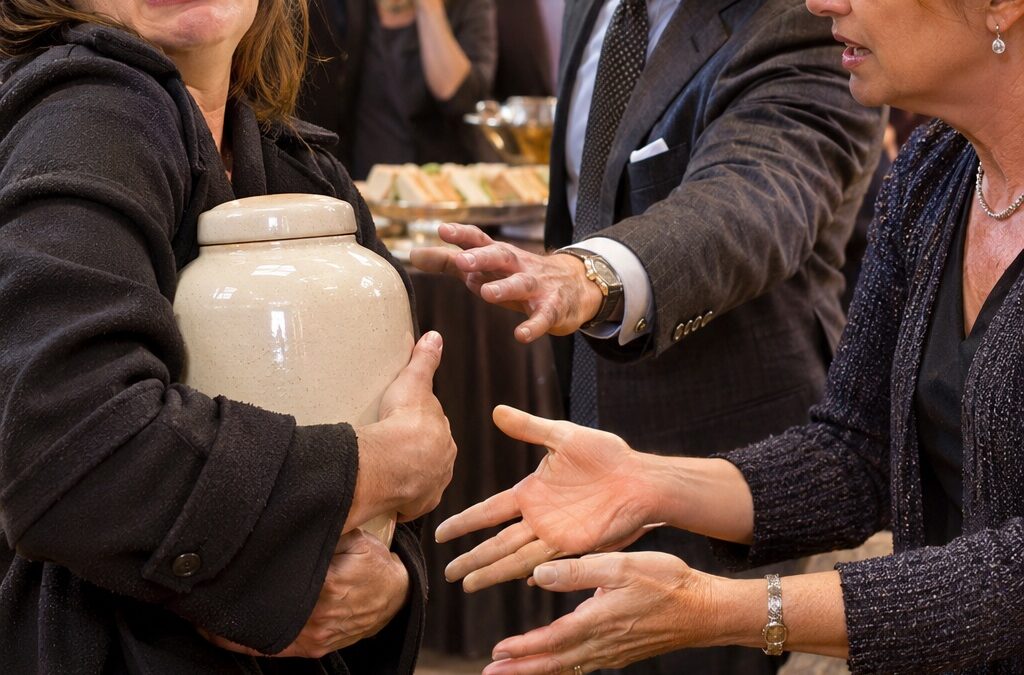
Part 3: Her Voice In The Room
“I want Tessa making the decisions,” Evelyn said.
Howard held his phone above the open file.
Her voice sounded stronger than I remembered from December.
“Tell me why,” his recorded voice answered.
“Curtis asked me for the money set aside here. He wanted a weekend away with Brooke. When I said no, he said I could let Tessa handle everything.”
Beside the photograph, Brooke stopped adjusting her purse strap.
Evelyn continued without anyone helping her find words.
“So that’s what I’m doing. Tessa will follow what I ask. She won’t change it to get the money.”
Curtis looked at Howard’s phone rather than at me.
I had heard the recording before that afternoon. Hearing it beside her urn was different.
I pressed my thumb beneath the ceramic handleless curve.
There was no convenient place to put my hand.
Howard let the recording continue.
On it, he asked whether Evelyn understood the appointment.
She said she did.
He explained that her representative would make disposition decisions. That authority concerned her remains and the arrangements surrounding them.
It was not a general financial power of attorney.
Evelyn repeated the distinction in her own words.
“Tessa handles what happens to me after I die. She doesn’t get to spend my bank account.”
Someone behind Celia moved a chair away from the wall.
Curtis glanced toward the sound.
Howard’s recorded voice asked whether anyone had pressured her.
“No,” Evelyn answered. “I asked to come here.”
Then she described the niche she already owned.
She wanted to be placed beside her late husband.
She wanted the simple service they had discussed.
She did not want people booking a larger event merely because money had been reserved for one.
“If I change my mind, I’ll tell you,” she said.
I remembered that part of the appointment clearly.
She had looked directly at me across Howard’s desk.
I had been holding her appointment calendar in my lap.
I asked whether she wanted someone else to attend.
“No,” she had said. “I’ve already spoken to my children.”
On the recording, Howard asked about the care arrangements.
Evelyn gave the name of her medical office, then paused.
“Tessa does the calling,” she said. “She writes things down. When I forget what they said, she reads it back.”
I lowered my eyes to the urn’s lid.
That was the part I had skipped when listening alone.
I could manage the practical instructions more easily.
Hearing her describe me made me check whether my coat was buttoned.
Howard stopped the recording after she confirmed her selection.
He did not add anything immediately.
Neither did I.
Curtis rubbed the side of his mouth.
“That was a family disagreement,” he said.
“The appointment was still her decision,” Howard answered.
“I’m not disputing that she said it.”
He looked at me for the first time since playback.
“But you’re using a complaint about a trip to control everything.”
“I’m following her arrangements.”
“You can follow them and still let us honor her.”
He had changed his request again.
It was no longer that I had refused care.
It was no longer that Evelyn could not understand.
Now he wanted the proposed ceremony treated as harmless.
I asked him what Brooke planned to do with the urn.
He looked toward her.
“A gathering,” he said. “Something people could attend properly.”
“We’re attending something now,” Celia said quietly.
Curtis’s jaw moved before he answered.
“This is sandwiches in a side room.”
Several relatives were still standing beside those sandwiches.
An aunt reached for a napkin and folded it.
Howard laid the file on an empty place at the table.
“The reception doesn’t replace the disposition instructions,” he said.
“Neither would ours,” Curtis answered.
“Then why do you need possession of her ashes?”
Brooke answered before he could.
“He said we needed them at the ceremony.”
Her voice was smaller than it had been earlier.
She was not looking at me when she spoke.
Curtis gave her a quick, irritated glance.
“Because that’s what a memorial is for.”
Howard shook his head.
“People can remember Evelyn without taking custody of the urn.”
I shifted its weight against my coat.
My forearm had started to ache.
Celia noticed and pulled a chair toward me.
I sat without handing the urn to anyone.
She pushed another chair beneath my purse.
That small action should not have mattered so much.
Earlier, she had reached for the ashes to protect Curtis.
Now she was finding somewhere for me to sit.
I did not thank her yet.
Howard asked whether I wanted the remainder played.
“No,” I said. “That explains her choice.”
Curtis looked relieved for a moment.
Then Howard opened the signed declaration.
He identified the execution date and witness section.
He did not announce that the paper made me an owner.
He explained the actual authority it gave me.
Evelyn had appointed me to direct her disposition.
He had verified the document after her death.
He had relied on it for the cremation arrangements.
No new family vote could replace it at a reception.
Curtis looked toward the people nearest the doorway.
“I never got a copy.”
“She didn’t ask me to send you one,” Howard said.
“She should have told me.”
“She told us she had discussed her wishes with you.”
He did not accuse Curtis of lying about that.
He simply left the statement where everyone could hear it.
Brooke moved away from the photograph completely.
She stood near the closed door now.
“Are we still supposed to reserve the place?” she asked.
Curtis made a short motion with his hand.
“Not here.”
But she kept looking at him.
I asked Howard whether any arrangements had been changed.
“Not by me,” he said.
“Any funds sent out?”
“Nothing has been transferred.”
Curtis turned back from Brooke.
“We haven’t even discussed the budget.”
Howard rested his hand on the open contract.
“Then we should clarify the request I received.”
He looked directly at Curtis.
“Who asked us to send the reserve to your personal account?”
Part 4: The Money He Expected
“I did,” Curtis said. “For the ceremony.”
Howard nodded once.
He had not asked because he lacked the answer.
He needed Curtis to stop suggesting arrangements were approved.
“Your email included your personal account instructions,” Howard said.
“I was trying to keep things simple.”
“Those instructions did not authorize a payment.”
Curtis put his hands on the back of a chair.
“I’m not asking you to explain banking to me.”
“I’m explaining why no money was sent.”
Brooke took a step closer to the table.
“You said it was being released.”
“I said it was available.”
“To you,” she said. “You said available to you.”
Curtis looked at the relatives behind her.
“This isn’t the place for account details.”
I agreed with that much.
“No account details,” I said. “Just explain whose refund it is.”
Howard turned the contract toward me.
I recognized the crease across its lower corner.
I had carried my copy in a bag during appointments.
The original in his file was flat and clean.
“The purchaser is Tessa,” he said.
“She paid the contract amount.”
Curtis gave a small shrug.
“We’re married.”
“That doesn’t change whom this contract directs us to repay.”
Howard made the distinction carefully.
The disposition declaration gave me authority over Evelyn’s arrangements.
It did not give me automatic rights to her estate.
It did not turn her money into mine.
The refund came from a different agreement entirely.
I had signed as purchaser and supplied the payment.
The unused optional reserve was returnable to me.
Evelyn had signed her own disposition instructions separately.
Curtis looked down at the contract but stayed standing.
“How much was actually used?” he asked.
“Exactly what the contract allocates,” Howard answered.
I supplied the figures because I had paid them.
“The total was $9,800.”
Howard pointed to the service allocation.
“The completed and scheduled basic arrangements total $3,600.”
That included cremation, the simple funeral, and the urn.
It also covered transport and placement in Evelyn’s niche.
The remaining $6,200 was the optional larger-memorial reserve.
We had discussed using it only if Evelyn requested more.
She never did.
She had wanted it available while she considered things.
Keeping the reserve had been my choice as purchaser.
I had been able to afford that choice then.
It had come from savings I brought into the marriage.
Curtis knew I had helped with expenses.
He had not asked to see the signed allocation.
His mother had told him a reserve existed.
He had treated that information as an available balance.
Brooke looked at the contract, then at me.
“So this isn’t something she left him?”
“No,” I said.
Curtis straightened.
“You don’t know what my mother intended privately.”
“We know what she signed here,” Howard said.
“And what I paid,” I added.
I was not willing to argue about a future inheritance.
I wanted the funeral contract kept out of his account.
That was something we could settle in that room.
Howard explained that no optional service had been ordered.
There was no approved replacement ceremony in his records.
He had received Curtis’s email and declined to act.
He had planned to discuss it with me after the reception.
Curtis had reached me before Howard could.
That explained his confidence when he arrived with Brooke.
He had wanted my agreement in front of witnesses.
If I surrendered the urn, the next request would sound routine.
He could describe it as finishing arrangements already underway.
I looked at the urn resting against my knees.
“Please note that I’m not authorizing changes,” I said.
Howard took a pen from inside the file.
“I’ll confirm that in writing.”
“No third-party account instructions,” I added.
“Correct.”
Curtis pulled the chair out and finally sat.
“You’re making this sound like theft.”
“I’m telling Howard where not to send my payment.”
Brooke’s mouth tightened at the word “my.”
She had apparently expected a fund belonging to Curtis.
I could see her rearranging what he had told her.
That did not make her presence easier to bear.
She had still arrived beside my husband at his mother’s reception.
But I would not pretend she knew the contract.
Curtis leaned toward me across the table.
“If you wanted the money back, you could have said.”
“I never offered it to you.”
“You knew we were planning something.”
“You told me what you wanted. I didn’t agree.”
Howard closed the section containing the account request.
He did not display the account number to the room.
That mattered to me, despite everything.
I did not want his private information scattered among relatives.
I wanted him unable to use mine.
I asked Howard about the urn’s return after the reception.
He explained the secure storage arrangement we had already made.
It would stay with the funeral home before placement.
I could carry it to his office when we finished.
He would record receiving it back into custody.
Curtis watched me listen.
“You’re really going to lock me out of this?”
“You can visit her niche after placement,” I said.
“That isn’t what I asked.”
“I know.”
Celia sat beside the chair holding my purse.
She looked tired enough to leave, but she stayed.
“I didn’t know Tessa paid it,” she said.
Curtis turned toward her.
“That’s not the issue.”
“It was enough of an issue to ask for her refund.”
He pushed his chair back slightly.
The relatives nearest us began moving toward the refreshments.
Nobody seemed to know whether the reception should continue.
Howard offered to keep his office available for practical questions.
He would not hold a public financial conference indefinitely.
I asked for a written summary after the reception.
He agreed to include the balance and refund terms.
He also agreed to confirm that nothing had been redirected.
Those were simple things he could actually do.
There was no court order being invented in the hallway.
There was a contract he was responsible for administering.
Curtis waited until Howard stepped toward the door.
Then he leaned down beside my chair.
“What if we made it smaller?”
I looked up at him.
“What?”
“The ceremony. Would you pay for a smaller one?”
Part 5: What His Sister Wanted
“No,” I said.
Curtis looked toward the room before answering.
“Could you at least let me finish talking?”
“I heard the question.”
He pulled his chair back toward mine.
Brooke remained standing near the door.
He lowered his voice, but not enough.
“We can handle the rest of this privately.”
“The arrangements are staying as they are.”
“I mean us.”
He touched the chair’s edge rather than my hand.
It was a gesture I recognized from difficult restaurant conversations.
He wanted us leaning close enough to look reconciled.
I kept the urn on my lap.
“There isn’t a ceremony payment attached to that conversation.”
“I didn’t say there was.”
“You asked whether I would pay.”
“I’m trying to make something work.”
Across the table, Celia looked down at her folded hands.
Curtis noticed me watching her.
“Can you give us some space?” he asked.
She started to rise, then stopped.
“You asked her to do this in front of us.”
“Celia.”
“You did.”
He turned back to me with a tight expression.
“I could tell people I spoke badly.”
“You can tell them that without my paying.”
“I’m offering to correct it.”
“Then correct it.”
He sat still for a moment.
A relative near the coffee stopped stirring.
Curtis did not stand and make an announcement.
Instead, he said, “You did help my mother.”
The words were directed only toward me.
I looked at the table behind him.
“Please say it where you accused me.”
His cheeks darkened.
Howard had stayed by the doorway.
He was not blocking anyone from leaving.
Nobody was trapped inside our argument.
Curtis could have walked out whenever he chose.
He stayed because he still wanted something.
Finally, he turned toward the nearest relatives.
“Tessa helped with Mom’s care,” he said.
“That wasn’t what you said earlier,” Celia answered.
He glanced at her sharply.
I spoke before they could start arguing.
“I arranged her appointments. I stayed with her.”
I kept my voice at the level of ordinary conversation.
“I didn’t refuse her care.”
A woman near the coffee nodded toward me.
“I saw you at the house,” she said.
I knew which visit she meant.
Evelyn had asked me to find a clean cardigan.
We had been interrupted by the doorbell.
I had answered with the cardigan over my arm.
The woman did not need to tell that story aloud.
Her acknowledgment was enough to make me look away.
Celia drew her chair closer to mine.
“I should have said something before,” she told me.
“Yes.”
“I thought if you handed it over, he’d settle down.”
“He wanted the ashes and the money.”
“I know that now.”
“You knew he was blaming me.”
She stared at the urn.
“Yes,” she said.
Curtis stood.
“Apparently this is going to be a trial.”
“No,” Howard said from the doorway. “It’s still a reception.”
He asked a relative to uncover the remaining sandwiches.
That ordinary request let people move again.
Someone poured coffee into a clean cup.
Someone else straightened Evelyn’s photograph.
The room became usable without becoming comfortable.
Brooke approached Curtis near the wall.
I could hear them because neither whispered successfully.
“Nothing is reserved,” she said.
“I know.”
“I mean on my end. I only made inquiries.”
“Then there’s no problem.”
“There is if you told everyone I was arranging it.”
He said something too quietly for me to hear.
She stepped back.
“No. You told me your family needed help.”
Celia looked toward her, then away.
Brooke adjusted the purse strap on her shoulder.
“I’m not planning a replacement ceremony.”
She said that clearly enough for Howard to hear.
He nodded as he would to anyone declining services.
Curtis asked her to wait outside.
She shook her head and left the room.
I did not follow her or demand an explanation.
My husband was still standing beside his mother’s photograph.
That was enough conversation for that afternoon.
Celia reached for a paper cup and stopped.
“Do you want some water?” she asked me.
“Yes.”
She brought it back and set it within reach.
I could not easily drink while holding the urn.
Howard offered to take the urn into secure custody.
I said I wanted to carry it there myself.
He told me to come whenever I was ready.
Curtis watched us make that arrangement.
He did not try to take it again.
The reception ended without any formal closing.
People came to my chair before leaving.
Some mentioned Evelyn’s laugh or her particular ways.
A relative told me about a recipe I already knew.
I listened because that was what I had come for.
Not every conversation needed to concern Curtis.
Celia gathered unused napkins into a clean stack.
Then she brought my purse to me.
“I shouldn’t have asked you to save his face.”
“No,” I said. “You shouldn’t have.”
She opened her mouth as though another explanation was ready.
Then she closed it and held the purse out.
I put its strap over my shoulder.
Howard led me down the hall to his office.
The room was quieter than the reception room.
I could hear a cabinet latch clicking somewhere nearby.
He cleared a padded space on his desk.
Only then did I set the urn down.
My fingers stayed curved after I released it.
Howard gave me time to straighten them.
He documented its return and showed me the storage process.
I checked the identification privately with him.
There was no need to turn that into another scene.
We discussed the scheduled niche placement.
I told him I needed to reconsider who would attend.
“That can be arranged,” he said.
“I don’t want another argument beside the niche.”
“We can keep the practical details private.”
I nodded and put my copy of the declaration away.
When I returned to the hallway, Curtis was waiting.
His coat was over his arm.
For a moment, he looked like someone waiting after an appointment.
Then he looked at my purse.
“Are you taking all that paperwork home?”
“Yes.”
He glanced toward the office behind me.
“And where are you planning to sleep?”
Part 6: The Appointment I Kept
“At home,” I said.
Curtis looked surprised.
I was too tired to explain that leaving immediately required work.
I had clothes, identification, and work things there.
I also needed somewhere familiar to put down my bag.
He had driven separately with Brooke.
I drove myself back without waiting for him.
The house looked exactly as we had left it.
There were shoes beside the door and mail on a chair.
I placed Evelyn’s file on the kitchen table.
Then I moved it into my work bag.
I did not want another discussion over an open document.
Curtis came home while I was rinsing a glass.
He set his keys down carefully.
That careful sound irritated me more than a slam would have.
“Can we talk without an audience now?” he asked.
“I need to wash my face.”
“We can’t keep putting this off.”
“I’m going upstairs.”
He did not stop me.
I took a towel from the linen cupboard.
There was a damp spot on my coat sleeve.
I realized it came from Celia’s cup of water.
I hung the coat where it could dry.
Then I washed my face and changed into clean clothes.
The guest room had become a place for laundry.
I moved the basket onto the floor.
I put my phone and charger beside the bed.
Curtis appeared in the doorway before I sat down.
“You’re sleeping in here?”
“Yes.”
“That’s a statement.”
“It’s where I’m sleeping.”
He leaned against the frame.
“Mom didn’t know everything about our marriage.”
“I didn’t ask her to judge our marriage.”
“She clearly had opinions.”
“She made her arrangements.”
He started to speak, then looked at my bag.
“I don’t want this turning into a legal mess.”
“Neither do I.”
“Then don’t make decisions while you’re upset.”
I took my work clothes from the laundry basket.
“I’m making an appointment for advice.”
He moved away from the door.
It was not an eviction or a dramatic departure.
We still had a shared home and unfinished obligations.
I could sleep in another room without pretending otherwise.
That night, I charged my phone and opened the recording.
I did not play Evelyn’s voice again.
I checked that the file opened and saved another copy.
Then I checked the scanned declaration and contract.
I made a folder I could find without searching.
Those were things I could do while exhausted.
I wrote down what had happened at the reception.
I used the exact words I remembered.
When I was uncertain, I marked the uncertainty.
I did not improve anyone’s dialogue to make it worse.
Curtis’s actual words were enough.
On January 20, 2025, I spoke with a family-law attorney.
I brought the funeral contract and funding records.
I also brought the declaration, though she explained its limits.
“It handles disposition,” she said. “Not your separation.”
“I understand.”
“And this contract controls the funeral home’s refund process.”
“Yes.”
“Whether either spouse raises a marital-property argument is separate.”
That was not the simple answer I had wanted.
It was a useful one.
I told her the payment came from premarital savings.
She asked whether I could trace it.
I showed her the account history I had preserved.
She did not promise an instant ruling.
She advised me not to hide money or empty joint accounts.
I had not done either.
We discussed a limited agreement concerning this refund.
It could leave broader separation questions for later.
I liked having a practical request instead of an enormous argument.
After the appointment, I called Howard.
I formally requested the unused contract reserve back.
He explained the ordinary processing steps.
He would return it to the original funding account.
He would not send it to Curtis’s supplied account.
I asked for written confirmation of both points.
He sent the confirmation without adding opinions about my marriage.
Then I asked to postpone the niche placement.
It had been scheduled for January 21, 2025.
I wanted it moved to February 18, 2025.
Howard checked the cemetery’s availability before confirming anything.
He also checked that the basic arrangement price remained unchanged.
It did.
The urn would stay securely in his custody meanwhile.
I was not postponing because Curtis had authority to block me.
I was postponing because I wanted to attend without another confrontation.
Evelyn had not required a particular placement date.
She had required a particular place.
That distinction helped me make the call.
I remembered taking her to see the niche.
She had stood with her handbag against her stomach.
She asked whether the opening would be easy to reach.
The cemetery employee showed her the location.
Then she asked where visitors could park.
She was always thinking about someone’s knees or walking distance.
I had asked whether she wanted flowers.
“Not if they’ll leak all over the place,” she said.
At home, I found a folded cardigan in my car.
It was one I had brought back from her house.
I carried it inside and laid it over a chair.
I did not know yet where it should go.
Curtis came into the kitchen while I was making toast.
“Did you request the money?” he asked.
“I requested the refund.”
He noticed the difference but did not correct it.
“What did the lawyer say?”
“I’m not discussing that conversation.”
“So there is a lawyer.”
“Yes.”
He stood beside the counter for a while.
Then he asked whether we could arrange a meeting through counsel.
Part 7: The Terms In Writing
“Yes,” I told him.
I gave the request to my attorney.
I did not turn our kitchen into a negotiation room.
On January 27, 2025, I began formal separation proceedings.
There was no immediate decree.
There was paperwork, scheduling, and advice I had to reread.
I kept going to the library for my shifts.
Books still came back with grocery receipts inside them.
People still needed help finding holds on the shelf.
I liked being asked questions with answers I could locate.
At home, Curtis and I used careful practical sentences.
“Are you using the car?”
“Your mail is on the table.”
“The repair person called.”
None of that meant we were repairing the marriage.
It meant we were living in the same house temporarily.
He no longer asked for the urn.
Howard’s verification had ended that particular argument.
Curtis instead asked that the refund be treated as shared money.
His position came through counsel, not across our kitchen.
I was grateful for that much.
I could read it when I had slept.
He argued that I had chosen to support his mother.
He said the household had benefited from my doing so.
My attorney asked for the original funding records again.
I supplied the complete trace rather than selected pages.
The payment had come from identifiable premarital savings.
The refund was for the same unused payment.
The contract named me as purchaser and refund recipient.
Those facts supported my position.
They did not authorize me to announce a final property division.
My attorney made that distinction repeatedly.
We sought a narrow written agreement about this particular refund.
Everything else could remain unresolved.
Curtis initially wanted language crediting him with funeral expenses.
I read the proposed line while sitting in my parked car.
The heater had fogged part of the windshield.
I used my sleeve to clear a patch.
Then I read it again.
I had paid the contract.
Evelyn had described who handled her care.
I was not signing a statement that erased it afterward.
I called my attorney.
“Please take that line out.”
“We can request that.”
“I’m not agreeing that he funded it.”
She asked whether I would accept neutral language instead.
It would identify the payment without awarding anyone praise.
“Yes,” I said. “Neutral is fine.”
I did not need the agreement to call me devoted.
I needed it not to say something false.
Meanwhile, Celia called when I was folding work clothes.
I let it ring before answering.
She asked whether she could correct what relatives had heard.
“You don’t need my permission to tell the truth.”
“I don’t want to repeat your private business.”
“Then leave the account details out.”
We discussed what could be said accurately.
Evelyn chose her arrangements and appointed me.
I had arranged care and stayed with her.
There was no approved replacement ceremony.
Those were facts already exposed at the reception.
Celia sent a correction to relatives she had spoken with.
She showed it to me afterward.
She did not blame confusion or say everyone made mistakes.
She said she had asked me to surrender the urn.
She said that request had been wrong.
I read her message while a shirt cooled beneath my hand.
Then I put the shirt on a hanger.
“Thank you for correcting it,” I told her.
“I should have done it there.”
“Yes.”
She did not ask me to soften that answer.
That made our next conversation possible.
Curtis heard about her message and objected.
He said she was making a private dispute public.
She reminded him where he had accused me.
I learned about their exchange from her, not him.
I asked her not to become a messenger between us.
She agreed.
Brooke did not contact me.
Howard confirmed she had ordered nothing through the funeral home.
There was no cancellation fee to fight over.
There was no approved venue waiting for payment.
Curtis’s promised ceremony had never become an actual arrangement.
That mattered because it removed another possible demand.
He could not hand me a legitimate bill for services I had approved.
He could still complain about embarrassment.
He did that through short, irritated remarks at home.
I stopped answering those remarks.
When he asked a practical question, I answered it.
When he wanted me to explain why Brooke had left, I went upstairs.
I was looking at apartments by then.
I used my own phone and went after work.
I did not ask Celia to come.
I needed to know whether I could tolerate each place alone.
One apartment smelled strongly of fresh paint.
Another had a bedroom window that would not latch properly.
The place I chose had ordinary cabinets and a working lock.
It was close enough to my job.
I could put a small table beside its kitchen window.
Those were sufficient reasons.
I told my attorney before signing anything.
We discussed how to handle the move openly.
I was not trying to create a false emergency.
I was choosing another place to live.
On February 14, 2025, we signed the limited interim agreement.
Curtis would not dispute my receipt and retention of this refund.
The agreement did not settle every marital issue.
It did not dismiss the separation proceedings.
It did not pretend we had reached a friendly understanding.
It resolved the specific money he had tried to redirect.
I read the signed copy at my attorney’s office.
Then I asked for a copy I could keep accessible.
I put it beside the funeral contract in my bag.
Later, Howard called about the cemetery confirmation.
The arrangement for February 18, 2025 was ready.
He asked one final practical question.
“Who would you like us to expect?”
Part 8: A Room Of My Own
“I’ll call you back,” I said.
Howard told me there was time to decide.
I wrote the question on the back of an envelope.
Then I placed it beside the kettle in my apartment.
The move had been smaller than I expected.
Clothes took up more room than furniture.
My work shoes went beside the door.
The cardigan from Evelyn’s house stayed folded in a tote.
I had not brought everything I owned from the marriage.
We still needed to address shared belongings through the separation process.
I took what we agreed I could take.
Anything uncertain stayed where it was for the moment.
I wanted a place to sleep, not another disputed inventory.
Curtis watched me carry out the work bag.
“The papers are all in there?” he asked.
“My copies are.”
He looked as though he wanted to add something.
Instead, he moved away from the doorway.
He did not help carry the bag.
I had not asked him.
At the apartment, I set it on the kitchen counter.
Then I opened cupboards and chose where cups should go.
I had never expected that choice to take time.
I kept reaching toward a cupboard that was not there.
I moved the kettle beside an outlet.
I put a spoon in a drawer and shut it.
Those small tasks occupied the first evening.
The refund arrived in the original funding account.
I checked the amount against Howard’s written confirmation.
It was $6,200, exactly as the contract required.
I saved the transaction record with the signed agreement.
I did not send Curtis a photograph of the balance.
His attorney could receive confirmation through mine.
There was nothing useful to prove over a text message.
The money remained traceable and where it belonged.
It had not paid for Brooke’s ceremony.
It had not become a reward for surrendering Evelyn’s ashes.
I used no part of it to make a public gesture.
I simply left it in the account.
At work, I stopped volunteering explanations for looking tired.
When a coworker asked whether I needed a break, I accepted.
I ate lunch sitting down instead of beside a circulation cart.
I put my phone in my bag during the meal.
That was new enough that I checked for it twice.
There were still messages about separation paperwork.
There were still days when a routine question made me cry.
I cried over a missing sweater rather than at the reception.
It happened while I was emptying a laundry bag.
I could not find the sweater Evelyn wore near the end.
Then I remembered it had stayed at her house.
I sat on the floor beside the bag for a while.
Afterward, I finished putting the laundry away.
Celia called to ask about the niche placement.
I told her I had not finalized attendance.
“Would you rather I stayed away?” she asked.
“I haven’t decided.”
She accepted that without arguing.
Then she asked whether I still had Evelyn’s cardigan.
“Yes.”
“Do you want to keep it?”
“I think so.”
“Then keep it.”
There was no inventory dispute over that cardigan.
Celia had other things she wanted from her mother’s home.
We agreed those belongings should be handled separately from my marriage.
She could speak with Curtis about their mother’s estate matters.
I did not need to become the person managing all of them.
That was another habit I had to interrupt.
I started to offer to organize a list.
Then I closed the notebook.
“Please work that out with him,” I said.
“All right,” she answered.
I unfolded the cardigan after the call.
There was a loose thread near the cuff.
Evelyn had worried at it while listening to television.
I tucked it inside instead of cutting it.
Then I laid the cardigan over the back of my chair.
I did not need to decide its permanent place.
The envelope with Howard’s question was still beside the kettle.
I turned it over and wrote Celia’s name.
I wanted her there if she could attend without managing me.
I called and told her that plainly.
“No requests to change the arrangements,” I said.
“I understand.”
“No conversation about saving Curtis embarrassment.”
“I understand that, too.”
“And I’m not bringing the recording.”
“I wouldn’t ask you to.”
I told her the time directly, without a family announcement.
She said she would drive herself.
Then I called Howard.
“Celia and me,” I said.
He confirmed that no public notice was necessary.
I asked whether Curtis had contacted him again.
“He asked about access after placement,” Howard said.
“What did you tell him?”
“That cemetery visiting rules would apply.”
That was appropriate.
I had authority to carry out Evelyn’s instructions.
I did not have authority to erase her son’s existence.
He could visit the niche like other family members.
He could not take possession of the urn.
Howard confirmed that the cemetery understood the placement instructions.
I asked him to send the final service summary.
It showed the basic arrangements already paid under the contract.
There was no surprise balance.
The refundable reserve had been returned.
I put the summary in the folder and closed it.
Curtis later sent a message about the placement.
He did not ask me to change the location.
He asked whether I expected him there.
I read the message standing beside my kitchen window.
Then I answered.
“It will be private. You can visit afterward.”
He replied that he would not attend.
I did not ask whether Brooke would be with him elsewhere.
It had stopped being a question I needed answered.
On February 18, 2025, I dressed for the weather.
I put tissues in my coat pocket.
I left the contract folder in the apartment.
Howard already had everything he needed.
At the cemetery, Celia waited near the walkway.
She was alone.
Howard arrived with the urn in a protective carrier.
He checked with the attendant before opening it.
Then he placed the ceramic urn into my hands.
Its weight was familiar immediately.
The attendant checked the location and moved beside us.
He opened the niche.
Part 9: Where She Asked To Go
I stayed where I was until he stepped aside.
The opening looked smaller than I had imagined.
Then I saw how the urn would fit.
Howard asked whether I wanted him to carry it forward.
“No,” I said. “I can.”
Celia stood beside me without reaching.
That was the first thing I noticed about her.
At the reception, she had held both hands out.
Here, she kept them folded around her own gloves.
There were no relatives waiting for an explanation.
There was no photograph on a refreshment table.
Nobody was preparing to announce another version of Evelyn’s wishes.
The attendant gave us space without disappearing.
Howard checked that I understood the placement procedure.
He spoke quietly and used ordinary words.
Nothing about it required a speech from me.
I looked toward the space beside the opening.
Evelyn’s late husband was already there.
She had described that location during the planning meeting.
She had not asked for a large audience.
She had asked that we get the place right.
“We’re in the right spot,” I said.
Howard nodded.
“Yes.”
I adjusted my grip before stepping closer.
The ceramic felt cool through my fingers.
I remembered carrying it into the reception room.
Then I had worried about dropping it among folding chairs.
Now the walkway was clear.
I could move without someone reaching across me.
Celia took a breath beside my shoulder.
“Tessa, before you put her in there.”
I turned my head.
She had removed her gloves.
“I knew you were staying with her,” she said.
I waited.
“I knew about the recliner. I knew you were tired.”
A car door closed somewhere beyond the walkway.
Celia looked down at her bare hands.
“I asked you to give it over anyway.”
“Yes.”
“I was embarrassed by what Curtis was doing.”
“So you asked me to make it easier for him.”
“Yes,” she said.
She did not add that grief had confused her.
She did not say Curtis had always been difficult.
She kept her answer about what she had done.
“I’m sorry,” she said.
I looked at the urn’s lid.
“I needed you to say she was cared for.”
“I should have.”
“You can still say it when it comes up.”
“I will.”
I nodded once.
I was not ready to tell her everything was fine.
She did not ask me to.
Howard stood far enough away to let us speak.
The attendant looked toward the path rather than at us.
I appreciated both of them for that.
Celia opened her purse and took out a tissue.
She held it toward me, not toward the urn.
I shook my head.
“Keep it,” I said.
She pressed it beneath her own eyes.
For a while, neither of us spoke.
I remembered Evelyn asking me to steady her spoon.
I had held it above the bowl while she swallowed.
There had been no audience then, either.
I could hear her television from the next room.
Curtis had called to say he would not make it over.
I had told Evelyn dinner was ready.
She asked whether I had eaten.
I said I would afterward.
She pushed the bowl slightly toward me.
“Get your own,” she said. “This one’s mine.”
I laughed at the memory before I meant to.
Celia looked up.
“She told me not to steal her dinner,” I said.
Celia wiped beneath her nose.
“That sounds like her.”
It did.
That was easier to hear than another statement about sacrifice.
I wanted to remember the woman who guarded her soup.
The woman who chose the parking spot with the shortest walk.
The woman who asked whether flowers would leak.
She had been ill, but she had still been particular.
The recorded meeting had preserved that, too.
Curtis had tried to describe a mother too overwhelmed to choose.
I had heard her choose, clearly and without prompting.
The witnesses had watched her sign.
Howard had followed the instructions after her death.
Nothing about that depended on Curtis liking the selection.
He had received no refund and no transfer of custody.
The replacement ceremony had not taken place.
Brooke had withdrawn from planning it at the reception.
Whatever remained between them was no longer part of Evelyn’s arrangements.
My marriage was still being addressed through separation proceedings.
The limited agreement had settled this refund, not everything.
There would be more documents to read.
I would still need to answer difficult questions.
But none of them needed answering beside the niche.
I had left those papers on my apartment counter.
The kettle would be where I put it when I returned.
My work shoes would be beside the door.
Nobody would be waiting to ask whether I had made Curtis look bad.
Celia asked whether I wanted company afterward.
“Not today,” I said.
“All right.”
“Maybe another time.”
“Call me when you want.”
She stepped back so I could approach the opening.
Howard moved close enough to help if I needed him.
I asked whether there was anything else to sign first.
“Not before you place her,” he said.
The attendant indicated where the urn should sit.
I looked inside and checked the space again.
There was room for my hands to withdraw safely.
That mattered suddenly more than anything anyone might say.
I did not want to scrape the ceramic against the edge.
I lifted it slightly and moved closer.
Celia stayed behind my shoulder.
Howard stood beside the attendant.
The placement instructions were complete.
The refund had been returned.
Curtis could visit afterward under the cemetery’s ordinary rules.
I had nothing left to negotiate before doing this.
I held Evelyn’s plain ceramic urn in both hands and set it inside her niche.








