My husband hid my sister’s letters for 7 years — Then a mailman brought envelope “#29,” and he was served divorce papers at work with employees and customers present.
Complete story · 7 parts · about 29 minutes · ending included
Part 1 · Part 2 · Part 3 · Part 4 · Part 5 · Part 6 · Part 7
Part 1 of 7
“Slot on your box is rusted shut, ma’am — must’ve jammed in last night’s storm. Didn’t want to leave it in the rain.”
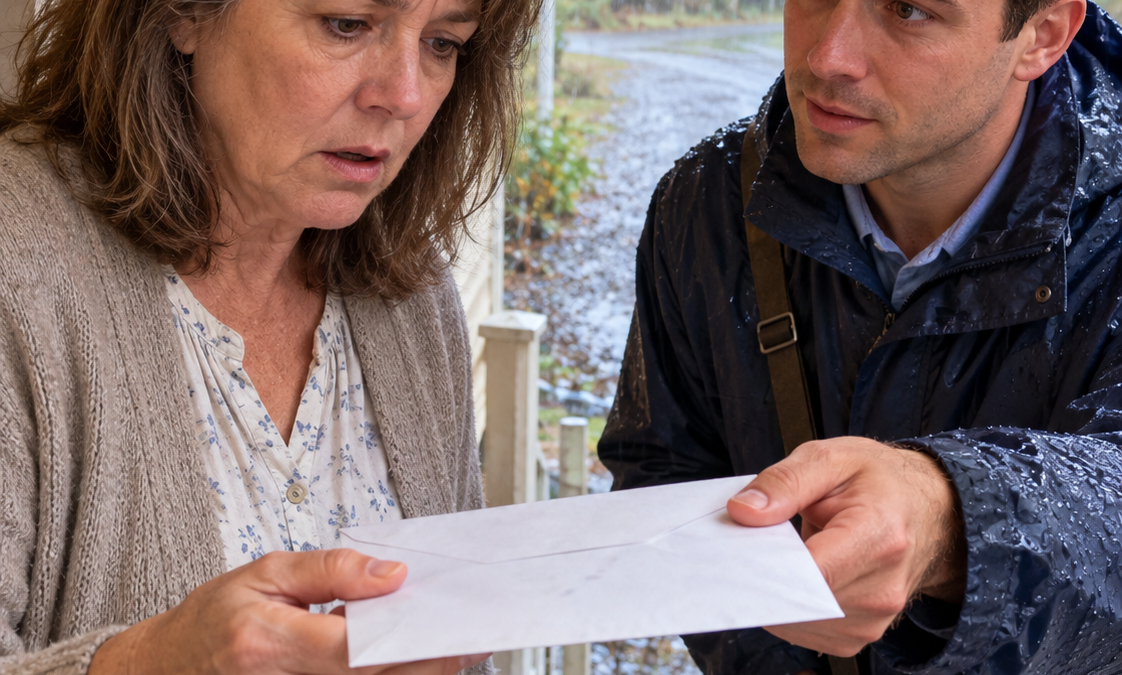
At 8:10 a.m. on Monday, October 5, 2026, a substitute mailman held out an envelope marked “#29” in my younger sister Misty’s handwriting, the first of hers to reach me since our falling-out.
He stood on the porch steps of our rented ranch house on Hardy Road. Rain dripped from his sleeve. He looked about thirty.
Dwayne had left at 7:00 for Pecan Bend Marine on Highway 8, where he sold boats.
“Thank you,” I said.
The mailman went back to his mail truck while I turned the envelope over. The number was on the back flap. My sister made her nines with a long tail, almost a second line beneath the figure.
I opened it under the porch roof.
Inside, the paper held one line:
“Tina — this is my 29th letter. Please don’t sell the lake house before you read the ones you never answered. — Mist”
That meant twenty-eight had come earlier.
I had received none.
My name and address were right. A man had carried the letter up our drive that morning. My sister had written about others as though I had opened them and chosen not to answer.
I worked alone doing bridal alterations in a small shop on the square in Grenada. At fifty-three, I still checked a measurement before trusting what a customer remembered. I traced the address with a fingertip, from our house number down to the zip code.
The letter went back into the envelope, then into a sewing bag beside the door. I closed the zipper. My sister had asked me to read something before I sold the place at the lake. I hadn’t signed a sale.
Last night, at Sunday supper in the Cedar Hill fellowship hall, my husband had stood beside me with a prayer list book in his hand.
About sixty people sat at the tables. A real estate broker from our church occupied the next one. The pastor waited at the front.
Dwayne used the warm voice the congregation heard when he led the Wednesday prayer group.
“Pray she lets that lake house go. And pray she forgives a sister who hasn’t written her one word in seven years.”
I had been reaching for my water. I put the cup down.
Misty and I had quarreled after Mama’s funeral in June 2019 and hadn’t spoken since.
The broker nodded.
I shook my head at the pastor. He saw me. His gaze stopped on mine before he lowered his chin.
Sixty heads bowed.
The man at the front prayed “for Tina’s letting go.”
I kept my eyes open. From my seat beside my husband’s empty chair, I could see the serving spoons standing in the bowls. Nobody had asked me whether I wanted to sell. They had heard him ask for help with me, and now supper waited while the pastor supplied it.
After putting the letter away that morning, I walked the quarter mile down our gravel drive in the rain. At the end, where the drive met Hardy Road, stood a locked slot mailbox my husband had put up in 2019. He had said thieves stole mail out there. I tried the slot lid with my thumb. Rust ran along the hinge. It wouldn’t push in, even when I pressed with the heel of my palm.
A date showed at the foot of the post: “8-17-19”. He had traced those figures with his finger while the concrete was wet. I remembered standing there with him. Seven years later, rain filled the grooves. The only brass key rode on his key ring, with him at work. I had never been given a copy.
In eleven years of marriage, he had handled all the mail. In 2019, he had set up my phone, too, “so you don’t have to fool with it.” He took care of those things; I asked whether anything had come for me and handed him the phone when a setting needed changing. I left the mailbox shut and walked back uphill. Water had soaked through my shoes by the time I reached the porch.
He went down for the mail at 5:15 that afternoon and came back with his hands in his jacket pockets.
“Box was empty. Nothing from anybody. Never is.”
I didn’t mention what was in the sewing bag.
We were eating supper at our kitchen table at 6:30, just the two of us, when he brought up the buyer. The broker had phoned me Thursday. I’d said I would think about it.
“Cash offer won’t wait past Sunday, babe. Pastor says you can sign right after the blessing Sunday. Broker’s already sent our joint account to the closing attorney for the wire.”
“I told her I’d think.”
“I know,” he said. “You’ve had a few days.”
The brass key was in his pocket with the rest of his keys.
He spoke gently, as though I had a headache and he could turn down the light.
“Sell it, babe. The money’s yours — I just want you free of that sad house.”
The “sad house” was my lake house twelve miles out on Gum Branch Lake, where I’d driven every June since Mama died to sit by myself. He had said “sell it” every night for three weeks until I signed the listing on September 22.
My plate was still half full.
“Your sister let you go seven years ago. Let the house go too.”
I folded my napkin and said, “Pins first.”
He knew my shop rule. I pinned before I cut.
The bag stayed zipped through supper and afterward.
By 9:40 p.m., I was entering Tuesday’s fittings at the kitchen table on an old tablet he had given me for the shop in 2019. It traveled between work and home with me every day.
The television played in the den, where he sat.
A notification slid down the screen and vanished.
“Parts – Marina: Sunday?”
I took the message for the parts counter at the marina asking about an order. Without opening it, I gave it no more thought.
Then I picked up my own phone.
Not one call from Misty had rung through since our quarrel. I opened the call settings and looked for why.
The “Blocked Contacts” list held exactly one line:
“Misty (Sis) — mobile”
Since 2019, every phone I had owned, Dwayne had set up for me.
I had never put anyone on that list.
Part 2 of 7
The only key to the locked mailbox down by the road rode on Dwayne’s key ring, and Sunday’s signing was five days away. At 8:05 a.m. on Tuesday, October 6, the same substitute mailman stopped his mail truck beside me on Hardy Road. Dwayne had left for work at 7:00.
The carrier pressed the slot lid with his thumb. Rust held the hinge fast.
“Post office never keeps a key to a locked box, ma’am. Whoever put it up holds it.”
“So there isn’t a spare anywhere?”
“No, ma’am.”
He walked to the truck and came back with a screwdriver. He worked the tip under the edge, gave the handle one careful turn, then pushed again.
The lid swung inward.
“It’ll take mail now.”
He put the tool away, then pulled a card from the clipboard on his dash.
His eyes moved down the writing.
“Route card says the mister asked us never to bring anything up to the house. Box only. Yesterday it was jammed and pouring, so I walked it up.”
I watched him tuck the card back in place.
“He asked for that?”
“Yes, ma’am. That’s what I’ve got here.”
The quarter-mile drive climbed behind me toward our rented house.
I took out my phone and crouched beside the concrete at the foot of the post. The numbers Dwayne had pressed there seven years earlier showed plainly in the morning light.
“8-17-19.”
I took a photo.
He had not only put a lock between me and whatever came in the mail. He had asked the post office to keep everything at the far end of our drive, where only his brass key could reach it.
The mailman had already climbed back into his truck.
“Thank you,” I said.
“Yes, ma’am.”
He drove on.
I stood beside the mailbox long enough to call my Tuesday clients and move their fittings.
Then I looked uphill.
When Dwayne wanted something kept out of the house, he kept it at my boathouse on Gum Branch Lake, beside his fishing boat. It had its own lock. Guests never used it, and I seldom went inside.
My sewing bag was on the passenger seat of my car, parked at the foot of the drive. Letter #29 and the shears were together in the zipped bag.
By 10:40, I had driven the twelve miles out to the lake house.
Since I signed the listing on September 22, I had stopped taking weekend renters so the place could be shown. No car sat by the cabin. No voices came from the porch.
The house had been mine since 2009.
So had the spare key for the boathouse on my lake-house key ring. Dwayne carried the only other copy.
I unlocked the separate door and stepped inside.
His boat filled most of the center space. A workbench ran along one wall. Above the bow, on a rafter, sat a red cooler wound thick with silver tape.
I knew it.
More than once, when I had come inside looking for something, Dwayne had pointed toward the rafters and said, “my old bait cooler, it leaks, leave it up there.”
I set the bag on the workbench.
A boat ladder leaned nearby. I placed it beneath the rafter, climbed high enough to reach the red cooler, and eased it down against my hip before setting it next to the bag.
The silver tape covered the lid seam.
I took the shears from the bag.
At my shop, I could cut a row of stitches without touching the satin underneath. The tape did not require that kind of care.
One blade slipped beneath an edge.
I cut straight across.
The strip separated with a dry pull, but I left the lid closed.
For more than two hours, I sat near the workbench before I could make myself lift it.
At 1:15 p.m., my phone buzzed.
Dwayne had sent a text.
“Drove past the square on lunch. Shop’s dark. Where you at?”
I stared at the screen.
He was close enough to my shop on his lunch break to notice the lights were off.
My thumbs stayed over the phone for a second.
Then I typed:
“Fabric run.”
I sent it and turned the screen off.
The cooler sat where I had left it.
I lifted the lid.
Envelopes filled the bottom, standing upright.
I touched the top one by the edge and stopped.
Misty’s handwriting.
The same long-tailed letters I had seen on #29.
I took out the first envelope and set it on the workbench. Then the next.
I did not break a seal.
One after another, I removed them until the cooler was bare inside.
I counted before I trusted what I was seeing.
Twenty-eight.
I lined them up across the workbench and used my phone to photograph the fronts and backs.
Each was addressed to me.
“Tina Gholston, Hardy Road.”
The postmarks were from Southaven.
They ran three months apart, back through the years, with the latest from May 2026.
Twenty-seven envelopes had numbers written on the back flaps.
The flaps were marked 2 to 28.
Every one was still sealed.
One envelope had no number.
Its postmark was the earliest.
August 12, 2019.
A clean slit ran along the edge, as neat as a knife cut.
Nothing was left in it.
Part 3 of 7
If I signed at the church supper on Sunday, the lake house I had owned since 2009 went to a cash buyer. The red cooler had to look untouched before Dwayne next walked into the boathouse.
Tuesday afternoon, I checked the photos on my phone against each envelope, one by one, before I moved anything else.
Two shots covered each one, front then back, so the postmark and any flap number showed.
August’s empty envelope matched too, down to the clean slit at its top edge.
I carried the stack to my car, came back for the roll of silver tape on the workbench, sealed the red cooler along the cut seam, then climbed the ladder and put it back on the rafter above the bow of Dwayne’s fishing boat.
From the floor, it looked the way it had that morning.
That was enough.
I locked the boathouse, drove the twelve miles into Grenada, and took the 28 envelopes straight to the safe at my shop on the square. Letter #29 stayed zipped in my sewing bag.
After six, I turned the sign on the door, locked up, and opened #2.
I worked in order.
The first pages were careful. Misty was sorry about the supper after Mama’s funeral, sorry about the wedding dress, sorry we had let one ugly argument become the last thing we ever said to each other.
She had wanted the dress for Harper someday.
I had taken it back to Grenada and hung it at my shop, where it still waited inside its garment bag.
The words on those pages did not accuse me of stealing it. They did not sound like somebody keeping score. She kept reaching across the same distance I had helped build.
I never once called her first after that fight.
With my thumb, I smoothed letter #2 against the cutting table, then pressed the fold flat as if fixing a crooked seam.
From #8 on, a crayon drawing came folded inside each one. Harper had drawn a house with a boat dock. The roof changed. The water changed. Once the dock leaned so hard it looked ready to slide off the page.
The idea never changed.
Three of the letters carried the same sentence:
“I won’t bring up what I wrote you that August again.”
I set the empty August envelope beside them.
I still did not know what had been inside it.
Near midnight, I reached #28, dated May 2026.
“This is my last, unless you write back.”
The paper stayed open beneath my palm for a long time.
Wednesday, right after I locked the shop door at six, I started at #2 once more.
By then I knew where #11 was.
February 2022.
The page had been written from a hospital bed in Memphis the night before her breast cancer surgery.
“If you can come, come. If you can’t, I’ll understand.”
I had to move my chair back from the cutting table.
That week in 2022, I had been hemming a bride’s train.
I remembered the dress because the satin had been soft enough to show every needle mark. I had spent two evenings on the floor, pinning the curve, checking the fall, taking out one section that pulled half an inch too high.
My sister had been waiting for surgery in Memphis.
I had been measuring lace.
I had not known.
Letter #11 lay beside my tape measure until the shop clock reached 6:25.
At 6:45 p.m., I was back at our rented house on Hardy Road with supper between us.
Dwayne cut into his meat and spoke as if he were going over errands.
“Buyer’s walk-through is Saturday at 10:00 at the lake house.”
I kept eating.
“The pastor’s giving you a minute to share before you sign Sunday.”
He took a drink.
“I texted the prayer group. Told them to stand with Tina Sunday.”
I folded my napkin once.
He leaned back in his chair.
“You’ll stand up in front of everybody and let it go. Nobody’s going to watch you pick that cabin over your marriage.”
“Saturday at ten,” I said.
“That’s right, babe.”
I carried my plate to the sink.
Later, I told him I had to go back to the shop “to finish a hem” for Saturday’s bride.
He nodded like the answer belonged on a list he had already made.
Letter #11 was open beside Mama’s garment bag when I took out my phone.
The blocked list still showed “Misty (Sis).”
I read the number from the screen and punched it into the shop phone.
My finger rested on the last button.
Then I pressed it.
Before the first ring, I hung up.
The empty August envelope sat inside the safe a few feet away. I still had no idea what Misty’s first letter had said, and I had no answer ready if she asked, “Why didn’t you come in February 2022?”
I kept my hand on the receiver as the lights around the square went off one by one.
Dwayne left for work at 7:00 on Thursday, and twenty minutes later I sat alone at the kitchen table on Hardy Road with the old tablet in front of me.
He had handed it to me in 2019 for my fitting calendar, and it was still signed in to his account.
The notification from Monday came back to me.
“Parts – Marina: Sunday?”
This time I opened Messages on purpose.
“Parts – Marina” was not a person’s name.
The contact photo showed the woman from the parts counter at Pecan Bend Marine. I had seen that face every time I brought him lunch at the store.
The thread began in mid-September.
At the top was her first text, dated September 14:
“New counter, new start. You said this year.”
Early September was when “sell it” had started coming across our supper table every night.
I picked up my own phone.
Starting at the top, I photographed each message on the old tablet as I moved down the thread, one screen at a time. I kept the dates in the frame. I kept the contact name in the frame.
Near the bottom, his words stopped sounding like hints.
September 30, 10:14 p.m.: “Once the lake money’s in the joint account, I file. Half is yours, like I promised.”
October 5, 10:02 p.m.: “Sunday she signs at church dinner. Nobody says no in front of sixty people.”
Part 4 of 7
Dwayne still counted on me to sign the cabin away in front of the church on Sunday. As he watched me load my car in the driveway of our rented house on Hardy Road, he thought I was finally giving in.
At 6:30 p.m. on Thursday, October 8, I said, “I’ll sleep at the lake house until Sunday, to get it ready for the walk-through.”
He kissed my forehead over the open car door.
“Now you’re thinking, babe,” Dwayne said.
From that night on, I never slept under the Hardy Road roof again.
I drove to Gum Branch Lake, twelve miles from Grenada, and stayed on in the house he expected me to sell.
By 10:00 a.m. on Friday, October 9, my copies of the deed and the listing agreement were on a family-law attorney’s desk in Grenada. I had brought them from my shop safe.
The lawyer was about sixty, dry and exact, and she read the ownership line aloud.
“Tina L. Gholston, a single woman,” she said.
Those were the words I had signed under when I bought the place. Dwayne’s name had never been added. I had come to find out what my signature on the contract had already given away.
She flipped my copy of the agreement forward to the page with the numbered terms.
“It’s yours, paid off before the wedding. Put the sale money in a joint account, and in Mississippi it can stop being yours. Paragraph nine takes it off the market with one letter and the four hundred the broker spent on photos and the sign. No sale binds you unless you sign. Give her both on Sunday, and don’t sign.”
“Even with the offer waiting?” I said.
“Your signature is still yours to give.”
On my phone, I opened the photos of Dwayne’s two messages and handed the screen across the desk. The lawyer looked at each one.
“That’s a promise, not proof. For fault, the court wants inclination and opportunity.”
“I moved out last night.”
She pushed the letter taking my house off the market toward me. I signed my name and wrote a check for four hundred dollars.
Both went into my wallet, folded together.
“I’ll file your divorce papers at the Chancery Clerk’s office in Grenada County at three-thirty this afternoon. Dwayne will be served Tuesday.”
My shop was closed for the day when I called Misty at her home in Southaven from the landline at 7:15 p.m. Friday.
She picked up on the second ring; the TV behind her went quiet.
I said, “I got your twenty-ninth. The rest never reached my hands until this week.”
Nobody spoke for a moment.
Misty said, “He called me that August. He said you’d call the sheriff if I came.”
I wound the phone cord around my finger.
“He told me you said you were done. And the first envelope’s empty, Mist.”
The line crackled.
“Then he read it. I’ll tell you to your face, not on a phone.”
I wrote “5:30 — back lot” in my appointment book on the counter.
“Sunday supper, Cedar Hill. Five-thirty. Park around back. When you see me carry in a red cooler, come in. Bring Harper.”
The letters rode with me from the shop safe to Gum Branch Lake Friday night; at 7:00 a.m. on Saturday, October 10, I stood the boat ladder under the high rafter above the bow of Dwayne’s fishing boat.
I brought the cooler down, put the letters back inside, and laid letter #29 on top.
Dwayne would cancel Sunday supper and tell the whole church I was “not well” if he noticed any sign that I had been through his hiding place.
I taped the cut seam shut, climbed back up, and set the sealed box where it had sat for seven years.
At 10:00 a.m., the broker walked the buyer from the cabin down to the boathouse, and Dwayne and I followed.
Dwayne stayed on the floor and tipped his chin up at the rafter.
“Old bait cooler. Leaks. Stays with the house. Buyer can haul it off with the junk,” he said.
His feet never touched the ladder, and nobody broke the tape above his boat.
If the house sold, a stranger would cart my sister’s letters straight to the dump.
I slept there Saturday too, and at 3:00 p.m. on Sunday, October 11, I moved the cooler into the trunk of my car.
By supper, I had parked in Cedar Hill’s back lot near the fellowship hall’s rear entrance. My wallet held the signed letter and the check.
After the blessing, Dwayne stood with the broker at the head of the room at 6:05 p.m. She held the acceptance papers for the offer in a folder.
“Seven years, and a sister who hasn’t written her one word — and still she holds on to that cabin. Tonight Tina lets it go,” Dwayne said to about sixty people.
I stood up and slipped out the rear entrance straight to my car.
There, I opened the trunk and took hold of the handles with both hands.
I carried the red cooler down the center aisle, past the rows of folding chairs, and set it on the front table, an arm’s length from Dwayne.
Part 5 of 7
At 6:08 p.m., I peeled the tape off the red cooler that held my sister’s letters, and the rear door of the fellowship hall swung open. Misty walked in with Harper, and the room turned to look.
Harper stayed close to Misty, their sleeves touching. From the front table, I could see the top of her head just below her mother’s shoulder.
I lifted the letters out in stacks, address side up where Dwayne could see. November 2019 showed on one postmark, February 2020 on another; farther down, the dates reached May 2026. Each one I turned over bore a number on the back flap in Misty’s hand. Along the cut edge of the unnumbered one, the paper parted all the way across, with no sheet tucked inside. I laid letter #29 on top and set the empty envelope apart beside it, its August 12, 2019, postmark facing the room.
Dwayne looked at that one first.
He had never thrown them out. A sack of mail in the store’s dumpster would have been noticed, sealed letters let a man say he’d kept them for me, and I almost never set foot in the boathouse.
“Twenty-eight before this one,” I said. “Every three months since August 2019. Twenty-seven numbered in my sister’s hand — and one he already opened.”
His thumb caught against the side of the prayer list book.
Beside him, the broker still held the folder with the acceptance papers. The letters lay on the table between her and me, addressed in handwriting I could pick out without reading a name.
With my gaze on Dwayne, I read back the request he had given the room last Sunday.
“‘Pray she lets that lake house go. And pray she forgives a sister who hasn’t written her one word in seven years.’”
The pastor’s head came up.
“I kept every one of them for you. You weren’t strong enough after your mama,” Dwayne said.
Across the top of the stacks, my name filled the middle of the addresses, above the road and town where he and I had lived. The edges had stayed sealed until I opened the letters myself.
I held my phone screen out toward the pastor, with Misty (Sis) on the list’s only line.
“Blocked Contacts. Misty. You set up my phone in July 2019, and all my later phones, from your backup. I’ve never put anybody on that list. And that August you told my sister I’d call the sheriff if she came.”
Near the door, Misty nodded.
The pastor bent closer and read the list without a word.
Dwayne pressed his thumb flat against the book’s edge.
“This is about our future, Tina. That money was always going to both of us.”
The old tablet faced the room when I read the message dated September 30, 10:14 p.m.
“‘Once the lake money’s in the joint account, I file. Half is yours, like I promised.’ Half for who, Dwayne?”
His mouth opened, but I was already reading the words from October 5 at 10:02 p.m.
“‘Nobody says no in front of sixty people.’”
His gaze went past me toward the doorway, where Misty stood beside Harper.
The broker set the folder down on the table.
“He emailed me on the first to send the closing attorney your joint checking for the proceeds, pending Tina’s signed wire instructions.”
Dwayne shifted his heel against the floor.
From my wallet, I took the termination letter and the check for four hundred dollars and handed both across the table to the broker, my signature facing up.
“I’m taking my house off the market.”
She turned to Dwayne.
“Then there’s nothing to sign tonight.”
His chin lowered toward the paperwork. The space for my signature was still blank, within reach of where he stood.
“I filed for divorce Friday at the chancery court.”
The little book bent slightly between his palms.
At the back of the room, Harper tugged her mother’s sleeve.
“I drew you a house on every one since I was five, Aunt Tina. Didn’t you get my houses?” Harper said, loud enough for the room.
From the stack, I pulled a crayon drawing and held the house with its boat dock up where Harper could see. The dock reached out from the yard in crooked strokes, each board drawn separately. Above the shore stood the house, its roof wider than the walls. Out where the planks ended, the crayon had pressed hard enough to leave small ridges of wax.
Harper tipped her head to see around Misty’s arm.
The pastor walked up to our table, stopping across from my husband with the letters between them.
“Dwayne, I prayed the words you gave me. Give me that list.”
He handed over his prayer list book without opening the cover. The pastor took hold of the spine and kept the book against his side.
At a side table, people traded looks; someone said, “Not at church,” and an older woman said, “Well, bless his heart.”
I put my hand on the cooler’s red lid, beside the envelope he had opened in 2019.
“Twenty-eight letters, Dwayne. She never stopped writing.”
Part 6 of 7
The pastor held Dwayne’s prayer list book against his side at 6:40 p.m. that Sunday, October 11, and said, “Dwayne, you won’t lead the Wednesday night group anymore.”
He left the front table and walked out through the side door. The pastor stayed where he was in the fellowship hall, facing some sixty people who had watched the handover.
Misty and Harper were still by the rear entrance.
The women at the side table pulled out plates of food and brought them to the two waiting at the back.
At 8:00 p.m., the cash offer ran out, and nobody had signed anything.
Misty drove her daughter back to Southaven that night because Harper had school Monday.
The broker’s email reached my phone at 9:15 a.m. Monday, October 12: “Listing withdrawn at seller’s request.”
I was at the lake house, where I had stayed since Thursday night. The confirmation was addressed to me, the seller, under my own name. Dwayne’s name had no place beside mine in the broker’s written answer. The house he had counted on selling was off the market now, and my phone held the proof of it.
Within that same hour, my lawyer copied me on her email to Dwayne. He had until Saturday, October 17, to take his boat out of my boathouse and leave his key to that building with me.
Dwayne still lived on Hardy Road. His boat sat at my lake house for five more days behind a lock his key could open. That night I bolted every door of the cabin by hand and left the porch light burning until morning.
The half he had promised away would never exist.
My lawyer emailed the proof of service to my phone at 2:00 p.m. Tuesday, October 13. According to that paper, a process server had handed Dwayne the divorce papers at 10:30 a.m. at Pecan Bend Marine.
The form read: “Served in person at the sales counter, employees and customers present.”
Below it sat the server’s signature, dated that same Tuesday morning. Three and a half hours had passed between the handoff and my lawyer’s message. I had not been at the store. That paper was my only account of what had happened at the counter; I had no words from Dwayne to add.
By 4:00 p.m. Wednesday, October 14, Misty sat across from me in my lawyer’s office in Grenada, with her sworn statement on the table in front of her.
Harper was in school. Misty had driven down from Southaven alone for this, without her daughter beside her to hear what had been kept out of the church supper.
My lawyer, a woman of about sixty, sat at the head of the table. The account in front of Misty had not yet been signed.
Misty said, “I saw Dwayne at Silver Bayou in Tunica that night, August tenth. He saw me too.”
“When did you try to tell me?” I said.
“That Sunday I called him. ‘Tell her yourself, or I will.’ Monday I mailed you the first letter, with a picture in it.”
“What made you write again this month?”
“I saw your boathouse on a listing site that Thursday. That’s why I wrote again.”
From my purse, I took the empty envelope and set it between us, postmark up: August 12, 2019. That date was the Monday right after the Saturday Misty had named. There was no number on the back flap and nothing inside the slit opening. Whatever Misty had sealed into it was gone before I ever held it.
“Did you still have the picture?”
“I wasn’t bringing it into a church. Not with Harper there. It was on my old phone in a drawer. I printed it last night.”
“Why didn’t you call the shop’s landline or mail a letter to me at the shop instead of the house? In seven years, what kept you from walking in and asking me what I’d received?”
“He said you read the first one. I thought you’d seen that picture and chosen him. Showing up at your shop would’ve made you pick in front of a bride.”
“I never saw that photograph, Misty. He never put what you sent that Monday in my hands.”
“A letter, you could throw away. A call, you’d have to hang up on me yourself. I couldn’t hear you do that.”
“My car could have made that drive too, Misty.”
“I should have driven down anyway.”
Misty signed the sworn statement and took one 4×6 photo print from her wallet. She slid the picture across the table face up and left it with me to keep.
Looking down, I saw Dwayne at the casino buffet counter, his hand on the small of a woman’s back.
I knew her face, the same face as the “Parts – Marina” profile picture on the old tablet.
When I turned the photo over, the time Misty had copied from the details was on the back, in her hand.
“Silver Bayou, Tunica — Aug 10, 2019, 9:42 PM. This was in my first letter. I’m so sorry, Tina. — Mist”
Part 7 of 7
I laid three things side by side on the lake house kitchen table Thursday morning, October 15: the original 4×6 print dated August 10, 2019; the slit, empty envelope postmarked August 12, 2019; and my phone showing the picture I had taken at the foot of the Hardy Road mailbox post, “8-17-19.”
One week after Tunica. Five days after her first letter. Pulling my chair up, I stopped when my knees touched the table.
My lawyer called from her office in Grenada while I sat there alone, with the screen still lit beside the postmark.
“I filed a copy of your photo and Misty’s sworn statement in the divorce case this morning,” my lawyer said.
“His hand on her back shows ‘inclination’; what Misty swore to about them leaving the buffet and walking toward the casino hotel elevators shows ‘opportunity.’”
“You moved out the same day you read his texts, and you haven’t slept under his roof since, so nothing you did undoes that ground.”
Through the kitchen window at 9:00 a.m. Saturday, October 17, I watched Dwayne back his trailer down beside the boathouse. His truck stopped with the rear wheels close to the water, the empty supports aimed at the doorway.
Dwayne opened the building with his own key and went straight to his fishing boat. From where I stood, I could see him bend over the bow to fasten the winch cable.
The handle went around in his fist, drawing the hull forward a little at a time. Water fell from the underside as the bow rose onto the trailer, and the cable stayed taut between turns.
His shoulders blocked the doorway until the stern cleared. With the last turn, the boat settled onto the supports behind his truck.
I kept my place at the window while he secured the load and came toward the porch. Dwayne left his boathouse key on the railing without knocking or saying a word.
Once his truck was gone, I went outside and picked up the key from where he had placed it. I dropped the small piece of metal into the empty red cooler on the porch and closed the lid.
Misty and Harper arrived at noon, and I led them inside to my sewing table. Mama’s wedding dress lay in the garment bag I had brought from my shop.
Across from me, Misty took the other chair while Harper leaned between us, reaching for the long zipper.
I drew the fastener down the length of the bag.
“It was always half yours,” I said.
Misty caught the open edge before the plastic could slip back over the skirt.
“Then it’s half Harper’s,” Misty said.
Harper bent closer until the ends of her hair brushed the table. The bodice was wider than her shoulders, and she spread her arms along the sleeves to see where her fingers reached.
“Did Grandma wear that whole thing all day?” Harper said.
“Through the wedding.”
Misty kept the plastic back while I lifted out the veil. Harper moved into the space beside my chair and tipped her head toward me, her hands pressed flat against her thighs.
The lace caught on one small section of hair above her ear. Once I worked it loose, the netting fell over her shoulders and halfway down her back.
“Pins first,” I said around the two I held between my lips.
At the first pin, Harper laughed out loud, tipping her chin up until I had to follow with my hand.
“Hold still, miss.”
Harper clamped her mouth shut, but the corners kept pulling up. Misty reached across to keep the trailing tulle from slipping beneath my elbow while I finished the fitting.
The veil stayed in place when Harper took a careful step away from the chair. Through the netting, she looked down at the skirt still spread inside the open bag.
Misty smoothed a sleeve of Mama’s gown across her wrist without looking up.
“I’m sorry I never drove down,” she said.
“You don’t owe anybody sorry for years somebody else took,” I said.
Harper turned too quickly, and a length of lace swung against my sleeve. I grabbed the loose netting before the chair could snag it.
By 4:00 p.m., the three of us were setting a plain mailbox on a cedar post at the head of the drive. Misty braced the upright while I fastened the base, and Harper stood back to tell us when the front faced the road.
Harper crouched to check the little door from underneath, then came around to Misty’s side of the post. A last turn of my screwdriver brought the base down flush; Misty let go, and the cedar stayed straight.
On a sheet across my knee, I wrote to Misty: “Mist — this is my first letter. I want you to open your box one day and find me in it.”
With Misty beside me to give the street and number, I addressed the envelope to her house in Southaven. I sealed the flap and pressed a stamp onto the corner, clear of the spot my niece had already claimed for a drawing.
Across the blank space below, Harper drew a house with a boat dock. Two women sat at the far end, their legs hanging over the water, their hands joined in a thick stroke of crayon.
I handed the letter to her. With the drawing facing up, she slipped it inside and closed the mailbox.
Harper raised the red flag. That box would never have a lock.
THE END
More stories
My sister moved our 68-year-old mother onto a cot for her in-laws—Then Mom brought a folder to their anniversary party, and the family had to leave her house.My boss gave his daughter until Friday to leave her home after 16 years—then the folder he left on my counter helped stop his auctionMy brother demanded our parts manager sign a confession for six missing pumps—Then my 10-year-old son’s bird video showed the whole room who had loaded them.My wife put a $1,200 sticker on my mother’s jewelry box before the funeral—Then Mom’s lawyer made her peel it off with thirteen of us watching.My sister-in-law called me “the hired help” while taking my 74-year-old dad’s phone — Then six lock codes exposed her secret rental, and she canceled before 14 guests.My brother-in-law used a $180 drill in Mom’s purse to push care-home papers—Until the store owner checked his cameras and my sister tore up the forms.








