My Husband Locked Me Outside With Our Newborn, Until Our Daughter Lifted The Camera
Part 3: What Sadie Had Saved
Sadie pointed to the file and touched the playback bar.
“Here. Before he went to the front door.”
The officer started it with the sound turned low.
Cole’s voice came through clearly.
“Sadie, stay by the cake. Kelsey, put Marissa’s jewelry in your bag. If she wants it back, she can sign away the house.”
I put my palm over Owen’s exposed ear.
Not because he understood, but because I needed something to do.
Sadie looked at the floor beside my shoe.
The officer paused the recording and looked at Cole.
He opened his mouth, then looked toward Kelsey.
“That isn’t what it sounds like,” he said.
The officer asked him not to interrupt the review.
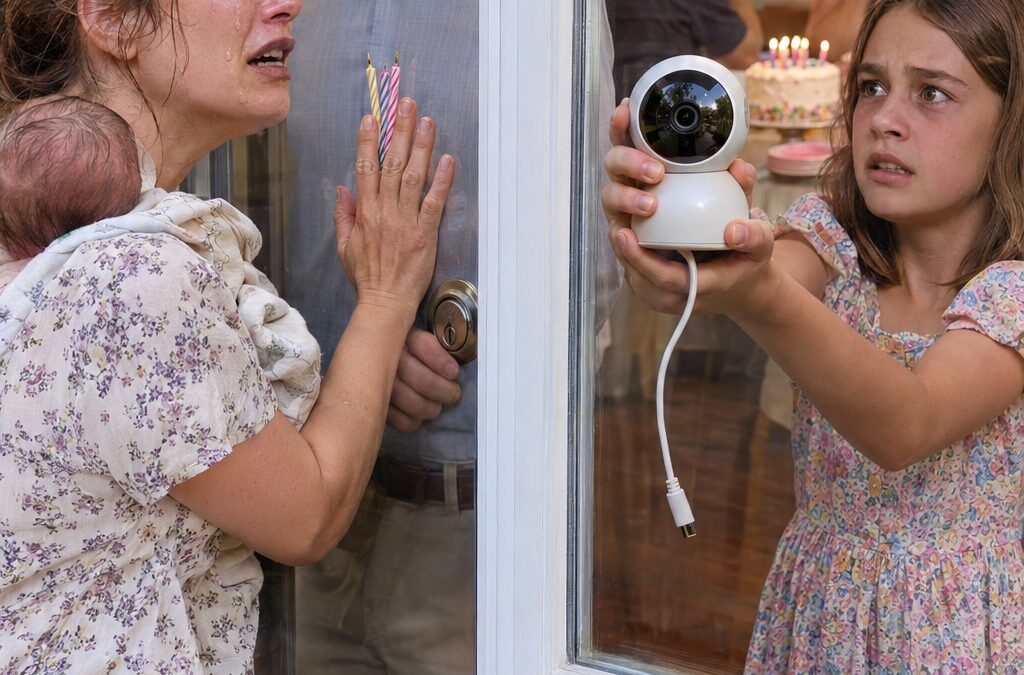
On the screen, Cole crossed toward the front door. I was visible outside with Owen against my shoulder. The recording showed him close the door and turn the lock.
It also caught me asking to come inside.
Sadie stood close enough to touch my sleeve.
She had known the camera was recording that afternoon.
We had tested its sound together when we installed it. She had spoken into it and laughed at her own playback.
Cole canceled the cloud subscription after that.
He had assumed canceling payment stopped the whole camera.
It still saved to the memory card inside.
Sadie knew because we had watched those test files together. She had been standing in the room when Cole addressed her. She preserved the conversation she had heard and participated in.
Unplugging it stopped fresh footage from overwriting older files.
She hadn’t known whether anyone would believe her description.
So she brought the camera where I could see it.
The officer asked whether we could preserve the original file.
“Yes,” I said. “Please tell me how.”
He explained that they would document what they reviewed. I would also need to retain the original recording.
Nobody promised me an arrest or an immediate court order.
I was grateful for that plain explanation.
I needed to know what was actually happening.
Kelsey adjusted the strap on her shoulder.
“Can I leave? I didn’t agree to all this.”
The officer asked about the jewelry mentioned on the recording.
Cole answered before she did.
“It’s household property. We’re separating.”
“That’s my jewelry,” I said.
“We bought plenty of things while we were married.”
“Not those pieces.”
Kelsey looked between us, then opened the bag voluntarily.
A small cloth pouch lay beneath her wallet.
I recognized the crooked stitch along its top edge.
My aunt had sewn that pouch before giving it to me. The clasp on the bracelet inside caught on that stitch.
I had never bothered replacing it.
The officer asked Kelsey to leave the pouch on the table.
She did, keeping her eyes on Cole.
“I thought you said she knew,” she told him.
He shook his head at her, barely moving it.
I could see the birthday cake behind the bag.
Sadie’s uneven icing flower was still near the edge.
A guest began gathering the other children into the kitchen.
Judith helped without turning it into an announcement.
Trent stood near the living-room doorway, holding his phone low.
I looked at him.
“You saw me outside.”
He pulled his lips together before answering.
“I didn’t know what was going on.”
“You saw Owen.”
“I thought Cole would open it.”
He had kept filming while he thought that.
I didn’t ask to see his video.
There was enough happening in front of me.
The officer asked me to identify the jewelry.
I described the bracelet clasp and the pendant’s repaired chain.
Both were inside the pouch.
Then Cole changed his argument.
“She can’t decide everything is hers because she’s upset.”
“I had them before we got married.”
“Do you have proof of that?”
“Yes. Family pictures.”
I knew exactly which pictures I meant.
My aunt had fastened the pendant around my neck before marriage. Someone photographed us together afterward, my hair caught beneath the chain.
I had complained about that photograph for years.
Now I wanted the original file and its date.
The officer explained that ownership disputes might require court proceedings. He would document the attempted removal and what everyone said.
The jewelry would remain in the house that evening.
Kelsey agreed to leave without it.
She picked up her bag and walked toward the door.
Cole followed her into the entryway, speaking under his breath.
She pulled away before he finished.
The front door shut behind her.
I watched the place where her bag had rested.
My stomach tightened when Owen began crying again.
I had forgotten which side I had last fed him on.
Judith asked whether I wanted water.
“Yes. And his blanket from the chair.”
She brought both without asking anything else.
Sadie sat beside me while I settled her brother.
The officer took Judith’s account separately from mine.
She described the locked door and my repeated knocking. She had seen Cole refuse access while I held Owen.
She hadn’t heard the earlier conversation about the jewelry.
The officer wrote that distinction down.
I noticed because I needed everyone to be exact.
Cole could not be allowed to turn guesses into contradictions.
When the officers finished, they explained our immediate options.
We both had rights to the house.
They were not dividing marital assets that evening.
They were not ordering Cole permanently out.
Cole said he would stay with Trent while things settled.
I asked him to say that in front of the officer.
He did, with his jaw pushed forward.
Trent finally put his phone in his pocket.
He helped Cole collect clothes and his work things.
The officer stayed while they gathered those belongings.
I didn’t follow Cole through the rooms.
Judith stood near the hallway until they finished.
After the door closed, Sadie asked about the cake.
“Can we still have some?”
I looked at the candles beside the plate.
“Yes,” I said. “We can still have cake.”
She chose the slice with her crooked flower.
The remaining guests sang softly, without making her start over.
I held Owen and watched her eat the icing first.
Later, I put the unused candles in the kitchen drawer.
Cole sent a message before I had finished cleaning.
He wanted me to sign a waiver giving up the house.
Then, he wrote, we could “sort out the rest.”
Part 4: The Papers I Wouldn’t Sign
I read his message beside the open dishwasher.
Then I closed the dishwasher without loading anything else.
I did not answer the request about the house.
I saved the message and called a family-law office.
The first person who answered asked whether I was safe.
I said Cole was staying with his brother.
Then she asked whether I had received any court papers.
“Not yet,” I said. “Just something he wants signed.”
She told me not to sign it before getting advice.
I put my phone beside the camera on the counter.
Owen was asleep, and Sadie was brushing her teeth.
For the first time that evening, nobody was speaking.
I checked that the memory card was still inside.
Then I put the whole camera in a clean container.
I wrote down when Sadie had unplugged it.
I wrote down who had handled it afterward.
I didn’t cut the footage into a shorter clip.
I didn’t send it around to relatives.
The officer had asked me to preserve the original.
That was the instruction I could follow that night.
Judith came back after the guests had gone.
She helped me make copies without changing the original file.
We saved the full recording, not just Cole’s sentence.
I wanted the moments before and after it intact.
Sadie watched from the doorway.
“Did I do something wrong taking it down?”
“No.”
“Dad said I wasn’t allowed to touch it.”
“You brought it to me. You asked for help.”
She rubbed the end of her pajama sleeve.
I shut the laptop so she wouldn’t watch again.
“You’re done with this part,” I told her.
The next morning, I photographed the jewelry together.
Then I photographed the clasp and the repaired chain.
I found the older family pictures on my saved drive.
There was my aunt, standing behind me, fastening the necklace.
The original date was earlier than our marriage.
I copied those files into the same evidence folder.
I also found the closing papers for our house.
Cole’s name was there beside mine.
Nothing about his locked door had changed that.
At my appointment, I brought the original camera.
I brought the copies, photographs, messages, and closing papers.
My attorney listened before explaining what each item could establish.
The recording showed what happened and what Cole demanded.
The deed showed that I had ownership rights.
Neither automatically awarded me the whole house.
That would require an agreement or a court decision.
Leaving temporarily also would not automatically erase my equity.
Cole’s demand depended on me believing something untrue.
“He wants you to sign away a claim,” she said.
“He said we could sort everything else out afterward.”
“Then nothing gets signed without reviewing everything together.”
We discussed the children before discussing the furniture.
I wanted Sadie’s school routine to stay steady.
I wanted Owen’s feeding needs considered without shutting Cole out.
I wanted to sleep without hearing the deadbolt turn.
My attorney explained the temporary-occupancy process.
There would be notice, a hearing, and an opportunity to respond.
The birthday party would not become an instant eviction order.
We filed on June 3, 2024.
Cole was served on June 5, 2024.
After service, his messages changed.
He stopped asking directly for the house waiver.
Instead, he said I was making co-parenting impossible.
He wanted to come and go without arranging it.
He said Sadie needed to see us behaving normally.
I forwarded those messages to my attorney before answering.
We proposed arrangements that kept exchanges outside the children’s rooms.
Necessary parenting communication stayed practical and short.
I did not tell Sadie to report what Cole said.
When she came back from seeing him, I asked about dinner.
I did not ask whether Kelsey had been there.
Cole also began questioning my ability to afford the mortgage.
That was a real issue, and he knew it.
My reduced work hours had cost $6,400 in wages.
That money had covered time spent doing family work.
It was not income I could simply recover later.
I pulled out my work schedule and called my supervisor.
We discussed my return from leave and available hours.
I needed real employment information, not hopeful estimates.
My attorney told me not to stop essential payments impulsively.
So I kept a record of household expenses.
We asked the court to address temporary financial responsibilities.
I did not empty accounts or hide marital money.
There was enough uncertainty without creating more myself.
Judith wrote a statement about what she had witnessed.
She separated what she saw from what I later told her.
She had seen me outside with the baby.
She had heard my request to enter.
She had seen Cole refuse.
Her account matched the camera’s view of the doorway.
That mattered when Cole’s response described a cooling-off period.
He acknowledged locking the door but disputed the reason.
His lawyer argued the recording lacked the surrounding marital context.
My attorney supplied the complete original file.
There was no trimmed beginning for them to challenge.
The court did not need every argument from our marriage.
It needed the facts relevant to the motion.
Before the hearing, I watched the footage with my attorney.
I turned away when my own voice asked to enter.
She paused it and offered me a moment.
“Keep going,” I said.
I wanted to know exactly what would be shown.
At the hearing on June 18, 2024, Judith testified.
I answered questions about the house and the lockout.
Cole sat beside his attorney without looking toward me.
The recording was played with its surrounding footage.
When his instruction about the jewelry came through, he looked down.
His lawyer moved to the question of future arrangements.
They proposed shared occupancy with separate sleeping areas.
My attorney asked how that would protect normal access.
She pointed to the locked door and the coercive demand.
The judge asked Cole about conditioning jewelry on the house.
He said he had been angry and spoke badly.
He no longer claimed the camera had stopped working.
The judge reviewed the proposed temporary order.
Then she turned the papers toward herself and began ruling.
Part 5: Who Could Stay
The judge granted me temporary exclusive occupancy.
Cole would not return to live there while the order applied.
It did not decide the final property division.
It did not cancel his interest in the house.
My attorney explained those limits again before we left.
I wanted to understand the order I would rely on.
The court addressed retrieval of his remaining personal belongings.
Counsel arranged the details so we would not negotiate at the door.
The children’s temporary arrangements were handled separately.
Household obligations were addressed through the pending case.
Nothing about that day meant I could ignore the mortgage.
I took the order home in a plain folder.
Then I put it somewhere Sadie would not find it.
She had already carried enough adult information.
When Cole returned for his arranged pickup, Judith stayed nearby.
I had set his identified belongings together.
We checked items against the agreed list.
There was no birthday table to talk around this time.
There were no guests to impress.
Cole walked through slowly, looking toward the bedroom hallway.
“Am I allowed to get my own coat?”
“It’s with your other things.”
He found it folded across the box.
He looked at me as if I had hidden something.
Then he put it on top without another comment.
I did not tell him the house was mine.
It wasn’t solely mine yet.
I said only what the order actually allowed.
The retrieval ended without police needing to attend.
Afterward, I checked the windows and sat on the stairs.
Owen was asleep in the room behind me.
For a while, I counted the stair spindles without meaning to.
Then Sadie asked where we kept the extra pillowcases.
Ordinary questions started coming back in small pieces.
I returned to work after leave with a written schedule.
Childcare plans went on the refrigerator, away from court papers.
I packed Owen’s bag before packing my lunch.
I checked the bag again at the door.
Some mornings, I forgot my own lunch anyway.
Keeping the house still required more than wanting it.
I needed a mortgage I could qualify to carry.
The lender reviewed income, debt, and employment documentation.
The current joint loan could not simply lose Cole’s name.
A divorce decree would not make the lender release him.
My attorney made sure I understood that distinction.
We would need a refinance or another workable outcome.
I gathered pay records and answered the lender’s requests.
I did it after bedtime, with the kitchen cleared.
The camera stayed put away with the original evidence.
I had no desire to make it a household decoration.
Meanwhile, the property discussions moved from accusations to numbers.
The agreed house value was $218,000.
The joint mortgage balance used in settlement was $160,000.
That left $58,000 in home equity to allocate.
The marital portion of Cole’s retirement was also $58,000.
Those were settlement figures, not promises about future prices.
My attorney laid the proposed division out plainly.
I could receive the house and its corresponding debt.
Cole could retain the marital retirement portion in his account.
Neither asset would be counted twice.
The retirement money had tax and access considerations.
Those details were reviewed rather than treated as identical cash.
After advice, we agreed to the overall trade.
At first, Cole wanted the house sold instead.
His attorney asked whether I could actually refinance.
It was a fair question, however much I disliked hearing it.
I gave my attorney the lender’s current requirements.
We put a deadline and a fallback into the negotiations.
If I could not perform, I could not pretend otherwise.
Then Cole asked to keep the retirement and receive house proceeds.
My attorney rejected that proposal without making a speech.
The draft figures showed why it did not work.
He could not receive both marital assets while I took debt.
Once that was clear, he stopped proposing the same split.
He moved to the contents of the house.
We made lists of furniture, tools, and personal belongings.
Not every disagreement deserved a hearing.
I let go of a dining set I never liked.
I did not trade my aunt’s jewelry for a sofa.
The jewelry’s history was supported by the photographs.
It remained identified as my separate property.
Cole’s attorney had those pictures before the final negotiations.
There was no surprise photograph waved around at closing.
The surprise had been his instruction caught at the party.
Everything afterward required patient, ordinary documentation.
Trent sent me a message during those months.
He said he should have stopped filming.
I read it while Owen slept across my lap.
Then I answered without trying to make him comfortable.
“You should have opened the door.”
He wrote that he knew.
I did not ask him to explain Cole to me.
I did not send him the recording.
Sadie still deserved relatives who were not discussing it constantly.
She began asking whether another birthday party would happen.
“Yes,” I told her. “You still get birthdays.”
“Without everybody being mad?”
“I’ll handle the invitations.”
She seemed relieved by that small answer.
I stopped discussing the case where she could hear.
When I slipped, I ended the call and apologized.
She did not need to become better at noticing adults’ mistakes.
She needed homework help and someone to find her other shoe.
As the settlement took shape, the lender requested updated documents.
My hours and pay had to match the application.
I sent what they requested through the proper channels.
Then the final employment verification remained outstanding.
The loan officer called while I was clearing breakfast.
Everything depended on confirming the work I had actually resumed.
Part 6: The Drawer Beside The Stove
I called my supervisor before my next patient-billing shift.
She knew the lender’s request was coming.
I gave written permission for the necessary employment information.
Then I put my phone away and started work.
There was nothing useful in refreshing my messages all morning.
By lunch, the verification had been returned.
The lender still had its remaining closing requirements.
I followed the checklist instead of treating approval as finished.
My attorney reviewed the final property terms with me.
The decree was entered on March 14, 2025.
It awarded me the house, subject to the mortgage obligation.
Cole retained his $58,000 marital retirement share.
My settlement share was the $58,000 in house equity.
There was no additional equity payment hidden behind that exchange.
Other agreed personal-property arrangements were incorporated as required.
The jewelry stayed with me.
The order required the title transfer and refinance steps.
If I could not complete them, the fallback provisions applied.
I read that section more than once.
I knew what the house meant to Sadie.
I also knew I could not keep an unaffordable promise.
During the months before closing, I kept everything current.
I answered document requests even when they repeated earlier ones.
I did not spend money assuming the loan had already funded.
Cole communicated through counsel about the property paperwork.
He wanted his mortgage obligation ended.
For once, our immediate goals matched.
His attorney arranged the required deed signature and delivery.
The closing office handled it with the loan transaction.
I did not change title first and hope financing followed.
I wanted the transfer and payoff properly coordinated.
On June 13, 2025, the refinance closed.
The new loan paid off the joint mortgage.
Cole’s interest transferred under the decree and closing documents.
The required deed was recorded through the closing process.
His name was no longer on my new mortgage.
I was responsible for that loan myself.
The closing agent handed me my copies.
I checked the names and property address before leaving.
Then I sat in my car and called my attorney.
“It’s done,” I said.
She confirmed what documents I should retain.
I placed them in the same folder as the decree.
The original camera files stayed separately preserved.
I had no plans to delete them.
I also had no plans to watch them again.
At home, the dishwasher needed emptying.
Owen had scattered toys beneath the kitchen chairs.
Sadie had left a school paper beside the fruit bowl.
I put the closing folder away before touching any of it.
Then I warmed leftovers and asked about her day.
She told me about a disagreement over a class project.
I listened without checking my phone.
That became a habit I had to practice.
For months, every message had seemed potentially urgent.
Now most of them could wait until after dinner.
Cole continued to be the children’s father.
The divorce did not erase his parenting responsibilities or time.
Exchanges followed the arrangements in our final orders.
He did not come inside without an invitation.
I kept communication about the children focused on the children.
When he asked about a jacket, I answered about the jacket.
When he complained about the settlement, I referred him to counsel.
I did not negotiate it again in the driveway.
He had kept the retirement asset we agreed he would keep.
He had not kept the house or my jewelry.
The temporary occupancy dispute was over.
The final title and financing work was finished.
There was no reason to debate a birthday-party version of events.
Kelsey did not return to my home.
I heard conflicting things about her and Cole afterward.
I stopped asking which version was true.
None of those answers changed my mortgage payment.
None helped Sadie get ready for school.
Trent came to a later family gathering by invitation.
He did not pull out his phone while the children ate.
I noticed, though I did not congratulate him.
He helped carry plates into the kitchen afterward.
There were things I could accept without calling them repaired.
Judith still came across the lawn with things for the children.
Sometimes she brought a card or an extra garden tomato.
She never asked me to replay the recording for anyone.
When relatives wanted details, she directed them back to me.
I appreciated that more than she probably knew.
Sadie asked about the camera while we sorted a cupboard.
“Are we putting that back?”
“Not in the living room.”
“What if we need it?”
I sat down beside her on the kitchen floor.
“You don’t have to watch for trouble.”
She traced the edge of the cupboard door.
“But I saw it.”
“Yes. And you got an adult to help.”
“Would you have got back inside anyway?”
“I was going to keep asking for help.”
I didn’t tell her a prettier version than that.
Then I put the container on a high shelf.
She went back to looking for the cookie cutters.
The next birthday cake was not particularly smooth.
Sadie wanted to do more of it herself.
I stood beside her while she pushed icing outward.
Owen reached for the mixing spoon from his chair.
We moved it farther back and gave him his own.
A flower slid toward the edge of the cake.
I reached to fix it, then asked first.
“Do you want help with that one?”
“No. I like it.”
“All right.”
Judith arrived before the other guests and washed her hands.
She asked Sadie where she wanted the plates.
Sadie pointed, and Judith put them there.
Nobody went down my hallway without asking.
Nobody told me where I should stand.
When the cake was ready, I opened the kitchen drawer.
The birthday candles were beside the spare measuring spoons.
I had saved them in their original little wrapper.
I took them out and checked that they weren’t cracked.
Sadie came over and leaned against my shoulder.
“Can I put those in this time?”
I held the candles flat across my open hand.
She picked them up and pressed them into her cake.








