My Mother Fired Me Before A Crowd After Brain Surgery — Then My Friend Brought Out My Contract
Part 3: The Paragraph She Skipped
Elise read the paragraph without raising her voice.
“The license may not be assigned without Dana’s prior written consent.”
Mother reached for her glass but did not drink.
Elise kept her fingertip on the page.
“This company can service the listed accounts through June 30, 2025. It cannot sell Dana’s retained portfolio rights without her signature.”
That was the part Mother had expected me to erase.
On June 7, 2025, she had brought a release to my house. I was taking prescribed pain medication after surgery.
She put it beside my water glass.
“Sign this so we can handle things for you.”
I read enough to see more than permission for temporary help. It released claims and transferred my retained rights.
I pushed it back across the table.
“No. Leave me a copy.”
Mother took it away instead.
Marcy had been sitting beside the couch. She saw the unsigned pages go back into Mother’s bag.
Now Mother looked at her across the office table.
“The release took care of that,” Mother said.
Owen turned to Elise.
“Did you receive an executed release?”
“No.”
Mother moved her glass onto a folded napkin.
“Marcy handled the paperwork.”
My sister pressed her fingertips into an empty paper cup.
“Tell him what happened,” I said.
She glanced toward the visitors beside the doorway.
“Dana, we shouldn’t discuss your medical situation here.”
“We’re discussing a piece of paper.”
Mother leaned toward her.
“Find the release.”
Marcy set the cup down.
“There isn’t a signed one.”
Mother’s hand stayed beside the glass.
“What do you mean?”
“She didn’t sign it.”
I held my folder against my stomach.
Owen looked directly at my sister.
“You were present?”
Marcy nodded.
“Please say what you saw.”
“Dana pushed it back. She said no.”
“And Beverly took it away?” he asked.
“Yes.”
Mother pulled out a chair and sat down.
“You told me that was handled.”
Marcy rubbed the cup’s folded edge.
“I thought she would sign after she felt better.”
“That wasn’t what I asked you.”
I looked at Mother.
“You were there when I refused, too.”
“I thought we had an understanding.”
“I asked you to leave a copy.”
Nobody needed to decide whether medication affected my judgment.
There was no signed consent to evaluate.
Elise said that plainly, without discussing my medical records.
“The required signature wasn’t obtained. That’s the issue here.”
Owen touched the corner of his closed purchase folder.
“Then this cannot proceed as presented.”
Mother looked toward the visitors along the wall.
“This is a family disagreement.”
“You offered me a business asset,” Owen said.
He had not signed the purchase papers.
He had not paid anything.
Mother had announced a completed deal before either happened.
I shifted my chair away from the table edge.
Standing through her announcement had worn me out.
I was still recovering from surgery on May 31, 2025.
The tumor had been benign, but recovery still required rest.
Being tired did not make the release signed.
Elise straightened the agreement beside Owen’s untouched folder.
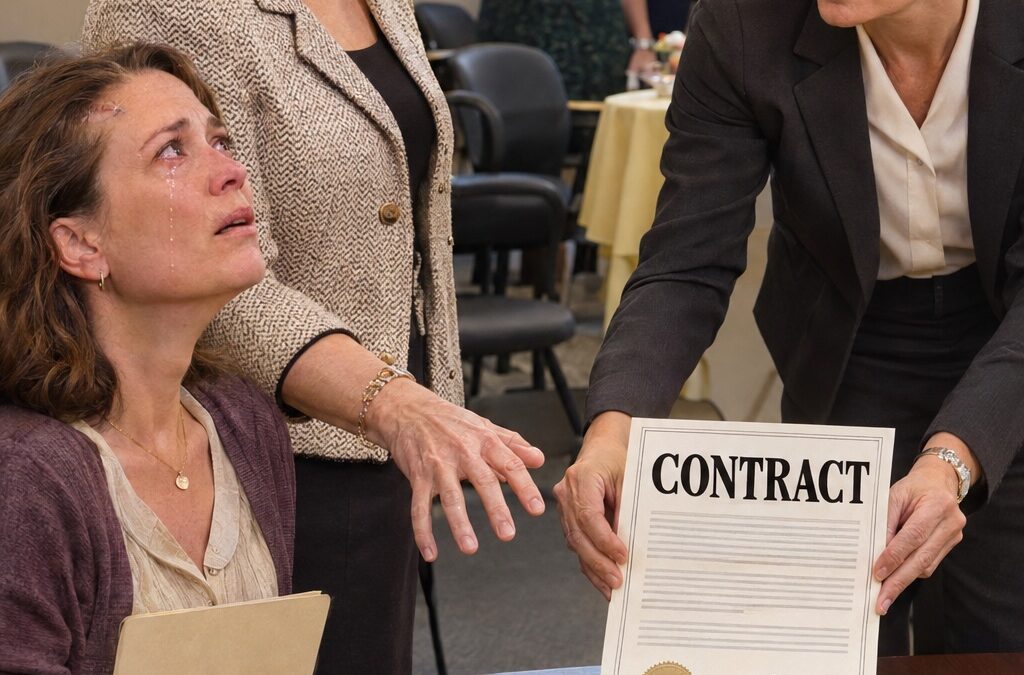
“CONTRACT” was printed across the front sheet.
Mother recognized the signature page when Elise turned it.
She stopped reaching toward Owen’s papers.
“That arrangement was made under the previous owner.”
“Yes,” Elise said. “With the company.”
Mother had bought the company’s shares on June 30, 2023.
She had not created a different company by buying them.
The company still owed what its existing agreements required.
Our agreement had been signed on June 30, 2016.
The former owner’s authorized management signed for the business.
I signed as the owner of my established portfolio.
I became an employee doing bookkeeping through the office.
Under that separate agreement, I retained the portfolio and goodwill.
The company received a fixed-term license to service those accounts.
Mother knew the license existed when she bought in.
She had asked me where the agreement was kept.
What she lacked now was consent to assign it.
She had relied on Marcy saying the paperwork was handled.
She had not asked to see my signature.
Owen asked Elise what the company could actually transfer.
She answered carefully.
“Not people. Every client chooses their own provider.”
Mother interrupted.
“Of course clients have a choice.”
“Then that needs to remain clear,” Elise said.
My agreement protected a defined business interest.
It covered the portfolio I brought and its related goodwill.
It did not mean I owned anyone’s business decisions.
Clients could stay, leave, or hire somebody else.
But Mother could not sell my retained rights as hers.
She could not promise continuing licensed access after expiration.
“Those accounts have been serviced here,” Mother said.
“For nine years,” I answered.
I knew the work behind the account names.
There was the landscaping client’s weekend payroll problem.
I had been cleaning up dinner when he called.
My plate was beside the sink, still holding scraps.
He sounded embarrassed before he described the error.
I dried my fingers and opened my laptop.
Then I talked him through correcting the payroll file.
He read each field aloud while I checked it.
By the time we finished, the dishwater was cold.
That was one weekend call among years of them.
Nobody had calculated a separate price for those weekends.
They were simply hours I had given those relationships.
Mother tapped the contract with her fingernail.
“You’re making this sound like we contributed nothing.”
“No,” I said. “I’m saying this says what belongs to whom.”
Elise left that answer alone.
She was my oldest friend, but not my lawyer.
We were both 42 now.
Our friendship went back before either had steady work.
At this table, she represented Owen, who was 55.
She had received the executed agreement during authorized buyer diligence.
That was on June 20, 2025.
The request for confirmation had reached me through that process.
I checked my own copy and answered permitted factual questions.
Elise had not advised me what to demand.
She had not shared Owen’s confidential discussions with me.
Now she turned toward him, not toward me.
“The servicing license ends June 30, 2025.”
Mother adjusted the cuff of her blouse.
“We would have renewed.”
I lifted my eyes from the folder.
“I haven’t agreed to renew.”
“You haven’t said you wouldn’t.”
“I haven’t agreed.”
Owen pulled his chair closer to the table.
“Was renewal part of what you offered me?”
Mother looked at his folder again.
“We can make the arrangement work.”
“Not without the necessary rights,” Elise said.
The room still held all 35 visitors.
Some had lowered their paper plates.
Others were watching Mother instead of the documents.
She straightened a stack of unused napkins beside her.
Then she pushed Owen’s closed folder toward him.
“Then we’ll change what you’re buying.”
Part 4: What Was Actually For Sale
Owen did not open the folder.
“What exactly would change?”
Mother pointed toward the desks behind us.
“The systems. The active work. Everything already operating here.”
“Do you mean the entire company?” Elise asked.
“No. The portion we discussed.”
“The portfolio,” Owen said.
“The servicing side of the portfolio.”
I pressed my folder against my ribs again.
Mother was speaking faster now.
She described the office routines and existing work schedules.
She mentioned how familiar Marcy was with the accounts.
Marcy stood beside the table without adding anything.
Elise waited until Mother finished.
“Those descriptions don’t establish ownership.”
Mother looked at her.
“There is equipment involved.”
“Equipment can be listed separately,” Elise answered.
“There are unpaid invoices.”
“Receivables can also be identified.”
Owen moved his purchase folder away from the napkins.
“None of that is what we priced.”
The proposed payment was $76,000 for the client-account rights.
It was not a purchase of the desks.
It was not a purchase of office supplies.
It was not payment for invoices already owed.
Elise separated those things while Mother listened.
The company kept its equipment, working records, and receivables.
It also kept its unrelated clients and business.
My license ending did not transfer those assets to me.
But owning them did not give Mother my portfolio.
She could sell what the company actually owned.
She could not rename my rights and sell those, too.
Owen opened his folder just enough to remove a note.
Then he closed it again.
“That is not the transaction I came to consider.”
Mother leaned toward him.
“Dana could stay available during a transfer.”
I looked at her.
“You just fired me.”
She glanced toward the people still near the doorway.
“We can reconsider that.”
“My employment?”
“Yes. With reduced hours while you recover.”
I loosened my grip on the folder.
“What would you need me to sign?”
“We would work that out.”
“The release?”
Mother put both palms on the table.
“You’re making cooperation sound unreasonable.”
“I’m not signing anything here.”
Owen stood and picked up his folder.
“Then I’m withdrawing from this portfolio transaction.”
Mother rose with him.
“We can meet without an audience.”
“You can send a separate proposal for company-owned assets.”
He tucked the purchase folder under his arm.
“But I am not buying these portfolio rights.”
There was no check for Mother to return.
There was no completed sale to reverse.
She had announced one before the review was finished.
Elise collected the diligence copy of the agreement.
My copy stayed inside my folder.
The company’s executed copy belonged with its own records.
Nobody carried off the office files.
Owen told Mother further proposals should go through counsel.
She followed him toward the door, still speaking.
He answered once, then left.
Elise paused beside my chair.
“Do you have a way home?”
“Yes.”
“Good. Please don’t stay standing around.”
That was my friend speaking.
She left with Owen rather than staying as my advocate.
The visitors began collecting cups and finding their bags.
I heard polite goodbyes from near the doorway.
Mother answered them with a tight smile.
I stayed seated until the room cleared.
Then she pulled a chair beside mine.
“You could have warned me.”
“You watched me refuse.”
“I mean before today.”
“You announced this today.”
She folded a used napkin into a smaller square.
“The money was supposed to help the company.”
“I didn’t agree to sell my rights.”
“We employ you. We handle the overhead.”
“And the license says what that arrangement includes.”
Mother looked at Marcy.
“Tell her how much work we’ve carried during recovery.”
My sister picked up the crushed cup.
“I can’t tell her she signed.”
“I didn’t ask you to.”
“You asked me to handle the paperwork.”
Mother pushed her chair back.
“You told me it was handled.”
Marcy looked down at the cup.
“I thought I could get her to agree.”
I put my folder into my bag.
“I’m going home.”
Mother followed me toward the entrance.
“We can still discuss your position here.”
“I need to rest.”
“We need an answer about the accounts.”
“You don’t have my consent.”
Outside, I stopped long enough to settle my bag.
The folder’s edge had left a mark against my blouse.
At home, I put it on the kitchen table.
Then I ate, took my prescribed medication, and lay down.
I did not spend that afternoon copying office files.
I did not send client records to my personal email.
When I could sit comfortably again, I made a list.
What did I own?
What belonged to the company?
What did the transition provisions require?
What could I tell clients before the license expired?
I took those questions to an independent business attorney.
Elise was not involved in that consultation.
The attorney reviewed my agreement and its account schedule.
We discussed the dismissal separately from the property rights.
My mother could end my employment as she had announced.
That did not give her ownership of my portfolio.
My portfolio ownership did not guarantee my old desk.
I did not ask the attorney to recover that desk.
I asked for help ending the license correctly.
We reviewed the existing transition provisions line by line.
They required reasonable cooperation with notices and authorized transfers.
They did not permit me to raid the company’s database.
They did not permit Mother to extend the license herself.
I instructed the attorney to confirm nonrenewal in writing.
Then we worked through what lawful preparation involved.
I could prepare my own service terms and schedule.
I could identify records I already lawfully held.
Confidential working files still needed proper client authorization.
Outstanding company invoices would remain company invoices.
Unfinished client tasks needed clear responsibility during transition.
I wrote each point in a notebook.
I also asked about my recovery schedule.
The attorney told me to promise only work I could provide.
I could do that without describing my medical history.
When we finished, I placed the notebook beside my folder.
There were still calls to make and forms to review.
But I knew which questions belonged to which documents.
Mother called while I was resting.
I let the call go to voicemail.
When I played it, her voice sounded clipped.
“Bring back that folder and all those contact files.”
She paused, then added, “They belong in my office.”
Part 5: The Notices Went Out
I played the message again at my kitchen table.
Then I sent it to my attorney.
We did not answer with a claim to everything.
We made a written inventory instead.
My folder contained my copy of the executed agreement.
It also held my original account schedule and personal notes.
Those were not company property because Mother demanded them.
The office’s working records were a different matter.
Its billing history, receivables, and operational materials stayed there.
Confidential client files required authorization before any transfer.
I had not downloaded the company database.
I had not taken its office contact files.
The account schedule already in my folder was mine.
We explained those distinctions in a written response.
Then I gathered the company equipment I had at home.
I wiped dust off it, not business records.
I packed everything carefully and included the office key.
The return inventory listed each item.
I took the box back when I felt able.
Marcy met me near the front door.
The open-house chairs were back at the desks.
The table had been cleared of cups and plates.
She looked at the bag on my shoulder.
“Did you bring the folder?”
“No. I brought the company property.”
“Mother wants all the paperwork back.”
“The company papers are in the box.”
I put the inventory beside it.
“Please check this before I leave.”
She checked the items against the list.
I waited, leaning against the edge of an empty desk.
Neither of us mentioned the open house at first.
Then she said, “I didn’t know she’d fire you.”
“You knew I didn’t sign.”
Marcy kept looking at the inventory.
“Yes.”
Mother came out before we could say more.
She stopped beside the box.
“Where’s the client information?”
“The company files are still in the company system.”
“And your list?”
“My attorney answered that.”
“I’m asking my daughter.”
“I’m giving you the same answer.”
She looked from my bag to Marcy.
“You’re both making this unnecessarily difficult.”
Marcy put her initials beside the returned items.
I kept my copy of the receipt.
Mother watched me place it inside my folder.
“You understand those clients can stay here.”
“Yes,” I said. “They can also choose someone else.”
That was how the transition notice was written.
It named June 30, 2025, as the license expiration.
It explained that the existing servicing arrangement was ending.
Clients could choose the company under a new agreement.
They could choose me under separate independent terms.
They could also choose another provider entirely.
No notice said they belonged to me.
No notice suggested Mother had to close her business.
The attorney checked each sentence before it went out.
I read the draft aloud at my kitchen table.
“Does this imply I’m working full-time?” I asked.
We changed the availability sentence to make that clear.
I would be working a medically reduced schedule.
Clients needing more coverage could make another choice.
The record-transfer language took additional discussion.
Mother’s lawyer requested a defined authorization process.
That was reasonable, and we agreed.
The company needed to know who authorized each transfer.
It also needed to preserve its own required records.
Mother wanted my contact information removed from the notice.
My attorney declined under the existing transition provisions.
The notice had to make the available choices usable.
Listing a choice without any way to exercise it would not.
There was no sudden court order or police visit.
There were drafts, responses, and corrected wording.
I approved documents during the working periods I had set.
Then I closed the laptop and rested.
Mother called after the notices were approved.
“I can give you a good recommendation,” she said.
I moved my appointment book away from my dinner plate.
“For what?”
“For your work. If anyone asks.”
“What are you asking me to do?”
“Stop discussing what happened at the open house.”
I looked at the folded return receipt beside me.
“I’m not requesting a recommendation.”
“You may need one after being away.”
“My clients know the work I’ve done.”
“They may wonder whether you can still manage.”
“Then I’ll explain my availability.”
She waited for me to say something else.
I did not offer silence as a condition of anything.
The notices went out through the authorized process.
No confidential client files accompanied them.
Those would move only after each client’s instructions.
I checked the delivery list with my attorney.
Then I put it away before I became tired.
Marcy called after the notices were sent.
I agreed to talk, but not about Mother’s complaints.
“What did you mean when you called me confused?”
She exhaled against the phone.
“I wanted Owen to stop asking questions.”
“Did you believe I didn’t understand the release?”
“No.”
I turned my pen between my fingers.
“You heard me refuse.”
“Yes.”
“And you let Mother think I’d agreed.”
“I thought you would eventually.”
“That wasn’t something you could tell her was handled.”
“I know that now.”
I asked her to correct what she had said.
Not just with me in a private call.
Owen had heard her question my understanding.
The people in the office had heard it, too.
She needed to tell them what she actually witnessed.
Marcy did not ask me to write it for her.
She sent Owen a correction and copied me.
It said she had no basis for calling me confused.
It said I had refused to sign the release.
It also said she had witnessed Mother take it away.
She repeated those facts to the office staff.
I read her message without answering immediately.
Then I saved it with the other transition records.
On June 30, 2025, the license expired as written.
There was no automatic renewal waiting behind the date.
Mother’s company retained its equipment and unrelated business.
It retained money owed for work it had performed.
It did not retain exclusive servicing rights to my portfolio.
I sat at home reviewing the remaining transition checklist.
An authorization still needed a signature.
An unfinished payroll task needed a clear handoff.
Another file needed secure delivery to the chosen provider.
I checked each item against the client’s written instructions.
Then my phone rang beside the appointment book.
It was the landscaping client.
“I got the notice,” he said.
“Are you actually going to be available?”
Part 6: My Own Worktable
“Yes,” I told him. “But not the way I was.”
I opened my appointment book to the working schedule.
I explained the reduced hours planned around my recovery.
Messages would be answered during those working periods.
Payroll deadlines needed to be arranged in advance.
I would not promise constant weekend availability.
He listened without interrupting.
“Can you handle what we already have coming up?”
“Let’s look at it before either of us commits.”
We reviewed the unfinished work and the next deadline.
I asked what the office had already completed.
Then I checked what records still needed authorization.
There was enough time to arrange an orderly handoff.
I told him exactly what I could take on.
He asked me to send the independent service terms.
I sent them after our call.
His decision to continue with me was documented separately.
His records moved only after he authorized their transfer.
The other clients made their choices the same way.
Some signed new arrangements with Mother’s company.
Some chose different bookkeepers.
Some asked to continue with me.
I checked the workload before accepting each engagement.
I did not call clients who chose elsewhere to argue.
I did not tell anyone they owed me loyalty.
They needed dependable bookkeeping, not another family dispute.
On July 1, 2025, I began independent service.
My worktable faced a window at home.
I moved the household mail into a drawer.
The contract folder went beside my appointment book.
I arranged secure storage and appropriate software access.
I kept work records separate from personal papers.
My attorney had checked the service and authorization forms.
I used those rather than making promises by phone.
When technical help was needed, I hired ordinary outside assistance.
I limited access to what that work required.
I did not ask Marcy to quietly retrieve office files.
I did not use an old company login.
Where permission was missing, I waited for it.
Where an invoice belonged to Mother’s company, it stayed hers.
Those details made the transition slower than copying a database.
They also kept me from guessing about ownership.
My schedule included time when the computer stayed closed.
At first, I kept reaching for the phone anyway.
A call came after I had finished working.
I picked it up, then stopped before answering.
I listened to the message instead.
The client needed a report explained, not an emergency response.
I wrote the request in my appointment book.
Then I called during the next scheduled working period.
The client thanked me and opened the report.
Nothing had been lost by waiting.
Another afternoon, I stopped halfway through organizing records.
I could feel myself rereading the same entry.
I saved the work and closed the screen.
My water glass was still full beside it.
I drank, ate something, and lay down.
When I returned, the saved file was where I expected.
Mother’s company continued operating in its office.
She did not lose the desks or company receivables.
She did not lose unrelated accounts her company had developed.
What she did not receive was Owen’s $76,000.
He never completed the portfolio purchase.
There was no revised sale of my rights afterward.
The servicing license had expired, and I had not renewed.
Elise called after Owen’s transaction file was closed.
“Can I come by as your friend?”
“Yes,” I said. “Please do.”
She brought lunch in plain containers.
I cleared a place away from the work papers.
We talked about how I was sleeping.
She asked whether I was managing the reduced schedule.
I showed her the appointment book.
“You actually put the rest periods in?”
“I kept filling them otherwise.”
She nodded and passed me a container.
Eventually, I thanked her for reading the agreement aloud.
She set down her fork.
“I had to tell Owen what he could buy.”
“I know. I’m still glad you did.”
She had not needed to argue about my character.
She had not needed to interpret my recovery.
She had read the agreement supplied by the company.
Before leaving, she asked whether my copy was stored safely.
I showed her the secure duplicate arrangement.
Then we washed the lunch containers together.
Marcy asked to visit after that.
I told her she could come without Mother.
She arrived without papers or a message to deliver.
We sat at the kitchen table.
She kept her hands around her glass.
“I saw you refuse,” she said.
“I should have said that immediately.”
“Yes.”
“I thought if the sale happened, everyone would calm down.”
I closed my appointment book.
“You meant Mother would calm down.”
Marcy looked into her glass.
“Yes.”
I let her sit with that answer.
She did not say I had misunderstood her.
She did not ask me to call Mother.
“I corrected it with Owen and the staff,” she said.
“I saw.”
“I’m sorry I made you prove it.”
I set my pen down.
“I need you not to discuss my health with clients.”
“I won’t.”
“And don’t bring forms for Mother.”
“I won’t do that either.”
“If I refuse something, don’t describe it as confusion.”
She nodded before answering.
“I understand.”
We talked a little longer.
When I got tired, I told her.
She stood and carried her glass to the sink.
She left without asking me to explain the tiredness.
Afterward, I rested before returning to my table.
Mother called less often.
When she asked about clients, I discussed no confidential work.
When she asked about my health, I gave brief answers.
Once, she asked whether I intended to keep working at home.
“For now.”
“You had a proper office.”
“I have what I need.”
She said the open house had gotten out of hand.
I moved the phone away long enough to breathe.
“You announced I was fired.”
“I was trying to arrange your recovery.”
“No. You were arranging a sale.”
She did not apologize.
I did not stay on the phone waiting for one.
I told her I had work scheduled and ended the call.
The following morning, the landscaping client sent his information before I needed to request it.
Everything was organized.
He included the exact error message from his software.
I smiled when I saw it.
During our scheduled call, we fixed the problem without rushing.
Then I closed his file.
There were no visitors watching me.
There was no purchase folder on the table.
My mother was not standing behind my chair.
I wrote the next appointment in my book.
Then I rested my hand on my contract folder beside it.








