My Mother-in-Law Took Our Wedding Money While I Was Pregnant, Until I Replayed the Camera
Part 3: The Message I Kept
Paula’s voice came through my phone speaker.
“Rachel, it’s Paula, calling about Adam’s home exercises.”
Denise looked at Adam, but he kept watching me.
“His progress shows you’ve been doing the daily work. Thank you for helping him follow through.”
The message continued with instructions about supporting his heel. They were instructions I had followed beside his recovery chair.
Then the message ended.
I left my phone resting flat in my palm.
“That was February 20, 2025,” I said.
Denise opened her mouth, then looked toward the tables.
“I was his daily caregiver,” I continued. “I also covered our household expenses during his recovery.”
Adam moved closer, but I stepped toward an empty chair.
“I used $6,800 from my maternity savings.”
I sat down before finishing.
“That was the money I had put aside for leave.”
My aunt was not there to speak for me. No lawyer had arrived with a folder. There was just my phone, Holly’s camera, and people who had heard Denise tell a different story.
Adam pulled the chair beside mine away from the table.
“I knew she was covering things,” he said. “I didn’t know she had used that much.”
“You didn’t ask,” I said.
He sat down without answering.
The injury had happened in November 2024. By January, we were paying household expenses from my savings while his recovery continued.
I had kept working at the dental office.
At home, I moved the laundry basket out of his path. I put his exercise towel where he could reach it. When his leg cramped, I sat beside him until he could settle.
None of that meant Denise had never visited.
She had brought food and driven him to appointments.
But visiting wasn’t the same as being there each evening.
I hadn’t told her where our household money came from. Adam and I had kept separate savings accounts. She had never asked to see mine.
Paula’s message had stayed on my phone because I wanted her instructions available.
I hadn’t saved it for an argument at my wedding.
Denise folded her arms.
“Fine. You helped him,” she said. “That doesn’t change Brooke’s situation.”
“No,” I said. “It changes what you just told everybody.”
A guest beside the aisle lowered her napkin. Another woman reached across the table and touched my shoulder.
“I’m sorry, Rachel,” she said.
I nodded because I couldn’t manage much more.
Denise looked toward Brooke.
“Your landlord isn’t waiting while we discuss old expenses.”
Brooke held the bag against the edge of her chair.
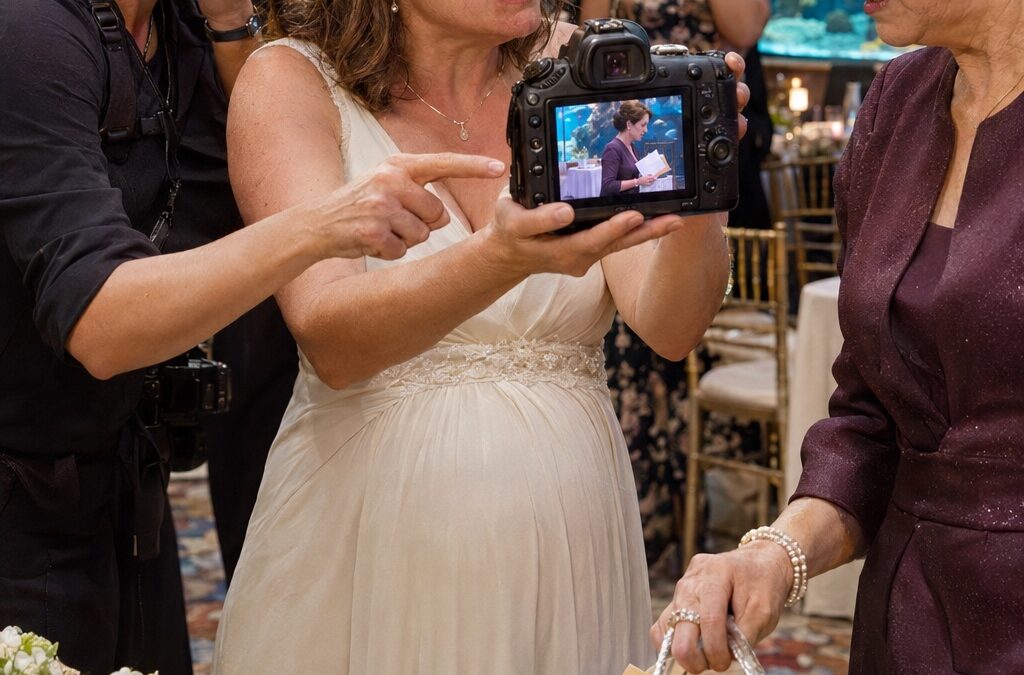
I stood again and asked Holly for the camera.
“Please explain what you recorded.”
Holly moved beside me, keeping her voice ordinary.
“I was filming the speeches from my tripod. The table was within the shot.”
She showed me where to begin playback.
The image moved across the small screen.
There was Denise, standing beside the gifts.
There was her hand gathering envelopes from the table.
There was the stack carried against her dress.
The recording didn’t show what was inside each envelope. It didn’t show a total or prove what anybody intended.
But it showed Denise taking them.
Holly turned slightly so Adam could see.
“I can preserve the original file,” she said.
“Please do,” I answered.
Denise looked away from the screen.
“You’re acting like I stole from strangers.”
“They gave those gifts to us.”
“Adam is my son.”
“He’s also standing here saying he didn’t approve this.”
Adam raised his head.
“I didn’t, Mom.”
It was the sentence I had needed earlier.
It came after I had asked him directly, with guests listening.
I was glad he said it. I was still angry that I had needed to ask.
Denise looked at him for several seconds.
Then she changed her approach.
“Brooke was going to lose her apartment. I thought you’d understand once you heard.”
“You could have asked,” he said.
“And have her embarrassed like this?”
Brooke set the bag on her chair.
“Mom, stop saying you’re protecting me.”
Denise reached toward the bag, but Brooke kept hold of its handles.
“You told me the money was settled,” Brooke said.
That was the first time Denise looked uncertain.
“What did she promise you?” I asked.
Brooke stared down at the open bag.
“She said she would get $4,100 from the wedding gifts.”
Adam leaned forward.
“When?”
“Before today.”
Denise pressed her lips together.
The rent amount wasn’t a guess made beside our gift table. It had been discussed before we exchanged our vows.
She had decided where our gifts would go.
Then she had waited for guests to deliver them.
Brooke rubbed a bent envelope between her fingers.
“I thought Adam knew,” she said.
“I didn’t know,” he repeated.
“Did you think I knew?” I asked.
Brooke didn’t answer immediately.
“I took Mom’s word for it.”
I reached for the back of my chair.
My dress had pulled tight beneath my stomach. I loosened the fabric and sat again.
“All the envelopes come back,” I said.
Denise stepped closer.
“Let’s discuss repayment privately.”
“No loan was agreed to.”
“Rachel, these people don’t need to hear this.”
“They heard you say I didn’t need our gifts.”
Nobody interrupted.
Behind us, a server quietly moved a tray away.
I asked Brooke to put the bag on the table.
She did, but kept one hand through its handles.
“Some cards are still here,” she said.
“What does that mean?”
Denise reached toward her daughter’s elbow.
Brooke moved it away.
“I thought this was arranged,” she said again.
Then she looked directly at me.
“The money can’t all come back tonight.”
Part 4: What Left the Reception
“Why not?” I asked.
Brooke pulled an empty envelope from the bag.
Denise had opened the cash envelopes before carrying them over. Some were tucked inside cards. Others had been stacked loose beneath the tissue paper.
Brooke had already put the cash in her purse.
“The rent money is here,” she admitted.
“Then give it back,” Adam said.
Denise stepped between him and the chair.
“She needs to keep her apartment.”
I looked at Brooke.
“Have you paid the landlord yet?”
“Not yet.”
“Then nothing prevents you from returning it.”
She gripped her purse strap.
For a moment, I thought she would open it.
Instead, she looked at her mother.
That was when I understood how this could continue.
Denise had made a promise using money she didn’t own. Brooke was now choosing whether to rely on that promise.
They both knew we hadn’t approved it.
“Put it back,” Adam said.
Brooke shook her head.
“I can’t lose my place.”
I had no authority to search her purse. Neither did Adam. I wasn’t going to turn our reception into a struggle over a handbag.
I asked Holly to keep the recording.
Then I asked for the cards and empty envelopes.
Brooke handed those over.
Denise watched me stack them beside the camera.
“You have her address,” she said. “You know she isn’t disappearing.”
“That doesn’t make this a loan.”
“Call it whatever makes you comfortable.”
“I’m calling it money we want returned.”
Adam stood beside the chair while I checked the cards.
I didn’t read personal messages aloud.
I matched envelopes to cards where I could. I put loose pieces together without guessing.
A guest approached and said she had given us cash.
“Was my card in there?”
I showed it to her.
She nodded, then looked toward Denise.
“That was for the couple,” she said.
Another guest came over with the same concern.
I asked them not to announce amounts across the room.
“Would you write down what you gave us later?”
They agreed.
That mattered more than another argument.
The camera showed the taking. The guests could establish what had actually been taken.
Holly offered to preserve the complete recording, not just the part showing Denise.
“Keep the original,” I said. “Please don’t cut it down.”
She nodded.
“I’ll send you a copy and keep my file.”
I asked whether the camera had been recording during our exchange.
“No,” she said. “Only playback.”
We weren’t pretending to have evidence we didn’t have.
What came afterward would need witnesses.
Adam collected the empty envelopes while I wrote down which guests had spoken to us.
He asked whether I wanted him to call the police.
“I want the money returned,” I said. “And I want everything documented.”
We could make a report if needed. But nobody there could promise an officer would collect cash from Brooke’s purse or decide our civil claim.
I wanted to sit somewhere without an audience.
Before leaving the room, I faced Denise.
“Return the full amount. Don’t spend it.”
She looked at Brooke, not me.
“We’ll contact you,” she said.
They left together.
I watched Brooke carry her purse through the doorway.
Adam stayed beside me.
He offered his arm, and I held the chair instead.
“I can walk,” I said.
“I know.”
“Then get the cards.”
He picked them up.
We moved to a quiet room off the reception space.
Holly brought water and set her camera on a table.
I could hear plates being cleared beyond the door.
There were still people waiting for cake.
I looked down at my wedding ring and turned it until the smooth part rested against my palm.
“I asked you to help before she left,” I said.
Adam sat across from me.
“I thought calling it a loan would stop the argument.”
“It would have stopped me.”
He looked at the cards in his hands.
“Yes,” he said.
I didn’t tell him it was all right.
He didn’t ask me to.
Holly showed us how to identify the recording in the files she would send.
She also offered to write down what she had personally seen.
Not what she thought Denise intended.
Not what somebody else had told her.
Just where the camera stood, what it recorded, and what happened while she was beside us.
I thanked her.
Then I called the guests who had approached us.
Others contacted us after hearing what happened.
I kept each response with the matching card.
Some guests had given checks or other gifts. Those remained untouched. I didn’t include them in the missing-cash total.
The confirmed cash gifts added up to $4,100.
It matched the amount Denise had promised Brooke.
That didn’t mean the camera proved the sum. It meant several kinds of evidence now pointed to the same loss.
At home, I saved Holly’s original video copy.
I copied the donor messages into a separate folder.
I photographed the envelopes as they had been returned.
Adam checked the names against our guest list.
He didn’t tell his mother what any guest had contributed.
That information wasn’t hers.
Brooke later confirmed she had used the cash for rent.
She knew by then that neither of us had approved it.
I asked for that confirmation in writing.
She sent it, followed by an apology that also explained why she felt she had no choice.
I saved both parts.
Denise called while I was sorting the cards.
I let it go to voicemail, then sent a message.
“Please put repayment arrangements in writing.”
I wasn’t collecting secret recordings.
I wanted a clear record of what she was willing to do.
She answered with a written refusal.
Adam read it beside me at the kitchen table.
His mother’s position had changed again.
She now claimed that his words at the reception had authorized the money as a family loan.
Part 5: The Names on the Claim
Adam read the message again.
“I asked you,” he said. “You said no.”
“Your mother left that part out.”
He placed the phone on the table.
“I’ll tell her.”
“Tell her in writing.”
He wrote his response while I sat beside him.
He explained that he hadn’t given advance permission. His suggestion at the reception hadn’t been an agreement. I had refused it immediately.
Then he asked for our money back.
Denise replied that family shouldn’t handle trouble through messages.
Adam didn’t call her.
For once, I didn’t have to ask him twice.
That evening, we went over our household accounts.
I showed him what remained in my separate savings.
He looked at the balance for a long time.
“I should have known,” he said.
“You should have asked how we were managing.”
He nodded.
There wasn’t a useful answer beyond that.
We agreed our household budget would rebuild what I had used. The wedding money, if recovered, would go into our baby reserve.
Those were separate problems.
His mother returning money wouldn’t undo the months when I had quietly covered expenses.
I also told him I wanted counseling.
Not because I needed help accepting his mother.
Because he had asked me to absorb another loss publicly.
He agreed to arrange it.
I kept my own account. We changed how we reviewed shared expenses. Neither of us would commit joint money to relatives without the other’s agreement.
Those changes didn’t depend on Denise liking them.
We sent a written demand for repayment.
It identified the cash gifts, the amount, and the fact that no loan had been authorized.
We kept the delivery record and her response.
She offered to talk after the baby arrived.
I didn’t agree to an indefinite delay.
I checked the small-claims process through Toledo Municipal Court.
The claim fit within Ohio’s $6,000 limit.
Because the gifts had been intended for both of us, Adam and I filed together.
I wasn’t going to pretend his interest didn’t exist.
I also wasn’t going to let that interest become an excuse for his mother to take everything.
We named Denise as the defendant.
She had gathered the envelopes and directed their transfer.
Brooke’s later use of the cash did not erase Denise’s part.
We sought the actual missing amount, not an invented figure for embarrassment or a ruined reception.
The filing requested $4,100 plus allowable costs.
We filed on July 8, 2025.
Denise was served on July 15, 2025.
Nothing had been decided just because we filed.
We still had to prove the claim.
Her first call went to Adam.
He told her to keep discussion about the claim in writing.
She then asked him to remove his name.
“They were gifts to both of us,” he told her.
I heard his side from the next room.
He didn’t put her on speaker for me.
When he finished, he came to the doorway.
“She wants me to say I agreed.”
“What did you say?”
“That I didn’t.”
I went back to folding the baby’s clothes.
That was the kind of answer I needed to see repeated.
The baby arrived on August 28, 2025.
I won’t pretend the court folder mattered much that day.
It stayed zipped inside a bag at home.
Adam handled meals, laundry, and appointment calls.
When I needed something from across the room, he got it without asking why I couldn’t.
When his mother requested a visit, he answered her himself.
We didn’t use the baby as payment for the debt.
We also didn’t invite someone into our home to argue about money while I recovered.
Visits could wait until we were ready.
Denise sent a card.
I put it with the other cards without answering.
As the hearing approached, I organized the evidence again.
The donor confirmations established the amount and intended recipients.
Holly’s original footage established the taking.
Her account explained where the camera had been and what she personally observed.
Brooke’s message established the cash had been used.
Denise’s own messages showed her position on repayment.
Paula’s voicemail stayed out of that evidence packet.
It had corrected a public lie about my caregiving.
It didn’t prove how much wedding cash Denise took.
I didn’t want the hearing to become an argument about who loved Adam more.
The legal issue was smaller and clearer than that.
We had received gifts.
Denise had taken them without permission.
They had not been returned.
Before the hearing, we followed the court’s requirements for evidence and witnesses.
I checked how the video could be played.
I brought organized copies rather than expecting the court to search my phone.
Holly attended to testify.
The necessary donor evidence was ready as well.
We arranged childcare so I could concentrate.
On September 18, 2025, Adam and I sat together in court.
Denise sat across the room with her papers aligned.
She had dressed carefully and looked prepared.
I was glad she was taking it seriously.
I wanted a decision, not another family meeting.
When asked about the money, she did not deny moving the envelopes.
She argued that she was helping resolve a family emergency.
Then she relied on Adam’s loan comment.
He explained when he had said it.
He also explained my immediate refusal.
The recording placed Denise at the gift table before that exchange.
Holly described her camera position and confirmed the original file.
The video was played.
Denise watched without speaking.
The evidence about the gifts established the total.
The messages established that the cash hadn’t been returned.
I answered questions without describing every dinner where Denise had claimed credit.
I didn’t mention the aquarium fish or the wedding cake.
I said what had been given, what had been taken, and what we had requested afterward.
Denise was allowed to respond.
She said she believed Adam would have agreed.
The judge asked whether she had obtained permission before taking the gifts.
“No,” she said.
Then the judge turned back to the evidence and began explaining the decision.
Part 6: The Money Came Back
The judgment was for us.
Denise owed $4,100 plus the awarded filing and service costs.
The decision didn’t depend on whether Brooke needed rent.
It depended on the gifts belonging to their recipients.
Denise had no authority to redirect them.
Adam’s later suggestion hadn’t created the agreement she claimed.
I listened while the judge explained the result.
Then I wrote down what we needed to do next.
A judgment was not the same as money in our account.
I knew that much before we left the courthouse.
Outside, Denise approached Adam.
“Are you satisfied?” she asked.
He kept his papers tucked beneath his arm.
“I wanted you to return it before this.”
She looked toward me.
“You could have kept this private.”
“I asked you to put the envelopes back.”
She glanced at Holly, who stood near the doors.
Then she walked away.
Holly waited until Denise was gone.
“Do you need anything else from me?”
“No,” I said. “Thank you for coming.”
She had already given up work time to attend.
I offered to reimburse the expenses we had discussed.
She told me we could settle that separately.
Nobody posed for a picture outside the courthouse.
Adam drove home while I checked on the baby.
When we reached our street, he asked whether I wanted to talk.
“Not yet.”
He carried the bag inside and made lunch.
I put the court papers in the same folder as the donor messages.
Then I picked up my baby.
For the rest of that afternoon, the folder stayed shut.
Denise paid on October 3, 2025.
She paid the full judgment amount and awarded costs.
We confirmed that the payment had cleared.
Then we filed the required acknowledgment that the judgment was satisfied.
There was no reason to leave an unpaid judgment showing once she had paid it.
I wanted the record accurate from beginning to end.
I don’t know which account she used.
I don’t know whether Brooke helped her.
We didn’t investigate because we weren’t entitled to direct her private finances.
What mattered was that the money she had diverted was returned.
We put the recovered $4,100 into our baby reserve.
Adam and I continued the separate plan for rebuilding my maternity savings.
We didn’t describe the judgment payment as his contribution.
His mother owed that money.
Our household owed a different kind of repair.
That repair happened in ordinary conversations.
Adam started checking the shared budget with me.
He stopped saying we were fine without knowing the balances.
When a relative requested money, he told me before responding.
If we didn’t both agree, nothing left our joint funds.
I did the same.
He also handled his mother’s calls.
I no longer stood beside him while he tried to persuade her I hadn’t meant what I had plainly said.
If she complained about the lawsuit, he ended that conversation.
If she wanted a visit, he checked with me.
We attended counseling.
I told him that hearing “family loan” had made me feel alone in my wedding dress.
He didn’t explain his intention again.
He listened.
Later, he said, “I wanted the room comfortable.”
“I was in the room,” I answered.
He nodded and wrote something on the pad he had brought.
That mattered more than a speech about choosing me.
Brooke sent an apology after the judgment.
She admitted she should have returned the cash when she learned we hadn’t agreed.
She didn’t ask me to tell Denise that everything was forgiven.
I thanked her for acknowledging it.
We weren’t suddenly close.
But I could answer that message without correcting another excuse.
Denise’s apology was different.
She said she regretted how the reception had ended.
I replied that the problem was taking our gifts.
She didn’t answer that part.
I didn’t send another message trying to make her.
She had paid the judgment.
She did not handle our money again.
When gifts arrived for the baby, Adam and I opened them ourselves.
We wrote down who sent them.
We thanked those people directly.
There was no family collection bag and no relative assigned to decide where cash was most needed.
At gatherings, I sat beside Adam instead of leaving him to manage his mother alone.
If she said something inaccurate, I corrected the fact.
I didn’t wait until dishes needed clearing.
That changed some conversations.
Others became shorter.
Neither required an announcement.
Several wedding guests checked in after the hearing.
I thanked the people who had supplied statements.
I told them the money had been recovered.
I didn’t circulate the court papers or Holly’s recording.
Their wedding gifts had already become evidence.
They didn’t need to become entertainment among our relatives.
Holly contacted us about newborn photographs after we were settled.
I had nearly canceled them while we waited for payment.
Adam told me we could keep the appointment within our budget.
This time, we checked that together.
Holly came to the house with the same camera.
I recognized the worn place beside its controls.
She photographed the baby near the window while Adam stood close.
When the baby needed feeding, she put the camera down and waited.
Nobody hurried me back into position.
Afterward, she showed us a picture.
The baby was asleep against Adam’s shoulder.
His hand covered the small back completely.
“Can I see that again?” I asked.
Holly placed the camera in my hands.
The strap settled across my fingers, just as it had at the reception.
I sat in my own chair.
Adam brought my water and lowered himself beside me.
There were clean burp cloths stacked on the table.
The court folder was put away.
I pressed the playback button with my thumb.
In my hands, Holly’s camera showed our sleeping baby.








