My Mother Told Coworkers Not To Help As Dad Pulled My Healing Arm — Then Someone Intervened
Part 3: The Woman Beside Reception
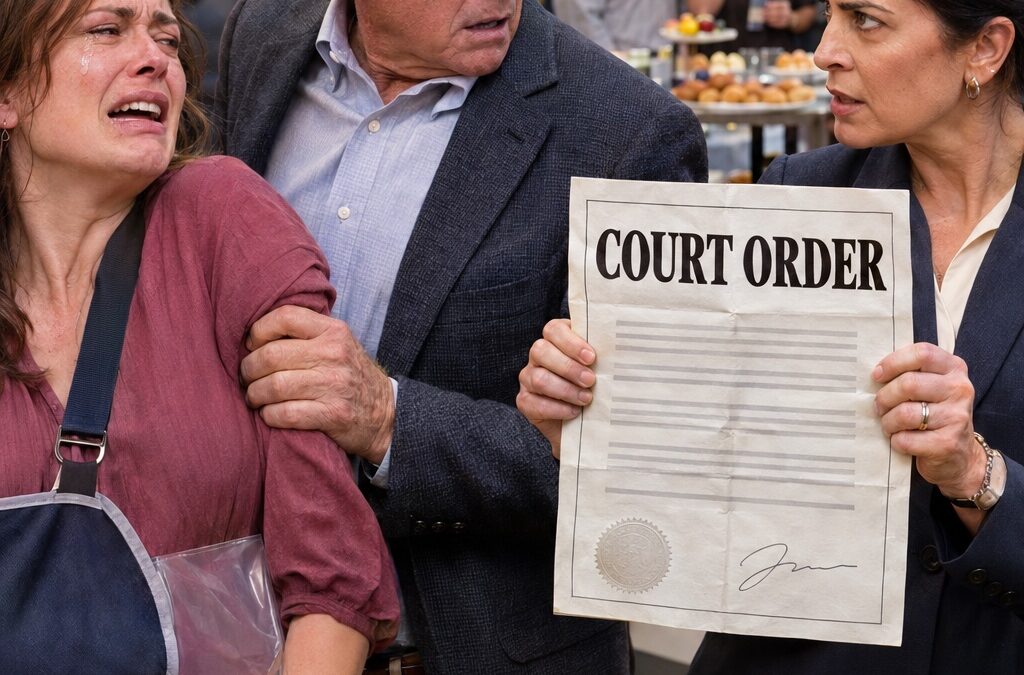
“My name is Monica,” she said. “I’m here to serve court orders.”
She looked at my father, then my mother.
“I was assigned to serve both of you before I arrived.”
She had not come because somebody called from the party.
She was already carrying the orders issued that morning.
And she had personally watched them grab me.
My father looked at me instead of answering her.
“You brought this into your sister’s office?”
“Our office,” I said.
Monica asked him to confirm his identity. He did, while insisting he had done nothing wrong.
My mother answered before Monica finished asking her.
There were separate papers for each of them. Monica identified the documents and handed each parent their service copies.
Both were temporary domestic violence civil protection orders.
An Ohio judge had issued them after hearing my sworn testimony that morning.
They required my parents to stay away from me and prohibited the contact described in the orders.
They also gave the date for a full hearing.
My father held his copy by a corner.
“We didn’t even get told about court.”
Monica did not argue about the evidence.
She explained that these were emergency ex parte orders. The scheduled hearing was their opportunity to respond.
I had not warned my parents about filing.
That was why my father had walked into reception smiling.
That was why my mother thought employees were the only witnesses she needed to control.
My mother looked at the pages without turning them.
“She makes everything sound worse than it is.”
Monica glanced toward my chair.
“I saw you both put your hands on her.”
Brooke stepped closer to the visitor desk.
“I told you. That’s how they handle disagreements.”
Monica looked directly at her.
“She asked them to let go.”
Brooke pressed her lips together.
For the first time, she had no explanation ready.
My father lifted his copy toward me.
“You told a judge we attacked you?”
“I described what happened.”
“You were upset about business.”
“I described that too.”
My mother started toward my chair.
Monica reminded her to read and obey the order.
My mother stopped beside the refreshments table.
The employees had pulled back enough to leave a path.
Nobody offered her a plate.
Owen crouched beside me, keeping his hands to himself.
“Do you want somebody to check your shoulder?”
I moved my fingers inside the sling.
The pulling had hurt. I could still feel it.
“I’m calling my surgeon’s office,” I said.
He handed me my phone from the visitor desk.
I asked for medical advice and described the contact.
The office gave me instructions and symptoms to watch for.
Owen stayed nearby while I wrote them down.
My father watched me make the call.
Now he tried to speak quietly.
“You’re making people think we hurt you.”
I did not answer that.
I had already answered it in court.
Monica recorded the service information she needed. She would file her returns so the court knew both respondents had received their orders.
She was not a police officer.
She did not announce an arrest.
The grabbing had happened before she completed service.
That did not make it harmless or erase it.
It meant the new incident needed its own accurate record.
Owen asked whether I wanted the police called.
I said I wanted to report what had happened.
My father opened his mouth, then looked at Monica.
He folded his papers instead.
My mother picked up her purse with both hands.
“We came to celebrate our daughters,” she said.
Owen straightened beside my chair.
“Then you should have let Leah stay.”
My sister stared at him.
He was usually the person who smoothed things over.
He would fix a rushed order without complaining. He would move a delivery so Brooke could keep an appointment.
This time, he kept looking at my parents.
“Leah trained me on the finishing equipment,” he said.
“She built the production schedule we still use.”
I rubbed my thumb along the sleeve’s open edge.
He continued before Brooke could interrupt.
“She didn’t come here looking for charity.”
My father glanced toward the employees.
Nobody looked away for him.
Monica reminded my parents about the order terms again.
They left through the reception doors carrying their copies.
Brooke did not follow them.
She stood behind the visitor desk, gathering her packet.
The refreshments were still arranged for a photograph.
A knife lay beside an untouched cake.
I asked Owen to save the camera recording immediately.
He went to the office system while I watched.
The camera had recorded without sound. It showed the visitor desk and the hallway entrance.
It showed my sling.
It showed both parents taking hold of me.
Owen exported the original recording without trimming it. He kept the source file in the system, too.
He wrote down how he had retrieved it.
He had managed that system since we installed it.
That mattered later when someone suggested I had assembled a misleading clip.
I did not post the recording.
I did not send it around to relatives.
I gave it to my lawyer and the police.
Monica waited until I could speak without employees nearby.
She told me her account would be available through the proper channels.
She had come to do a job.
My parents had supplied another incident while she stood there.
Before leaving, she explained how I could obtain my own copies.
I had left the courthouse with arrangements moving quickly.
By the time I went home, I had the documents I needed.
I slid them into the sleeve.
At home, I set it beside my discharge instructions.
Then I sat at the kitchen table without opening the food Owen had packed.
My phone displayed a message from Brooke.
She had finally sent the packet.
The subject still described it as leave paperwork.
I opened the attachment with my good hand.
The first page discussed my recovery.
The next page transferred something that had nothing to do with leave.
Part 4: What Brooke Wanted Signed
It assigned my entire ownership interest to Brooke.
There was no purchase price.
There was no payment schedule.
There was no promise to restore my interest afterward.
I read the paragraph again, moving the screen closer.
The document did not merely reduce my duties.
It made my sister the owner of my share.
My parents had wanted me to sign it publicly. They wanted witnesses to a willing signature, not witnesses to their hands on my shoulder.
I forwarded the attachment to my lawyer.
Then I sent Brooke a short reply.
“I am not signing this assignment.”
She called before I could set down the phone.
I let it go unanswered.
Typing was awkward with my arm immobilized.
I rested the phone against a folded dish towel.
“Please put business questions in writing,” I sent.
Her reply came while I was still seated.
“You said you needed less responsibility.”
“That doesn’t mean giving away my ownership.”
She did not dispute the assignment language.
Instead, she said keeping me on the books complicated things.
I opened the folder where I kept our original agreement.
The pages had been signed on June 7, 2021.
My $38,000 contribution purchased a 25% ownership interest.
Brooke held the remaining 75%.
Our parents held none.
They were not managers or officers.
They could have opinions about the business. They could not authorize a transfer of my property.
The agreement also required my signed consent to transfer my interest.
I had never given that consent.
My lawyer confirmed that the proposed assignment was not medical leave paperwork.
It was an ownership transaction.
Calling it routine did not change what it did.
The protection orders did not decide any of this.
They did not give me Brooke’s share.
They did not make my parents pay for my interest.
They addressed safety and contact.
For the business problem, I needed the business agreement.
For the assaults, I needed the court orders and evidence.
I kept those folders separate.
That helped when everybody tried to mix them together.
My mother had always been good at mixing things.
She could turn a question about my money into a conversation about gratitude.
She could turn my refusal into concern about Brooke.
Now I answered only the question actually before me.
Brooke wrote that the company could not afford uncertainty.
I asked her to identify the uncertainty.
She said customers might worry if the sisters were fighting.
I asked her not to discuss my medical information with customers.
She said employees needed consistent leadership.
I agreed that employee instructions should be documented.
Every answer went back through the same business email thread.
I did not argue through family messages.
I asked Owen to retain the reception recording in its original form.
I also asked that ordinary security procedures be followed.
My parents were not to enter the workplace to find me.
Brooke could still run the company within her authority.
My parents did not gain authority because she was their favorite.
I checked my own account permissions with the company’s technical support.
I changed my personal password and enabled the available verification.
I did not lock Brooke out of company accounts.
I did not remove customer files.
I needed an accurate business record, not another accusation.
The preparation was slow work with my arm in a sling.
I took breaks between messages.
Sometimes I dictated a sentence, then corrected the words.
Once, I nearly sent Brooke an apology.
I had typed that I was sorry about the reception.
Then I pictured the sleeve flattened against my stomach.
I deleted the sentence before sending.
I could regret what the employees had witnessed.
That did not make their parents’ conduct my fault.
The medical records were harder to sort.
On May 23, 2025, my father had twisted my arm during an argument over signing.
My mother had held me in place.
I had reported what happened and sought medical care.
The surgery followed on May 28, 2025.
The surgeon could describe my injury and treatment.
The surgeon had not witnessed the argument.
I made sure my lawyer knew that distinction.
I did not need anybody claiming more than they knew.
On June 3, 2025, my parents confronted me again.
My father caught my wrist while my mother demanded that I stop delaying.
Afterward, a voicemail told me to finish the paperwork.
I had saved the original message, not just a transcript.
That contact was what finally sent me looking for immediate protection.
I had spent too long hoping surgery would make them stop.
My lawyer organized the material for the full hearing.
There were my sworn descriptions and the earlier reports.
There were treatment records and the saved voicemail.
There was the reception recording.
There was Monica, who had arrived for service and seen the new contact herself.
Owen could explain the camera system and export.
None of those pieces depended on my family agreeing with me.
Brooke took a different approach as the hearing approached.
She sent a cash-flow explanation.
She said paying me out would strain the business.
I had not demanded an immediate buyout.
I had refused a gift of my interest.
Those were different things.
“If you want to buy my share, make an offer,” I wrote.
“Until then, I remain an owner.”
She said she thought I wanted to be done.
“I want to recover without being grabbed.”
That reply ended the business exchange for the day.
I practiced getting dressed for court without lifting my arm.
A loose sleeve caught on my sling.
I sat down and started again.
On June 16, 2025, I arrived with my records organized.
My parents sat apart from me.
Their papers were stacked neatly.
They had come with a different description of the reception.
According to them, they had only been helping me.
Part 5: The Recording Played Through
My father said I had looked unsteady.
My mother said she feared I might fall.
They described their hands as support.
I watched my lawyer write those words down.
Neither parent looked toward my sling.
At the full hearing, both had an opportunity to respond.
They had been served at the reception.
The service returns were filed.
This was not another hearing they claimed to know nothing about.
The judge heard the petitions separately, with evidence relevant to each parent’s conduct.
I had to describe what each had done.
I could not simply say “they” and leave it there.
That was harder than I expected.
I identified my father’s hand on my arm.
I identified my mother holding me during the earlier assault.
I described the wrist contact after surgery.
Then I described what happened at reception.
My father looked down while I spoke.
My mother shook her head.
I kept my eyes on the person asking questions.
My lawyer introduced the medical records through the proper procedure.
They established the injury, treatment, and surgery.
They did not magically identify who had caused it.
My account and the other evidence supplied that part.
The earlier police documentation showed when I reported the assault.
The saved voicemail preserved the pressure about signing.
The judge listened to the actual recording.
My father’s voice filled the courtroom.
I had heard that message repeatedly at home.
Hearing it there made me grip the sleeve differently.
I flattened it against my knee instead of rolling its edge.
My parents’ lawyer asked about the business disagreement.
Yes, I owned part of the company.
Yes, Brooke wanted a transfer.
Yes, I had refused to sign.
None of that required a stranger to interpret.
The question was whether the conduct had happened.
Monica testified about arriving at the office.
She explained her assignment and how she identified my parents.
She had been lawfully appointed to perform service.
She had not known my family before that day.
My father’s lawyer asked whether I had hired her to take my side.
She explained the service arrangement.
Then she described what she had personally observed.
My father pulling my arm.
My mother placing a hand on my shoulder.
Me telling them to let go.
She distinguished what she saw from what people later told her.
That was what made her testimony difficult to dismiss.
She did not try to explain our entire family.
She described the space around the visitor desk.
She described my sling and my parents’ hands.
My mother’s lawyer asked whether parents sometimes assist injured children.
Monica answered the question without arguing.
Then she repeated that I had asked them to stop.
Owen testified about the reception camera.
He explained where it was mounted.
He explained the system he used to retrieve the footage.
He had preserved the original file.
He had not edited out the approach to the grabbing.
The recording played from before my father reached for me.
I could see myself holding the sleeve.
I could see Brooke carrying her packet.
I could see the moment my body turned sideways.
My father had said he was preventing a fall.
The screen showed him pulling me toward the hallway.
My mother had said she was steadying me.
The screen showed her reaching after I tried to move back.
There was no sound from the camera.
Monica and Owen supplied what they had heard.
Their accounts matched my request to be released.
My father stared at the screen until it stopped.
Then he looked down at his papers.
My mother began speaking to her lawyer.
The judge asked her to wait.
I did not feel like celebrating.
My arm ached from sitting in the same position.
I wanted the hearing finished and the orders clear.
There were questions about future contact.
I said I did not want family meetings.
I did not want them coming to my workplace.
I did not want Brooke used to pass along demands.
The judge considered the evidence and continued protection against both parents.
The orders would remain in effect for three years.
Each parent received an order addressing their own conduct.
The terms were explained.
The court did not decide who was the better daughter.
It did not decide whose work mattered more.
It decided the protection issue before it.
My parents could not dismiss the result as a party misunderstanding.
They had answered the evidence in court.
My father asked whether I could still contact him.
My lawyer directed my attention to the written terms.
I was not going to improvise exceptions in the hallway.
My mother wanted to speak after the hearing.
I stayed where court staff directed me.
I left without a family discussion.
Outside, I checked that the sleeve held my copies.
The pages had picked up a bend along one corner.
I smoothed it against the seat before we drove away.
The business problem remained.
That surprised some people who heard about the orders.
They assumed the court would settle everything at once.
It could not turn an unpaid assignment into a fair sale.
Brooke still held her majority interest.
I still held mine.
Our obligations under the company agreement still existed.
My lawyer sent a clear business response.
I would not sign the unpaid assignment.
If Brooke wanted sole ownership, she could propose a purchase.
If she did not, we would address operations under our existing agreement.
There would be no parental meeting to settle it.
There would be no reception signature.
Brooke took time before responding.
During that waiting period, I followed my recovery instructions.
I answered necessary business questions in writing.
I did not disappear from responsibilities I still held.
Owen sent production updates through the proper channels.
Brooke stopped copying our parents into business discussions.
That was not an apology.
It was a practical change I could verify.
Then my lawyer called about a written offer.
Brooke was finally proposing to pay for my share.
Part 6: The Sleeve Comes Home
The proposed price was $38,000.
It was the amount I had invested.
It did not pay me for every late evening.
It did not undo the reception.
But I could evaluate it without my father gripping my arm.
I asked for independent advice before answering.
My lawyer reviewed the company agreement and proposed transfer.
I also reviewed the financial information I was entitled to receive.
I wanted to understand what I would surrender.
A 25% interest was not just a memory of my deposit.
It carried rights and possible future value.
Nobody told me I had to accept the offer.
Nobody called it medical leave.
I could reject it and keep my ownership.
I could negotiate terms.
I could decide that a paid exit suited me.
That was the first business decision in this dispute that felt like an actual choice.
Brooke wanted a clean transfer.
I wanted a completed payment before release of the signed assignment.
Our lawyers arranged the closing documents accordingly.
The agreement described what was being sold.
It addressed the end of my ownership and work role.
It did not require me to withdraw truthful evidence.
It did not cancel the protection orders.
My parents were not parties to the purchase.
Their names did not give them signing authority.
Brooke asked whether we could settle it without involving everybody.
I told her the lawyers were already handling it.
There was nothing left to finish at a family table.
She did not try that request again.
On July 18, 2025, the sale closed.
The funds cleared before my signed transfer was released.
Brooke acquired my 25% ownership interest.
I received $38,000.
Only then did she become the sole owner.
The paper my parents wanted me to sign for nothing had never taken effect.
The company records were updated through the proper process.
I returned the business property I still held.
Owen checked the equipment list with me.
He did not make it into a farewell performance.
He brought the items to a table I could reach.
I signed the acknowledgment with my good hand.
Then he asked about the old production guide.
It was the guide I had made while training him.
Brooke wanted to keep using it.
The sale documents addressed the company materials.
I told him where the current file was stored.
I did not sabotage the work on my way out.
The people running those machines had done nothing to me.
Brooke came into the office while we were finishing.
She stood near the table without touching my things.
“I should have sent you the full packet,” she said.
“You should have called it an ownership transfer.”
She looked at the acknowledgment in front of me.
“Yes.”
I waited.
She did not mention our parents’ hands.
She did not take back what she had said to Monica.
I did not supply an apology for her to agree with.
Owen closed the equipment list.
Brooke asked whether I wanted to say anything to the staff.
I did, but not in front of another cake.
I wrote a short departure message.
I thanked the production staff for their work.
I explained that I had sold my interest and was leaving my role.
I did not describe myself as rescued.
Before it went out, Brooke corrected the founders’ description attached to the company’s internal anniversary message.
It identified us both as founders.
It identified my production role.
That correction did not restore the years of being dismissed at family dinners.
It did mean employees were no longer being sent the false version.
I saved a copy.
Then I closed the company email after the transition was complete.
My parents did not receive the sale proceeds.
They did not get to announce that I had finally cooperated.
They remained subject to their protection orders.
I kept the orders where I could find them.
I followed the written terms instead of relatives’ interpretations.
When somebody asked whether a family gathering might settle things, I declined.
I did not send a message for them to carry back.
I did not ask Brooke to explain me.
The house was quiet during those first days away from work.
I noticed how often I reached for my phone.
There were no production questions waiting when I woke.
There were no messages demanding a signature before breakfast.
I put the phone facedown while doing my prescribed exercises.
Some movements still hurt.
I followed the instructions instead of trying to prove I was recovered.
The money stayed in my account while I considered what work came next.
I did not use it to make a dramatic purchase.
I paid attention to ordinary things I had postponed.
I arranged my appointments without checking the production calendar.
I bought groceries I could carry with my good arm.
I put frequently used plates on a lower shelf.
The sling no longer had to compete with a stack of employee forms.
Owen checked in without asking me to solve a machine problem.
He told me the staff had received my message.
I thanked him for preserving the recording.
He said he was glad he had put his plate down.
I remembered that small movement clearly.
It happened before he knew anything about the court orders.
He had simply heard me ask someone to stop.
Brooke and I kept any remaining transition questions in writing.
When those ended, I stopped checking for them.
We had completed a sale.
We had not repaired our relationship.
I no longer treated those as the same task.
One afternoon, I cleared the kitchen table for my next recovery appointment.
My discharge instructions were still beside the clear sleeve.
There was a faint dent where I had pressed it against my stomach.
I took out the protection-order copies and straightened them.
Then I slid them back inside, facing the same direction.
I laid the filled sleeve beside my discharge instructions.








