My nephew changed one deadbolt and tried to sell my 78-year-old father’s shop while he had pneumonia—Then Dad’s trust certificate reached the table, and the closing stopped before anything was recorded
Complete story · 7 parts · about 30 minutes · ending included
Part 1 · Part 2 · Part 3 · Part 4 · Part 5 · Part 6 · Part 7
Part 1 of 7
My own shop key stopped halfway in the lock on the side door and would not turn. Dad had given me that key in 2020 and said, “Your name’s on the shop papers now.” Six years later, on Tuesday, October 6, it no longer opened his shop.
At 4:10 p.m., Wyatt and I stood beside Nygaard Marine on Agate Bay Road in Two Harbors, about 27 miles from Duluth. The shop had been Dad’s since 1987, and he was 78 now. That morning, from Room 412 at St. Brendan’s, he had asked me to drive up for his reading glasses and the logbook. “Take my lanyard,” he had said.
The pair he wanted was already tucked inside my jacket. I had found them in Dad’s pickup in the yard after one of the keys opened the cab. Where my key had jammed, a brand-new brass deadbolt shone bright in the old wood, with the hardware store sticker still on its face.
That entrance had been the everyday way into the shop for as long as I could remember. My key had turned there the last time I stopped by before Dad went into the hospital Thursday with pneumonia. He was recovering, but five nights in meant every ordinary errand now had to fit around visiting hours.
Wyatt held Grandpa’s list of things to bring in one hand. His eyes went from the lock to what lay bright orange across my palm. Hanging from it were the house key, the truck key, a brass tag stamped “ELLEN K.”, and one empty hook.
“Grandpa’s lanyard is missing a key.”
I had always assumed that hook was for Dad’s shop key. It got one touch before I looked at my key, still useless where I had put it. Duluth was a 40-minute drive back down the shore, and the hospital would not wait for us. Solving a changed lock would have to come after I got my eleven-year-old son to his grandfather.
I pulled my key free and tried the handle once. It did not give. The brass looked recent enough that the sticker had not collected a speck of dust yet.
At 5:40 p.m., after Highway 61 roadwork and a full hospital parking ramp slowed us, we reached Room 412. I stopped in the doorway before Wyatt could step around me.
Jesse was bent over Dad’s pillow, close enough that his mouth was near Dad’s ear. Dad’s eyes were closed. The oxygen tube ran under his nose, and the tray beside him was empty. Low but clear, Jesse said it into the quiet: “Two more weeks, old man, and the boat shop is mine.”
Wyatt’s fingers caught my sleeve and pulled once. I did not move. Dad had raised Jesse from the time he was twelve, after my sister Kari died in 2007, and I had heard Jesse call him plenty of things. I had never heard that one.
Jesse straightened and turned. His smile came first, then his gaze went to Wyatt, to me, and down to what I was holding. When he shifted, the squared corners of folded white papers showed at the top of his zipped front, and his cap sat on the visitor chair. The sill and cabinet held no flowers.
He tapped his jacket pocket once. “Relax, Aunt Erica. I’ve got his power of attorney. You tune pianos.”
“Little sharp,” I said.
His smile tightened for half a second. Thursday night, when Dad signed the short-form financial paper, he had told me it was for Jesse to handle hospital bills and house papers while pneumonia kept him in St. Brendan’s. Jesse had the original.
He stepped around us into the hallway. Wyatt moved closer to the bed, while I stayed near the doorway long enough to hear Jesse stop beside a nurse at the chart station.
“How long’s he expected to be in?” Jesse asked. He stood with one hand in his pocket.
The nurse looked up. “You asked me that earlier today.”
“I’m asking again,” Jesse said. His voice carried into the room.
The nurse faced the station again. “He’s recovering. That’s what I can tell you.”
Back in the room, Jesse lifted his cap from the seat, the folded papers still riding against his chest.
I set Dad’s reading glasses on the tray. Since Thursday, I had hung the lanyard on the bed rail every evening. This time, it went into my jacket pocket, and I pulled the zipper closed.
Jesse watched me do it for a beat. He put on his cap and left.
Wyatt climbed into the other chair and opened the paperback he had brought from school. I sat beside Dad until the nurses changed shifts. His slow breathing continued, and his eyes remained closed.
By the time Wyatt and I left, Duluth was dark. I drove him home, watched him unlock our front door, and waited until the porch light came on. Then I turned north again.
At 8:15 p.m., I pulled into the gravel yard at Nygaard Marine alone. Sunset had been around 6:40, and the shop windows were black. I carried the flashlight in one hand and my own key in the other.
The altered entrance got no second try; I walked around the building toward the water. At the dock-side door, the old lock was still there, dull and scratched from years of lake weather. My key turned easily.
Inside, the smell was cedar, oil, and cold lake air. I swept the flashlight across the counter, the wall hooks, and the workbench until the beam caught the logbook where Dad always left it. I picked it up without opening it and tucked it under my left arm.
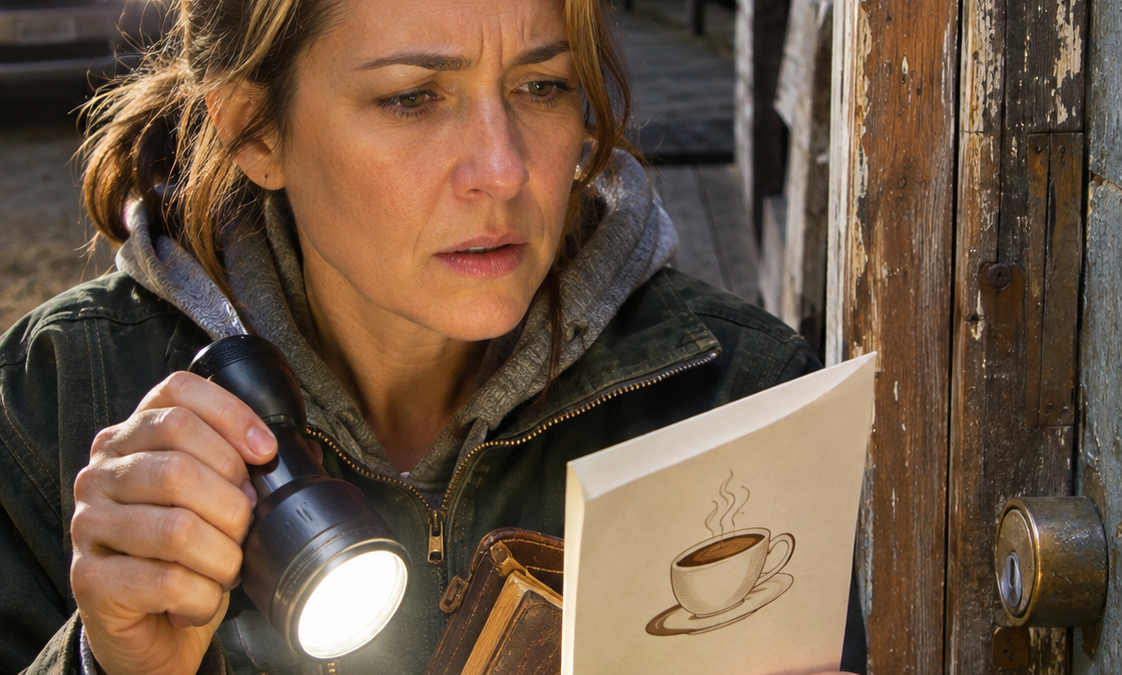
Stepping out, I locked up behind me and turned toward the yard. Something pale showed along the frame at shoulder height. I pulled out the card and saw the printed coffee cup on the front.
Picking up where the Facebook post left off
My left elbow pinned the logbook against my ribs. Holding the light steady, I opened the card and tipped it until the handwriting came clear.
“Jesse — we’re in love with the dock!! See you Thursday the 22nd, 2 p.m., Lakehead Title. — Abby & Zach Tollefson”
Part 2 of 7
Abby Tollefson’s public post showed Dad’s dock beneath the words “Our lakeside coffee shop is happening!” when I searched her name on my phone in the van Tuesday night.
She had posted it Monday. On the wall in the background, the Ellen K.’s wheel still hung where Dad had left it. Abby and Zach Tollefson believed the place was becoming theirs, with Lakehead Title handling the sale.
So the post had gone up one day before my key hit the new brass deadbolt. I enlarged the image until the boards and windows filled my screen. I lowered the phone and looked through the windshield at Nygaard Marine. Then I slid what I had found into my tuning kit and drove back to Duluth.
At home, I left the logbook by the front door with my jacket folded on top, the lanyard still zipped in its pocket, ready for St. Brendan’s in the morning.
Wednesday at 9 a.m., I sat in the chair beside Dad’s bed in Room 412 while he ate toast from his tray. He was awake and sitting up, the oxygen tube still under his nose. I laid his keys on the blanket, then his book.
He put the logbook into the canvas bag under his bed and hung the lanyard on the rail. I told him my own key had stopped in the new deadbolt and that I had gone around to the dock-side door. Then I told him about what I had pulled from the frame and the Tollefsons’ photo.
The other thing reached my throat and stopped there. I looked at his pillow, heard Jesse’s low voice from yesterday evening in my head, and pressed my tongue against the back of my teeth. Dad ran his thumb once over the empty hook.
“Is the Ellen K.’s wheel still on the wall?” he asked. I said, “Yes.” He looked toward the window.
“Don’t say a word to Jesse. Not to that young couple, either. Let it be.”
I watched his thumb leave the hook. “Dad, they think they’re buying the place.” He answered without looking at me. “Let it be. Go to my house. Bottom of the sea chest. Bring me the green folder. Don’t open it.”
“You want me to leave them thinking that?” I asked. He picked up his coffee, took one sip, and set it back on the tray. “You heard me.”
Wednesday at 3:30 p.m., I was driving through Two Harbors on my way to Dad’s house when Nygaard Marine came into view. Jesse stood on the dock with Zach and Abby. Zach had one hand on a post while Abby stretched a tape measure across the boards where a small table could fit.
My van rolled past slowly enough for Abby to see the “Piano Tuning” lettering on the door. She smiled and waved with the tape still in one hand. I put neither hand up. Both stayed at ten and two, and I drove on.
At Dad’s house, my own house key opened the door. His old wooden chest waited in its usual spot, with what he wanted tucked at the bottom exactly as promised. I took it out, lowered the lid, and carried it to my van unopened.
Wednesday at 6 p.m., I handed Dad the green folder in Room 412. Without opening it, he leaned over the rail and slid it into the canvas bag beside the logbook. Then he pulled the bag farther under the bed with two fingers.
“You looked?” he asked. I said, “No.” A single nod was his answer before he reached for his water.
Thursday at 10 a.m., I sat at Marilyn Dahl’s baby grand in Duluth with my tuning tools laid beside me. One note in the middle register beat sour against its neighbor. I eased the pin until the pitch came true, struck the pair once more, and rested my hand on the keys.
“What if somebody has a power of attorney for his father,” I said, “and he tries to sell the father’s shop?” Marilyn had known me for years, and retirement had not softened the lawyer in her voice.
“That paper reaches only property held in your father’s own name. If the shop’s in a trust, the trust owns it, and only the trustees can sell it. So who are they?”
“Dad. And me. Jesse drove us to the notary.”
Marilyn leaned back in her chair. “Then nobody closes without you — unless a closer takes his word for it. If a deed gets recorded, undoing it is a lawsuit. Months.”
I set the tuning hammer on the next pin. “So Jesse’s paper can’t do this alone.” Marilyn said, “Not with property held that way.”
I kept the card, the couple’s names, and the hospital whisper to myself, the way Dad had ordered.
She let the subject drop, and I went back to the baby grand. By the time I packed my tools, every note I had touched held where I left it. I zipped the tool case shut and headed out to the driveway.
Friday, October 9, at 7:50 p.m., I was home in Duluth wiping down my tuning hammer when my phone lit with an unknown number. I answered, and a bright young voice came through before I could say more than hello.
“Is this Erica? Your card was on the shop corkboard. Jesse said the family’s taken what they want, but there’s a box of your dad’s tugboat photos — do you want them before the twenty-second? We sent Jesse $20,000 yesterday for the hospital bills, and he knocked $15,000 off. It’s real now!”
Part 3 of 7
“Saturday. I’ll come for the photos.”
The next morning, October 10, at 10 a.m., Wyatt and I stepped onto the dock at Nygaard Marine beneath a cardboard sign that read EVERYTHING MUST GO. Folding tables ran along the boards with Dad’s hand tools, clamps, tackle, oil cans, and shop odds spread across them, while Jesse stood over a legal pad taking cash.
A socket set Dad used on winter jobs lay open beside a coffee can of cotter pins. Price stickers covered things that had never been for sale.
I had come for the photo box. Before I reached it, I saw a man from Silver Bay carrying the Ellen K.’s wheel toward a small trailer. Dad had kept it on that wall for years, high enough that Wyatt used to crane his neck to see the brass center.
The buyer settled it against a folded moving blanket and cinched the strap tight. “Three hundred,” Jesse said, and the man counted the bills into Jesse’s open hand. Then the Silver Bay man wrote his name and phone number on the sale list and tucked the pen under the clip.
Jesse looked at me. “It’s a steering wheel, Aunt Erica. The buyers want the room empty by the twenty-second.” I did not answer him.
I leaned close to Wyatt and said, “Get a picture of that page for me.” Wyatt raised his phone, took the shot, and lowered it. “His number’s on there. And the price.”
A cardboard carton marked with Dad’s handwriting sat under the nearest table. I had a hand out for it when Jesse walked to the far end, where the little outboard rested between a vise and a crate of old dock hardware, and I straightened to watch him.
Dad and Jesse had rebuilt that motor the summer after Kari’s funeral. My nephew was 13. By then, my older sister had been gone less than a year, and Dad had the boy at his elbow through June and July with greasy parts spread across the workbench.
Jesse picked the motor up by its handle and carried it to the bed of his truck without looking at me or Wyatt. When he came back, he set the legal pad down and pointed toward the parking area. “Next time you come up here, I call the sheriff.”
I bent, took the carton, and tucked it against my ribs. Wyatt walked beside me to my van, and neither of us turned around.
Monday, October 12, at 4 p.m., Dad’s fever was back at 102°F, and he shivered under two blankets in Room 412. The lanyard hung from the bed rail, and the canvas bag stayed closed under the bed with the logbook and the green folder inside.
I sat in the chair and told him a man from Silver Bay had paid $300 for the Ellen K.’s wheel. His fingers stopped worrying the blanket seam. Then I told him about Abby’s Friday call. “She said they wired Jesse twenty thousand for your hospital bills.”
Dad looked straight at me. “The twenty-second. Two o’clock?” I said, “Yes.” He turned his face to the wall. “Let it be.”
The room gave me nothing to push against. A nurse’s cart rolled past outside, rubber wheels clicking over the floor seams, while Dad stayed turned toward the painted cinder block. I waited until his shaking eased before I stood.
His water cup sat untouched on the tray, so I moved it within reach and then put on my coat. Afterward, I went down to the visitor lot and climbed into my van. My hands rested on the steering wheel, one above the other, and the key was still in my coat pocket.
Cars pulled out around me. A family crossed toward the elevators carrying a grocery-store bouquet and a cardboard cup tray, and a man scraped something from his windshield two rows over. I did not start the engine.
The dashboard clock read 6:02, then 6:44. By the time the glass had gone dark enough to show my own face, the parking lamps had come on. I put the key in and drove home.
Friday, October 16, at 10 a.m., the doctor on duty stood at the foot of Dad’s bed with a chart tucked against one hip. Dad was sitting up higher than he had been on Monday, his hands outside the blanket.
“Fever’s been down two days. If he stays clear through the weekend, we’re talking discharge — maybe Thursday.” Thursday was four days before the October 26 date the hospital still had while they waited on a rehab bed.
I looked at Dad, and he met my eyes without moving his head. He said nothing. One finger tapped the blanket, then lay flat.
That night at home in Duluth, I opened my job book at the kitchen table after Wyatt went to bed. Most pages held piano addresses, customer names, mileage, and short notes about what I had adjusted.
I started with Tuesday, October 6. Day by day, I wrote down the lines I had heard, beginning with Jesse’s whisper and continuing through Dad’s orders, Marilyn’s answer, Abby’s call, the dock, Monday in Room 412, and what the doctor had said that morning.
I kept each date separate. No guesses went on the page, and no plan did either; only words that had already been spoken. When I finished, I shut it and left the book beside my tuning case.
Monday, October 19, at 6 p.m., I reached my van in the hospital parking garage and found Jesse blocking the driver’s door, his phone lit with a photo of Haley Mattson, the Rochester nurse he was marrying in June. He said, “Title lady asked if there’s another trustee. I said no. You just witnessed Grandpa’s signature that day. His sea chest is empty, so you’ve got the trust paper. Hand it over.”
I said, “It’s not in my van.” He answered, “I’ve got thirty-one grand on cards, Aunt Erica. Then Thursday at two. You bring it to Lakehead, I read it at the table, I sign, you go home. You don’t show, those kids sue Grandpa, not me. Haley’s folks are driving up from Rochester.”
Part 4 of 7
Tuesday, October 20, at 8 a.m., fifty-four hours before the closing, Dad lifted the flap of the green folder in front of me with both hands. From inside, he drew the trust certificate dated June 12, 2020, with his signature, mine in my own hand, and a notary seal. I had just told him every word Jesse said in the parking garage and about my October 8 “what if” to Marilyn over the baby grand. Dad sat propped against the raised bed, and I stayed in the chair beside him.
Near Dad’s knee, his canvas bag rested on the blanket. The logbook remained shut at the bottom while Dad held the page by its edges. The seal pressed a round ridge into the paper, and I knew the uphill slant of my E before my eyes reached the typed name beneath it.
“Call that lawyer whose piano you tune. I want that power of attorney torn up. Thursday, two o’clock. You drive. If I call that office today, he hears by supper, and that couple’s twenty thousand goes wherever he wants it.” I took the page and slid it inside, then lowered the flap and returned the folder to the canvas bag.
Later that morning, I phoned Marilyn from the hospital hallway. “Dad wants Jesse cut off as his agent.” Her answer came without a pause. “The paper has to be signed in front of a notary.” Marilyn said the draft would reach my email that evening, and I ended the call with the wall clock above the nurses’ station still moving toward noon.
At 7 p.m., I was at my kitchen table in Duluth when Jesse sent a photo from a Canal Park steakhouse showing a reservation card: “Table for 6 — Thursday 6:00”. His message underneath said, “Drop the paper at two and go. Don’t make it weird.” I did not answer. I set the phone next to my job book and cleared a space beside the printer.
Marilyn’s email arrived at 8 p.m. with the revocation she had drafted. The first page stated that Gordon Nygaard ends Jesse Bolstad’s authority to act for him. I fed the sheets through my printer, squared the stack against the table, and checked the ink. Then I put the pages in my tuning case for the night and latched both brass catches.
Wednesday, October 21, at 9 a.m., I stood beside the bed in Room 412 with the case at my feet and held Jesse’s text in front of Dad. Dad gave one nod. I took the revocation out and slipped it into the folder behind the certificate, then put everything back into the bag under the bed.
The thermometer read 99.9°F when the physician on duty came in. “If his temperature is normal tomorrow morning, I’ll sign the discharge.” Then the chart went back under one arm and out the door. I folded my appointment list once, put it in my coat pocket, and thumbed my phone awake to see the hour.
Even with a normal reading, the release paperwork could drag past noon. If Dad could not leave, the closing would only be postponed; Jesse would still be Dad’s agent and could still move the Tollefsons’ twenty thousand wherever Jesse liked. I carried my tools out to the van and drove to the first job on my list.
At each piano that day, I listened for the beat that told me two strings were not together, made the adjustment, and checked the clock before packing up. Between appointments, I watched the dashboard minutes change at red lights, then went back to notes that ran a little sharp. Felt strips, mutes, and my tuning hammer went back into place in the same order at every stop. By late afternoon, the metal handle was warm in my palm, and the date on each invoice looked larger than the customer’s address: October 21.
By 11:40 a.m. on Thursday, October 22, Dad’s temperature was normal and the discharge was signed. Dad put the orange lanyard around his neck, and the hook with no key showed against his shirt. He set the folder on the seat of his walker, whose four legs ended in yellow tennis balls. One palm stayed over the papers while I gathered his coat.
I drove my van to Superior Street with Dad beside me and parked near Lakehead Title & Closing. The dashboard clock read 1:41 when I cut the engine. In the lobby, Dad stopped the walker by the elevator and pressed the button. “Go on up.” I took the stairs alone and kept my right hand on the rail all the way to five. On each landing, I glanced at the brass floor number and climbed on.
At 1:52 p.m., I walked into the fifth-floor conference room with nothing in my hands and took the chair nearest the door. Michelle Sandberg was at the head of the table, a name plate and paper file in front of her. Jesse sat beside Michelle, then Haley, then the Mattsons up from Rochester, with Zach and Abby across the table. From my chair, I heard Jesse telling his future in-laws, “Grandpa begged me to sell. The hospital bills are drowning him.”
Michelle turned a page in her file. “Mr. Bolstad, I still need the certificate of trust before anyone signs.”
Jesse pointed at me in front of the whole table. “That’s my aunt. She tunes pianos. She’s just the delivery girl — hand it over and you can go.” Mr. Mattson laughed, and his daughter looked down at her phone.
“The trustee is bringing it.” No one answered me. I stood from my chair, crossed to the door, and held it open while, out in the hallway, the tennis balls on the walker’s feet squeaked across the floor.
Part 5 of 7
At 2:03, with the sale contract waiting in front of Jesse’s chair, Dad came through the door I held open, the hook with no key swinging against his shirt. Across the room, Jesse’s shoulders jerked. “Grandpa? You’re supposed to be—” I let the door close and followed one pace while the walker rolled to the corner of the table.
Dad lifted the green folder off the walker’s seat, drew out the certificate, and laid it in front of Michelle. Then he lowered himself onto the seat he had just cleared and planted both shoes squarely on the carpet. “Gordon Nygaard Revocable Trust. Two trustees. Who signed for the trust?” The question came out flat and steady, the way Dad asked for a line or a cleat when there should have been one right answer.
At the head of the table, she studied the notary seal and the two signatures. An overhead light caught the raised circle when she angled the page, and her eyes moved from the June 12, 2020 date to Dad’s name, then mine. Each name held her attention for a beat.
She traced the seal’s edge once and compared each typed name with the ink below it. The page stayed flat between her hands while Jesse watched from the next place over. She handed the certificate back to Dad, and he returned it where it had come from, now on his lap.
Without passing anything across, she pulled one page from the paper file and kept it in front of herself. October 13 sat near the top beside Jesse’s email.
She read aloud, “Gordon Nygaard is the sole trustee.” She lowered the page only far enough to keep the date visible. Jesse’s eyes followed the page down to the surface in front of her and then lifted to Dad, as if his own sentence had betrayed him.
“He’s on antibiotics. He doesn’t know what he’s signing. My power of attorney covers everything he owns.”
The volume in Jesse’s voice had climbed above the one he used with the Mattsons before Dad arrived. Zach’s hands stayed folded near the edge in front of him, and Abby’s smile disappeared. Mr. Mattson leaned back, mouth closed. After a glance at Dad, Jesse’s eyes moved to me, then down to the date on the page.
Without changing tone, Michelle answered Jesse. “I asked you on the ninth if there was another trustee, Mr. Bolstad. Your power of attorney signs for what he owns. The trust owns this building. Both trustees sign, and both of them are in this room.” Her palm rested flat on the October 13 page.
Mr. Mattson looked from Michelle to me, then to the folder in Dad’s hands. Minutes earlier, he had laughed when Jesse called me the delivery girl.
One finger came up as Jesse pointed at me. “Aunt Erica dug that paper up to cut me out. She’s wanted this shop since Mom died.” The gesture held for another beat. I said nothing.
Dad did not raise his voice. “You drove us to the notary that day, Jesse. You waited in the truck.” At Dad’s words, Jesse’s hand dropped into his lap. His eyes came to me and held there longer than before. Jesse’s mouth tightened into a straight line.
Abby moved without being asked. She laid her phone face up on the table and kept two fingers pressed along its edge. The amount and memo were large enough to make out from where I stood. She turned the screen toward Michelle.
Michelle leaned over and read the transfer receipt aloud. “Twenty thousand dollars, October eighth, to Jesse Bolstad, personal checking. Memo: Nygaard hospital.” Her eyes paused at the account line.
She looked up at Jesse. “The contract says the deposit is paid to the seller. The seller on this contract is Mr. Nygaard. That’s your personal account.”
Jesse glanced toward Zach. Zach’s attention fixed on Jesse. Abby’s fingertips kept their place on the phone.
Before Jesse could speak, Dad said, “My hospital bill hasn’t been paid a dime.” Dad had left Room 412 less than three hours earlier, and his words reached every chair. His hands remained still on his knees, one thumb resting against the seam of his trousers.
Haley lifted her face and looked straight at Jesse. “You told my dad your grandpa begged you to sell.” She pushed her chair away from Jesse until its back touched Mrs. Mattson’s chair. Her fingers laced in her lap, and the strip of carpet she had opened between them stayed clear.
Turning toward Haley, Jesse kept both shoulders square to the room. Haley held his gaze. Her mother’s hand came to rest against her wrist. Zach’s folded hands separated and settled flat, while Abby kept hold of the proof Jesse had told them was for hospital bills.
At that, Michelle closed her file. “This closing is cancelled. Nothing gets recorded today.” Zach leaned back.
Dad kept his eyes on Jesse and said slowly enough for all of us to hear, “Two more weeks, old man, and the boat shop is mine.” Jesse went still, one hand resting near the contract.
I had never told Dad those words, and nobody else had either.
“I heard you, Jesse. Every word.”
Part 6 of 7
Dad drew Marilyn’s revocation of Jesse’s power of attorney from the green folder on his lap and placed it on the table beside the closing papers. At 2:40 p.m., he signed it on the line Michelle tapped. She waited for the last stroke and added her notary stamp. Keeping the original, she pushed one copy toward Jesse and slid another to me. The ink of her seal sat beside Dad’s name and the October 22 date. “Mr. Bolstad, you’re on notice. You no longer act for Mr. Nygaard.”
Nobody changed seats. Dad kept both hands on his knees. Haley sat next to her mother, with Mr. Mattson on the other side, while Zach and Abby sat farther down. I stood at Dad’s shoulder. Jesse’s October 1 authority ended there.
Friday, October 23, I drove my own copy of the revocation to the credit union in Two Harbors. A clerk scanned the document into the account file, stamped my sheet October 23, and handed it back.
From there I went to St. Brendan’s in Duluth and carried the same paper to the billing desk. The woman ran it through the copier for the hospital file, wrote the date on the top edge, and returned mine to me.
By noon, both offices had been given notice.
That afternoon Abby sent me a photo of the demand letter before she mailed it to Jesse. The page gave Jesse ten days to return twenty thousand dollars, by Monday, November 2, or the couple would sue him in Lake County. Zach had signed it in blue ink, Abby under him. Her text under the picture said, “Michelle said we could go to the police. We just want our money back by the second.”
On Friday, October 30, Michelle called me. “Abby has it,” she said. “Mr. Bolstad sold his truck and brought in a cashier’s check. The full amount is back.” I thanked Michelle and hung up.
Back on Saturday, October 24, the day after Abby’s text, Haley called me at home in Duluth. The voice on the line was quieter than the one that had snapped at Jesse over the closing table. “We’re postponing the wedding. Mom and Dad heard all of it.”
At my kitchen counter, I held a cold mug. “The little outboard?”
“Still in Jesse’s storage shed,” Haley said. “It never sold, and it never came back.”
“The steakhouse?”
“Nobody went Thursday night. That table for six went unused.”
I did not ask what Jesse said afterward. We ended the call after a quiet goodbye, and I left the mug where it was.
At 10 a.m. Sunday, November 1, I pulled up at Nygaard Marine with Dad, forty minutes out of my driveway in Duluth. He had lived with me since his discharge. At the door by the dock he guided the walker over the threshold, his first time back in the shop after the hospital. The orange lanyard hung around his neck, one hook under the brass tag holding nothing.
One step inside, Dad paused and faced the bare spot where the wheel used to hang. Wyatt, who had ridden up in the back seat with the photo carton, was already at the wall with two pieces of tape. He fixed a picture of the Ellen K. over that pale rectangle and stepped back. With one thumbnail, Wyatt pressed each strip flat and smoothed the four corners. The tugboat sat low in gray water, bow pointed toward a harbor I knew from childhood. Dad studied the picture for a beat, then moved on without touching the pale wood around it.
Wyatt pulled up the sale list on his own phone and put the Silver Bay man’s number on a scrap beside the tape roll. “I’m writing him a letter.”
At the workbench, Dad eased onto a chair. The canvas bag sat by his shoe, the walker an arm’s length away. I waited at his elbow. Tires crunched over the gravel out front and stopped.
Jesse came through the dock-side door because of a handwritten note Dad had sent with me: “Keys on my bench by Sunday.” On the workbench, Jesse laid two new deadbolt keys and one old brass key. Metal clicked once against wood, and Jesse walked back outside without looking at Dad or speaking.
From the front window, I watched Jesse pull away in a gray sedan I didn’t know and head toward town. Dad’s hands lay motionless on his thighs until the sound faded.
I recognized only the new keys. I had no idea what the remaining one opened or why Jesse had returned it.
Under the bench lamp, Dad lifted the third key and turned it over. Two hand-cut letters caught the light: “K.N.” He held them toward me long enough for me to make them out.
“Your sister’s key, Erica. I watched him take it off my lanyard on the bed rail, on the third.”
My fingers curled against the edge in front of me. I looked at the hook with no key, the one Wyatt had spotted at the side door on October 6. All those years, Dad had worn that key and never told me whose it was.
Kari’s key went down beside the two deadbolt keys. Then Dad reached into the bag at his shoe and brought out the logbook. He opened it on the workbench to a page covered in pencil handwriting and pushed it toward me.
“Oct 7. On the 3rd, J. took Kari’s key off my lanyard. I let him think I was asleep.” “Yesterday he leaned in and said two more weeks. He gets the same two weeks he gave me. E. keeps quiet.”
Part 7 of 7
Monday, November 2, Wyatt sent a handwritten letter asking a stranger in Silver Bay to return a wheel bought for $300, addressed from an online search of the name and number on the sale list. Dad rode beside me from my house in Duluth, and on the way to Agate Bay Road, I pulled over outside the school so Wyatt could drop the envelope into the blue mailbox before class. After the last sixth graders disappeared into the building, Dad and I continued up the shore.
At Nygaard Marine, a locksmith from Two Harbors removed the cylinder from the new deadbolt at the side door and spread small pins on a cloth over a toolbox. Using the old cut as a guide, he changed the pins and worked the piece back into place. A screwdriver clicked against the strike plate before the bolt slid home without catching. Kari’s key opened it again, and my own turned just as cleanly. I stepped outside and tried mine once more from the other side. The second pass felt no different from the first.
I held it open while Dad came through gripping the walking frame. At the workbench, Dad lowered himself into the chair and left the walker at his knee. From the wood in front of him, he took Kari’s key and clipped it onto the hook on his orange lanyard. The brass bow settled beneath the ELLEN K. tag, where the hook had carried nothing since October 3. His thumb crossed the hand-cut K.N. once and fell back to his lap.
A canvas bag rested by the chair. He reached into the bag and brought out a folder holding the trust papers and the certificate. He offered it to me.
“You keep these in your tuning case now. Two trustees means two copies.”
I opened the case by my tool roll and slid the folder beneath the felt strip that held my steel fork. White edges showed under the strip when I closed the lid, mixed in with wedges, mutes, and the tools I carried from house to house. Six years earlier, all of it had sounded like something for a notary table. Now it rode with me from piano to piano.
That afternoon, the workbench had been cleared except for the lease letter, a pen, and Dad’s reading glasses. Zach and Abby came in through the front of the shop, and I moved the page to the middle of the four of us. It offered them the room they were standing in for a coffee counter starting in May. Nothing on it promised them the whole building, storage space, or anything Jesse had tried to sell.
I signed on my line and passed the pen to Dad. He braced one wrist against the wood, wrote his name below mine, and capped the pen. Two names in blue ink sat at the bottom when Dad pushed it forward. The Tollefsons read from the first line to the last without speaking, shoulders almost touching.
Abby pressed both hands over her mouth and walked out to the front step, tears already running down her cheeks. I followed with a box of tissues from the counter. A tissue came free, and Abby wiped beneath each eye before folding it smaller.
“May?” she said.
“May,” I said.
Back inside, Zach stood beside Dad. Dad put one finger by the line naming the trust as landlord.
“Next time, the deposit goes to the title company. Not to the seller’s grandson.”
Zach nodded once. “It will.”
Dad slid the signed letter toward them. They began measuring with their eyes instead of a tape, talking quietly about where a pastry case could fit and how to keep the glass clear. Questions followed about water, shelving, and how much of the front window could carry a menu board. We answered only what the lease covered and left the rest for spring.
From the chair, Dad listened and made no promise beyond what we had signed. I packed my tuning case, heard the metal clasp snap shut, and carried the papers out with me.
Saturday, May 29, 2027, was the first morning of Memorial Day weekend, and customers were already lined along the dock, waiting for the coffee place to open. About seven months had put fresh paint around the service opening and two small tables by the windows, but the plank floor still gave the same short squeak under my shoes. Steam fogged one corner of the glass while sleeves, lids, and napkins waited in neat stacks behind it.
The wheel was back on the shop wall. The Silver Bay man had read Wyatt’s letter, brought it back, and accepted only the same $300 paid in October. Jesse had not come up Agate Bay Road since the fall, had not called or sent anything, and his name was on none of Dad’s papers.
On a stool at the edge of the dock, Dad sat wearing the orange lanyard, every key in place. Abby stood beside him with the thermos from home and poured the first cup of the day. She pressed on a white lid, wrote “Captain” on the top with a black marker, and handed it over. Dad turned the word toward me so I could read it, then drank.
Wyatt leaned against a piling and studied the keys hanging from Dad’s neck.
“Grandpa’s lanyard isn’t missing anything now.”
Dad rubbed a thumb over the old brass bow and took another drink. My son grinned at the lid and carried a sleeve of napkins inside. The first woman in line shifted a paper sack from one arm to the other, and a man one place back peered through the glass at the menu. Nobody moved past the entrance.
October had left me a stack of hospital parking stubs no one ever thanked me for, and wanting that thanks did not make me ungrateful. I picked up my case of piano tools from by the stool and let the handle settle into my palm. Behind me, Abby capped the marker. It disappeared into her apron pocket.
From the dock, I walked to the shop’s side entrance to open it for the first customers, my key in my hand. The deadbolt’s brass face had dulled since fall, and the store sticker was gone. I put the cut teeth into the lock that had refused me last October and closed my fingers around the bow.
My key turned. It does every Saturday now.
THE END
More stories
My on-site manager had Shawna’s car towed while calling her a deadbeat and laughing at her gold-edged frame—Then his boss fired him on the spot, and he handed over his keys.My coworker’s husband replayed a nine-second clip beside their 13-year-old daughter to make his wife look dangerous—then the full deck recording played for 37 passengers, and he was banned from the landing.My Husband Brought One Brown Envelope to His Mother’s Dinner Table and Treated Me Like a Fool — Then 22 Relatives Watched Him Answer for What Was InsideMy best friend’s husband swore she slashed 4 tires at 11:30 that night until I read her 11:20 ER arrival line before 80 guests at his own party and a deputy handed him a citation.I stood in pajamas while my 47-year-old neighbor took five survey pins off my land—Until his own drone captured the truck, and his subdivision lost its surveyor approval.My mother-in-law brought birthday cake to my hospital room and called my emergency surgery a tummy ache—Then her photo exposed my husband declining the hospital’s call, and he signed separation papers.








