My Sister-in-Law Called Dad’s $2,400 Dresser “Inventory” and Told Mom to Eat in the Laundry Room—She Didn’t Know My Daughter’s Step Stool Would Lead to 40 Witnesses and a Sealed Envelope
Complete story · 7 parts · about 30 minutes · ending included
Part 1 · Part 2 · Part 3 · Part 4 · Part 5 · Part 6 · Part 7
Part 1 of 7
The dresser on the customer’s phone had sold for $1,850.
My knife stopped halfway through a rose stem.
At 10:40 Saturday morning, October 3, I was behind the counter at Sewell Stems on the square in Cookeville, trimming flowers for a wedding while the customer stood across from me holding her phone.
“My sister just bought this,” she said. “Look at those feet.”
I leaned closer.
The dresser had been painted a gray-green. New brass knobs ran across the drawers. The curved feet swept out and back under in the same shape my father had cut for years.
She tilted the phone toward me so I could see the post.
The words above the photo read:
Hollow Pine Woodworks — handcrafted by me in my backyard shop. SOLD — thank you!
My brother’s wife, Courtney, had made up that brand for herself.
I put the knife flat on the counter.
“How much?”
“Eighteen-fifty.”
The customer smiled.
“She said my sister got lucky. Apparently they’re selling fast.”
I picked up the rose again and finished the cut.
“What color ribbon did you want around the bridesmaids’ bouquets?”
“Champagne.”
I reached for the roll.
While I wrapped the stems, the customer lowered her phone. I never said Courtney’s name to her.
I never mentioned Dad.
The dresser in the post was not proof of anything. I knew the shape of Dad’s work, but somebody else could make the same curve. Anyone with a good eye could copy it from a photo.
I tied the ribbon and handed the flowers across the counter.
Sunday dinner started at Mom’s house at 5:30 the next evening.
Five plates were on the table at 212 Pennick Lane: Mom’s, Justin’s, Courtney’s, Ruby’s, and mine.
Justin and Courtney had been in Mom’s back bedroom since March, when their apartment rent went up. Their shoes had taken over part of the back entry. A garment rack now stood in the hall, and Justin’s delivery uniform hung from a hook Dad had always left empty.
In the corner stood the green dresser.
A price tag hung from it.
Hollow Pine — Collection No. 1 — $2,400.
I stopped behind my chair for half a second.
Dad had been gone since August of last year, but I knew those curved feet too.
“April, hon, green beans?” Mom said.
“Please.”
Mom handed me the bowl. I spooned some onto my plate and passed it to Ruby.
From the bowl, Ruby took a serving and pushed it toward Justin.
Across the table, Courtney told Justin about a woman from the clothing store who wanted to see “the collection” later in the week.
“People want pieces that tell a story,” Courtney said.
Justin cut his meat.
Mom asked Ruby about her plans for the rest of the evening.
“Finish my library book,” Ruby said. “Then maybe draw.”
“That sounds like a good Sunday night.”
With a nod, Ruby took another bite.
A fork scraped against a plate. The refrigerator started humming in the kitchen. Justin reached for the potatoes, and Courtney moved the dish within his reach before he asked.
My eyes returned to the corner.
The painted piece had been there long enough that everyone seemed used to eating with it in the room.
No one else at the table paid it any mind.
Halfway through supper, Mom took a drink of coffee, then stood to get the butter. On the way back to her chair, Mom stopped at the painted dresser in the corner and set the cup on top.
Courtney’s chair pushed back.
“That can’t go there.”
Butter dish in one hand, Mom turned.
In three steps, Courtney reached the dresser, picked up the cup, carried it into the kitchen, and poured the whole thing into the sink.
“That’s inventory, Jill.”
The empty cup stayed by the faucet as Courtney returned to the table.
Mom looked toward the sink.
Ruby lowered her fork.
Justin kept his eyes down.
I moved my water glass an inch away from the edge of my placemat.
Back in her chair, Courtney picked up her napkin.
“We need to talk about what we’re doing with this room this week.”
Mom set the butter on the table.
“What are you doing with it, hon?”
“I have people coming.”
“This week?”
“Yes.”
Courtney said it as lightly as asking for the salt.
She turned slightly toward Justin.
“We need somewhere to spread out the photos and price sheets.”
Mom kept one hand flat near her plate.
“I can clean the table after supper.”
“That’s not what I mean.”
Justin moved a piece of potato around with his fork.
Not a word came from Mom.
Then Courtney faced Mom.
“Take your plate to the laundry room, Jill. The grown-ups are talking.”
Justin looked at his plate.
“Mom, don’t make it a thing.”
Without a word, Mom picked up her plate and stood.
“Into water,” I said.
Courtney’s eyes moved to me.
“Is that a flower thing?”
It was. Flowers came in, they went into water first, and whatever else needed dealing with could wait until after.
Courtney laughed.
Quietly, Ruby lifted her own plate and followed Mom out of the room.
I stood and went after them.
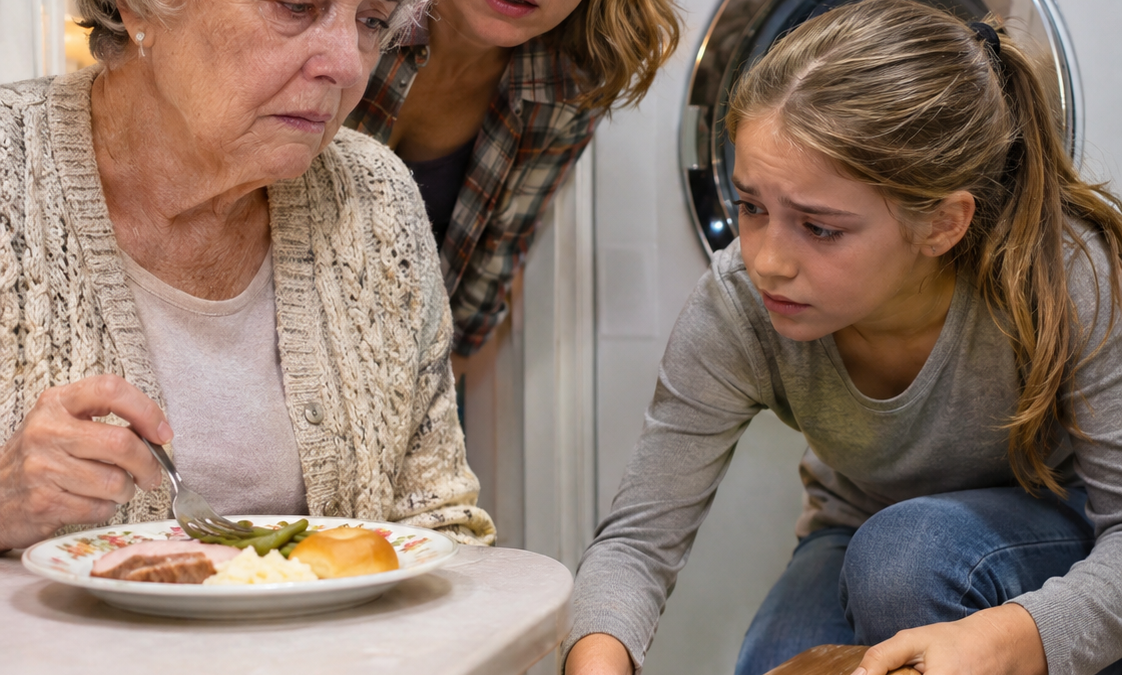
The laundry room was narrow enough that three people crowded the strip of floor beside the washer.
At the folding table, Mom sat with her plate. It was the same table she used for towels, sheets, and Justin’s work shirts.
Across from Mom, Ruby climbed onto the step stool Grandpa had built for her and balanced the plate on her knees.
I stayed standing near the door.
Mom cut another bite of meat and ate it slowly.
Ruby chased a green bean around her plate.
The dryer door reflected our shoes and the legs of Mom’s chair in its dull round glass.
Mom spoke without lifting her eyes from the tabletop.
“That green one has your daddy’s feet on it, April. I’d know them anywhere.”
I glanced back toward the hall.
Courtney and Justin were still talking at the supper table.
Dad’s shop stood behind the house, but Mom had not set foot in it since he died.
“How long have you thought that?” I asked.
“A month.”
Ruby looked up.
“You never said anything, Gran?”
Mom gave Ruby a small smile.
“Didn’t know what I was saying yet, hon.”
Ruby leaned forward and set her plate down next to Mom’s.
“Grandpa made this.”
She tapped the stool twice with her knuckles.
“I know,” I said.
My daughter stood, caught the little wooden seat with both hands, and tipped it over onto the floor.
Dark letters were burned into the underside.
Ruby crouched and put one finger directly on the first letter.
Part 2 of 7
The burned letters under the step stool read, “R.S. 2022 — RUBY.”
“Grandpa signed the bottoms,” Ruby said. “He said real makers sign the bottom.”
Mom stopped cutting her meat.
I took my phone out and crouched close enough to fill the frame with the underside of the seat. The letters came out dark and sharp in the photo.
Ruby watched me stand.
“Why are you taking that?”
“So I don’t have to trust my memory.”
“Your daddy made that for her birthday.”
“I remember.”
The stool went back upright in its usual spot beside the folding table, and Ruby reached for her plate.
No sound came from the dining room.
I had finished the flower orders downstairs and locked Sewell Stems by 8:00 Monday night, October 5. My phone was in my hand when I sat at the small table in my apartment above the shop and opened the Hollow Pine page.
I started at the top and worked backward.
The newest sold dresser, at the top, was dated Tuesday, September 29. The oldest was Tuesday, September 8.
Six posts carried the same words at the top.
“SOLD — thank you!”
I took six screenshots from top to bottom, keeping the picture, caption, and price together in each.
Four listed $1,850.
The remaining two carried $1,900.
Every piece had been repainted. New brass knobs replaced whatever Dad had used before, and each caption made the same claim.
“Handcrafted by me in my backyard shop.”
I opened the calculator and entered the six prices in order.
The total was $11,200.
That number stayed on the screen while I went back to the Hollow Pine page.
Each screenshot got a second check as I made sure no price had been cut off. I kept the six images on my phone.
My goal was one complete record of everything posted there by Monday night, so I scrolled on past the earlier entries.
An older photo dated Thursday, September 3, stopped me.
The walnut dresser lay upside down on a tarp.
“Day one on my newest build.” Courtney’s post ended with the same backyard-shop line as the six sold posts.
Nothing in the caption mentioned Dad.
I enlarged the Sept. 3 photo and moved toward one corner of the underside of the case.
The mark looked like a dark smudge in the wood at normal size.
I had to zoom all the way in until the letters came clear enough to read.
“R.S. 2009.”
The corner filled most of my screen now. The numbers had the same uneven spacing as the line under Ruby’s seat.
I saved that screenshot with the others and put my phone down.
Mom was volunteering at Shepherd’s Table Tuesday morning, October 6, until 2:00.
I called Marvin Ledbetter at 9:30.
“Can you meet me behind Mom’s house?”
“I can.”
The call ended there.
Marvin had been Dad’s best friend for forty years. He had built dressers beside Dad in that same shop.
We walked across the backyard together while I showed him the six screenshots and the corner of the Sept. 3 photo on my phone.
A combination lock hung where Dad’s old lock had been.
The decal on the door was new.
“HOLLOW PINE STUDIO — PRIVATE.”
Marvin bent toward it until he could read every letter.
The back room, where Dad kept his dressers, had its own lock, and only Mom’s key ring held that key.
Dad’s oldest friend rested one palm on the frame the two of them had built in 1996.
He said nothing.
The back door of the house opened.
Courtney came across the yard carrying a mug of coffee.
“That’s my studio,” she said. “Justin gave me the key in March.”
I faced her with my phone and the screenshots still in my hand.
“Those are Dad’s dressers, Courtney.”
She took one slow drink before answering.
“Prove it. Anybody can paint a dresser green.”
“Into water.”
I turned away.
Courtney’s voice caught me when I had gone fewer than ten steps.
“Come back here again and I tell Justin you’re harassing me, and your mom loses her son.”
I kept walking.
Marvin matched my pace toward the driveway.
He stopped beside my car.
“You still have the pictures?”
“Yes.”
“Keep them.”
I put my hand on the door handle.
“You heard what she said.”
“Every word.”
Neither of us went back toward the shop.
Marvin looked up the Hollow Pine page himself that evening.
A text from him reached my phone at 8:40 p.m. with a link and four words.
“Found her event page.”
I opened it.
The top showed the Hollow Pine name over a photo of painted furniture arranged under warm lights.
Date, time, and place appeared below the photo on the event page.
“Hollow Pine Woodworks Launch Night: Fri., Oct. 16, 7 p.m., Ridgeback Taproom.”
I scrolled.
A paragraph invited people to see new pieces, meet the maker, and hear what Courtney called the story behind the collection.
Another line sat below the invitation.
“Every piece handcrafted by me.”
My thumb moved lower.
The last line appeared.
“Coming spring 2027: the Hollow Pine showroom & studio — 212 Pennick Lane.”
Mom’s address.
Part 3 of 7
Courtney had already announced Mom’s house as her new showroom, and the woman who owned it had not seen the post yet. I slid my phone across the kitchen table at 7:00 Wednesday night, October 7.
Mom read down to the last line.
“Coming spring 2027: the Hollow Pine showroom & studio — 212 Pennick Lane.”
One finger rested near the address.
“That’s my house, hon.”
I took the phone back.
Neither of us said Courtney’s name.
My screen lit at 7:15 Thursday morning, October 8, while I was tying my shoes upstairs over Sewell Stems.
The message was a forward from Mom with no words added.
Courtney’s text appeared underneath exactly as she had sent it.
“Justin and I put your name on the Maple Court waitlist. Spring move-in. You’ll love it.”
I stood with one shoe tied and the other lace loose.
Mom had spent twenty-seven years feeding schoolchildren.
Now Courtney had picked an apartment for her.
A screenshot preserved the text before I went downstairs for work.
I was trimming rose stems at Sewell Stems at 8:45 Saturday morning, October 10, when the shop phone rang.
Mom’s neighbor from across the street said, “Honey, they’re selling your daddy’s tools on the driveway.”
I set the clippers down.
“Is Mom out there?”
“No, honey. I haven’t seen her.”
“Thank you for calling.”
The call ended.
I pulled up at 212 Pennick Lane at 9:10.
A folding table stood on the driveway under a cardboard sign.
“SHOP CLEAR-OUT — EVERYTHING MUST GO.”
Dad’s tool chest sat at one end, with his wood clamps spread across the other half.
Justin came from the side yard with another armful.
“Stop,” I said.
He dropped the load beside the rest.
“Courtney said Mom wanted it cleared.”
“Where’s Dad’s branding iron?”
His eyes went to the street.
“That little iron thing?”
“The one Marvin gave Dad. The one that burned R.S. into his work.”
Justin’s face changed before he answered.
“It sold.”
My fingers closed around the edge of my car door.
“For how much?”
“Five dollars.”
“Who bought it?”
“Some guy. I don’t know him.”
“Where is he?”
“Gone. His car left already.”
The metal edge pressed into the pads of my fingers until they hurt.
I released the door.
“Why are you doing this?”
He dug his phone out of his pocket.
The screen faced me.
“Your mom said clear it out. Tables at 8.”
“See? Mom told her.”
“That’s from Courtney?”
“Last night. I was on deliveries.”
My brother and his wife rarely texted. The message above Friday’s was more than five weeks old.
A date and time sat at the top: Tuesday, September 1, 2026, 10:02 a.m.
I read the words before Justin noticed where my eyes had gone.
“Your mom’s at Shepherd’s Table till 2. Bring bolt cutters. Don’t tell her yet.”
He jerked the phone away.
Neither of us moved.
Then he pocketed it.
“Don’t.”
I kept my eyes on him.
“She’ll leave me.”
Justin looked down at the cardboard sign.
“Don’t make it a thing, April.”
I got into my car.
I found Mom in the laundry room Saturday evening, folding Dad’s flannel shirt at the work surface.
The doorway was as far as I went.
“Did you tell Courtney to clear it out?”
Mom smoothed one sleeve flat.
“No.”
“What about Justin? Did you say it to him?”
“No.”
I waited.
Her hands stopped over the cloth.
“No police, April. He’s my boy. Let her have the shop.”
She folded the collar under, and I kept the bolt-cutters text to myself until I could bring Dad’s dressers home.
I called Marvin at his house that Saturday night.
“The branding iron is gone.”
The line stayed quiet for a moment.
“How?”
“Driveway sale. Five dollars. A stranger bought it before I got there.”
“I gave Ronnie that iron in 1996.”
“I know.”
“They got it for five,” he said.
“Yes.”
“Good night, April.”
“Good night.”
I hung up.
My phone rang at 2:00 Sunday afternoon, October 11.
Marvin was on the line, his voice firmer than the night before.
“I hadn’t opened his box since the funeral. Once we hung up Saturday, I went through it.”
I sat down on the stairs between my apartment and the shop.
“What did you find?”
“Ronnie kept a book on every keeper. I’ve got it.”
My fingers tightened on the stair rail.
“Keep it with you.”
“I will.”
“Don’t bring it over yet.”
“All right.”
We ended the call.
I arrived at Mom’s house at 3:00 that Sunday and told her Marvin had Dad’s shop book. She went straight to her bedroom closet and returned with the estate papers box. Mom worked through the stack without talking.
She stopped at the inventory and checked its first page before handing it to me.
A court stamp was pressed into the upper corner.
I read the heading first.
“Probate Court for Putnam County.”
Another line appeared below it.
“Personal Representative: Jill A. Sewell.”
I moved down the list until I reached a numbered entry.
“Item 14 — Nine (9) hardwood dressers built by decedent, 1996–2025, held in the shop at 212 Pennick Lane — estimated value $15,300.”
Six had already sold on Courtney’s page. Three were left, and launch night was Friday.
Part 4 of 7
Friday’s launch was three days away when Marvin set Dad’s blue cloth-covered shop book on Lynn Cagle’s desk at 9:00 Tuesday morning, October 13. He opened it to the one section Courtney had never seen.
Monday was Columbus Day, so the office had been closed.
The page heading read:
“Keepers — not for sale.”
Lynn read No. 1 through No. 8 aloud. Across the full page, the years ran from 1996 to 2025, and each one matched a brand Ronnie had burned into the work.
“No. 9, cherry, 2025. See under the top.”
The inventory came next.
I unlocked my phone to the screenshots of Courtney’s six SOLD posts. Lynn put the estate papers and my phone beside the shop book.
One finger stopped at Item 14.
“Jill, you’re the personal representative. These are the estate’s, not hers.”
Mom kept her eyes on the papers. “Justin loaded the green one from my dining room into his truck Monday morning, hon. Then two more from the shop. I stood on the porch and watched him drive them to Ridgeback.”
“Did you give Courtney any of them?” Lynn said.
“No.”
I reached for my phone, brought up the event page, and slid it across the desk.
The Friday listing held Lynn’s attention for a few seconds.
“They’re at the taproom now. Getting them back means she hands them over, or someone with a badge makes her.”
“No police, Lynn.”
A writ of possession was the first court option Lynn named. The earliest hearing would be five days after Courtney was served, already past Friday; Mom would have to post a bond worth the dressers, and a deputy could walk into the taproom to load them.
“No sheriff walking in there, no law officer at all.”
The other route was asking a judge to freeze the sale before Friday, Lynn said, which meant suing Courtney first.
“She gets one chance to hand them back,” Mom said.
One hand rested near the inventory as Lynn looked at Mom.
“If we tip off the taproom, Courtney can truck the dressers somewhere else before Friday.”
“A launch night is a sale night,” the lawyer added. “If those last three sell Friday, getting Ronnie’s work back means going after buyers who paid in good faith. That gets slower and uglier.”
Mom’s mouth tightened. “Give her the chance,” she said. “Put it in writing.”
The attorney turned to the computer, and the keys clicked while the rest of us stayed quiet.
“Three dressers within 72 hours,” Lynn said. “And the money from the six already sold?”
“Every dollar that belongs to the estate,” Mom said.
I read the finished draft: Mom, as personal representative, gave Courtney 72 hours to return the three dressers and 30 days to repay $11,200, or Mom would sue her for conversion in General Sessions Court.
The demand letter went under Mom’s pen first. Her signature filled the line at the bottom.
A second page ended Justin and Courtney’s permission to live at 212 Pennick Lane and gave them 30 days to leave. Mom signed that one too.
“And no changing locks on my own son.”
“Then it goes into her hand, with witnesses,” Lynn said.
She sealed both in an envelope and handed it to Marvin.
Marvin tucked it into the inside pocket of his coat.
At 2:00 Tuesday afternoon, the phone at Sewell Stems rang.
Lynn was calling from her office.
“I called Courtney. All I asked for was a time to talk about Ronnie’s estate. I didn’t mention the dressers or Ridgeback.”
“What did she say?”
“She hung up before I could say more.”
A short pause followed.
“Then she texted me.”
“Talk to me after Friday.”
My hand stayed on the shop phone.
“That’s all?”
“Nothing else.”
“Call me if she answers you again.”
“I will.”
“Thanks, Lynn.”
We ended the call.
I opened the Hollow Pine page on my phone Wednesday morning, October 14.
The six SOLD posts were gone.
A new post sat at the top.
“40 RSVPs! Pre-orders open at 7:30 Friday — $500 deposits”
I pulled up what I had saved on Monday the fifth and slid my thumb across the images until all six posts filled the screen.
The back room at Ridgeback Taproom held 40 guests at 7:20 Friday night, October 16, after dark.
A banner above the low platform read “HOLLOW PINE WOODWORKS — HANDCRAFTED BY COURTNEY SEWELL.” Three painted dressers stood below it, with the green dresser in the middle.
Courtney held the microphone while Justin stood beside the platform.
Mom, Marvin, and I walked in together and took chairs near the back. Justin’s wife spotted the owner of 212 Pennick Lane right away.
“Oh, my mother-in-law came! Jill, honey, this is a grown-up night. Grab a plate and find a spot back by the kitchen.”
A few people laughed.
Justin looked at the floor. Both of Mom’s hands rested quietly in her lap.
Heads swung back to the front. The middle piece still wore the gray-green paint and new knobs I had seen in Mom’s dining room.
Courtney placed one hand on the dresser and faced the room.
“Every dovetail in these, I cut with my own two hands, in my backyard shop. Nothing’s ever been sold. Tonight, you’re the first.”
She raised the deposit list, and people began to line up.
I stood from my chair and held up my phone, already open to the screenshots, then nodded to Marvin.
Marvin buttoned his coat over the envelope and walked toward the platform.
Part 5 of 7
“Ronnie Sewell taught me to check the bottom before I praise a piece.”
At 7:35 Friday night, Marvin said it from the foot of the low platform, loud enough for all 40 guests in the back room without amplification.
Courtney kept one hand around the microphone and the other on the deposit list. Marvin looked past her toward Mom.
Mom, the estate’s personal representative, nodded once from the chair beside mine.
Marvin put both hands on the green dresser and eased it away from the wall. The guest standing nearest stepped forward and took the other corner.
“Easy,” Marvin said.
The two men tipped the piece onto its back on the platform carpet. Nothing else up there moved.
His helper let go and moved aside. Marvin rested a hand against the dresser.
Now the underside of the base faced the room. The brand showed in the middle.
“R.S. 2025”
People closest to the platform bent down to look.
The brand held Courtney’s gaze for one beat. Then she lifted the microphone to her mouth.
“Anybody can burn letters into wood. I bought that stamp online.”
Her gaze moved to me. I said nothing.
My phone was already open when I handed it to the first person in the deposit line. The Sept. 3 photo filled the screen before the woman’s thumb moved.
A walnut dresser lay upside down on a tarp. Courtney had posted the picture herself.
“Day one on my newest build — handcrafted by me in my backyard shop.”
One swipe brought up my zoomed-in screenshot of that underside corner, where the brand read plainly.
“R.S. 2009”
Another person took my phone from the woman. The saved SOLD posts followed one by one, four at $1,850 and two at $1,900, $11,200 in all.
“SOLD — thank you!”
Those posts had disappeared from the Hollow Pine page Wednesday. My screenshots still showed the repainted dressers under Courtney’s own claims that she had handcrafted them.
Guests waiting to pay glanced at each other. Near the front of the line, a woman lowered the check she had been filling out.
Two more people passed my phone along before it came back to me.
Courtney’s mouth tightened.
“Jill gave them to me. She’s been confused since Ronnie died. Ask Justin.”
Her husband stood beside the platform with his head bowed.
Nobody spoke to him.
While everyone waited, he took out his phone. One thumb moved across the screen.
Justin looked up without turning toward Courtney.
“This is from September first. Ten-oh-two in the morning.”
He read the text in his own voice.
“Your mom’s at Shepherd’s Table till 2. Bring bolt cutters. Don’t tell her yet.”
I saw Mom’s fingers close around the edge of her chair.
My brother lowered his phone.
“Mom wasn’t confused. I was a coward.”
A reply started on Courtney’s lips, but Marvin moved before she spoke.
He reached inside his coat and pulled out the envelope Lynn had sealed Tuesday. One end stayed in his grip as he offered it to Courtney.
“From the personal representative of Ronnie’s estate. That’s Jill.”
A long second passed before she took it. Marvin let go.
Courtney opened the envelope atop the platform, list and microphone gripped together. Two signed pages came out.
I didn’t need to get closer. I had read both in Lynn’s office.
The demand required her to return the three dressers within 72 hours and repay $11,200 in 30 days, or the estate would sue for conversion in General Sessions Court; the other letter gave Courtney and Justin 30 days to move out of 212 Pennick Lane. She read the first page to the bottom, then turned to the second.
The same woman tucked the checkbook into a purse and walked out of the line. A man behind her moved toward the exit.
Courtney pressed the signed pages together.
“You brought an attorney into this?”
Mom stayed seated.
Dad’s friend kept his place beside the green dresser.
“Your name is on the paper you’re holding,” Marvin said.
“You don’t live in that house.”
“No,” Marvin said. “Jill does.”
My brother put his phone away. Courtney turned toward Justin.
“Are you really going to stand there and let them do this?”
His arms stayed at his sides.
“They didn’t send that text.”
Her eyes dropped to the two letters.
I kept my phone in my hand and said nothing. Courtney brought the microphone up again.
“This was supposed to be a launch. If anybody here still wants a spot on the list, I can take your deposit.”
She looked down at the names.
I stayed where I was as Mom stood.
Her chair remained behind me while she walked forward at an even pace. I did not follow.
Dad’s friend moved aside when Mom reached the platform.
She put one foot on the low edge, then the other, and faced Courtney. Mom spoke plainly, leaving the microphone alone.
Twenty-seven years running a school cafeteria had taught her to make herself heard from the serving line to the far tables without shouting.
“Two Sundays ago she poured my coffee in the sink and told me this.”
Her eyes stayed on Courtney.
“Take your plate to the laundry room, Jill. The grown-ups are talking.”
Courtney drew breath to answer. Mom raised one hand.
“The grown-ups are talking now, Courtney. Sit down.”
Part 6 of 7
The taproom manager carried the ladder from the bar to the platform while Courtney held the $11,200 demand in one hand.
“Banner comes down tonight, Courtney. And your booth at our holiday market is off.”
It was about 8:15 p.m. Friday, October 16.
Most of the forty guests were still in the back room. Courtney looked at the manager, then at the wall above the platform.
She left the signed pages on the bar and climbed the ladder herself.
“HOLLOW PINE WOODWORKS — HANDCRAFTED BY COURTNEY SEWELL.”
Courtney unfastened the banner and brought it down against her chest.
The green dresser stayed on its back on the platform carpet.
People who had been waiting to pay returned their pens one at a time. A woman placed the last one near the register.
The deposit list lay on the bar.
Mom stood beside me. Justin kept several feet between himself and Courtney, while Marvin watched without speaking.
Two guests near the exit left together. Another person moved away from the payment line and followed them. Courtney came down from the ladder and faced the manager.
“This was booked weeks ago.”
He stood still with his hands at his sides.
Nobody in the room spoke up for her.
Saturday was October 17, 10:00 a.m.
Justin and Marvin brought the three dressers into 212 Pennick Lane.
The green dresser went back into its corner of the dining room. I watched Marvin guide the last few inches while Mom stood clear of the wall.
Lynn Cagle put the repayment agreement on the kitchen table. Mom sat across from Lynn, and I took the chair at the end. Courtney came in last and settled into the empty seat facing the attorney.
The first amount was $3,200 due now. The monthly entries ran from November 2026 through June 2027, $1,000 each, until the full $11,200 had been repaid.
“Where?” Courtney said.
Lynn pointed to the signature line.
Courtney signed the agreement at the table.
No one filled the next few seconds with talk. She sent the $3,200 from her phone while Lynn watched.
“Done.”
The attorney checked the payment.
“That part is done.”
Mom rested her palms on her knees. Courtney looked toward her.
“So now you leave the buyers alone?”
Lynn answered without raising her voice.
“Six people paid in good faith and didn’t know the dressers belonged to the estate, which could still claim all six because whoever took them never had title to sell.”
“You’re making me pay for furniture left in strangers’ houses?” Courtney said.
“Let those six stay where somebody wanted them,” Mom said to Lynn.
The attorney gave one nod.
“The money still comes from you.”
“So that’s your choice, Jill?”
“It is, hon.”
The chair legs scraped once as Courtney stood. Justin watched his wife.
“You said you wanted this settled,” he said.
“I just sent $3,200 today.”
“You sold eleven thousand two hundred.”
Courtney pressed her lips together.
“I heard the number last night.”
My brother looked down.
“Your next $1,000 payment is due next month,” Lynn said.
“Then another the month after that?” Courtney said.
“Yes.”
“Through June?”
“Yes.”
“Fine.”
The kitchen doorway stayed empty after Courtney walked out, and the back bedroom door closed down the hall.
I remained in my chair. One edge of the dresser was visible from the kitchen.
Sunday was October 18, 5:30 p.m.
Courtney stayed in the back bedroom.
The dining table held Mom, Justin, Ruby, Marvin and me.
Justin poured Mom’s coffee into her cup and set it in front of her.
Ruby watched my brother take his place. He looked at Mom.
“Court and I are out by the fourteenth. Her sister’s in Sparta. If she misses one payment, it comes out of my check.”
“You don’t have to cover her debt, hon,” Mom said.
“I know. I’m saying I will if she falls short.”
My brother rubbed his thumb along the side of one finger.
Marvin set his fork down without a word.
“You didn’t sign that agreement,” I said.
“No.”
“Then don’t promise what you can’t cover.”
He met my eyes.
“I can cover a thousand if I have to.”
Ruby lowered her gaze.
Mom spoke again. “The fourteenth is before the thirty days are up.”
“I know.”
“Sparta is a drive for work.”
“I know that too.”
“Are you going with her?” I said.
“Yes.”
“Even after Friday?”
Justin glanced at the hall.
“Yes.”
The table went quiet for a moment.
He turned back to Mom.
“I’ll get our things out. I won’t touch anything in the shop.”
“You understand what you’re saying, hon?”
“Yes.”
“And Courtney knows?”
“She knows.”
Mom said, “Thank you.” Justin nodded once.
Marvin turned his attention to the green dresser in the corner.
After supper, I wiped down its top.
Dad’s friend took the shop book out of his coat pocket and opened it to No. 9.
“‘See under the top.’ I took it for a joinery note.”
My gaze settled on Marvin.
“You read that the night the branding iron sold.”
“First time I’d looked inside this book since Ronnie gave it to me.”
I stayed beside No. 9 with Mom behind my shoulder as Marvin pulled the top drawer all the way out.
He set it on the table.
The empty opening sat just below my chin, too high to kneel under and too low to look up into while standing.
I turned on my phone’s flashlight and bent to shine it upward.
The beam caught bare cherry wood above the drawer opening. I crouched, but from down there the light reached only the near edge.
Ruby watched me for a second, then carried the step stool to the dresser.
“Here, Mom.”
I sat down on it.
At that height, my eyes were level with the opening and the beam lit the whole underside of the top.
Dad signed the bottom of everything. Under No. 9’s top, the burned marks ran farther than his initials.
I raised my phone until the whole line showed in the light.
Every letter was Dad’s handwriting, dark against the pale cherry.
“For Jill — forty years, Oct. 11, 2025. Still my best idea. — R.”
Part 7 of 7
Mom reached past my shoulder into the drawer opening and laid two fingers on Dad’s burned line.
I held my phone’s flashlight on the words beneath her hand, written for a day he never lived to see. Ruby stood at my elbow, and Marvin and Justin waited by the table where the top drawer rested.
“For Jill — forty years, Oct. 11, 2025. Still my best idea. — R.”
October 11, 1985, was the day my parents married. Dad died on August 14, 2025, at sixty-six, two months short of their fortieth.
Since the funeral, Mom had never opened his shop door.
“Leave his shop be,” she used to say.
Her fingertips moved over the date.
“He told me I was his best idea every anniversary. I thought it was just a thing he said.”
No one answered. The back bedroom door stayed closed.
She touched the last initial once, then drew her hand away.
“Strip that green off, April. I want to see his cherry.”
“I can do that.”
Her gaze held on Dad’s dark letters.
“Take your time with it, hon.”
I switched off my flashlight. Dad’s friend picked up the drawer and slid it home.
Saturday, October 24, 9:00 a.m.
Dad’s old lock was back on the shop door. Justin had cut off Courtney’s combination the Saturday the dressers came home and put the original back from the workbench drawer.
The green dresser stood in the middle of the floor with space around all four sides. Mom kept to the house.
I brushed paint remover across one panel while Marvin worked along the edge. The gray-green coating puckered, then lifted in soft ribbons when I drew the scraper underneath.
A reddish strip appeared beneath my hand.
“That’s pretty,” Ruby said.
“It’ll get prettier,” he said.
I cleared another narrow section. Dad’s dovetails showed sharp and tight where the finish had softened.
My daughter leaned close without touching the wet surface.
“Was it always this color under there?”
“Yes,” I said. “That’s the wood Grandpa used.”
She watched another curl fall away.
The front took most of the morning. Each pass exposed more grain, and thin traces of paint remained only along the joints and under the lip.
We stopped before the wood dried unevenly. The top and second end could wait seven days.
Saturday, October 31, 9:15 a.m.
Ruby stood on the step stool to reach the top.
“With the grain,” Marvin said, guiding the sanding block with two fingers. “Follow those long lines.”
She made one slow pass.
“Am I doing it right?”
“That’s it.”
I worked at the far end while fine dust gathered along the back edge. Another gray-green patch peeled away from the side panel under the scraper.
My daughter ran her fingertips over the place she had smoothed.
“I can feel where it gets rough.”
“What your hand catches shows you where to work next,” he said.
She made another careful stroke. I wiped the loose dust from the near edge and checked the place where Dad had joined the boards.
The seams barely caught my fingernail.
“Grandpa made this top?” Ruby asked.
“He did,” I said.
Dad’s friend tapped the sanded area with one finger.
“He knew how to make boards behave.”
Ruby smiled a little and bent back to the work.
By noon, there was no paint left on it. Dad’s cherry now showed from the feet to the top.
Saturday, November 14, 11:40 a.m.
Justin stood on the front porch of 212 Pennick Lane with Mom and me.
Courtney waited in the car at the curb. She never got out or spoke.
Across the street, a neighbor raked leaves while another worked near a driveway. Justin and Courtney’s moving boxes were already gone, and the thirty days ended the next day, Sunday, November 15.
My brother reached into his pocket and opened his palm.
The house key lay next to the shop key he had taken off the kitchen hook in March.
My mother held out her hand.
He placed one key there, then the other.
“Those are the two,” he said.
“Thank you, Justin,” Mom said quietly. His gaze dropped to the porch boards.
“Sunday dinner. Just me, if that’s okay.”
“Bring the coffee, hon.”
He nodded and went down the steps.
Courtney stayed in the passenger seat as the car pulled away. The neighbor across the road kept raking.
Mom’s fingers closed around the keys.
Saturday, November 14, 2:30 p.m.
The birdhouse sat upside down on Dad’s workbench.
Marvin held out a small branding iron.
“I had something made for you.”
The handle settled into Ruby’s hand.
“Look at the tip.”
She turned the metal toward the light.
The raised letters on the end spelled RUBY backward.
“That’s my name.”
“Sure is.”
He pointed to the underside of the first birdhouse she had built in the shop with him.
“Real makers sign the bottom.”
“Can I do it?”
“You built it.”
He showed her where to place the heated tip, then moved his hand away.
She pressed straight down. I watched the small square of metal stay level against the wood.
A few seconds later, the branding iron lifted.
RUBY showed dark beneath the little house.
My daughter grinned.
“Mr. Marvin, it worked.”
He gave one nod and motioned toward the bench.
“Come on, Ruby. Let it cool.”
Sunday, November 22, 5:30 p.m.
No. 9 stood in Mom’s kitchen, stripped to bare cherry and sealed clear. Thanksgiving was four days away.
Justin came alone.
He poured coffee into Mom’s cup and set the pot down.
“Here you go.”
“Thank you, hon.”
Ruby sat on the step stool next to Gran.
I took my place across from Marvin while Mom settled near my daughter. Mom had picked the spot by the wall for No. 9 herself.
Supper was pot roast and green beans. My brother asked Ruby about school, and she told him about a book she had read.
One hand stayed around Mom’s cup while she listened.
I watched her thumb rest against the handle.
For years, she had made room for everybody else in this house.
I knew how easy it was to care for everyone until asking for one small thing of my own sounded selfish.
After supper, she lifted the cup and rose.
My brother shifted his chair enough to let her pass.
She carried it across the kitchen to No. 9.
Not a hand moved to take it from her.
Mom set her coffee on Dad’s dresser, and nobody said a word.
THE END
More stories
My Husband Toasted ‘Finally Our House’ at His Mother’s Thanksgiving Table, About the House My Parents Left Me, Then I Set His Ex-Wife’s Court File Next to the Turkey.My husband hid my sister’s letters for 7 years — Then a mailman brought envelope “#29,” and he was served divorce papers at work with employees and customers present.My Sister Gave Mom’s Bedroom to Her In-Laws and Put Mom on a Cot in the Sewing Room, Then Threw Them a Party, Until Mom Showed Everyone the Credit Cards Opened in Her Name.My boss gave his daughter until Friday to leave her home after 16 years—then the folder he left on my counter helped stop his auctionMy brother-in-law used a $180 drill in Mom’s purse to push care-home papers—Until the store owner checked his cameras and my sister tore up the forms.My son-in-law laughed at my forty years as an electrician while offering a $522,000 annuity—Until his own paperwork surfaced and cost him a trusted church position.








