My Son Grabbed My Husband’s Urn Four Days After His Funeral — Then His Plan Unraveled
Part 3: The Message Julia Kept
Raymond’s recorded voice came through Julia’s phone.
He identified himself and referred to Scott’s call.
Then he explained why he was returning it.
“Scott asked me to arrange Evelyn’s departure before the memorial. He also requested authorization to sell the house immediately.”
Julia kept the phone flat in her palm.
“He told me Evelyn had already agreed to leave. I need to hear directly from her concerning any proposed change. I cannot proceed on that representation.”
I looked at Scott.
“I never agreed to leave.”
He pulled his jacket straight at the bottom.
“I said you understood we needed a plan.”
“That isn’t what your father’s trustee just said.”
Raymond was still connected on the other call. Julia stopped the recording and returned to speakerphone.
Scott spoke before anyone asked him a question.
“I was asking what options were available.”
“You represented that your mother had consented,” Raymond said. “She has now told us otherwise.”
Scott looked toward the dining room.
People who had been collecting dishes stopped moving.
Julia did not lower the phone.
“You gave him my callback number,” she told Scott. “You said I could help coordinate everything.”
“I expected you to help me.”
“I’m helping get the facts straight.”
Martin turned the open document toward me.
I recognized Dennis’s signature before I read anything else.
Raymond asked Martin to identify the section he had opened. Martin read its heading, then waited.
“The trust protects Evelyn’s lifetime occupancy,” Raymond explained. “She may remain while she chooses to live there.”
Scott pointed toward the folder.
“But the house eventually comes to me.”
“Your interest is a remainder interest,” Raymond answered. “It does not make you the current owner or trustee.”
Dennis had owned the house before we married. In 2018, he put it into his trust.
I remembered signing other household papers beside him then. I had not memorized the wording of his separate trust.
I remembered what he told me afterward.
I would not have to move after losing him.
Martin had witnessed the signing on June 12, 2018. The deed transferring the house was recorded June 15, 2018.
Raymond confirmed that the house remained trust property.
“There is no later amendment removing this provision,” he said.
Scott stopped questioning the document’s age.
Instead, he looked around the living room.
“The roof won’t maintain itself,” he said. “Neither will the taxes.”
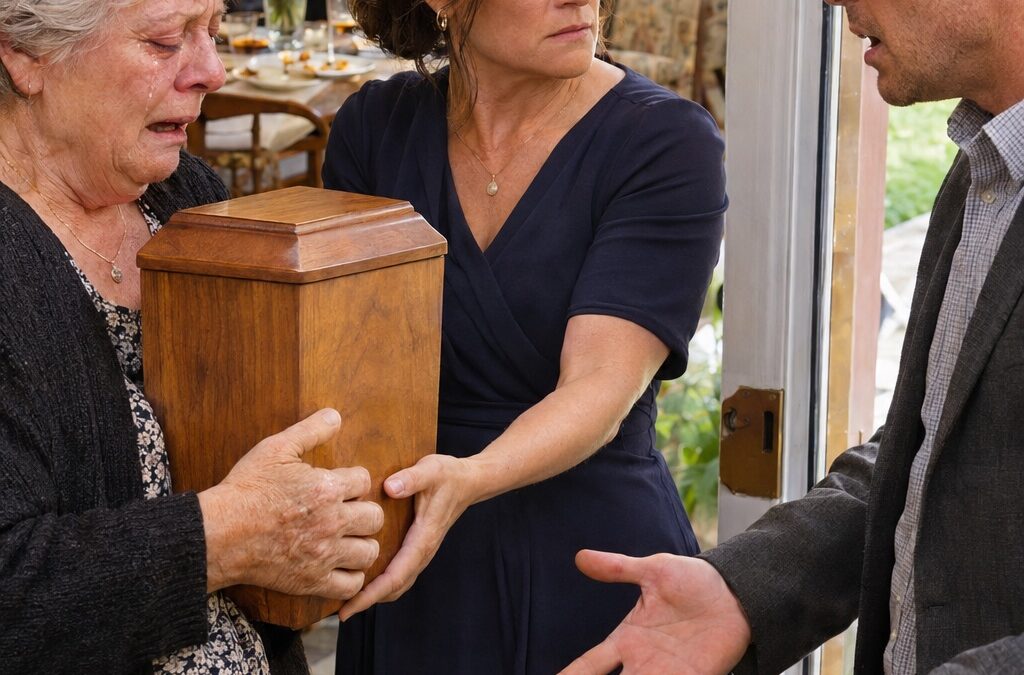
I set my palm flat against the urn’s lid.
I could manage groceries, utilities, and ordinary upkeep. Large bills were what had kept me awake lately.
Raymond answered before Scott could continue.
“The trust holds a $38,000 reserve for property taxes and homeowners insurance. Those payments are my responsibility as trustee.”
Scott looked back at the phone.
“That money could be distributed.”
“Not contrary to the trust’s existing obligations.”
I had not known the reserve’s balance.
Dennis had handled that arrangement with Raymond. Now I understood why the tax envelope had never worried him.
Scott walked toward the dining room and turned back.
“You could sell and choose something smaller,” he said. “There’s nothing wrong with that.”
“There isn’t,” Raymond said. “If Evelyn freely chooses it, with appropriate arrangements.”
Everyone looked at me then.
I could hear the kitchen faucet dripping.
“I haven’t chosen that,” I said.
Carol placed her stack of plates on the table.
“Scott was trying to think ahead,” she said.
“He took Dennis out of my hands.”
She looked down at the plates.
“He shouldn’t have done that.”
“You told me to cooperate.”
“I was thinking about the children.”
“So was their mother,” I said, looking at Julia.
Julia put her free hand over her mouth. She wiped beneath her nose, then lowered it again.
Scott said we were making him sound like a stranger.
Nobody answered that.
Raymond asked to speak with me about practical arrangements. I asked him to stay on speaker until those were settled.
I wanted no more separate versions of what I wanted.
He confirmed that correspondence could come directly to me. Scott would receive the beneficiary information he was entitled to.
Being his mother did not require using him as messenger.
Martin closed the folder but left it beside my chair.
He asked whether I wanted him to stay.
“Until everyone’s gone,” I told him.
Guests began gathering coats without discussing leftovers.
Some touched my shoulder on their way out. Others thanked me for having them, watching the floor.
Carol stayed near the door with her purse open.
“I didn’t know about the trust,” she said.
“You knew I lived here.”
Martin waited while she fastened her purse.
She said goodbye, but did not ask for a hug.
Scott remained beside the dining table after the others left. Julia stood near the doorway, holding her own coat.
He asked whether she was coming with him.
“After I help Evelyn clear up.”
“There are dishes,” he said, looking toward the kitchen.
“Yes,” she answered. “There are.”
I carried Dennis upstairs while Martin waited below.
I set the urn on my dresser, away from the edge. Then I took my glasses and came back down.
Raymond called again after the room had emptied.
This time, I spoke with him privately.
I asked him to preserve the voicemail and his notes. I asked that requests concerning my occupancy come to me directly.
He explained that he would document our conversation.
Julia sent me the saved voicemail before leaving.
I checked that it played, then saved another copy. Martin showed me where the occupancy provision began.
I put the trust copy in my desk drawer.
Those were ordinary things I could do myself.
Scott had stepped outside, but he came back in.
He watched me close the drawer.
“Would you at least sign a voluntary release?”
Part 4: The House After Everyone Left
“No,” I said.
He stood with his hand on the dining chair.
“You haven’t even heard what I’m offering.”
“You asked whether I would give up living here.”
“I asked whether you’d consider an arrangement.”
“Send any proposal to Raymond. I’ll get advice separately.”
Scott pulled the chair away, then pushed it back.
He left without taking any food home.
Julia finished wrapping what remained on the counter. She asked where I kept the containers.
I opened the cupboard and handed them to her.
Neither of us discussed what would happen at her house.
Before she left, she checked the front door latch.
I locked it myself after she stepped outside.
The following morning, I answered Raymond’s call at my kitchen table. He went through the expenses I would continue paying.
Utilities and ordinary upkeep remained mine.
The trust would handle property taxes and homeowners insurance. If something larger came up, I would contact him.
I wrote his number beside the household repair contacts.
On March 12, 2025, he sent the beneficiary information. Scott also received the trust copy he had requested.
There was nothing left for Scott to discover informally.
He knew what Dennis had signed.
For a while, his messages were about finding a buyer. Then they became proposals for smaller places I might like.
I did not tour any of them.
I forwarded the proposals to Raymond and kept copies.
I also arranged a consultation with my own lawyer.
I brought the trust, the recorded deed, and the voicemail. I wrote down the memorial events while I remembered them.
I included Carol’s words, although writing them embarrassed me.
My lawyer asked what outcome I wanted.
“To stay home without being pressured to sign,” I said.
She did not promise Scott would stop asking.
She explained that a beneficiary could bring a petition. Filing one did not suspend the occupancy provision.
On April 9, 2025, Scott filed his petition.
I was served on April 16, 2025.
I read the papers at the dining table.
He wanted the court to permit a sale despite the restriction. He described family financial pressure and the expense of maintaining the property.
The papers did not say he owned my house.
They asked a judge to change what prevented its sale.
That distinction did not make the envelope easier to open.
I placed it beside the trust instead of hiding it.
Then I called my lawyer and Raymond.
My lawyer prepared my response concerning my occupancy rights. Raymond’s counsel addressed the trustee’s administration and the trust’s purpose.
I did not have to argue with Scott by telephone.
When he called, I let it go to voicemail.
One message said legal fees would reduce what remained.
I saved that message, too.
Then I went outside and checked the loose porch rail. I arranged for an ordinary repair I could afford.
I was still responsible for looking after my home.
Julia came over without Scott and brought back my containers.
She asked before coming, and waited for my answer.
We sat where Dennis used to watch the afternoon light.
“I should have stopped him sooner,” she said.
“You stopped him before he got outside.”
“I heard what he said about the house before.”
I folded a dish towel across my knees.
“What happens between you is yours,” I told her. “But nobody can bring him here without asking me.”
She nodded and stayed to help with the dishes.
The hearing was on July 22, 2025, in Dane County Circuit Court.
I carried a folder, not Dennis’s urn.
My lawyer had already submitted the relevant documents. Raymond had supplied the administration records through his counsel.
The judge had the trust and recorded deed.
Scott’s lawyer argued that circumstances justified allowing a sale. Scott needed access to his expected inheritance, and the property carried expenses.
My lawyer returned to the provision’s specific purpose.
Dennis had provided for my continued residence.
Raymond’s reserve records answered the immediate carrying-cost argument.
There was no unpaid tax emergency requiring a sale.
My lawyer also addressed the supposed agreement to leave. I had signed no release and given no consent.
The saved voicemail supported my account of that dispute. It did not create my right to stay.
Dennis’s trust had already done that.
Scott listened while the judge questioned his requested relief.
He did not look toward me.
The court denied the petition.
The judge would not override my protected occupancy merely to accelerate Scott’s remainder interest.
The order left the trust’s administration with Raymond.
There would be no immediate sale or house distribution.
Outside the courtroom, Scott approached while my lawyer stood nearby.
“You know this changes things between us,” he said.
“I know you have to ask before visiting.”
He looked at my lawyer, then walked away.
I did not follow him down the hallway.
At home, I put the order beside the trust copy.
I sent Julia a message saying I was back.
Then I called the person repairing the porch rail. We arranged a time when I would be home.
Carol eventually called and asked whether I was still angry.
I was standing at the sink when she asked.
I turned off the water before answering.
“I still remember what you said.”
“I should have told him to put Dennis down.”
“Yes,” I said.
She did not defend it again.
I did not invite her over that day.
Scott received no proceeds from the house. Raymond continued paying the expenses assigned to the trust.
I paid my utilities and arranged the ordinary upkeep.
When mail arrived, I opened it at the kitchen table.
I no longer left envelopes unopened because Scott might call.
Julia still visits, but she asks me directly.
We sometimes eat soup from Dennis’s old bowls.
She takes her coat off only after I invite her in.
I moved his photograph back from the crowded dining table.
Then I carried the plain wooden urn downstairs.
I held it while deciding between the mantel and bookcase.
The bookcase had room beside our family photographs.
I stood there with Dennis’s urn in my hands.








