My Son-In-Law Shoved Me, A 71-Year-Old Widow, At Christmas Dinner — Then My Daughter Reached Into His Pocket
Part 3: The Page Beside My Plate
“Read it,” I said.
Allison moved the page beneath the table lamp.
“Improvements paid for by the owner remain the owner’s investment. Rent, utilities, and other household payments do not create an ownership interest or credit toward purchase.”
Curtis stopped adjusting his cuff.
“That’s not what we discussed.”
“It’s what Mom and I signed,” Allison said.
She turned the page so he could see both signatures.
The agreement was dated February 15, 2023. It allowed their family to move into my house on March 1, 2023, under a month-to-month arrangement.
Allison was the named tenant.
Curtis was listed as an authorized adult occupant.
He had not signed it, and I had never claimed otherwise.
Allison had handled the arrangement while he worked. She kept their copy with their household papers. He had never asked me for another copy or asked her to explain its terms.
Now he leaned closer without touching it.
“So you made an agreement about us behind my back.”
“You knew we were renting from Mom,” Allison answered.
“I knew she was helping.”
“Yes. By letting us live there.”
The plate beside my papers still held untouched food.
I moved my water glass away from the agreement.
Curtis watched me flatten the corner of the page.
“I never saw that paragraph.”
“You never asked to read our copy,” Allison said.
“You should have told me.”
“I told you we were renting.”
He looked toward the other tables.
“Could you lower your voice?”
She had not raised it.
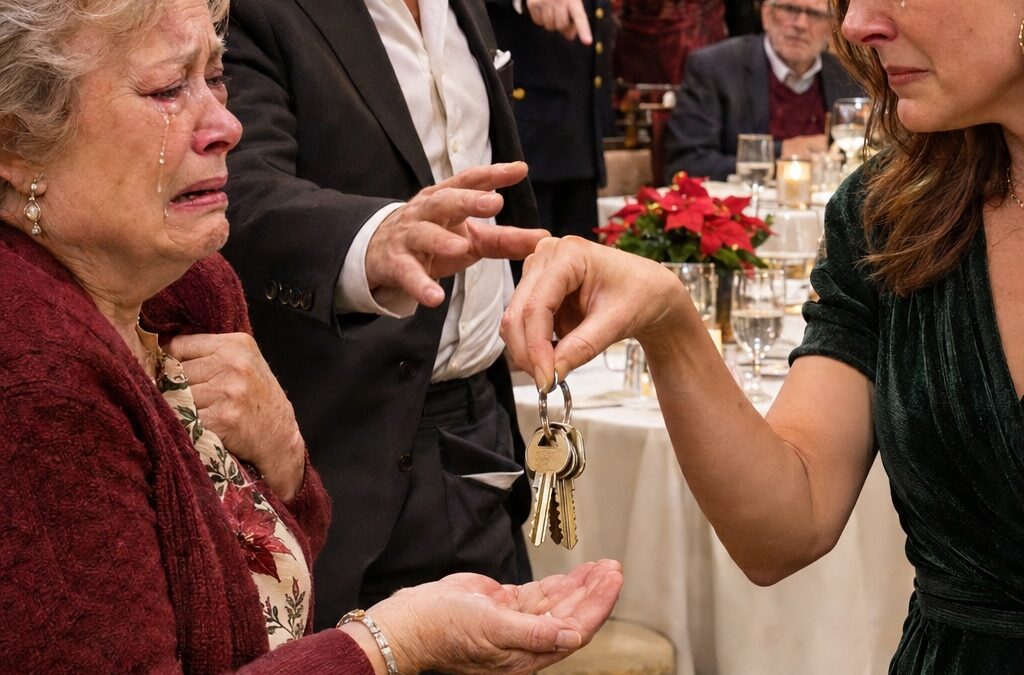
My keys lay beside my empty ring.
I picked up the ring and worked at its split.
The metal pressed beneath my thumbnail.
Allison reached toward my hand.
“Let me help.”
“I can do it.”
I slipped the first key onto the ring.
Curtis watched it turn around the metal.
“Having those doesn’t mean you can come through our door.”
“No,” I said. “It doesn’t.”
He looked back at me.
“You agree with that?”
“I own the house. You live there.”
I put the ring beside my plate.
“Both things are true.”
I had not asked to enter their bedrooms.
I had asked for the keys he borrowed yesterday.
Allison kept one hand on the agreement.
Near the entrance, Paul spoke quietly with the manager.
The bell captain still had a guest’s coat over his arm.
The manager asked him to come closer.
“Please explain exactly what you saw.”
Curtis pulled out his chair.
“This has already taken enough time.”
“I’m asking him,” the manager said.
Paul looked at me, then at Curtis.
“I was helping guests near the dining-room entrance.”
He indicated where he had been standing.
“She had her hand open, asking for her keys.”
Curtis started to speak.
The manager held up his hand.
“Please let him finish.”
“I saw him put the keys in his pocket.”
Paul pointed to the same pocket Allison had reached into.
“Then I saw him push her shoulder.”
“Move her,” Curtis said. “Not push.”
Paul did not argue about the word.
“She hit the chair behind her.”
I rubbed my shoulder through my sleeve.
The manager looked at me.
“I’m sorry I acted on his account first.”
He had already offered police assistance.
He asked again whether I wanted someone called.
“Not right now,” I said.
I wanted the facts kept.
I did not want immediate police attendance.
Paul nodded when I asked whether he would confirm his account later.
“I’ll tell them what I saw.”
He did not say he understood my family.
He did not pretend to know our property arrangements.
I thanked him for what he actually knew.
Curtis sat but left his chair turned sideways.
“I was trying to stop a disturbance.”
“You shoved me,” I said.
He looked toward the children.
“We’re not discussing that in front of them.”
“You did it in front of them,” Allison said.
The younger child stared at a bread plate.
The older one was pulling apart a paper napkin.
Allison gently took the torn pieces away.
Then she looked at me.
“Mom, I shouldn’t have told you to leave.”
I waited.
“I wanted people to stop watching.”
“So you wanted me outside.”
She nodded.
“I thought I could calm him down afterward.”
Curtis pushed his chair farther from the table.
“Don’t make this sound like something it wasn’t.”
Allison kept her eyes on me.
“I saw you hit the chair.”
I set my hand flat on the table.
“Then you knew why I was upset.”
“Yes.”
She folded her napkin, then unfolded it again.
“I knew.”
I did not tell her it was all right.
I took a drink of water instead.
Curtis looked at the agreement.
“You’re making a rental document into a family crisis.”
“You asked me for a deed this morning.”
“I asked you to finish what we started.”
“We started a month-to-month rental.”
He leaned forward.
“You spent that money so we could stay.”
“I spent it on my house.”
“For us.”
“For you to live in.”
He looked around again, checking who might be listening.
The relatives at our table had stopped passing dishes.
I kept my attention on the paper.
Curtis had demanded the transfer during his Christmas call.
That was why the agreement was in my purse.
I had not brought it to discuss over dinner.
I had brought it because he kept saying no paperwork mattered.
“You let the children get settled,” he said.
“Yes.”
“You helped choose where their things went.”
“Yes.”
“You knew they thought of it as home.”
“I still know that.”
He pointed toward the younger child.
“And you’re going to explain this?”
“I’m not asking a child to decide ownership.”
Allison pulled her chair closer to mine.
Curtis began naming what a move would involve.
Their beds. Their school things. The clothes upstairs.
I knew the drawers he meant.
I had steadied one while my grandson held a flashlight.
I had promised his school clothes a safe place.
That promise had never included giving Curtis my house.
“What are you planning?” he asked.
“I’m getting advice from an Ohio attorney.”
“You don’t need to waste money.”
“I need to know what to do properly.”
“We can talk at home.”
“Not like this.”
Allison looked toward the lobby.
Then she stood, gathering the agreement.
“Mom, can we talk somewhere else?”
Curtis put his hand on her chair.
“We’re talking right here.”
She stepped around him.
“I mean without you.”
Part 4: What My Daughter Had Paid
The manager showed us a lounge beside the lobby.
He left the door open at my request.
I could see the dining-room entrance from the sofa.
Paul was returning the coat he had been holding.
Curtis stayed at the table with the children.
Allison placed the agreement on a low table.
I sat with my purse against my knees.
For a moment, she stood instead of sitting.
“Are you hurt?”
“My shoulder is sore.”
“Do you want someone to look at it?”
“Not now.”
She sat beside me, leaving space between us.
The napkin was still in her hand.
She smoothed it over one knee.
“I should have stopped him sooner.”
“Which part?”
She looked down.
“The house talk. All of it.”
“Did you tell him I would transfer it?”
“No.”
“Did you say I had promised you?”
“No, Mom.”
She met my eyes that time.
“I never told him we were buying it.”
I pulled the agreement closer.
“Then what did you tell him?”
“That you wanted us settled.”
“I did.”
“That the renovations were for the family.”
“They were.”
She pressed the napkin between both palms.
“He kept saying that meant you wanted us there permanently.”
“And you said?”
“I said we could talk about the future later.”
I waited while someone passed the lounge doorway.
Allison watched the doorway too.
“I thought he’d stop pushing if I didn’t argue.”
“Did he?”
“No.”
She rubbed a crease out of the napkin.
“He started saying the utility payments counted.”
“Counted toward what?”
“Toward the house.”
“There wasn’t a purchase price.”
“I know.”
“There wasn’t a purchase agreement.”
“I know that too.”
She had been paying the agreed $300 monthly rent herself.
It came from her account, month after month.
Curtis paid the utilities.
Those payments kept lights on and rooms warm.
They did not go toward a mortgage.
He had never made mortgage payments on my behalf.
“Did he know you were paying rent?” I asked.
“Yes.”
“Then why did he say he paid for the house?”
She shook her head.
“He says things differently when he’s angry.”
I looked at her until she corrected herself.
“He said something that wasn’t true.”
“Yes.”
She put the napkin on the table.
“I’m not asking you to pretend otherwise.”
On Christmas Eve, Curtis had borrowed my house keys.
He said he needed them for a furnace appointment.
By dinner, he still had not returned them.
I lifted the ring from my purse.
Allison watched the keys settle against my fingers.
“I didn’t know he kept yours.”
“You watched me ask for them.”
“I meant before tonight.”
“He could have returned them yesterday.”
She nodded.
“I know.”
I put them away again.
She asked whether I wanted the children that night.
At my apartment, she meant.
She had already begun arranging something I had not offered.
“No,” I said.
Her mouth opened, then closed.
“I need to go home and rest.”
“I thought having them might help.”
“They need their things. You need to take them home.”
“With Curtis?”
“I can’t decide that for you.”
She leaned against the sofa cushion.
“If you end this, where do we go?”
“I don’t know yet.”
Tears ran down her cheeks.
She reached for the napkin again.
I handed it to her without moving closer.
My small rented apartment had no spare bedroom.
I had already spent $94,000 preparing my house for them.
I could not create another place by wishing.
Allison wiped beneath one eye.
“Are you going to sell?”
“I haven’t decided.”
“Move back?”
“I haven’t decided that either.”
“Then why make us leave?”
I opened my purse and checked the agreement was there.
“Because I can’t keep doing this with him.”
“He’ll say you’re punishing the children.”
“I heard him.”
“They’re already scared.”
“I saw them.”
She turned toward me.
“What am I supposed to tell them?”
“That the adults are arranging another place.”
“That sounds so easy.”
“It won’t be easy.”
I had spent years working a school cafeteria kitchen.
I knew what I could do standing on my feet.
I also knew what happened when I ignored pain.
I moved my sore arm carefully onto my lap.
“I’m seventy-one, Allison. I need to keep what I have.”
She looked at my purse.
“Will you change the locks?”
“Not while you’re living there.”
“Curtis thinks getting your keys back means—”
“The keys are mine. Your tenancy is another matter.”
I had not yet consulted an attorney.
I still knew I could not lock them out.
“I’m getting advice before I do anything.”
“Can I come?”
“To the attorney?”
“If you’ll let me.”
“Yes.”
She sat quietly after that.
The manager came to the open doorway.
He asked again whether I needed medical assistance.
I declined for the moment.
He provided contact information for the hotel incident.
Paul would give his eyewitness account if needed.
I tucked the information into my purse.
Curtis appeared behind the manager.
“The kids want their grandmother.”
Allison stood before I could answer.
“We’ll go back together.”
At the table, I crouched beside the children.
My younger grandchild caught my sleeve.
“Are you leaving because of us?”
“No, honey.”
“Did we do something?”
“No.”
I made sure the older child heard me too.
“I’m going to eat, then go home.”
Allison sat beside them.
Curtis looked at his plate.
We finished dinner without discussing the house again.
Allison paid the dinner charge as she had promised.
My meal had been her Christmas gift.
I thanked her for it.
I did not thank Curtis for allowing me to stay.
Near the lobby, he stopped beside my chair.
“Send me the terms you think we agreed to.”
“You’ve seen the agreement.”
“I mean what happens now.”
I put on my coat carefully.
“You’ll receive that in writing.”
Part 5: The Folder On My Table
On December 27, 2024, I cleared my apartment table.
I moved my grocery list beside the fruit bowl.
Then I set out the papers the attorney requested.
The deed came first.
I had acquired sole title on May 4, 2001.
My husband had died before the renovations began.
But this house had already been solely mine.
I had never transferred it to Allison or Curtis.
I checked the date before closing the folder.
The occupancy agreement went beside it.
Both Allison’s signature and mine were clear.
So was the February 15, 2023, signing date.
The arrangement began March 1 of that year.
I had kept my copy with the house records.
Allison had taken hers home.
Curtis had never requested one from either of us.
I added the renovation records.
The total was $94,000.
I did not need a calculator to remember it.
I checked the records anyway.
Then I put my grocery list facedown.
There were messages about the borrowed keys.
I saved those along with Curtis’s later demands.
I wrote down the hotel sequence while it remained clear.
I included Allison telling me to leave quietly.
I included her taking back my keys.
I included the manager moving me toward the lobby.
Then I wrote what Paul had witnessed.
I did not add what I wished somebody had said.
Allison arrived while I was looking for an envelope.
She knocked instead of calling from the parking lot.
When I opened the door, she checked my shoulder.
“Better?”
“Sore when I reach.”
“Did you sleep?”
“Some.”
She noticed my cup beside the sink.
Without asking, she washed and dried it.
Then she opened the wrong cupboard.
“The other one,” I said.
She put the cup away.
“What should I carry?”
I gave her the folder.
I kept my purse and keys with me.
At the consultation, the attorney asked my age.
“Seventy-one.”
“And your daughter?”
“Forty-two,” Allison said.
Curtis was forty-three.
The attorney noted who actually signed the agreement.
He read the authorized-occupant entry for Curtis.
Then he asked what outcome I wanted.
“I want the tenancy ended properly.”
“Are you seeking to sell to them?”
“No. Not under these circumstances.”
“Have you accepted any purchase proposal?”
“No.”
“Signed an option or purchase agreement?”
“No.”
He reviewed the deed and the ownership history.
He also checked the agreement’s notice terms.
Allison sat with her coat across her lap.
She answered when he asked about the rent.
“I pay the $300.”
“Does your husband pay it to your mother?”
“No.”
“What does he pay?”
“The utilities.”
The attorney asked about the renovations.
I showed him who had paid for the work.
Then he read the provision Allison read at dinner.
He did not say it gave me immediate possession.
Instead, he set the agreement down.
“They occupy the property as their home.”
“I understand.”
“You must end that arrangement lawfully.”
“That’s why I came.”
He explained Ohio’s month-to-month notice requirements.
He considered the monthly rental period and the dates.
Then he recommended notice delivered January 2, 2025.
It would terminate occupancy February 28, 2025.
That allowed more than the required notice period.
It also avoided an argument over a rushed holiday demand.
He would prepare the written notice.
Both Allison and Curtis would receive it personally.
Delivery would be documented.
“If they don’t leave?” I asked.
“Then we discuss the proper court process.”
He made clear that notice was not a court order.
I could not remove their belongings.
I could not shut off utilities.
I could not change locks to keep them out.
Allison looked at me as he spoke.
“I already told her that,” I said.
The attorney nodded.
“Keep doing it that way.”
He explained access before surrender.
Necessary visits had to be arranged lawfully.
My returned keys did not cancel their possession.
I wrote that down even though I understood it.
I wanted my own notes when Curtis started arguing.
Allison leaned forward.
“What if he says the improvements were his credit?”
The attorney looked at the payment records again.
“He can make a claim. These documents matter.”
There was no purchase agreement to support it.
There had been no ownership transfer.
There was an express provision addressing those payments.
He advised against debating the matter by telephone.
“Keep communications,” he said.
“If he proposes something, ask for it in writing.”
I put my phone beside my notes.
“I can do that.”
Outside the office, Allison walked slowly toward the car.
“The children finally know where everything belongs.”
I stopped beside the passenger door.
“I helped put it there.”
“I didn’t mean you don’t know.”
“I know where their school clothes go.”
She nodded.
“And the spare sheets. And the lunch boxes.”
“I know, Mom.”
I opened the door.
“I’m not doing this because I forgot them.”
Back at my apartment, she stayed for a while.
She placed the papers in their original order.
Then she asked the question she had been holding.
“If he apologizes, would you reconsider?”
“An apology doesn’t change what I can afford.”
“What if he means it?”
“I still can’t give away the house.”
She sat down again.
“I don’t want them moving in a panic.”
“Neither do I.”
“So we should start now.”
“Yes.”
She wrote February 28 in her phone.
Then she asked about places to look.
I gave her the information I knew.
I did not promise to pay for another home.
After she left, I contacted the hotel.
I asked the manager to retain the incident information.
I also asked that Paul’s account be preserved.
Nobody promised a recording, and I did not demand one.
The manager confirmed my request would be noted.
I put that note in the folder.
Curtis sent another message while I was eating.
He wanted to know whether I was serious.
I finished my food before replying.
“Yes. You will receive written notice.”
When the prepared notice reached me, I checked everything.
Both names.
The property address.
The delivery date and termination date.
Then I placed it beside my door.
It was ready for January 2.
Part 6: The Notice At The Door
Allison opened the door on January 2, 2025.
Curtis appeared behind her before she finished greeting us.
I had asked that both adults be present.
The attorney came with me to deliver the notice.
I stayed beside him on the porch.
He handed Allison her copy.
Then he offered Curtis his.
Curtis looked at the envelope without taking it.
“What is this?”
“Notice terminating the month-to-month occupancy,” the attorney said.
Allison had already opened hers.
She kept her finger on the termination date.
Curtis finally accepted his copy.
I watched him pull the page free.
No one needed to push past the door.
No one needed to argue over who received it.
The attorney recorded the personal delivery.
“February twenty-eighth?” Curtis asked.
“Yes,” I said.
“So not today.”
“Not today.”
He read the page again.
I was glad he asked that aloud.
I wanted no confusion about immediate removal.
He stepped back and indicated the kitchen.
“We can discuss this inside.”
I stayed where I was.
“This isn’t an inspection or a visit.”
“We don’t have to stand on the porch.”
“We can keep it brief.”
Allison moved beside him rather than behind him.
Her copy stayed open in both hands.
Curtis looked from the attorney to me.
“You really paid someone to do this.”
“I asked for proper advice.”
“We could have handled it ourselves.”
“I tried discussing it with you.”
He folded his notice along its original crease.
“What if we buy it?”
The attorney told him to submit any proposal in writing.
Curtis nodded as though that settled the problem.
“Then we need to account for the improvements.”
“They were my payments,” I said.
“They were made for our family.”
“They were made to my property.”
“Allison picked things out.”
“She lived there with the children. Of course she did.”
He looked toward the kitchen.
“She chose where the cabinets went.”
“And I paid for them.”
He rubbed the folded edge of the notice.
“You encouraged us to treat it like home.”
“Yes.”
“Then how can you act like that meant nothing?”
“It meant you had a home to rent.”
Allison lowered her paper.
“Curtis, we talked about this.”
He turned toward her.
“I’m asking your mother.”
“She answered.”
The attorney did not interrupt their disagreement.
He only repeated that the notice remained in effect.
A purchase proposal would not suspend it by itself.
Curtis shifted his attention back to me.
“What would it take to stop this?”
“I’m not agreeing to give you the house.”
“I didn’t say give.”
“You asked me to transfer it without payment.”
“That was between family.”
Allison looked down at her copy.
“No,” she said. “That wasn’t our arrangement.”
Curtis pressed his lips together.
“We’ll have this reviewed.”
“You should,” I said.
He looked surprised.
“I mean by someone who isn’t working for you.”
“Yes. Have someone advise you.”
I did not want them pretending not to understand.
I wanted the dates and their rights clear.
Allison asked about leaving before February 28.
“If we find somewhere, can we arrange an earlier day?”
“Yes.”
The attorney explained that surrender should be documented.
Everyone should know when possession was actually returned.
An empty room alone would not establish that.
Nor would a moving truck sitting outside.
Curtis glanced toward my purse.
“You’re not coming in with those keys this weekend.”
“No.”
“Because we still live here.”
“Yes.”
He waited as if another argument should follow.
I gave him none.
Any necessary access would be arranged.
Their utilities would remain available.
Their belongings would remain theirs to move.
The written notice did not authorize me to interfere.
Allison’s shoulders dropped a little.
The children appeared behind her in the hallway.
My younger grandchild held a school sweatshirt.
“Are you coming in, Grandma?”
“Not today, honey.”
“Can we come see you?”
“Your mom can call, and we’ll arrange it.”
The older child looked at the papers.
I asked about school before another question came.
We talked briefly about things they had brought home.
I stayed outside and listened.
They did not need me discussing deadlines over their heads.
Allison finally turned them toward the kitchen.
“I’ll be right there.”
Curtis still held the folded notice.
“So that’s all?”
“For today,” I said.
He took the paper inside.
I left without touching the door.
At my apartment, I filed the delivery record.
I wrote the date on my calendar.
Then I put the folder away for the evening.
There was nothing else I could lawfully accomplish by worrying.
Allison called over the next several days.
At first, she sent rental listings without questions.
Then she began asking practical things.
Would the children fit their dressers in a smaller room?
Was a place farther from my apartment too far?
Would I come look after she narrowed the choices?
I answered what I could.
“I can look,” I told her.
“I can’t choose your budget.”
“I know.”
“Or pay the difference.”
“I know that too.”
The next listing she sent was smaller.
She asked whether I thought the rooms could work.
“We can measure the furniture.”
That was a task I could actually help with.
Curtis also began sending more messages.
Some concerned the notice and moving arrangements.
Others said I was hurting the children.
I answered the practical questions.
I saved the accusations without answering them.
When he called, I let it go to voicemail.
If he had a proposal, he could write it.
He finally did send a different kind of message.
He wanted a meeting before anything became permanent.
He specified that Allison should not attend.
He said he had an offer I needed to hear.
Part 7: The Offer I Would Not Sign
I read Curtis’s message twice before replying.
“I won’t meet with you alone.”
He answered almost immediately.
“Then you aren’t serious about fixing this.”
I put the phone beside my plate.
After breakfast, I wrote back.
“Send your proposal in writing. Allison can attend.”
He said too many people were interfering.
I did not ask whom he meant.
Later, Allison called me herself.
“He says you refuse to hear him.”
“I refused to meet alone.”
“He didn’t tell me that.”
“He has it in writing.”
She was quiet for a moment.
Then she said she would attend.
We arranged the discussion through the attorney.
I did not want another conversation at the house.
The children did not need to wait upstairs.
I brought my folder but left most of it closed.
Curtis arrived with a proposal he had prepared.
He placed it in front of me.
“There. Written terms.”
I read before answering.
He wanted the house transferred to them now.
Payment would be worked out over time.
He also wanted the renovations counted toward their purchase.
I reread that part.
The improvements I had funded would become their credit.
My $238,000 house would leave my ownership first.
Any money coming afterward would depend on new promises.
I slid the proposal toward the attorney.
“I’m not signing this.”
Curtis leaned forward.
“You haven’t even discussed it.”
“I’ve read it.”
“We can make the payment terms formal.”
“I’m not financing a transfer to you.”
He looked toward the attorney.
“There are ways to protect her.”
The attorney said I was not required to accept one.
Nor was I obligated to sell at all.
Curtis pulled the proposal back toward him.
“You spent the money because we were moving in.”
“Yes,” I said.
“Then why shouldn’t it count?”
“Because I paid it.”
“For our benefit.”
“So you could live in a repaired house.”
He tapped the paper.
“That’s what I’m saying.”
“No. You’re asking me to count my money as yours.”
Allison looked at his proposal.
“Let me see that.”
He handed it over reluctantly.
She read slowly, moving one finger down the page.
When she finished, she put it flat.
“You told me you were offering to buy.”
“I am.”
“You didn’t say Mom would transfer it first.”
“We need the deed to move forward.”
The attorney clarified that this was not necessary.
A lawful sale could be structured with agreed payment terms.
But I had not agreed to sell.
And nothing required me to extend credit.
Allison looked directly at Curtis.
“You knew she wasn’t agreeing to that.”
“I’m trying to keep our family housed.”
“We have to look for housing we can afford.”
“We can afford this.”
“Not by getting her house for nothing.”
He pushed his chair back.
“That’s not what the document says.”
“It’s what you’re asking her to risk.”
I kept my palms on my knees.
I did not need to interrupt.
For once, Allison had read his proposal herself.
Curtis turned toward me again.
“You’re going to make the children move over paperwork.”
“I’m ending the rental arrangement.”
“That isn’t an answer.”
“It is my answer.”
The attorney brought us back to practical matters.
The notice still ended occupancy February 28.
No discussion had extended that date.
If they arranged an earlier surrender, we could document it.
Necessary access would be scheduled properly.
I agreed not to appear without an arrangement.
Curtis asked whether I would inspect during packing.
“Not unless there’s a reason and we arrange it.”
“Then stay out until we’re done.”
Allison closed her eyes.
I answered without matching his tone.
“I already said I would arrange access.”
The meeting ended without a purchase agreement.
I kept my copy of his proposal.
At home, I filed it behind the termination notice.
I did not put it beside my deed.
That evening, Allison called from somewhere quiet.
“He says Paul misunderstood what happened.”
“What part?”
“The shove. He says he was moving past you.”
I looked at the chair beside my table.
“Did you see him move past me?”
“No.”
“What did you see?”
“He pushed you.”
“Then you know.”
“I do. I wanted something he couldn’t call family gossip.”
I understood why she wanted another confirmation.
I also knew Paul had a job to do.
We contacted the manager rather than tracking him down.
The manager arranged for Paul to confirm his account.
He remained willing to say what he had seen.
He described my open hand.
He described Curtis putting the keys in his pocket.
He described the shove and the chair behind me.
He added no new details to help us.
When asked whether Curtis was merely passing, he said no.
“I was looking right at them.”
Allison thanked him herself.
Afterward, she called me again.
“I won’t repeat Curtis’s version anymore.”
“Thank you.”
“I mean to him, too.”
I heard the difference.
The housing search became more definite after that.
Allison stopped sending places that required my money.
She and Curtis settled on a rental they could manage.
It was smaller than my house.
The children would have to arrange their things differently.
Allison sent pictures of the empty rooms.
I pointed out where a dresser might fit.
She asked about shelves and storage.
I offered to help measure.
I did not offer another renovation fund.
When their arrangements were settled, she sent a proposed date.
They wanted to surrender possession February 27, 2025.
The walkthrough would happen that day.
I checked the date against my calendar.
Then I wrote back that we would arrange it.
Part 8: Before The Moving Truck Left
On February 27, 2025, I parked outside my house.
A moving truck stood in the driveway.
My original key ring was in my purse.
I left it there and knocked.
Allison opened the door with packing tape in hand.
“Come in, Mom.”
The hallway smelled of cardboard and floor cleaner.
The children’s coats were piled beside their school things.
I waited while she moved a box.
Then I set my purse where she indicated.
I did not begin opening doors.
They were still surrendering possession, not already gone.
Curtis carried a box through the hallway.
I stepped aside so he could pass.
He gave me a brief nod.
I nodded back.
The children sat in the front room with their bags.
My younger grandchild looked at the hallway dresser.
“Do we have to leave the drawer?”
I knew which drawer he meant.
“The dresser stays here,” Allison said.
His mouth tightened.
I lowered myself carefully beside him.
“We can make your new drawer work.”
“What if it gets stuck?”
“We’ll check it.”
“Will you bring the flashlight?”
“If your mom asks me over.”
Allison stood behind us.
“I’m asking.”
I looked up at her.
“Then yes.”
He reached for the zipper on his bag.
That answer seemed enough for now.
My older grandchild asked whether I would live there.
“I haven’t decided.”
“Will we still see you?”
“Yes.”
“Here?”
“Maybe here. Maybe at my apartment.”
I did not promise the house would remain unchanged.
I promised visits we could actually arrange.
Allison took their coats to the car.
I stayed beside the bags until she returned.
The kitchen counter held the remaining house keys.
I could see them beside the surrender paperwork.
I did not pick them up yet.
We would check the house first.
The attorney had prepared a simple acknowledgment.
It recorded voluntary surrender of possession.
It did not release unrelated claims.
It did not require agreement about Christmas dinner.
I had not come with a list of invented damages.
I wanted the belongings removed and the handover clear.
Allison walked beside me into the kitchen.
We opened the cupboards together.
A plastic container remained behind a stack of shelf paper.
She added it to an open box.
I checked beneath the sink.
She opened the refrigerator.
“It’s empty,” she said.
“I see.”
There was a spoon behind the stove drawer.
I handed it to her.
She laughed once, without much amusement.
“I checked that twice.”
“Things slide.”
She put it with the container.
Curtis came in as we checked the back door.
“You’re not going to charge us for every mark.”
“I’m checking that everything’s out.”
“That wall was like that.”
“I haven’t said anything about the wall.”
He looked at Allison.
She kept closing cabinet doors.
The house showed normal signs of people living there.
I had expected that.
The children had grown there for nearly two years.
I was not going to pretend every scuff was deliberate.
Curtis picked up the surrender acknowledgment.
“What exactly am I signing?”
“That you’re returning possession,” I said.
“What about claims?”
“It isn’t a release of unrelated claims.”
He looked at the page again.
Allison stood beside him.
“We read the draft.”
“I’m reading it now.”
“Then read it.”
I checked the kitchen window while he did.
The latch worked.
The screen remained in place.
When I turned back, he had lowered the paper.
“What if the new place isn’t ready?”
Allison stared at him.
“It is ready.”
“I’m asking.”
“We have the keys, Curtis.”
“I know that.”
“The beds are going there today.”
I put my notes on the counter.
“The surrender date was agreed.”
He looked toward the truck.
I waited.
There was no emergency nobody had mentioned.
There was a ready rental and a loaded truck.
I did not offer an extension to end the pause.
Allison took the paper from his hand.
“We’re finishing today.”
Curtis rubbed his face.
Then he went outside for another box.
We continued into the bedrooms.
Allison opened closets while I checked behind doors.
There was a mitten beneath one shelf.
She held it toward the children.
“Whose is this?”
They both said it was not theirs.
She put it in a bag anyway.
We found a school worksheet under a bed frame.
The older child took it without looking.
I did not ask whether it should be saved.
That was their decision.
The room where my grandson held the flashlight was empty.
The dresser remained against the wall.
I pulled open the repaired drawer.
It moved smoothly.
I remembered kneeling beside it during the renovation.
He had held the flashlight with both hands.
The loose drawer had frightened him when it tipped.
I steadied it and showed him where to aim.
“Your school clothes will have a safe place,” I said.
He had checked the drawer again before leaving the room.
Now I checked it without him beside me.
Nothing remained inside.
Allison watched from the doorway.
“You remember fixing that?”
“Yes.”
“He talked about it afterward.”
“I know.”
She leaned against the frame.
“I should have said something sooner.”
I closed the drawer.
“We’re finishing the house today.”
She nodded and stepped away.
The moving truck door closed outside.
The children carried their bags toward the car.
Allison called after them to wait.
We still needed to check the back room.
Curtis had kept tools and spare boxes there.
Its door remained closed.
He came in wearing his coat.
The last loose key rested between his fingers.
He stopped beside that door.
“All right,” he said. “Let’s get this done.”
Part 9: The Last Door I Checked
Curtis opened the back room and stepped aside.
The shelves were empty.
A short cord lay beneath the lowest one.
He bent and picked it up.
Allison checked the corner behind the door.
“That’s everything.”
I walked to the window and checked its latch.
Then I opened the closet.
Nothing remained except the empty shelf.
I looked behind the door before closing it.
There was no damage waiting to be discovered.
There was no box he intended to collect later.
The room was simply cleared.
I was glad to find it that way.
We returned to the kitchen.
Allison placed the acknowledgment on the counter.
She read it once more before signing.
Curtis stood beside her with his coat unzipped.
He took the page when she finished.
“I’m not agreeing with how this happened.”
“The document records surrender,” I said.
“It doesn’t require you to agree with me.”
He read the wording again.
Then he signed.
I signed where the attorney had indicated.
We each kept a copy.
The acknowledgment recorded their voluntary return of possession.
It did not settle every disagreement we had.
It did not turn the renovations into their purchase credit.
No sale had occurred.
No deed had changed hands.
Allison gathered the keys from the counter.
She counted them against the copies they had used.
Curtis added the one from the back room.
“Any others?” she asked him.
“No.”
She looked at me.
“That’s all of them.”
I compared the keys before putting them away.
The ones returned at Christmas remained on my original ring.
These were the additional copies used by the household.
I kept them together in my purse.
Curtis looked at the ring in my hand.
“You got what you wanted.”
“I got my house back.”
He glanced at Allison.
She did not soften my answer for him.
“The children are waiting,” she said.
He zipped his coat.
I stepped aside so he could leave.
There was no reason to block the doorway.
There was no reason to ask him to stay.
He walked outside toward the car.
Allison remained in the hallway.
“Do you want help cleaning?”
“I’ll look around first.”
“I can come back.”
“I’ll let you know what I need.”
She nodded, though she seemed ready to offer more.
I waited rather than filling the space.
Then she picked up the last bag.
“I’ll call before we visit.”
“Please do.”
“And I won’t bring him unless you agree.”
I looked at her.
“Thank you.”
She put the bag down and hugged me.
She did it carefully, remembering my shoulder.
It no longer hurt the way it had at Christmas.
I let her hug me anyway.
Outside, the children waved through the car windows.
I waved from the doorway.
The moving truck pulled away.
Then their car followed it.
I stayed until both were out of sight.
Inside, I closed the door without locking it yet.
The front room looked larger without their furniture.
I could see places the rugs had covered.
I walked through without deciding where anything should go.
The heating system started while I stood there.
I listened until warm air reached the room.
Then I checked the kitchen again.
Cabinets closed.
Water off.
Back door secure.
I put the surrender papers inside my folder.
The notice had been personally delivered January 2, 2025.
It had ended occupancy February 28, 2025.
They had returned possession voluntarily on February 27.
There had been no court filing.
I had not changed locks to force them out.
I had not denied access before surrender.
Nobody’s utilities had been cut off.
I checked those dates once more before closing the folder.
Curtis had not obtained my house.
He had not received a credit from my renovation spending.
He and Allison had arranged another place to live.
I still owned the property I had acquired in 2001.
I also still had ordinary expenses to handle.
The $94,000 had already been spent.
Getting possession back did not restore that money.
The house needed upkeep whether I lived there or not.
My small rented apartment still required rent.
I took my grocery list out of my purse.
It had become folded beneath the document envelope.
I smoothed it on the kitchen counter.
I needed food and my regular prescription refill.
This time, neither would wait behind a request from Curtis.
In the weeks afterward, I changed how I answered Allison.
If she needed something, I asked what she meant.
If she wanted childcare, we discussed the hours.
I had provided regular childcare for years.
I still liked being with my grandchildren.
But I checked my own appointments before agreeing.
When I needed to rest, I said so.
Allison began calling before making plans that included me.
She stopped sending expenses she expected me to cover.
When something at the rental needed arranging, she handled it.
Sometimes she asked where a shelf might fit.
Sometimes she wanted help sorting school clothes.
Those were things I could consider without touching savings.
She brought the children to my apartment without Curtis.
They put their shoes beside the door.
They asked where I wanted their bags.
I pointed to the space beside the sofa.
They fitted there without any trouble.
Allison sat down and asked about my appointment.
She waited for the answer.
I did not have to finish quickly before another request.
We still disagreed sometimes.
When that happened, she spoke for herself.
She stopped beginning with what Curtis thought I should do.
I did not ask her to report every argument at home.
I asked her not to make promises involving my property.
She agreed.
I thanked Paul through the hotel.
He was fifty-nine, working a Christmas shift when he saw us.
I had not needed him to understand the whole family.
He had described what happened in front of him.
I left him out of our later discussions.
At the house, I put away the final papers.
The renovation folder stayed closed.
I did not total the expenses again.
Before leaving, I checked my grandson’s repaired drawer.
It opened smoothly.
I shut it and rested my hand on the wood.
Then I picked up my purse.
At the front door, I stepped outside, pulled it closed, and tested the lock.
My original ring rested in my palm, carrying my house keys.








