My Sons’ Uncle Sold Grandma’s $2 Recipe Tin, Blamed My Child Support for His Brother’s Drowning—Then Police Arrested His “Drowned” Brother in Port Arthur, Texas.
Complete story · 7 parts · about 30 minutes · ending included
Part 1 · Part 2 · Part 3 · Part 4 · Part 5 · Part 6 · Part 7
Part 1 of 7
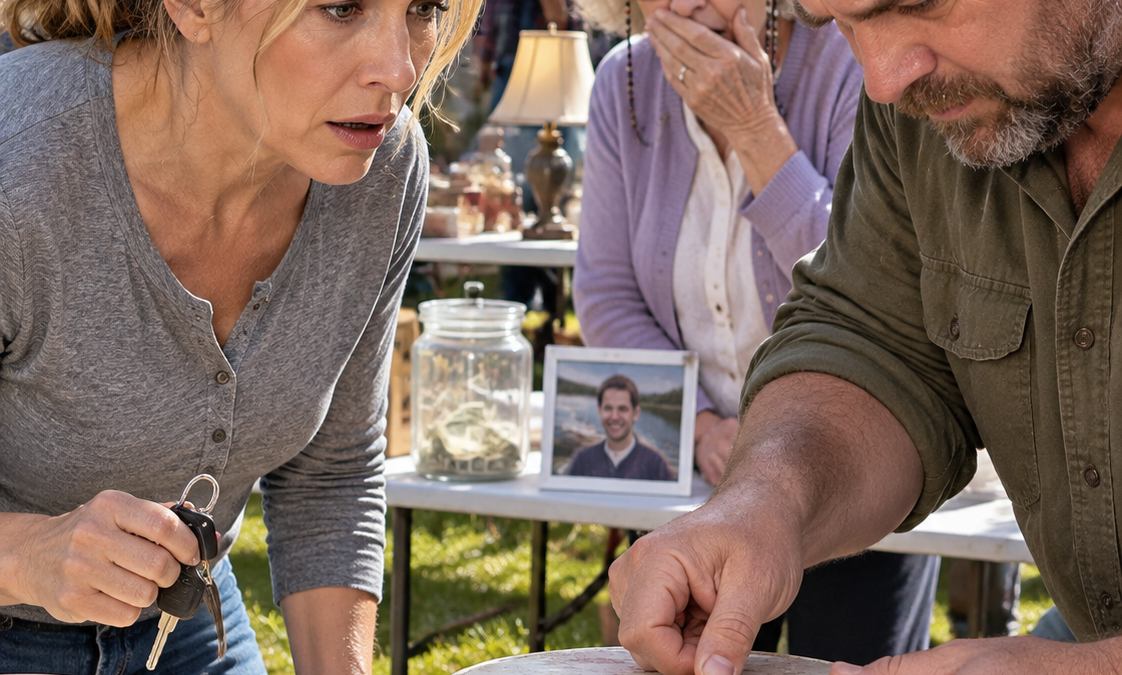
Lance Coffelt peeled a “$2” price sticker from a sheet and pressed it straight onto the lid of a cherry-blossom recipe tin on the sale table.
The $2 tag covered the tape where the boys’ late grandmother, Phyllis, had written, “For Colton & Ryder. Kristy keeps it till they’re grown.”
Lance was forty-seven, Brandon’s older brother, owner of Coffelt Marine, and executor of Phyllis’s will.
That Saturday, Sept. 26, 2026, at 9:40 a.m., her things were being sold off on her front lawn in Camdenton, two months after the funeral.
I had just parked at the curb. The boys followed me from the car.
Lance did not look up.
“Two dollars, Kristy. Same as anybody.”
Ryder stopped beside me.
“Why is Uncle Lance selling Grandma’s stuff?”
Colton leaned closer to the lid.
“Grandma wrote our names on it.”
Lance pressed one corner down with his thumb.
“And I put a price on it.”
A folding table stood a few feet away.
On it sat a donation jar with a photo of Brandon smiling on his bass boat.
Beside the jar, a poster read, “COFFELT BOYS FUND — Every dime goes to Brandon’s boys. Fish Fry, Friday, Oct. 9, Lakeview Veterans Hall”.
A QR code filled one corner.
About 15 neighbors drifted between card tables, boxes, and patio chairs.
Shirley Stroud waited near the folding table. She was seventy-six, president of the hall’s Ladies Auxiliary, and had been Phyllis’s friend for forty years.
Lance stepped up to the jar.
“My brother’s at the bottom of that lake. A judge makes it official on the fifteenth, and then he can finally rest.”
The words carried across the yard.
Colton looked at the picture on the jar.
I stepped close enough that only Lance could hear me.
“Money raised in the boys’ names should go into their savings accounts at Ozark Shores Credit Union. I can give you the account numbers.”
Lance turned toward me.
“You and your child support put my brother in that lake.”
He said it loud enough for the whole lawn.
Shirley looked down at the donation jar.
A man near the driveway picked up a lamp and turned away.
Two women by a box of Christmas decorations stopped talking.
Colton’s shoulders went stiff.
Ryder stared at Lance.
I was forty-one, worked the dispatch window for the Camdenton school district, and gave every bus driver who called in the same radio reply.
“Ten-four.”
He was the executor. Arguing on the lawn in front of the boys would get the tin pulled back. Two dollars made it ours.
I took two one-dollar bills from my wallet and put them in Lance’s hand.
Then I peeled the “$2” sticker off Phyllis’s tape, stuck it inside the lid, and carried the recipe tin to my car.
In the back seat, Ryder settled the cherry-blossom box on his lap.
His older brother took longer.
Colton stopped to look at his dad’s photo behind the clear plastic of the jar.
By the time both boys were in the car, Lance was already talking to another neighbor.
We pulled away from Phyllis’s house while people kept picking through the boxes in the yard.
Halfway home, Colton leaned forward between the seats.
“Can we bring Grandma’s apple pie for Dad’s fund to the fish fry?”
I kept my eyes on the road.
“Your dad owed seven hundred dollars a month for you two through the state Family Support Division, and he stopped paying entirely in early 2024. In July of last year, the county prosecutor charged him, a judge signed a warrant for his arrest, and the prosecutor’s office mailed me a letter about it. Twelve days later, his empty boat was found drifting in a cove near Ha Ha Tonka. His cap and his phone were in the boat. The life jacket was still stowed in its compartment.”
Colton sat back.
Ryder traced one finger along a painted flower on the lid.
“Did Grandma keep the pie recipe in there?”
“Probably.”
At 4:30 p.m., Grandma’s tin sat on my kitchen table, with a boy on either side.
Then Ryder lifted the lid.
The “$2” sticker stayed stuck inside it.
Both boys dumped the recipe cards in front of them and began hunting for Grandma’s apple pie.
Some were newer index cards in Phyllis’s handwriting.
The older ones had a printed line across the top.
“From the kitchen of Phyllis Haskett.”
Ryder held one up.
“Who’s Haskett?”
“Grandma’s name before she married Grandpa. Her brother Lloyd still has it.”
“Lloyd who?”
“Lloyd Haskett.”
Colton slid another card toward himself.
“Chocolate pie.”
Ryder checked behind it.
“Not apple.”
They worked through casseroles, cookies, breads, and cakes.
A stack of stained cards grew near Colton’s elbow.
From the pile, Ryder found a card for dinner rolls and read the title aloud.
His brother reached for the next one.
At the bottom of the stack lay the Veterans Hall fish fry card, folded in quarters.
Brown paper tape held the whole thing shut.
Across one strip, Phyllis had printed, “FISH FRY — for whoever makes the batter.”
With one fingertip, Ryder slowly followed the sealed edges of the folded card, tracing each side without lifting any corner loose.
“Grandma said nobody opens the fish one but the batter lady.”
Colton set the card aside and left it closed.
“Then don’t.”
We checked the remaining cards.
There was no apple pie recipe anywhere in the stack.
Ryder looked at me.
“Maybe Uncle Lance has it.”
“That belonged to Grandma.”
“Maybe she put it somewhere else.”
“Maybe.”
Colton gathered the loose cards into one pile.
“Can we still make something to bring?”
“We can decide later.”
By one corner, Ryder lifted that same card.
“This stays closed?”
“Yes.”
He slipped it underneath the other cards again.
The tin remained on the table where the boys had left it until after supper.
At 9:10 p.m., I sat there alone and filed the cards back behind the tabbed dividers.
Breads.
Cakes.
Cookies.
Main Dishes.
I straightened each section before moving to the next.
The taped card went back into the tin, still unopened, below the cards I had already put away.
Then I reached the divider marked “Pies”.
My hand stopped.
A faint pencil line crossed the lower edge of the tabbed card.
Phyllis’s writing shook more than it had on the older cards.
“Apple — under everything. Not till they need it.”
Part 2 of 7
I turned every card from the cherry-blossom tin upside down on my kitchen table at 7:15 a.m. on Sunday, Sept. 27, 2026.
The bottom of the stack held no apple pie recipe.
Only the fish fry card lay there, folded in quarters and still sealed with brown paper tape.
I did not peel it.
Phyllis’s pencil note on the “Pies” divider said, “Apple — under everything. Not till they need it.” I had taken those words to mean beneath the other cards.
The tin was empty now. I shook it beside my ear and heard nothing.
In one pass, I filed the stack behind the tabbed dividers, leaving the taped one closed. The “$2” sticker stayed inside the lid, and Phyllis’s strip remained across the top.
I set the tin on top of the refrigerator.
A minute later, my younger son came in and glanced up there.
“Did you find Grandma’s pie?”
“No.”
His fingers curled over the back of a chair.
“Maybe she meant somewhere else.”
“Grandma got her notes mixed up at the end, bud.”
He studied the cherry blossoms for another second, then headed down the hall.
The owner at Pappy’s Bait & Tackle was ringing up a dozen nightcrawlers when Colton, Ryder, and I reached the counter by the boat dock at 2:00 p.m. that Sunday.
A second donation jar sat by the register.
Brandon’s photo was taped to the front, with this year’s school pictures of both boys next to it. Below them, a paper label read, “COFFELT BOYS FUND — Lance Coffelt.”
Beside me, Colton glanced over. “Did Uncle Lance ask you for those?”
“No.”
The owner slid the bait container toward us.
“Lance says every dime goes to you boys.”
My older son leaned nearer, one finger under his own smile.
“He put my face on there.”
The man nodded. “Your uncle brought the setup in.”
I kept my hands off the jar.
“Where does the money go?”
“He told me it’s for you two.”
A few folded bills showed through the clear plastic.
Ryder stared at his fourth-grade picture. Then he caught my hand and pulled me toward the door.
“Can we go to the car?”
“Yes, bud.”
I paid for the nightcrawlers with a five and left the change.
Outside, Colton carried the bait. The jar stayed on the counter, exactly where we had found it.
That night at 8:00, Ryder opened his tackle box on the kitchen table.
From beneath a plastic bobber, he took the birthday card Brandon had mailed when Ryder turned seven.
One corner was bent. Inside, the capital letters were thick and square:
“HAPPY 7 BUD. CATCH A BIG ONE. B”
Under the B sat the little fishhook his dad drew on everything he signed.
My son held it by the edges and studied that mark.
“I kept this one,” he said.
“I know.”
He angled it toward me.
“Can I tape it on the jar? So people know he was real.”
I looked from the block letters to the hook.
“Keep it in your box, bud.”
For a moment, his thumb followed the edge without covering the writing.
“Okay.”
He slid it beneath the bobber and closed the lid.
The box went with him down the hall.
Lindsey Hurst set a coffee cup on the sill of my dispatch window at 5:50 a.m. Monday, Sept. 28, 2026.
She was thirty-eight, a Camden County sheriff’s deputy and the district’s school resource officer. Each morning, she rode the first bus out of the lot.
“After church yesterday, Shirley Stroud told me what happened at the yard sale,” Lindsey said.
“She said the boys were standing there when Lance blamed you for Brandon going into the lake.”
I checked the route board, then set my pencil beside the sheet.
“Can I ask you about last year’s charge?”
“Go ahead.”
“Is it still active?”
Her coffee remained on the sill.
“That warrant on Brandon is still sitting in the system. Nobody pulls a warrant on a man without a body.”
“Fourteen months,” I said.
I watched a driver cross toward the line of buses.
“Does that change anything?”
“No. Time doesn’t cancel it.”
The vehicle nearest the gate switched on its headlights.
Lindsey picked up her coffee.
“I’ve got to ride.”
I nodded and returned to the morning routes while she headed across the lot.
At 4:40 p.m. Tuesday, Sept. 29, 2026, my phone rang next to the afternoon route board while I checked returns.
The number on the screen was unfamiliar to me.
I answered.
“Kristy Coffelt.”
A woman’s voice said, “This is Prairie Oak Life, special investigations. I’m reviewing a claim before a court date. Has Brandon sent the boys anything since he went missing? Cards, money, a call?”
The company had carried Brandon’s $250,000 term life policy since 2014, and since 2017 the beneficiary line had read “Colton and Ryder Coffelt.”
As far as I knew, those names were still there.
I looked at the board.
“Cards, money, a call. No. Not one in fourteen months.”
“Not even through somebody else?”
“No.”
The investigator was quiet for a second.
I rested my finger beside an unfinished return time. The office was empty; nobody else could hear her.
The hearing Lance had mentioned on the lawn was set for October fifteenth. Until this call, I knew only that a judge might declare Brandon dead that day.
The woman spoke again.
“Were you told he changed his beneficiary from your sons to his brother Lance on July eighteenth? Nine days before the boat.”
Part 3 of 7
“Changing a beneficiary isn’t a crime, Kristy.”
Lindsey said it through the dispatch window at 5:50 a.m. Wednesday, Sept. 30, 2026, while the first buses warmed in the lot.
I had just passed on yesterday’s call from Prairie Oak: on July eighteenth, Brandon moved his $250,000 policy from Colton and Ryder to Lance, nine days before his boat was found drifting.
Lindsey kept one hand on the sill.
“Bring me something that says he’s breathing.”
I looked past her toward the route board.
“I’ll get you proof.”
“That’s what I need.”
I stood at the probate clerk’s counter in the Camden County courthouse at 12:10 p.m. Wednesday, between my two shifts.
Case.net gave me the case number on my phone. I asked to see Lance’s petition and paid for one copy.
The clerk slid the pages toward me.
Lance had asked the court to declare Brandon dead as of July 27, 2025, because his boat had been found empty.
His signature sat beneath an oath.
Halfway down one page, a sentence read, “Applicant is the sole primary beneficiary of a policy of insurance on the life of the absentee.”
Farther below was another.
“The absentee had every reason to live and no reason to leave.”
The hearing was set for Thursday, Oct. 15, 2026, at 9:00 a.m.
That left me two weeks and a day.
At the next counter, a woman I knew from the front desk of Lance’s lawyer’s office glanced at the copy of the petition in my hands. She said nothing.
I folded those pages and put them in my canvas tote bag.
My phone buzzed at home at 7:00 p.m. Wednesday.
One of my drivers had forwarded a post from the “Camdenton Community Board” group.
Lance had written, “Some people only show up for a dead man’s money. Kristy kept Mom from those boys for two years.”
It had 41 likes.
A parent from route 12 had commented, “Prayers for the Coffelt family.”
I drove Colton and Ryder to Phyllis’s house for pie every Sunday.
Lance’s post went up the same day the woman from his lawyer’s office saw my copy.
Without replying, I locked my phone and set it beside the sink.
My afternoon shift took me out to the middle school loading zone at 3:20 p.m. Thursday, Oct. 1, 2026, because route 12’s time had just changed.
Students were moving toward their buses when I found Colton standing beside Lance’s pickup truck.
Lance sat behind the closed driver’s-side window.
My son had his backpack over one shoulder.
“Colton.”
He looked at me, then at the door handle near his hand.
“Uncle Lance says you’re why Dad went out on the lake. I’m staying at his place. I’m standing up there at the fish fry for Dad.”
The route 12 driver waited with the door open.
I did not ask Colton to choose between us in a parking lot.
I took out my phone instead.
“How long are you staying?”
“Till tomorrow.”
I typed one message to Lance.
“Friday night, Lance. Six o’clock. He’s home for supper.”
A few seconds later, his screen lit inside the cab.
Lance read the text.
Then he raised one hand to me through the closed window.
I stepped back onto the curb.
Colton opened the passenger door, climbed in, and pulled it shut.
The pickup moved past the buses and turned toward the street.
I watched until route 12 had room to leave.
I called Prairie Oak Life’s claims line from the bus lot at 10:00 a.m. Friday, Oct. 2, 2026.
The representative said, “We can’t discuss a policy with someone who isn’t a party to it.”
I ended that call.
I reached the caseworker on our child support case at the state Family Support Division at 11:30 a.m.
“Arrears stay on the books, ma’am. With no location, there’s nothing to enforce.”
“So the $23,100 just piles up,” I said.
“That’s right.”
Afterward, I sat alone behind the wheel of an empty school bus.
The afternoon pickup list rested on my knee.
I drew one line through Colton’s name.
He would not be riding home that day.
Shirley Stroud called my kitchen phone at 7:30 p.m.
Colton had been home since six and was behind his closed bedroom door.
Ryder was in the bath.
Shirley said, “Honey, I need Phyllis’s batter for next Friday. Forty pounds. It’s the taped card at the bottom of her tin. Whoever makes the batter, that’s me now.”
“The one folded in quarters?” I said.
“Mm-hm. She sealed it in June and told me where it’d be.”
“I’ll call you back with the recipe.”
We hung up.
I reached above the fridge for Phyllis’s cherry-blossom tin and put it on the table.
The strip on the lid still carried her handwriting. Lance’s “$2” sticker remained inside.
I found the folded fish fry card among the stack, peeled the brown paper tape away in one pass, and unfolded the quarters.
Between the recipe lines sat a bundle held by a rubber band.
The papers were money transfer receipts.
I spread them across the table and counted 11.
Each one was for $300, dated the fifteenth of a month, from Aug. 15, 2025, through June 15, 2026.
PHYLLIS COFFELT was on the sender line.
The receiver line said LLOYD HASKETT, PORT ARTHUR, TX.
Haskett matched the name printed on Phyllis’s old recipe cards.
Lloyd was her younger brother. I had met him once, at our wedding in June 2012.
I photographed each receipt with my phone.
Under the last one lay an envelope postmarked Port Arthur, with “L. Haskett” written in the upper left corner.
I tipped it, and a photo printed at a drugstore counter slid out onto the table.
Brandon stood in front of a sign that read “HASKETT BOAT YARD — PORT ARTHUR, TX.”
His beard was longer.
Smiling, he held up a redfish.
I turned the photo over.
The print date on the back said 03/02/2026, more than seven months after the lake.
Part 4 of 7
The Port Arthur envelope was not empty.
A sheet of paper, folded in half, was tucked against the back.
I unfolded the sheet across the kitchen table at 7:45 p.m. Friday, Oct. 2, 2026.
Brandon’s block capitals filled the page.
“MAMA — GOT IT. LLOYD’S GOT ME ON AT THE BOAT YARD, CASH. LANCE SAYS ONCE THE JUDGE SIGNS HE WIRES MY HALF. DON’T TELL KRISTY. NOT EVER. B”
Under the B was the same little fishhook Brandon had drawn on Ryder’s birthday card.
Colton had come home at six, eaten supper without a word after I told him, “School nights are home nights,” and shut his bedroom door at seven.
Ryder was still splashing in the tub down the hall.
With my phone, I photographed Brandon’s letter and the drugstore print.
Then I slid both back into the envelope and laid it between the eleven receipts.
The boys were asleep by 9:15 p.m. that Friday when I called Lindsey.
Her voicemail answered.
I left no details there.
Instead, I sent, “I have something on Brandon. Paper. Port Arthur, Texas.”
No answer came that night.
My phone stayed quiet through Saturday morning and most of the day.
Lindsey’s reply arrived at 7:10 p.m. Saturday, Oct. 3.
“I’m in bed by nine. Phones get locked up seven a.m. to seven p.m. here. Jeff City till Thursday, nobody gets on campus. Back Friday afternoon, I’m on the door at the fish fry at 5. Bring them there. No pictures. I need the originals in my hand, chain of custody. Not the front office, Lance has coffee with half the night shift. Not the courthouse, it sits in a pile and the whole building hears. And don’t call Texas.”
Jeff City meant Jefferson City, where Lindsey’s training ran through Thursday, so her seat on the first bus out of our lot stayed empty all week.
I sent no pictures and called no one in Texas.
The receipts and envelope went back inside Phyllis’s batter card.
I set that folded card in the cherry-blossom recipe tin, then put the tin in my canvas tote bag.
The copy of Lance’s petition was already inside.
A knock brought me to the front door at 6:30 p.m. Thursday, Oct. 8, 2026.
I opened it only halfway.
Lance stood on the porch with a printed program in one hand.
“Thought you’d want this.”
I took it from him.
Near the middle, one line read, “6:15 — Colton & Ryder present their dad’s photo. Lance Coffelt: an update on Thursday’s hearing.”
The court date was Oct. 15.
He never asked whether either boy wanted to stand up there.
“Put ’em in something nice. Folks give more when they see the boys.”
I let my arm hang at my side.
“Where does the money go?”
“I don’t get a dime out of this, Kristy. I’m doing it for Brandon’s boys.”
I looked straight at him.
“Ten-four.”
Lance smiled once, turned, and walked down the porch steps.
After his truck left, I scanned the QR code at the bottom with my phone.
A payment screen opened: “Pay Lance Coffelt — @CoffeltMarine.”
I stuck the program on the refrigerator door.
Later, I set the recipe tin on my kitchen table before Colton and Ryder sat down with me at 8:15 p.m.
I took out the envelope and eased the print free.
“Your dad may be living in Texas,” I said. “Tomorrow night, I’m giving the papers to Lindsey.”
Neither boy answered.
I laid the photo where they could see Brandon with the redfish.
Then I opened the letter enough to show the fishhook under the B, keeping my hand over the written lines.
Colton’s eyes moved from Brandon’s face to that mark and stayed there.
“So he’s not in the lake. He just didn’t want to pay for us.”
I did not answer that for Brandon.
Ryder pushed back his chair, went to his room, and returned with the birthday card from his tackle box.
He put it in my bag.
“Show them his hook.”
“I will.”
Both papers went back into the envelope, and I slipped it inside Phyllis’s folded batter card. The card settled into the tin, and I shut the lid.
“This stays in this kitchen till tomorrow night.”
Colton nodded.
His eyes went to the program hanging beside the freezer handle.
He stood, pulled the sheet down, folded it in half, and dropped it in the trash.
By 5:00 p.m. Friday, Oct. 9, about 80 people had filled Lakeview Veterans Hall.
Fish fried in Phyllis’s batter, which Shirley had mixed from the recipe lines I read her over the phone.
The Ladies Auxiliary had a pie table along one wall.
I sat at table 6 with Colton on one side and Ryder on the other.
The tote rested on my lap.
There was no sign of Lindsey at the door.
Shirley came over from the cash table and bent close enough to be heard over the serving line.
“Lindsey got called to a wreck on 54.”
I looked toward the entrance.
If Lindsey did not come that night, I had only the hearing on Oct. 15.
That left Lance six days to learn what I had and call Brandon.
The wall clock showed 6:15 when Lance took the microphone beside an easel in the middle of the hall.
Brandon’s photo and the QR code poster stood on the easel.
Next to him, the main table held a donation jar.
“Colton! Ryder! Come on up here for your daddy.”
Neither moved.
Colton gripped the edge of his folding chair.
Ryder pressed his shoulder against my arm.
Lance laughed into the microphone.
“Their mama’s got ’em trained.”
A few faces turned our way.
He kept going.
“Thursday a judge makes it official. Some folks came tonight for the fish. Kristy came for the money. She’s been after Brandon’s checks since the day he drowned.”
Behind the Ladies Auxiliary’s cash table, Shirley looked at me.
The side door opened at 6:20 p.m.
Lindsey walked in with mud still on the hems of her uniform pants.
From the back of the room, she nodded to me.
Lance was still talking.
I stood up, Phyllis’s tin in both arms, and walked toward his microphone and the donation jar.
Part 5 of 7
I set Phyllis’s cherry-blossom recipe tin, eleven wire receipts inside it, on the main table next to the donation jar at 6:22 p.m., an arm’s length from Lance’s microphone.
Lindsey came up from the back of Lakeview Veterans Hall and took her place at my elbow. Mud had dried in brown ridges along the hems of her uniform pants. About 80 people sat at the long tables around us.
I opened the lid.
The “$2” sticker Lance had put there at the yard sale faced the room.
I pulled out the folded batter card, and one corner of a paper lining at the bottom rose with it; I pressed that corner down with my thumb and went on. Across both palms, I spread the card open.
The bundle lay there under its rubber band, beside the Port Arthur envelope with “L. Haskett” written at its top left.
I drew out the papers and said to the hall, “Phyllis sent three hundred dollars to Lloyd Haskett in Port Arthur, Texas, on the fifteenth of every month from August of last year through June. Eleven times.”
Both went into Lindsey’s hands, and Lance’s eyes followed them from mine to hers.
She slid the rubber band down far enough to read the top one. A pale line crossed the sheet where the band had sat for months.
Below that line ran PHYLLIS COFFELT, then LLOYD HASKETT, PORT ARTHUR, TX, then $300 and AUG 15 2025.
Lance said into the microphone, “Mama sent her baby brother money. That’s family. It isn’t Brandon.”
Turning the envelope, Lindsey brought the postmark upright while the bundle stayed under her thumb.
She read aloud, “Port Arthur, Texas, March third.”
That was seven months after Brandon’s bass boat had been found drifting empty.
She drew the letter out and left the photo inside the envelope. Lindsey read, “Lance says once the judge signs, he wires my half.”
The rest of the sheet stayed folded back; only that line of block capitals showed, and the B at the bottom with its hook.
Lance dug his fingertips into the edge of the easel and said, “Anybody can draw a fishhook. My brother’s at the bottom of that lake.”
I said, “The bottom of that lake.”
Ryder’s birthday card, softened from his tackle box, came out of my canvas tote bag, and I laid it on the main table in front of me.
Next to the card, Lindsey set the letter down, written side up.
The same block-capital B ended both, with a little fishhook drawn under each one.
Ryder said from table 6, “That’s Dad’s hook.”
Colton’s hand left the edge of his folding chair and closed over Ryder’s wrist. Neither boy stood.
Lindsey tipped the envelope until the snapshot slid out.
She held the photo up for the whole hall: Brandon, grinning at the camera, a redfish in his hands in front of the HASKETT BOAT YARD sign. His beard was longer than the last time I saw him.
Three men by the coffee urn swung their folding chairs to face us without standing up.
She turned the photo over.
“March second, twenty twenty-six.”
The drugstore machine had printed 03/02/2026 across the back.
Her gaze came up from the numbers to Lance.
“The wire company keeps the ID of whoever picked these up, Lance. And the felony warrant on Brandon never went anywhere.”
She watched as Lance’s palm left the easel and flattened against his thigh while he kept the microphone up.
Shirley came out from behind the Ladies Auxiliary’s cash table and walked to the easel.
Her phone rose to the QR code on the poster that promised, “Every dime goes to Brandon’s boys.”
When the payment page opened, she read it aloud, “Pay Lance Coffelt.”
A woman at a nearby table who had been aiming hers at the QR code let it drop to her lap.
Shirley stepped from the easel to the main table.
She lifted the donation jar with her free hand and carried it back behind the cash table.
There she held it against her hip, her phone in her other hand.
Her voice broke on the first sound, then climbed.
“That’s Phyllis’s batter in those fryers, Lance. Those are Phyllis’s grandsons. Not your pocket.”
Lance tightened his fingers around the microphone.
I took the copy of Lance’s petition from the tote and opened it to the sworn statement.
His signature sat below it. I held the pages up where Lance could see his own filing.
“You told me you don’t get a dime. You swore to a judge you’re the sole beneficiary. Brandon signed it over to you nine days before the boat.”
I brought the pages down until I could see Lance over them.
The next words had been Lance’s at the yard sale, and now I gave them back to him.
“You said, ‘You and your child support put my brother in that lake.'”
Grease crackled in a fryer behind the serving window, and at the pie table a woman held a metal server still over a cut pie.
With the petition at my chest, I watched Lance’s mouth open once and close.
The pages went down clear of Ryder’s birthday card and Brandon’s letter, and Lance set the microphone on the main table by Phyllis’s tin.
I did not look away from him.
“Your brother was never in that lake, Lance.”
Part 6 of 7
Shirley left the donation jar behind the Ladies Auxiliary’s cash table at 6:55 p.m., crossed to the main table and took up the microphone Lance had set down by the open recipe tin.
“Lance, every dollar that came in under those boys’ names goes into those boys’ names. Tonight.”
Beside me, Lindsey said, “Money people gave for two kids, sitting in your own account. Fix it right here, in front of these folks. I’m writing it up tonight either way.”
Lance took out his phone and opened the Ozark Shores app.
Quietly, I read the two savings account numbers from mine. The digits stayed between us.
From his checking, he sent $2,740 to Colton’s savings and $2,740 to Ryder’s, each as a member-to-member transfer.
He held the screen toward Shirley.
She read the two confirmation lines into the microphone.
“Colton Coffelt, $2,740.”
The screen scrolled under her thumb.
“Ryder Coffelt, $2,740.”
Around the long tables, chairs scraped, and three people near the serving window clapped before others joined them.
The Ladies Auxiliary kept the cash box and the jars, and Lance’s name was on no fund now.
He went through the side door with his phone already at his ear.
Several heads tracked him across the room, but nobody called after him.
Lindsey slipped the photo she was holding and the letter from the main table back into the envelope, then put it with the receipts into an evidence bag.
She gave me a property slip.
“I’m going out to my patrol car to call Port Arthur.”
Ryder’s birthday card and the copy of Lance’s petition went back into my canvas tote bag.
Two women from the Ladies Auxiliary came to the main table with a fish fry supply box.
Still holding the microphone, Shirley touched the open lid.
“I’ll copy her batter card for the Auxiliary book and bring the tin Tuesday, honey.”
I let them close the tin and pack it into the box; Phyllis had made the batter for this hall for thirty years.
My phone rang in my kitchen at 9:30 a.m. Saturday, Oct. 10, 2026.
From the other end, Lindsey said Port Arthur police had arrested Brandon at Lloyd’s house at 9:40 the night before on the Missouri felony warrant.
Brandon was being held in the Jefferson County jail in Texas, waiting to be sent back to Missouri.
Then she gave me the support arrears through the October payment.
“Twenty-three thousand one hundred, and now FSD has an address.”
“Twenty-three thousand one hundred.”
After we hung up, I called the number the Prairie Oak investigator had used and left a voicemail saying Brandon was arrested and Lindsey Hurst had the report.
That evening, Lloyd called me.
He had found me on a list Phyllis had mailed him in June, headed “If anything happens to me.”
“Lance called Brandon a little before seven. He was stuffing a bag and hollering for my truck keys. I kept them in my pocket and told him, sit down, I’ll drive you at first light. Phyllis made me promise I’d keep him fed. She never made me promise I’d lie for him.”
On Lloyd’s end, a lighter clicked twice. “Brandon was ready to run again and leave his own boys behind.”
“I opened the door myself. Port Arthur took my statement. Whatever a judge says I’ve got coming, I’ll take it.”
Case.net showed a new entry in the probate case when I checked my phone at 10:00 a.m. Tuesday, Oct. 13, 2026.
A dismissal had been filed for Lance’s petition, and the hearing on Thursday, Oct. 15, was gone from the calendar.
That afternoon, Lindsey called me at work.
She said the Prairie Oak investigator had asked her for the arrest report.
Lance’s claim was denied, his file went to the fraud unit, and the insurer reported him to the Missouri Department of Commerce and Insurance.
I went back to matching drivers with afternoon runs.
Colton stood at my dispatch window at 3:25 p.m. that Tuesday, his backpack on his shoulder.
“Can I sit with you till you’re off?”
I pulled a folding chair up beside the dispatch desk.
He worked through math homework while buses checked in and keys changed hands.
When my shift ended, he zipped his binder away and stood up.
Houses slid past his window most of the way home.
“I’m not going to Uncle Lance’s anymore.”
I reached across the console and squeezed his shoulder once.
Before supper that Tuesday, Shirley came into the house carrying the recipe tin and a glass pie plate Phyllis had loaned her last year.
She placed both on the kitchen table in front of me, Colton and Ryder.
“Copied her batter card. And she’d want this plate back where her pies get made.”
Her coat hung crooked after she missed the second buttonhole; she started the row again from the top.
“I stood on that lawn and let him say it to you. I’m sorry, honey.”
“Thank you, Shirley.”
She tugged the front straight, patted the pocket where her car keys sat, and left.
The fryer-oil smell of the hall kitchen was still in the recipe tin at 7:40 p.m. that Tuesday, so Ryder took it to the sink with a damp dish towel.
I had stacked the cards on the counter beside me.
When he reached the bottom, one corner stuck up.
Ryder pinched it and lifted the paper lining.
Beneath it lay an apple pie recipe card that read “Apple Pie — for my boys” and a savings passbook from Ozark Shores Credit Union in Phyllis’s name, with “Kristy Coffelt” on the payable-on-death line.
He drew both into his hands.
Inside the lid, the “$2” sticker still faced him.
At last I understood “under everything.”
Ryder set the passbook on the counter and gave me the recipe.
I turned the card over.
In Phyllis’s shaky handwriting, the back read, “Kristy — every time I sent Lloyd three hundred for Brandon, I put three hundred in this book for the boys. It’s in your name because you’re the one who stayed. I left the rest in my batter for whoever came asking. Bake this for them. — Phyllis”
Part 7 of 7
I slid the passbook and my driver’s license across the teller counter at 10:00 a.m. Wednesday, Oct. 14, 2026. Lance was still the executor of Phyllis’s estate, and I did not know whether the credit union would pay me or hold the money for him.
The teller sat behind the counter with a screen open and a CLOSED stamp beside her keyboard. She took the passbook and looked up the account.
“There are eleven deposits of $300.”
“Eleven.”
“Each one was made on the fifteenth, August 2025 through June 2026.”
The fifteenth was the date on every receipt in Lindsey’s evidence bag.
“That’s $3,300, plus a little interest.”
She opened another screen.
“Phyllis’s death certificate is already on file. Lance closed her checking account here in August.”
The passbook lay open between us.
“Does the executor have to approve the withdrawal?”
The teller shook her head.
“This kind of savings doesn’t become part of the estate. The executor can’t draw on it.”
She turned the screen slightly toward me.
“It’s paid to the person named on the payable-on-death line.”
My name appeared beneath Phyllis’s.
She checked my license and completed the withdrawal. I asked her to split the money evenly between Colton’s and Ryder’s savings accounts here.
Two deposits went through separately, and then she reached for the CLOSED stamp.
It thumped once on the last page, and she handed both back to me.
I pressed my thumb beside the wet CLOSED before returning my license to my wallet. The passbook went into my purse.
“It goes back in the tin.”
The teller nodded and moved the next account onto her screen. My morning shift was over, but the afternoon routes still needed dispatching.
The recipe tin sat open on the kitchen table at 7:00 p.m. that Wednesday, with Colton and Ryder seated side by side across from me.
The “$2” sticker clung to the inside of the lid, and Phyllis’s tape note still ran along the outside. Cherry blossoms covered the paper lining at the bottom.
The apple pie card lay beside my hand, and the stamped passbook waited in front of Colton.
I read the back of the card aloud to the boys, including Phyllis’s words about the money she had put away and why she had named me.
“Did Grandma know the whole time?” Colton asked.
“She knew. She was wrong to keep it from you, bud. And every month she picked you two.”
I placed the card face up between the boys.
Colton opened to the last page and ran one fingertip under CLOSED.
“Why’d Grandma put your name on the passbook instead of mine or Ryder’s?”
“Staying doesn’t usually get you thanked. Your grandma thanked me anyway.”
From the kitchen drawer behind my chair, I took a roll of tape, tore off a strip and passed it to Ryder.
Without a word, he lifted the passbook from Colton, laid it flat in the bottom of the tin and lowered the paper lining over it.
The strip went across the corner under his thumb until the tape held.
Six weeks later, flour covered half my counter by 11:00 a.m. on Thanksgiving, Thursday, Nov. 26, 2026, and Colton had the rolling pin.
The card, titled “Apple Pie — for my boys,” was propped against the recipe tin on the counter.
Step one was the bottom crust, and Colton rolled it wider than Phyllis’s glass pie plate before easing it in without a tear.
Phyllis’s handwriting called for apples sliced “thin as a dime.” Ryder stood beside Colton with a paring knife, stacking the slices on a cutting board.
Partway through, my phone rang near the flour.
The screen showed Lloyd’s name. Ryder tapped the speaker button himself before Lloyd spoke.
“Happy Thanksgiving, Kristy,” Lloyd said. “Is that pie going to taste like my sister’s?”
“We’ll tell you after,” Ryder said without looking up from the cutting board. Lloyd laughed and hung up.
The apple slices went into the glass pie plate, fanned over the bottom crust. Colton covered them with the top crust, and Ryder cut the steam vents with the paring knife.
Shirley stood by the range and turned the dial a notch.
“Turkey comes out at three,” Shirley said, wiping the oven handle. “Pie goes in after.”
The timer buzzed at 4:00 p.m. that Thanksgiving, and Shirley brought out the finished pie.
Its top crust had gone gold. She carried the glass pie plate to the table on a folded pot holder.
Ryder cut the first slice and set it on a small plate beside a picture of Phyllis at the head of the table, then passed the pie server to Colton.
“Next fish fry, we do Grandma’s pie table,” Colton told Shirley.
“The Auxiliary already put your names on it,” Shirley said.
Colton cut another slice for her, and she pulled out a chair.
At the counter, I closed the recipe tin and wiped the flour off it with a dish towel.
Ryder set the tin back on top of the fridge, where it lives now. Lance’s two-dollar sticker is still inside the lid. Under it, in marker, Ryder wrote: NOT FOR SALE.
THE END
More stories
My husband hid my sister’s letters for 7 years — Then a mailman brought envelope “#29,” and he was served divorce papers at work with employees and customers present.My sister’s new mother-in-law charged $6,400 to my sister’s card for her own trip—then the check-in agent announced that all three tickets had been canceled.My ex-husband told his new wife $1,150 monthly supported our son—until I read the state’s closing letter beside his birthday cake, and she told 30 guests she’d filed for divorce.My Sister Gave Mom’s Bedroom to Her In-Laws and Put Mom on a Cot in the Sewing Room, Then Threw Them a Party, Until Mom Showed Everyone the Credit Cards Opened in Her Name.My boss gave his daughter until Friday to leave her home after 16 years—then the folder he left on my counter helped stop his auctionMy brother-in-law used a $180 drill in Mom’s purse to push care-home papers—Until the store owner checked his cameras and my sister tore up the forms.








