My Stepmother Barred Me From Home After Spinal Surgery — Then Her Locksmith Walked Into My Hospital Room
Part 3: The Picture On His Phone
“That’s her upstairs entrance,” Warren said.
Joel brought the phone closer so I could see.
The photograph showed my separate exterior door.
A new hasp crossed the outside of its frame.
A padlock hung through it.
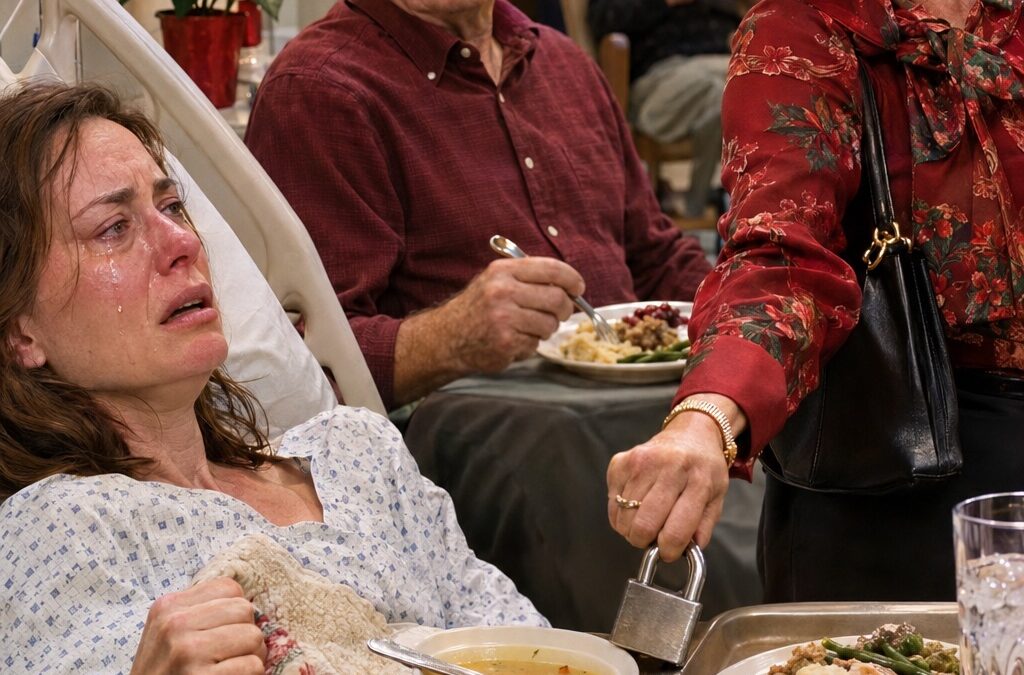
It wasn’t the loose lock beside my hospital tray.
That one had apparently been bought as a spare.
The installed lock was plainly visible in Joel’s photograph.
I knew the chipped corner of my own doorstep.
I knew the small drainage channel beside the frame.
There was no shared hallway behind that door.
It opened to the stairs serving only my apartment.
My father and Celia had their own downstairs entrance.
There wasn’t an interior connecting door between our homes.
They hadn’t secured their rental.
They had blocked the only entrance to mine.
“When was this taken?” I asked.
“December 24, 2025,” Joel said. “After I finished.”
My father rubbed his thumb along his plate’s edge.
Celia stared at the picture without reaching for it.
Joel explained that he routinely photographed completed exterior work.
It protected him if someone later disputed the installation.
He had kept this image in his job record.
My father hadn’t known he still had it.
“He said you wanted the vacant unit secured,” Joel told me.
“It wasn’t vacant.”
“I understand that now.”
“What did he give you?”
“His identification and his address. He lives there.”
“He lives downstairs.”
Joel nodded, looking directly at me.
“He said he was arranging this with your permission.”
My father leaned forward.
“I was dealing with a situation she couldn’t handle.”
“Did you tell him I was in the hospital?”
“I told him what he needed to know.”
Joel looked down at the photograph again.
“I was told the owner approved the work.”
“I’m the owner.”
“Yes. I understand that now.”
He was 52, with gray showing through his beard.
He kept his voice low in the hospital room.
He had been visiting another patient across the hall.
Now he was checking a job he had finished yesterday.
He asked to see the property documents on my phone.
I showed him the recorded deed first.
My purchase date was August 16, 2019.
My name was the only owner’s name.
Then I opened the signed downstairs rental agreement.
Their month-to-month tenancy began March 1, 2023.
The rent was $650, with calendar-month rental periods.
The description identified only the downstairs apartment.
I enlarged that section and handed Warren my phone.
He read it without speaking.
My father watched his brother’s face instead of mine.
“You’ve been there,” I said to Warren.
“I know.”
“You’ve eaten in my kitchen.”
“I know, Maren.”
“Then why did you think I couldn’t go home?”
He looked at Leonard before answering.
“Your father said you’d agreed to move out.”
I reached for my spoon, then left it alone.
The soup had developed a skin across the top.
“He said you were giving them the upstairs,” Warren continued.
“During recovery?”
“He made it sound like you weren’t coming back.”
My father pushed his chair away from the bed.
“I said we were discussing it.”
“No,” Warren said. “You said she had agreed.”
Celia pulled her purse into her lap.
“She shouldn’t live alone after an operation.”
“Nina is helping me.”
“That isn’t the same as family.”
Nina was 40, a year older than me.
She had already agreed to be my discharge support.
She had my instructions and the hospital contact information.
Neither Leonard nor Celia had asked about those arrangements.
They had hired someone to block my door instead.
Warren returned my phone.
“Was there ever an agreement for upstairs?”
“No.”
“Your father mentioned another rent amount.”
“An additional $950 if I ever moved.”
“And did you?”
“No. My clothes are still upstairs.”
Celia tugged her purse zipper back and forth.
“That was too much for family.”
“It was a proposed rent. You didn’t accept it.”
My father said we were getting away from the issue.
According to him, the issue was my condition.
He pointed at the equipment beside my bed.
I had undergone spinal surgery on December 22.
Standing still took help and concentration.
Moving my legs under the blanket took thought.
I wasn’t pretending otherwise.
But I hadn’t agreed to leave my apartment.
“The therapists will assess the stairs,” I said.
“That won’t make you ready.”
“You don’t decide my discharge.”
Celia turned to Warren.
“Tell her we can’t have strangers coming through constantly.”
“Through where?” he asked.
She didn’t answer immediately.
“Her entrance doesn’t go through your apartment,” he said.
Joel asked whether I had authorized any lock work.
“No.”
“Did anyone representing you authorize it?”
“No.”
He lowered his phone.
“Then I need to correct what I installed.”
My father reached for his coat.
“You’re taking her word over mine?”
“I’ve seen the deed and the rental agreement.”
“She’s had medication.”
“I can read the agreement,” Warren said.
My father looked at his brother for several seconds.
Then he turned back to Joel.
“You were hired to secure a door.”
“And I was told the owner approved it.”
The loose padlock remained beside my tray.
Warren had taken it from Celia’s hand earlier.
He had set it down where she couldn’t keep waving it.
She hadn’t tried to retrieve it again.
I asked Joel to send me his photograph.
The image arrived while everyone waited.
I saved it with the deed and agreement.
Then I sent those materials to Nina.
I asked her not to call my father.
I needed copies outside that hospital room.
Joel explained exactly what he could correct.
He would remove his hardware from my separate entrance.
He would not enter or alter the downstairs apartment.
He needed my written authorization and the ownership records.
I asked him to email his account of the job.
He agreed without making excuses.
“I should have verified more before doing it.”
My father tried to interrupt.
Warren raised his hand toward him.
“Let him finish.”
“I’m sorry,” Joel told me.
I nodded and reached for my water.
Warren moved it closer before I had to ask.
My back had started aching from sitting upright.
I pressed the call button for help adjusting the bed.
Everyone waited while I got settled again.
Celia checked her phone.
My father kept his coat across his knees.
When I could speak comfortably, I asked Joel about returning.
He could restore access on December 26, 2025.
I would still be in the hospital.
I didn’t want him confronting my father alone.
I also didn’t want Nina handling another family argument.
My father heard the date and shook his head.
“You’re not sending somebody over there behind my back.”
“It’s my entrance.”
Joel glanced toward Warren, then back at me.
“Will someone be there with me?”
Part 4: The Door I Needed Open
“I will,” Warren said.
He moved his plate onto an empty chair.
Then he took out his phone.
“What time do you need me there?”
My father stared at his younger brother.
“You’re actually going along with this?”
“I’m going with the man who installed the lock.”
“You don’t know what she’s been saying.”
“I know what you told me.”
Warren was 64, three years younger than Leonard.
I had seen him let my father finish arguments before.
This time, he opened his calendar and waited.
Joel gave him a time for the following morning.
I asked both men to confirm it with me.
Celia stood and pulled her purse onto her shoulder.
She left the loose padlock beside my tray.
My father waited for Warren to follow them.
Warren stayed seated.
After they left, Joel reviewed the arrangements with me.
I sent the documents and written authorization he requested.
My normal entrance lock would remain in place.
Their downstairs locks would not be touched.
He would document the frame before removing his work.
Then he would photograph the corrected entrance.
“Will the screw holes need repairing?” I asked.
“Yes. I’ll take care of those.”
“Don’t go through their apartment for anything.”
“I won’t need to.”
“There’s no connecting door anyway.”
“I understand.”
He showed me the saved photograph once more.
I checked that the copy on my phone matched.
Then he returned to the person he had been visiting.
Warren walked him out and came back.
He stood beside the visitor chair for a while.
“I thought he was being difficult about timing.”
“He told you I had agreed.”
“Yes.”
“You could have asked me.”
He lowered his eyes to the padlock.
“Yes,” he said again.
I wasn’t ready to reassure him.
I asked him to connect my phone charger.
He plugged it in and placed the cord within reach.
Then he asked what else I needed.
“Don’t negotiate my home while I’m not there.”
“I won’t.”
“Not even to keep everyone calm.”
He pulled the chair closer.
“I understand.”
I asked him to put the padlock in my bag.
He wrapped it in a spare plastic bag first.
I didn’t want it loose against my clothes.
There was no reason to leave it beside dinner.
After Warren left, I called Nina.
She answered with a pen scraping across paper.
She had been organizing my discharge instructions.
I told her what happened without softening it.
“Do you want me there now?” she asked.
“Check what I sent first.”
“Are they still in the room?”
“No.”
“Good. Let me open everything.”
I heard her set the pen down.
We went through the documents together by phone.
The deed was where I expected it to be.
The rental agreement had both their signatures.
There was no upstairs amendment or later lease.
I found the messages about the additional space.
The $950 proposal was still there.
Their refusal to pay additional rent was there too.
Nina asked whether I wanted to answer them that evening.
“No. I want to write this down.”
I opened a note and recorded what I remembered.
I included the date and who had been present.
I wrote what Joel said about permission.
I wrote Warren’s account of what Leonard told him.
I kept my own recollection separate from theirs.
Medication and exhaustion made details harder to keep straight.
I wanted the account finished while it was fresh.
On December 26, Warren called from outside my building.
Joel stood beside him on the video screen.
My father was near his own downstairs doorway.
He wasn’t blocking Joel.
He was speaking loudly enough for me to hear.
“She isn’t even coming home today.”
“I’m restoring her access,” Joel said.
Celia appeared behind Leonard.
“Who said Warren could come over?”
“Maren,” Warren answered.
Joel confirmed that he had checked my documents.
Then he showed me the hasp before starting.
I could see the same chipped doorstep.
I could see the little drainage channel.
Nothing in the photograph had been misunderstood.
They had secured my separate entrance from outside.
I watched until I needed to reposition in bed.
When I returned to the call, the hardware was off.
Joel photographed the area before repairing the screw holes.
My ordinary entrance lock remained unchanged.
The existing authorized key still worked.
Nobody entered their downstairs apartment.
Nobody touched their belongings or their door.
Warren carried the phone up my stairs.
My apartment looked exactly as I had left it.
The couch blanket was folded unevenly.
A clean mug sat upside down beside the sink.
My slippers were beneath the chair.
“Can you show me the kitchen?” I asked.
He turned the phone slowly.
There was my saucepan on the stove.
There was my mail on the table.
There was nothing vacant about that apartment.
“Check the fridge, please.”
He did.
Then I asked him to move some kitchen towels.
They were in a low drawer I couldn’t safely reach.
He put a few on the counter.
He asked before moving the chair near my table.
I told him where Nina could leave my instructions.
For several minutes, we discussed nothing but practical arrangements.
Then Celia called my phone.
I let it go unanswered.
Her message arrived while Warren was still upstairs.
She said visitors would disturb their downstairs routine.
She wanted me to check with them before scheduling help.
I forwarded the message to Nina.
I didn’t ask Celia to approve my discharge support.
Before leaving, Joel sent the completion photographs.
He included a short account of the corrected work.
I saved everything beside his original photograph.
That afternoon, I contacted a local attorney.
She asked for the deed and signed rental agreement.
She asked about the separate entrances and rental periods.
She asked whether anything downstairs had been changed.
I told her their access and utilities remained untouched.
“Keep it that way,” she said.
She would review the documents and applicable notice requirements.
I set down the phone and called Nina again.
She offered to wash my spoon and take it home.
I asked her to bring it when I was discharged.
Then the attorney called back.
She had reviewed the downstairs tenancy.
“Are you ready to give written termination notice?”
Part 5: The Notice They Would Receive
I asked her to explain the process first.
She spoke slowly enough for me to take notes.
The downstairs tenancy renewed by calendar month.
Written notice needed to allow the required advance time.
She proposed ending the tenancy January 31, 2026.
The notice would be served December 29, 2025.
That allowed more than thirty days before termination.
It would not authorize me to remove them myself.
It would not let me shut off utilities.
If they stayed, further notice and court proceedings would follow.
“What if he says I’m not making good decisions?”
“Has anyone been given authority to decide for you?”
“No.”
“Then your father doesn’t get that authority by saying it.”
I pressed my pen against the discharge folder.
“What if he says we had a family understanding?”
“We’ll preserve the actual agreement and communications.”
I looked at the rental agreement on my phone.
Before they moved downstairs, Leonard had resisted signing it.
He said nobody needed paperwork between parents and children.
I had insisted on describing the apartment clearly.
The duplex was my largest responsibility.
I worked as a medical billing clerk.
I couldn’t afford confusion about who owed what.
Now I read the premises description twice.
It said downstairs.
It had always said downstairs.
The attorney did not promise an effortless ending.
She said I needed to keep answering legitimate maintenance requests.
Their home remained theirs during the lawful tenancy.
Even after termination, I could not remove them myself.
“I understand.”
“Can you keep communications factual?”
“I can send housing questions to you.”
“That would help.”
I authorized her to prepare and serve the notice.
Then I put the documents away for the evening.
My back needed attention more urgently than my phone.
On December 29, the hospital completed my discharge arrangements.
My ability to manage stairs had been assessed.
We reviewed the help I would need at home.
Nina listened beside me with the instructions open.
She asked which symptoms required a call.
She checked the medication list against the discharge paperwork.
She didn’t promise I could manage without assistance.
I didn’t either.
She placed the folder where I could reach it.
My father wasn’t asked to approve anything.
I didn’t call him from the hospital lobby.
Nina drove me home with my bag beside me.
Warren met us outside at my request.
He carried the bag while Nina stayed close.
I looked at my entrance before we opened it.
The hasp was gone.
Small repaired spots remained where the screws had been.
My ordinary key worked.
We used the stair method I had practiced.
We didn’t rush.
Warren waited instead of advising me from behind.
At the landing, I needed to sit.
Nina had the chair ready.
My father’s television was audible downstairs.
I listened for his door while catching my breath.
It stayed closed.
Nina helped me settle on the couch.
She placed water and my phone within reach.
Warren checked the route to the bathroom.
He moved nothing without asking.
The apartment smelled faintly stale after being shut up.
Nina opened the curtains.
Warren put the grocery bags on the counter.
I was home, but there was still work to do.
We checked the medication schedule.
We checked where I would sleep and sit.
Nina put my clean spoon in the kitchen drawer.
I watched her do that and started crying.
She brought tissues without asking me to explain.
Warren took the empty grocery bags outside.
I wiped my face and asked for some water.
Later, the attorney confirmed service of the termination notice.
It identified the downstairs premises and the ending date.
It did not demand immediate removal.
It did not pretend a judge had already ruled.
I saved the service confirmation with the agreement.
My father called after receiving it.
Nina stayed while I answered.
“You arranged this while you were in the hospital?”
“I asked an attorney to handle the notice.”
“You couldn’t come tell us yourself?”
“I’m recovering from surgery.”
“So that matters when it helps you.”
I adjusted the pillow behind my back.
“The tenancy ends January 31.”
He said I was using his age against him.
Leonard was 67.
Celia was 63.
Neither age changed which apartment they had rented.
I told him the notice concerned our housing arrangement.
He said he had paid the agreed rent.
“I know.”
“Then what’s your complaint?”
“Paying downstairs rent doesn’t give you upstairs.”
“We were trying to help.”
I looked at the chair Warren had moved for me.
“Then you could have asked what I needed.”
Leonard said he remembered helping me plenty.
He wanted to know whether I kept a record of everything.
I didn’t answer that question.
In summer 2022, I had used vacation time caring for him.
I had provided unpaid evening care after his knee surgery.
I remembered warming a washcloth at his bathroom sink.
I washed his incision-side leg carefully, following the instructions.
I moved his walker close before he stood.
I stayed through his evening exercises, counting with him.
There was no bill for that summer.
I wasn’t claiming a financial loss now.
But I remembered asking whether the water felt too hot.
I remembered waiting while he rested between movements.
“You knew what recovering at home involved,” I said.
“And that’s why we were concerned.”
“Concern didn’t require a lock.”
Celia took the phone.
“We could have put you on our couch.”
“My discharge plan is for my apartment.”
“You insist on making everything harder.”
She asked whether upstairs would be wasted during workdays.
“It’s where I live.”
“We need more space.”
“There is no upstairs rental agreement.”
She paused.
Then she asked whether I would reconsider the additional rent.
“The upstairs isn’t being offered anymore.”
My father returned to the phone.
He said Warren would talk sense into me.
“Warren doesn’t decide this either.”
I ended the call before my next medication time.
Nina helped me record its main points.
I sent the note to the attorney.
For dinner, she heated soup in my saucepan.
I ate slowly against the cushion behind me.
There was no padlock beside my bowl.
Before I finished, Celia sent another message.
They would not leave the downstairs apartment.
Part 6: The Apartment Below Mine
I forwarded the message without answering.
Then I placed my phone facedown beside my bowl.
There was nothing useful to say that evening.
The attorney had explained what would happen next.
I didn’t need to argue through every step.
The downstairs apartment remained occupied as usual.
Their mail arrived.
Their lights stayed on.
Their entrance remained theirs to use.
I didn’t interfere with any of it.
I heard their ordinary movements through the building.
A cupboard closed while I was making breakfast.
Their television came on while I was resting.
Those sounds reminded me that notice wasn’t removal.
They still had rights I needed to respect.
When Celia reported a plumbing problem, I responded.
I asked for enough detail to arrange the repair.
Then I contacted the appropriate repair person.
Access was scheduled with the required notice.
I kept the invoice and completion confirmation.
I didn’t attach an argument about Christmas.
That took more effort than I expected.
I typed a sentence about how they treated my doorway.
Then I deleted it.
The plumbing problem needed fixing either way.
My attorney had been clear about that.
Their downstairs home wasn’t a bargaining tool.
Neither was my upstairs home.
Nina kept helping with my recovery.
She put groceries where I could reach them.
She helped with tasks I couldn’t safely manage.
As I improved, she let me do more.
If she moved a kitchen item, she showed me.
If she offered to call someone, she asked first.
One afternoon she lifted my saucepan from a low cupboard.
“Counter or upper shelf?”
“Counter for now.”
“Want me to leave it here afterward?”
“Yes, please.”
She didn’t explain why she knew better.
She put it where I had asked.
I began handling ordinary tasks for longer stretches.
Some days I could sort paperwork at the table.
Other days I stopped early and rested.
I followed my medical instructions rather than my father’s predictions.
There were follow-up appointments and medication questions.
There were laundry loads I couldn’t carry downstairs.
Nina helped arrange what I actually needed.
I didn’t give Leonard a daily report.
He occasionally sent a message about cold weather.
I answered when an answer was necessary.
A friendly opening didn’t replace the housing issue.
Celia sent suggestions for upstairs furniture arrangements.
She wanted a different room used as a sitting room.
She described where their extra belongings could fit.
I saved the messages without discussing my couch.
They had not accepted the $950 proposal.
They had not received possession upstairs.
They had not acquired it by making decorating plans.
Warren called after speaking with my father.
“He says you’re making him homeless.”
“Is he looking for another place?”
“He wants me to talk you out of this.”
I set down the towel I was folding.
“Is that why you called?”
“No.”
“Because I’m not discussing it through you.”
“I know.”
He sounded tired.
I didn’t offer to make the conversation easier.
He said he had offered help viewing rentals.
Leonard had refused because he expected me to reconsider.
“He thinks you’ll calm down,” Warren said.
“I’m following the process.”
“I told him that.”
“Then there’s nothing else for you to explain.”
Warren asked whether I needed anything from the store.
I gave him a short list.
When he brought it, he didn’t carry it downstairs first.
He came to my entrance and waited for me.
I was still annoyed with him about Christmas.
I could also accept the groceries he had offered.
We put the items away without another family discussion.
My father called one evening while Nina was there.
He asked whether I was comfortable.
I said I was managing with help.
Then he asked whether the notice could be canceled.
“No.”
“You don’t even want to talk about it?”
“I’ve talked about it.”
“We’re right downstairs if you need us.”
“I’ve made other arrangements.”
He went quiet.
Then he said I was making a permanent decision over one incident.
I looked toward my doorway.
It had taken planning to hire Joel.
It had taken an explanation about a supposedly vacant unit.
Then Celia had brought a spare lock to my hospital.
It hadn’t happened in one careless sentence.
“I’m not renewing the tenancy,” I said.
He asked whether an apology would change that.
“I would listen to an apology.”
“But would it change it?”
“No.”
He ended the call without giving one.
I wrote down the conversation afterward.
I didn’t send him another explanation.
Before the termination date, the attorney checked in.
She asked whether any new agreement had been made.
“No.”
“Have you accepted any payment for a later period?”
“No.”
“Have they surrendered possession?”
“No.”
Their curtains remained in the windows.
Their furniture remained inside.
Celia was still receiving packages at their door.
I had no reason to think they were preparing to leave.
The attorney reviewed what I should do after January 31.
I wrote the dates on a calendar.
I did not post them where Leonard would see them.
This wasn’t a countdown I needed to perform for him.
On January 31, 2026, the tenancy ended under the notice.
I spent part of that day resting.
I washed a few dishes.
I checked the lock on my own entrance before bed.
Nobody arrived to carry out their furniture.
No authority appeared simply because a date had passed.
Their belongings remained downstairs the following morning.
I took no steps to remove them.
I sent the attorney a factual update.
Then I made breakfast and followed my medication schedule.
My father called before noon.
He sounded almost cheerful.
“Well, we’re still here.”
“I know.”
“So what happens now?”
“The attorney will handle the next steps.”
“You really want to keep doing this?”
“I’m not making another agreement.”
He said the same thing again, more slowly.
“We’re still here, Maren.”
After we hung up, the attorney returned my message.
The next written notice was ready for service.
Part 7: The Papers On My Table
On February 2, 2026, the required holdover notice was served.
The attorney handled its wording and service.
She explained the waiting period before filing.
I wrote down what she told me.
I didn’t attach my own letter.
I didn’t knock downstairs demanding an immediate answer.
Celia texted asking whether the notice was real.
I referred her to the attorney’s contact information.
She replied that I could still stop everything.
I left that message unanswered.
My father called Warren instead of me.
He wanted his brother to describe me as confused.
Warren refused.
Then Leonard suggested surgery had changed my temperament.
Warren asked whether that explained the lock installed beforehand.
My father ended that conversation.
Warren told me afterward because the attorney should know.
He didn’t ask me to settle their disagreement.
“What exactly did he ask you to say?” I asked.
Warren repeated it as closely as he could.
I wrote it down without adding anything.
“Did he say who you should tell?”
“He wanted me to start with you.”
“Then what?”
“I didn’t let him finish that plan.”
I sent the attorney the account.
She reminded me to focus on the tenancy.
My father’s opinions about my mood didn’t change the documents.
On February 6, 2026, the possession action was filed.
The papers identified the downstairs apartment.
They described the terminated month-to-month tenancy.
They did not claim he had rented the whole building.
I read them carefully before the attorney proceeded.
I checked the March 1, 2023, start date.
I checked the monthly rent.
I checked the January 31 termination date.
Then I put the file away.
I had billing work and recovery tasks of my own.
I didn’t want the case spread over every surface.
My father tried sending another rent payment.
I contacted the attorney before doing anything with it.
I had been warned not to casually accept later rent.
I didn’t deposit it and hope explanations would fix things.
The attorney handled the proposed payment.
It was returned with the appropriate written explanation.
No new tenancy was created.
Leonard called as soon as he learned that.
“You always wanted the rent before.”
“For the tenancy that ended.”
“So now money isn’t good enough?”
“This isn’t a rent negotiation.”
“I’m offering to pay what we agreed.”
“You were given notice ending that agreement.”
He said he would explain it to the judge.
I told him he could present his position there.
I didn’t coach him about what to say.
I also didn’t threaten what would happen if he lost.
The attorney would handle the case.
Celia tried a different approach that evening.
She offered to sign something about staying out of upstairs.
The downstairs arrangement could continue, she suggested.
I read her message at my kitchen table.
Nina was putting clean towels away.
“Do you need me to write anything down?” she asked.
“No. It’s a message.”
I sent it to the attorney.
Then I replied that the possession case would proceed.
Celia called my answer cold.
I stopped looking at the phone.
Nina asked where I wanted the towels.
I pointed to the shelf I could reach.
That conversation was easier to finish.
Warren continued offering practical help to Leonard and Celia.
He would drive them to view a place.
He would help carry manageable belongings.
He would not promise them more time in my building.
When my father asked him to guarantee I would reconsider, he declined.
Warren told me that much and no more.
I didn’t need a report on every rental they rejected.
I needed him not to offer my apartment.
As the hearing approached, I assembled my documents.
The recorded deed came first.
The signed downstairs agreement followed.
Then came the termination notice and service records.
The holdover notice and court papers went behind those.
Joel’s original photograph remained in its original message.
His correction photographs were stored beside it.
I saved copies without replacing the original files.
I kept Warren’s account separate from my own notes.
The attorney decided what the court actually needed.
She told me the hearing concerned possession.
It wasn’t a trial of every family grievance.
That was a relief.
I didn’t want to explain every difficult holiday.
I didn’t want to assign a price to caring for Leonard.
There was no damages claim for my vacation time.
There was no criminal charge against either of them.
I wanted the downstairs tenancy resolved through the proper process.
The attorney checked the dates once more.
She checked the notice periods and proof of service.
She checked that I hadn’t made another agreement.
I answered the same questions without getting impatient.
My father had counted on loose family understandings.
I could sit through another careful document review.
Joel confirmed he could explain his work and records.
He still had the December 24 completion photograph.
He still had my authorization for the correction.
He didn’t pretend to know our entire family history.
He knew which entrance he had been hired to secure.
That was what mattered about his account.
Warren also agreed to attend.
I asked him not to talk to Leonard on my behalf.
“I won’t.”
“Even in the hallway.”
“I understand.”
“Let the attorney handle requests.”
He nodded.
We went over the hospital conversation once.
He corrected one detail about where he had been sitting.
I changed my note.
Neither of us needed the other’s memory to be perfect.
We needed to say only what we remembered.
The hearing was scheduled for February 24, 2026.
The night before, I put my folder beside my coat.
I checked the appointment time twice.
Nina called to ask whether I had eaten.
I told her I was heating soup.
She reminded me to bring water the next morning.
I added a bottle beside the folder.
Then Leonard sent a final message.
He said the judge would understand why he needed control of both apartments.
Part 8: What The Judge Asked
I showed that message to the attorney before the hearing.
She read it without promising it would decide anything.
The case still depended on the tenancy and proper process.
On February 24, 2026, I went to court.
My documents were in a plain folder.
Warren came because he had firsthand knowledge.
Joel was there to explain his work and records.
Leonard and Celia sat together.
They had brought the downstairs agreement too.
At least we would be discussing the same document.
My father didn’t greet me.
Celia watched me sit, then looked toward my back.
I moved carefully because I still needed to.
I didn’t hurry to prove I was completely well.
The attorney reviewed what I might be asked.
I should answer the actual question.
If I didn’t know, I should say so.
If I needed a date, I could check.
That was easier than preparing a speech.
When our matter was called, I took my folder.
My father carried his papers in one hand.
Celia stayed close beside him.
The judge asked about ownership.
The recorded deed established my sole ownership.
The judge asked about the rental arrangement.
The signed agreement identified the downstairs premises.
The $650 monthly rent was clear.
The calendar-month rental periods were clear too.
Then the notices and service records were reviewed.
My father didn’t claim he had purchased the building.
He knew I owned it.
He argued that family arrangements had changed the situation.
He said they had reasonably expected to stay.
He described making the downstairs apartment comfortable.
Then he began talking about my surgery.
The judge brought the discussion back to occupancy.
Had there been an agreement extending the tenancy?
Had I granted them the upstairs apartment?
My father said we had talked about it.
We had.
The proposed additional rent had never become an agreement.
I answered that directly when asked.
“There was a discussion. I didn’t rent them upstairs.”
Celia said I had offered it.
I explained the conditions of that discussion.
It concerned a possible future move that never happened.
I had continued living upstairs.
My belongings had remained upstairs during surgery.
There was no upstairs lease.
There was no transfer of possession.
My father said the lock was temporary.
He said he had worried about my safety.
My attorney kept the issues separate.
The lock incident explained why cooperation had failed.
It did not replace the required termination process.
The written notices and service still mattered.
That was why we had completed them.
When the work was questioned, Joel identified his photograph.
He explained when and why he had taken it.
He pointed out the separate upstairs entrance.
He described what Leonard had said about permission.
Then he explained correcting the work after speaking with me.
He had checked the deed and downstairs agreement first.
He had removed only the hardware he installed.
He had not entered or changed the downstairs apartment.
My father said Joel had misunderstood his concern.
Joel stayed with the question he was answering.
He had been told the owner authorized securing a vacant unit.
I had not authorized it.
The unit was not vacant.
Warren’s account was just as limited.
Leonard had told him I agreed to move.
At the hospital, Warren learned I had not.
He had read the agreement and seen Joel’s photograph.
The next day, he accompanied Joel to restore access.
He didn’t claim to know Leonard’s private intentions.
He repeated what his brother had told him.
My father looked at him throughout that account.
Warren looked toward the person asking the questions.
The judge returned to the downstairs tenancy.
The proper notice had ended it January 31.
Leonard and Celia had remained after that date.
The later notice and filing had followed.
There was no new agreement extending their occupancy.
I hadn’t accepted a payment creating a new tenancy.
The payment had been returned through counsel.
My father’s concern about my stairs did not grant him occupancy rights.
It didn’t undo the termination notice either.
The court granted possession on February 24, 2026.
I wrote the date in my notes.
Then I waited while the attorney explained what followed.
The order did not authorize me to move their belongings.
I still could not change the downstairs locks myself.
If they failed to leave, enforcement would proceed properly.
I asked her to repeat the surrender arrangements.
I wanted no confusion about who would do what.
Outside the courtroom, my father stopped Warren.
“Now tell her to give us some time.”
Warren glanced toward the attorney.
“She needs to handle that through counsel.”
“You’re my brother.”
“I know.”
“You sat there while she did this.”
“I answered the questions I was asked.”
My father turned away from him.
Celia came toward me instead.
“Are you satisfied?”
I held the folder against my side.
“The possession issue has been decided.”
“You can stop talking like that.”
“I’m discussing apartment arrangements through the attorney.”
She glanced at my folder and stepped back.
Nobody apologized in the hallway.
We left separately.
Later, the attorney received a proposed surrender date.
They planned to leave March 2, 2026.
That was before the scheduled enforcement.
The arrangement would be documented.
I agreed to an orderly surrender.
I did not withdraw the possession order in advance.
Leonard wanted help paying for the move.
I declined through the attorney.
Warren offered the practical assistance he had already discussed.
He did not offer my money.
He did not offer an upstairs room.
Celia asked whether furniture could remain in the basement.
The attorney clarified the removal arrangements.
We weren’t starting an informal storage agreement.
I went over the inspection plan with Warren.
I wanted another person present.
I wanted photographs of the apartment’s condition.
I wanted the returned access documented.
I didn’t want an argument conducted over open drawers.
The evening before surrender, I charged my phone.
I printed the ordinary inspection list.
I set it beside my folder on the table.
Then Leonard sent a message.
The moving vehicle was arranged, he said.
He also wanted to discuss something during the final inspection.
Part 9: My Own Kitchen Table
I answered before spending the evening guessing.
Apartment matters could be discussed through the attorney.
Then I put the phone on the kitchen counter.
I checked my inspection list once.
I left the rest until morning.
On March 2, 2026, their moving vehicle arrived.
I watched briefly from upstairs.
Nina had offered to come.
I told her Warren would be present for the inspection.
She could call afterward instead.
I didn’t need to make the departure a gathering.
Leonard and Celia moved their belongings out.
Warren helped with what he had offered to carry.
He did not bring anything upstairs for storage.
Nobody entered my apartment.
I stayed inside until the agreed inspection time.
The attorney had explained how surrender would be documented.
I wasn’t relying on a promise across the driveway.
When Warren called, I took my folder downstairs.
The apartment looked larger without their furniture.
There were ordinary marks where chairs had stood.
The kitchen needed cleaning.
A curtain fitting had come loose.
I took photographs before discussing anything.
My father followed me from room to room.
He seemed to expect complaints about every scuff.
I noted what I saw and kept moving.
Normal wear wasn’t a reason to invent a debt.
Anything else would be handled under the applicable rules.
I checked the cabinets and closets.
Celia opened the last cupboard before I reached it.
“Nothing in there.”
I looked anyway, briefly and without comment.
We checked the bathroom and their entrance.
Warren stayed nearby without answering for either side.
Leonard handed over their access items.
The surrender was documented.
I sent confirmation to the attorney.
Ordinary security work could now be arranged lawfully.
I had waited until possession was returned.
Celia looked around the empty living room.
“We could have made this work.”
I held the folder against my stomach.
“You locked my entrance while I was hospitalized.”
“We’ve been over that.”
“Yes.”
She waited for me to continue.
I didn’t.
My father cleared his throat.
Their replacement place was smaller, he said.
They would not have the extra room Celia wanted.
They were paying for their own housing now.
He said it as though I might offer another option.
I looked down at the inspection list.
There was nothing on it about housing them again.
“What did you want to discuss?” I asked.
He glanced toward Warren.
“Family shouldn’t need permission to visit.”
“That’s separate from renting.”
“So can we come upstairs?”
“Not today.”
He looked toward the staircase behind me.
Celia put her hand on his sleeve.
They left without coming up.
Warren remained until their vehicle pulled away.
Then he helped me finish checking the windows.
I asked him to photograph my repaired entrance frame too.
I wanted the records stored together.
He sent the images before leaving.
Downstairs was mine to maintain again.
It was also another space to clean and prepare.
I stood in the kitchen making a practical list.
Cleaning.
The loose curtain fitting.
A review of the ordinary maintenance items.
I wasn’t choosing another tenant that day.
I could take time before making that decision.
There would be no informal promise to another relative.
There would be an application and a written agreement.
I wrote that in my notes.
Warren followed me upstairs when I invited him.
I needed to sit before we talked.
He waited while I settled at my kitchen table.
Then he put his phone away.
“I owe you an apology for the hospital.”
“You apologized that day.”
“Not for all of it.”
He folded his hands on the table.
“I believed him because asking you was inconvenient.”
I kept my eyes on him.
“He sounded certain. You were recovering. I wanted dinner pleasant.”
“That was my Christmas dinner too.”
“I know.”
“You asked me to leave my house.”
“Yes.”
“Until he calmed down.”
He nodded without defending the wording.
“I should have asked you what had actually happened.”
I didn’t tell him it was forgotten.
It wasn’t.
But he had accompanied Joel the next morning.
He had told the truth in court.
He had helped without asking me to reverse my decision.
“I’m glad you stayed after they left the hospital.”
“I should have done more before they left.”
“Yes.”
We sat for a while after that.
Then he asked whether I needed groceries.
I told him what was missing.
He wrote it down rather than guessing.
After he left, Nina called.
“Is it done?”
“They surrendered the apartment.”
“How are you?”
“Tired.”
“Have you eaten?”
“Not yet.”
She offered to bring dinner.
I said I had soup and could heat it.
“Do you want company anyway?”
“You can come if you want.”
“I’ll ask again when I’m ready to leave.”
“That works.”
I set the phone down and checked the saucepan.
For months, my recovery had required other people’s help.
I still needed some of it.
I could accept help without giving away my apartment.
Nina had shown me that in ordinary ways.
Warren was learning to do the same.
During the months afterward, visits required an invitation.
Leonard sometimes sent brief messages.
I answered what I was willing to answer.
I didn’t discuss another rental arrangement.
Celia did not receive access to my apartment.
Warren called before coming over.
If I was resting, he came another day.
My recovery continued with appointments and ordinary setbacks.
I could do more in the kitchen.
I could carry more without asking for assistance.
I still followed the instructions that applied to me.
The repaired spots at my entrance remained noticeable.
Eventually they would need better paint matching.
For now, the door opened when I unlocked it.
I checked it before bed as I always had.
The loose hospital padlock stayed packed with my records.
I didn’t put it on a shelf.
I didn’t need to see it at dinner.
That evening, I warmed soup in my own saucepan.
I set a bowl at my kitchen table.
My discharge folder had finally moved out of the dining space.
In its place sat a folded grocery list.
I opened the drawer Nina had organized for me.
The spoon from the hospital was lying with the others.
I took it out and sat down.
There was no lock beside my dinner.
I dipped my own spoon into the bowl.








