At Thanksgiving my daughter asked if the $4,800 hearing aids she sent had arrived. I read her lips while her husband stared at the turkey.
Complete story · 7 parts · about 28 minutes · ending included
Part 1 · Part 2 · Part 3 · Part 4 · Part 5 · Part 6 · Part 7
Part 1 of 7
“Dad, did those $4,800 hearing aids ever come?”
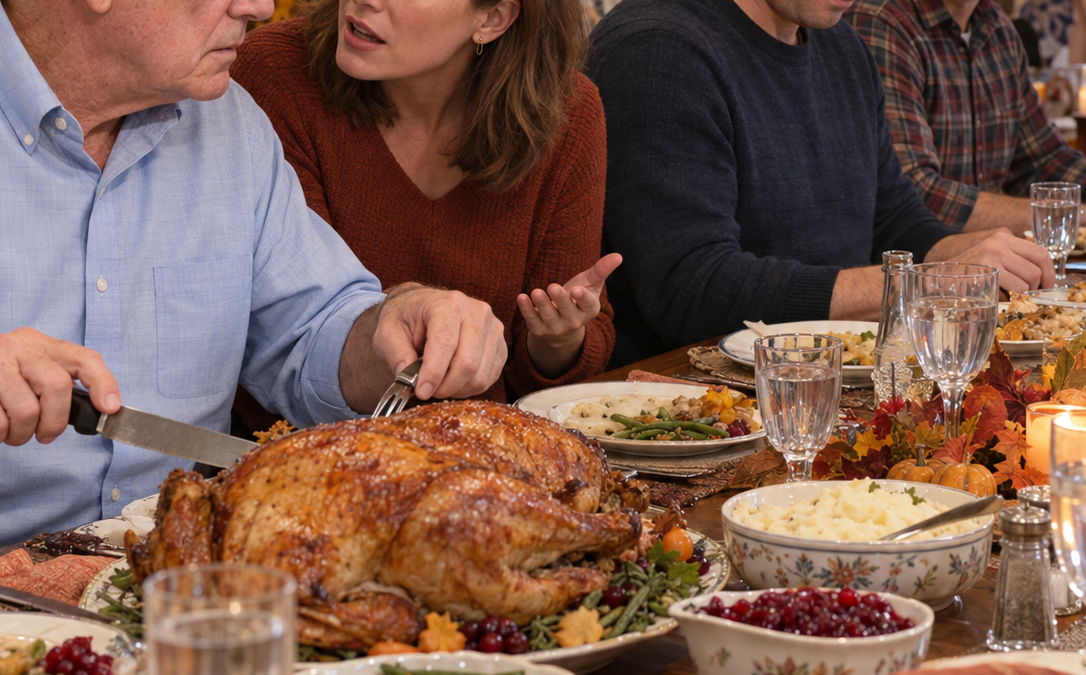
I held the carving knife above the turkey at my Thanksgiving table in Peoria.
There were fourteen of us, and I sat at the head.
Lindsay leaned across a serving bowl, waiting for an answer.
I tilted my good ear toward my daughter and watched her lips.
“Say that again, sweetheart.”
Chris stared down at the turkey.
My son-in-law kept his eyes on the platter while Lindsay started to repeat herself.
Then Chris spoke loudly enough for the whole table.
“Save your money, Lindsay. He can’t hear us anyway. He just nods.”
Cousins laughed.
My face burned.
I set the carving fork down.
“Say it to my face, Chris. I read lips.”
A cousin stopped smiling with a roll halfway to his mouth.
Chris looked up then.
I watched him decide whether I was making a joke.
I wasn’t.
Lindsay pushed back from the table just enough to straighten her shoulders.
“Chris.”
My daughter said his name sharply enough that I heard it.
He raised his palms.
“Come on, big guy. We’re having a nice dinner.”
“Then have one,” I said.
The turkey needed carving, and people were waiting with empty plates.
I picked up the fork.
My hand shook when I pressed it into the breast.
I hated that more than the laughter.
Someone near the far end said something behind a raised glass.
I missed it.
I kept cutting.
Lindsay watched me instead of passing her plate.
“White meat?” I said.
My daughter nodded.
I laid slices beside the potatoes, careful to keep the knife steady.
Chris reached for his glass.
“Need some ice,” he said.
He got up before Lindsay could finish turning toward him.
I followed his mouth until he faced the kitchen.
After that, I had only the scrape of his chair and his back.
Steven shifted his plate out of his brother’s way.
Chris squeezed past without looking at me.
I had retired from union electrical work knowing when a man was avoiding a question.
I wasn’t ready to say that was happening here.
But I hadn’t answered Lindsay, and Chris had left.
“Dad, put that down a minute,” my daughter said.
I lowered the knife to the platter.
Lindsay spoke too fast for me to catch the next part.
“Slower.”
My daughter pressed her lips together, then moved closer.
“The hearing aids. Did you get them?”
“No.”
Lindsay glanced toward the kitchen.
I knew that look from when my daughter was young.
Something hadn’t come out the way Lindsay expected.
“I thought Chris told you,” I said.
“Told me what?”
I started to answer, but somebody asked for the turkey.
At least, I thought that was what the pointing meant.
I lifted the platter.
“Pass that down.”
Lindsay helped me move it around the serving dishes.
My daughter kept a hand beneath the china until the next person took it.
I waited until nobody needed me, then stood.
From the dining room doorway, I could see Chris beside the refrigerator.
He had the ice tray on the counter.
Before filling his glass, he emptied his pockets into the wire junk basket on top of the fridge.
He did that when he brought groceries, too.
Folded slips, crumpled paper, whatever he didn’t want in his pants.
“Your filing cabinet, big guy,” he’d called it once.
I usually left the pile alone.
Chris’s hand came away from the basket, leaving another wad of paper behind.
Beneath it was a glossy envelope with an ear logo.
That envelope had been there since January.
I’d put it in unopened with the other mail I didn’t think needed an answer.
Chris shut the freezer.
He saw me in the doorway and lifted his glass.
“Getting there.”
“I came for the butter.”
He pointed to the counter.
The dish was beside his elbow.
I took it back myself.
Lindsay had moved my water glass away from a spot of spilled gravy.
My daughter looked up when I sat down.
“Do you want me closer?”
“Yes.”
That was easier than pretending I’d heard.
Lindsay drew the chair nearer, then waited while I spread butter on a roll.
I was embarrassed by how carefully my daughter watched me.
I wanted Lindsay to eat while the food was hot.
I also wanted that question finished.
“You said forty-eight hundred,” I said.
“Yes, Dad.”
“For hearing aids?”
My daughter nodded, slower now.
I put the roll down.
I hadn’t known that amount until Lindsay said it over the turkey.
Chris ran errands for me because he worked in Peoria.
Lindsay lived with him in Bloomington, and extra shifts had kept my daughter away.
When I needed something picked up, Chris was usually already nearby.
That had seemed practical.
“Did you send him money?” I said.
“Yes.”
Lindsay looked past me toward the kitchen again.
My stomach felt tight.
“Why didn’t you ask me?”
“I sent messages.”
“To me?”
“To Chris. To check how things were going.”
I wiped my fingers on my napkin.
Calls were hard.
I lost words, guessed wrong, and heard people getting tired of repeating themselves.
Still, I wished my daughter had asked me.
“I didn’t get hearing aids,” I said.
“I can see that.”
Lindsay’s eyes went to my ears, then dropped to the plate.
My daughter hadn’t eaten the turkey I’d carved.
A serving spoon tapped a bowl farther down the table.
People were talking again, with their faces turned toward one another.
I couldn’t follow them from where I sat.
I kept my eyes on Lindsay.
“Where did the money go?”
My daughter opened her mouth, then stopped.
I waited.
Behind Lindsay, through the doorway, I could still see the wire basket.
The glossy corner stuck out beneath Chris’s discarded paper.
My daughter touched my wrist.
Lindsay looked puzzled now.
“Dad, I sent three hundred every month too. Since January.”
Picking up where the Facebook post left off
Part 2 of 7
“They’re back-ordered. The clinic keeps pushing it.”
Chris came back with ice rattling in his glass.
Lindsay kept a hand beside my Thanksgiving plate.
Then my son-in-law looked at my daughter.
“Your dad told me he didn’t want them. Too proud.”
I waited until Chris faced me.
“What did I tell you?”
He pulled out his chair.
“Don’t start, big guy. I’m trying to explain.”
Lindsay took her hand off the table.
“Are they delayed, or did Dad refuse them?”
Chris put his drink down without answering.
My daughter reached for the phone beside the napkin.
“Wait,” Lindsay said.
I watched a thumb move up the screen.
Chris picked up his fork.
“Can we eat while it’s hot?”
Lindsay held the phone toward me.
February showed above a message from Chris.
“Your dad loves them. Says he can hear the birds again.”
I reached the end, then started at the beginning.
The message hadn’t changed.
It said I had hearing aids.
It said I loved them.
I touched the side of my head.
There was nothing behind my ear except the arm of my glasses.
“That’s from you?” I said.
Chris leaned back.
“Yeah. We talked about it.”
“No.”
“You must have forgotten.”
My face grew hot again.
Lindsay lowered the phone just enough to see over it.
“Dad says he never got them.”
Chris looked down the table.
Someone had stopped passing the green beans.
I wanted my daughter to keep that screen where I could see it.
I hadn’t heard birds in a long time.
I hadn’t told Chris otherwise.
“Let me finish reading,” I said.
Lindsay brought the phone closer.
Beneath the message, my daughter had answered with a row of hearts.
I looked away from those.
“Dad?” Lindsay said.
“I didn’t say that.”
My daughter nodded, but kept staring at the screen.
Chris reached for a serving spoon.
“There’s been some crossed wires. We’ll sort it out.”
I pushed my plate back.
My appetite was gone, and the turkey was cooling in its gravy.
Farther down, someone lifted an empty water pitcher.
I stood to take it.
“Let me,” Lindsay said.
“I can fill a pitcher.”
My daughter released the handle.
I went to the sink and ran cold water.
From there, I could see Chris talking at the table.
His head was bent toward Lindsay, and I couldn’t make out a word.
I shut off the faucet before the water reached the rim.
When I returned, my son-in-law sat up.
I set the pitcher down and stayed beside my chair.
“My debit card,” I said.
Chris glanced at my empty plate.
“What about it?”
I held out my hand.
“I want it back for tomorrow’s groceries.”
Lindsay looked from my palm to her husband.
Chris gave me a quick smile.
“I can pick up whatever you need.”
“I’ll go.”
“You don’t need to make a trip.”
“Give me the card.”
He patted a pocket, then reached toward another.
I waited.
My hand began to feel foolish, hanging there between us.
I kept it out.
“It’s in the truck,” Chris said.
“Get it.”
“I’ll grab it later. Let’s finish dinner.”
Steven looked up from his plate.
Chris saw his brother watching and pushed his chair back.
“Don. Come here a second.”
He pointed toward the hallway.
I lowered my arm.
Lindsay started to stand.
“Stay there, sweetheart,” I said.
I wanted my card.
I thought Chris might be taking me toward the front door to get it.
Instead, he stopped beside the coat hooks.
The dining room was behind me.
Chris stepped close enough that I could smell beer on his breath.
Then he turned his face toward the wall and started talking.
I caught a low sound.
Nothing I could use.
“Face me.”
His mouth kept moving where I couldn’t see it.
I put a hand against the wall to steady myself.
“Chris. Turn around.”
He finally looked at me.
The smile was gone.
“Don’t upset her on a holiday. You get confused.”
I understood that.
He had made sure I could.
“My card,” I said.
“Later.”
He tried to step past me.
I moved aside, but stayed by the hooks while he returned to the dining room.
My coat hung there.
I could have put it on and walked out to his truck.
But I didn’t know whether it was locked.
I wasn’t going to search a vehicle while Chris sat inside telling people I was confused.
My fingers were still shaking.
He’d said I forgot having hearing aids.
Then he’d refused to hand over the card he used for my shopping.
If that was what he needed it for, why keep it now?
I had groceries.
I was standing in my own house, asking for my own property.
Across the hallway, I could see Lindsay’s phone beside the plate.
My daughter had left the screen lit.
I walked toward it, then stopped at the dining room doorway.
Chris was drinking his beer.
Lindsay looked up at me.
“Did he get it?”
“No.”
My daughter turned toward her husband.
Chris pointed at his food.
I didn’t wait to hear what he said.
The clinic.
I remembered the room before I remembered its name.
A padded chair.
Headphones.
A woman behind a window telling me to raise my hand.
Chris had driven me there last December.
I’d watched the woman’s mouth through the glass when the instructions stopped making sense.
Afterward, my son-in-law had walked me to the truck.
“Just wax, big guy,” he’d said.
That was why I hadn’t expected hearing aids.
I’d thought the test was finished business.
Now I remembered the sign outside the building.
A large ear beside the front door.
The same ear was on the glossy envelope I’d tossed unopened into the basket in January.
That letter on my refrigerator had come from the hearing center.
Part 3 of 7
I lifted the wire basket off the refrigerator while football played in the living room.
The glossy envelope slid against my wrist.
Inside was a letter dated January 26, 2026.
I had opened it standing beside the sink.
Now I pulled out a kitchen chair and sat down.
My name was printed above the address.
Donald Hodges.
I flattened the page against the table with my palm.
The order in my name had been cancelled January 23.
At the purchaser’s request.
I moved my finger down to the next line.
Refund issued: $4,800.00.
Card ending 7731.
Cardholder: Christopher Roberson.
I took my glasses off and wiped them on my shirt.
There was gravy on one lens.
I cleaned it away, put them back on, and found the cardholder’s name.
Christopher Roberson.
Chris had bought something for me.
Then he had cancelled it and received the money back.
That had happened in January.
Today was Thanksgiving.
I looked toward the doorway.
From my chair, I could see part of the television.
A player ran across the screen.
Someone in the living room lifted an arm.
I couldn’t make out what was said.
Chris had told Lindsay the clinic kept pushing the order back.
I pressed my finger against the cancellation date until the paper dented.
There had been nothing coming for months.
I felt sick.
The turkey I’d barely touched seemed to be sitting high in my throat.
I pulled the basket closer.
When I’d lifted the envelope, crumpled slips had fallen beneath it.
I picked one up and opened the folds.
ATM withdrawal.
$300.00 cash.
Card ending 2208.
That was my debit card.
I knew those last digits.
I’d checked them often enough when paying for something over the phone.
The receipt was dated November 2.
I turned it over.
Nothing on the back.
Another slip had the same amount and card number.
October 2.
I spread the paper with the side of my hand.
The terminal address was where Chris worked.
The ATM outside his dealership.
He hadn’t bought groceries there.
I reached into the basket again.
Some receipts had been rolled into tight little balls.
Others were folded around themselves, with the printing on the inside.
I worked them open without tearing them.
September.
August.
I put the months in order along the edge of the kitchen table.
A chair scraped somewhere behind me.
I covered the letter with my forearm and looked up.
Nobody came through the doorway.
I hated doing that in my own kitchen.
I moved the basket so it hid the papers from the dining room.
Then I kept sorting.
There were eleven receipts.
January through November.
The second day of each month.
The amount stayed the same.
Three hundred dollars cash, taken from my account with the card Chris kept.
I checked the dates against the row I’d made.
No month was missing.
Lindsay had said the money started in January.
My daughter had been sending it while I thought I was getting by on my own.
I pulled a paper napkin from the holder.
The drawer beside me had a pen under the takeout menus.
I tested it in a corner until the ink came through.
11 × $300.
I wrote $3,300 beneath that.
Then I added $4,800.
The total was $8,100.
I checked the arithmetic with separate columns.
It came out the same.
I had spent years adding hours and checking electrical loads.
My hearing hadn’t stopped me from doing that.
I looked at the total until my eyes stung.
Eight thousand one hundred dollars.
I hadn’t known to look for any of it.
There were no bank statements stacked beside my chair.
Chris had set up the paperless account messages.
I hadn’t learned to use the email he’d made.
When I asked about a balance, he told me.
When he brought groceries, I thanked him.
I put the pen down because I was gripping it too hard.
The skin between my thumb and finger had gone white.
My card was supposedly in his truck.
I wanted it out of his reach.
The card-services number was written inside my old checkbook.
I found it in the drawer and brought my phone to the table.
I dialed carefully.
A recorded voice started.
I caught “press,” then lost what came after.
I held the speaker closer to my better ear.
The choices continued.
I waited for them to repeat, but the message changed.
My thumb hovered above the keypad.
I couldn’t tell which number would get me a person.
I ended the call.
The credit union was closed for Thanksgiving.
I could go there in the morning, stand at a desk, and see someone’s face.
Tonight, Chris still had my card.
I laid the phone beside the napkin.
Lindsay could help with a call.
I could bring my daughter into the kitchen and put the letter in front of her.
Let Lindsay sit where I was sitting.
Let my daughter find out away from the guests.
I pictured those hearts beneath Chris’s February message.
Lindsay had believed I could hear the birds.
My chest hurt.
I wanted to spare my daughter the roomful of faces.
Then I looked through the doorway at my place at the head of the table.
Chris had called me confused where people could hear him.
He’d made them laugh there.
I gathered the receipts and put them in date order.
I had already decided.
I folded the letter into my shirt pocket and squared the slips against the table.
“At the table,” I told myself, “where he said I can’t hear.”
Part 4 of 7
“Steven, will you trade seats with Chris?”
I stood at the kitchen counter, the ATM receipts hidden below its edge.
The folded clinic letter pressed against my chest inside my shirt pocket.
Steven stopped in the doorway.
“Where do you want me?”
“On my right.”
He looked toward the dining room.
“That’s Chris’s chair.”
“I know.”
I slid the receipts into my pants pocket, keeping the stack together.
Steven waited.
I liked that about him.
He didn’t fill the space before I could finish.
“I need him across from me,” I said.
“So you can see him?”
“His mouth.”
Steven looked straight at me.
“Okay.”
He didn’t ask what was in my pocket.
I was grateful for that, but I wasn’t ready to tell him.
Through the doorway, I could see Lindsay gathering plates.
My daughter had stacked mine on top.
There was still turkey on it.
I wanted to go over and say I’d eat later.
Instead, I stayed beside the counter while Steven went to move the chairs.
Chris was near the television with his beer.
Steven touched his brother’s arm and pointed toward the dining room.
I couldn’t follow what Steven said.
Chris looked at the table, then at me.
I kept my face still.
My son-in-law shrugged.
The chair on my right had let Chris turn toward the guests without facing me.
Steven’s old place was across from it, near my end.
From my seat, I would be able to watch Chris.
If he let me.
I went back to the head of the table.
Steven moved his water glass to my right and brought his napkin with it.
“Here?” he said.
“That’s good.”
He pulled the chair out and left enough room for me to sit.
I lowered myself carefully.
The papers rubbed against my leg.
I checked that the letter stayed below the edge of my shirt pocket.
I didn’t want Chris seeing it yet.
Lindsay came back for the serving dishes.
“Are you okay, Dad?”
I made sure my daughter was looking at me.
“I need you to sit down when you’re done.”
“Okay. Do you want coffee?”
“Water.”
Lindsay set the pitcher closer to my hand.
I poured a little and swallowed.
My mouth was dry.
The room was getting busy again.
People came back from the living room, carrying glasses and talking over their shoulders.
I couldn’t keep up with the changing faces.
I watched the empty chair across from Steven.
I had the letter.
I had the receipts.
But I could still get a word wrong.
Chris could answer a question with his head down.
I might miss what he said, then ask something he’d already answered.
He would call that confusion.
He’d done it before the turkey was cleared.
Soon there would be fourteen people at the table again.
Lindsay would hear her husband clearly.
My daughter would see me struggling.
I was afraid Lindsay might believe him.
I pressed my feet flat against the floor.
The dates were printed on paper.
I didn’t have to guess those.
Steven sat down beside me.
“Need anything?” he said.
“Keep looking at me when you talk.”
“Sure.”
He turned his chair slightly so I could see his face without twisting.
I left my hand on my lap until it stopped shaking.
Then the pie came out.
Lindsay carried it through the kitchen doorway with a stack of small plates.
My daughter set those beside the turkey platter, which still held scraps from dinner.
Someone moved a serving bowl to make room.
Chris reached the table before Lindsay could start cutting.
He stopped behind his new chair.
“What’s this, assigned seating?”
“I asked Steven to move,” I said.
My son-in-law looked at his brother.
Steven unfolded his napkin.
“I’m fine here.”
Chris smiled at the guests.
“Whatever the boss wants.”
I heard “boss.”
I saw the rest.
He put a hand on the chair back, but didn’t sit.
Instead, he raised his beer.
“Before we get into dessert.”
Lindsay stopped with the pie server above a plate.
Chris waited until faces turned toward him.
Mine was already there.
“To family who take care of each other.”
He lifted the bottle higher.
People raised their drinks.
I kept my water on the table.
Chris nodded toward me.
“Somebody’s got to handle Don’s stuff.”
People clapped.
I saw hands coming together along the table.
My ears caught only scattered sharp sounds.
A cousin smiled at Chris, then looked toward me as if I should thank him.
I felt humiliated.
The letter in my pocket had my name on it.
The account was mine.
Yet Chris stood over my table accepting thanks for looking after me.
Lindsay lowered the pie server.
My daughter was watching her husband now.
Chris turned enough to include me in his smile.
“I only use his card for his groceries, right, big guy?”
I kept my eyes on his mouth until he finished.
Then I nodded once.
On purpose.
His shoulders loosened.
He took a drink.
I put my hand over my pants pocket, feeling the squared edge of the receipts.
Chris hadn’t asked what I’d understood.
He had seen my nod and accepted it.
Beside me, Steven reached for his fork.
Lindsay began serving the pie.
My son-in-law set his bottle down and pulled out the chair.
As he sat, Chris leaned toward me.
He made sure I could see his mouth and formed the words without a sound.
“Nobody believes a deaf guy, Don.”
Part 5 of 7
I stood and took the clinic letter from my shirt pocket.
I laid it flat beside the turkey platter.
“Order for Donald Hodges,” I said.
Chris stopped moving his chair.
I kept my finger beneath the line.
“Cancelled January twenty-third. At the purchaser’s request.”
Lindsay set the pie server down.
“Refund of four thousand eight hundred dollars to card ending seven-seven-three-one.”
I looked straight at my son-in-law.
“Cardholder Christopher Roberson.”
Chris reached toward the paper.
I put my palm over it.
“Lindsay can have it.”
My daughter picked up the letter and read the lines I’d just said aloud.
Lindsay brought the page closer, then looked at the refund amount.
“January?” my daughter said.
“Yes.”
Chris stayed seated.
The smile he had used for his toast was gone.
“I was holding it for him. Don can’t keep track of money anymore.”
Lindsay lowered the page.
“You told me they were delayed.”
Chris started talking before my daughter finished.
His head turned toward the far end of the table.
I missed the words.
“Face me,” I said.
He looked back.
“Sit down, Don.”
I stayed on my feet.
My knees were stiff, but they would hold.
I pulled the receipts from my pants pocket.
Some edges had curled again.
I smoothed them against the table and slid the stack to Steven.
“Read those,” I said.
Steven set his fork across the edge of his plate.
He opened the top slip.
“Three hundred dollars. November second.”
My daughter looked at the paper in his hand.
Steven moved to the next receipt.
“October second. Three hundred.”
He sorted them into a row beside his plate.
I watched his mouth.
“September second. August second.”
Chris reached for his beer, then left it where it was.
Steven checked the remaining dates.
“January through November. The second of each month.”
“Which card?” I said.
“Ending twenty-two-oh-eight.”
“Mine.”
Steven brought a receipt closer to his face.
“The terminal is at the dealership.”
I pointed at Chris.
“Where he works.”
My daughter gripped the clinic letter along its folded edge.
“I sent it on the first,” Lindsay said.
I waited until my daughter turned toward me.
“Three hundred. On the first of the month.”
“And it came out the next day,” I said.
Steven counted the slips and squared them beside his plate.
“Eleven withdrawals.”
“Thirty-three hundred dollars,” I said.
I had done the arithmetic in the kitchen.
I could say it without looking at the napkin.
“Plus the hearing aids. Eight thousand one hundred.”
A cousin lowered a glass without drinking.
I could see people looking at the receipts, then at Chris.
Nobody was smiling now.
My son-in-law leaned toward Lindsay.
“Lindsay, it’s our money anyway. It’s all one pot.”
My daughter’s face went pale.
“The money I sent Dad?”
Chris opened his mouth.
Lindsay picked up the phone before he answered.
The message was still there.
My daughter held the screen toward him.
“Your dad loves them. Says he can hear the birds again.”
Lindsay said each word slowly.
I didn’t need to ask for anything repeated.
Chris looked away from the screen.
“You’re making this into something it isn’t.”
Steven picked up his fork, then put it down.
“You paid cash for that hunting lease in March, Chris. You told Mom it was a bonus.”
Chris stared at his brother.
I looked at the receipts beside Steven’s plate.
March was in that stack.
The second.
Three hundred dollars.
I couldn’t know which bills had paid for the lease.
But Steven had heard Chris’s explanation at the time.
My son-in-law pushed back from the table.
“Seriously? You’re getting into this?”
Steven kept his face turned where I could see it.
“You said cash. I remember.”
Chris’s jaw tightened.
I held out my hand.
“My card, Chris.”
He glanced toward the hallway.
I kept my palm open.
My son-in-law reached into his pants pocket and took out his wallet.
The card hadn’t been in the truck.
It had been with him when I asked before.
Chris pulled it from a slot and held it between his fingers.
Fourteen people were at my Thanksgiving table.
He handed it over where they could see.
I checked the last digits.
Then I put it in my front pocket.
Lindsay set the letter beside the platter and began tapping on the phone.
“Dad, check your account when you get to the credit union.”
“What are you doing?”
“Sending you forty-eight hundred.”
Chris leaned toward the screen.
My daughter moved it out of his reach.
“This is from me,” Lindsay said.
The phone showed the completed transfer to my account.
My daughter held it still until I nodded.
Then Lindsay opened the card controls.
Chris put a hand on the table beside the phone.
“Can we talk at home?”
Lindsay removed him as an authorized user on the card.
My daughter showed me the confirmation, then went into the banking access settings.
Chris watched without touching the screen.
Lindsay removed his access there, too.
“He’s out of my banking app,” my daughter said.
I looked at the letter, then at the receipts.
Lindsay had sent money to help me.
Chris still owed the eight thousand one hundred he’d taken.
I wanted that settled.
But I wanted something else said before I sat down.
I waited until my son-in-law faced me.
“I can’t hear well, Chris. I can still read.”
I sat down.
Lindsay stood beside the untouched pie.
My daughter pointed toward the hallway.
“Get your coat, Chris. Leave Dad’s house key on the table.”
Part 6 of 7
At nine Friday morning, I laid my debit card on the credit union desk.
It was November 27, the morning after Thanksgiving.
“Cancel this one,” I said. “Ending twenty-two-oh-eight.”
Lindsay sat beside me with the clinic letter in a folder.
The employee looked at my daughter when she answered.
I raised my hand.
“Please face me. I read lips.”
The employee turned her chair.
“Of course, Mr. Hodges.”
I watched her mouth.
She asked whether I had the card with me now.
I tapped the plastic on her desk.
“My son-in-law had it. He doesn’t get it back.”
She asked me to confirm my information, then cancelled it.
I waited for the printed confirmation.
The word was there.
Cancelled.
I put that page in front of me.
Next came a new card.
The employee brought over the keypad so I could choose my PIN.
I entered it myself.
Lindsay looked away until I finished.
“I want paper statements,” I said.
The employee began explaining something about online delivery.
I caught part of it, then held up my hand.
“Paper. In my mailbox.”
She showed me the mailing address on the screen.
It was my house in Peoria.
I checked it before saying yes.
The employee changed the delivery setting and printed the confirmation.
I added it to my pile.
“Anything else?” she said.
I looked at Lindsay.
“My daughter. I want her listed as my trusted contact.”
The employee explained what that meant.
Lindsay could be contacted about concerns.
It didn’t give my daughter permission to spend my money.
“That’s what I want,” I said.
I signed where the employee pointed.
Then I asked for the account activity from January through November.
The transfers and withdrawals filled the pages.
Lindsay’s money arrived on the first.
Three hundred dollars came out in cash the next day.
I followed the entries with my finger.
My daughter didn’t try to hurry me.
At the bottom of the last page, I stopped.
“That’s enough for today,” I said.
Outside, Lindsay held the folder while I zipped my coat.
My hands were cold.
“Do you want me to keep these?” my daughter said.
“No. I’ll take them.”
Lindsay handed them over.
I put the new card in my own wallet before we left.
On Monday, November 30, my daughter came to my kitchen.
We set the paperwork beside the napkin I’d used for the arithmetic.
The ink had bled through in places.
Lindsay found the Illinois APS hotline number and put the call on speaker.
I caught the greeting, then lost the next sentence.
My daughter looked at me.
“Want me to help?”
“Yes. Tell her I can answer.”
Lindsay explained my hearing.
Then my daughter repeated the intake worker’s questions slowly, facing me.
My name.
My age.
Who had access to the account.
“My son-in-law,” I said.
Lindsay repeated my answers into the phone only when the worker asked.
I told the worker about the hearing test.
The cancelled order.
The refund.
I gave the amounts from the papers in front of me.
My voice shook when I reached the monthly withdrawals.
I kept going.
The worker said something I couldn’t make out.
Lindsay wrote it on a clean sheet and turned it toward me.
Financial exploitation.
I looked at those words.
“That’s what she called it?” I said.
“Yes, Dad.”
I moved closer to the speaker.
“I didn’t give him permission to take that money.”
The intake worker arranged for a caseworker to come.
Before ending the call, Lindsay asked the worker to speak slowly when visiting.
When the caseworker came, I sat at my kitchen table with the folder open.
Lindsay stayed beside me.
I gave the answers.
The caseworker copied the letter and the bank pages.
I kept the originals in the folder.
On Friday, December 4, Lindsay drove me to Steven’s house.
Chris was waiting in the driveway.
He wore the jacket he’d taken from my hallway on Thanksgiving.
I stayed beside the passenger door.
My son-in-law walked over with an envelope.
“Here,” he said.
I didn’t reach until he faced me.
Chris pulled out a cashier’s check and handed it over.
Eight thousand one hundred dollars.
Payable to Donald Hodges.
I checked the amount in words against the figures.
They matched.
Lindsay stood close enough to see.
“That’s the full amount,” my daughter said.
“Yes.”
I put it back in the envelope.
Chris shoved his hands into his pockets.
“Are we done?”
“I have the check,” I said.
He looked toward Steven, who stood near the garage.
His brother didn’t answer for him.
Chris went inside without saying goodbye.
I watched the door close.
“He’s sleeping in my basement,” Steven said.
I turned so I could see his face.
“For now.”
Lindsay folded her arms.
“Has your mom talked to him?”
Steven shook his head.
“She’s stopped taking his calls.”
My daughter looked down at the driveway.
I held the envelope against my coat.
I’d wanted the money returned.
I was relieved to have it.
I was still angry.
Steven walked us to the car.
Before Lindsay opened the driver’s door, my daughter touched my sleeve.
“Dad, look at this.”
I thought there might be something else about Chris.
My stomach tightened.
Instead, Lindsay held out the phone.
A new order filled the screen.
Hearing aids.
Patient: Donald Hodges.
I looked at my daughter, then back at my name.
The payment was complete.
“My own card,” Lindsay said. “I paid the clinic myself.”
I moved the screen closer.
Would I hear my family at Christmas?
My daughter pointed to the appointment beneath the order.
“Your fitting is December seventeenth, Dad.”
Part 7 of 7
The furnace started humming, and I jerked upright in my chair.
My new hearing aids were tucked behind my ears.
Christmas Eve lights blinked on the tree across my living room.
“What was that?”
Lindsay looked up from the gift bags.
“What?”
“That low sound.”
My daughter listened, then pointed toward the floor vent.
“The furnace.”
I stared at the metal grille.
Warm air moved the edge of the tree skirt.
I laughed.
Lindsay smiled, but waited while I listened.
“I thought something was wrong with it,” I said.
“Is it too loud?”
“No.”
I settled back against the cushion.
The sound continued beneath us.
I’d spent years listening for bad motors and loose connections.
Now I was sitting in my own house, surprised by the heat coming on.
I laughed again.
My daughter put the bags down.
“Good?” Lindsay said.
“Good.”
Across the room, my grandson tore into a present.
The wrapping paper made a sharp ripping sound.
I turned toward the tree.
He had a strip of red paper in his hand and the box between his knees.
I heard another tear before I saw him pull.
“Careful with that,” Lindsay said.
My grandson looked up.
I could hear the paper crackling against his sleeve.
“That one’s from me,” I said.
“I know.”
He bent over the package again.
I watched him work a thumb beneath the tape.
For once, I didn’t need to study his face to know what he was doing.
The box scraped against the floor.
He pulled the lid free and laughed.
I heard that, too.
I put my hand over my mouth.
Lindsay came to stand beside my chair.
My daughter didn’t ask what was wrong.
I pointed toward the tree.
“The paper,” I said.
Lindsay looked at the scraps around his shoes.
“I heard him opening it.”
My daughter rested a hand on my shoulder.
I held it there.
My grandson lifted his present to show me.
I could see his mouth moving behind the box.
“Put that down so I can see you,” I said.
He lowered it.
“Thank you, Grandpa.”
“You’re welcome.”
I kept smiling after he went back to his gift.
When Steven arrived, he carried a pecan pie against his coat.
I saw him through the front window and went to open the door.
“Where do you want this?” he said.
“Kitchen counter.”
Steven stepped inside and wiped his shoes.
I heard the soles drag across the mat.
He glanced down when I did.
“Snow,” he said.
“I heard it.”
Steven looked at my ears, then nodded.
“Pie might be loud, too. The pan keeps bending.”
He squeezed the edge.
The foil made a little popping sound.
I laughed before he could do it again.
“Don’t break it before we eat it.”
He took off his coat and followed me into the kitchen.
I got the plates while Steven found the pie server.
There was no need to raise his voice.
I still missed a word when he turned toward a cupboard.
“Face me a second,” I said.
Steven turned.
“Coffee?”
“Please.”
He waited for my answer before reaching for a mug.
We carried dessert into the living room.
I’d brought in a small folding table so we could eat near the tree.
Steven set the pie down and moved a chair to the head.
Then he stepped aside.
“Here you go, Don.”
I started straightening a napkin that didn’t need it.
My hands had begun shaking.
Steven stayed beside the chair.
“You okay?”
I looked toward my grandson on the floor.
He was talking to Lindsay while my daughter gathered the torn paper.
“I still wanted to be included when I couldn’t keep up,” I said.
Steven put a hand on my shoulder and left it there.
I stopped working at the napkin.
My eyes filled.
I wiped them with my sleeve, then sat where he’d made room for me.
Steven cut the pie.
I took a plate and managed a bite before my grandson came over to inspect it.
“Is that nuts?”
“Pecans.”
He leaned closer.
I moved my fork out of his way.
“You can ask for something else,” I said.
He looked toward the kitchen, where Lindsay had gone for drinks.
Steven sat down with his plate.
I could hear his fork touch the china.
The furnace shut off.
Without the hum, the room sounded different.
I listened to my grandson moving a box beneath the tree.
I heard water running in the kitchen, then a cupboard closing.
I left the chair beside me empty for Lindsay.
Behind me, in the kitchen doorway, my daughter spoke in a normal voice.
“Dad.”
I turned around before Lindsay could say it twice.
“Right here, sweetheart,” I said, pulling out the chair beside me.
THE END
More stories
My HOA president sent two men with shovels into my late husband’s memorial garden and fined me $2,400—Then her own financial records cost her the presidency.
You Might Also Enjoy




