At the hospital’s 100th anniversary gala, my daughter-in-law told 300 guests I was just the family babysitter. Ten minutes later, the keynote speaker called my name.
Complete story · 7 parts · about 29 minutes · ending included
Part 1 · Part 2 · Part 3 · Part 4 · Part 5 · Part 6 · Part 7
Part 1 of 7
“That’s Marcy, just our family babysitter. She’ll take the kids out at eight.”
Mackenzie said it into a microphone at 7:55 p.m., pointing toward Table 31.
I was sixty-four, and my son was looking down at his plate.
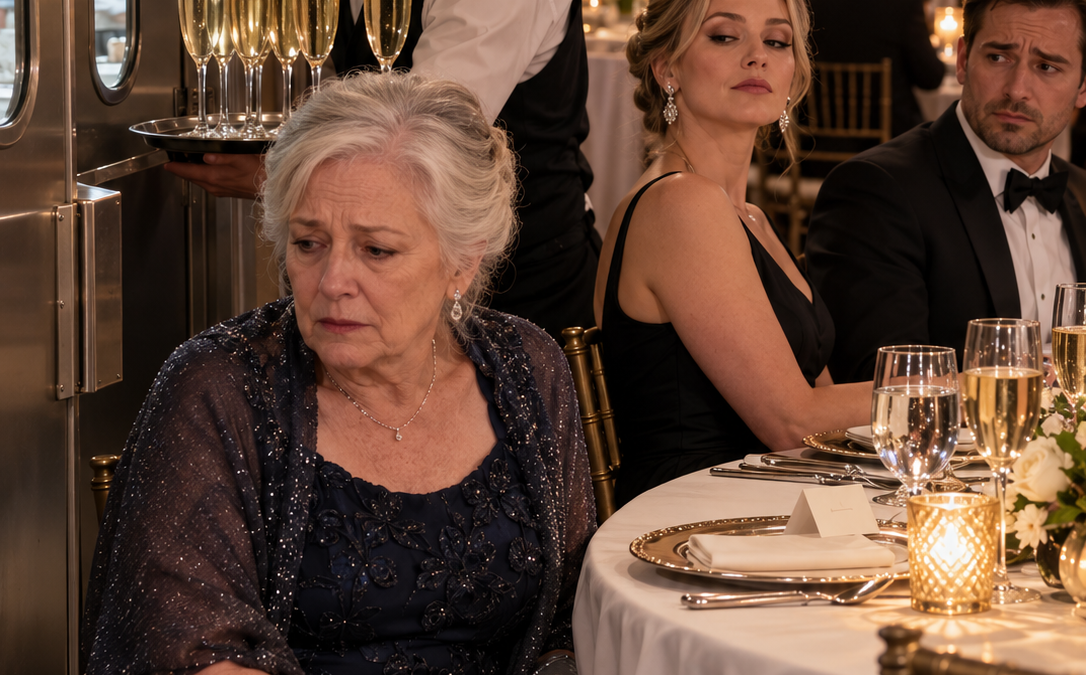
Fifteen minutes earlier, I had been trying to keep my chair clear of the kitchen door.
It was Saturday, November 7, and I had worn my good black pants.
I had pressed them that afternoon in the garage apartment behind Dominic’s house.
At 7:40, I sat against the swinging door with my purse between my shoes.
The place card Mackenzie had assigned me said “CHILDCARE.”
No name beneath it.
I turned it slightly, checking whether mine was on the other side.
The back was blank.
A waiter parked a tray of champagne flutes at my elbow.
I pulled my sleeve away before it caught a stem.
“Ma’am, scoot in? We need the door.”
I scooted.
My knees pressed against the table leg, and the door cleared my chair.
“Thank you,” the waiter said.
“You’re welcome.”
I tucked my feet beneath me so nobody would trip over them.
The twins sat nearby in their dress clothes, restless and warm.
One wanted a drink of water.
I moved a glass closer and held it steady while small hands found it.
Across the ballroom, people stood beside tables and admired each other’s clothes.
I could see the hospital’s centennial decorations above their heads.
Summit Valley had been founded in 1926.
A hundred years was worth celebrating.
I had thought there might be room in that celebration for me.
Mackenzie came over long enough to check the children.
“Keep their coats handy, sweetie.”
“They’re on the chair.”
“Good. We need things to run smoothly tonight.”
Mackenzie straightened the place card until its printed word faced the room.
I watched that small adjustment.
My face grew warm before anything had been said into the microphone.
“Where’s Dominic?” I said.
“Talking to somebody. He’ll be here.”
Mackenzie checked the kitchen doorway and stepped aside for a server.
Then my daughter-in-law went back toward the front.
I kept my hands in my lap.
There were three hundred guests in that ballroom, with seats costing $250 apiece.
Mine was close enough to the kitchen that I could hear dishes being stacked.
Whenever the door opened, bright light crossed my shoes.
I had come as Dominic’s mother.
I had helped dress the twins and checked that their shoes were comfortable.
Still, I had expected a place card with my name.
I felt foolish for wanting one so badly.
Dominic arrived and pulled out his chair.
“You okay, Mom?”
“The door keeps catching.”
He glanced behind me.
“That’s a tough spot.”
I waited, but he said nothing else.
Dominic unfolded his napkin instead.
One of the twins reached toward his sleeve, and he bent down to listen.
I knew that look on my son’s face.
He had noticed the problem and was hoping it would stay small.
A server reached past my shoulder to collect the tray.
I leaned forward without being asked.
My back had begun to ache from sitting crooked.
At the front, Mackenzie stood near the podium with Felicia Dunlap.
Felicia was Mackenzie’s nurse manager and the committee chair.
I recognized Felicia from the program lying closed beside my plate.
Mackenzie smoothed the front of her outfit.
My daughter-in-law looked polished and pleased, exactly where Mackenzie wanted to be.
I had been proud when Mackenzie became an RN.
That feeling made what followed hurt worse.
At 7:55, the welcome began.
People settled into their chairs, and Dominic turned toward the podium.
Mackenzie leaned toward the microphone with Felicia beside her.
Then came the introduction I had never agreed to.
Mackenzie pointed across the room and called me the family babysitter.
My daughter-in-law announced that I would take the children out at eight.
Laughter traveled between the tables.
I couldn’t tell who was laughing at me and who was following along.
Dominic studied his plate.
I wanted my son to raise his head.
Instead, I lifted my chin toward the podium.
“Happy to.”
The words came out clearly.
I hated how practiced they sounded.
Mackenzie gave a quick, satisfied smile and returned to the welcome.
I lowered my eyes before anybody could mistake my expression for agreement.
My hands would not stay still.
I pressed my palms against my knees until I could pick up the program.
The cover felt thick and smooth beneath my fingers.
I opened it beside the place card.
“8:05 — Keynote: Dr. Janelle Hadley, NICU graduate, 1988.”
Ten minutes after the welcome.
Five minutes after I was supposed to leave.
I rested my thumb beneath the printed name.
Dominic shifted beside me.
“Mom, the kids are getting tired.”
“They’re sitting fine.”
“I know. I just meant it’s been a long evening.”
“It’s not eight yet.”
My son looked toward Mackenzie.
I closed the program before Dominic could follow my eyes to the keynote listing.
One of the twins leaned against my arm.
I brushed a strand of hair away from the child’s forehead.
None of this was their fault.
I loved watching them.
I also wanted to sit through a hospital dinner without being sent outside.
Those feelings fit together easily enough for me.
The kitchen door swung open, and I moved my chair another inch.
Then I reached down for my purse.
A loop of yellow yarn had caught near the zipper.
I eased it free and tucked it inside.
Underneath was a folded printout I had carried since Tuesday.
I had kept that page close while Mackenzie discussed coats, schedules, and getting me home.
My daughter-in-law had never asked what I knew.
From the podium, Mackenzie looked toward our table again.
I left my chair where it was.
Why would a babysitter carry an email printout to a hospital gala?
I drew the folded paper from my purse, keeping it below the table’s edge.
The printout was an email Mackenzie sent from her hospital account.
It said I had advanced dementia.
Picking up where the Facebook post left off
Part 2 of 7
At 6:12 p.m. on Sunday, November 1, my phone lit up.
“Mon–Fri as usual. Twins’ meds at noon. Swim Tuesday.”
I took a screenshot so I could check the schedule without searching through messages.
Mackenzie sent some version of that text most Sundays.
I stood at my small kitchen counter in the garage apartment and checked the coming week.
No appointment of mine would interfere.
I typed, “Got it.”
Then I put on my shoes and walked over to the house.
I had left a sweater in the living room.
Through the kitchen window, I could see Mackenzie bent over the island.
Papers covered the spot where the twins usually ate their snacks.
“Don’t let them touch this,” Mackenzie said when I came inside.
“The seating’s almost done.”
I picked up a crayon near the edge and put it away.
“What seating?”
“The centennial gala. Saturday.”
Mackenzie drew a short line beside a table number.
I stood across the island, holding my sweater against my stomach.
“I wondered what time you wanted us there.”
“Family hour starts at six. I’ll need you with the kids.”
“Will we eat together?”
“You’ll have a seat.”
Mackenzie moved a sheet aside to reach her pen.
That was when I saw my name.
“T31 — M. Gorski — childcare, out by 8 (before keynote).”
I read the instruction through to the closing parenthesis.
My name took up less space than the directions for removing me.
“Who’s the keynote?”
“Some doctor. You wouldn’t know her.”
Mackenzie kept writing.
I wanted to ask why a doctor’s speech meant I had to leave.
Instead, I adjusted the sweater over my arm.
“Do the children need to be home by eight?”
“They’ll be tired, Marcy.”
“The chart says before the keynote.”
“It’s a hospital event. There’ll be speeches.”
“I’ve heard speeches.”
Mackenzie looked up then.
“You’ll have had dinner. It’s easier if we don’t make this complicated.”
The refrigerator hummed behind me.
I felt embarrassed, though I hadn’t done anything wrong.
I had asked about a seat at a dinner.
Dominic came in carrying a cup and stopped beside the sink.
“Still working on that?” he said.
“Some of us have committee responsibilities,” Mackenzie said.
My son rinsed his cup.
I looked at the island again.
In 2024, Mackenzie’s pharmacology notes had covered that same counter.
I remembered moving the fruit bowl so we could spread the pages out.
“You studied here for your pharmacology exam,” I said.
Mackenzie capped her pen.
“What?”
“The exam I helped you pass. We sat right here.”
I hadn’t planned to bring it up.
But Mackenzie had said I wouldn’t know a doctor, as if hospitals were foreign to me.
I wanted my son to hear that.
I wanted Mackenzie to remember asking for my help.
“That was a favor, sweetie, not a résumé.”
My face burned.
Dominic set his cup in the sink.
“Kenz, come on,” he said.
I waited beside the island.
He could have said we had worked for hours.
He had seen the notes and heard Mackenzie practicing answers.
Instead, Dominic wiped his hands on a towel.
Then my son left the kitchen.
Mackenzie slid the seating chart beneath another page.
“I need to finish this.”
“I’ll get out of your way.”
I hated hearing myself say that.
I had spent thirty-eight years working nights in a NICU.
Still, I stood in my son’s kitchen holding a sweater like an excuse for being there.
One of the twins called from the living room.
“Grandma, can you help?”
A zipper had caught in the couch cushion.
I sat down and eased the fabric free while the child leaned against me.
That part of my evening was simple.
Somebody needed help, and I knew what to do.
When I went back to my apartment, I put the sweater over a chair.
Then I checked the screenshot.
Monday through Friday.
Medicine at noon.
Swimming on Tuesday.
I set an alarm for the next day’s medication.
On Monday, I arrived before Dominic and Mackenzie left for work.
Mackenzie gave me a quick reminder about the twins’ lunch.
“The medicine’s where it always is.”
“I know.”
“Text me if there’s a problem.”
“I will.”
Mackenzie picked up her bag and left.
There had been no question about whether I could manage.
At noon, I checked the instructions and gave the twins their medicine.
After lunch, I wiped the table and rinsed their dishes.
I kept thinking about the seating chart.
I knew the difference between helping with my grandchildren and being introduced as childcare.
I just didn’t know how to say it without Dominic looking toward the door.
At 4:20 p.m., my phone rang.
Yvonne Kubiak’s name appeared while I was folding a small shirt.
“Can you talk?” Yvonne said.
“The kids are playing. What’s wrong?”
“I got a call from the foundation.”
I set the shirt on the laundry basket.
“What foundation?”
“The hospital’s. They’re putting things together for the centennial.”
Yvonne had been our NICU charge nurse before retiring.
I expected a question about an old coworker or a photograph I might have kept.
“They asked me for pictures from 1988,” Yvonne said.
“What kind?”
“Staff pictures. Anything from the unit.”
I moved to the kitchen doorway, where I could still see the twins.
“Why do you sound upset?”
Yvonne paused.
“Marcy, I need to tell you exactly what they said.”
My fingers tightened around the phone.
“All right.”
“They wanted them ‘for the night nurse — sadly she has dementia, the family says.’”
I looked toward the medicine on the counter.
I had measured those doses a few hours earlier.
“Whose family?” I said.
“They meant yours.”
For a moment, I couldn’t answer.
I was frightened by how easily somebody had said it.
Who had told the hospital my mind was gone?
“Did they give you a name?” I said.
“They were asking about you.”
I sat on the kitchen stool.
“Me?”
“Marcy, I told them I’d just talked to you.”
“Did they say who told them?”
“No name.”
I stared at the edge of the island where Mackenzie had written my exit time.
“What exactly do they want with me?”
“They’re looking for the 1988 night nurse, Marcy.”
Part 3 of 7
“Could I see the reply you got from my family?”
At ten Tuesday morning, I sat in the foundation office with my purse on my knees.
The coordinator pulled a chair closer to the desk.
“Mrs. Gorski, I’m sorry about what you heard.”
“I need to see what was said.”
I had told Dominic I needed an hour that morning.
My son had stayed with the twins without asking where I was going.
Now I watched the coordinator turn toward the computer.
“There was an email,” the coordinator said.
“From whom?”
“Mackenzie Gorski.”
My stomach tightened.
I had suspected Mackenzie since Yvonne’s call, but hearing the name still hurt.
“Would you print it?”
The coordinator clicked something, and the printer started beside the desk.
I watched the sheet slide into the tray.
It looked ordinary.
Black type on white paper.
The coordinator handed it to me.
Monday, September 14, 2026.
9:41 p.m.
Mackenzie’s hospital email address appeared above the message.
“Yes, Marcy Gorski is my mother-in-law and was the NICU night nurse.”
I held the page closer.
“Sadly, she has advanced dementia. Please don’t contact her.”
My hands began to shake.
I set the paper on the desk so I could keep looking at it.
Mackenzie had written that I was the nurse.
My daughter-in-law had known exactly whom they wanted.
“When did you try to find me?” I said.
“A letter went out in July.”
“I never got a letter.”
The coordinator checked the address.
It was my old house.
“I moved in 2023,” I said. “The forwarding expired in 2024.”
“The retiree file had a telephone number, too.”
The coordinator read it aloud.
“That landline was disconnected when I moved.”
“We saw your surname on the committee list. We asked Mackenzie whether you were related.”
I flattened the printout beneath my palm.
“And then you stopped.”
“After that message, yes. Dr. Hadley respected the family’s request.”
“It wasn’t my request.”
“I understand that now.”
I wanted to ask how Mackenzie could have done it.
The coordinator couldn’t answer that.
Instead, I asked for the date of the original letter.
The coordinator checked, then brought out another page.
“Dr. Hadley sent this to help us identify the nurse.”
It was a copy from an old hospital chart.
The dates ran from January 13 into January 14, 1988.
I leaned forward.
Notes appeared at fifteen-minute intervals.
At the end of each entry was the same signature.
“M. Gorski, RN.”
I knew the loops in the G.
I knew the way I crowded the last letters when I was tired.
“That’s mine,” I said.
The coordinator waited while I followed the entries down the page.
I remembered writing at bedsides with my shoulders bent and my feet aching.
The handwriting was smaller than mine was now.
But I didn’t need anybody to identify it for me.
“Where did this come from?”
“The hospital kept the chart on microfilm. Dr. Hadley requested her own records on July eighth.”
The coordinator checked the correspondence.
“They arrived August sixth.”
I touched the margin, keeping my finger clear of the writing.
Somebody had gone looking for a name I had signed during a night shift.
Mackenzie had answered by telling them I could no longer be contacted.
“Does the committee know I’m here?” I said.
“No.”
“Please keep it that way until I’ve spoken with Dr. Hadley.”
“I won’t tell them.”
The coordinator took down my current phone number.
I folded Mackenzie’s email and put it in my purse.
I wanted to get home before Dominic needed to leave.
By noon, I was checking the twins’ medicine.
That evening, I helped get their things ready for swimming.
Mackenzie asked whether I had remembered the towels.
“Yes.”
“Good. They hate getting cold afterward.”
I stood beside the kitchen counter with the bag open.
The printed email was in my purse a few feet away.
I wanted to put it in front of Mackenzie.
I wanted to ask why a woman with advanced dementia was trusted with medicine and children.
But I had asked to speak with Dr. Hadley.
I would hear what the doctor had to say.
At 7:30 p.m., my phone rang in the garage apartment.
“Mrs. Gorski? This is Dr. Janelle Hadley.”
“Marcy,” I said.
“Thank you for letting the foundation give me your number.”
“I saw the chart page.”
“Then you recognized your handwriting?”
“Yes.”
Dr. Hadley’s voice softened.
“You put a yellow cap on me at two in the morning. My mother still has it.”
I stopped with my hand against the kitchen counter.
“On you?”
“I was the little girl in that chart.”
I sat down.
The baby had been born at 1:52 that morning.
Twenty-nine weeks.
Two pounds, ten ounces.
I remembered the ice storm and the Cleveland transport that couldn’t get through.
I remembered being twenty-five and alone with that little girl.
“You’re Janelle,” I said.
“Yes. I’m thirty-eight now.”
My eyes filled.
I had spent years wondering about babies whose families I never saw again.
Now one of them was calling me.
“I’m a neonatologist in Columbus,” Dr. Hadley said.
I pressed my palm flat against my thigh.
“I’m glad.”
“I wanted to thank you. Then I was told I shouldn’t call.”
“I saw that email.”
“I’m sorry I accepted it.”
“You were trying to respect a family.”
“I want people to know whose name was on those notes.”
I looked toward my purse.
“Does Mackenzie know what you found?”
“No. Let me say it at the keynote, in front of everyone. Will you come?”
I thought of the seating chart.
Childcare, out by eight.
Could I sit through Mackenzie’s gala without saying a word?
“And you won’t tell the committee beforehand?” I said.
“No.”
“I’ll be there,” I said. “At the table she picked for me.”
Part 4 of 7
“At 8:05, I’ll call your name,” Dr. Hadley said.
I sat at my kitchen counter Tuesday night, holding the phone.
Mackenzie’s folded email lay beside my purse.
“My name won’t be in the program?”
“Mine will. Yours won’t appear in the printed run of show the committee sees.”
I looked at the clock above the stove.
Dr. Hadley knew Mackenzie expected me to take the children home at eight.
The doctor had gone quiet when I explained that part.
Now Dr. Hadley said, “If you’re out the door at eight, I’m thanking an empty chair.”
“I heard you.”
“Can you stay?”
“I’ll need to.”
My answer sounded steadier than I felt.
I could already picture Mackenzie checking the time and handing me the children’s things.
Saying no in that room would be harder than saying yes on the phone.
“I don’t want to cause trouble during your speech,” I said.
“You’re the person I came to thank.”
I put my hand over the folded paper.
“All right.”
After the call, I checked that the printout fit securely inside my purse.
I wanted it with me Saturday.
Then I sat for a while without turning on the television.
I was afraid I would stand when Mackenzie told me to.
I had spent so long making departures easy for that family.
Shoes found, coats zipped, children settled before anybody needed to ask.
This time, I would have to let someone wait.
On Thursday evening, Mackenzie stood at the kitchen island checking her phone.
“I gave Felicia the seating chart today,” Mackenzie said.
Dominic was searching a cabinet for a glass.
“So that’s done?” he said.
“Finally. I don’t want people moving around Saturday and making a mess of it.”
I was putting the twins’ cups beside the sink.
Mackenzie glanced toward me.
“You know where you’re supposed to be, Marcy.”
“Table thirty-one.”
“And you’ll have the kids.”
“I know.”
Dominic filled his glass.
Nobody asked whether I wanted to hear the keynote.
I dried my hands and went back to the apartment.
That night, I took yellow yarn from my knitting bag.
I had made tiny caps during my nursing years.
Some went home with babies whose heads were still smaller than their fathers’ palms.
I cast on stitches for a new one.
The familiar work helped my hands settle.
I counted carefully, then checked the size against my fingers.
I thought about the cap Dr. Hadley’s mother had kept.
I hadn’t known it had survived.
I hadn’t known the little girl wearing it would grow up to care for babies herself.
When my eyes blurred, I put the needles down.
I was happy about Janelle.
I was angry with Mackenzie.
I didn’t have to choose between those feelings.
By the time I finished, the apartment was quiet and my tea was cold.
I laid the new cap flat on the counter.
A small piece of yellow yarn remained.
On Saturday, I dressed early.
I checked my purse before leaving the apartment.
The email was inside.
I had told Yvonne that Dr. Hadley wanted me to stay for the keynote.
My friend hadn’t asked whether Mackenzie approved.
At six, we arrived for family hour at the hotel.
The twins stopped just inside the ballroom to look at the decorations.
Mackenzie caught up with us carrying their coats.
“Here, sweetie.”
My daughter-in-law laid the coats across my arms before I could answer.
“Hold these. I need to find Felicia.”
“Where should I put them?”
“Keep them with you. You’ll need them when you leave.”
Mackenzie walked toward the front of the room.
I adjusted the bundle so it wouldn’t drag.
Yvonne stood near the entrance.
My friend looked at the coats, then at my face.
Yvonne tapped her watch.
“I know,” I said.
“Make sure you do.”
A guest squeezed past us, and I stepped aside.
“Are you staying close?” I said.
“I’m here.”
That was enough.
I found our table against the kitchen door and put the children’s coats on a chair.
The twins wanted to walk around before dinner.
I took them as far as the edge of the room, then brought them back.
I could see the podium from our seats.
I checked the route between the tables without getting up again.
There would be people watching if Dr. Hadley called me.
My stomach tightened at that thought.
I had walked toward emergencies without worrying who saw me.
Walking toward a microphone felt different.
By 7:58, Mackenzie had introduced me to the room as the family babysitter.
I had answered, and Dominic had kept his eyes on his plate.
Now my daughter-in-law stood beside my chair.
Mackenzie held out Dominic’s car keys.
I didn’t reach for them.
My daughter-in-law took my hand and pressed the keys into my palm.
“Kids. Car. Now. Before the speeches.”
The metal felt cold.
“Where’s Dominic?” I said.
“He’s staying.”
My son was close enough to hear.
Dominic looked toward the children, then back at Mackenzie.
I waited for him to say something.
One of the twins reached for a coat.
“Are we going, Grandma?”
“Wait a minute,” I said.
Mackenzie lowered her voice.
“They’ve had enough. Let’s not make this difficult.”
I closed my fingers around the keys.
My purse rested against my leg.
Inside was the message saying I couldn’t be contacted because I had advanced dementia.
Mackenzie had just handed me the car keys and the children.
I wanted to say that aloud.
Instead, I looked toward the podium.
I still had to stay until my name was called.
Mackenzie lifted the coats from the spare chair.
“Marcy.”
I kept my feet beneath the table.
The lights dimmed.
My daughter-in-law stayed at my shoulder, waiting for me to get up.
“I’m waiting, sweetie,” Mackenzie said.
Part 5 of 7
At 8:05 p.m., my old signature filled the ballroom screen.
Dr. Hadley stood beneath the 1988 chart page, holding a tiny yellow cap.
“Marcy Gorski, would you come up?”
Mackenzie’s hand tightened on the coats.
I pushed my chair back.
For a second, the kitchen door blocked my way.
A server caught it and held it open while I stepped clear.
I took my purse and left the place card facing the room.
CHILDCARE.
I walked past the tables with Dominic’s keys pressed into my palm.
People turned to look.
My knees felt weak, but I kept moving toward the stage.
Dr. Hadley lowered the cap carefully onto the podium.
Felicia stood beside the steps.
“That’s you?” Felicia said.
“Yes.”
Behind me, Mackenzie’s voice rose.
“She’s our babysitter. She’s never worked in a hospital.”
I paused on the steps, my palm resting on the rail.
My daughter-in-law was coming down the aisle.
Mackenzie had put the coats down somewhere.
Now there was nothing in those hands to make this look like childcare.
I turned toward the screen.
The notes were large enough for people near the back to see.
“M. Gorski, RN.”
My name, over and over, at fifteen-minute intervals.
Dr. Hadley stayed at the microphone.
“These are the notes from my own hospital chart,” Dr. Hadley said.
Mackenzie reached the steps.
“There’s been a misunderstanding.”
I opened my purse.
The folded email caught against the lining, and I had to ease it free.
I was shaking badly enough that Felicia noticed.
“Take your time,” Felicia said.
I handed over the page.
“September fourteenth,” I said. “From Mackenzie’s hospital account.”
Felicia unfolded it.
I pointed to the sentence above the lie.
“You wrote that I ‘was the NICU night nurse.’”
Mackenzie looked at the paper.
Then my daughter-in-law looked toward the tables.
I had hoped Mackenzie might stop.
Instead, Mackenzie spoke louder.
“She has dementia. She mixes up the past.”
My face burned.
Dr. Hadley stepped away from the microphone, but I lifted my hand.
I needed to answer that myself.
I opened the screenshot on my phone.
“Sunday,” I said. “Six twelve p.m.”
I held it up where Felicia and Mackenzie could see.
“Twins’ meds at noon.”
The screen dimmed, and I touched it to keep the message visible.
I wanted the date there, too.
“Monday through Friday, as usual,” I said.
Felicia leaned closer.
Mackenzie’s mouth tightened.
“That’s a family schedule.”
“Yes,” I said.
I let that answer stand.
My daughter-in-law had called me confused in front of three hundred guests.
The instructions on my phone were less than a week old.
Felicia kept the email open.
“Marcy, would you step up here?” Dr. Hadley said.
I climbed the remaining steps.
From the stage, I could see Table 31 against the kitchen door.
Dominic was standing now.
The twins were beside their chairs, watching us.
I wanted to go to them.
I also wanted to finish saying what I had come to say.
Mackenzie moved closer to Felicia.
“Table 31 was the last seat left. I didn’t put her there.”
Felicia looked directly at my daughter-in-law.
Then the committee chair reached for the folder beside the podium.
I watched Felicia turn past a schedule and lift out the seating chart.
Mackenzie’s handwriting was visible across the sheet.
Felicia held it where Mackenzie could see the entry.
“Childcare, out by 8, before keynote.”
My son had finally stepped into the aisle.
I couldn’t tell whether Dominic was coming to help or asking me to stop.
Felicia tapped the chart.
“You gave me this Thursday.”
“I was protecting her. Speeches like this upset older people.”
Mackenzie’s voice had lost its smoothness.
Dr. Hadley picked up the yellow cap.
“This belonged to me,” Dr. Hadley said.
I looked at the small stitches.
The yellow had faded since the night I pulled it over that baby’s head.
“My parents kept it,” Dr. Hadley said. “They kept the nurse’s name, too.”
Mackenzie turned toward the microphone.
“It’s my workplace. I didn’t want family drama at my gala.”
I lowered my phone.
I had spent the week wondering whether I could stay quiet until the keynote.
Now I was standing beside the woman that little girl had become.
I didn’t need to argue about whether I belonged there.
Dr. Hadley held out the cap.
“Would you like to hold it?”
I took it with my free hand.
It weighed almost nothing.
My throat hurt, and I couldn’t answer.
At the foot of the steps, Dominic said, “Mom.”
The keys were still in my palm.
My son came up far enough to reach me.
Dominic held out his hand, and I let him take them.
“Mom stays. I’ll walk the kids out. She tutored you through pharmacology, Kenz.”
I looked at my son.
Dominic met my eyes.
I had wanted those words in the kitchen.
Hearing them now still mattered to me.
Mackenzie stared at her husband.
“Dominic.”
My son went back down the steps.
The twins moved toward him, and he gathered their coats.
I watched until the children were beside their father.
Then I turned back.
Felicia stood next to Mackenzie with the email in one hand.
“You signed that email with your hospital title.”
Mackenzie looked toward the ballroom doors.
Nobody nearby was laughing.
I could hear a glass being set on a table.
Dr. Hadley moved aside at the microphone.
I stepped forward, holding the cap below the podium.
My voice sounded strange through the speakers.
“I wasn’t the babysitter, Mackenzie. I was the night nurse.”
My daughter-in-law’s face drained of color.
Felicia closed the folder around the seating chart.
“What happens now?” Mackenzie said.
The committee chair kept Mackenzie’s email separate.
“My office, Monday, eight a.m.”
Part 6 of 7
“They gave me a written warning.”
Mackenzie said it Monday evening, November 9, with a hospital folder against her chest.
I stood at the kitchen sink, washing the twins’ cups.
“Felicia and HR,” Mackenzie said. “They put it in my file.”
Dominic pulled out a chair.
“What else?”
“I’m off the committee.”
Mackenzie dropped the folder onto the island.
“They withdrew Rising Star, too.”
I turned off the faucet.
My daughter-in-law looked at me.
“You could have talked to me privately.”
“I wasn’t asked privately to leave.”
Dominic rubbed his forehead.
“Kenz, what did they say about the email?”
“That I used my hospital title to give false information.”
Mackenzie pushed the folder farther across the counter.
I dried my hands.
There had been no confused words in that message.
Mackenzie had named me, identified my work, and asked strangers to leave me alone.
My daughter-in-law went down the hall without looking at either of us.
Dominic stayed at the island.
After a while, my son picked up his phone.
“The profile’s gone,” Dominic said.
“What profile?”
“The Rising Star page.”
Dominic turned the screen toward me.
He had found the hospital’s awards page.
Mackenzie’s picture was no longer there.
My son lowered the phone.
“It said ‘first nurse in my family,’ Mom.”
I sat across from him.
“I know.”
Dominic looked toward the hallway.
I waited until my son faced me again.
“The weekday childcare ends Friday.”
He put the phone down.
“This Friday?”
“Yes.”
“Mom, we need time to work something out.”
“You have this week.”
Dominic leaned back.
I wanted to soften it.
I could feel the familiar answer forming before he asked another question.
I can manage another week.
I kept that answer to myself.
“Are you saying you won’t watch them anymore?”
“I’m saying I won’t be their weekday childcare.”
“They love being with you.”
“I love being with them.”
My voice shook, and I waited until it settled.
“I’m still their grandma.”
Dominic ran a hand over his mouth.
I could see him calculating schedules.
For years, I had made those calculations before anybody needed to notice them.
“Will you tell them?” my son said.
“We can tell them together.”
“And you’ll still be right out back.”
“I’m moving, Dominic.”
He stared at me.
“Where?”
“A condo. Saturday.”
My son looked through the kitchen window toward the garage apartment.
I had lived there since 2023.
Now I needed a door I could close without waiting for somebody to need me.
“Do you want help?” Dominic said.
“With the boxes. Yes.”
By Friday, my sweater drawer was empty.
I packed my knitting things beside the new yellow cap.
My old RN pin was in a small box underneath them.
I held it against my palm, then wrapped it so the clasp wouldn’t catch.
That afternoon, I gave the twins their snack and sat with them at the table.
They asked whether my new place had room for them.
“Yes,” I said.
“Can we come?”
“Yes. You can visit.”
I wanted that word to sound welcoming.
I also wanted to mean it.
When Mackenzie came home, I gave the usual account of their day.
Medicine taken.
Lunch eaten.
Nothing missing from the swimming bag.
My daughter-in-law listened with folded arms.
“I suppose we’ll have to pay somebody now.”
I zipped my purse.
“Yes.”
On Saturday, November 14, Dominic carried boxes into my condo.
My son set one beside the kitchen counter and straightened slowly.
“The daycare is fourteen hundred eighty dollars a month,” Dominic said.
“For the twins?”
“Yes. They start Monday.”
I nodded.
He waited, as if there might be something else I could offer.
I opened the box marked kitchen.
“That’s a lot,” Dominic said.
“It is.”
My son looked down at his hands.
“I didn’t know what it would cost.”
“I didn’t either.”
Dominic went back outside for another load.
I put my cups in the cabinet, choosing a shelf I could reach comfortably.
I didn’t need to leave room for anyone else’s things.
My son returned carrying a box with the newspaper tucked beneath one arm.
“This came out today.”
Dominic spread the paper on my counter.
There was my photograph beside Dr. Hadley.
I was holding the faded yellow cap.
My mouth was partly open, caught between speaking and smiling.
Below the picture was the announcement of a $25,000 scholarship in my name.
Dr. Hadley’s parents had funded it.
I checked the amount before looking at the photograph again.
Twenty-five thousand dollars.
“They named it for you,” Dominic said.
I put my hand flat beside the article.
I hadn’t known what to do with my face in that picture.
Now I couldn’t stop looking at it.
“I wish your dad could see this,” my son said.
My eyes stung.
“Me, too.”
Dominic stayed until the boxes were inside.
Before leaving, my son asked whether I needed anything from the store.
“I have what I need.”
Later, Yvonne arrived with something tucked under one arm.
My friend stepped around a box and looked at the newspaper.
“That picture’s already on Mackenzie’s unit board.”
I looked up.
“How do you know?”
“I stopped at the hospital. Saw it hanging there myself.”
“Did you see Mackenzie?”
“No. I saw your face on the board.”
Yvonne set a volunteer form beside the paper.
“Now look at this.”
NICU cuddler.
I touched the heading.
“I brought you the form,” Yvonne said. “You decide.”
I pulled out a chair.
I had loved the twins’ warm weight against me when they were babies.
I remembered sitting beside incubators through the night.
Could I go back through those NICU doors?
I filled in my address, using the new one.
Then I signed my name and chose my first shift.
“Saturday, November twenty-first,” I said. “Seven p.m.”
Part 7 of 7
At seven p.m. on Saturday, November 21, I scrubbed my hands at the NICU sink.
The little girl weighed two pounds, eleven ounces.
I dried between my fingers before going to the chair beside the incubator.
The bedside nurse helped settle the baby into my arms.
I checked where the blanket folded beneath that tiny shoulder.
Then I sat back and began to rock.
My hands knew what to do.
They were as sure as they had been in 1988.
I had worried about that on the drive over.
I had imagined feeling clumsy, or needing somebody to remind me how to sit.
Instead, I watched the baby’s face and adjusted my arm.
“There,” I said.
The girl’s mouth moved against the edge of the blanket.
I stopped rocking for a moment, letting the little body settle.
The unit sounded familiar, though the equipment looked different.
I heard soft voices, a drawer closing, the small regular sounds of the monitor.
My volunteer badge rested against my chest.
I had checked it before leaving the condo.
Marcy Gorski.
My name was easy to read.
I looked down at the baby again.
“I brought something,” I said.
The bedside nurse passed me the new yellow cap.
I eased it over the girl’s head, keeping the edge clear of the eyes.
My stitches looked large against that small face.
I smoothed the top with a finger.
A familiar voice came from beside the chair.
“That looks right.”
Dr. Hadley had come from Columbus.
I looked up and smiled.
“You made it.”
“I wanted to see your first shift.”
Dr. Hadley held the cap from 1988 on a clean cloth.
The old yellow was softer and paler than the one I had finished at home.
The doctor placed it beside the baby for a moment.
I looked from one cap to the other.
“I remember making that,” I said.
“My mother remembers taking it home.”
Dr. Hadley lifted the keepsake away and laid it safely on the nearby table.
The young mother stood at the foot of the chair.
I had seen the mother come in, but we hadn’t spoken yet.
“Are you somebody’s grandma?”
“Yes,” I said. “Twins. They’re five.”
The mother smiled at the baby in my arms.
“I thought so. You look comfortable.”
“I’ve held a few.”
Dr. Hadley smiled but let me answer.
I reached for the small pin secured inside my cardigan.
I had brought it in its little box, then taken it out before scrubbing.
With the baby supported against my arm, I clipped my old RN pin beside the volunteer badge.
“I was a night nurse here,” I said.
“How long?”
“Thirty-eight years.”
The mother pulled a chair closer.
“That’s longer than I’ve been alive.”
“It went fast.”
I looked at the girl’s yellow cap.
“Some nights didn’t.”
The mother laughed quietly, then pressed a hand beneath tired eyes.
“I keep thinking I should know what to do.”
“What would you like to do?”
“Hold her without being scared.”
“We can help with that.”
The bedside nurse brought the recliner closer.
I showed the mother how I had supported the baby, keeping my movements slow.
Then the nurse helped settle the girl against the mother’s bare chest.
I stayed beside them while the blanket was arranged.
The mother kept looking down.
“Like this?”
The nurse checked the baby’s position.
I rested my hands on my knees.
The girl tucked against the mother, and the young woman’s shoulders lowered.
I watched those shoulders more than the monitor for a moment.
The mother had been holding them high since coming into the room.
“Can I put my hand here?”
“Yes,” the nurse said.
The mother spread a palm over that small back.
I stayed close without reaching in.
At the window, Yvonne appeared holding two coffees.
My friend raised them where I could see.
I nodded.
Yvonne pointed toward the chair outside, then settled down to wait.
Nobody was asking me to hurry.
Dr. Hadley drew up beside me and put a hand on my shoulder.
“You can sit,” the doctor said. “You’ve been standing.”
I sat.
The hand stayed there for a moment.
Tears blurred my sight before I could look away.
I felt embarrassed that they had come so fast.
Dr. Hadley passed me a tissue.
“I needed looking after sometimes, too,” I said.
The doctor pulled the tissue box closer so I could reach it.
I wiped my cheeks and stayed in the chair.
The young mother looked over.
“Will you stay a little longer?”
“Yes.”
Later, the bedside nurse settled the girl back into the incubator.
The new cap came off and rested on the cloth beside the old one.
I remained close enough for the mother to reach my hand.
I started humming the way I used to during a long night.
The mother leaned back in the recliner and closed tired eyes.
Two yellow caps, thirty-eight years apart, rested side by side while I hummed and the monitor ticked steady.
THE END
More stories
At our 25th anniversary party, my husband toasted his office manager as ‘the woman who built my life’ before 80 guests. I said okay. His shop is on my land.At my granddaughter’s graduation party, my daughter-in-law told 40 guests I’d hand over my pension or go to a nursing home. She lives in my house.I gave my mom half my liver. At her recovery party, Dad toasted my sister for saving her and handed her Mom’s car keys in front of 40 guests.On Mother’s Day, my daughter toasted her mother-in-law as ‘the mom I never had’ in front of 20 guests, then gave her my mother’s pearls.My son sold his condo and pulled a moving truck into my driveway on my 68th birthday, in front of 25 neighbors. My street doesn’t allow anyone under 55.On Memorial Day my daughter gave my lake house’s 4 bedrooms to her in-laws and left my suitcase on the porch. She forgot what I kept in 2019.
You Might Also Enjoy




