For three years I sent Mom $400 a month. At the Fourth of July cookout, my sister told 25 relatives I’d never given Mom a dime, and Mom nodded.
Complete story · 10 parts · about 41 minutes · ending included
Part 1 · Part 2 · Part 3 · Part 4 · Part 5 · Part 6 · Part 7 · Part 8 · Part 9 · Part 10
Part 1 of 10
At 1:40 p.m. on July 4, Lonnie passed a coffee can for Mom’s hail-damaged roof.
Misty took it and wrote her phone number on a paper plate. “Or send it to Mom’s account, hon.”
A cousin turned to me beside the grill. “You could chip in for once, Cory.”
I had a hot dog caught between the tongs.
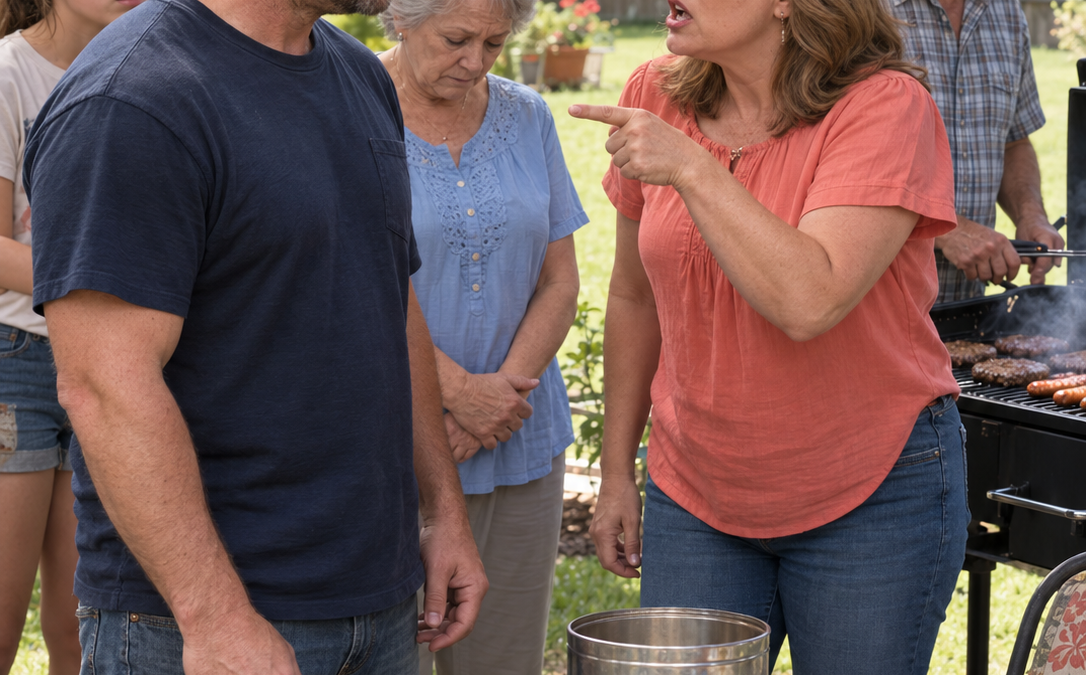
Misty pointed at me, smiling wide enough for the relatives near the back door.
“Three years, and my brother’s never given Mom one dime. Not one.”
The words carried across Mom’s backyard to the relatives sitting along the fence.
Twenty-five relatives were there to hear my sister say it.
Mom looked down at the plate in her lap and nodded.
That hurt worse than the words.
I waited for Mom to lift her eyes, but Mom kept picking at a potato chip.
Lonnie stopped beside the grill with a package of hamburger buns.
“Roof won’t patch itself,” Lonnie said.
“I know.”
The cousin held the can near my elbow. A folded bill stuck up through the plastic lid.
Misty tapped the paper plate with the marker.
“Cash is fine, too, hon. Whatever’s easiest.”
My face felt hot, and it wasn’t from the charcoal.
I wanted to ask Misty to repeat what she’d said.
I wanted Mom looking at me when Misty answered.
But Addison was standing beside the picnic table, holding a stack of paper napkins.
My daughter had heard it, too.
Addison looked from Misty to me. I gave Addison a small nod, asking her to stay where she was.
I lowered the hot dog onto the platter.
Then I placed the tongs on the metal shelf beside the grill.
“If you say so, Misty.”
Misty’s smile tightened.
I thought of the black binder in my truck console.
The truck was parked out front, beyond Mom’s side gate.
I could picture the binder against the console latch, right where I kept it.
My dad had kept receipts in envelopes marked with a ballpoint pen.
I used a binder. Same habit, different container.
“Don’t get sore,” the cousin said. “We’re trying to help your mama.”
“I know what the can’s for.”
Misty took it back and moved toward the lawn chairs.
“Who needs change?” Misty said, sweet and loud.
Somebody called for mustard.
Lonnie put the buns on the table, and the cookout started moving around me again.
I stood beside the grill without picking up the tongs.
Mom’s roof needed work. I could see a damaged patch above the kitchen window.
I had driven ninety minutes from Corpus Christi wanting a plate of food and an afternoon with Mom.
I hadn’t expected to be pointed at.
Still, that wasn’t what kept me standing there.
Mom had nodded.
Misty could say what Misty wanted. I couldn’t understand why Mom had agreed.
“Dad?”
Addison held out a paper plate with a bun on it.
“You haven’t eaten.”
“Give me a minute.”
“Do you want me to get you something?”
“Water.”
Addison glanced toward Misty, then headed for the cooler beside the back steps.
I wiped my palms on my jeans.
I had sent $400 every month.
That was money from welding pipe on refinery turnarounds, working fourteen days at a stretch.
I sent it through my credit union app before I paid for anything extra.
I’d promised Misty I wouldn’t bring it up with Mom.
Now my sister was collecting money in front of me, saying I hadn’t given a dime.
I didn’t know what to make of it.
Lonnie lifted the grill lid.
“You taking a break?”
“Just getting water.”
“I’ve got this.”
I walked toward the cooler.
Mom was already there, struggling with a bag of ice against the white lid.
“Let me,” I said.
Mom stepped aside while I lifted the bag and broke the clump against the ground.
The plastic split at one corner. Ice scattered across the grass.
“Your daddy used to do that,” Mom said.
“Usually broke the bag, too.”
Mom gave me a small smile.
I tipped what was left into the cooler and reached for a bottle.
Addison handed me the one she’d already pulled out.
“Thanks, kid.”
Mom touched my wrist before I could twist off the cap.
“Misty said your hours got cut, baby. I never held it against you. I’ve just been short every month since your daddy.”
I looked at Mom’s hand.
There was a pale mark where Mom’s wedding ring had worn against the skin.
“My hours?”
“Don’t be embarrassed.”
“I’m not.”
Mom glanced toward the yard before speaking closer to my ear.
“I should’ve told Misty not to say that. You didn’t need folks hearing about your business.”
Addison stayed beside the cooler.
I couldn’t answer with my daughter watching me and Mom trying to spare my feelings.
My father had died in May 2023.
At the funeral, Mom had said, “I won’t take a dime from my children.”
I had heard it myself.
Mom had meant it, too. I knew that proud look.
That was why I’d kept my promise to Misty.
I thought I had found a way to help without making Mom feel dependent.
Now Mom was apologizing for people hearing that I couldn’t afford to help.
My stomach tightened.
“I’m working, Mom.”
“I know you do what you can.”
Mom said it kindly. That made it harder to hear.
A burst of laughter came from the folding chairs.
Misty was standing there with the coffee can pressed against one hip.
Mom watched the can for a second, then faced me.
“Your uncle says we’ll get the roof handled.”
“You should’ve called me.”
“You’ve got Addison.”
“My daughter’s taken care of.”
“I know, baby.”
Mom patted my wrist, trying to settle me.
I wanted to say the amount right there.
Four hundred dollars. Month after month.
But Mom was already embarrassed, and I still didn’t understand what I was hearing.
I handed Addison my water.
“Stay with Grandma a minute.”
I went through the side gate to my truck.
The console latch stuck against the binder’s corner. I eased it free and carried the binder back.
Mom was still beside the cooler.
“Cory, don’t worry about finding money today,” Mom said.
I stopped in front of her.
“Misty told me you hadn’t been able to send anything. I believed her.”
Mom’s eyes dropped to the black binder under my arm.
“What’s that, baby?”
Picking up where the Facebook post left off
Part 2 of 10
“Just my records,” I said, holding the black binder against my ribs.
Mom touched its worn corner beside the cooler.
Before Mom could ask more, Misty called from the lawn chairs.
“We need to be realistic about this roof.”
Mom’s hand fell away from the binder.
Misty stood beside the coffee can, where the relatives could hear.
“If the repairs cost too much, Mom may have to sell.”
I looked at my sister.
“Sell the house?”
“There’s the garage apartment at my place,” Misty said. “Since some of us don’t help.”
Mom pressed her lips together.
“That hasn’t been decided,” Mom said.
“I said may, hon. I’m trying to give you options.”
Misty spoke as though Mom should thank her.
I could see the kitchen window behind my sister. Dad had replaced that screen himself.
Mom had lived here with him.
Now Misty was discussing the house like something Mom needed cleared out before the weekend.
“The roof needs fixing,” I said.
“That’s what I’ve been saying.”
Misty lifted the coffee can.
“Which takes money.”
A relative near the fence reached for a wallet.
Mom watched the ground while a bill went through the slot.
I wanted to put the binder on the picnic table.
But I needed to understand why Mom thought I hadn’t sent anything.
I didn’t want to start an argument with only part of the facts.
“Mom’s staying here today,” I said. “Can we leave it at that?”
Misty gave me a patient smile.
“Nobody’s packing a suitcase, Cory.”
A few people chuckled.
Mom went toward the kitchen without taking anything from the food table.
I started after her, but Lonnie called for the platter beside my elbow.
I handed it over and moved the mustard away from the hot grill.
By then, Mom was inside.
Addison had put my water on the picnic table.
My daughter was folding the empty napkin wrapper when Misty held out the can.
“Here, sweetheart. Ask your daddy if he’s got a dime.”
Two aunts laughed.
Addison didn’t.
My daughter took the can carefully and walked toward me.
I hated that Misty had put it in Addison’s hands.
Addison was fifteen. Collecting money from me in front of relatives wasn’t her job.
“You don’t have to ask,” I said.
“I wasn’t going to.”
Addison held the can out, eyes fixed on mine.
There was anger in that look. I knew where it came from.
“Put it on the table, kid.”
“Dad.”
“I heard.”
Misty came closer.
“It’s a fundraiser, hon. Don’t make it uncomfortable.”
I kept my voice low.
“Then ask me yourself.”
Misty’s smile disappeared for a second.
“I already did.”
Addison placed the can beside the paper plate with Misty’s phone number.
The metal bottom struck the table harder than Addison intended.
One of the aunts stopped laughing.
I tucked the binder closer and stepped away.
I needed a minute where nobody was watching my face.
At the truck, I put the binder back in the console.
I hadn’t opened it.
I stood with the driver’s door between me and the street, holding the edge.
Mom believed my hours had been cut.
Misty had said that to Mom.
Those facts were clear. The rest wasn’t.
From the yard, somebody called that the cooler needed more ice.
“I’ll get it,” I said.
It gave me a reason to go inside.
Mom’s kitchen was cooler than the yard, but still warm around the stove.
A serving spoon rested on a folded dish towel.
I opened the freezer and pulled a bag from behind a covered bowl.
A notice caught my eye beneath the freezer handle.
A plain magnet kept it flat against the refrigerator, facing the kitchen table.
The heading said “Disconnect Notice.”
I left the freezer door open for a second.
The past-due amount was $286.
Below it was the disconnection date: February 10, 2026.
Across the bottom, Mom had written, “Lonnie paid 2/12.”
I knew Mom’s handwriting from birthday cards and grocery lists.
I closed the freezer and put the ice in the sink.
My fingers had gone stiff around the plastic.
Mom’s power had been disconnected.
I had spoken to Mom on Sundays. Ten minutes, usually, between work and getting ready for another week.
Mom had told me about the weather, the yard, what Addison should bring next visit.
Mom hadn’t mentioned this.
I looked toward the doorway, expecting Mom to come in.
Nobody did.
The refrigerator hummed beside me.
I tried to picture Mom here without it running, waiting for Lonnie to pay.
My face grew hot with shame.
I hadn’t known.
Then I looked at the date again.
February.
I picked up the ice and carried it outside.
“Set it there,” Lonnie said, pointing beside the cooler.
I did, then headed through the gate.
This time, I climbed into the truck and shut the door.
The seat burned through my jeans.
I opened the console and lifted out the binder.
The printed confirmations were in order, the newest behind the last clear sleeve.
I counted the sheets.
Thirty-six.
I checked the amount on each one as I turned it.
Four hundred dollars.
The first was dated August 1, 2023.
The last was July 1, 2026, just a few days earlier.
On the confirmations was the same recipient line.
“Recipient: Misty Talley — account ending 4471.”
I had known the account was in Misty’s name.
I believed the money paid Mom’s bills.
That was what I had been sending it for.
I worked backward through the sleeves until I reached February.
There was the confirmation.
The transfer was completed, with $400 sent to the account ending 4471.
I lifted the sheet closer to the windshield.
Where had the February money gone?
The notice on Mom’s refrigerator hadn’t been a warning about some possible future cutoff.
The power had actually been disconnected. Lonnie had paid two days later.
I held the confirmation flat against the steering wheel.
My $400 had left on February 1.
Mom’s power had been cut on February 10.
Part 3 of 10
I laid the February confirmation across the truck’s steering wheel.
My phone was in the cup holder beside the open binder.
Four hundred dollars had gone out before Mom lost her power.
I opened my messages and found Misty’s name.
Our thread had cookout plans, birthday reminders, and questions about my work schedule.
Between those were the replies I wanted.
“Got it. Mom says thank you.”
I scrolled back through the months.
The same words kept appearing after I told Misty the money had been sent.
“Got it. Mom says thank you.”
I had accepted that as enough.
Mom didn’t want help discussed. Misty handled the account.
I worked, sent the money, and kept quiet.
Now I counted the replies against the confirmations.
Thirty-six transfers.
Thirty-six thank-yous passed along by my sister.
I stopped at February.
“Got it. Mom says thank you.”
Under that was another message.
“she cried.”
I remembered receiving it.
I had been tired, sitting in my truck after work, glad the money had helped.
I hadn’t called Mom to ask about it.
I thought calling would embarrass her.
My hand tightened around the phone.
Nine days after that transfer, Mom’s electricity had been disconnected over $286.
I didn’t know how to fit those facts together.
I scrolled farther back, past the first payment, to when Misty gave me the account information.
There was the message that had kept me quiet.
“Account’s in my name, easier for her bills. Don’t ever bring it up with her, she’d die of shame.”
I stared at that last part.
Misty had known I heard Mom at Dad’s funeral.
I could still picture Mom standing beside the kitchen counter afterward, refusing offers of money.
I had wanted to help without another argument about pride.
So I had agreed.
I moved my thumb away from the reply box.
I wanted to type a question to Misty right then.
Instead, I took a screenshot of the account message.
Then I started saving the monthly replies.
I made sure the dates showed with the words.
When one screen cut off part of a message, I adjusted it and took another.
I wanted the conversation exactly as it was.
Outside, a car door slammed.
I looked through the windshield, then returned to the phone.
The cookout was still going on behind the house.
I could hear somebody asking where the ketchup had gone.
I saved February’s messages together, including the line about Mom crying.
My mouth felt dry.
I finished the replies and checked that I had saved each month.
Then I opened the binder across my lap.
The clear sleeves caught the light, leaving white streaks over the printed amounts.
I pulled out the first sheet and laid it on the passenger seat.
I photographed it from above.
The date was clear. So were the amount and recipient.
I worked through the pages in order, returning each confirmation to its sleeve afterward.
Dad had taught me to keep proof of what I paid.
He hadn’t taught me what to do when keeping it hurt.
I put the July confirmation down and reached for my phone.
The passenger door opened.
Addison stood there with my water bottle.
“You left this.”
“Thanks.”
My daughter’s eyes went to the paper on the seat.
I hadn’t covered it.
Addison leaned closer without touching the sheet.
“Four hundred dollars?”
I nodded.
“To Aunt Misty?”
“Yes.”
Addison looked at the binder on my lap.
“What’s the rest?”
“The same thing. Different months.”
My daughter stayed in the doorway.
I could see Addison counting the sleeves with her eyes.
“Dad, how long?”
“Since August of 2023.”
Addison climbed in carefully, keeping clear of the confirmation.
The door shut behind my daughter.
We sat without speaking for a few seconds.
Then Addison said, “Grandma thinks you haven’t helped.”
“I know.”
“But you did.”
“I sent it.”
“Then why did Aunt Misty say that?”
“I’m going to find out.”
Addison turned toward the house.
My daughter’s face was red, and I knew it wasn’t only the heat.
“I should’ve said something when Aunt Misty handed me that can.”
“No.”
“Those aunts laughed.”
“I heard them.”
“You let everybody think it was true.”
That hurt because Addison was right.
I had stood beside the grill and let Misty’s words stay unanswered.
“I needed to check this first,” I said.
I showed Addison the February confirmation.
Then I explained the notice on the refrigerator.
My daughter looked from the paper to my phone.
“Does Grandma know you sent it?”
“That’s what I need to ask.”
“Ask her now.”
“I will.”
“I mean before Aunt Misty gets to her.”
I looked through the windshield toward the gate.
Mom had tried to spare my feelings beside the cooler.
Would Mom talk as freely with Misty close enough to hear?
My sister had already answered for Mom about selling the house.
I needed to hear what Mom knew without somebody interrupting.
Addison reached toward the passenger door handle.
“Give me one hour,” I said.
My daughter stopped.
“For what?”
“To talk to Grandma. Keep this between us until then.”
Addison looked at the sheet again.
“I don’t like it.”
“Neither do I.”
“But one hour,” Addison said. “I promise.”
I finished photographing the last confirmation before putting it back.
Addison watched me close the rings and straighten the sleeves.
“Are you asking Aunt Misty first?”
“No.”
I picked up the water bottle and drank.
Then I tucked the phone into my pocket, with the screenshots saved.
“What are you going to say to Grandma?” Addison said.
“I’m going to ask Mom one question,” I said. “And I’m asking her alone.”
Part 4 of 10
“Mom, can we talk in the sewing room?”
I stood beside the hallway door with the black binder under my arm.
Mom put a dish towel on the kitchen counter.
“Is something wrong with Addison?”
“No. Addison’s fine.”
Mom followed me down the hall.
The sewing machine sat beneath the window, covered with a faded pillowcase.
A measuring tape hung from the chair back.
I remembered Mom hemming my work pants there, refusing to let me pay someone else.
I moved the chair away from the table.
“Sit a minute.”
“Cory, you’re making me nervous.”
“I don’t mean to.”
Mom stayed standing.
I put the binder on the edge of the sewing table, keeping it closed.
“I wanted to ask you about—”
“What’s going on in here?”
Misty stood in the doorway.
Neither of us had heard my sister come down the hall.
“I’m talking to Mom,” I said.
“Mom’s got people waiting outside.”
“We need a minute.”
Misty looked at the binder, then at Mom.
“Are you all right, hon?”
“I’m fine,” Mom said.
“You look upset.”
“I didn’t say that.”
Misty stepped between me and the table.
“Come get some air.”
My sister took Mom’s arm.
It looked gentle. Misty was already guiding Mom toward the door.
“Let Mom answer me,” I said.
Misty stopped.
“You hear yourself?”
“I haven’t asked anything yet.”
“Then it can wait.”
Mom looked over Misty’s shoulder at me.
I wanted Mom to stay.
I also hated seeing Mom caught between us in that little room.
“I just need to talk to you,” I said.
“We’ll talk, baby,” Mom said.
Misty walked Mom down the hall.
I picked up the binder and followed.
At the back door, my sister raised her voice.
“Cory’s upsetting Mom on the Fourth. Can somebody please get her a chair?”
Faces turned toward us.
Mom’s cheeks went red.
“I can get my own chair, Misty.”
“Of course you can, hon.”
My sister still had Mom’s arm.
I stopped on the back step, with the binder pressed against my side.
A relative dragged a lawn chair into the shade.
Mom sat, staring at the paper plate somebody handed over.
I had wanted one private answer.
Now the yard was watching Mom recover from a conversation we hadn’t even had.
Lonnie came around the grill.
“What’s the trouble?”
“Ask Cory,” Misty said.
“I asked Mom to talk.”
“About money,” Misty said.
I hadn’t gotten that far.
Lonnie looked at the binder.
Then my uncle looked straight at me.
“Your mama’s lights were off two days in February. Where were you?”
I opened my mouth.
The transfer date was right there under my arm.
So was the amount.
But I still hadn’t heard from Mom what Misty had told her about the account.
I could show Lonnie a payment to my sister.
I couldn’t yet explain why Mom had been sitting in a house without power.
“Let me talk to Mom,” I said.
“I’m talking to you.”
“I know.”
Lonnie waited.
I had no answer I was ready to give across that yard.
A cousin stood from a folding chair and gathered the children nearby.
“Come on. Let’s play over here.”
The cousin led the kids toward the other side of the yard.
One child glanced back at me.
My stomach dropped.
I hadn’t shouted. I hadn’t threatened anybody.
Still, I was the person the children needed to be moved away from.
Lonnie turned back to the grill.
Misty bent beside Mom’s chair and said something I couldn’t hear.
I walked to the picnic table.
My hands were shaking when I reached for my water.
I set the binder on the bench beside me and twisted the cap carefully.
Addison stood at the food table, making a plate.
My daughter added a bun, then a little potato salad.
“Is that yours?” I said.
“Grandma didn’t eat.”
Addison carried the plate toward Mom.
A minute later, Mom got up and headed inside with my daughter.
I watched through the kitchen window.
Addison put the food on the table and pulled out a chair.
Mom sat.
My daughter took the chair beside Mom instead of coming back outside.
I was grateful enough that my throat hurt.
Addison had promised me an hour.
My daughter was keeping that promise without leaving Grandma alone.
I put the water down.
For a while, I stayed near the table, answering when somebody asked for a serving spoon.
Misty resumed passing the can.
The kitchen window gave me a narrow view of Mom eating.
I wanted to go in.
I also knew Misty was watching me.
When I finally picked up the binder, my sister’s eyes followed it.
I went through the side gate toward the trucks.
Misty came after me.
“Cory.”
I stopped beside my driver’s door.
Out here, my sister didn’t bother smiling.
“What are you doing with that thing?”
“Keeping my records.”
“Don’t get smart.”
“I’m not.”
Misty stood between me and the gate.
Behind my sister, somebody in the yard called for more buns.
Nobody could hear us clearly from there.
“Bring up money today and Mom’s blood pressure goes through the roof. That’s on you.”
I felt scared then.
Misty knew I would.
I had just seen Mom embarrassed in front of relatives.
I didn’t want to make Mom sick.
“You brought up money,” I said.
“I’m helping with the roof.”
“You told people Mom might have to sell.”
“And you’re making this harder.”
I looked toward the kitchen window, but I couldn’t see Mom from the driveway.
Was telling the truth going to hurt her?
I didn’t know what Mom had been told, or how much another argument would cost her.
Misty reached for the gate latch.
“Leave Mom alone until we’re finished.”
I held the binder tighter.
“Finished with what?”
“At 7:30, I’m announcing the roof total by the grill,” Misty said. “You will not upset her again.”
Part 5 of 10
My phone buzzed while I stood beside the truck with the binder.
Addison had sent a message.
“Come to the kitchen. Grandma’s showing me something.”
I went through the side gate without looking for Misty.
Mom sat at the kitchen table with a paper check register open.
Addison had moved the plate aside.
“Close the door, baby,” Mom said.
I did.
Mom held a finger against a line in the register.
“Addison said you had a question about money.”
My daughter looked at me.
“I didn’t tell Grandma about the papers,” Addison said.
“Grandma asked why you were upset.”
Mom turned the register so I could see it.
“I keep track,” Mom said. “I don’t spend without writing it down.”
“I know you don’t.”
The page had groceries, insurance, and utility payments in Mom’s small handwriting.
Near the top was a deposit.
Social Security. $1,612.
Mom pulled an older register from beside her elbow.
“I’ve got the others here.”
I put my binder on the table.
“Mom, have you ever received four hundred dollars from me?”
Mom’s finger stopped moving.
“No, baby.”
“Through Misty.”
Mom shook her head.
“Not once?”
“No.”
I sat down because my knees felt weak.
“Since August of 2023,” I said. “Four hundred a month.”
Mom looked at the binder, then at my face.
“You sent that?”
“Yes.”
“To Misty?”
“To the account Misty gave me.”
Mom opened an older register to a page marked August.
There was the Social Security deposit.
Below it were checks Mom had written and amounts subtracted from the balance.
No deposit from me.
Mom turned the pages.
I followed the money coming in, month after month.
Only Social Security.
There was no $400 in the old registers or the one beside my hand.
“Did Misty pay bills straight from that other account?” I said.
“Not that I know of.”
“Did Misty ever give you cash from it?”
“No.”
Addison sat very still.
Mom rubbed the edge of a page between her fingers.
“I asked Misty to set something up that summer,” Mom said.
“So you could send help.”
I waited.
Mom’s eyes were wet now.
“I couldn’t keep saying I was fine when I wasn’t.”
I remembered that funeral promise.
Mom had changed her mind because the bills hadn’t stopped when Dad died.
I wished Mom had called me.
“What did Misty tell you?” I said.
“The bank needed somebody with a computer.”
Mom glanced toward the closed back door.
“Misty said the account had to be in her own name.”
My chest tightened.
“Have you seen a statement?”
“No.”
“A bank card?”
“No, Cory.”
“Any money from it?”
“Nothing.”
Mom folded her hands on the table.
“I thought there wasn’t anything to see.”
I couldn’t get a word out for a few seconds.
I had been sending money to an account Mom couldn’t see.
Misty had thanked me for payments Mom didn’t know existed.
“What did Misty say when you asked?” I said.
“Your hours were cut. You were ashamed.”
Mom’s voice got quieter.
“Misty said asking you would make it worse.”
Addison pushed the untouched water glass closer to Mom.
My daughter didn’t say anything.
I looked down at my binder.
Misty had told me Mom was too proud to hear the money mentioned.
Misty had told Mom I was too ashamed to be asked.
I understood now.
My sister had given us different stories, then made sure we wouldn’t compare them.
“I promised Misty I wouldn’t bring it up,” I said.
“I never asked for that,” Mom said.
“I know that now.”
Mom wiped under one eye with a fingertip.
There was anger in my chest, but grief was there, too.
Mom had gone short while believing I couldn’t help.
I had worked and sent money while believing Mom’s bills were getting paid.
Misty had stood outside and called me out in front of the family.
“Why would Misty do that?” Mom said.
“I don’t know what the money bought.”
That was the truth.
I knew where I had sent it. I knew Mom hadn’t received it.
I didn’t know what Misty had done afterward.
Mom looked toward the yard.
“Maybe Misty’s holding it somewhere.”
“Then Misty can show us.”
My mother wanted an answer that would leave her daughter innocent.
I wanted that, too.
But I had seen the disconnect notice.
Mom had needed $286 while my sister sent me a message saying Mom cried with thanks.
I kept my voice steady.
“I need you beside the grill at seven-thirty.”
“Why out there?”
“Because that’s where Misty told people I never helped you.”
Mom stared at the register.
“Cory, those people don’t need our business.”
“They heard about your lights. They heard about my work.”
I paused.
“They need to hear this part.”
Mom didn’t answer right away.
I knew the risk.
Mom might side with Misty in front of everyone.
Thirty-six sheets of paper might not be enough when believing them meant facing what her daughter had done.
I was scared of that.
I was more scared Mom would keep trusting the same arrangement.
“Just stand with me,” I said. “You can ask questions yourself.”
Mom closed the register.
“I’ll come out.”
Addison stayed beside Mom while I picked up the binder.
Through the window, I saw Misty pressing tape against the cooler.
A sheet of paper beneath my sister’s hand said “$2,150!”
Misty smoothed the corners, stepped back, and raised an empty cup.
I opened the kitchen door.
“To this family,” Misty said, testing the words toward the chairs.
Then my sister lowered the cup and started over.
I looked back at Mom.
Mom was still sitting, one hand resting on the closed register.
“Seven-thirty,” I said.
“I heard you, baby.”
I tucked the binder under my arm and walked to the grill.
“Misty,” I said. “I’ve got something Mom needs to hear.”
Part 6 of 10
At 7:40 p.m., Misty raised a plastic cup beside the grill.
The “$2,150!” sign was still taped to the cooler.
Mom stood between Addison and me.
“I want to thank the people who stepped up today,” Misty said.
My sister waited until the conversations stopped.
“Twenty-one hundred and fifty dollars. That’s going into Mom’s account like always.”
Lonnie stood behind the grill with a towel over his shoulder.
Misty lifted the cup higher.
“Some people understand that family takes care of family.”
I held the binder against my side.
Mom kept looking at the coffee can on the table.
Misty turned toward me.
“Three years, and my brother’s never given Mom one dime. Not one.”
This time, I didn’t put my eyes down.
“Mom,” I said. “Take this.”
I held out the binder.
Misty lowered the cup.
“We’re in the middle of something, Cory.”
“So am I.”
Mom reached for it.
I opened the cover before placing the binder in Mom’s hands.
The first confirmation was in its clear sleeve.
“Start with the name,” I said.
Mom brought the page closer.
“Cory, what is this?” Lonnie said.
“The money I sent.”
My uncle put the towel down.
Misty stepped toward Mom.
“You don’t need to go through paperwork out here.”
Mom turned away from Misty’s hand.
“I can read it.”
That was the loudest Mom had spoken all afternoon.
Lonnie reached into his pocket and pulled out a small flashlight.
My uncle clicked it on and aimed it at the page.
The plastic sleeve had a crease across the printing.
Mom tilted the binder until the light caught the words.
“Recipient: Misty Talley.”
Nobody answered.
“Date and amount,” I said.
“August first, 2023. Four hundred dollars.”
Misty looked around the yard.
“Cory knows what that is.”
Mom turned the sheet.
The rings made a small scraping sound.
“Recipient: Misty Talley.”
Mom moved her finger down.
“September first, 2023. Four hundred dollars.”
Lonnie shifted the flashlight.
Mom turned another page.
“Recipient: Misty Talley.”
My mother stopped before reading the date.
I could see Mom’s fingers trembling against the sleeve.
“There are thirty-six,” I said. “Four hundred dollars each.”
A cousin stepped closer to see.
Misty put the cup on the table.
“Don’t twist this into something ugly, hon.”
“I haven’t said what it is.”
“You handed Mom a stack of papers in front of people.”
“You told those people I never sent anything.”
Misty’s mouth tightened.
I kept my hand beneath the binder so Mom didn’t have to hold its weight.
The same twenty-five relatives who had heard my sister accuse me were listening now.
Nobody reached for another plate.
Mom looked up.
“Misty, this has your name.”
“That’s a joint account. Mom’s on it. I just handle it.”
The answer came quickly.
My mother studied my sister’s face.
“I’m on it?”
“Yes, hon. That’s what I said.”
Mom looked back at the confirmation.
I knew what Misty’s first message said.
I had it saved on my phone.
But Mom needed an answer from somebody outside this yard.
“Then the bank can confirm it,” I said.
Misty folded her arms.
“On the Fourth of July?”
“Branches are closed. The phone line’s open.”
“We can clear this up Monday.”
Mom shook her head.
“I want to know now.”
Addison moved the chair from behind the table.
“Sit here, Grandma.”
Mom sat with the binder open across her knees.
I found the contact page for Gulf Prairie Regional Bank, the bank holding Misty’s account ending 4471, and showed Mom the customer service number.
Under it were the words saying the line was available twenty-four hours.
Mom held out a hand.
“Call it, baby. Put it where I can hear.”
I dialed and turned on the speaker.
The recorded greeting sounded too cheerful beside the grill.
Misty moved closer.
“Mom, you don’t know the account number.”
“I know my name.”
The recording offered choices.
I selected help with an account, then followed the option for a representative.
Music played through the speaker.
Lonnie kept the flashlight pointed down.
The coffee can sat near Misty’s elbow.
I watched Mom’s thumb rub the edge of the binder.
My mother could still close it.
Mom could hand me back the papers and tell everyone we would sort it out later.
I was afraid that would happen.
Addison rested a hand on the chair back and stayed quiet.
Then a woman answered the call.
Mom leaned toward the phone.
“I need to find out whether I’m on an account at Gulf Prairie Regional Bank.”
The representative asked for Mom’s name.
“Charlene Harmon.”
Misty shifted beside the table.
Mom gave her birth date when asked.
Then Mom gave her Social Security number, speaking carefully and without looking at the relatives nearby.
I kept my eyes on my mother.
The representative asked Mom to wait while she searched.
There was a faint tapping sound through the speaker.
Misty reached for the cup, then left it on the table.
Mom stared at the phone in my palm.
I wanted the bank to say Mom’s name was there.
I wanted a problem we could fix without what I feared being true.
But the confirmations were open on Mom’s lap.
My sister’s name showed through the plastic.
“Are you still there?” Mom said.
“Yes, ma’am. I’m checking.”
Lonnie raised his eyes from the binder to Misty.
My uncle didn’t say anything.
Mom straightened in the chair.
“I was told it was a joint account,” Mom said. “My daughter says I’m on it.”
The tapping stopped.
“Ma’am, I don’t show any account under your name.”
Part 7 of 10
Misty picked up the coffee can from beside her cup.
“Mom told me to hold it for emergencies.”
The bank representative’s voice was still coming through my phone.
Mom thanked the woman, then reached over and ended the call.
“I never told you that,” Mom said.
“You were upset after Dad. You don’t remember everything.”
I opened the message thread.
“Here’s February,” I said.
Misty looked at the phone.
“Those are private messages.”
“You said they were from Mom.”
I held the screen where my sister could see it.
“Got it. Mom says thank you.”
Mom’s eyes lifted from the binder.
“That was February first,” I said.
Then I read the next message.
“she cried.”
Mom shook her head.
“I didn’t know you’d sent anything.”
Lonnie put the flashlight on the table.
“The notice is still on the refrigerator?” my uncle said.
“Yes,” I said.
Lonnie went inside.
Nobody followed.
Misty held the can against her stomach and watched the back door.
I could hear a chair scrape inside the kitchen.
Mom stayed seated, with the confirmations open across her knees.
Addison leaned down and quietly asked if Grandma wanted water.
Mom nodded.
My daughter picked up the bottle beside the chair and loosened the cap.
Lonnie came back carrying the disconnect notice.
The magnet had left a dent near the top.
My uncle held the paper beside my phone.
“Was February an emergency?”
Misty didn’t answer.
Lonnie pointed at Mom’s handwriting.
“I paid it. Two hundred eighty-six dollars.”
My sister looked toward the relatives gathered behind us.
“Every penny went to her bills.”
“Then why did I have to pay this one?” Lonnie said.
Mom gripped the water bottle without drinking.
I had wanted an explanation.
I still wanted Misty to name something we had missed.
But my sister wouldn’t look at the notice.
Lonnie laid it beside the binder and took out his phone.
“What name did you tell me to send the roof money to?”
“Mom’s account,” Misty said.
“I’m asking the name.”
“Lonnie, we can sort this out.”
My uncle tapped the screen.
Then Lonnie held up the phone.
“Three hundred dollars. Misty Talley.”
A cousin pulled out a phone near the picnic table.
Another cousin did the same.
For a minute, the only words came from people trying to find their payment records.
One cousin turned a screen toward Lonnie.
“Mine says Misty, too.”
The other cousin nodded.
“Same here.”
Misty lowered the can toward the table.
Lonnie took it before my sister could put it down.
“I’ll hold this.”
“You don’t need to do that.”
“I said I’ll hold it.”
My uncle carried the can to the far side of the grill.
The cousins stayed beside their phones.
I helped Mom close the binder so Mom could stand.
My mother’s knees were stiff from sitting.
Addison took the water bottle while I moved the chair back.
Mom walked a few steps toward the kitchen door.
I followed, leaving enough room for Mom to turn around.
Mom stood with a hand against the doorframe.
I waited.
I wasn’t going to put words in my mother’s mouth.
When Mom faced the yard again, the tears were gone.
“Never given me one dime, you said. Where is my money, Misty?”
My sister pressed her hands together.
“Mom, please. There are people here.”
“They were here when you said it.”
“We need to talk inside.”
“I asked where my money is.”
Addison stood beside Mom.
“Dad printed every single one, Grandma.”
Mom reached for the binder again.
I handed it over.
My mother opened the cover and looked at the first confirmation.
Then Mom turned to the last.
Misty watched without moving.
“You could’ve told me you were sending it,” Mom said to me.
“I should have.”
Misty started to speak.
I took out my phone again.
“Here’s why I didn’t.”
I found the message from the beginning and read it aloud.
“Account’s in my name, easier for her bills.” I read the rest aloud: Misty said I must never bring it up with Mom because Mom would die of shame.
Mom closed her eyes.
I lowered the phone.
“I believed Misty.”
“So did I,” Mom said.
My sister reached toward the binder.
Mom pulled it closer.
“You don’t need to keep passing that around,” Misty said.
“It’s mine to look at,” Mom said.
I stepped beside my mother.
“Thirty-six months, Misty. Every one of them has your name.”
Misty’s face drained of color.
For once, my sister didn’t call anybody hon.
Lonnie stood near the grill with the can beneath his hand.
The disconnect notice lay flat on the table.
Nobody was laughing now.
“I can straighten this out,” Misty said.
Mom looked up from the pages.
“Where is it?”
“I need some time.”
My mother’s mouth trembled.
I wanted to reach for Mom, but Addison was already holding her arm.
I waited until Mom looked at me.
“What do you want to do?” I said.
Mom looked toward the relatives, then back at Misty.
My sister took a step forward.
“Don’t let Cory turn this into something.”
Mom held up a hand.
“No.”
I stayed beside my mother.
The binder was open between us.
Mom pressed a finger against the first page, where my sister’s name was printed.
“Monday we go to the police. Both of us.”
Part 8 of 10
On Monday, July 6, Mom set the black binder on a desk at the Victoria Police Department.
The officer pulled a blank form closer.
Mom kept a hand on the cover until I sat beside her.
“We’re here about money my son sent for me,” Mom said.
The officer asked us to start at the beginning.
I gave the dates and amounts.
Mom explained asking Misty to set up an account.
Then Mom described what my sister had said when no money arrived.
The officer looked at me.
“And you were sending it?”
“Four hundred a month.”
“Starting when?”
“August first, 2023. The last one was July first.”
I opened the binder.
The officer looked through the confirmations, then took the copies we had brought.
I handed over the printed screenshots, too.
The account message was at the front.
Behind it were Misty’s replies, with the dates showing.
“Did you make these transfers yourself?” the officer said.
“Yes.”
“What did you understand the money would be used for?”
“My mother’s bills.”
Mom folded her hands in her lap.
“I didn’t receive it,” Mom said.
The officer asked about the account and the bank call.
We answered without guessing.
I didn’t know where Misty had spent the money.
I knew what my sister had told me. Mom knew what Misty had told her.
We had the messages and the confirmations.
The officer wrote $14,400 on the report.
I watched the pen stop after the last zero.
That number looked different on police paperwork.
It had been a monthly payment in my mind, something I fit around my own bills.
Now the amount was written in one place.
“Thirty-six transfers,” I said.
The officer checked the pages.
The payments were recorded together in one report.
Mom reached for my wrist under the desk.
I turned my hand and held hers.
Neither of us said anything.
When we left, Mom carried the report information in her purse.
I had the original binder.
Outside, my mother stopped beside the truck.
“I didn’t think I’d ever be sitting in there about Misty.”
“I know.”
Mom looked toward the building.
“But I told the truth.”
“Yes, you did.”
We stood there a little longer before getting in.
Our next stop was my lawyer’s office.
I put the same binder on another desk.
This time, Mom opened it herself.
The lawyer listened while we explained the transfers and the stories Misty had told us.
He looked closely at the first message.
Then he checked the payment dates against the replies.
“You sent the money because you believed it would support your mother,” he said.
“Yes.”
“And your mother says none reached her.”
“None,” Mom said.
He explained that agreeing to send money didn’t mean agreeing to its being taken through a lie.
Then he laid out the civil demand.
“Fourteen thousand four hundred dollars,” he said. “Under the Texas Theft Liability Act.”
Mom looked at the paper in front of him.
“That’s what Cory sent.”
“Yes. The demand will also address up to one thousand dollars more and attorney’s fees if this goes to court.”
I asked him to keep the letter plain.
I wanted Misty to know the amount, the evidence, and what came next.
I didn’t need a page about how disappointed we were.
My sister already knew.
The lawyer prepared the demand and let us check the facts before sending it.
I checked the dates.
Mom checked her name.
When the letter went out, my hands were flat on my knees.
“What if Misty won’t pay?” I said.
“Then we discuss filing suit.”
Mom picked up her purse.
Nobody could tell us which choice my sister would make.
At Mom’s bank, we sat beside each other again.
This desk had a small bowl of wrapped candy on it.
Mom took out her paper checkbook.
“I want the help coming here,” Mom said.
The bank employee confirmed the details for Mom’s existing checking account.
With my phone resting beside Mom’s checkbook, I used my credit union app to redirect the monthly transfer.
Mom watched my thumb move across the screen.
I entered the account information carefully, then checked it against what the employee had provided.
“Here,” I said.
I turned the phone toward my mother.
Charlene Harmon.
Mom leaned closer.
“That’s my name.”
“Yes.”
The next scheduled payment was $400 on August 1.
I showed Mom the amount and date before saving it.
“No going through Misty?” Mom said.
“Straight into your checking.”
Mom touched the edge of my phone.
“I can write it in my register.”
“You can.”
The employee answered Mom’s questions about checking that it had arrived.
Mom wrote the answers on the back of a deposit slip.
I waited until my mother was satisfied.
There was no promise to keep it quiet this time.
Mom knew what I was sending and where it would go.
By the time we got back to the truck, my shirt was damp across the shoulders.
Mom asked if I wanted lunch.
“Something small,” I said.
“I could eat.”
That felt like progress after the cookout.
We stopped before I drove Mom home.
The demand was out. The police had the copies.
I still had no answer about repayment.
Late that afternoon, my phone rang.
Misty’s husband.
I stepped onto Mom’s porch before answering.
“Cory.”
“Yeah.”
“I’ve seen the letter.”
I gripped the porch rail.
“Then you know the amount.”
“I didn’t know about any of this.”
“What did Misty tell you?”
The pause stretched on, and I moved the phone to my other ear.
The call was still connected.
“Your money paid her SUV note, Cory. I never knew.”
Part 9 of 10
On Friday, July 24, my lawyer called about a cashier’s check.
“Fifteen thousand four hundred dollars,” he said. “It’s here.”
I was holding a grocery bag outside Mom’s kitchen door.
I put it down before asking him to repeat the amount.
He did.
Misty had paid the $14,400 I sent, plus another $1,000.
There was no apology with it.
I hadn’t expected one, but I asked whether my sister had included a letter.
“Just the check,” the lawyer said.
I went inside.
Mom was putting clean silverware into the drawer.
“The money came.”
Mom stopped with a fork in her hand.
“All of it?”
“Fifteen thousand four hundred.”
My mother sat at the kitchen table.
I waited while Mom pressed her hands together.
Then Mom reached for her purse.
“Let’s go get it.”
At the lawyer’s office, Mom examined the check before signing it.
My mother’s name was printed on the front.
I kept looking at the amount.
For months, Mom had worried about bills with no idea where my payments had gone.
Now the money was finally going where I had meant it to go.
We took the check straight to Mom’s bank.
Mom handed me the signed check while the teller prepared the deposit.
I slid it across with the deposit slip for Mom’s checking account.
“Into this account,” I said.
The teller checked the information and processed it.
Mom stayed beside me until the receipt came back.
Outside, my mother took it from the envelope and checked the amount.
Then Mom tucked it inside her checkbook.
“I want this where I can find it.”
We drove home without calling Misty.
Lonnie came over that afternoon carrying the coffee can and a notebook.
My uncle put them on the kitchen table.
“I’m getting the roof money back to people,” he said.
Mom looked at the can.
“We still need the roof.”
“We’re still fixing it.”
Lonnie opened the notebook.
My uncle had written down who had given cash and who had sent money to Misty.
The cousins checked their amounts against the list.
Cash went back from the can.
Lonnie covered the refunds for the payments sent to Misty’s account, too.
My uncle didn’t take that money from Mom’s deposit.
“You shouldn’t have to cover that,” I said.
“I’ll deal with Misty. They gave for Charlene’s roof.”
Lonnie marked the refunds as they were returned.
My uncle included the cousins who said to leave their money in the fund.
“Take it back first,” Lonnie said. “Then decide what you want to do.”
The old collection was finished before Lonnie started handling a new one.
This time, my uncle kept the list and the money.
Mom would see the estimate and the payments.
Nothing would go through Misty.
I sat beside Lonnie while my uncle wrote down a roofing company’s number.
Mom brought the checkbook over and stayed at the table with us.
Nobody had to speak for my mother.
When Lonnie asked what work Mom wanted quoted, Mom answered.
The family chat changed that weekend.
A notice showed that Misty was no longer an admin.
Lonnie posted the roof information.
A cousin asked where to send a contribution, and my uncle answered directly.
I showed Mom the conversation on my phone.
Mom looked at the screen, then handed it back.
“I need to call Misty.”
I stayed at the table while Mom made the call.
My mother held the phone close and waited.
“Misty, it’s Mom.”
I heard my sister’s voice, but not the words.
“No, I’m not calling about the check.”
Mom looked down at the table.
“I’m telling you to call before you come over.”
The answer was loud enough that Mom moved the phone away from her ear.
My mother waited until Misty stopped.
“Yes, even you.”
Mom’s fingers tightened around the phone.
“Don’t come by without calling first. I need you to hear that.”
I watched my mother listen.
Then Mom ended the call and put the phone down.
“Do you want me to stay?” I said.
“For supper.”
“I can do that.”
Mom got up to check the refrigerator.
The following week, roofers backed a trailer into the driveway.
Lonnie met the crew outside with the estimate folded in a shirt pocket.
I moved my truck out of the way.
From the yard, I watched the first ladder go against Mom’s house.
The roof had been a reason for passing a can and discussing where Mom might have to live.
Now somebody was actually starting the work.
Mom stood beneath the porch, listening to the crew leader explain what would happen that day.
My mother asked about the damaged area above the kitchen.
The roofer pointed it out and answered.
Addison came through the door carrying a pitcher of iced tea.
My daughter had filled plastic cups and set them on a tray.
“Where do you want these?” Addison said.
We cleared a spot in the shade.
When the workers came down for a break, Addison handed out the tea.
Mom went inside for more ice.
I followed with the empty pitcher.
On the kitchen counter was a calendar, open beside Mom’s grocery list.
Addison came in behind me and pointed to September.
“Are we still coming here for Labor Day, Grandma?”
Mom stopped at the freezer.
I waited for the answer.
Nobody had discussed another cookout since the Fourth.
Lonnie was outside, talking over the sound of work above us.
Addison kept a finger beside September 7.
“We can bring food,” my daughter said.
Mom shut the freezer and turned toward us.
“Will you be here, Cory?”
“Yes.”
Mom looked through the window at the ladder against the house.
Then my mother took the pen from beside the calendar.
“I’m hosting Labor Day here myself, under my new roof.”
Part 10 of 10
“Move those burgers over,” Lonnie said, pointing with the tongs.
It was Monday, September 7, and new shingles covered Mom’s roof.
Addison carried plates past us toward the porch.
“Grandma said to leave room for the potato salad.”
“Your grandma always says that,” Lonnie said.
I moved the burgers away from the hottest part of the grill.
My uncle lifted one edge with the spatula and nodded.
“That’ll do.”
Through the kitchen window, I could see Mom taking a bowl from the refrigerator.
My mother had planned the food and called us about when to arrive.
When I asked what to bring, Mom gave me a list.
I had brought what was on it.
That morning, Mom had checked the groceries and put them away.
Now there was food waiting on the counter and a clean table on the porch.
Addison came back with a serving spoon.
“Grandma wants you inside a minute, Dad.”
“Take over?” I said to Lonnie.
“Been doing that since before you were born.”
I handed my uncle the spatula.
Mom stood beside the kitchen drawer with a roll of tape.
The black binder was on the table.
I had brought it in when Mom asked.
“I want the first one,” Mom said.
I opened the cover and slid the August 1, 2023 confirmation from its sleeve.
My mother held it by the corners.
Four hundred dollars.
Recipient: Misty Talley.
Mom put the paper against the refrigerator door.
The disconnect notice was gone.
I recognized the small dent in the paint where its magnet had rested.
Mom tore off a piece of tape.
“Here?”
I nodded.
My mother fixed the top corner, then the other.
The page hung straight.
“People will see it,” I said.
“I know.”
Mom pressed the tape with a thumb.
Then my mother stepped back and stood beside me.
For a while, we looked at the paper.
I remembered sitting in my truck after work, sending that first payment.
I had wanted Mom to have one less thing to worry about.
Now Mom could see the date and amount without asking anyone what had happened.
My mother touched my elbow.
“Come sit with me.”
“Lonnie’s got food going.”
“Lonnie can manage.”
Mom picked up an envelope from the counter.
My name was written across it.
Outside, Addison had put the plates at the end of the porch table.
My daughter moved a chair so Mom could sit in the shade.
I started toward the steps, but Mom caught my hand.
“Here, baby.”
My mother pulled out the chair beside hers.
I sat.
Mom placed the envelope in my lap and kept hold of my hand.
My fingers were rough against Mom’s palm.
My mother turned my hand over and touched a thick patch of skin below my thumb.
Mom knew where those marks came from.
I looked down because my eyes had started to sting.
My mother had never been cruel about my work.
But for three years, Mom had believed I couldn’t spare anything.
I had stood in this yard while people laughed at that.
“It hurt that you believed I didn’t care, Mom.”
My mother’s chin trembled.
“I’m sorry, Cory.”
Mom put my hand against her cheek.
I couldn’t speak.
My mother held it there until I looked up.
Then Mom lowered our hands to the arm of the chair without letting go.
Addison stopped beside the table.
My daughter saw my face and quietly sat on the porch step.
I opened the envelope with my free hand.
There were flowers on the front of the card.
Inside, above Mom’s message, was a number.
Mom had written it large enough to fill the top of the page.
I ran a finger beneath it.
It was the first thank-you card Mom had given me in three years.
My mother leaned close.
“I counted the pages.”
“I know.”
“I wanted the number right.”
I tried to read the message below it.
The words blurred.
Addison moved from the step to the chair beside mine.
“Want me to read it, Dad?”
I handed my daughter the card.
Mom was still holding my other hand.
Beyond the porch rail, Lonnie flipped a burger.
My uncle looked over, saw us sitting together, and lowered the grill lid.
“Few more minutes,” Lonnie said.
“We’re here,” Mom said.
Addison opened the card carefully.
“Thirty-six,” my daughter said.
Mom nodded.
A little breeze lifted the empty envelope from my knee.
I caught it against the chair arm.
Above us was the new roof.
From inside the kitchen, I could hear the refrigerator running.
Addison looked from Mom to me, then down at the card.
My daughter cleared her throat.
Mom’s shoulder rested against mine as Addison read the rest aloud.
“Thank you for taking care of me when I didn’t know. Love, Mom.”
THE END
More stories
I gave my mom half my liver. At her recovery party, Dad toasted my sister for saving her and handed her Mom’s car keys in front of 40 guests.On Mother’s Day, my daughter toasted her mother-in-law as ‘the mom I never had’ in front of 20 guests, then gave her my mother’s pearls.My son sold his condo and pulled a moving truck into my driveway on my 68th birthday, in front of 25 neighbors. My street doesn’t allow anyone under 55.On Memorial Day my daughter gave my lake house’s 4 bedrooms to her in-laws and left my suitcase on the porch. She forgot what I kept in 2019.On Halloween, my neighbor sent his crew to rip out my wife’s wheelchair ramp in front of 70 trick-or-treating families. I spent 28 years enforcing the law he broke.At my daughter’s baby shower, my second wife gave my late wife’s rocking chair to her daughter in front of 30 guests. My daughter’s name is carved under the seat.
You Might Also Enjoy




