My Brother-In-Law Made Me Hold His Beer At The Boat Show, So I Challenged His Trophy Claim
Complete story · 10 chapters · about 41 minutes · ending included
Chapter 1 · Chapter 2 · Chapter 3 · Chapter 4 · Chapter 5 · Chapter 6 · Chapter 7 · Chapter 8 · Chapter 9 · Chapter 10
Chapter 1: The Name Beside The Trophy
“I built her from bare wood,” Antonio said.
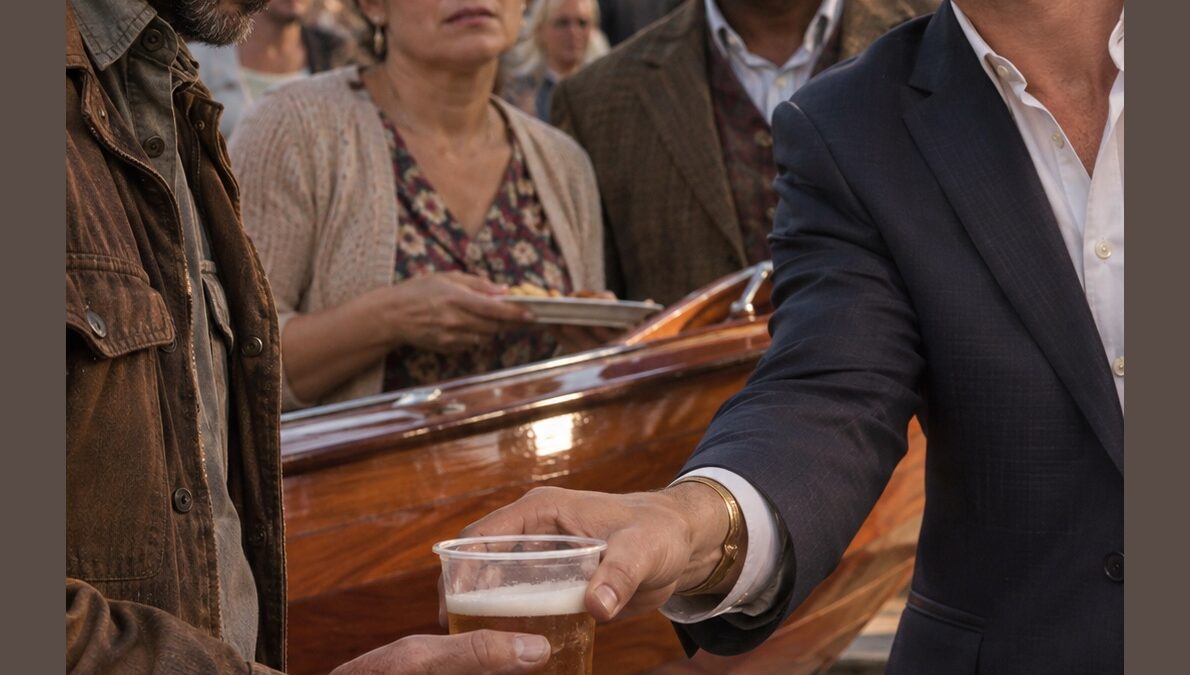
He lifted the brass trophy, set it beside his elbow, and pushed his beer into my hand.
“Hold my beer, shop boy.”
Forty registered guests heard him.
The cup was cold against my palm.
The trophy caught the afternoon light.
Behind both sat the twelve-foot cedar skiff I had spent fourteen months building.
Antonio smiled toward the phones pointed at him.
I stood half a step behind his shoulder with his drink.
That was the picture he wanted.
Owner in front.
Builder holding the beer.
The words hurt worse because he made them sound playful.
Antonio had been turning my work into his introductions for months.
A dinner became a sales pitch.
A family visit became a chance to mention “his” boat.
A question about cedar became a story with Antonio at the center.
I had allowed plenty of those little claims to pass.
I needed commissions.
Antonio knew it.
He also knew I would not trade my name for a referral.
I looked at the skiff instead of him.
The varnish was smooth enough to reflect the dock rail.
The cedar grain ran clean along the hull.
I knew where each plank had fought me.
I knew which rib had needed steam twice.
I knew the aft seat had a brass shop tag underneath it.
My job number.
My hands had made everything Antonio was standing beside.
“Your speech left something out,” I said low.
Antonio kept smiling.
A woman near the trophy table leaned toward the skiff.
“How did you get that curve so tight?” she asked.
Antonio turned before I could answer.
“You have to know when the wood is ready,” he said.
My stomach tightened.
He had watched me bend those ribs once.
He had stood in my shop doorway with a coffee while I worked.
Now he was answering like the knowledge had lived in his hands.
I looked down at my right thumb.
A pale scar crossed the pad where a cedar edge had opened it months earlier.
There was still a thin line of cedar shavings caught in the seam of my work boot.
Proof nobody had planned to photograph.
Antonio kept talking.
He mentioned patience.
He mentioned feel.
He even curled his fingers in the air like he was showing the woman how the plank had moved.
Heat rose along my neck.
I wanted to say the whole thing right there.
Who cut the stock.
Who set the ribs.
Who fitted the planks.
Who sanded until midnight before the final coat.
Instead, I watched him take credit one sentence at a time.
Silence can look polite from across a room.
From inside it, silence can cost you your own name.
A photographer stepped closer.
“Antonio, one with the boat and trophy.”
Antonio moved beside the bow.
I started to step with him.
His hand came up.
“Just me,” he said, waving me back.
A few people glanced my way.
That small motion hurt.
No shouting.
No scene.
Just my brother-in-law erasing me from the frame of my own work.
I looked at Ana near the refreshment table.
My sister had a stack of napkins in one hand and a tray in the other.
She had that tight look she got when she was trying to keep the room calm.
Antonio planted one hand on the skiff.
The photographer raised the camera.
I set his beer on the trophy table.
Then I walked straight to Jermaine Baird.
Jermaine was forty-one, a cabinetmaker, and the judging panel chair.
He had a program folded under one arm.
“Where did the builder’s name come from?” I asked.
Jermaine looked toward the skiff.
“The public tag?”
“Yes.”
He walked with me to the display stand.
The small card listed the entrant.
Antonio Hobbs.
It did not say builder.
It did not say owner.
It did not say who had made the hull.
I stared at that clean little card and felt exactly how much could disappear between two printed words.
Jermaine unfolded the program.
His finger moved below the award schedule to a boxed section labeled corrections.
I had seen the program that morning.
I had not needed that box until Antonio raised my boat’s trophy.
Jermaine said, “The award was announced, but the correction window is still open.”
That gave me something solid to stand on.
My anger did not leave.
It got quieter.
More useful.
I looked past Jermaine toward the intake table.
Several sealed entry packets sat in a shallow file tray.
Beside them was a stack of blank objection forms.
Antonio’s signature was somewhere inside one of those envelopes.
I could not see what he had written.
Jermaine could not simply hand it to me in the middle of the dock.
The club had a process.
For once, Antonio’s smile did not decide what happened next.
I picked up a program.
The trophy had already been given.
People had already taken pictures.
Antonio had already told forty guests he built the skiff.
I needed to find out whether my name could still be added after everybody had heard his version.
Behind me, another camera clicked.
I turned.
Antonio was posing beside the bow again.
My skiff.
His trophy.
My name nowhere in the picture.
Jermaine pulled one blank objection form from the stack and put it in my hand.
A white sheet.
A place for my name.
A place for the job number.
You may also like
My Husband Tore My Apron At Our Daughter’s Engagement Dinner, So I Checked The Bakery Email
My Sister-In-Law Sent Me To The Laundry Room At Our Reunion, So I Checked Her Room List
My Son-in-Law Dumped My Late Husband’s Chair After Surgery, So I Asked What He Was Hiding
He tapped one line in the correction box.
“Four o’clock. In writing.”
Picking up where the Facebook post left off
Chapter 2: The Words On His Phone
The objection form stayed flat in my hand.
Antonio’s beer still sat beside the brass trophy.
I walked straight toward him.
“Correct the record with me,” I said.
Antonio looked at the paper, then at my face.
His smile tightened.
Two guests were still standing near the skiff, admiring the cedar grain.
Antonio turned toward them instead of answering me.
“He just varnished her.”
The words were casual.
Almost generous.
Like he was giving me the smallest piece of my own boat.
My stomach pulled tight.
Fourteen months of work had become varnish.
Cutting.
Bending.
Fitting.
Sanding.
All of it wiped away with four words.
One guest looked from Antonio to me.
The other stared at the skiff.
Antonio rested his hand on the gunwale like that settled ownership and labor at once.
I held up the objection form.
“You know that isn’t true.”
Antonio lowered his voice.
“Ricardo, don’t do this here.”
He had just done it here.
Where people I did not know could hear him.
Where my sister stood close enough to hear too.
Where people who might someday hire someone to build a boat were listening.
That was what hurt.
A lie told privately could still be corrected privately.
Antonio had turned his version into advertising.
I pulled my phone from my pants pocket.
His message from that morning was still near the top of our thread.
I opened it.
Antonio saw the screen before I said anything.
The message was short.
Every rib you bent looks perfect. All I picked was the stain.
I angled the screen toward Antonio so his own message faced him.
His face changed for half a second.
No grin.
No easy salesman’s look.
Then it came back.
“Nobody wants a family argument on the dock,” Antonio said.
That one cut differently.
He had taken my work.
Now he wanted my silence to keep things pleasant.
I looked toward Ana.
She was still near the refreshment table, passing napkins to people who did not need them.
That was what she did when tension started climbing.
Keep her hands moving.
Keep everybody supplied.
Keep the peace from breaking in public.
I hated that Antonio had put her in the middle.
I hated more that he expected me to stay there too.
“This isn’t about a family argument,” I said.
Antonio glanced toward the guests.
“It sure looks like one.”
“Then correct it.”
He did not.
Instead, he picked up his beer.
I watched his fingers close around the cup I had been holding minutes earlier.
My anger sharpened.
He could carry his own drink.
He could carry his own lie too.
I walked back to Jermaine.
The blank form had three lines for the objection and a box for supporting information.
I set it on the intake table.
Jermaine handed me a pen.
“What are you challenging?” he asked.
“The builder credit.”
Jermaine waited.
That was his way.
He did not finish another man’s answer.
I wrote my name first.
Ricardo McKee.
Then the job number.
My hand stayed steady.
That mattered to me.
I had spent too many years learning how to keep a blade straight when the wood wanted to pull sideways.
This felt the same.
Pressure did not mean I had to follow it.
I copied Antonio’s text onto the form exactly.
Every rib you bent looks perfect. All I picked was the stain.
Jermaine compared the excerpt to my phone.
Then he said, “Source?”
“Antonio Hobbs, this morning.”
Jermaine wrote a short notation beside the excerpt.
Antonio had moved closer.
He did not interrupt.
That made me more uneasy than one of his jokes.
I finished the objection.
I stated that I had built the complete hull under job 62 and that Antonio was the customer.
I did not add speeches.
I did not call him a liar.
The paper only needed facts.
Jermaine turned the form toward me.
“Sign at the bottom.”
I signed.
Antonio crossed his arms.
“Are we really doing paperwork over this?”
I looked at him.
“You took a trophy for my work.”
He gave a small shrug.
“The boat won.”
That hurt too.
He said it like boats appeared by themselves once enough money changed hands.
Like the hands behind them were replaceable.
Like mine were.
Jermaine checked the dock clock.
He stamped the objection.
The mark landed before four.
A hard little sound.
Official enough to stop Antonio from smiling.
Jermaine wrote the receipt number on my copy.
“Your objection is timely,” he said.
Antonio looked away toward the water.
Jermaine continued.
“You referenced a signed order.”
“I have the original at my shop.”
“Bring it before the panel file closes at six.”
“I will.”
Antonio turned back fast.
“What order?”
I looked at him.
He knew.
That was the part that made my skin go cold.
He had signed it with me when the build started.
Job 62.
Customer and builder on the same sheet.
He was asking because two guests could still hear us.
“I’ll bring it,” I said.
Antonio rubbed one finger along the rim of his cup.
“Ricardo, you’re turning a small issue into a whole production.”
“No.”
I folded my receipt copy.
“You made it public.”
Ana approached with an empty serving tray held against her hip.
“Is this filed?” she asked.
“Yes.”
She looked at Antonio.
He gave her the same patient expression he wore whenever someone pushed back on one of his sales pitches.
Patient.
Slightly wounded.
Ready to explain why everybody else had misunderstood him.
Ana did not ask me to withdraw.
That surprised me.
Antonio noticed too.
Jermaine gathered the objection and attached my text excerpt.
Then he slid the packet into the review tray.
“The entrant gets a copy,” he said.
Antonio’s jaw tightened.
That was the first time I wondered what he had written on his original entry.
He had told the family he put me down as the builder.
If that was true, a correction should have been simple.
He could have signed it.
He could have said the award announcement used the wrong name.
He could have ended the whole thing before I drove back to my shop.
Instead, he had called me the varnish man.
I watched a club volunteer copy my objection.
The volunteer carried it across the table to Antonio with a small response sheet clipped behind it.
Antonio took the pages.
His eyes moved down my statement.
Then he checked one box.
He bore down on the pen until the stroke showed through the sheet beneath it.
Jermaine turned the response toward the file.
I saw Antonio’s choice.
I dispute this correction.
Not confusion.
You may also like
My Grandson Tried Selling My Farm While I Was Hospitalized, So I Requested Records — And Saw Enough
My Daughter Accused Me of Ruining Her Wedding Cake, So I Asked the Baker for Proof
My Sister Claimed My Quilt At The County Show, So I Challenged Her Entry And Exposed A Lie
Not a mistake.
A fight.
Chapter 3: The Copy In My Shop
The fight was real now.
Antonio’s checked box stayed in my head as I left the dock.
I drove straight to my shop.
The cedar smell hit me when I opened the door.
Long curls of shavings still filled the bin beside my bench.
The empty building cradle sat against the wall.
For fourteen months, the skiff had rested there while I worked.
Now Antonio stood beside it in photographs with a trophy.
That hurt in a way I could not sand smooth.
I crossed to the metal file cabinet.
My job folders were arranged by number.
I pulled open the drawer and found 62.
The folder edges were worn from invoices, material receipts, and measurements.
The original order sat near the front.
I already knew what it said.
That did not make seeing it easier.
I laid it beneath the bench light.
Job 62. Builder: Ricardo McKee. Customer: Antonio Hobbs.
Below that came the scope.
Builder supplies labor and materials for complete hull.
Plain words.
No sales language.
No family version.
Antonio’s signature sat at the bottom beside mine.
I touched the edge of the paper instead of the signatures.
My hands were steady.
My stomach was not.
He had signed this before I ordered the cedar.
Before the first rib.
Before the first plank.
Before his speech turned my work into his story.
People forget conversations.
Signed paper does not have to remember.
I made a copy.
Then I photographed the order clearly and sent it to Jermaine with the objection number.
My phone showed the message delivered.
The panel file had not closed yet.
I checked the time once.
Enough room.
I put the original back into a clean sleeve.
That one was coming with me.
No photograph could replace the paper Antonio had touched himself.
My phone buzzed before I reached the shop door.
Ana had written in our family group thread.
Antonio, Ricardo says the club is reviewing the builder credit.
Another message appeared almost immediately.
Antonio.
I put him down as the builder.
I stopped walking.
For a second, anger gave way to confusion.
If that was true, why dispute my correction?
Why refuse to fix the public record?
Why tell guests I only varnished the boat?
I typed one sentence.
Send us a picture of the entry.
Antonio answered fast.
Club paperwork is club business.
My jaw tightened.
Ana responded next.
If Ricardo is listed, why not show him?
Three dots appeared beneath Antonio’s name.
Then vanished.
Then appeared again.
I waited beside the open shop door with job 62 tucked under my arm.
His answer finally came.
Because I’m not feeding this drama.
That word stung.
Drama.
A useful word when somebody wanted the injured person to become the problem.
He had taken public credit.
I had filed a form.
Somehow my paper was the disturbance.
I called him.
Antonio answered on the fourth ring.
“What?”
“Show me the entry.”
“You already filed your complaint.”
“Then show me what you signed.”
He went quiet.
I could hear voices behind him at the dock.
“You need to withdraw this,” Antonio said.
My grip tightened on the phone.
There it was.
Not a correction.
A demand.
“You told Ana I’m listed as builder.”
“You are making everybody uncomfortable.”
“That wasn’t my question.”
Antonio sighed.
“You know I paid for the boat.”
I looked at the order on my bench.
Eighteen thousand four hundred dollars.
Paid in full.
Labor and materials.
That made Antonio the customer.
It did not put tools in his hands.
“Send the entry,” I said.
“No.”
The answer came clean and quick.
That frightened me more than another excuse.
He wanted me to trust a form he would not show me.
A form important enough to win him a trophy.
A form he claimed already proved my point.
“Withdraw the objection,” Antonio said.
My chest felt tight.
This was my sister’s husband.
A man who had eaten at my table.
A man who knew exactly how hard independent work could be.
He also knew commissions mattered to me.
That was why the request carried more than family pressure.
Antonio could introduce me to customers.
He could stop doing that too.
I had understood that bargain long before this afternoon.
Stay useful.
Stay quiet.
Let him talk.
But there was a line between needing work and surrendering authorship.
Antonio had crossed it with my boat.
“I’m coming back with the original,” I said.
“Ricardo.”
I ended the call.
The drive to the dock felt shorter.
I kept the order flat on the passenger seat inside its sleeve.
When I returned, the crowd had thinned.
The skiff still rested on its display stands.
The brass trophy was no longer beside Antonio.
Jermaine stood at the intake table organizing the review file.
I handed him the original.
He compared it to the copy I had sent.
“Received before six,” he said.
Then he placed my copy into the panel folder.
The original came back to me.
Antonio stood several yards away with Ana.
He looked at the sleeve in my hand.
“You can still stop this,” he said.
Ana turned toward him.
Antonio lowered his voice.
“Think about Sunday.”
I already had.
The public correction.
The same people.
The same boat.
The same question he still refused to answer.
What had Antonio actually written on that entry?
I slid job 62 under my arm.
Jermaine looked at me.
“If this proceeds, you’ll need to stand behind your objection before the panel.”
Antonio watched my face.
So did Ana.
I knew what withdrawing would buy me.
Quiet.
Family peace for one evening.
A lie with my name missing from it.
“I’ll stand behind it,” I said.
At the panel.
You may also like
My Sister Gave Away My Daughter’s Birthday Dollhouse, So I Saved The Tag And Found The Truth
My Daughter-in-Law Took My Name Off Our Thanksgiving Cookbook, So I Asked The Printer For Proof
My Manager Called Me A Cleaner At My Retirement Dinner, So I Asked For The Program
In front of Antonio.
With the original in my hand.
Chapter 4: The Customers On The Flyer
Antonio’s face hardened when I said I would stand behind the objection.
Ana stopped moving beside him.
Antonio reached into a cardboard box near the display table.
“Then at least help me get these out,” he said to her.
He handed Ana a thick stack of glossy flyers.
She took them automatically.
That was Ana.
Put something in her hands when a room got tense, and she started passing it out.
Napkins.
Plates.
Flyers.
Anything easier than choosing a side.
Antonio nodded toward the remaining guests.
“Give those to people before they leave.”
Ana looked down at the top sheet.
So did I.
A photograph of the cedar skiff filled most of the page.
Below it was Antonio’s name.
Then a line advertising custom wooden boat builds.
My chest went tight.
I took one flyer from the stack.
Another line mentioned a tentative fall boatbuilding demonstration at the club.
Antonio had not only claimed my work.
He was using it to sell work he did not do.
The trophy speech had lasted minutes.
This could last months.
A flyer traveled.
A flyer got folded into somebody’s pocket.
A flyer could become a phone call from someone who wanted a boat built.
Antonio knew exactly what he was doing.
“You’re advertising custom builds?” I asked.
Antonio shrugged.
“I know people who can get them done.”
“That isn’t what this says.”
“It’s marketing.”
That word hurt more than I expected.
My fourteen months had become marketing.
My hands had become a sales sample.
My name had become optional.
Ana held the remaining flyers against her stomach.
“Antonio, who would build these boats?”
He looked at her.
“We’d figure it out when somebody called.”
We.
I heard the trap in that little word.
He could sell.
I could build.
Then he could stand beside the finished hull and explain how much experience he had.
I handed the flyer back to Ana.
“I’m not taking commissions through him.”
Antonio laughed once.
“You need commissions.”
“I know.”
“Then stop acting offended by free leads.”
That cut deep because he knew my shop depended on paid work.
Independent builders did not get steady paychecks.
Some months were strong.
Some were thin.
Antonio had always treated that uncertainty like leverage.
A referral came with a joke.
An introduction came with a claim.
A favor came with his name attached to mine.
I had tolerated too much because I wanted the work.
Need can make a bad arrangement look temporary.
Then one day you notice it has become the arrangement.
Jermaine was still sorting the review materials at the intake table.
Antonio looked toward him.
Then he looked at the skiff.
“I can pull the boat,” he said.
Ana’s fingers stopped against the flyers.
I knew what he meant.
The posted terms allowed an entrant to withdraw the hull before public correction.
The award eligibility would go with it.
No boat in review.
No corrected trophy.
No fall demonstration attached to that winning hull.
Antonio stepped closer to me.
“You want to make this ugly, I’ll take her home.”
That hurt too.
He said it like the boat itself could be used against me.
Fourteen months on my bench.
Now one trailer strap could make the evidence disappear from the dock.
I kept my voice level.
“If you pull it, you lose the award.”
Antonio’s mouth tightened.
“And you lose your little correction.”
I looked at the skiff.
The cedar still shone under the dock lights.
The hull did not know whose name sat on a card.
People did.
That was why this mattered.
Jermaine glanced over but did not interrupt.
The rules were posted.
Antonio had a choice.
He could preserve the award and let the correction proceed.
Or he could remove the boat and give up what he had spent the afternoon showing off.
Ana looked from him to the trailer area.
“Are you actually taking it?”
Antonio did not answer.
Instead, he reached for the flyers again.
“Just pass those out.”
Ana did not move.
“Antonio.”
He held out his hand.
She lowered her eyes to the glossy stack.
Then Ana started gathering the flyers already sitting along the table edge.
One from beside the programs.
Two near the refreshments.
Another somebody had left beside the dock rail.
Antonio watched her.
“What are you doing?”
Ana added them to the stack in her arms.
“I’m collecting these.”
His face changed.
“Ana.”
“No.”
Her voice stayed quiet.
That surprised me more than shouting would have.
She turned toward me.
“Keep your objection.”
My throat tightened.
Ana had spent the whole afternoon trying to keep peace.
Now she had chosen truth over comfort.
It did not fix what Antonio had done.
It still mattered.
Antonio stared at her.
Then at me.
The flyer box stayed open.
The trailer stayed empty.
And the skiff remained on its display stands.
He wanted the demo too badly to pull it.
That was when I understood the size of his gamble.
He was betting that when the panel opened the file, the crowd would believe the man who owned the boat instead of the man who built it.
Ana carried the flyers toward the club table.
Antonio stayed beside the hull.
I kept the original order under my arm.
Tomorrow the panel would open his entry.
Would Antonio still leave the skiff entered once everyone could see what he had signed?
He stepped close enough that Ana could not hear him.
His voice dropped.
The salesman was gone.
You may also like
My Father-in-Law Called Me The Handyman At His Anniversary, So I Checked His Camera And Everything Changed
My Brother Called Me a Thief at Dad’s Birthday, So I Opened His Messages and Exposed His Lie
My Sister Claimed My Cabin At The Association Meeting, So I Checked The Records And Found A Surprise
So was the smile.
“Walk this back before tomorrow or don’t come by the house.”
Chapter 5: The Builder Line
Antonio’s threat stayed between us.
I did not answer it.
Jermaine called both of us to the intake table after submissions closed.
The sealed entry packets were gone from the tray.
One file remained in front of him.
Antonio Hobbs.
Job 62.
Antonio came over slowly.
He still had the look of a man expecting somebody else to blink.
I carried my original order in its clear sleeve.
Jermaine sat between us and opened Antonio’s club file.
“I can show the signed fields now,” he said.
Antonio’s jaw tightened.
That reaction hit me before I saw a word.
He had spent hours refusing to show the entry.
Now the rules were doing it for him.
Jermaine removed a copy and turned it so we could both see.
Antonio’s signature was at the bottom.
Above it was the builder declaration.
I felt my stomach drop.
Jermaine read it aloud.
Shop tag: 62. Builder: Antonio Hobbs. I built this hull myself.
For a second, I only stared.
That was what he had hidden.
Not a clerical mistake.
Not my name in the wrong box.
His.
He had told Ana, I put him down as the builder.
He had refused to show us the paper because the paper said the opposite.
My hurt turned hot.
He had lied at the trophy table.
Then he had lied in the family thread.
Two rooms.
Two audiences.
Whatever version served him.
I pulled the original order from its sleeve.
My hands stayed careful even though my chest felt tight.
I set it beside his entry.
The same job number sat on both.
Jermaine looked from one page to the other.
I pointed to the builder line I had known for fourteen months.
Then I read it in full.
Job 62. Builder: Ricardo McKee. Customer: Antonio Hobbs. Builder supplies labor and materials for complete hull.
Antonio’s signature sat beneath that agreement.
Mine sat beside it.
I faced Antonio.
Surprise never crossed his face.
That hurt worse.
He knew exactly what both papers said.
Antonio picked up his copy of the club entry.
He folded it once.
Then again.
“You never laid the planks,” he said.
I stared at him.
That claim was so far from the truth that I almost answered too fast.
I remembered the plank edges against my fingertips.
The clamps.
The fitting.
The nights my shop smelled like wet cedar and varnish.
Antonio had visited during some of it.
He had seen the hull taking shape on my cradle.
Now he was trying to remove my hands from the work while standing over papers that named me.
“You watched me do it,” I said.
Antonio gave a small shake of his head.
“I saw you work on parts.”
Parts.
Another small word meant to shrink fourteen months.
I felt anger behind my ribs.
He had already reduced me to varnish once.
Now he was reducing a complete hull to parts.
Jermaine picked up his pen.
“Antonio claims Ricardo did not lay the planks,” he said.
He wrote it in the review notes.
Antonio frowned.
“You don’t have to write every sentence.”
Jermaine kept writing.
“If you make a factual claim during review, I note it.”
That stopped him.
Jermaine finished the line and looked at both of us.
“The public session is tomorrow before the last dock display.”
Antonio tapped the folded copy against his palm.
“Why does this need an audience?”
I felt that one too.
Forty people had been useful when he held the trophy.
Now an audience was suddenly improper.
Public praise had been fine.
Public correction was the problem.
I looked at Jermaine.
“The rules provide for a dock correction?”
“Yes.”
“If the objection is sustained?”
“Yes.”
“I want that.”
Antonio looked at me.
“You really need people watching?”
“I need the people who heard you.”
His face tightened.
Jermaine did not react.
He simply placed Antonio’s entry copy back in the review folder.
“The hull remains entered unless Antonio withdraws it before the correction.”
Antonio glanced toward the skiff.
That was the choice he had threatened me with.
Pull the boat.
Lose its award eligibility.
Lose his path to the fall demo.
Or leave it there and let the panel compare both signatures in public.
He said nothing.
I slid my original order back into its sleeve.
Jermaine handed it to me instead of keeping it.
“You hold your original,” he said.
“I will.”
Antonio still had time to remove the skiff.
I watched him look toward the trailer area.
Then toward the brass trophy case.
Status won.
The boat stayed on its display stands.
He was betting the guests would believe the owner.
The man with the polished speech.
The man whose name had already been announced.
Maybe he thought a signature could be explained away if he talked long enough.
Maybe he thought mine could.
Ana stood near the club doors with Antonio’s collected flyers under one arm.
She looked at the sleeve in my hand.
“You saw it?”
“Yes.”
Her face changed.
“He didn’t put you down?”
“No.”
I did not soften it for her.
“He signed himself as builder.”
Ana looked toward Antonio.
Her mouth pressed flat.
That hurt to see.
She had defended peace all afternoon because she thought there might still be some misunderstanding hiding inside the paperwork.
There was not.
I started toward the parking lot with job 62 under my arm.
Then I stopped.
I turned back toward Jermaine.
“One thing tomorrow.”
He waited.
“Name me in front of the people who heard his speech.”
Not privately.
You may also like
My Sister Shamed Me At Her Birthday, So I Asked To See Mom’s Caregiver Bill
My Sister Shamed Me At Mom’s Memorial, Then My Niece Played The Message She Hid
My Son Banned Me From The Cabin At Christmas, So I Made A Move He Never Expected
At the dock.
With my name on the work.
Chapter 6: What The Panel Scored
The brass trophy was back on the table.
Antonio stood beside it with one hand near the base.
The skiff gleamed behind him under the dock lights.
Sunday had brought forty registered guests back for the public correction.
Antonio had brought the trophy himself.
He positioned it beside the boat like yesterday’s photographs had never been interrupted.
That told me what he expected.
Another picture.
Another smile.
Another chance to make his version look permanent.
I carried job 62 in its clear sleeve.
Antonio noticed it immediately.
His mouth tightened, then relaxed when two guests stepped closer.
The salesman came back.
Jermaine stood at the center of the panel table.
Two other panelists sat beside him with the review file open.
Ana stayed near the end of the dock.
No flyers today.
Nothing in her hands.
That alone made the morning feel different.
Jermaine waited until the guests settled.
“This session concerns a timely builder-credit objection involving entry 62,” he said.
Antonio touched the trophy.
I felt my stomach tighten.
He still acted like possession settled everything.
The boat.
The trophy.
The story.
Jermaine looked at me.
“Ricardo, show the order you submitted.”
I took the original from its sleeve.
The paper looked small against the long folding table.
Fourteen months of work reduced to a few printed lines and two signatures.
I read the part that mattered.
Job 62. Builder: Ricardo McKee. Customer: Antonio Hobbs. Builder supplies labor and materials for complete hull.
A few guests shifted.
Antonio stared toward the water.
I pointed to his signature.
Then mine.
My hands stayed steady.
Inside, I felt every person watching.
Yesterday Antonio had called me the varnish man.
Now the paper called me the builder.
That difference hurt because it should never have required a hearing.
Jermaine nodded.
“Supporting message?”
I took out my phone and opened Antonio’s delivery text.
I read it exactly.
Every rib you bent looks perfect. All I picked was the stain.
The words carried farther than I expected.
One woman near the front turned toward Antonio.
A man beside her looked at the hull.
Antonio rubbed his thumb across the trophy base.
I knew that message had bothered him yesterday.
Today forty people heard it.
My chest felt tight.
Not from fear anymore.
From finally hearing his own words placed beside his claim.
A panelist lifted the score sheet from the folder.
She turned it toward me.
“Mr. McKee, this is what the judging panel scored.”
The sheet identified the boat by its club entry.
It also carried the shop tag number.
Below that were the hull categories.
Fairness of the lines.
Joinery.
Finish.
Construction quality.
The finished hull had been scored.
Not Antonio’s ownership.
Not his sales pitch.
Not whoever stood closest to the trophy.
The boat.
That mattered.
I looked at the skiff.
Every number on that sheet came from something my hands had done.
Antonio leaned over the table.
“So you accepted my entry.”
Jermaine did not answer yet.
He was comparing the score sheet to the signed papers.
Antonio reached toward the trophy.
Jermaine slid it several inches away from him.
The brass base scraped softly across the table.
That little sound cut through everything.
Antonio froze.
So did I.
Yesterday he had lifted that trophy like proof.
Now Jermaine had moved it beyond his hand while the panel checked the file.
Antonio’s face reddened.
“That was the plan,” he said.
Nobody interrupted him.
“I did the work myself.”
My stomach turned.
He said it while my order sat open in front of him.
He said it after everyone heard the text about the ribs.
He said it because repeating a lie was easier than surrendering the picture he wanted.
That hurt.
There are people who apologize when proof reaches the table.
Antonio dug in.
He pointed toward my order.
“That paper was the arrangement.”
Jermaine looked up.
Antonio continued.
“I paid Ricardo to handle materials and help with the hull.”
Help.
There was another small word.
Varnish yesterday.
Parts after that.
Help today.
Every version made my work smaller.
I wanted to argue each one.
I did not.
The papers were doing more than anger could.
Jermaine said, “Your signed entry says you built the hull yourself.”
Antonio crossed his arms.
“That was the plan.”
He glanced at the guests.
“I did the work myself.”
Ana looked down.
Seeing that hurt too.
This was her husband saying it where she could no longer pretend the problem was paperwork.
One panelist wrote another note.
Antonio noticed.
His voice sharpened.
“Why did the committee accept my entry if you didn’t believe me?”
That question changed the room.
Several guests looked at Jermaine.
Antonio saw it and pushed harder.
“You signed me in.”
Jermaine rested one hand on the review file.
Antonio pointed at him.
“You had the form.”
Jermaine’s face stayed calm.
“You submitted a signed entry.”
“And you accepted it.”
“You were admitted to the show.”
Antonio gave a short laugh.
“So now that means nothing?”
Jermaine waited for the whole question to finish.
That was his way.
I looked at the score sheet again.
Entry 62.
Job 62.
Finished hull.
The panel had judged the boat standing on those supports.
But what exactly had the committee accepted when it signed Antonio in?
His ownership?
His paperwork?
His claim?
Antonio seemed to think acceptance meant verification.
I could see the argument forming on his face.
If they let him through the door, then his statement must have been good enough.
If the trophy reached his hand, then nobody could take it back.
That was how he treated every room.
Get inside first.
Talk confidently.
Make everyone else feel rude for checking.
My fear returned for a second.
What if the panel decided its own mistake mattered more than his?
What if keeping the show smooth mattered more than correcting one builder’s name?
Jermaine closed one folder.
Then another panelist placed Antonio’s signed entry beside my order.
Two sheets.
Two signatures.
One job number.
Antonio looked at the papers and then at the trophy beyond his reach.
His voice went hard.
“Strike Ricardo’s objection.”
Nobody moved.
Antonio pointed at the brass cup.
“Let the award stand.”
The request sat on the table.
You may also like
My Daughter Made Me Her Free Camp Grandma At The Summer Kickoff, Then A Dad Handed Me Her Week 9 Envelope
My Supervisor Called Me A Cleaner At Christmas Dinner, So I Kept My Seat And Questioned Her Credit
My Adoptive Mother Pulled My Chair Away At My 50th Birthday, So I Called The Woman She Hid
Against both signatures.
Against my name.
Chapter 7: The Name They Corrected
Nobody touched the trophy.
Antonio’s request still sat against both signed papers.
Then I remembered his message to Ana.
“I put him down as the builder.”
I looked at Jermaine.
“He told our family that yesterday.”
Ana lifted her head from the end of the dock.
Antonio turned toward me.
“That has nothing to do with this.”
“It has everything to do with this.”
My voice stayed low.
Inside, I was shaking with anger.
He had lied in public.
He had lied privately.
Then he had tried to make those lies meet in the middle and look like confusion.
Jermaine opened Antonio’s entry again.
“We’ll use what was signed,” he said.
I had not heard anything more direct all weekend.
No family argument.
No sales pitch.
No memory contest.
Just the paper.
Jermaine read Antonio’s declaration aloud.
Shop tag: 62. Builder: Antonio Hobbs. I built this hull myself.
A murmur moved through the guests.
Antonio looked toward Ana.
She did not rescue him.
Jermaine held the club copy where the guests could see it.
I pulled my original order from its sleeve and held it beside that copy.
The paper stayed in my hand.
My phone stayed with me too.
Jermaine leaned close enough to read the builder line without taking the order.
Then he read it aloud.
Job 62. Builder: Ricardo McKee. Customer: Antonio Hobbs. Builder supplies labor and materials for complete hull.
Two papers.
The same job.
Antonio’s signature connected both.
My chest hurt.
I had spent fourteen months building the skiff.
Antonio had spent one weekend trying to talk me out of my own work.
A panelist stood.
“I want the shop tag confirmed.”
She walked to the skiff.
The guests shifted aside.
Antonio followed two steps, then stopped.
The panelist leaned under the aft seat.
Her hand disappeared beneath the cedar.
Then she read the small brass tag.
“Sixty-two.”
The number landed harder than any speech.
The same number on my order.
The same number on Antonio’s entry.
The same hull sitting ten feet away.
I slipped the order back into its sleeve and kept it under my arm.
Antonio rubbed his jaw.
Then he pointed toward the boat.
“I paid for every board. It’s my boat.”
That line hurt because one part was true.
He had paid.
Eighteen thousand four hundred dollars in full.
He owned the skiff.
But money had become his answer for everything.
Who built it?
I paid.
Whose hands shaped it?
I paid.
Whose name belonged on the work?
I paid.
Ownership was real.
So was authorship.
One did not erase the other.
Jermaine looked at Antonio.
“Yes, you own it.”
Antonio spread his hands.
“Then what are we doing?”
The panelists spoke quietly among themselves.
I could hear paper sliding across the table.
The score sheet stayed open.
The hull score did not change.
That mattered too.
Nobody was pretending the boat had become worse because Antonio lied.
The craftsmanship had already been judged.
Only the builder credit was wrong.
Jermaine turned toward the guests.
“The panel is keeping the hull’s score.”
Antonio’s shoulders loosened.
For half a second, he thought he had won.
Then Jermaine continued.
“We are correcting the builder.”
Antonio went still.
My stomach tightened.
Jermaine took the brass trophy from the far side of the table.
This time he did not merely slide it away.
He lifted it.
Antonio reached out slightly.
Jermaine kept it.
“You bought the boat,” he said.
Then he looked toward me.
“He built it.”
Forty guests heard that too.
The same number who had heard Antonio call me shop boy.
I felt something in my chest loosen.
Not victory exactly.
Recognition.
My name had finally reached the same room as my work.
Jermaine faced me.
“Ricardo McKee, please come up.”
I walked toward the table.
My legs felt heavier than they should have.
Antonio stood beside the skiff.
He did not move.
My order stayed under my arm.
My phone stayed in my pocket.
Jermaine held out the trophy.
I accepted it with my free hand.
The brass was warmer than Antonio’s beer had been.
I looked down at it.
Yesterday it had felt like evidence against me.
Now it was only a trophy.
The important thing was the sentence Jermaine had said before handing it over.
He built it.
I turned toward the skiff.
The photographer stepped forward.
“Ricardo, right here.”
He pointed toward the trophy table.
I moved one step, then stopped.
The angle would have cut most of the boat out.
I shook my head.
“Make room for the skiff.”
The photographer shifted.
Antonio looked at me.
His face was tight.
I did not want him erased.
That surprised me.
The boat was his.
He had paid for it.
He had every right to own it.
He just did not have the right to own my name too.
I looked directly at him.
“You own the boat. Leave my name on the work.”
Antonio’s mouth opened.
Nothing came out.
Ana pressed her lips together.
Her eyes looked wet.
That hit me harder than the trophy.
She had spent years smoothing rooms for Antonio.
Passing things out.
Changing subjects.
Keeping family dinners from cracking.
Today she stood still.
No tray.
No flyers.
No rescue.
The photographer raised his camera.
Behind him, somebody asked about the fall demonstration Antonio had advertised.
I heard the words clearly.
“Who’s leading it now?”
Antonio looked toward the signup table.
So did I.
His flyer had already promised people something that was never his to teach.
Whose name would be on that fall demo now?
Jermaine picked up the corrected sheet.
My name was on the builder line.
Ricardo McKee.
The photographer stepped backward.
You may also like
My Sister Knocked My Birthday Plate Down, So I Kept The Receipts She Signed
My Son Stranded Me Before Our Family Reunion, So I Called The Driver And Heard What He Sent
My Son Called My Gift Garbage At His Housewarming, So I Asked His Wife About The Bill
Then another step.
Far enough to fit me and the cedar skiff into one frame.
Chapter 8: The Name On The Clipboard
The photographer lowered his camera.
My name was still visible on the corrected sheet.
Antonio walked straight to the sign-up table.
A clipboard rested beside a stack of programs.
Several names were already written beneath the fall demonstration heading.
Antonio reached for it.
“I invited these people,” he said.
His hand closed around the top edge.
That move hurt in a new way.
He had lost the builder credit.
Now he was reaching for the customers anyway.
Same boat.
Same crowd.
Same habit.
Take the useful part and act like it belonged to him.
Jermaine stepped over.
“Antonio.”
Antonio kept hold of the clipboard.
“I’m collecting the people who want the demo.”
Jermaine took it from his hand.
Antonio stared at him.
“They came because I told them about it.”
Jermaine looked down at the page.
The fall build demonstration had Antonio’s name beside the presenter slot.
I remembered the flyer Ana had collected.
Tentative fall demo.
Antonio had advertised it before the panel ever opened his file.
He had sold the next room before finishing his lie in this one.
Jermaine picked up a pen.
Antonio’s face changed.
“Wait.”
Jermaine drew one firm line through Antonio Hobbs.
I watched the ink cross his name.
My stomach tightened.
Antonio had threatened to keep me away from his house.
He had threatened to pull the skiff.
He had counted on the trophy becoming a sales tool.
Now the club was removing the part he wanted most.
Jermaine said, “Only the verified winner can lead the fall demo.”
Antonio looked toward me.
“You’ve made your point.”
I felt that sentence.
As if getting my name back had been punishment.
As if the truth became excessive once it cost him something.
I kept quiet.
The rule was doing the talking now.
A woman who had been near the skiff stepped forward.
She held one of Antonio’s leftover flyers.
“Can I ask you something?”
Antonio turned toward her.
His salesman’s smile tried to come back.
“Sure.”
The woman lifted the flyer.
“If I’d placed an order with you, who would have built my boat?”
Antonio stopped smiling.
I watched his fingers tighten around the bottom corner of the paper.
That question reached exactly where the trophy argument had not.
Not who paid.
Not who owned the skiff.
Who would have done the work?
Antonio glanced at me.
Then at Ana.
Neither of us answered for him.
My chest felt tight.
For months, Antonio had made introductions sound simple.
His customers.
His builds.
His connections.
But a customer asking where the labor actually came from changed the pitch.
The woman waited.
Antonio folded the flyer once.
Then again.
He slid it into his jacket pocket.
He never answered her.
He walked toward the parking area.
No explanation.
No joke.
No promise that somebody had misunderstood him.
Just his back moving away from the table.
I watched until he passed the dock gate.
Part of me expected Ana to follow.
She did not.
That mattered.
Jermaine looked down at the crossed-out presenter line.
Then he turned the clipboard toward me.
“The slot is open.”
I looked at him.
“You offering it to me?”
“Yes.”
My first feeling was fear.
Not of teaching.
Of becoming another version of Antonio.
Standing in front.
Talking bigger than the work.
Then I looked at the skiff.
Teaching did not have to be a performance.
It could be one skill.
One tool.
One piece of cedar.
Something useful enough that nobody needed a sales pitch.
“What would you want covered?” I asked.
Jermaine said, “Your choice.”
I thought about the tight curve a guest had asked Antonio about yesterday.
That question had started one of the worst moments of the weekend.
Antonio had answered with my knowledge.
I knew what I wanted to teach.
“Hand-planing cedar,” I said.
Jermaine nodded.
“One practical skill?”
“One.”
“No build sales?”
“No.”
That answer came fast.
I had no interest in turning the dock into a commission table.
If somebody wanted my work afterward, they could ask me directly.
My name would be enough.
Jermaine handed me the pen.
I signed the presenter line.
Ricardo McKee.
Seeing my name there felt different from seeing it on the corrected builder sheet.
One repaired the past.
This one opened something ahead of me.
I handed the clipboard back.
Ana stood beside the skiff.
Her eyes followed the crossed-out line before meeting mine.
I walked over.
“Would you bring your son?”
Ana looked surprised.
“To the demo?”
“Yes.”
I glanced toward the boat.
“I can give him a small piece of cedar.”
Her mouth softened.
Antonio had threatened to shut me out of their house.
Now I was asking for his son to stand beside my bench.
Family did not have to mean pretending nothing happened.
It could mean leaving a door open without surrendering the truth.
Ana looked toward the parking lot.
Antonio was gone.
“I don’t know what he’ll say.”
“I’m asking you.”
That made her look back at me.
Fear moved across her face.
Then hurt.
Then something steadier.
Would she bring her son after Antonio had threatened to cut me out?
I did not push.
The display still needed closing.
Programs had to be gathered.
The trophy table had to be cleared.
The skiff still belonged to Antonio and would eventually need to leave.
Ana reached for the empty flyer box.
Then she stopped.
She set it down.
“Ricardo.”
I waited.
She pointed toward the display table.
“Come help me close this.”
Not Antonio.
You may also like
My Husband Shamed Me At Our Anniversary, So I Called The Jeweler He Named
My Fundraiser Chair Sent Me To Eat By The Trash, So I Refused To Keep Serving
My Brother Accused Me Of Selling Mom’s China At Thanksgiving, So I Asked For The Buyer
Me.
Ana had decided where she was standing.
Chapter 9: The Card With Two Names
The dock felt quieter after Ana chose my side.
Then Antonio came back from the parking lot.
Ana was waiting with his flyers in both hands.
She walked straight to him.
“These are yours,” she said.
Antonio looked at the stack.
“You collected them?”
“Yes.”
“Why?”
Ana held them out.
“Because I’m not pitching work for you again.”
Antonio did not take them at first.
His face tightened.
I felt my stomach knot.
Ana had spent years smoothing things over.
Now she was saying no without raising her voice.
That took more courage than people noticed.
Antonio finally took the flyers.
“You’re making this personal.”
Ana looked at him.
“You made Ricardo’s work your sales pitch.”
Antonio glanced toward me.
I stayed beside the trophy table.
This was Ana’s sentence to finish.
She did.
“I’m done helping you do that.”
Antonio slid the flyers under his arm.
No apology.
No argument either.
Just a look that said he had expected obedience and found a boundary instead.
That hurt to watch.
Not because Ana was weak.
Because I finally saw how often peace had meant her carrying his version of things.
Ana turned away from him.
She picked up a blank display card from the club supplies.
Then she placed it on the trophy table.
White card.
Empty lines.
Nothing claimed yet.
Antonio followed her glance toward the skiff.
“You still need a boat for that demo,” Antonio said.
I turned toward him.
He nodded toward the cedar hull.
“Use this one.”
The offer caught me off guard.
My first instinct was suspicion.
Antonio had spent the weekend using the skiff as proof of himself.
Now he was offering it back as a teaching piece.
“For the demo only?” I asked.
“Yes.”
“No sales table.”
He frowned.
“I didn’t say anything about sales.”
“I’m saying it.”
Antonio looked toward Jermaine, then back at me.
“Fine.”
I touched the blank card.
“One more thing.”
Antonio gave a tired sigh.
“What?”
I looked at Ana.
“Write two separate labels.”
She picked up a marker.
I pointed to the top line.
“Builder.”
Ana wrote it.
Then I pointed beneath it.
“Owner.”
She wrote that too.
The difference looked simple on paper.
Builder.
Owner.
Two roles.
Two names.
No confusion needed.
“Put Ricardo McKee beside builder,” I said.
Ana wrote my name.
Then I nodded toward Antonio.
“Antonio Hobbs beside owner.”
She wrote his.
Antonio watched the marker move.
His mouth tightened again.
I waited.
He had one last chance to make ownership sound bigger than it was.
Instead, he said, “All right.”
That mattered.
Not forgiveness.
Not repair.
Agreement.
The kind you could point to later if somebody tried changing the story.
Ana set down the marker.
The card sat between us.
Builder: Ricardo McKee.
Owner: Antonio Hobbs.
Clean.
Separate.
True.
Antonio looked toward the trailer.
“We should get the boat loaded.”
A club dolly stood near the rail.
He brought it over.
Together, Antonio and Ana steadied the skiff while I checked the supports.
Then they eased the hull onto the dolly.
I stepped back.
The cedar moved slowly toward the parking area.
Seeing Antonio beside it still hurt.
Part of me expected him to reach for the old story again.
He did not.
Ana kept one hand on the stern.
Antonio held the bow.
They rolled the skiff toward his trailer without speaking.
I followed with the blank flyer box and the trophy.
At the trailer, Antonio lowered the tongue support.
Ana guided the dolly into place.
The hull went up carefully.
No rushing.
No pretending one person had done everything.
That picture stayed with me.
Antonio owned the boat.
Ana was helping move it.
I had built it.
Three people.
Three roles.
Truth did not need everybody to be the same thing.
Once the skiff was secured, Ana came back toward me.
She looked at the cedar scraps near the display table.
“Can my son help with the demo?”
I smiled before I could stop myself.
“Yes.”
Her shoulders lowered.
“Actually help?”
“Yes.”
“Not just watch?”
“He can work.”
That brought something softer into her face.
I walked to my tool box.
Inside was a cedar offcut I had brought for demonstration practice.
Smooth on one side.
Rough on the other.
Small enough for a boy to carry.
I handed it to Ana.
“Have him bring this.”
She ran her thumb over the grain.
“What will he do?”
“I’ll show him how to plane it.”
Ana nodded.
“He’ll like that.”
I believed her.
The weekend had started with Antonio holding a trophy and me holding his beer.
Now Ana was holding a piece of cedar for her son.
That felt better than revenge ever could.
I looked toward the trailer.
Antonio was tightening one strap.
On Saturday, October 17, people would ask about that skiff again.
They would see the same curve.
The same varnish.
The same brass tag under the aft seat.
What would Antonio say when somebody asked who built it?
I did not know yet.
That answer belonged to him.
But the display card would not.
Ana picked it up from the trophy table and carried it toward the trailer.
Antonio saw her coming.
She held out the card.
“You’ll need this when you bring the boat back.”
He looked down at the two labels.
Builder.
Owner.
My name.
His name.
For a second, nobody spoke.
Then Antonio took the card from her.
“I’ll bring it back with the boat.”
You may also like
My Husband Humiliated My Son At His Academy Banquet, So I Checked The Mail He Handled
My Mom Mocked My Job At Thanksgiving, So I Asked Questions And Uncovered My Brother’s Secret
My Stepdaughter Locked Me Out Of My Own Cabin Bedroom, So I Read Her Group Text Out Loud
Two names.
In his hand.
Chapter 10: Room For The Wood
The cedar skiff was back at the same dock.
Antonio set the two-name card beside it.
Builder: Ricardo McKee.
Owner: Antonio Hobbs.
Four weeks had passed.
The brass shop tag still sat beneath the aft seat.
The hull still caught the light the same way.
But the space around it felt different.
A woman stopped beside Antonio and looked over the curve.
“Who built it?”
My stomach tightened out of habit.
That question had started everything.
Antonio looked toward me.
Then he pointed.
“My brother-in-law built her.”
Nothing followed.
No joke.
No smaller version of my work.
No claim about varnish or parts.
Just my role, spoken where he had once taken it.
I felt the words settle in my chest.
Hearing my work credited gave me no rush of victory.
It finally put me beside the work that had been carrying my hands all along.
Antonio moved away to help with the display.
Ana came toward me carrying two cups.
She set one beside my tools.
“Ginger ale.”
“Thanks.”
Antonio reached for the other cup himself.
Then he carried it away.
I looked at Ana.
She noticed too.
Her mouth curved slightly.
Neither of us said anything.
We did not need to.
The first time we stood at this dock, I had been holding Antonio’s beer while he held my trophy.
Today his drink stayed in his own hand.
That was enough.
My nephew came up carrying the cedar offcut I had given Ana.
He held it with both hands.
“I brought it.”
“I see that.”
He smiled.
I cleared a place on the table.
The brass trophy was sitting near the edge.
For a second, I remembered Antonio setting it beside his elbow before pushing his beer toward me.
I picked it up.
Then I moved it aside.
“Wood goes here.”
My nephew put the cedar in the open space.
That felt right.
The trophy had caused enough trouble.
The work deserved the center.
Ana stood beside her son.
Antonio remained several feet away near the skiff.
He did not interfere.
He did not explain.
He let me teach.
I braced the cedar against a stop.
Then I set the hand plane in my nephew’s hands.
“Two hands.”
He adjusted them.
“Like this?”
“Good.”
I put my hand on his shoulder and guided his stance.
That small touch nearly broke me.
Not because anything was sad.
Because after everything Antonio had threatened, his son was still here.
Family had bent.
It had not snapped.
“Push from your legs,” I said.
My nephew leaned forward.
The plane caught too deep and stopped.
He looked embarrassed.
“That happens.”
I backed it up.
“Try again.”
Ana watched quietly.
My nephew reset his hands.
This time the blade moved.
A thin ribbon of cedar lifted from the board.
His face changed immediately.
“I did it.”
“You did.”
He looked toward Antonio.
Antonio had turned around.
For one second, I wondered whether he would make the moment about himself.
He did not.
He nodded at his son.
“Looks good.”
My nephew smiled wider.
That was the repair I wanted.
Not pretending the weekend had never happened.
Not forcing everybody back into the same old places.
Just telling the truth and building from there.
A guest stepped closer.
“Can kids try?”
“One at a time,” I said.
Another person asked about the plane.
I showed the blade adjustment.
No sales pitch.
No promised commissions.
Just cedar, steel, and hands learning what pressure felt right.
Ana leaned against the table.
“You happy?”
I looked toward the skiff.
The two-name card still stood beside it.
Antonio was answering another guest.
I could not hear the whole conversation.
Then his hand pointed toward me again.
That did something to me.
For months, I had wondered whether wanting credit made me difficult.
It did not.
Wanting my own work named was not vanity.
I had needed to learn that.
Silence had protected Antonio’s story, never mine.
The truth had cost us comfort.
It also gave us something better than comfort.
Clear roles.
Clear names.
A family that could still meet without one person swallowing the truth.
My nephew pushed the plane again.
This pass was longer.
The cedar made that soft whisper I had known most of my adult life.
Ana rested one hand briefly on my shoulder.
I looked at her.
She squeezed once.
No apology speech.
No explanation.
Just recognition.
That was enough to hurt in the good way.
The dock around us filled with ordinary sounds.
Water against pilings.
People talking.
A hand plane working.
Antonio carrying his own cup.
The brass trophy sat farther down the table beside a small decorative oar.
I did not need it centered anymore.
My nephew finished another pass and lifted the plane.
You may also like
My Son-in-Law Sent Me To A Motel For Christmas, So I Came Back With A Pie And His Own Texts
My Daughter-in-Law Trashed Sunday Lunch, So I Brought Proof That Silenced Her Celebration
My grandson skipped my 70th birthday for Vegas. Monday he stormed into my bingo night, furious his truck payment bounced, but the truck was in my name.
A fresh curl loosened from the blade.
It floated down beside the brass oar.
THE END
More stories
At Thanksgiving, my daughter-in-law claimed my 12-year cookbook as hers before 24 guests. Then the printer read her original instructions.
At my retirement dinner, my boss said I’d wasted 28 years sweeping floors. Then the director opened the nomination he’d signed.
My sister stood up at our lake association meeting and called my cabin her place. My smart lock had logged all 9 door codes she’d sold since June.
At our school’s Christmas dinner, my supervisor called me the cleaner. Then a donor asked why she had signed my 14 repair estimates.
At my 50th birthday, my aunt called me an ungrateful adopted girl. Then my birth mother arrived holding the letters my aunt returned.
At my 60th birthday supper, my sister called me a freeloader. Then her husband asked why my name appeared on every mortgage payment.
You Might Also Enjoy




