My daughter-in-law brought moving boxes into my million-dollar house on Christmas Eve and announced, “You can stay somewhere else tonight”—I asked my son to read one page aloud.

Chapter 1: Boxes at Christmas
My daughter-in-law brought moving boxes into my million-dollar house on Christmas Eve and announced, “You can stay somewhere else tonight”—I asked my son to read one page aloud.
But before I asked him to read, I had to call him back downstairs.
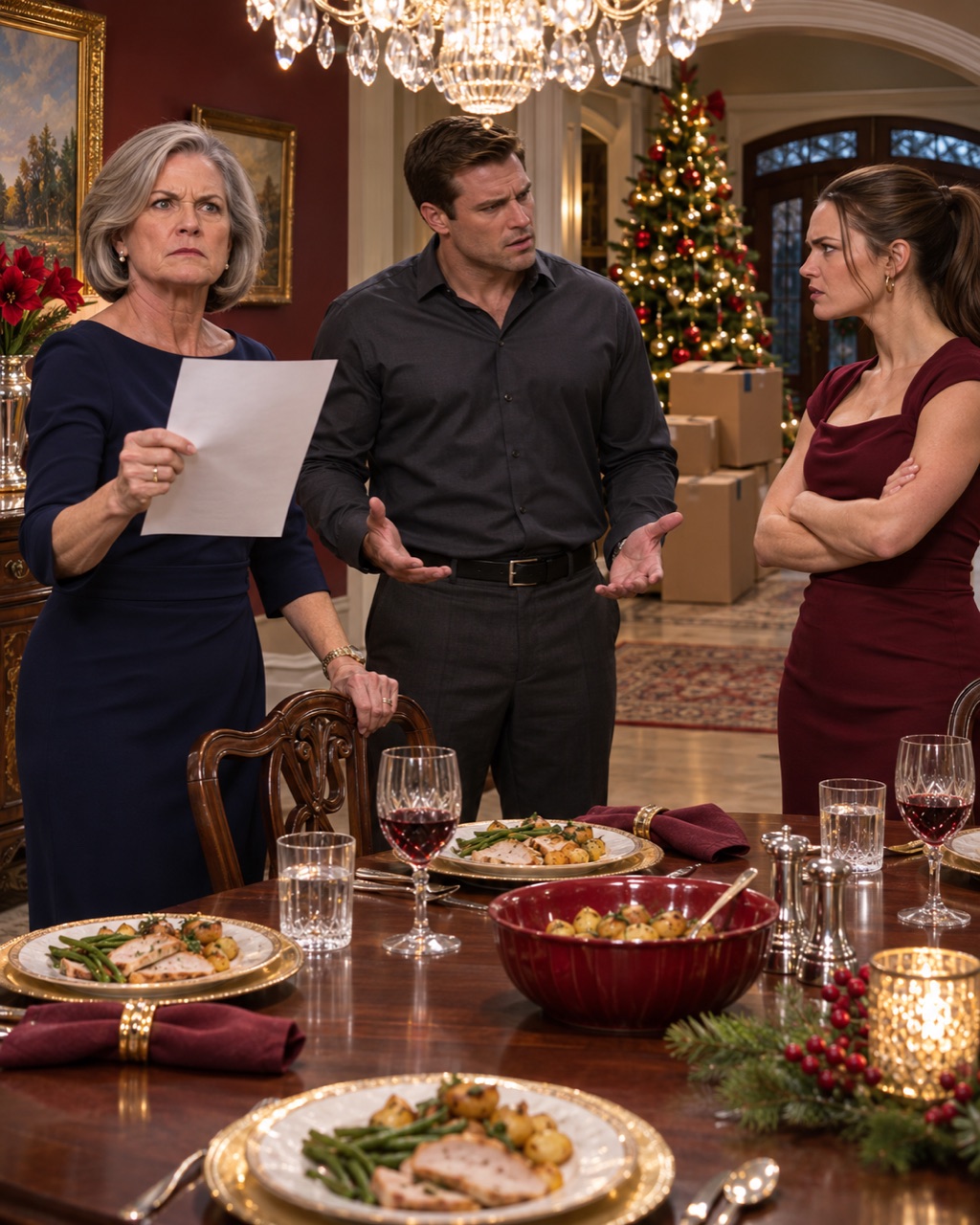
Carly carried a box past me while our relatives were eating. She set it beside the dining room entrance, near the others she and Evan had brought inside.
“You mean leave my house?”
“We need the bedrooms more than you need them.”
She said it without lowering her voice.
Behind her, the Christmas tree was lit. The red serving bowl sat on the table, still full of potatoes. I had been standing beside the sideboard, deciding whether anybody needed more gravy.
Now I was being told to leave.
“Your relatives can help you find somewhere,” she added.
My son stood near the stairs.
He looked at his wife, then at the boxes, as though the next thing required of him was obvious.
Our relatives remained seated. One watched Evan. Another looked down at her dinner. The relative nearest the entrance leaned back, leaving room for Carly to pass.
Nobody offered me somewhere to sleep.
Nobody should have needed to.
“I invited you for dinner,” I said.
Carly gave a little laugh through her nose.
That was what embarrassed me most at first. Not the boxes. The laugh, with everyone sitting there and my serving spoon still beside an unfinished plate.
I felt humiliated.
I was dressed for Christmas dinner in my own dining room, and my daughter-in-law was explaining where I would not be sleeping.
“Evan, bring that one up,” she said.
He did.
He picked up a box marked for a bedroom and carried it past the dining room entrance. He did not turn toward me before starting upstairs.
I watched until his shoes disappeared around the turn.
For a moment, I thought he would stop on his own.
He knew that staircase. He knew where my bedroom was. He had visited this house for years, always arriving with a coat or something for dinner, never with bedding pressed against his chest.
“Come back down here.”
His steps stopped.
Carly watched me instead of him.
“He’s already carrying it,” she said.
“I can see that.”
“It doesn’t need to become a whole thing.”
At the table, a relative put down her fork.
I looked toward the stairs again. I wanted Evan downstairs before I said anything else. I would not have this discussion with his wife while he continued arranging their belongings above my head.
“Evan.”
“I’m coming.”
He returned without the box.
That bothered me almost as much as his going up.
He had heard me call him, but he had still found somewhere upstairs to leave what he was carrying.
“Carly said you knew,” he told me.
He said it toward the table.
Not to me.
The relatives could hear every word, but none of them had invited him to move into my home. I waited for him to ask the person who lived there.
He did not.
Carly stepped closer to the stairs.
“We’ll use the big bedroom.”
I knew which room she meant.
There were spare bedrooms in the house. She had discussed them often enough. But the big bedroom was mine, with my clothes in the closet and my reading glasses beside the bed.
“What happens to my things?”
Evan finally looked at me.
Carly answered him instead.
“We can sort that out after Christmas.”
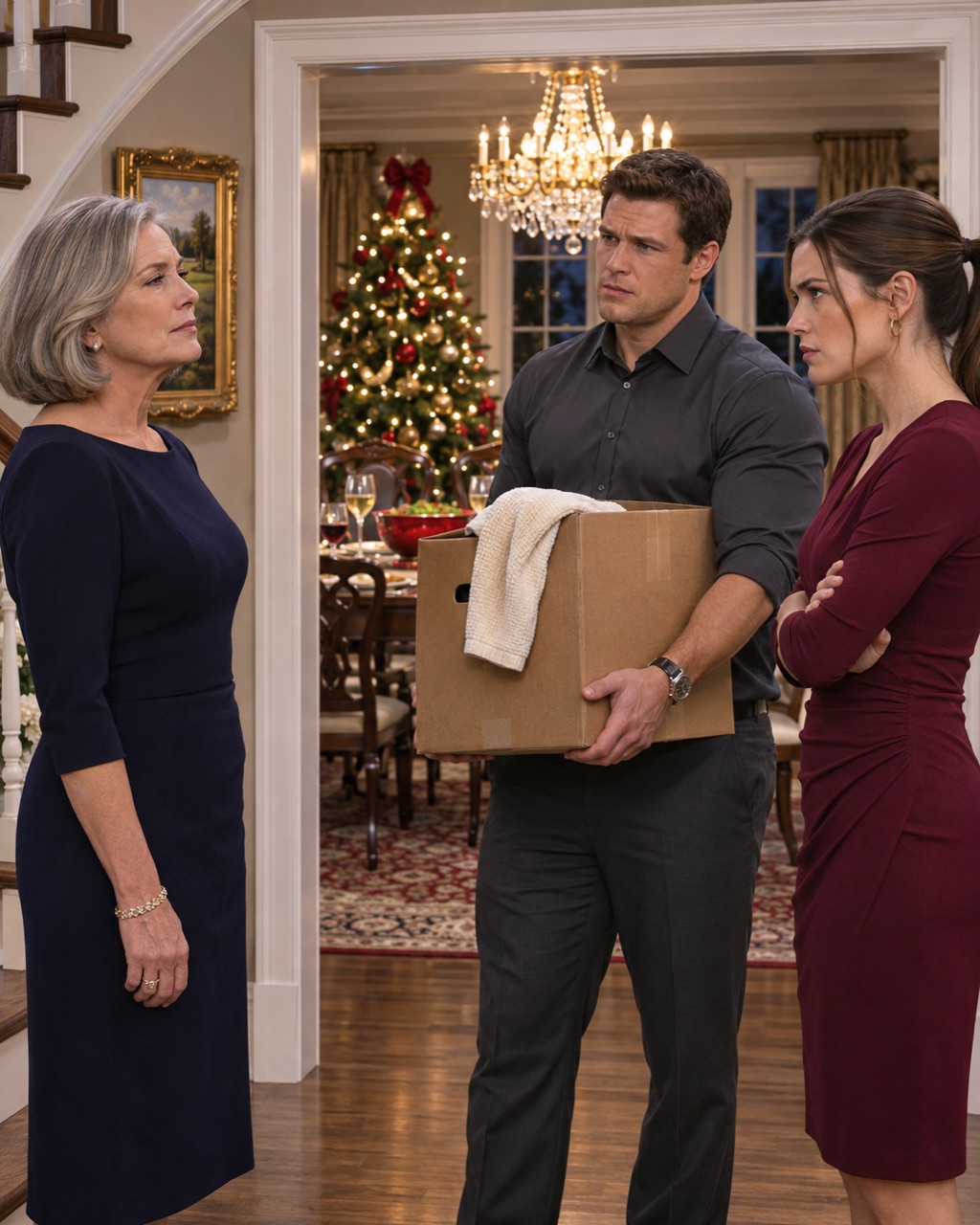
There was a box of bathroom things beside her feet. A bath towel hung over its edge. Another box had bedding written across the top.
They had not brought decorations.
They had packed for sleeping here.
I felt sick.
I had been checking the oven while they decided which of my rooms they would take.
A relative pushed her chair back. She remained seated, looking between Evan and me.
Carly noticed.
“Please keep eating,” she said.
That made me turn fully toward her.
“This is my dinner.”
“I know you made dinner.”
“That isn’t what I mean.”
She glanced at Evan, asking him without words to handle me.
He rubbed his forehead.
“Mom, can we get through Christmas?”
I looked at the stairs.
The box was still upstairs.
He wanted Christmas to continue around it.
That was the arrangement he was asking me to accept: dinner on the table, relatives behaving politely, their belongings inside, and my objection postponed until it would be harder to make them leave.
“I was getting through Christmas,” I said.
“We’re not trying to upset you.”
“Then why am I being told to sleep somewhere else?”
Carly answered before he could.
“Because we’re trying to make this practical.”
She pointed toward the bedrooms above us, as if their being empty at that moment settled who could use them.
“You have all this room.”
“And I live here.”
“We know that.”
But she had just told me to go.
I looked at my son. He was standing close enough to the stairs to turn back toward them without crossing the dining room.
I wanted him away from the boxes.
Not physically.
I wanted him to stop acting as though carrying them had been an ordinary favor for his wife.
“Did you pack those knowing you were coming to Christmas dinner?” I asked.
“Mom, Carly told me—”
“I heard what Carly told you.”
His mouth closed.
The relatives did not help him finish.
I had spent the afternoon expecting the usual things. Coats near the entrance. Questions about the food. Someone asking whether I needed help carrying a dish.
I had not expected to stand beside a full Christmas table asking why my son’s bedding was upstairs.
Carly tried again.
“We can talk about the rooms after everyone finishes.”
“No.”
My answer surprised Evan more than it surprised her.
He looked toward the table, then back at me. I could see him waiting for me to soften it.
I did not.
The food could wait. The room upstairs could not become theirs simply because everybody wanted to avoid an uncomfortable conversation.
I stepped where Evan had to face me instead of the stairs.
“Before you carried that box up, did you ever ask me whether I had invited you to move in?”
Chapter 2: The Page Beside the Sideboard
“I thought Carly had talked to you.”
Evan said it quietly, but everyone heard him.
“She had,” I said.
Carly looked relieved too soon.
“We discussed dinner.”
She turned toward the table.
“This is what I mean. Things get misunderstood.”
That word was why I had printed the conversation.
Not because I expected this exact scene.
I had not imagined the boxes beside the tree or my son going upstairs. But I had heard clear refusals described as misunderstandings before, and I wanted the actual words nearby if it happened again.
For the past year, Carly had looked at my spare bedrooms as though I had forgotten to put them to use. She would pause in a doorway during a visit and mention where their clothes could go. Another room would make a good place for her to work. When I asked why she was planning rooms she did not sleep in, she laughed and said she was only talking. Evan called it talking too. Nothing serious. I had hosted and cooked Christmas dinner for the family for eight years, buying the groceries myself, and I kept inviting them because I wanted the family together. Somewhere along the way, Carly had begun treating being welcome at the table as permission to discuss living beyond it.
A few days before Christmas, she had brought up bedroom belongings again.
I was in my kitchen when her message arrived.
Could they bring some things when they came?
I had stopped what I was doing.
Not because I was confused.
Because “some things” had become her way of avoiding the word moving.
I wrote that the invitation was for Christmas Eve dinner only. They needed to go home afterward.
Then I read my own message again.
It was plain.
I had not added an apology. I had not suggested discussing bedrooms after the holiday. There was nothing in it about a trial stay.
Carly replied.
That conversation stayed on my phone.
On Christmas Eve morning, before I started the meal, I printed the complete exchange on a page.
The heading read MESSAGES.
I checked that nothing had been cut off. Then I left it beside the dining room sideboard.
Not at anyone’s place setting.
Not propped against the potatoes.
Beside the sideboard, where I could leave it untouched if dinner was only dinner.
Now Carly stood between me and the entrance, saying that we had misunderstood each other.
“What part?” I asked.
“This wasn’t supposed to be an argument.”
“That doesn’t answer me.”
Evan looked tired.
He had carried a box upstairs. I had cooked Christmas dinner. Somehow I was being asked to make the evening easier for him.
Carly glanced at the boxes.
“There’s no point taking everything home when we’ve already brought it inside.”
“That was your decision.”
“It’s temporary.”
She spoke more gently then.
I recognized the change. Giving orders had not worked, so she was presenting the move as a modest favor I was making unnecessarily difficult.
“Another month at our place costs $1,800,” she said. “Staying here would let us get ahead.”
The rent was not new information.
The assumption that I would replace it was.
Evan looked at me.
“Can we just leave the argument until after Christmas?”
“The boxes would still be here.”
“We wouldn’t be in your way.”
Carly looked toward the stairs again.
She had already said they would use my bedroom.
I did not let him turn that into a discussion about whether I would notice them.
I own the house they were moving into.
I bought it before Evan married Carly. Neither of them had lived here. Neither had paid toward it. They had not been promised a room, much less my room.
“No. I’m not sleeping somewhere else.”
Carly’s mouth tightened.
“You’re making a temporary arrangement sound ugly.”
“You asked your wife,” I told Evan. “You didn’t ask me.”
He looked away.
That was when I went to the sideboard.
Carly started talking about the space again. All the bedrooms. All the room I did not need every day.
I picked up the printed conversation.
The relatives followed me with their eyes as I walked to the head of the table. My heels sounded louder than I wanted them to.
I stopped facing Carly.
Then I raised the page to chest height.
She stepped back.
Evan moved away from the stairs and turned toward her.
“Carly, I own the house you’re moving into.”
“Wait.”
“Those boxes aren’t staying here.”
She looked at the page, then at the relatives.
“This isn’t everybody’s business.”
“You brought the boxes during dinner.”
“We don’t need an audience.”
“I didn’t arrange one.”
A relative leaned back to give Evan a clear view.
I pointed to the heading.
MESSAGES.
He recognized that it was a conversation between his wife and me. He could see where my invitation began.
Carly did not reach for it.
She looked at Evan instead.
“We can discuss this privately.”
“Not before he knows what I actually said.”
I had no interest in reading every disagreement we had ever had. The page held only the short exchange about Christmas.
That was enough.
The next $1,800 rent bill she wanted to avoid was coming after Christmas. She had brought boxes as though that bill would become irrelevant once the family saw them inside my house.
I kept the page facing them and waited for his answer.
“Read the conversation out loud, Evan.”
Chapter 3: Dinner Only
“Do you really want me to read it here?”
Evan looked past the page at the relatives.
“Yes.”
Carly started to speak.
I kept my attention on him.
He had accepted her version without asking me. Now he could hear mine without anybody shortening it for him.
“It’s personal,” she said.
“It concerns the boxes you brought into my dining room.”
“We could have talked afterward.”
“You told me to sleep somewhere else before dinner was over.”
Evan came closer.
He did not take the page at first. He bent enough to read the heading and the beginning of the exchange.
I held it where he could see.
The red bowl was near my elbow. I could smell the potatoes cooling, and I suddenly remembered leaving the dessert where it would be ready to serve.
I had planned the evening around feeding people.
Not this.
“Start with what I wrote,” I said.
Evan swallowed.
Then he read my message.
The invitation was for Christmas Eve dinner only. They were to go home afterward.
He stopped there.
Carly looked toward the entrance.
“That was before we had everything ready.”
I looked at her.
“Before you packed?”
“Before we came.”
“You didn’t ask again.”
“I didn’t think you would make us take everything back once we got here.”
A relative’s chair moved against the floor.
Evan was still looking at the page.
I could see he wanted to ask something, but I did not help him get past the reply underneath my message.
“Keep reading.”
“Mom—”
“The whole exchange is there.”
He looked at Carly.
She folded her arms.
“We all know what an invitation to dinner says.”
“Then this should be easy.”
There was no need to raise my voice. The room had become quiet enough that he could read normally.
He began again.
He read my restriction without changing it into a suggestion.
Then he reached Carly’s answer.
“Understood. Dinner only. We’ll go home afterward.”
He stopped.
Nobody supplied another explanation.
That was the reply she had sent a few days before Christmas. Not something written afterward. Not something I had added while they stood in my dining room.
Her own acknowledgment.
I watched Evan read it again without speaking.
I had been angry when he went upstairs. Hearing him read that line made me sad in a different way.
He should have known before touching the boxes.
He could have asked me.
Carly looked at him.
“Don’t act like that settles everything.”
“It settles what I invited you to,” I said.
“I understand what you wrote.”
“You said you understood then.”
She did not deny the reply.
There was no sensible way to do that with the complete conversation in front of him and her phone available if she wanted to compare it.
Instead, she changed the subject.
“We’re family.”
“I invited family to dinner.”
“People help their family.”
“They also ask before moving in.”
Evan finally took the page.
I let him.
He held it close enough to read without leaning over my hand. His eyes went from my message to hers.
I stayed at the head of the table.
Carly had wanted me somewhere else that night. I was not going to step out of the room now so she could explain the exchange to him without me hearing.
One of the relatives looked at her plate, then pushed it a little farther from the edge.
Nobody resumed eating.
Carly noticed the waiting.
“We’re ruining everybody’s dinner.”
“No,” I said. “We’re deciding whether your boxes stay.”
“That’s the same thing right now.”
“It isn’t.”
She looked at me for a long moment.
Then she tried a softer voice.
“You could have just said you weren’t comfortable.”
“I did say no.”
“Not like this.”
“I said it before you packed.”
Evan looked up.
That was the first time he seemed to understand the order of things. My refusal had not been a reaction to seeing the boxes.
It had come before them.
Carly knew what I had said when she brought bedding into my home.
He lowered the page.
“Why didn’t you tell me this was the conversation?”
“Because I thought we could work it out when we got here.”
“With my things upstairs?” I asked.
“I wasn’t going to throw your things away.”
“That wasn’t the question.”
She pressed her lips together.
Nobody had accused her of throwing anything away. She had introduced a worse possibility so that taking my bedroom might sound reasonable beside it.
I would not discuss that possibility.
My bedroom was not available.
Neither were the others.
The fact that I could physically fit them in the house did not change my answer.
Evan looked toward the stairs.
The box he had carried was still out of sight.
I let him look.
I wanted him to remember exactly how little he had asked before putting it there.
Carly spoke to the relatives.
“This is being made to sound like we came here to hurt her.”
I answered before anyone else had to.
“You came here after saying you would go home.”
She turned back toward me.
The page had done what I needed it to do. It had settled the claim that I had approved the move.
Now she had to ask for something I had not offered.
“That doesn’t mean you couldn’t help us now.”
Chapter 4: What Evan Was Told
“What did Carly tell you, Evan?”
I asked while he was still holding the page.
He looked at his wife.
“I’m asking you.”
Carly moved closer to him.
“We talked about a temporary arrangement.”
“I want to hear what he understood.”
He read the reply again before answering.
“She said you’d talked about us coming here for a while.”
“And that I agreed?”
“Yes.”
The word came out plainly.
I had expected it, but hearing him say it in front of her still hurt.
He was not describing a misunderstanding between us. He was describing something his wife had told him that my actual words did not support.
Carly did not interrupt immediately.
She watched him, waiting to see how much he would say.
“What did temporary mean?” I asked.
“Until we could get ahead.”
“Did you ask me how long?”
“No.”
“Did you ask which room?”
“No.”
I stopped there.
I did not need a long list of things he had failed to ask. He was already looking toward the stairs again.
A relative reached for her drink and waited with it near her plate.
The ordinary movement made the room feel stranger.
Dinner was still here.
People were still thirsty.
My son and his wife were still standing beside moving boxes as though they might be allowed to finish if they found the right explanation.
Carly spoke.
“I told him you had space.”
“That part is true,” I said.
“And you do.”
“It doesn’t mean I offered it.”
Evan returned the page.
He did not try to fold it or put it away. He held it out with the writing facing me, and I kept it where we could all see it.
“What about your home?” I asked him.
“What about it?”
“Can you go there tonight?”
“Yes.”
Carly looked at him quickly.
He saw it.
“We can go home,” he said again.
“Have you given it up?”
“No.”
“Are you being made to leave?”
“No.”
That changed the room.
Until then, Carly had spoken as though bringing the boxes inside created a problem that I now had to solve.
But they had somewhere to sleep.
Their own bed was available.
Their bathroom was available.
There was no need for me to leave mine.
I felt relieved, and then furious that I had been made to ask.
Carly had stood beside the tree and suggested my relatives find me somewhere while her own home waited for her.
“We’re trying not to keep paying for a place we don’t need,” she said.
“You still need somewhere to live.”
“We could live here.”
“Not with my permission.”
Evan looked down.
He had begun the evening with an approved temporary move, at least as he understood it.
Now he had the actual conversation in front of him and a direct refusal beside him.
I could see him trying to adjust without making his wife look worse.
That was his concern.
Mine was the box upstairs.
“You didn’t tell me she said dinner only,” he told Carly.
“I told you it was temporary.”
“That isn’t the same thing.”
“No, it isn’t,” I said.
Carly looked annoyed at my answering.
“This is between us.”
“The claim you discussed is about my house.”
“We’re married. We can talk.”
“Of course you can. You cannot give each other permission to live here.”
A relative nodded slightly.
Carly saw that too.
She turned away from the table, trying to make the conversation smaller, just her and Evan near the entrance.
I stayed where I was.
I would not have to chase an explanation into another room.
Evan spoke toward me.
“I should have checked.”
“Yes.”
“I thought it was already settled.”
“It was settled. I said dinner, and she agreed to go home.”
He looked at the page again.
I did not hold it closer.
He had read enough.
The proof was no longer the issue. What he would do after reading it was.
Carly glanced at the boxes.
“Everybody’s upset. We don’t need to decide everything while people are watching.”
“We do need to decide where those go.”
“We could leave them out of the way.”
“No.”
“Just until we talk.”
“We are talking.”
She had begun with my leaving the house. Now she was asking to leave belongings in it.
That was a change, but not an agreement I was willing to make.
I looked at Evan.
“You have a home you can return to.”
“Yes.”
“And you know I did not invite you to move here.”
“Yes.”
He answered more firmly this time.
I could have accepted that as enough if I had wanted the conversation to end without anything changing.
But the box was still upstairs.
Carly stood close to the entrance, blocking part of my view of the stairs, and Evan had not made a move toward them.
“Then why are your boxes upstairs?”
Chapter 5: The Next Rent Bill
“Because I carried one up.”
Evan answered without looking at Carly.
“That’s what I need you to deal with,” I said.
Carly spoke before he could move.
“We haven’t finished talking.”
“We’ve finished discussing whether I invited you.”
“There’s still the practical side.”
I knew what she meant.
The rent.
She had mentioned $1,800 as though saying the amount out loud would make my refusal unreasonable.
Now she faced me directly.
“Our next rent bill hasn’t been paid.”
Evan did not contradict her.
The relatives stayed seated. Nobody offered to help, and nobody looked as though they had expected to become part of a discussion about the couple’s housing.
I had invited them to Christmas dinner.
So had I invited Evan and Carly.
That was the entire invitation.
“Your home is still available,” I said.
“It costs $1,800.”
“I heard you.”
“We could stop spending that while we stay here.”
“You cannot stay here.”
Carly took a breath.
“We wouldn’t need you to do anything.”
I looked at the box of bathroom things.
She followed my eyes.
“Other than let us use the rooms.”
“And leave my own bedroom?”
“We could work out the bedroom.”
“No.”
She had offered to reconsider the most offensive part, hoping the rest would become acceptable.
It did not.
I was not negotiating which rooms they could have.
Evan stood with his arms loose at his sides, looking between us.
I wanted him to answer her.
I also knew he had already let her speak for me once. I was not going to wait while he decided whether my answer sounded serious enough.
“You’ll need to pay for your home,” I said.
“Not if we don’t live there.”
“Where you live is your decision. Living here is not an option.”
She glanced toward the relatives.
There were adults sitting at my table who knew how much work went into keeping a home. Carly was trying to make the situation look like unused space against a rent bill.
I did not discuss my savings.
I did not explain my expenses.
I was not going to list what I paid to justify occupying the house I had bought.
“You could afford to help,” she said.
“I’m not discussing my money.”
“This isn’t about taking money from you.”
“You’re asking to stay without paying rent.”
“We’re family.”
“I understand who you are.”
She stopped for a moment.
I was angry, but I kept my answers plain because any extra explanation became something she could argue with.
If I said I liked quiet, she would promise to be quiet.
If I said I needed the bedrooms, she would ask what for.
I did not need a reason she approved.
“I’m not offering rooms,” I said.
Evan looked at me then.
Not at the relatives.
Not at his wife.
At me.
I thought he might finally say he would bring the box down.
Instead, Carly asked whether we could wait until after dessert.
The dessert had become useful to her now. Earlier, dinner was something I was ruining by objecting. Now it was a reason to postpone removing what she had brought.
“No,” I said.
“People are still eating.”
“They can finish.”
“You’re making us do this in front of everybody.”
“You brought everything in front of everybody.”
A relative quietly moved her chair farther from the route to the entrance.
She did not say anything.
She was making room for boxes to leave.
Carly watched her.
That small practical choice seemed to upset her more than any of my answers.
She had expected people to want the scene over badly enough to persuade me.
They wanted the scene over.
They were not asking me to give up a bedroom to accomplish it.
Evan glanced toward the stairs.
“I can bring it down.”
Carly turned to him.
“Not yet.”
He hesitated.
I saw it.
Even after reading the conversation, he was waiting for her to agree with what I had said.
I could not decide for him whether he would disappoint his wife.
I could decide what remained in my house.
“That box needs to come down,” I said.
“We can at least talk privately first,” Carly told him.
He looked toward me.
“You can talk privately at home,” I said.
Carly’s face changed.
Not surprise this time.
She understood I meant it. The rent bill would remain theirs, and the move would not become temporary permission just because the holiday made refusing unpleasant.
She turned fully toward Evan.
“Leave the upstairs box where it is.”
Chapter 6: Bring It Down
“Bring it down, Evan.”
I said it before he could answer her.
He looked up the stairs.
Then at me.
Carly stayed close to him.
“We can leave it there while we finish.”
“No. Everything you brought for moving in needs to go.”
“All of it?” Evan asked.
“All of it.”
I did not say it harshly.
I wanted there to be no smaller version he could agree to with Carly while believing he had done what I asked.
Not the bedding upstairs and the bathroom things downstairs.
Not the bedroom box left out of sight until the relatives went home.
Everything.
He took a step toward the stairs.
Carly spoke his name.
He stopped, but he did not turn all the way back.
“We have to take it home,” he said.
“We haven’t agreed on that.”
“Mom didn’t agree to us bringing it.”
There it was.
Not a complete apology.
Not yet.
But he had finally said the part that mattered without asking me to make it easier.
Carly glanced at the relatives.
“This is ridiculous.”
Nobody answered.
Evan went upstairs.
I stayed beside the table while his steps crossed the floor above us.
My bedroom had not been occupied. My things had not been moved.
Still, hearing him walk upstairs to retrieve a box he should never have put there made me feel exposed.
I had spent the evening asking for ordinary decisions about my own home to be treated as mine.
Carly looked toward the sideboard.
The page was still visible.
“You were ready for this.”
“I was ready to show what I said.”
“You printed our conversation.”
“Yes.”
“On Christmas.”
“This morning.”
She looked back at me.
I could see the next argument coming. That preparing to defend my answer meant I had somehow planned the trouble.
I answered before she developed it.
“I hoped I wouldn’t need it.”
“You could have called.”
“You acknowledged the message.”
“That doesn’t mean you needed to keep it.”
“It was already on my phone.”
She said nothing to that.
I did not explain my years as an office manager. I did not need to turn keeping a short conversation into a special skill.
I had printed it because I had been clear and expected to be told I had not.
That was all.
Upstairs, Evan picked up the box.
We heard him moving toward the stairs.
One of the relatives shifted her feet out of the path from the dining room entrance.
The room was starting to behave as though the boxes would leave.
That mattered.
Carly had brought them in expecting the family to adjust around her decision. Now the family was making room for the opposite.
She looked at the red serving bowl.
“Your food’s getting cold.”
“I know.”
“We could have had a nice dinner.”
“We were having one.”
I did not add anything.
There was no need to explain who had interrupted it.
Carly moved toward the entrance as Evan came into view.
He held the box against his chest, just as he had when he carried it up.
This time he was coming down.
He paused near the bottom to see where the other boxes stood.
I looked past him toward the entrance.
“Take it outside with the rest.”
He nodded.
Carly put herself close enough to him that he had to stop before passing.
“Evan.”
He looked at her.
She lowered her voice, though the room was quiet enough that we could hear.
“We need to think before we do this.”
He adjusted his footing on the stair.
“We can think at home.”
“Once we take everything out, she’ll act like we chose to leave.”
I answered.
“You are choosing whether to respect my answer.”
Carly faced me.
“So that’s what this is now?”
“It has been my answer since before Christmas.”
Evan waited with the box.
I did not want him standing on the stairs arguing. I also would not carry the box for him to end the discomfort.
He had brought it up.
He could bring it down.
“You have somewhere to go,” I said.
“We know,” Carly replied.
“Then go there with your things.”
A relative spoke quietly from the table.
“There’s room to get through here.”
She meant the entrance.
Not a bedroom.
Evan looked at the space she had cleared.
He started down again.
Carly lifted her voice.
“Stop at the bottom of the stairs.”
Chapter 7: Not Just His Boxes
Evan reached the bottom and kept the box in his arms.
“What?” he asked.
Carly pointed toward the boxes by the entrance.
“Take yours. Leave mine until we work this out.”
I looked at her.
“No.”
“They’re my things.”
“Yes. They need to go with you.”
She turned toward Evan again, as though I had not answered.
“Just take that one out.”
He looked at the box he held.
It had become clear what she was doing.
If some of her belongings stayed, the move would not feel finished. She would have a reason to come back, a reason to go upstairs, a reason to keep discussing space I had already refused.
I did not need to accuse her of that.
I only needed to say what could remain.
“No moving boxes stay here.”
“It’s not moving in to leave a few things.”
“You brought them for bedrooms.”
“That doesn’t make them dangerous.”
“I didn’t say they were dangerous.”
She looked frustrated.
I was not following her into the argument she preferred.
The question was not whether a towel could harm me.
The question was whether I had to store belongings brought as part of a move I had rejected.
I did not.
Evan went toward the entrance.
Carly stepped aside enough to let him pass.
He carried the box out.
The room felt different without him standing between her and me.
She looked younger for a moment, though she was 34 and had arrived ready to tell me where to sleep.
“You’re really doing this.”
“Yes.”
“On Christmas Eve.”
“You chose tonight to bring them.”
She glanced at the relatives.
I did not look away from her.
I had spent too long letting the presence of family make a clear answer sound impolite.
Now the same family had watched her point my son upstairs.
They could also watch me tell her the boxes were leaving.
Evan returned.
He did not go back toward the table.
He stopped beside the remaining belongings.
“What goes next?”
“All of it,” I said.
Carly answered at the same time.
“Not my bathroom things.”
He looked down at the towel hanging over the box.
“We brought those together.”
“They’re mine.”
“Then carry them,” I said.
She stared at me.
I had not shouted. I had not called her a name. There was nothing for her to demand I take back except the instruction itself.
“You could at least hold on to them while we decide what to do.”
“You can decide at home.”
“We may need to bring them back.”
“You do not have permission to bring them back.”
Evan looked at her.
That part was new to him too, I thought.
He had accepted a story about a temporary stay. Now his wife was discussing a return after the answer had been read aloud and refused in person.
He could no longer treat the problem as a single conversation she had described badly.
Carly heard the silence around her.
She changed her tone.
“I’m asking for somewhere to leave my things. That’s all.”
“No,” I said.
“You leave things at family’s houses.”
“Not after using them to announce a move.”
She glanced toward the sideboard again.
The page was no longer in my hand. It did not need to be.
Evan had read it.
The relatives had heard it.
Carly could not make my printed answer disappear by making a smaller request beside the boxes.
I felt tired then.
Not uncertain.
Tired in my feet, in the dress I had chosen for a pleasant evening, while the dinner I had cooked sat waiting.
I wanted to sit down.
But I would not sit down with moving boxes left by the stairs.
Evan picked up another box.
Carly watched him.
“You’re just doing whatever she says now?”
“It’s her house.”
“She’s your mother.”
“Yes.”
He did not explain beyond that.
I was glad.
He did not need to argue that being my son required obedience in everything. He needed to understand that being my son did not let him move into my bedroom without asking.
He carried the box toward the entrance.
Carly looked at the seated relatives.
Until then, she had spoken around them or complained about their presence.
Now she wanted them involved.
“Will somebody please tell her she’s taking this too far?”
Chapter 8: In Front of the Family
“She invited us to dinner.”
The relative nearest the entrance said it without getting up.
Carly looked at her.
“I know she did.”
“Not to decide who lives here.”
Carly glanced toward the others.
“I’m not asking anyone to decide. I’m asking you to help her calm down.”
“I am calm,” I said.
“You printed messages!”
“And Evan read them.”
She looked around the table again, waiting.
A relative set her glass down.
“What would you like us to tell her?”
“That this doesn’t need to happen tonight.”
“The boxes came tonight,” I said.
Carly turned toward me.
“I was answering her.”
“I’m listening.”
The relative kept her hand beside her glass.
“Kathleen said you can’t stay. We heard her.”
“You’re making it sound like we’re strangers.”
“No. You’re family visiting for dinner.”
Carly pulled her shoulders back.
Nobody moved a chair or offered to take her aside. They stayed where I had seated them, with their unfinished food in front of them.
One of the relatives looked directly at me.
“You don’t have to leave your house.”
“No,” I said. “I don’t.”
I had not realized how badly I needed someone besides me to say it plainly.
I did not cry.
But I stopped gripping the back of my chair.
Carly noticed my hand move.
“See? Now everybody thinks I was throwing you out.”
“You told me to sleep somewhere else.”
“For tonight.”
“That is tonight.”
She looked down toward the table, then back at the relative who had answered her.
“You understand that helping family sometimes means being flexible.”
“I understand she said no.”
“We could all discuss it.”
“There isn’t anything for us to vote on.”
The relative drew her napkin back onto her lap.
Carly stayed facing her for a moment, as though the conversation could not be finished until she agreed it was finished.
Then she tried someone else.
“She has bedrooms she doesn’t use.”
“That is up to Kathleen,” another relative said.
They did not ask how often I opened the doors upstairs.
They did not ask which bed Carly wanted or whether their stay could be made shorter.
I felt grateful.
The relative nearest the table’s end moved her plate enough to make room for me when I returned.
It was such an ordinary invitation.
A place to sit at my own dinner.
Carly noticed it too.
“You’re all acting like I came to take something.”
“You told me to sleep somewhere else,” I said.
“We needed the room.”
“Preparing dinner was not offering bedrooms.”
She opened her mouth.
I kept going.
“I set places for you. I cooked food for you. I did not clear out my bedroom for you.”
“We weren’t asking you to clear it out tonight.”
“You said we could sort out my things after Christmas.”
A relative looked toward the stairs.
Carly followed her glance.
“Nothing happened to her things.”
“Because I stopped you,” I said.
She looked back at me.
“We could have discussed which room.”
“No. I’m not discussing rooms.”
The relative nearest the entrance leaned forward slightly.
“Do you need us to move so you can carry those through?”
Carly looked offended.
“I’m talking to you.”
“And I answered you.”
The relative stayed seated.
Evan came back inside.
He stopped when he saw Carly facing the table.
“What happened?”
“She asked us to persuade your mother,” a relative said.
He looked at Carly.
Then he turned to me.
“I’m sorry I started upstairs with that box.”
I stayed quiet long enough to hear whether there was more.
He did not add that Carly had told him to do it.
He had already told me that.
Now he was speaking about his own action.
“I should have asked you before I carried anything.”
“Yes,” I said.
“You called me back, and I still left it up there.”
“Yes.”
He looked ashamed.
I did not rush to tell him it was all right.
It was not all right.
His apology mattered, but the boxes still needed to leave.
“Thank you for saying that,” I told him.
Carly looked away.
“That doesn’t mean everybody needs to keep repeating it.”
“Nobody is repeating it,” Evan said.
“We know what happened.”
“I didn’t know what Mom had written.”
“You know now.”
“Yes.”
He said it firmly enough that she stopped.
He put his hand against the side of a remaining box, but did not lift it yet.
“I should have asked when we came in,” he said to me.
“You could have.”
“I saw you by the table.”
“I was right here.”
Carly shifted beside him.
“You’re apologizing like you did something on purpose.”
“I carried it on purpose.”
He looked at her, then back at me.
“I didn’t trip and leave a box upstairs.”
I pressed my lips together.
That was the first thing he had said that made me want to reach for him.
I stayed beside my chair.
He needed to finish what he had started before either of us tried to make the evening feel better.
Then he looked at the remaining boxes.
“I’ll finish.”
Carly did not pick up hers.
She stood beside them, looking toward the dining room as though there might still be someone willing to make me change my mind.
A relative reached for her fork.
Carly watched the movement.
“You’re just going to eat?”
The fork stopped above the plate.
“Kathleen made dinner.”
“That’s not what I’m talking about.”
“I know.”
The relative lowered her fork again, but she did not get up.
I went back toward my place at the table, remaining on my feet.
Carly watched me.
“If you sit down, we can all just eat.”
“The boxes leave first.”
“We can do it later.”
“Before dessert.”
She looked toward the food.
Evan bent over the box he had touched.
Carly put her hand on its top.
“Wait.”
He straightened.
“For what?”
“For us to have a conversation without everybody staring.”
The relatives looked down at their plates.
I did not.
“You asked them to speak,” I said.
“And they did.”
“Not the way you wanted.”
Her hand stayed on the box.
Evan waited until she removed it, then lifted.
Nobody applauded him or thanked him for carrying out what he had brought. The relative nearest the entrance simply pulled her feet back.
He carried the box outside.
Carly stayed.
I wondered if she expected me to become embarrassed by the work and offer to keep something.
I did not.
She had brought what she could carry.
She could carry it home.
When Evan returned, she spoke quietly to him near the entrance.
I could not hear every word.
He shook his head and looked toward the bathroom box.
“All of it,” I said.
He nodded.
Carly turned back toward the table.
“Fine. We’ll take it now.”
I waited.
She still had not reached for anything.
Evan moved toward the remaining belongings, but she kept looking from my chair to the relatives beside it.
I left the page beside the sideboard.
She looked at the relatives, then at me.
“I’ll come back after everyone leaves.”
Chapter 9: Before Dessert
“No, you won’t.”
I answered before Evan could mistake her statement for a plan we had agreed on.
Carly stood still.
“I mean to talk.”
“Not tonight.”
“You can’t refuse to speak to us forever.”
“I’m refusing a return tonight.”
She looked toward the relatives.
I had made it specific.
There would be no return that evening.
The boxes would go.
Dinner would continue.
Evan faced her.
“We’re going home.”
“We can come back after—”
“No,” I said.
He nodded.
“We’re going home,” he repeated.
Carly looked at him.
“Are you answering for both of us now?”
“I’m telling you where I’m taking these.”
He put his hands under a box.
She moved closer.
“Put that down while we talk.”
He did not lift it yet.
I watched him, waiting to see whether we were about to start the same discussion beside the same belongings.
Then he straightened with the box in his arms.
“We can talk at home.”
“You keep saying that.”
“Because that’s where we’re going.”
He did not raise his voice or argue about their marriage in front of us. He turned toward the entrance.
The relative nearest him tucked her chair in.
Carly stepped aside.
He carried the box through.
She watched him leave, then looked at me.
“You could tell him to wait.”
“I want him to take it out.”
“I mean while I finish speaking.”
“You can speak while you carry yours.”
She looked down at the bathroom things.
The towel still hung over the edge.
She caught it with her hand and pushed it inside.
Then she bent, gripped the box, and lifted.
I moved clear of her path.
I did not reach for the bottom or offer to take an end.
She stopped beside me.
“Are you really going to stand there and watch?”
“Yes.”
Her mouth tightened.
She carried it through the doorway.
I had looked at that towel and imagined someone using my bathroom while I slept somewhere else.
Now it was leaving.
I could breathe more easily.
A relative asked whether I wanted help with dessert.
“In a minute,” I said.
She began gathering what she could reach without getting in the way.
“Leave my plate,” I told her.
“All right.”
I wanted to sit back down and finish what I could.
But first I wanted the boxes gone.
Carly came back inside while Evan was outside.
She stopped at the dining room entrance.
“Can I at least finish eating?”
I looked at her place.
“You can sit down when your things are out.”
“Then you’re not making us leave?”
“You cannot stay here. You cannot leave moving boxes here. Those are the answers I gave you.”
She glanced toward the stairs.
“So if we finish dinner, you’ll say we stayed.”
“No. Dinner is what I invited you for.”
For a moment, she had nothing to say.
I moved my chair back against the table.
She watched me do it.
“I’m not carrying anything upstairs again,” she said.
“You haven’t carried anything upstairs tonight.”
She looked toward the door.
Evan came back inside.
“Is there anything else up there?” I asked.
“No. Just the box I brought down.”
“Nothing in my room?”
“No. I didn’t put anything in your room.”
I believed him.
He had not occupied it. He had carried a box upstairs and left it, and that was enough for me to address.
I did not need to make it worse than it had been.
He looked toward the sideboard.
“Do you want that?”
I knew he meant the page.
“I’m keeping it.”
He nodded.
He did not ask me to throw it away to prove we were finished.
Carly folded her arms.
“Can we stop looking at the paper now?”
“Nobody is holding it,” I said.
Evan looked away from the sideboard and toward the remaining belongings.
“Is this yours?”
He asked Carly, not me.
She looked at what he indicated.
“Yes.”
“Will you take it?”
She hesitated.
He waited.
The relative clearing plates stopped so Carly could pass through without having to turn sideways.
Carly bent to lift the box.
“Don’t take my dinner away,” she said.
The relative left her plate.
No one argued with her.
Evan followed her toward the door with what remained for him to carry.
I stayed where I could see the stairs and entrance.
A relative came beside me with plates in her hands.
“Can I get through?”
I stepped back.
“Of course.”
She went past me, doing the sort of thing I had expected family to do that evening.
Clearing dinner plates.
Not helping me find another bed.
Evan returned and looked around the entrance.
I looked too.
There was no box beside the stairs.
No bathroom things by the dining room doorway.
The Christmas tree was visible again without cardboard beside it.
“That’s everything,” he said.
I checked the place where Carly had first set hers down.
“Yes.”
He rubbed his palms against his clothes.
“Do you want us to help with the table?”
“Not now.”
He nodded.
I did not want to keep finding reasons for them to remain.
Carly returned to the entrance without a box.
She looked at the space by the stairs.
“We brought all that for nothing,” she said.
“You brought it after agreeing to go home.”
She did not answer that.
Evan stood beside her.
“We’ll go.”
“Where?” I asked.
“Home.”
I wanted him to say it plainly, and he did.
Not somewhere else.
Not to look for a place.
Their own home.
“Your place is still available?”
“Yes, Mom.”
“Then that’s where you need to take your things.”
He nodded.
Carly looked back at her plate.
Then at the relatives.
Nobody invited them to put the boxes back or suggested they had suffered enough embarrassment.
The relatives were letting my answer stand.
“You can finish dinner,” I said. “That was never permission to sleep here.”
Carly shook her head.
“I don’t want it now.”
“All right.”
I did not ask her to eat for my sake.
Evan opened the door.
She moved beside him, then turned back.
“You really think this was necessary?”
“Yes.”
“Every box.”
“Yes.”
There was nothing else to explain.
I did not tell her how much the house was worth. I did not remind her how long I had worked before retiring.
Evan kept the door open.
Carly remained beside him.
For a moment, I thought she would leave without another request.
Instead, she looked at me and changed what she was asking for.
“Will you at least cover the rent?”
Chapter 10: No Rent Check
“No.”
Carly looked at me as though the answer required more.
I did not give her more.
The boxes were gone, but she was still trying to make the next $1,800 bill my responsibility.
Evan stood at the open door.
“Mom’s said no,” he told her.
“She said we couldn’t stay.”
“And I’m not paying your rent,” I said.
Carly glanced behind me.
The relatives could hear us.
She had wanted privacy when the page appeared. Now she spoke loudly enough to reach the table.
“We were trying to keep from having this expense.”
“I know what you were trying to avoid.”
“Then you understand why we brought our things.”
“I understand. I did not agree.”
She shifted toward the door without going through it.
“You could help us this way instead.”
“No.”
“Without us staying.”
“I heard you.”
Evan looked down.
Carly watched him, waiting for him to join her request.
He moved his hand on the edge of the door.
“We need to go.”
“We still have rent.”
“Yes.”
She turned back to me.
“You don’t have to worry about it the way we do.”
“I’m not discussing my finances.”
“We were trying to get ahead.”
“You’ll need to make plans that don’t involve moving into my home.”
“Or asking you for anything?”
“I’m answering the request you made.”
I kept my hand on the back of the chair near me.
She waited.
I waited too.
Then she asked, “You won’t even talk about it?”
“Not tonight. I’m not paying it.”
Evan looked at her.
“She answered.”
Carly drew in a breath and turned toward the open door.
I was not going to make them stay for another discussion. I was not going to block them, threaten them, or insist they apologize before leaving.
They had somewhere to go.
They could go there.
“Good night,” I said.
Evan answered.
Carly left with him.
Voluntarily.
No one touched them. No one locked them out while their belongings remained inside.
Their things went with them to the home they still had.
I closed the door and stood there for a moment.
Then I went back to the dining room.
The red serving bowl was on the table. Potatoes clung to the serving spoon, and the food had cooled.
A relative looked at me.
“Do you want to sit?”
“Yes.”
She pulled the chair clear of the table.
I sat.
That was when I cried.
Not loudly.
I was looking at the empty space near the entrance and could not keep pretending that the evening had only been inconvenient.
Someone passed me a napkin.
I pressed it under my eyes.
“I’m sorry about dinner.”
“You don’t need to apologize.”
“I wanted you to enjoy it.”
“We know.”
The relative beside me left her hand near mine without taking it.
I liked that she let me decide.
I put my hand over hers briefly, then reached for my glass.
Nobody told me to call Evan back.
Nobody suggested that Carly had meant well.
I was grateful for that too.
After a little while, I stood to bring dessert.
A relative rose with me.
“Tell me what to carry.”
I pointed.
She picked it up.
That simple exchange nearly made me cry again.
I had asked for something in my kitchen, and someone had listened without proposing a different arrangement.
At the table, another relative moved the red bowl so we could set dessert down.
“Where do you want this?”
“Leave it there for now.”
She did.
I brought the dessert in and served it.
Someone held out a plate.
I put a portion on it, then passed it along.
My serving hand was steady because I had done this sort of thing for years, even when I was tired.
“Will you have some?” the relative beside me asked.
“Yes.”
She waited until I sat before passing my plate back.
I took a bite.
For a while, the only questions were ordinary ones.
Did anyone want more?
Was that plate finished?
Should we move a glass out of the way?
I could answer those.
I had not packed a bag.
I had not asked anyone for a spare bed.
My chair was still at the table.
Conversation returned slowly.
Nobody acted as though I needed to entertain them through what had happened. We ate dessert, and the evening ended without another discussion of bedrooms.
When the relatives were ready to leave, I walked with them to the entrance.
One looked toward the stairs before turning to me.
“Will you be all right here?”
“Yes. I want to be here.”
“All right.”
She did not offer to stay unless I asked.
They said good night to me at my door.
I closed it after them.
Later, I checked upstairs.
I paused at the place where Evan had left the box.
Nothing remained.
I went to my bedroom and looked in.
The bed had not been slept in. My things were where they belonged. I did not have to reclaim a drawer or move someone else’s toiletries.
I touched the reading glasses beside my bed, then left them where they were.
Downstairs, the printed conversation still lay beside the sideboard.
I picked it up.
The heading, MESSAGES, faced me.
I read Carly’s acknowledgment again, although I knew what it said.
Then I put the page somewhere I could find it.
I did not destroy it.
I also did not leave it displayed beside the Christmas tree.
There were dishes to finish.
I carried the red bowl to the kitchen and ran water into it.
The potatoes needed loosening from the spoon.
I washed it with the rest.
Then I finished the ordinary work of closing the house for the night.
Lights.
The last look at the table.
I checked the entrance without having to step around anything.
I slept in my own bed.
The following morning, I went downstairs without wondering who might be in the kitchen.
There were no moving boxes near the entrance.
No towel hanging from one.
I made breakfast and sat down.
I was still upset.
A good night’s sleep had not made being told to leave feel harmless.
But I did not regret my answer.
When the phone rang, I looked at it before picking up.
Evan.
I wanted to hear his voice.
I also left my breakfast where it was instead of getting up as though he had already asked me to do something.
“Morning, Mom.”
“Morning.”
“Did you sleep?”
“Yes. Did you?”
“Some.”
I waited.
“I wanted to call.”
“I’m glad you did.”
I meant that.
I did not ask what Carly thought of my refusal or whether they had unpacked everything. I wanted to hear what my son had called to say.
There was a pause.
Then he asked whether he and Carly could come over.

Chapter 11: Not This Morning
“Not this morning.”
Evan was quiet after I said it.
“We just want to talk.”
“I’m not having company this morning.”
“We wouldn’t bring anything.”
“I understand.”
I did understand.
The boxes were not the only issue now.
He had allowed his wife to tell him what I wanted without checking with me. Then he had carried belongings upstairs while I stood beside the dinner table.
I wanted time without having to host the explanation too.
“Is this because Carly asked about the rent?” he said.
“It’s because of the whole evening.”
“She knows you said no.”
“She knew I said dinner only before she arrived.”
He did not dispute that.
I could hear him breathing.
I stayed at the kitchen table rather than walking around looking for work to do while he talked.
My breakfast was in front of me.
I moved the plate back so I would not keep staring at what I had stopped eating.
“We could just come for a little while,” he said.
“No.”
“Would later be better?”
“Not today.”
“All right.”
He said it, but did not end the call.
I let him stay on the phone.
That was different from opening my door.
“Are you alone?” he asked.
“Yes.”
“Wouldn’t you rather have somebody there?”
“Not this morning.”
He went quiet again.
I reached for my glass.
I did not need him to tell me that I might feel better after seeing them. I had already considered what I wanted before answering.
“I’m not asking you to come over today,” I said.
“Okay.”
“If that changes another time, the invitation needs to come directly from me.”
“Okay.”
“And you need to speak to me yourself.”
“I will.”
“Not ask Carly whether I said yes.”
He let out a long breath.
“I understand.”
I hoped he did.
I was not demanding that he stop trusting his wife about everything. I was requiring him to check with me about my own home.
“An invitation to dinner is dinner,” I said.
“Yes.”
“Not somewhere to stay.”
“Yes.”
“And not permission to bring things for a bedroom.”
“I know.”
I stopped.
He had heard me.
Repeating it until he sounded miserable would not improve anything.
For a while, neither of us spoke.
Then he asked, “If you tell Carly something, you want me to call and check?”
“If it concerns you moving into my house, yes.”
“Right.”
“If I invite you over, you can hear the invitation from me.”
“I should have called.”
“Yes.”
He cleared his throat.
“I thought asking again would be bothering you.”
“You could have bothered me with a question before carrying a box upstairs.”
“I know.”
I pressed my thumb against the edge of the table.
I wanted to stop sounding angry.
I was also still angry.
“I’m listening to you now,” I said. “That doesn’t mean I’m ready for a visit.”
“Okay.”
I could see the sideboard from where I sat.
The page was no longer beside it.
Evan asked whether I was throwing it away.
“No.”
“Carly said you might keep bringing it up.”
“I’m keeping it. That doesn’t mean I’m bringing it to every visit.”
He was quiet.
“Did you tell her you were calling?” I asked.
“Yes.”
“Then tell her what I actually said.”
“That you don’t want company today.”
“Yes.”
“And that we need to talk to you directly about visits.”
“Yes.”
“Not that you never want us there.”
“I didn’t say that.”
“I know.”
I pushed my chair back, taking the phone with me.
I went to where I had put the page and took it out.
I did not need to read it aloud again.
I wanted to have it in front of me while we discussed whether keeping it was the problem.
“Do you remember what you read?” I asked.
“Yes.”
“Then you know why I printed it.”
He took a moment.
“Yes.”
“I had already answered. I didn’t want to argue over whether I had answered.”
“I understand.”
I looked at Carly’s reply.
Then I put the page away again.
Evan had not asked me to bring it out, and I did not tell him I had. Keeping it did not require his approval.
I went back to the kitchen table.
“Did you get home?” I asked.
“Yes.”
“All your things?”
“Yes.”
“And you stayed there?”
“Yes, Mom.”
That was enough.
Their home had remained available throughout the scene in my dining room. It remained available afterward.
I was not going to ask for proof of every ordinary thing they did there.
“Were you worried we wouldn’t go back?” he asked.
“I wanted you to say where you were going.”
“We went home.”
“Good.”
He started to say something, stopped, then asked whether I had eaten breakfast.
“I have.”
“All of it?”
“I’m sitting with it.”
“I’m keeping you.”
“We’re talking.”
It was a small question, and I was glad to answer it.
We could still speak like mother and son.
I picked up my fork.
I did not need to pretend Christmas Eve had been acceptable for that to happen.
He told me he was sorry about dinner.
“I heard your apology last night,” I said.
“I mean it.”
“Then give me the morning I’m asking for.”
“I will.”
“Without coming over.”
“We won’t.”
“Thank you.”
I expected the call to end there.
Instead, he stayed on.
I waited.
There had been a time when I would have filled that pause for him. Offered a reason he could accept. Said I knew he had been caught in the middle.
I set my fork down again.
“I keep thinking about going upstairs,” he said.
I looked toward the dining room entrance.
So did I.
Not constantly.
But enough.
“You apologized for it,” I told him.
“I know.”
“Then what do you need to say?”
“I don’t want you thinking I was trying to put you out.”
“I heard what your wife said. I saw you carrying the box.”
“I know how it looked.”
“It wasn’t only how it looked.”
“No.”
I waited again.
He did not ask whether I would feel differently if he came over and said it in person.
He did not put Carly on the phone.
For once, he seemed willing to have the conversation I had agreed to have, where I had agreed to have it.
“Go ahead,” I said.
He hesitated.
“I want to explain why I carried the box upstairs.”
Chapter 12: His Part in It
“I’ll listen, but not in person today.”
Evan accepted that.
He began to explain on the phone, and during the following week we spoke again.
I did not need the account all at once.
At first, he talked about believing Carly.
“She said you had already talked it through.”
“I know what she told you,” I said.
“She said temporary.”
“I heard that too.”
“I didn’t think we were taking over.”
I looked at my breakfast plate.
“Your wife told me to sleep somewhere else.”
“I know.”
“And you asked me to get through Christmas.”
He did not answer immediately.
“I meant without fighting.”
“With the box upstairs.”
“Yes.”
I waited.
“That isn’t all of it,” he said.
“What else?”
“I wanted it to be settled.”
I put my fork down.
He went on.
“If I asked you, we’d have to discuss it again.”
“You hadn’t discussed it with me at all.”
“No. I hadn’t.”
“Carly had. You hadn’t.”
“I know.”
He was speaking more slowly now.
“I wanted what she told me to be enough.”
That was more honest.
He had wanted the move to be approved because it would solve something for him too.
“I saw you standing there,” he said. “I still went up.”
“Yes.”
“I should have asked before I picked it up.”
“Yes.”
“And when you called me, I should have brought it back down with me.”
I was sitting at my kitchen table.
I looked toward the stairs.
“I kept waiting for you to come down with it,” I said.
“I should have.”
“You came down empty-handed.”
“I know.”
I rubbed a spot on the table with my thumb.
There was nothing there to wipe away.
“I appreciate you saying that,” I told him.
“I’m sorry I did it.”
“Thank you.”
I felt sad, but less guarded.
He had not added that Carly made him carry it.
He had named what he had done.
We finished that call without arranging a visit.
I returned to my breakfast.
During the following week, we spoke again.
He suggested stopping by.
I had not invited him.
“No,” I said.
“I’d only stay a little while.”
“Not today.”
He caught himself before turning it into an argument.
“Okay. I should have asked whether you wanted a visit.”
“Yes.”
“I did ask.”
“You asked to stop by. I said no.”
He was quiet, then answered plainly.
“Okay.”
I stayed at the table with the phone against my ear.
He did not end the call angrily.
He did not repeat the request in different words.
“Can we keep talking?” he asked.
“Yes.”
“All right.”
That was better.
We could have a conversation without my having to open the door first.
He returned to Christmas Eve.
“I’m not calling to tell you it was all Carly.”
“I’m glad.”
“She told me you agreed. I believed her. But I was there when you said you hadn’t.”
“Yes.”
“I could have stopped.”
“You could have asked me before you went upstairs.”
“I could have.”
He paused.
“I also wanted not to pay the rent.”
I looked toward the sideboard.
“You don’t need to tell me your whole budget.”
“I’m not asking you to pay.”
“Good.”
“I’m saying I wanted it too.”
“All right.”
He let that sit without adding another reason.
I was glad he did.
I did not need to argue that the rent was expensive. He had told me what he wanted to avoid, and I had already said I would not provide the rooms or the money.
“It’s still your responsibility,” I said.
“Yes.”
I waited to hear whether he would ask for another kind of help.
He did not.
Instead, he asked whether I was still upset with him.
“Yes.”
“Okay.”
“I can talk to you and still be upset.”
“I know.”
“I wanted you at dinner. I didn’t want you moving in.”
“I understand that now.”
I shifted the phone to my other ear.
“Then we don’t need to go over the bedrooms again.”
“We won’t.”
There was no second request through Carly.
No appeal to the relatives.
No suggestion that they could arrive and persuade me once they were inside.
I went on with my day after the call.
Later in the week, Evan called again.
He did not begin by asking to come over.
He asked how I was.
I told him.
Then I asked how he was.
He sounded uncomfortable, but he did not make his discomfort a reason I should reconsider.
That helped.
We spoke without going back over the printed page.
Before we ended the call, I said I wanted to see him when I was ready.
“I’d like that,” he said.
“I’m not asking you over today.”
“I heard you.”
“Let me finish.”
“Okay.”
I offered a short visit a few weeks later.
He stayed quiet while I explained.
“Just a visit,” I said.
“I understand.”
“No moving belongings.”
“None.”
“And no discussion about my paying rent.”
“Okay.”
“I’m not leaving that open for later in the visit.”
“I won’t ask.”
I looked toward the kitchen chair across from me.
I wanted him to sit there without anything waiting by the stairs.
“We can have something to eat,” I said.
“That would be nice.”
“And when the visit is over, you go home.”
“Yes.”
I did not dress the invitation up as a reward.
I wanted to see my son.
I also wanted to know what I was agreeing to before he arrived.
We agreed that the visit would be short and that he would leave when we had planned for it to end.
He repeated that back to me without making it sound ridiculous.
“Come over for a visit. Leave when we agreed.”
“Yes.”
“No boxes.”
“Yes.”
“No rent discussion.”
“That’s right.”
“I can do that, Mom.”
I let myself smile.
“I would hope so.”
He gave a small laugh, then stopped.
“I’m not making fun of it.”
“I know.”
I began to feel I could look forward to it.
Then he paused.
I knew there was another question.
I kept the phone at my ear instead of ending the call and leaving him to guess.
“What is it?” I asked.
This time, at least, he was asking me before making a decision.
“Does the invitation include Carly?”
Chapter 13: A Short Visit
“It’s for you alone for now.”
Evan answered without arguing.
“Okay.”
“I’m not asking you to choose between us.”
“I know.”
“I’m telling you who I’m inviting into my home.”
“I understand.”
There was a difference between accepting that and liking it. I did not require him to like it.
He did not ask whether Carly could come anyway if she stayed quiet. He did not suggest bringing her and leaving her to wait outside.
He accepted the invitation I had actually offered.
A few weeks later, he arrived alone.
Without boxes.
I saw that before I opened the door all the way.
His hands were empty, and he waited for me to let him in.
“Hi, Mom.”
“Hi.”
He came inside and stopped near the entrance rather than walking toward the stairs.
I took him into the kitchen.
I had made something simple to eat.
There were potatoes in the red serving bowl.
I had used it because it was a serving bowl I liked, not because I wanted him to stare at it and remember Christmas.
He noticed it anyway.
His eyes rested on it before he sat down.
I did not ask what he was thinking.
We had already discussed the evening.
I wanted this visit to have room for something else.
“Are you hungry?” I asked.
“Yes.”
“Then help yourself.”
He did.
For a little while, we talked about ordinary things.
My house.
His work.
How we had been spending our days.
He did not turn questions about me into questions about the spare rooms. He did not suggest that living alone was a problem I needed him to solve.
I had been watching for that without meaning to.
When it did not happen, I relaxed enough to eat.
I felt glad he had come.
Not because everything was repaired.
Because the visit was actually the visit I had offered.
After we ate, he looked toward the dining room.
“I am sorry I carried that box upstairs.”
“I know.”
“I should have asked you directly.”
“Yes.”
“And I shouldn’t have asked you to get through Christmas like you were the one causing it.”
I looked at him.
That had stayed with me almost as much as the box.
He had wanted my objection to stop while the thing I objected to remained upstairs.
“Thank you,” I said.
He nodded.
I did not tell him to forget it.
I also did not make him keep apologizing until the visit was over.
We had food in front of us, and he had come as invited.
That mattered.
He told me they were still in their current home.
Carly was there.
The belongings had gone back with them, and their rent remained their responsibility.
He did not ask for money.
I did not ask him to describe what Carly had said about me afterward.
I was not interested in collecting every angry remark she might have made.
What mattered was what they did.
They had returned home.
They had kept their belongings there.
They were not moving into mine.
I hoped Carly would eventually be able to visit without trying to change that answer.
I had not invited her yet.
There was no need to decide every future holiday while Evan sat in my kitchen.
Future visits would require a direct invitation.
Not a message passed through somebody else.
Not the assumption that an invitation once given could be stretched to cover another person, another night, or a bedroom.
Evan knew that now.
When the agreed end of the visit came, he looked at the time and stood.
He did not ask whether he could stay longer.
He did not begin a new difficult conversation at the door.
“Thank you for having me over.”
“You’re welcome.”
“I’ll call.”
“Do that.”
At the entrance, he turned back.
He seemed to want to say more.
Then he simply told me he loved me.
“I love you too.”
He left.
I closed the door and went back to the kitchen.
No box waited near the stairs.
Nothing had been left behind as a reason to return.
There was no towel hanging over cardboard, no bedding, no discussion waiting until everyone else had gone home.
I put away the leftovers.
The printed conversation was still where I had kept it.
I did not need to look at it.
It had settled what needed settling in front of the people who had watched the boxes arrive. Keeping it did not mean I had to read it every time I missed my son.
I could miss him and invite him.
I could enjoy seeing him and expect him to leave when the visit ended.
I continued living alone because that was what I wanted.
The rooms upstairs stayed mine to use.
Some days I had company.
Some days I did not.
I no longer accepted plans for my home that arrived disguised as something already decided.
That afternoon, the house was quiet again.
I returned to the kitchen table and finished the potatoes still waiting in the red serving bowl.
You Might Also Enjoy




