My Daughter Kicked Me Out Despite My Heart Failure — Then Her House Sale Stopped
Chapter 1: The Suitcase Beside Me
> My daughter dragged my suitcase into her office lobby and said, “Your house is sold. Leave.” At 70, I had just come from a heart appointment. Her employees watched beneath my granddaughter’s graduation banner. My savings had furnished that office. My granddaughter asked me to stop embarrassing her. The photographer lowered his camera and asked for my attorney’s name.
The suitcase wheels caught against the entrance mat.
Celia jerked the handle until the bag came loose.
Then she parked it against my leg.
My blue rolling suitcase still had her luggage ribbon attached.
She had tied it there before an earlier trip.
I stared at that ribbon instead of answering.
“What are you talking about?”
“You heard me.”
“My house isn’t for sale.”
“We’re not doing this here.”
“You brought my bag in here.”
Behind her, paper plates waited beside a graduation cake.
Maisie’s banner hung above the reception chairs.
I had helped choose those chairs in 2019.
Now my appointment papers rested on an empty seat.
That morning, I had eaten toast at Celia’s counter. She told me to finish before we left. Then she told me to bring my bag downstairs. I thought she was saving us another trip.
I had begun staying with her on May 27, 2025.
The visit was supposed to be temporary.
I wanted company before my scheduled heart appointment.
I have diagnosed heart failure and take daily medication.
My condition was managed through appointments and those pills.
Nobody had told me I could not live independently.
My house remained ready for me across Columbus, Ohio.
There were clean towels beside my bathroom sink.
Chicken was thawing in my refrigerator.
After the appointment, Celia drove toward her office.
“We’re stopping for Maisie’s party,” she told me.
“Then you’ll take me home?”
“We’ll talk inside.”
I kept the updated medication list inside my appointment papers.
At the office, Maisie hugged me beneath her banner.
“Oh, Grandma, you made it.”
“I wouldn’t miss seeing you.”
She was 18 and careful about her graduation hair.
Her hug barely brushed my shoulders.
Then she turned toward Grant beside the windows.
I recognized him from Celia’s office opening.
Before I could speak to him, Celia approached.
“Do you need help setting anything out?” I asked.
“No,” she said. “You need to listen.”
Then she went outside and fetched my suitcase.
Now she stood between me and the party doorway.
I tried to step around her.
Celia shoved me backward with her hands.
My heel slipped against the smooth lobby floor.
I caught the chair back before I fell.
“Your house is sold. Leave.”
“That house is still mine.”
“Go cry somewhere else.”
Tears had reached my chin before I noticed them.
I wiped them with the edge of my sleeve.
My appointment papers slid from the chair.
I bent carefully and gathered them from the floor.
Celia stepped into the space I had left.
“Go outside. I’ll deal with you later.”
“Where am I supposed to go?”
“You should have thought about that earlier.”
“Earlier than what?”
She looked toward her employees instead of answering.
“Mom gets confused when she’s tired.”
“I’m asking about my house.”
An employee stopped arranging the plates.
Another moved a chair, then left it crooked.
Nobody asked whether I needed somewhere to sit.
I had been my house’s sole owner since 1998. My sewing basket sat beside my living-room chair. Celia knew where I kept copied mortgage records. Knowing that drawer was not permission to sell anything.
I had never given her a power of attorney.
She owned this office business.
She did not own my house.
The chair under my hand had familiar upholstery.
I had pulled that fabric tight myself.
In 2019, I knelt beside its overturned frame.
A little pile of cut fabric covered my skirt.
Celia stood above me, checking the unfinished room.
“Can you finish before people get here?”
“Hold that corner flat for me.”
She pressed it down with her shoe.
“Not with your heel,” I told her.
“You’ll leave a mark.”
I worked my stapler around the chair’s underside.
Grant came through with his photography equipment.
“Should I photograph this room yet?”
“Give Mom another minute,” Celia said.
I finished and brushed the scraps from my lap.
The furnishings had cost $14,000 from my savings.
That money was a gift, not a loan.
It had not purchased any ownership for me.
Afterward, I kept helping without pay through May 2025.
I straightened cushions and mended loose chair seams.
I stopped replacing worn things at my own house.
My kitchen curtains had faded along their folds.
Celia’s reception chairs still looked ready for clients.
Now she watched me gather my medical papers.
I reached for the extended suitcase handle.
It was adjusted for her height, not mine.
Maisie came toward us from beneath the banner.
For a moment, I expected her to help.
“Grandma, please just go.”
I released the handle.
“What?”
“We haven’t even done the graduation pictures.”
Her eyes moved toward Grant’s camera.
“Please don’t ruin them.”
“I came straight from the doctor.”
“I know, but everybody’s watching.”
She lowered her voice for that last part.
She did not ask why my bag was there.
She did not ask why her mother pushed me.
Celia straightened the suitcase beside my leg.
“There. Even Maisie understands.”
I smoothed my appointment papers against my skirt.
“What happens to everything in my house?”
“You don’t need all that stuff.”
“And the money?”
“I’m taking the $86,000 to repay my investment-property loan.”
Until then, she had not mentioned any amount.
I certainly had not supplied it.
She said it clearly, with employees standing nearby.
I pressed the papers against my stomach.
“I haven’t agreed to any of this.”
“Keep your voice down,” she said.
She reached toward the suitcase handle again.
I put my hand over it.
“Leave my bag where it is.”
Grant lowered his camera against his chest.
He looked at Celia, then at me.
The plates remained untouched on the party table.
Maisie moved back toward her graduation banner.
Grant came closer without raising his camera again.
“Who is your attorney?” he asked.
Chapter 2: Back Into the Lobby
Celia answered before I could open my mouth.
“We don’t need to involve anybody else.”
Grant kept looking at me.
“I remember you fixing those chairs,” he said.
“This is a family matter,” Celia told him.
“You were still working when the guests arrived.”
He said it where her employees could hear.
I looked down at the chair beside me.
A tiny fold remained near its wooden arm.
I had never been able to flatten it completely.
“I remember,” I said.
Grant was 52 now, with gray at his temples.
He had photographed the opening in 2019.
Celia had hired him again for Maisie’s graduation party.
He rested his camera against his side.
“Do you have your attorney’s number?”
“Helen,” I said. “I have her number.”
Celia gave a short laugh.
“An estate lawyer isn’t going to fix your mood.”
“She handles my papers,” I said.
I took my phone from my purse.
The conference room stood beyond the reception chairs.
Its glass wall faced the lobby.
“May I use that room?” I asked an employee.
She looked toward Celia, then opened the door.
I asked Grant to come with me.
He followed without touching me or my suitcase.
I could walk there myself.
I wanted somebody who had heard Celia’s words.
Helen answered while I was lowering myself into a chair.
She was 59, and already knew my estate documents.
I had not chosen her that afternoon.
She had helped me plan before any of this.
I told her where I was.
Then I repeated what Celia had said.
“Have you signed anything authorizing a sale?”
“No.”
“Have you given Celia authority to sign for you?”
“No.”
“Have you agreed to move out?”
“No. I’m supposed to go home.”
Helen asked whether my symptoms had changed.
I told her I needed to sit, not an ambulance.
My chest felt as it had after the appointment.
My face was wet, and my papers were bent.
“Stay seated while we sort this out,” she said.
Grant pulled out the chair across from me.
“There’s something I need to tell you.”
I moved my phone between us.
He looked through the glass toward the lobby.
Then he brought his eyes back to mine.
“I heard her say she signed your name.”
I stopped smoothing the papers.
“What do you mean?”
“She was on the telephone before you arrived.”
He spoke slowly enough for Helen to follow.
“She said she did it without your permission.”
I looked toward the doorway.
Celia was moving plates around the party table.
Her movements were quick and ordinary.
“Did you record her?” Helen asked.
“No,” Grant said. “I heard her.”
“Then we need to keep that distinction clear.”
He nodded, although Helen could not see him.
She asked him to explain where he had stood.
She asked what he had heard directly.
She stopped him when he began describing his impression.
“Tell me her words, not what you concluded.”
I pressed my palm over my appointment papers.
Through the glass, my suitcase stood near the entrance.
Nobody had moved it.
Helen asked Grant whether he would sign a statement.
“If it says what I heard, yes.”
She said she would prepare it for his review.
Celia tried the conference-room door while we waited.
The employee had pulled it closed, not locked it.
“What are you doing in here?”
“Speaking with Helen,” I said.
“You’re upsetting Maisie.”
“I’m asking about my house.”
“We can discuss it after the pictures.”
Helen spoke loudly enough for Celia to hear.
“Bonnie has denied giving authority to sell.”
Celia glanced at the phone.
“Then explain to her that paperwork exists.”
“Please preserve it,” Helen said.
Celia left without answering.
Grant kept his hands folded beside his camera.
He did not tell me everything would be fine.
I was grateful he did not make that promise.
An employee brought the pages Helen had sent.
She placed them on the conference table.
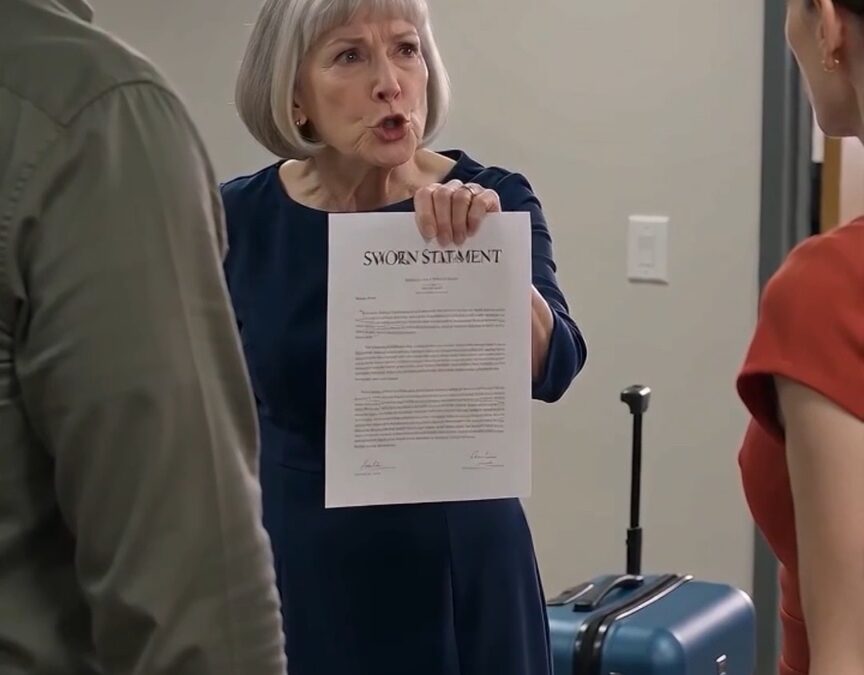
The heading read, “SWORN STATEMENT.”
Grant read through the pages without signing immediately.
Helen asked him to correct anything inaccurate.
He followed each line with his finger.
“This is what I can say,” he told her.
Another employee came in and closed the door.
She explained that she was an Ohio commissioned notary.
Helen asked about her involvement in any sale papers.
She said she had not notarized my authorization.
She was not the notary named on that acknowledgment.
I had not even seen the acknowledgment yet.
The employee-notary checked Grant’s identification.
She administered the oath before he signed.
He swore that his statement was true.
Then he signed in her presence.
She completed the notarization while he remained seated.
Nobody asked her to certify that Celia was guilty.
She was witnessing his sworn signature.
Helen explained that distinction to me afterward.
“This preserves his account,” she said.
“It doesn’t replace obtaining the transaction file.”
“What should I do now?”
“Keep the original safe. I’ll need it.”
I held the finished document by its edges.
The party was still underway outside the glass.
Celia was gathering people near the windows.
I stood and picked up my medical papers.
Grant opened the conference-room door for me.
I returned to the lobby beside my suitcase.
“Not now, Mom,” Celia said.
“Now.”
“Take that outside.”
“No.”
I set the document flat on the nearby table.
Then I stepped toward it again.
“Then look at this.”
Grant stood beside me, facing Celia.
I lifted the document and held it still at chest height.
“Grant heard you faked my signature.”
Celia looked at the document, then toward Grant, and backed into the reception desk with her mouth open.
“Wait. You heard that?”
Her hand landed against the desk behind her.
Then she looked at me instead.
“What did he tell you?”
Chapter 3: What He Heard
“He told me what you said,” I answered.
Celia reached toward the document.
I drew it back against my appointment papers.
“You can speak to Helen.”
Grant remained beside me without reaching for his camera.
There would be no photograph of that moment.
His work equipment hung unused against his side.
Celia looked past him toward the conference room.
“You’ve turned a private conversation into something else.”
“I have described what I heard,” he said.
“You don’t know what you were listening to.”
“Then explain it to the closing agent,” I said.
I did not know who that was yet.
I only knew Helen intended to find out.
Celia’s eyes moved toward the employees.
She straightened away from the reception desk.
“Everybody needs to get back to the party.”
An employee picked up the abandoned stack of plates.
Maisie stayed beside the windows, looking at the floor.
I put the statement inside my appointment folder.
The top edge would not fit completely.
I held the folder shut with my hand.
Grant asked whether I wanted somewhere quieter.
I returned to the conference room with him.
This time I pulled my suitcase behind me.
Its wheels bumped against the doorway.
I lowered the handle and left it beside my chair.
Grant sat across from me again.
I needed to hear his account without Celia interrupting.
“Tell me from when you got here,” I said.
He laid his camera carefully on the table.
“I arrived early to check the light.”
He had come through the office before the party.
The reception area was still being arranged.
He was checking where he could place his equipment.
Celia was near the office corridor, using her telephone.
She had not noticed him near the open doorway.
He could hear her side of the conversation.
He could not hear the other person’s words.
“She was talking about your house,” he said.
“What exactly did she say?”
He paused before repeating it.
“I signed Mom’s name to the house-sale authorization.”
I pressed my thumb against the folder’s bent corner.
Grant continued, keeping his voice level.
“She said, ‘No, I didn’t ask her permission.’”
I looked down at my name on the medical papers.
My own handwriting marked a question for the doctor.
“Did she say she was allowed to do it?”
“Not while I could hear her.”
“Did she say why?”
“She referred to needing the closing to go through.”
He would not turn that into a longer quotation.
He said he remembered the admission clearly.
He would not pretend every other word was exact.
That was what Helen had put in his statement.
He had heard Celia admit signing my name.
He had heard her say she had not asked permission.
He had not watched her create the document.
He had not inspected an original.
He did not know who was listening on the telephone.
He could not identify a bank account from that conversation.
There was no recording waiting on his camera.
“I don’t leave it recording between photographs,” he said.
“I understand.”
“I want you to know what this does establish.”
I pulled the sworn statement out again.
The paper lay over my medication list.
Helen had separated his direct observations from his assumptions.
It described where he had stood.
It described Celia speaking before noticing him.
It recorded the admission without adding a confession to everything.
“Why didn’t you tell me when I arrived?”
“You arrived with her,” he said.
“Then there were guests around you.”
He had been deciding how to approach me privately.
Then Celia had brought the suitcase inside.
He heard me deny agreeing to a sale.
That was when he asked about my attorney.
I read his signature near the bottom.
“Thank you for staying,” I said.
He moved his camera farther from the table’s edge.
“You needed someone to say what happened.”
Outside, Celia called for people to gather for photographs.
Grant looked toward the glass.
“I still have work I was hired to do.”
“I know.”
“I won’t change my statement to keep it.”
I slid the document back into my folder.
Nobody had asked him to choose a side beforehand.
He had been hired to photograph a graduation celebration.
I had arrived expecting cake and a ride home.
Now I was checking that my medicine was in my purse.
Celia opened the conference-room door again.
“If you’re finished, the photographer is needed.”
Grant stood without taking his statement back.
I stayed seated until Celia looked at me.
“I’m going home.”
“We still need to discuss where you’re staying.”
“I’m staying at my house.”
“You’re making this harder than it needs to be.”
“Send the papers to Helen.”
She folded her arms.
“You don’t understand the arrangements.”
“Then send her the arrangements.”
I arranged my own ride home.
I did not ask Celia to drive me again.
Grant carried my suitcase to the entrance at my request.
He left it beside me with the handle lowered.
Maisie was near the windows when I passed.
She touched her hair without looking up.
I did not ask her to follow me.
At home, I stood inside my own front door.
The living-room curtains were exactly as I had left them.
My sewing basket waited beside my chair.
I put the suitcase against the bedroom wall.
Then I checked the refrigerator and took my medication.
My house had not disappeared while Celia was speaking.
But I knew documents could cause trouble without moving furniture.
Helen called while I was sitting at my kitchen table.
I laid the sworn statement in front of me.
She had begun tracing the proposed transaction.
“Bonnie, there is a scheduled closing.”
I gripped the edge of my chair.
“When?”
“June 2, 2025.”
Chapter 4: Before Anyone Signs
I pulled the kitchen calendar toward me.
June 2, 2025, was already printed on it.
Nothing in my handwriting marked a house closing.
My next medical reminder was the only personal note nearby.
“I haven’t agreed to meet anyone,” I said.
“That is important,” Helen answered.
“Do not sign anything Celia sends you.”
“I won’t.”
“Do not give her your identification.”
My wallet lay beside the phone.
I put it back in my purse.
Helen wanted to review my existing records.
She also wanted a written denial from me.
Not a message full of accusations.
Not an argument about what I had given Celia.
A clear account of authority I had never granted.
I opened the drawer Celia knew about.
Copied mortgage statements lay beneath an old envelope.
My house documents were behind them.
The drawer had never needed a lock before.
I spread the records over the kitchen table.
I separated originals from copies as Helen instructed.
Then I photographed the messages already on my phone.
Celia had written that we needed to talk.
She had written that I should stop upsetting Maisie.
She had not sent me a signed authorization.
I preserved the messages without answering them.
“Should I tell her I have these?”
“Keep them,” Helen said. “Don’t argue through your phone.”
I put the statement in a clean folder.
Then I added my identification and house records.
The appointment papers went in a separate folder.
For once, the office matter did not get stacked above my health.
At Helen’s office, I set everything on her desk.
She asked me to explain my temporary stay with Celia.
“Company before the appointment,” I told her.
“Was your house unsafe?”
“No.”
“Had you agreed to give up possession?”
“No.”
“Did you intend to return home afterward?”
“Yes. I had food waiting in the refrigerator.”
She wrote that down without treating it as trivial.
My packed suitcase did not mean I had moved.
My diagnosis did not transfer authority to my daughter.
Helen asked whether I had ever signed blank forms.
I said I had not.
She asked about powers of attorney.
“You prepared my planning papers,” I reminded her.
“And we will check the actual file,” she said.
She did not rely only on my memory.
She reviewed what she had prepared for me.
Nothing gave Celia valid authority to sell my residence.
Helen placed that information beside Grant’s sworn statement.
“Her office license doesn’t authorize this,” she said.
“I know she sells houses.”
“She still needs the owner’s actual authority.”
I touched the corner of my identification card.
“She told everyone I was confused.”
“Were you confused about owning your house?”
“No.”
“Then we’ll state what you knew and did.”
She drafted my denial while I remained across from her.
I read it carefully before signing.
It said I had not authorized the sale.
It said I had not signed the disputed authorization.
It said Celia had no permission to sign for me.
I asked Helen to include my continued residence.
She made sure the wording reflected the facts.
I was not asking her to undo a gift.
The office furnishings were not part of this claim.
“I gave her that money,” I said.
“I’m not trying to turn it into a loan.”
Helen nodded and kept those matters separate.
We were protecting my house from an unauthorized transaction.
She asked whether I wanted her to contact the closing agent.
“Yes. Tell them to stop it.”
She explained that the agent would need specific documents.
A telephone complaint alone might leave questions unanswered.
She would deliver my denial and Grant’s statement.
She would identify the challenged authority in writing.
She would demand that no closing proceed on that basis.
“Can you promise they’ll listen?”
“I can make the notice clear and documented.”
She would also request preservation of the transaction file.
I asked what that meant in ordinary words.
“No papers quietly replaced after the dispute is known.”
I nodded and moved the folder toward her.
At home, I placed copies in my sewing drawer.
The original statement stayed where Helen instructed.
My blue suitcase remained against the bedroom wall.
I took out my clothes and put them away.
The little medication pouch returned to my bathroom shelf.
I did not wheel the suitcase back toward the door.
Celia called while I was folding my blouse.
I let the phone ring until it stopped.
Then a message appeared.
She said the sale arrangements were already underway.
She said delaying them would create expenses.
I saved the message and sent it to Helen.
I did not type an apology.
Later, Helen called to confirm the documents were ready.
She read my denial back to me.
Hearing it aloud made me check every phrase.
I had not signed.
I had not authorized.
I had not surrendered possession.
Those were separate facts, and all were true.
“What if she sends something that looks like my signature?”
“That is why we’re challenging the purported authority itself.”
“What if she says I changed my mind?”
“Your denial addresses whether you agreed at all.”
I pulled my kitchen chair closer to the table.
There was a loose thread on its cushion.
Usually I would have reached for my sewing basket.
Instead, I finished listening to Helen.
She wanted me reachable when the closing office opened.
I set my phone charger beside the kitchen outlet.
I put my identification back in the folder.
Then I laid my house key beside my medication list.
Helen called again before the scheduled opening.
“I have the packet,” she said.
“My next stop is the closing agent.”
Chapter 5: The Closing File
On June 2, 2025, I ate at my kitchen table.
My phone lay beside the plate.
I did not drive toward a closing office.
I had no appointment there and nothing to sign.
Helen delivered my denial before the closing could proceed.
She delivered Grant’s sworn statement with it.
Her written demand identified the disputed authorization.
She asked that the transaction be halted immediately.
She also asked that the entire file be preserved.
I rinsed my cup while I waited.
Then I set it down without drying it.
Every sound from the phone made me turn.
When Helen called, I answered before sitting.
“The closing agent has stopped the transaction.”
I lowered myself into the kitchen chair.
“Has anybody received money?”
“No.”
“Has anybody signed away my house?”
“No deed has been executed or transferred.”
I looked toward the hallway leading to my bedroom.
My suitcase was still where I had left it.
“Can somebody come here for possession?”
“Possession has not transferred, Bonnie.”
Helen made me hear the distinctions.
There had been a proposed contract.
There had been a scheduled closing.
Those were not the same as a completed conveyance.
The closing agent had not accepted an original authorization.
My seller identity had not been verified.
No deed had been executed.
No proceeds had been paid.
The agent was preserving the file as disputed.
I held the phone with both hands.
“So when she said it was sold—”
“She described a completed result that had not happened.”
The statement did not make every legal question disappear.
But it had reached someone with authority to stop closing.
My written denial left no uncertainty about my position.
The absence of accepted original authority mattered too.
Helen wanted me to come review the available documents.
I put on my cardigan and took my folder.
I did not bring my suitcase.
At her desk, the file looked disappointingly ordinary.
Printed pages, copied signatures, financial estimates.
Nothing about the paper showed my kitchen or bedroom.
Yet those pages concerned the place where I slept.
Helen pointed to the proposed sale price.
“$186,000.”
I looked at it for a moment.
Celia had not even asked what I wanted.
Below it was the estimated mortgage payoff.
“$94,000,” Helen said.
I recognized that as consistent with my mortgage records.
The estimated sale expenses were $6,000.
Helen wrote the calculation on a separate sheet.
The expected proceeds were $86,000.
The amount Celia had announced in the lobby.
“She knew the estimate,” I said.
“Yes.”
“She said it before I knew anything about it.”
Helen kept that distinction in her notes.
The figures were estimates, not money already waiting for Celia.
But they explained the amount she had claimed publicly.
Then Helen moved another document in front of me.
“There is something else in the file.”
It contained directions for paying the seller’s proceeds.
Celia had submitted those instructions with the transaction materials.
The destination was an account she controlled.
I read the page again from the beginning.
“My money was supposed to go there?”
“Those were the instructions she submitted.”
“Did the closing agent approve that?”
“No. The instructions had not been verified.”
I pushed my chair back enough to stand.
Then I sat again.
Helen left the page where I could see it.
It was not merely a plan to sell my house.
The file also directed the expected proceeds away from me.
Celia had presented herself as my agent on the contract.
She had supplied a scan of the purported authorization.
The scan bore a counterfeit notarial acknowledgment.
The employee who notarized Grant’s statement was not named there.
Her proper notarization had nothing to do with that copied acknowledgment.
I asked whether the scan itself could sell my house.
“Not lawfully without actual authority,” Helen said.
“But we need an order preventing further use.”
The closing agent had stopped this scheduled transaction.
A court could address the authorization beyond that file.
Helen did not tell me the house was suddenly free of every risk.
She told me what had stopped and what remained.
I preferred that to another confident promise.
I examined the payment instructions once more.
Celia had known where my copied records were kept.
That access had supplied facts she could use.
It had not supplied my consent.
“Can she change the account and try again?”
“We will give notice of the dispute and seek relief.”
“Then do that.”
Helen kept the original records organized for the case.
I took copies home in my folder.
At the kitchen table, I compared the estimate with my statement.
The mortgage was real.
The expected expenses were ordinary enough.
The authorization was the part I had never given.
That made the file harder to dismiss as nonsense.
It had been assembled to look usable.
Celia had not simply shouted an empty threat.
She had created a transaction around my residence.
My phone lit up while the pages were spread out.
Celia’s name appeared above a new message.
She said Helen had interfered with the closing.
I preserved it and did not answer immediately.
Then Celia called.
I answered with Helen’s packet beside my hand.
“You’ve seen the numbers now,” she said.
“We need to discuss how to get this finished.”
Chapter 6: Her Investment, My House
“I’m not finishing that sale,” I told her.
“You haven’t heard what I’m offering.”
“I’ve seen the payment instructions.”
Celia stopped speaking for a moment.
Then her voice became careful.
“Those can be changed.”
I moved the packet away from my coffee cup.
“Your account was listed.”
“It was a way to handle the loan.”
“Your loan.”
“It affects all of us if that property fails.”
She wanted me to meet and talk privately.
I said any discussion would include Helen.
Celia objected to the cost of involving lawyers.
I did not argue about her legal expenses.
“Send your position to Helen.”
Eventually, we sat across from each other in Helen’s office.
Celia brought a folder and placed it neatly down.
She did not grab for mine this time.
Helen kept the disputed papers in front of her.
I sat with my purse on the floor.
My identification and house key remained inside it.
Celia began with the suspended closing.
“You’ve made the buyer nervous.”
“I did not authorize a sale,” I said.
“There were arrangements that could have worked.”
Helen slid my written denial forward.
“Bonnie is disputing the authority, not negotiating a price.”
Celia looked at the page without picking it up.
“Then let’s talk about new authorization.”
It was a different request now.
She was no longer asking me to accept her declaration.
She wanted me to approve what she had started.
She explained that her investment property carried a short-term loan.
The payment deadline was putting pressure on her.
She needed the expected proceeds to settle that obligation.
“The property needs time,” she said.
“My house isn’t your financing.”
“You’d still have somewhere to live.”
“Where?”
“We could work that out.”
I waited for something specific.
She adjusted the corner of her folder.
“You stayed with me before the appointment.”
“For company,” I said.
“Not because my house was uninhabitable.”
Helen wrote while we spoke.
Celia looked toward her and lowered her voice.
“I’m trying to keep a bad situation manageable.”
“By using my sale proceeds.”
“Temporarily.”
I touched the copy of the payment instructions.
“The instructions did not say that.”
She did not repeat that the account belonged elsewhere.
The document was sitting between us.
Instead, she asked whether I understood investment financing.
I had spent years measuring hems and balancing my savings.
I did not need her loan terms explained to know ownership.
“You bought that property,” I said.
“Yes, and I’m trying not to lose it.”
“Then deal with that property.”
Her mouth tightened.
“You gave me money for the office.”
“That was a gift.”
“You believed in the business then.”
“I did.”
“And now you’re letting paperwork destroy everything?”
“The paperwork tried to sell my house.”
Helen moved the payment instructions beside the purported authorization.
“We need to keep the transactions separate,” she said.
“The office furnishings do not create authority over Bonnie’s residence.”
Celia sat back and crossed her arms.
She knew the gift was not a recoverable loan.
She also knew it did not make me an office owner.
I was not claiming either thing.
I wanted my house left out of her investment debt.
Celia turned to me again.
“You could sign properly now.”
“No.”
“We could revise where the money goes.”
“No.”
“Let me finish explaining.”
“I understand what you need.”
Helen set her pen down.
“Bonnie has answered the request.”
Celia looked at my cardigan sleeve.
A little fraying showed near the cuff.
“You’ve never cared about having much,” she said.
I folded the cuff inward.
“I care about staying in my house.”
She opened her folder and removed a page.
It described her investment problem, not my authority.
She pointed to the short-term loan obligation.
I did not need to know its unspecified balance.
The loan was secured by a property she owned.
She had an asset she could sell.
She wanted to avoid doing that with my proceeds.
“Your mother has declined,” Helen said.
“We will seek an order concerning the disputed authorization.”
Celia gathered her papers into their folder.
“You could stop this from becoming public.”
“I asked about it in your lobby,” I said.
“You called me confused.”
She looked away from me toward Helen.
“Does she understand how expensive litigation can be?”
Helen answered without raising her voice.
“We have discussed the process and the requested relief.”
I had asked those questions before the meeting.
I had considered the strain of attending to it.
My heart condition did not make the decision hers.
“I’m authorizing Helen to proceed,” I said.
Celia stood and picked up her folder.
She did not knock anything over or threaten us.
She had not gotten the approval she wanted.
At the door, she tried another practical appeal.
“If the property sells under pressure, it won’t be ideal.”
“I’m not agreeing to sell my residence.”
After she left, I remained in my chair.
My purse strap had twisted around my ankle.
I bent and carefully unwound it.
Helen waited until I was sitting upright again.
“Are you ready for me to file?”
“Yes.”
She reviewed what she would ask the court to prohibit.
Then she put the disputed authorization on top.
“The next step concerns this document,” she said.
Chapter 7: The Authorization on Paper
I had imagined something more convincing than a scan.
On Helen’s desk, the signature looked like a hurried imitation.
It used my name.
That did not make it mine.
The purported authorization concerned the sale of my house.
Celia had supplied it as limited authority to act.
She had then purported to sign the contract as my agent.
Helen did not ask me to guess how it was assembled.
She asked what I could truthfully deny.
“Did you sign this?”
“No.”
“Were you present for this acknowledgment?”
“No.”
“Did you tell anyone to notarize your signature?”
“No.”
I held the edge of the paper flat.
I wanted to tear it across my printed name.
Instead, I let Helen place it in the file.
The copied acknowledgment named someone other than the employee-notary.
That employee had notarized Grant’s sworn statement properly.
She had checked his identification and administered his oath.
She had not retroactively approved anything Celia supplied.
Helen kept those facts clear in the filings.
She did not accuse the employee because she worked there.
She did not treat a notarial stamp as proof of consent.
My denial addressed the underlying authorization.
Grant’s account corroborated the lack of permission.
The transaction records showed how the document was used.
Together, they presented more than a family disagreement.
At home, I gathered anything Helen still requested.
I found earlier examples of my signed records.
She explained that they could provide context.
We were not depending on my amateur handwriting comparison.
I placed them in sleeves so the edges stayed clean.
Then I checked my saved messages again.
Celia had begun talking about cooperation and damage control.
I preserved those messages along with the earlier ones.
I did not send her photographs of my evidence.
Helen handled service and notice through the proper process.
Celia received the filed allegations and request for relief.
There was no secret order slipped past her.
She had an opportunity to respond.
Helen explained that temporary relief was not the final judgment.
It would protect against further use while proceedings continued.
“What exactly will it stop?” I asked.
“Use of the disputed authorization while the case proceeds.”
“Not just this closing?”
“That is the protection we’re requesting.”
I sat with those words before answering.
“Then please request it.”
Grant stayed available as Helen prepared the evidentiary record.
He reviewed his sworn account again.
He did not add details because the case had grown serious.
When asked what he could not know, he answered plainly.
He had not witnessed the pen touching paper.
He could not identify the unseen telephone listener.
He had no audio recording.
He had heard Celia admit signing without permission.
He had also witnessed my denial in the lobby.
His testimony stayed within those limits.
I saw him before the court appearance.
He wore a clean shirt without his camera equipment.
“Are you all right being here?” I asked.
“Yes.”
“I know this wasn’t the job you accepted.”
He looked toward Helen’s folder.
“I’m here to answer what I was asked.”
I thanked him and sat beside my attorney.
The courthouse chair was harder than my kitchen chair.
I kept my medication list folded in my purse.
Helen had told me to bring what I needed.
I did not leave my health supplies behind to appear capable.
I could manage my condition and still require treatment.
Those facts did not cancel each other.
During the proceedings, Helen presented the disputed authorization.
She identified the scan and its copied acknowledgment.
She presented my denial of signing or consenting.
She presented Grant’s corroborating sworn account and testimony.
The halted closing file showed the attempted use.
The court was not deciding who had been a generous mother.
It was deciding whether the disputed authority could keep being used.
That helped me answer without drifting into old arguments.
When asked about my stay with Celia, I explained it.
It began on May 27, 2025.
It was temporary company before my heart appointment.
My house remained habitable and remained my residence.
I had not surrendered ownership by packing clothes.
I had not granted sale authority by accepting a ride.
I did not need to describe every unpaid office errand.
Those were painful facts, but not the authorization.
Helen kept the case on the document.
On June 18, 2025, the court granted temporary relief.
The disputed authorization could not be used while proceedings continued.
Helen showed me the order rather than merely describing it.
I read my name and the property reference.
Then I asked her to explain the operative language.
She did, without pretending the case was finished.
“We still need a final determination,” she said.
I put my copy in the folder.
At home, I made myself a simple supper.
I sat at the table instead of eating over the sink.
My phone stayed nearby, but I did not watch it.
Later, Helen called about the next proceedings.
“Celia has been given the opportunity to contest the forgery.”
I looked at the folder beside my plate.
“What happens if she doesn’t?”
Chapter 8: The Order in My Folder
Helen did not answer with a promise.
“The court still needs a proper record,” she said.
“Her position matters, but we present our proof.”
I kept attending to the requests she sent.
I reviewed my declaration for accuracy.
I checked that the dates matched my calendar.
I confirmed again that I had never signed the authorization.
None of that was exciting work.
I sat with reading glasses and a sharpened pencil.
When I found an unclear phrase, I asked about it.
Helen corrected language rather than telling me to ignore it.
The house was not a formality to me.
I wanted the record right.
Celia did not contest the forgery in the proceedings.
She did not produce valid authority from me.
She did not transform my temporary visit into consent.
There was no signed permission waiting in another drawer.
Helen explained that we would seek the final declaration.
I asked whether Celia’s silence alone gave me the house.
“You already own the house,” Helen said.
“We are addressing the false claim of authority.”
I put down the pencil.
That distinction mattered more than I expected.
I had started speaking as though I needed my property returned.
No deed had ever transferred it.
The dispute had threatened my ownership without lawfully changing it.
I still wanted a court order preventing further claims.
At the courthouse on July 11, 2025, I carried my folder.
My medical papers remained in their separate pocket.
Grant’s statement was part of the record.
So was my denial.
So were the documents showing the attempted transaction.
Celia had received notice and the chance to respond.
The proceedings did not depend on a surprise in a hallway.
She had already lost the advantage of calling me confused.
The evidence was now where witnesses and the court could examine it.
I sat beside Helen and kept my purse upright.
The clasp had started sticking lately.
I pressed it closed until it caught.
I did not look around for Celia’s reaction.
I listened for what the court was deciding.
On July 11, 2025, the court declared the purported authorization invalid.
It was unenforceable against me.
Helen wrote the result on her pad.
Then she turned it slightly so I could see.
I read the words before looking up.
“Does that cover the authorization she submitted?”
“Yes.”
“Can she use it to say I agreed?”
“No. The court has declared it invalid against you.”
I let my purse rest against my leg.
There was no celebration in the courtroom.
Other business waited, and people were still working.
Helen gathered the papers before we left.
Outside the courtroom, she reviewed the next administrative steps.
The unauthorized transaction would be canceled in the closing file.
The court order would be delivered where needed.
Records of the dispute would be retained.
I asked whether any money had escaped while we waited.
“No money changed hands,” she said.
“And the deed?”
“No deed changed hands.”
She looked directly at me.
“Your title never transferred, Bonnie.”
I wanted to hear that without the hallway noise.
We sat before leaving, and she repeated it.
I had remained the owner throughout.
The stopped closing had not resumed.
The invalid authorization could not bind me.
I could take the order home and keep it.
I did not owe Celia permission because proceedings had inconvenienced her.
At Helen’s office, we went over the final documents.
She placed the court order on top.
Beneath it were the denial and supporting statement.
I asked which pages to keep readily available.
She marked them without adding dramatic warnings.
I also asked about the office furnishings.
“They remain a completed gift,” she said.
“I know. I don’t want confusion about that.”
Winning this dispute did not turn everything I had given into debt.
I was not collecting $14,000 from Celia.
I was keeping the home I had never authorized her to sell.
Those were different matters.
Helen confirmed the closing agent had canceled the unauthorized transaction.
The file retained the notice and court result.
The proposed sale had ended before any conveyance.
There were no seller proceeds for Celia to collect.
There was no legitimate authorization left for her to present.
I put my copy of the order into a firm folder.
At home, I opened the drawer beside my sewing chair.
Old receipts and office notes filled much of it.
I removed Celia’s supply lists.
I removed the scraps I had saved for chair repairs.
Then I made room for my court papers.
My hand paused on a photograph from the office opening.
My skirt showed beneath the chair I had covered.
I placed the photograph in an envelope.
I did not tear it or put it on display.
That evening, I read the order at my kitchen table.
The house was quiet enough to hear the refrigerator.
I took my pills with water and checked the next appointment.
My phone rang while the folder was still open.
Celia’s name appeared on the screen.
I let the call finish.
Her message came afterward.
“If I can’t use the proceeds, I have to sell my investment property.”
Chapter 9: What She Had to Sell
I sent Celia’s message to Helen.
Then I put the phone beside the closed folder.
I did not calculate what I could spare.
I did not open my savings records.
Celia had received none of my expected proceeds.
The $86,000 had never become hers.
It had not even become completed sale proceeds.
It was an estimate attached to an unauthorized transaction.
Her short-term loan remained attached to her investment problem.
She later sold her own investment property to settle that loan.
I did not attend that closing.
I did not sign anything for it.
Helen confirmed the resolution without suggesting I had caused a forfeiture.
Celia had an obligation and an asset she could sell.
She used that asset instead of my home.
There was no sale amount for me to discuss.
I did not ask whether she liked the result.
She called after the property was sold.
“I had to let it go,” she said.
“I understand you sold it.”
“It was supposed to be temporary financing.”
“I did not agree to finance it.”
She began describing what the investment could have become.
I listened without offering another payment.
Then she changed the subject to the office.
A reception chair had developed a loose seam.
She asked whether I could take a look.
I looked at the sewing basket beside my chair.
The familiar request had almost produced my familiar answer.
“I’m not doing office work anymore.”
“It wouldn’t take you long.”
“You’ll need to arrange the repair.”
She exhaled into the telephone.
I waited rather than explaining my whole history.
The seam was hers to arrange.
The chairs belonged to her business.
So did the work of maintaining them.
After the call, I gathered the remaining office material.
There were fabric samples in a drawer.
A spare office key lay in a small dish.
There were notes about cushion sizes and cleaning supplies.
I packed the business items together for return.
I did not keep them as a reason to visit.
I had helped without pay through May 2025.
That arrangement was finished.
The $14,000 gift stayed a gift.
There would be no new furnishings from my savings.
There would be no unpaid repair visits.
I wrote that plainly in a message.
Celia replied that I was taking everything personally.
I saved the reply and went back to my kitchen.
My own curtain hem had come loose near the window.
I mended it while sitting at the table.
Nobody stood above me asking when I would finish.
The afternoon light made the faded folds obvious.
I measured them for my own replacement plans.
Another practical matter bothered me more than the curtains.
Celia had access to my house.
She knew my routines and where I kept records.
I could not make her forget those things.
I could change what she was able to enter.
I arranged to have the locks changed.
The locksmith worked while I sat near the doorway.
I tested the new key myself before the work was finished.
It turned cleanly without needing to be lifted.
I kept the new keys with me.
Celia did not receive one.
I moved my house papers from the familiar drawer.
The copies went into secured storage at home.
Helen kept what she needed in her file.
I did not leave the court order beneath office shopping lists.
When Celia asked about access, I answered directly.
“You no longer have a house key.”
“What if there’s an emergency?”
“I have arrangements for my medical needs.”
She did not need entry to manage my life.
My heart failure still required attention.
The court order had not changed my medication.
I kept the updated list in my purse.
For appointments, I arranged transportation that did not depend on Celia.
I left time to walk slowly from the entrance.
I brought questions instead of letting somebody answer over me.
At home, I put appointment papers in their proper folder.
They no longer carried a sworn statement underneath.
I resumed my own grocery trips too.
I used a cart even when the list was short.
I could stop and rest without someone hurrying me.
I bought chicken and vegetables I knew I would eat.
I checked the weight of bags before lifting them.
Managing my condition meant adjusting how I did things.
It did not mean surrendering my home.
At the register, I almost added office napkins.
Celia had always seemed to run out.
I set them back before unloading my cart.
My grocery money stayed with my groceries.
Back home, I put food away before making tea.
The kitchen chair still had its loose thread.
I repaired it for myself that afternoon.
The little sewing scraps went straight into the wastebasket.
I did not save them for an office project.
Some days I still opened Celia’s messages too quickly.
Some nights I remembered Maisie looking toward Grant’s camera.
I did not call her to ask why she had done it.
She had heard me ask where I would go.
She had asked me to leave anyway.
Her graduation photograph was not something I wanted to discuss.
Then her name appeared on my phone.
“Grandma, may I come see you?”
I set my cup down before answering.
“What do you want to talk about?”
“What I said at the party,” Maisie wrote.
Chapter 10: The Suitcase Upstairs
I read Maisie’s message again before replying.
Then I asked whether she meant to come alone.
She said she did.
I told her we could have a short visit.
I did not offer lunch or a whole afternoon.
There would be tea if she wanted it.
She answered that tea would be fine.
Before she arrived, I wiped the kitchen table.
I moved the court folder into its drawer.
I left my sewing basket beside my chair.
There was no reason to make the house look unfamiliar.
I also left the new key on my own ring.
When Maisie knocked, I went to the door slowly.
She stood on the porch without a gift bag.
She did not hold her graduation photographs.
Her hands were clasped around her phone.
“Hi, Grandma.”
“Come in.”
She looked at the lock as I closed the door.
Then she followed me into the kitchen.
I asked whether she wanted tea.
She nodded and sat in the chair across from mine.
For a moment, she kept looking at the tabletop.
I poured the water and sat down.
She put her phone facedown beside her cup.
“I asked you to leave,” she said.
“Yes.”
“You had just come from your appointment.”
“Yes.”
“And Mom had your suitcase there.”
I rested my hand beside my own cup.
Maisie swallowed and kept going.
“I saw her push you.”
That was the part she had not acknowledged before.
I waited.
“I should have asked whether you were hurt.”
“I caught the chair.”
“I know. I watched you do it.”
She rubbed her thumb along the cup’s handle.
“I was thinking about how the pictures would look.”
I looked at her, not at her phone.
“You told me not to ruin them.”
“I did.”
She did not soften it into a misunderstanding.
She did not say everybody had been upset.
“I’m sorry I asked you to leave, Grandma.”
Her eyes filled, but she stayed in her chair.
“I’m sorry I cared more about the pictures.”
I moved the tissue box toward her.
She took a tissue and folded it.
“I didn’t know about the papers then.”
“You knew I said I hadn’t agreed.”
“Yes.”
“You knew I didn’t know where to go.”
“Yes.”
She wiped beneath her eyes and looked back up.
“I should have listened to you.”
That was the apology I had needed to hear.
Not a request to agree that Celia meant well.
Not an explanation that I had frightened the guests.
Maisie named what she had seen and chosen.
“Thank you for saying it plainly,” I told her.
She nodded and held the tissue in her lap.
I drank some tea while it was still warm.
Neither of us rushed to fill the next pause.
After a while, she asked about my appointment.
I told her my condition was still being managed.
I was taking my medication and keeping follow-up visits.
She asked whether I needed a ride sometime.
“I have arrangements,” I said.
“But you can ask how I’m doing.”
“I will.”
I did not promise that she could handle my calendar.
I did not hand her my house key.
Her apology was a visit, not a new caregiving arrangement.
She looked toward the living room.
“Your sewing basket is still there.”
“Of course.”
“I remember sitting near it when I was little.”
I remembered that too.
She had liked sorting buttons into the lid.
I did not turn the memory into a promise.
There would be no automatic return to every old arrangement.
She had not come asking for money.
She did not ask me to buy photographs.
She did not pull out a form needing my signature.
She sat and drank the tea I had offered.
That made it easier to stay at the table.
After a while, I told her I needed rest.
She stood without asking for another errand.
“Can I call you?”
“Yes. Call first before visiting.”
“I will.”
At the door, she asked whether she could hug me.
I said she could.
Her arms settled carefully around my shoulders.
She did not keep looking past me toward anything else.
Then she stepped back and put her phone away.
“Thank you for letting me come.”
“I’m glad you apologized.”
I watched until she reached the walk.
Then I closed the door and turned the new lock.
The kitchen cups were still on the table.
I rinsed them and left them to dry.
My afternoon medication waited beside a glass of water.
I took it and checked my appointment calendar.
Nothing on that page involved Celia’s office.
Her investment property had been sold to settle its loan.
Her office remained her responsibility.
She had received no money from my house.
The court order stayed in my secured papers.
Helen had confirmed that my title never transferred.
I no longer checked the folder every morning.
I checked my groceries and my medication instead.
I made my own appointment arrangements.
When the phone rang during supper, I finished chewing.
I did not leave my plate to solve an office problem.
Upstairs, my bedroom window was open a little.
The curtains moved against the sill.
My clothes from the visit had long been put away.
My blouse hung where I could reach it.
The medication pouch belonged on the bathroom shelf.
Nothing remained packed for Celia to take somewhere.
I pulled the suitcase away from the bedroom wall.
The ribbon she had tied around its handle was still there.
I untied it and put it in the wastebasket.
Then I checked the pockets and zipped them closed.
The handle slid down with a small click.
I opened my bedroom closet and made room beneath my clothes.
I put away my empty, unpacked blue rolling suitcase.
You Might Also Enjoy




